Catalyst: If the answer is False, explain why.
1. True or false. Populations tend to be stable
in size.
2. True or false. All individuals in a species
are exactly alike.
3. True or false. Different traits can be
inherited.
4. True or false. Resources are unlimited.
5. True or false. Natural selection is when
organisms with superior traits survive to
pass those traits onto offspring.
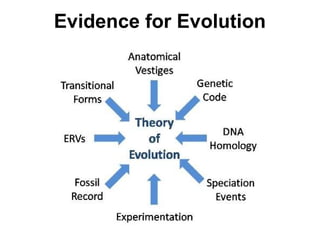
Evidence for Evolution
5 areas of scientific study provide evidence for
evolution.
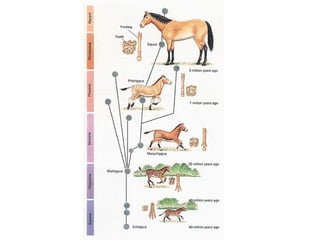
1.) Fossil Record
2.) Comparative Anatomy
3.) Comparative Embryology
4.) Molecular Biology
5.) Biogeography
Fossil Record
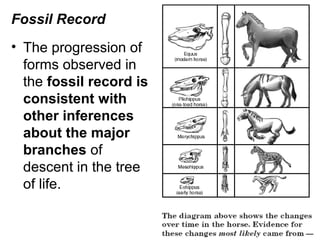
• The progression of
forms observed in
the fossil record is
consistent with
other inferences
about the major
branches of
descent in the tree
of life.
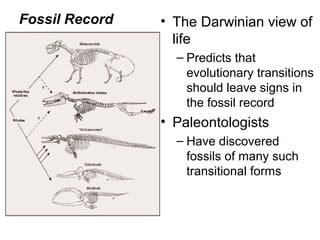
• The Darwinian view of
life
– Predicts that
evolutionary transitions
should leave signs in
the fossil record
• Paleontologists
– Have discovered
fossils of many such
transitional forms
Fossil Record
Comparative Anatomy
The study of anatomical structures and
evolutionary relationships.
• Homologous structures
• Analogous structures
• Vestigial structures
Comparative Anatomy
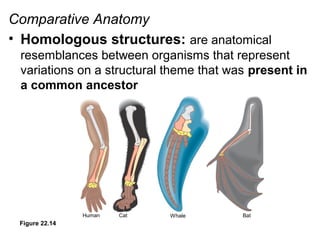
• Homologous structures: are anatomical
resemblances between organisms that represent
variations on a structural theme that was present in
a common ancestor
Figure 22.14
Human Cat Whale Bat
Comparative Anatomy
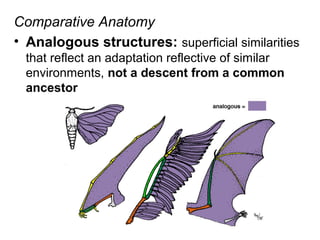
• Analogous structures: superficial similarities
that reflect an adaptation reflective of similar
environments, not a descent from a common
ancestor
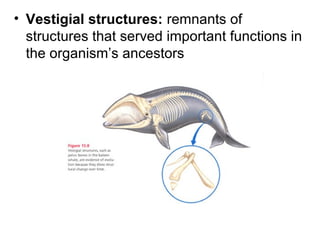
• Vestigial structures: remnants of
structures that served important functions in
the organism’s ancestors
Comparative Embryology
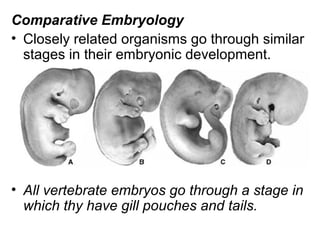
• Closely related organisms go through similar
stages in their embryonic development.
• All vertebrate embryos go through a stage in
which thy have gill pouches and tails.
Molecular Biology
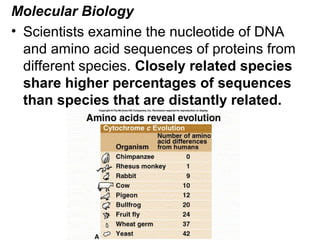
• Scientists examine the nucleotide of DNA
and amino acid sequences of proteins from
different species. Closely related species
share higher percentages of sequences
than species that are distantly related.
Molecular Biology
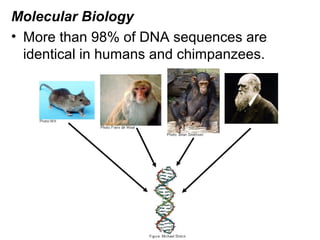
• More than 98% of DNA sequences are
identical in humans and chimpanzees.
Biogeography
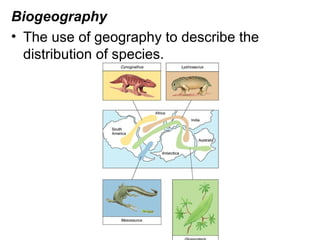
• The use of geography to describe the
distribution of species.
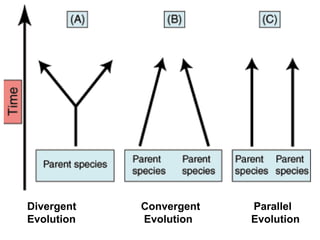
Biogeography: Divergent Evolution
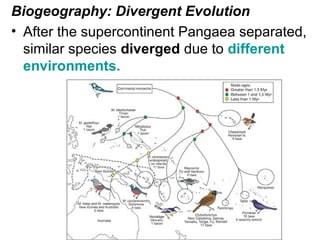
• After the supercontinent Pangaea separated,
similar species diverged due to different
environments.
Biogeography: Convergent Evolution
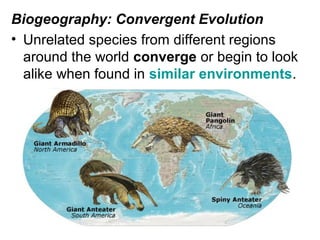
• Unrelated species from different regions
around the world converge or begin to look
alike when found in similar environments.
Divergent Convergent Parallel
Evolution Evolution Evolution
Connection: Biogeography and Comparative
Anatomy
• Types of comparative anatomy can also be
classified as convergent and divergent
evolution, which structure is an example of
divergent evolution? Convergent evolution?

Evidence for evolution

  • 1.
    Catalyst: If theanswer is False, explain why. 1. True or false. Populations tend to be stable in size. 2. True or false. All individuals in a species are exactly alike. 3. True or false. Different traits can be inherited. 4. True or false. Resources are unlimited. 5. True or false. Natural selection is when organisms with superior traits survive to pass those traits onto offspring.
  • 2.
  • 3.
    5 areas ofscientific study provide evidence for evolution. 1.) Fossil Record 2.) Comparative Anatomy 3.) Comparative Embryology 4.) Molecular Biology 5.) Biogeography
  • 4.
    Fossil Record • Theprogression of forms observed in the fossil record is consistent with other inferences about the major branches of descent in the tree of life.
  • 6.
    • The Darwinianview of life – Predicts that evolutionary transitions should leave signs in the fossil record • Paleontologists – Have discovered fossils of many such transitional forms Fossil Record
  • 7.
    Comparative Anatomy The studyof anatomical structures and evolutionary relationships. • Homologous structures • Analogous structures • Vestigial structures
  • 8.
    Comparative Anatomy • Homologousstructures: are anatomical resemblances between organisms that represent variations on a structural theme that was present in a common ancestor Figure 22.14 Human Cat Whale Bat
  • 9.
    Comparative Anatomy • Analogousstructures: superficial similarities that reflect an adaptation reflective of similar environments, not a descent from a common ancestor
  • 10.
    • Vestigial structures:remnants of structures that served important functions in the organism’s ancestors
  • 11.
    Comparative Embryology • Closelyrelated organisms go through similar stages in their embryonic development. • All vertebrate embryos go through a stage in which thy have gill pouches and tails.
  • 12.
    Molecular Biology • Scientistsexamine the nucleotide of DNA and amino acid sequences of proteins from different species. Closely related species share higher percentages of sequences than species that are distantly related.
  • 13.
    Molecular Biology • Morethan 98% of DNA sequences are identical in humans and chimpanzees.
  • 14.
    Biogeography • The useof geography to describe the distribution of species.
  • 15.
    Biogeography: Divergent Evolution •After the supercontinent Pangaea separated, similar species diverged due to different environments.
  • 16.
    Biogeography: Convergent Evolution •Unrelated species from different regions around the world converge or begin to look alike when found in similar environments.
  • 17.
  • 18.
    Connection: Biogeography andComparative Anatomy • Types of comparative anatomy can also be classified as convergent and divergent evolution, which structure is an example of divergent evolution? Convergent evolution?