The Evidence are the Bases of
Evolution (Biogeography, Fossil Record,
DNA Protein Sequences)
Evidences from Fossil Records:
 A fossil is the remain or evidence of a living thing. The most
common fossils are bones, shells, and seeds or pollen
grains. Most fossils are incomplete because only the hard
parts of the organism, such as the bones or teeth become
fossils while the soft tissues either decay or are eaten away
before fossils can form.
 Most fossils are formed when the whole or part of an
organism gets buried in sedimentary rocks (mud or silt).
Evidences from Fossil Records:
 The earliest fossils are those of prokaryotes (blue-green
bacteria) that appeared about 3.4 to 3.6 billion years ago.
- This finding tells us that very simple forms of life lived in the
past and, over million of years, probably gave rise to many
kinds of organisms with more complex body structures.
 The remains of many ancient plants and animals show
structural similarities to certain organisms that live today,
although none is exactly the same as the living species.
Also, fossils found in the younger rocks are not found in
much older rocks.
- These findings imply that ancestral forms gradually evolved
over millions of years and gave rise to offspring that are no
longer exactly like themselves.
Fossil Records: Types Of
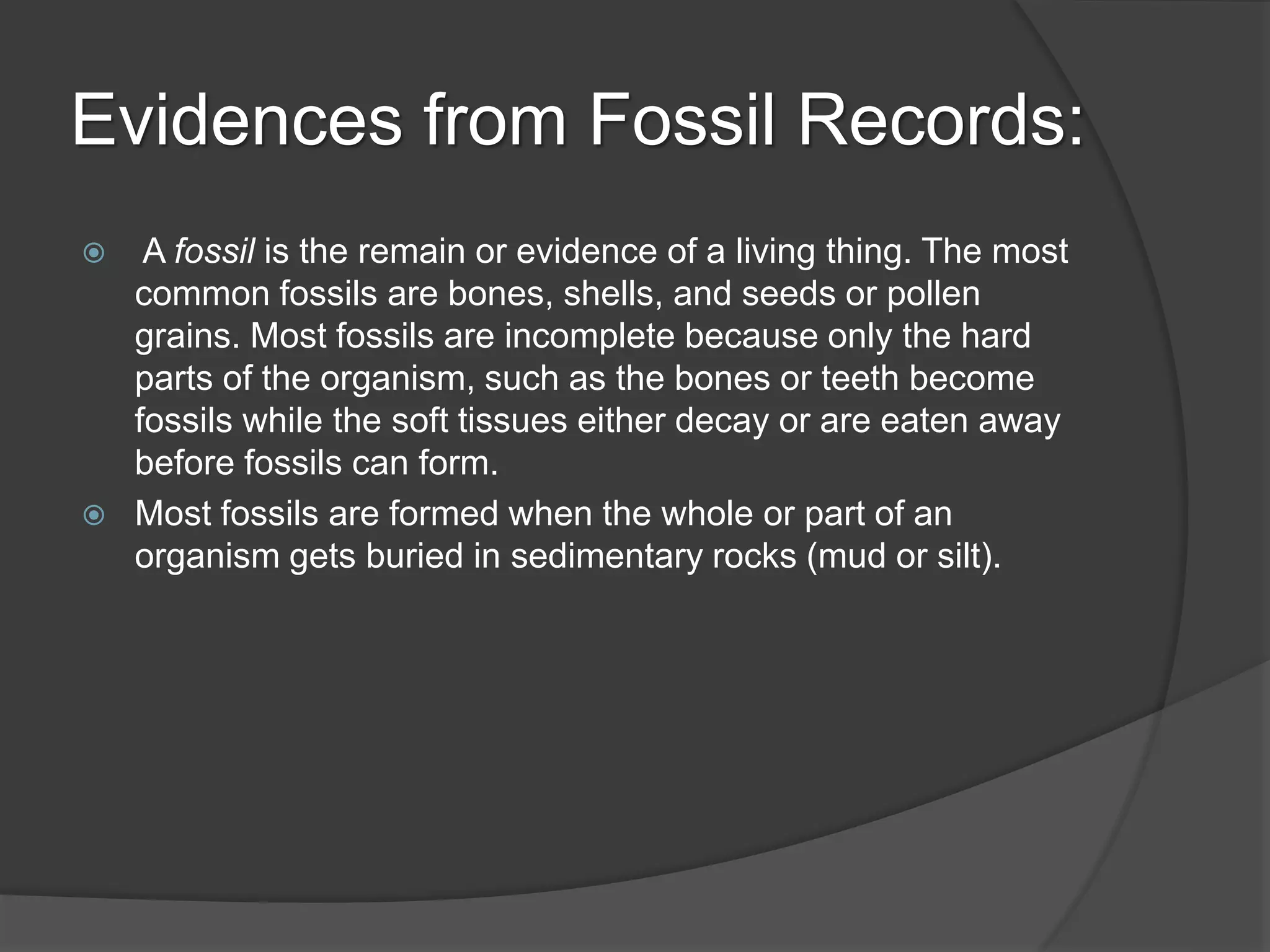
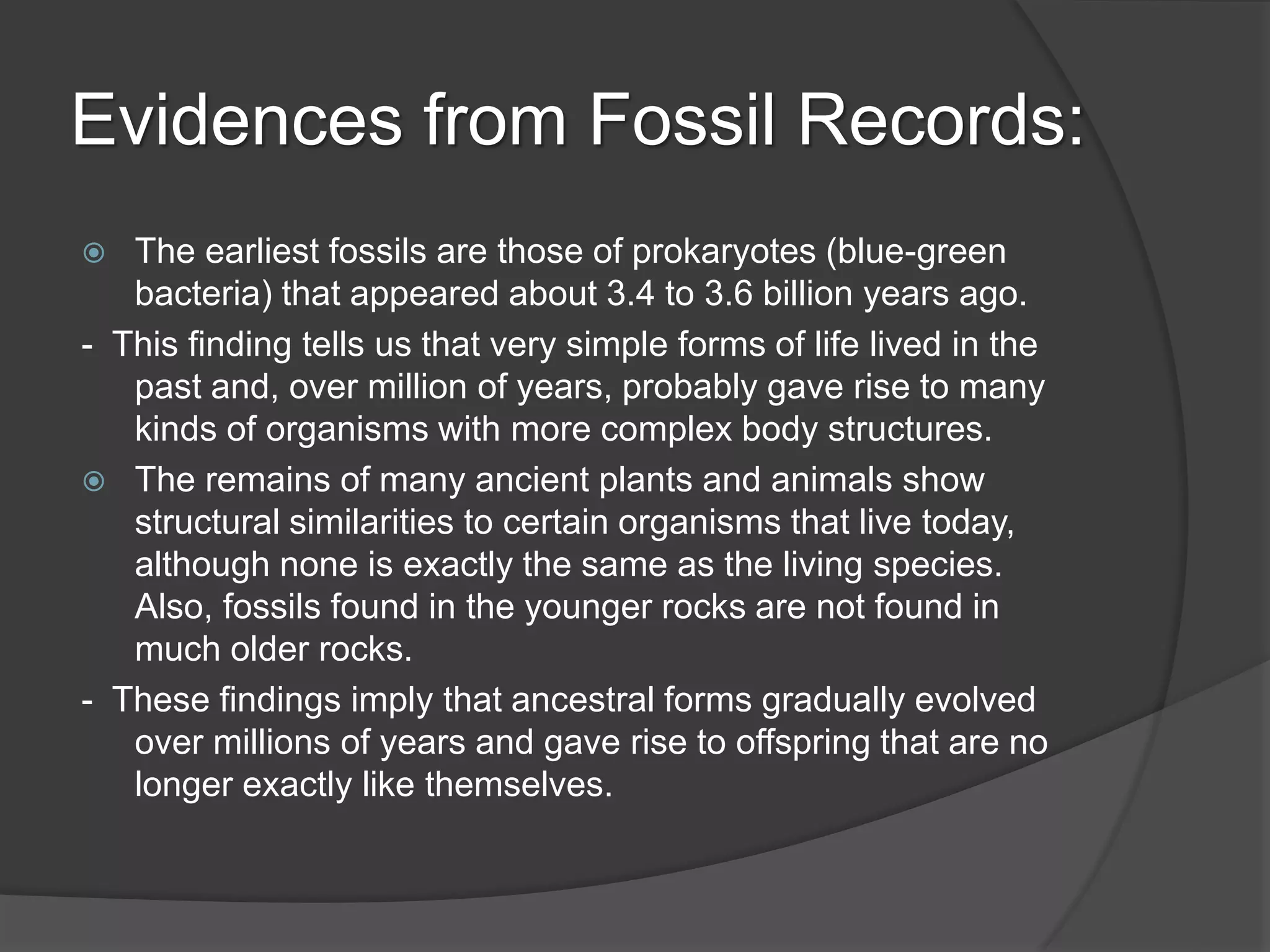
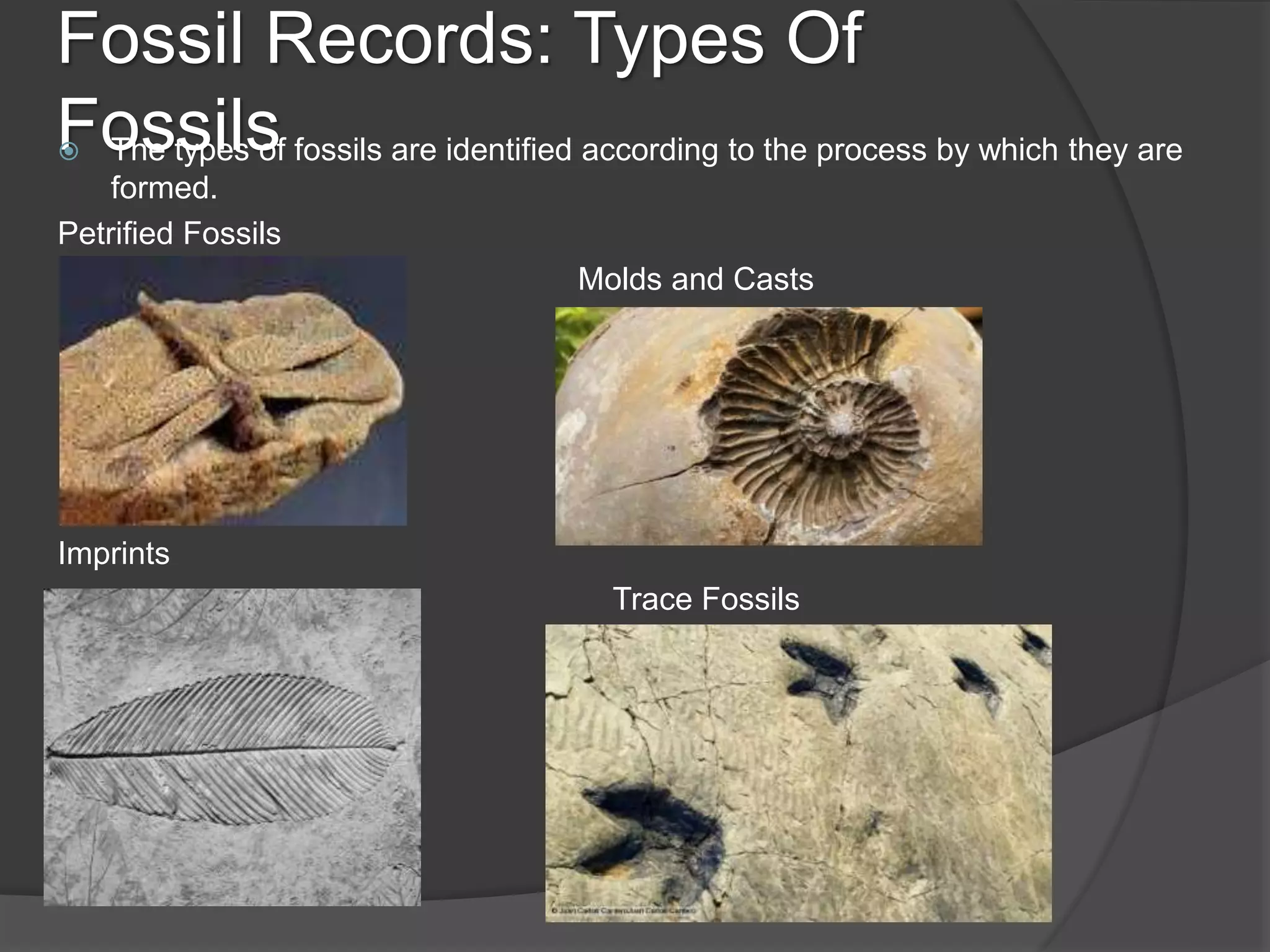
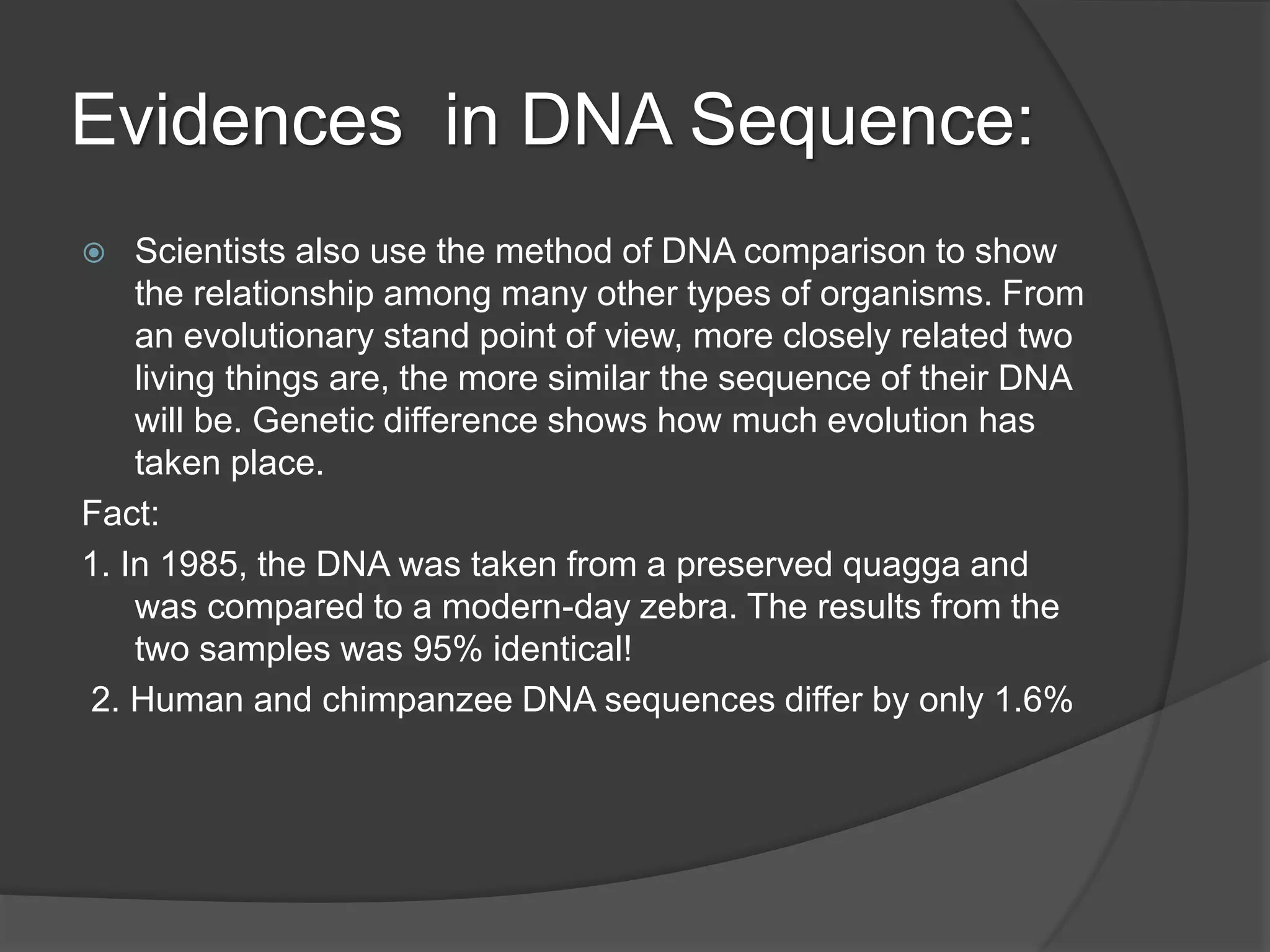
Fossils The types of fossils are identified according to the process by which they are
formed.
Petrified Fossils
Molds and Casts
Imprints
Trace Fossils
Fossil Records: Fossil
Types
Preservations of Entire Organism in:
Amber
Tar Pits
Frozen in Ice
Evidences in DNA Sequence:
 Scientists also use the method of DNA comparison to show
the relationship among many other types of organisms. From
an evolutionary stand point of view, more closely related two
living things are, the more similar the sequence of their DNA
will be. Genetic difference shows how much evolution has
taken place.
Fact:
1. In 1985, the DNA was taken from a preserved quagga and
was compared to a modern-day zebra. The results from the
two samples was 95% identical!
2. Human and chimpanzee DNA sequences differ by only 1.6%
Evidences in Protein
Sequence: Aside from analyzing DNA structure to show relationships
between organisms, variations are formed in the protein
structure of one group of organisms as it evolves into
another group.
 Organisms of the same group should have the same DNA
sequence for a specific structure of proteins.
 Scientists believe that the more similar the structure of
protein molecules of different organisms, the more related
they are and the more recent the existence of their common
ancestor
 Biochemical analysis of their component amino acids of
some representative animals has been made to support the
idea of evolution (refer to the figure below.)
 Unrelated species have different amino acids.
 In this figure. The species sharing a common ancestor with humans
have fewer amino differences with human hemoglobin.
Species Amino Acid
Differences
Gorilla 1
Rhesus Monkey 8
Mouse 27
Chicken 45
Frog 67
Lamprey 125
Evidences of evolution

Evidences of evolution

  • 1.
    The Evidence arethe Bases of Evolution (Biogeography, Fossil Record, DNA Protein Sequences)
  • 2.
    Evidences from FossilRecords:  A fossil is the remain or evidence of a living thing. The most common fossils are bones, shells, and seeds or pollen grains. Most fossils are incomplete because only the hard parts of the organism, such as the bones or teeth become fossils while the soft tissues either decay or are eaten away before fossils can form.  Most fossils are formed when the whole or part of an organism gets buried in sedimentary rocks (mud or silt).
  • 3.
    Evidences from FossilRecords:  The earliest fossils are those of prokaryotes (blue-green bacteria) that appeared about 3.4 to 3.6 billion years ago. - This finding tells us that very simple forms of life lived in the past and, over million of years, probably gave rise to many kinds of organisms with more complex body structures.  The remains of many ancient plants and animals show structural similarities to certain organisms that live today, although none is exactly the same as the living species. Also, fossils found in the younger rocks are not found in much older rocks. - These findings imply that ancestral forms gradually evolved over millions of years and gave rise to offspring that are no longer exactly like themselves.
  • 4.
    Fossil Records: TypesOf Fossils The types of fossils are identified according to the process by which they are formed. Petrified Fossils Molds and Casts Imprints Trace Fossils
  • 5.
    Fossil Records: Fossil Types Preservationsof Entire Organism in: Amber Tar Pits Frozen in Ice
  • 6.
    Evidences in DNASequence:  Scientists also use the method of DNA comparison to show the relationship among many other types of organisms. From an evolutionary stand point of view, more closely related two living things are, the more similar the sequence of their DNA will be. Genetic difference shows how much evolution has taken place. Fact: 1. In 1985, the DNA was taken from a preserved quagga and was compared to a modern-day zebra. The results from the two samples was 95% identical! 2. Human and chimpanzee DNA sequences differ by only 1.6%
  • 7.
    Evidences in Protein Sequence:Aside from analyzing DNA structure to show relationships between organisms, variations are formed in the protein structure of one group of organisms as it evolves into another group.  Organisms of the same group should have the same DNA sequence for a specific structure of proteins.  Scientists believe that the more similar the structure of protein molecules of different organisms, the more related they are and the more recent the existence of their common ancestor  Biochemical analysis of their component amino acids of some representative animals has been made to support the idea of evolution (refer to the figure below.)  Unrelated species have different amino acids.
  • 8.
     In thisfigure. The species sharing a common ancestor with humans have fewer amino differences with human hemoglobin. Species Amino Acid Differences Gorilla 1 Rhesus Monkey 8 Mouse 27 Chicken 45 Frog 67 Lamprey 125