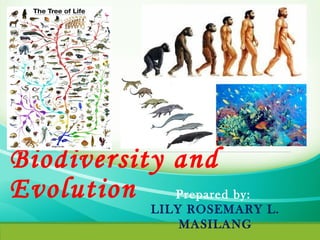
Biodiversity and
Evolution Prepared by:
LILY ROSEMARY L.
MASILANG
What is
evolution?
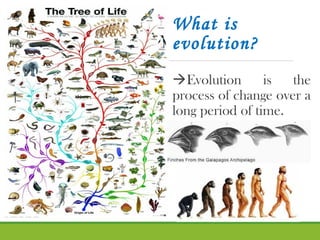
Evolution is the
process of change over a
long period of time.
What is biodiversity?
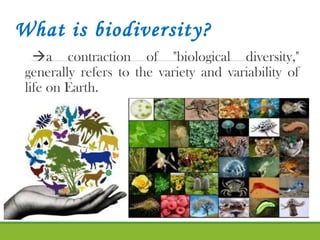
 a contraction of "biological diversity,"
generally refers to the variety and variability of
life on Earth.
What is a fossil?
Fossils are ancient remnants of once living things.
They are our only links to the past.
They tell us of ancient environments and organism
habits.
Many times they are used used to help distinguish
periods of geologic time
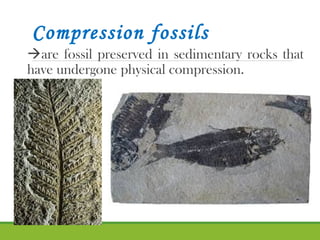
Compression fossils
are fossil preserved in sedimentary rocks that
have undergone physical compression.
Impression fossils
Are created from organic matter being
impressed in material like clay.
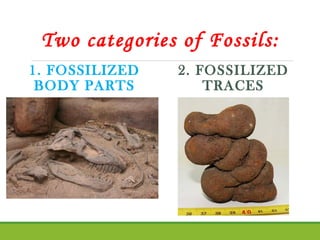
Two categories of Fossils:
1. FOSSILIZED
BODY PARTS
2. FOSSILIZED
TRACES
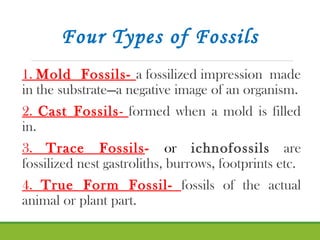
Four Types of Fossils
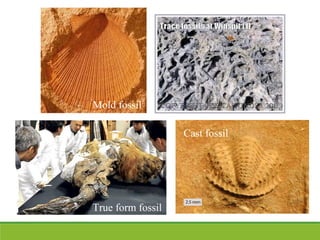
1. Mold Fossils- a fossilized impression made
in the substrate—a negative image of an organism.
2. Cast Fossils- formed when a mold is filled
in.
3. Trace Fossils- or ichnofossils are
fossilized nest gastroliths, burrows, footprints etc.
4. True Form Fossil- fossils of the actual
animal or plant part.
Cast fossil
Mold fossil
True form fossil
Methods in Determining the age of
a Fossil
1. Relative
Dating- a method
used to determine
the age of the rocks
by comparing them
with the rocks in the
other layer.
2. Radiometric Dating- is a method used to
determine the age of rocks using the decay of
radioisotopes present in rocks.
3. Carbon Dating- used to tell the age of an
organic material.
Methods in Determining the age of
a Fossil
Thank you for
listening!!!!!!!!
Fascinating Fossils
Fossils – Remains of ancient life that have been turned to stone
Body Fossil – Actual parts of plants and animals that have been turned
to stone (i.e. bone, shells, leaves)
Coprolite – Fossilized dinosaur dung (scat)
Fossilization – Process by which the remains of ancient living things are
turned to rock
Paleontologist – A scientist who studies fossils and ancient life
Sedimentary Rock – Rock made of layers of tightly packed sand and
clay
Sandstone – A type of sedimentary rock that is made of sand
Trace Fossil – A fossilized sign that a plant or animal once lived in an
area (i.e. footprints, coprolite)
Porous – Full of tiny holes that water, air, and light can pass through
Ricky, a famous p ___ ___ ___ ___ ___ ___ ___ ___
___ ___ ___ ___ t , was hiking in Darawan searching for f
___ ___ ___ ___ ___ ___, which are remains of ancient life
that have turned to stone. All of a sudden the ground shook beneath
him. Ricky ran over a hill and saw that there had been a huge
landslide. He went over to look at the piles of rocks and saw layers of
s ___ ___ ___ s ___ ___ ___ ___, a type of
sedimentary rock. Fossils are found in sandstone, so Ricky was
excited to search through the rocks! Just as he began to dig, he found
fossilized bones. The bones had turned to stone through a process
called ___ ___ s s ___ ___ ___ ___ ___ ___ ___
___ ___. Ricky saw that the fossils belonged to an Apatosaurus.
These bones are examples of b ___ ___ ___ ___ ___ ___
___ i l ___, which are fossilized parts of plants and
animals. Ricky hiked further up the mountain and found fossilized
dinosaur dung, called c ___ ___ ___ ___ ___ ___ ___
___. He also found a huge footprint, which is an example of a t
___ ___ ___ ___ f ___ ___ ___ ___ ___. Ricky
carefully removed the fossils from the rocks and donated them to a
Answers:
Paleontologist
Fossils
Sandstone
Fossilization
Body Fossils
Coprolite
Trace Fossils

Biodiversity and Evolution

  • 1.
    Biodiversity and Evolution Preparedby: LILY ROSEMARY L. MASILANG
  • 2.
    What is evolution? Evolution isthe process of change over a long period of time.
  • 3.
    What is biodiversity?  acontraction of "biological diversity," generally refers to the variety and variability of life on Earth.
  • 4.
    What is afossil? Fossils are ancient remnants of once living things. They are our only links to the past. They tell us of ancient environments and organism habits. Many times they are used used to help distinguish periods of geologic time
  • 5.
    Compression fossils are fossilpreserved in sedimentary rocks that have undergone physical compression.
  • 6.
    Impression fossils Are createdfrom organic matter being impressed in material like clay.
  • 7.
    Two categories ofFossils: 1. FOSSILIZED BODY PARTS 2. FOSSILIZED TRACES
  • 8.
    Four Types ofFossils 1. Mold Fossils- a fossilized impression made in the substrate—a negative image of an organism. 2. Cast Fossils- formed when a mold is filled in. 3. Trace Fossils- or ichnofossils are fossilized nest gastroliths, burrows, footprints etc. 4. True Form Fossil- fossils of the actual animal or plant part.
  • 9.
  • 10.
    Methods in Determiningthe age of a Fossil 1. Relative Dating- a method used to determine the age of the rocks by comparing them with the rocks in the other layer.
  • 11.
    2. Radiometric Dating-is a method used to determine the age of rocks using the decay of radioisotopes present in rocks. 3. Carbon Dating- used to tell the age of an organic material. Methods in Determining the age of a Fossil
  • 12.
  • 13.
    Fascinating Fossils Fossils –Remains of ancient life that have been turned to stone Body Fossil – Actual parts of plants and animals that have been turned to stone (i.e. bone, shells, leaves) Coprolite – Fossilized dinosaur dung (scat) Fossilization – Process by which the remains of ancient living things are turned to rock Paleontologist – A scientist who studies fossils and ancient life Sedimentary Rock – Rock made of layers of tightly packed sand and clay Sandstone – A type of sedimentary rock that is made of sand Trace Fossil – A fossilized sign that a plant or animal once lived in an area (i.e. footprints, coprolite) Porous – Full of tiny holes that water, air, and light can pass through
  • 14.
    Ricky, a famousp ___ ___ ___ ___ ___ ___ ___ ___ ___ ___ ___ ___ t , was hiking in Darawan searching for f ___ ___ ___ ___ ___ ___, which are remains of ancient life that have turned to stone. All of a sudden the ground shook beneath him. Ricky ran over a hill and saw that there had been a huge landslide. He went over to look at the piles of rocks and saw layers of s ___ ___ ___ s ___ ___ ___ ___, a type of sedimentary rock. Fossils are found in sandstone, so Ricky was excited to search through the rocks! Just as he began to dig, he found fossilized bones. The bones had turned to stone through a process called ___ ___ s s ___ ___ ___ ___ ___ ___ ___ ___ ___. Ricky saw that the fossils belonged to an Apatosaurus. These bones are examples of b ___ ___ ___ ___ ___ ___ ___ i l ___, which are fossilized parts of plants and animals. Ricky hiked further up the mountain and found fossilized dinosaur dung, called c ___ ___ ___ ___ ___ ___ ___ ___. He also found a huge footprint, which is an example of a t ___ ___ ___ ___ f ___ ___ ___ ___ ___. Ricky carefully removed the fossils from the rocks and donated them to a
  • 17.

Editor's Notes

  • #3 This change started from the simple origin of life and led to the wide variety of plants, animals and microorganisms found today.
  • #5 The absence of fossils in rocks can make it difficult to be sure what took place in the past. Fossils can range in size from 6-foot leg bones to microscopic animal shells. Most fossils we find are of today are of organisms hard parts. Hard parts give scientists an idea of how strong the animal was, what may have been feeding on it, what it ate, the speed of the organism, etc. hard parts are what most people think of as fossils. In reality they are the most rare. They consist of shell, bone, scales. leaves., wood, teeth, claws and horns. An organism’s soft parts are commonly preserved, but when they are they can tell scientists a lot about the organism. Soft parts can tell the environment and the organism’s sensitivity to it’s sorroundings.
  • #6 Typically, only the basic outline and surface structure are preserved in compression fossils; internal anatomy is not preserved.
  • #7 As time goes on, that organic material ill rot and decompose, but its impression will remain leaving a fossils.
  • #8 Fossilized body parts- bones, claws, teeth, skin, embryo etc. Fossilized traces- or ichnofossils which are footprints, nests, dung, toothprints etc. That record the movements and behaviour of organisms.
  • #11 Does not provide numeric dates for the rocks. Questions: Which fossil were alive at the same time? Why? Which fossil(s) are the oldest? How can you tell?