BIOLOGICAL OXIDATION
Oxidation is a reaction with oxygen directly or indirectly  OR  to lose hydrogen and / or electrons. This process is carried out by enzymes. There can be the following three classes of biological oxidation :- -  loss of one or more electrons - loss of one or more hydrogen atoms - addition of one or more oxygen atoms
EXERGONIC and ENDERGONIC REACTIONS :- In exergonic reactions, free energy is released while in endergonic reactions, free energy is absorbed.  This free energy moves between the two reactions through the common intermediate . This common intermediate is thus a carrier of chemical energy between the two reactions. Two chemical reactions have a common intermediate when they occur in a sequence. For example A + B  ->  C + D D + X  ->  Y + Z D is the common intermediate and can act as carrier of chemical energy.
ATP as an ENERGY CARRIER Many coupled reactions use ATP to generate common intermediate. These reactions may involve ATP cleavage --- the transfer of a phosphate group from ATP to another molecule ATP synthesis ---- the transfer of phosphate group from an energy rich intermediate to ADP, forming ATP.
Energy carried by ATP ATP ---- one molecule of adenosine ( adenine + ribose )  ,  and three phosphate groups. The phosphate groups are attached to each other by high-energy phosphate bonds.  -Removal of one phosphate ->-> ADP -Removal of two phosphates ->-> AMP  The standard free energy of hydrolysis of ATP , is approx. – 7.3 kcal/mol for each of the two terminal phosphate groups.
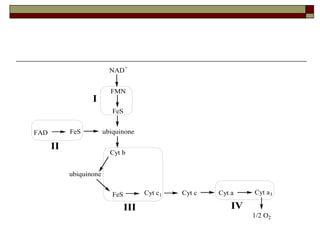
ELECTRON TRANSPORT CHAIN During the metabolism of energy rich molecules, the metabolic intermediates of these reactions donate electrons to  specific co-enzymes– NAD and FAD to form energy rich reduced coenzymes, NADH and FADH 2 .  These reduced coenzymes, in turn each donate a pair of electrons to special electron carriers, collectively called Electron Transport Chain.  Free energy is lost by these electrons as they pass down this chain. Part of this energy is used to form ATP from ADP – OXIDATIVE PHOSPHORYLATION. The remainder of this energy is used in processes like Ca transport and to form heat.
Site of ETC MITOCHONDRIA ---- inner mitochondrial membrane. It is impermeable to most small ions, small and large molecules --- requirement of specialized carriers. The matrix of mitochondria contains  - TCA cycle enzymes - fatty acid oxidation enzymes - Mitochondrial DNA and RNA NAD and FAD ADP and Pi
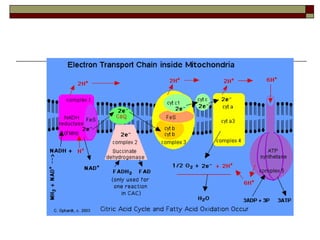
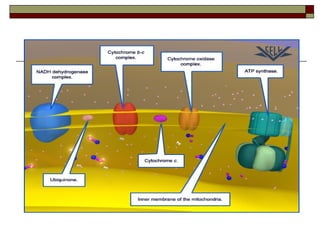
Organization of the chain The inner mitochondrial membrane can be divided into five protein complexes :- - complexes I, II, III, IV, and V Complex I to IV, each contains a part of the ETC.  Complex V is used for ATP synthesis. Each complex accepts or donates electrons to electron carriers --- coenzyme Q and Cytochrome c. Each carrier donates electrons to the next carrier in the chain. The electrons ultimately combine with oxygen and protons to form water.
 
Reactions of the electron transport chain 1- Formation of NADH:- NAD is reduced to NADH Enzyme --- dehydrogenase --- removal of two hydrogen atoms from the substrate  ---- both electrons and a hydride ion are transferred to NAD , forming NADH and a hydrogen ion.
2 – NADH Dehydrogenase :- NADH transfers the free proton and the hydride ion to NADH dehydrogenase --- complex I.  FMN is already present in this complex. It receives two hydrogen atoms and becomes FMNH 2.
3- Coenzyme Q :-  It is a quinone derivative. Also called ubiquinone.  It can accept hydrogen atoms from two sources ---  FMNH 2  ( complex I )  and from FADH  2  , produced on succinate dehydrogenase ( complex II ). CoQ links flavoporoteins to cytochromes.
4- Cytochromes :- Each cytochrome contains a heme group made of a porphyrin ring with an iron atom. The iron in cytochromes is converted from its ferric- Fe 3  to ferrous-Fe 2  form and functions as a reversible carrier of electrons. The electrons are passed along the chain from coQ to cytochromes b and c1 ( complex III ), c and a + a 3  ( complex IV ).
5- Cytochrome a + a 3  :- Also called cytochrome oxidase. At this site, transported electrons, molecular oxygen and free protons come together to produce water.
Release of free energy during ETC:- Free energy is released during the transfer of electrons along the electron transport chain. Coupled oxidation – reduction reactions --- Redox pairs e.g NADH -> NAD and FMN-> FMNH 2 . Redox pairs differ in their tendency to lose electrons. The transport of a pair of electrons from NADH to oxygen releases 52.58 calories--- used mainly for ATP formation.
 
Coenzyme Q  (CoQ, Q or ubiquinone) is lipid-soluble. It dissolves in the hydrocarbon core of a membrane. the only electron carrier not bound to a protein. it can accept/donate 1 or 2 e - .
Cytochromes   are electron carriers containing heme .  Hemes in the 3 classes of cytochrome ( a ,  b ,  c ) differ in substituents on the porphyrin ring.  Some cytochromes(b,c1,a,a3) are part of large  integral membrane protein complexes .  Cytochrome c  is a small, water-soluble protein.  Cytochromes
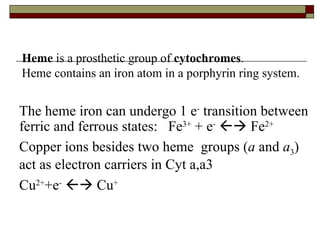
The heme iron can undergo 1 e -  transition between ferric and ferrous states:  Fe 3+  + e -     Fe 2+ Copper ions besides two heme  groups ( a  and  a 3 ) act as electron carriers in Cyt a,a3  Cu 2+ +e -     Cu + Heme  is a prosthetic group of  cytochromes .  Heme contains an iron atom in a porphyrin ring system.
NAD + , flavins and Q carry electrons and H + Cytochromes and non-haem iron proteins carry only electrons NAD +,  FAD undergo only a 2 e -  reaction;  cytochromes undergo only 1e -  reactions FMN, Q undergo 1e -  and 2 e -  reaction Electron carriers
ETC ---- REVIEW a series of highly organized oxidation-reduction enzymes Final common pathway in aerobic cells to transfer electrons to oxygen. Inner mitochondrial mem. Four complexes/ components
Complex I – NAD + CoQ Reductase Transfer of two electrons from NADH to CoQ via FMN, coverting it into FMNH 2. -  FMNH2 transfers electons to Fes proteins which transfer electrons to CoQ. - CoQ accepts electrons from FMNH 2  ( complex I ) and from FADH 2  ( complex II ) . CoQ is the link between flavoproteins and cytochromes.  Pumping of protons.
Complex II – Succinate + CoQ Reductase transfer of electrons from Succinate to CoQ via FADH 2 . Succinate is converted to Fumerate during this. Complex III- CoQ + Cyto. C reductase Transfer of electrons from CoQH 2  to Cyt.c via Cyt.b  & Cyt. c1.  Fe+++ of cyt c1accepts electrons and forms Fe++ . Complex is also a proton pump.
Complex IV ---- Cyt.c reductase Transfer of electrons from cyt c to molecular oxygen via Cyt.a , Cu++ , and Cyt.a 3 .  Water is formed as a result. This complex also acts as proton pump.
 
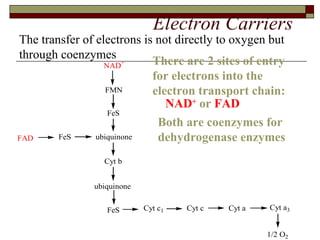
Electron Carriers NAD +  or  FAD There are 2 sites of entry for electrons into the electron transport chain:  Both are coenzymes for dehydrogenase enzymes The transfer of electrons is not directly to oxygen but through coenzymes
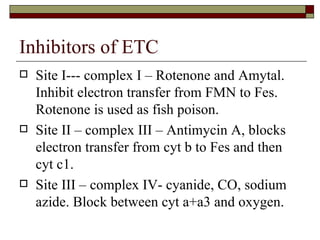
Inhibitors of ETC Site I--- complex I – Rotenone and Amytal. Inhibit electron transfer from FMN to Fes. Rotenone is used as fish poison. Site II – complex III – Antimycin A, blocks electron transfer from cyt b to Fes and then cyt c1. Site III – complex IV- cyanide, CO, sodium azide. Block between cyt a+a3 and oxygen.
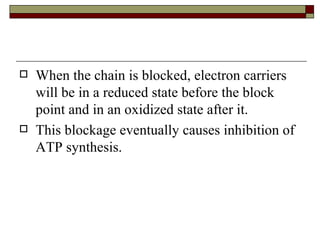
When the chain is blocked, electron carriers will be in a reduced state before the block point and in an oxidized state after it.  This blockage eventually causes inhibition of ATP synthesis.
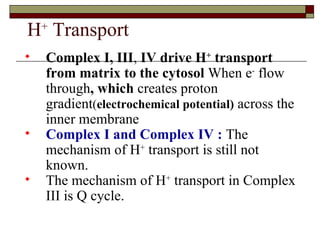
H +  Transport Complex I, III ,  IV drive H +  transport from matrix to the cytosol  When e -  flow through , which  creates p roton gradient ( electrochemical potential)  across the inner membrane  Complex I and Complex IV :  The mechanism of H +  transport is still not known. The mechanism of H +  transport in Complex III is Q cycle.
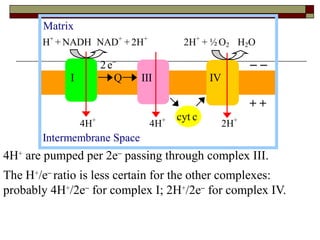
4H +  are pumped per 2e   passing through complex III.  The H + /e  ratio is less certain for the other complexes: probably 4H + /2e   for complex I; 2H + /2e   for complex IV.
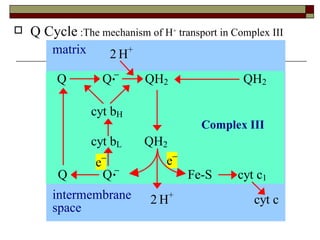
Q Cycle  :The mechanism of H +  transport in Complex III
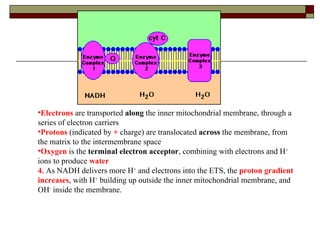
Electrons  are transported  along  the inner mitochondrial membrane, through a series of electron carriers  Protons  (indicated by  +  charge) are translocated  across  the membrane, from the matrix to the intermembrane space  Oxygen  is the  terminal electron acceptor , combining with electrons and H +  ions to produce  water   4.  As NADH delivers more H +  and electrons into the ETS, the  proton gradient increases , with H +  building up outside the inner mitochondrial membrane, and OH -  inside the membrane.
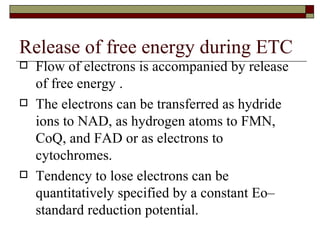
Release of free energy during ETC  Flow of electrons is accompanied by release of free energy . The electrons can be transferred as hydride ions to NAD, as hydrogen atoms to FMN, CoQ, and FAD or as electrons to cytochromes. Tendency to lose electrons can be quantitatively specified by a constant Eo– standard reduction potential.
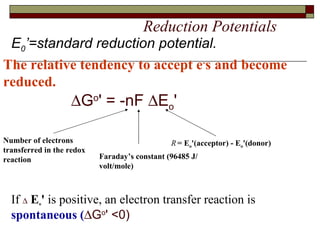
Reduction Potentials Number of electrons transferred in the redox reaction Faraday’s constant (96485 J/volt/mole) Crucial equation:    G o ' = -n F    E o '   The relative tendency to accept e - s and become reduced.   = E o '(acceptor) - E o '(donor) E 0 ’=standard reduction potential. If     E o '  is positive, an electron transfer reaction is  spontaneous (  G o ' <0)
OXIDATIVE PHOSPHORYLATION
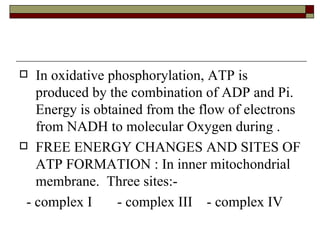
In oxidative phosphorylation, ATP is produced by the combination of ADP and Pi. Energy is obtained from the flow of electrons from NADH to molecular Oxygen during . FREE ENERGY CHANGES AND SITES OF ATP FORMATION : In inner mitochondrial membrane.  Three sites:- - complex I  - complex III  - complex IV
Chemiosmotic hypothesis of ATP synthesis  Complex I,III and IV are proton pumps. Free energy of oxidation of components is coupled to the translocation of H+ from inside to outside of inner mitochondrial membrane. Accumulation of protons at this site ----- electrochemical potential will drive the synthesis of ATP by activation of ATP synthase.
ATP synthase Complex V Composed of two domains --- F1 and Fo Fo domain ---- spans the inner mitochondrial membrane and serves as a channel through which protons reenter into mitochondrial matrix. F1 ----- extra membranous part, projects into mitochondrial matrix.
The protons accumulated on the cytosolic side of inner mitochondrial membrane re-enter the mitochondrail matrix through Fo. This causes rotation of Fo. Rotation of Fo results in confirmational changes in F1 and result is the activation of catalytic activity of ATP synthase. ADP and Pi then combine to form ATP.
Inhibition of Oxidative Phosphorylation OLIGOMYCIN ------ binds with Fo domain, - blocks H+ channels,  no reentery of protons in mito. matrix.  No oxid phospho. ETC also stops due to accumulation of protons Respiratory control ---- phosphorylation of ADP to ATP is essential for cellular respiration. Decreased level of ADP and Pi also decrease ATP synthesis.
Uncouplers of oxidative phosphorylation These compounds uncouple ETC and Oxidative phosphorylation. They increase permebility of inner mito mem to protons. 2,4 dinitrophenol is a classic example. It causes ETC to proceed at a rapid rate without forming a proton gradient. Energy is released as heat, not used for ATP. High doses of Aspirin also act as uncoupler. Natural uncoupler --- brown fat.
Transport of ADP and ATP  Adenine nucleotide carrier --- transport of one molecule of ADP from cytosol into mito and exports one ATP from mito into cytosol. Inhibited by plant toxin atractyloside.
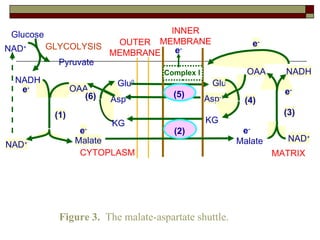
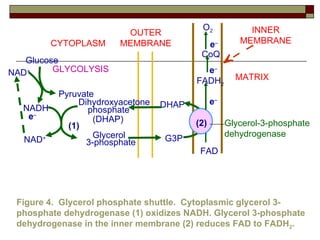
Transport of reducing equivalents NADH produced in cytosol cannot enter mito. Two electrons of NADH called reducing equivalents, enter mito using shuttle mechanism.
CYTOPLASM OUTER MEMBRANE MATRIX INNER MEMBRANE Figure 3.   The malate-aspartate shuttle.  OAA Malate (1) e - NAD + e - Glu 0 (6) Glu 0 Asp -1 (4) KG KG Malate (2) e - e - OAA NADH NAD + (3) e - Complex I e - NAD + Glucose Pyruvate GLYCOLYSIS NADH Asp -1 (5)
CYTOPLASM INNER MEMBRANE MATRIX FAD Glycerol-3-phosphate  dehydrogenase (2) DHAP OUTER MEMBRANE Figure 4.  Glycerol phosphate shuttle.  Cytoplasmic glycerol 3-phosphate dehydrogenase (1) oxidizes NADH. Glycerol 3-phosphate dehydrogenase in the inner membrane (2) reduces FAD to FADH 2 . G3P Dihydroxyacetone phosphate (DHAP) NAD + 3-phosphate Glycerol e  (1) FADH 2 e  CoQ e  O 2 e  NADH Glucose Pyruvate GLYCOLYSIS NAD +

Biological oxidation

  • 1.
  • 2.
    Oxidation is areaction with oxygen directly or indirectly OR to lose hydrogen and / or electrons. This process is carried out by enzymes. There can be the following three classes of biological oxidation :- - loss of one or more electrons - loss of one or more hydrogen atoms - addition of one or more oxygen atoms
  • 3.
    EXERGONIC and ENDERGONICREACTIONS :- In exergonic reactions, free energy is released while in endergonic reactions, free energy is absorbed. This free energy moves between the two reactions through the common intermediate . This common intermediate is thus a carrier of chemical energy between the two reactions. Two chemical reactions have a common intermediate when they occur in a sequence. For example A + B -> C + D D + X -> Y + Z D is the common intermediate and can act as carrier of chemical energy.
  • 4.
    ATP as anENERGY CARRIER Many coupled reactions use ATP to generate common intermediate. These reactions may involve ATP cleavage --- the transfer of a phosphate group from ATP to another molecule ATP synthesis ---- the transfer of phosphate group from an energy rich intermediate to ADP, forming ATP.
  • 5.
    Energy carried byATP ATP ---- one molecule of adenosine ( adenine + ribose ) , and three phosphate groups. The phosphate groups are attached to each other by high-energy phosphate bonds. -Removal of one phosphate ->-> ADP -Removal of two phosphates ->-> AMP The standard free energy of hydrolysis of ATP , is approx. – 7.3 kcal/mol for each of the two terminal phosphate groups.
  • 6.
    ELECTRON TRANSPORT CHAINDuring the metabolism of energy rich molecules, the metabolic intermediates of these reactions donate electrons to specific co-enzymes– NAD and FAD to form energy rich reduced coenzymes, NADH and FADH 2 . These reduced coenzymes, in turn each donate a pair of electrons to special electron carriers, collectively called Electron Transport Chain. Free energy is lost by these electrons as they pass down this chain. Part of this energy is used to form ATP from ADP – OXIDATIVE PHOSPHORYLATION. The remainder of this energy is used in processes like Ca transport and to form heat.
  • 7.
    Site of ETCMITOCHONDRIA ---- inner mitochondrial membrane. It is impermeable to most small ions, small and large molecules --- requirement of specialized carriers. The matrix of mitochondria contains - TCA cycle enzymes - fatty acid oxidation enzymes - Mitochondrial DNA and RNA NAD and FAD ADP and Pi
  • 8.
    Organization of thechain The inner mitochondrial membrane can be divided into five protein complexes :- - complexes I, II, III, IV, and V Complex I to IV, each contains a part of the ETC. Complex V is used for ATP synthesis. Each complex accepts or donates electrons to electron carriers --- coenzyme Q and Cytochrome c. Each carrier donates electrons to the next carrier in the chain. The electrons ultimately combine with oxygen and protons to form water.
  • 9.
  • 10.
    Reactions of theelectron transport chain 1- Formation of NADH:- NAD is reduced to NADH Enzyme --- dehydrogenase --- removal of two hydrogen atoms from the substrate ---- both electrons and a hydride ion are transferred to NAD , forming NADH and a hydrogen ion.
  • 11.
    2 – NADHDehydrogenase :- NADH transfers the free proton and the hydride ion to NADH dehydrogenase --- complex I. FMN is already present in this complex. It receives two hydrogen atoms and becomes FMNH 2.
  • 12.
    3- Coenzyme Q:- It is a quinone derivative. Also called ubiquinone. It can accept hydrogen atoms from two sources --- FMNH 2 ( complex I ) and from FADH 2 , produced on succinate dehydrogenase ( complex II ). CoQ links flavoporoteins to cytochromes.
  • 13.
    4- Cytochromes :-Each cytochrome contains a heme group made of a porphyrin ring with an iron atom. The iron in cytochromes is converted from its ferric- Fe 3 to ferrous-Fe 2 form and functions as a reversible carrier of electrons. The electrons are passed along the chain from coQ to cytochromes b and c1 ( complex III ), c and a + a 3 ( complex IV ).
  • 14.
    5- Cytochrome a+ a 3 :- Also called cytochrome oxidase. At this site, transported electrons, molecular oxygen and free protons come together to produce water.
  • 15.
    Release of freeenergy during ETC:- Free energy is released during the transfer of electrons along the electron transport chain. Coupled oxidation – reduction reactions --- Redox pairs e.g NADH -> NAD and FMN-> FMNH 2 . Redox pairs differ in their tendency to lose electrons. The transport of a pair of electrons from NADH to oxygen releases 52.58 calories--- used mainly for ATP formation.
  • 16.
  • 17.
    Coenzyme Q (CoQ, Q or ubiquinone) is lipid-soluble. It dissolves in the hydrocarbon core of a membrane. the only electron carrier not bound to a protein. it can accept/donate 1 or 2 e - .
  • 18.
    Cytochromes are electron carriers containing heme . Hemes in the 3 classes of cytochrome ( a , b , c ) differ in substituents on the porphyrin ring. Some cytochromes(b,c1,a,a3) are part of large integral membrane protein complexes . Cytochrome c is a small, water-soluble protein. Cytochromes
  • 19.
    The heme ironcan undergo 1 e - transition between ferric and ferrous states: Fe 3+ + e -  Fe 2+ Copper ions besides two heme groups ( a and a 3 ) act as electron carriers in Cyt a,a3 Cu 2+ +e -  Cu + Heme is a prosthetic group of cytochromes . Heme contains an iron atom in a porphyrin ring system.
  • 20.
    NAD + ,flavins and Q carry electrons and H + Cytochromes and non-haem iron proteins carry only electrons NAD +, FAD undergo only a 2 e - reaction; cytochromes undergo only 1e - reactions FMN, Q undergo 1e - and 2 e - reaction Electron carriers
  • 21.
    ETC ---- REVIEWa series of highly organized oxidation-reduction enzymes Final common pathway in aerobic cells to transfer electrons to oxygen. Inner mitochondrial mem. Four complexes/ components
  • 22.
    Complex I –NAD + CoQ Reductase Transfer of two electrons from NADH to CoQ via FMN, coverting it into FMNH 2. - FMNH2 transfers electons to Fes proteins which transfer electrons to CoQ. - CoQ accepts electrons from FMNH 2 ( complex I ) and from FADH 2 ( complex II ) . CoQ is the link between flavoproteins and cytochromes. Pumping of protons.
  • 23.
    Complex II –Succinate + CoQ Reductase transfer of electrons from Succinate to CoQ via FADH 2 . Succinate is converted to Fumerate during this. Complex III- CoQ + Cyto. C reductase Transfer of electrons from CoQH 2 to Cyt.c via Cyt.b & Cyt. c1. Fe+++ of cyt c1accepts electrons and forms Fe++ . Complex is also a proton pump.
  • 24.
    Complex IV ----Cyt.c reductase Transfer of electrons from cyt c to molecular oxygen via Cyt.a , Cu++ , and Cyt.a 3 . Water is formed as a result. This complex also acts as proton pump.
  • 25.
  • 26.
    Electron Carriers NAD+ or FAD There are 2 sites of entry for electrons into the electron transport chain: Both are coenzymes for dehydrogenase enzymes The transfer of electrons is not directly to oxygen but through coenzymes
  • 27.
    Inhibitors of ETCSite I--- complex I – Rotenone and Amytal. Inhibit electron transfer from FMN to Fes. Rotenone is used as fish poison. Site II – complex III – Antimycin A, blocks electron transfer from cyt b to Fes and then cyt c1. Site III – complex IV- cyanide, CO, sodium azide. Block between cyt a+a3 and oxygen.
  • 28.
    When the chainis blocked, electron carriers will be in a reduced state before the block point and in an oxidized state after it. This blockage eventually causes inhibition of ATP synthesis.
  • 29.
    H + Transport Complex I, III , IV drive H + transport from matrix to the cytosol When e - flow through , which creates p roton gradient ( electrochemical potential) across the inner membrane Complex I and Complex IV : The mechanism of H + transport is still not known. The mechanism of H + transport in Complex III is Q cycle.
  • 30.
    4H + are pumped per 2e  passing through complex III. The H + /e  ratio is less certain for the other complexes: probably 4H + /2e  for complex I; 2H + /2e  for complex IV.
  • 31.
    Q Cycle :The mechanism of H + transport in Complex III
  • 32.
    Electrons aretransported along the inner mitochondrial membrane, through a series of electron carriers Protons (indicated by + charge) are translocated across the membrane, from the matrix to the intermembrane space Oxygen is the terminal electron acceptor , combining with electrons and H + ions to produce water 4. As NADH delivers more H + and electrons into the ETS, the proton gradient increases , with H + building up outside the inner mitochondrial membrane, and OH - inside the membrane.
  • 33.
    Release of freeenergy during ETC Flow of electrons is accompanied by release of free energy . The electrons can be transferred as hydride ions to NAD, as hydrogen atoms to FMN, CoQ, and FAD or as electrons to cytochromes. Tendency to lose electrons can be quantitatively specified by a constant Eo– standard reduction potential.
  • 34.
    Reduction Potentials Numberof electrons transferred in the redox reaction Faraday’s constant (96485 J/volt/mole) Crucial equation:   G o ' = -n F  E o ' The relative tendency to accept e - s and become reduced.  = E o '(acceptor) - E o '(donor) E 0 ’=standard reduction potential. If  E o ' is positive, an electron transfer reaction is spontaneous (  G o ' <0)
  • 35.
  • 36.
    In oxidative phosphorylation,ATP is produced by the combination of ADP and Pi. Energy is obtained from the flow of electrons from NADH to molecular Oxygen during . FREE ENERGY CHANGES AND SITES OF ATP FORMATION : In inner mitochondrial membrane. Three sites:- - complex I - complex III - complex IV
  • 37.
    Chemiosmotic hypothesis ofATP synthesis Complex I,III and IV are proton pumps. Free energy of oxidation of components is coupled to the translocation of H+ from inside to outside of inner mitochondrial membrane. Accumulation of protons at this site ----- electrochemical potential will drive the synthesis of ATP by activation of ATP synthase.
  • 38.
    ATP synthase ComplexV Composed of two domains --- F1 and Fo Fo domain ---- spans the inner mitochondrial membrane and serves as a channel through which protons reenter into mitochondrial matrix. F1 ----- extra membranous part, projects into mitochondrial matrix.
  • 39.
    The protons accumulatedon the cytosolic side of inner mitochondrial membrane re-enter the mitochondrail matrix through Fo. This causes rotation of Fo. Rotation of Fo results in confirmational changes in F1 and result is the activation of catalytic activity of ATP synthase. ADP and Pi then combine to form ATP.
  • 40.
    Inhibition of OxidativePhosphorylation OLIGOMYCIN ------ binds with Fo domain, - blocks H+ channels, no reentery of protons in mito. matrix. No oxid phospho. ETC also stops due to accumulation of protons Respiratory control ---- phosphorylation of ADP to ATP is essential for cellular respiration. Decreased level of ADP and Pi also decrease ATP synthesis.
  • 41.
    Uncouplers of oxidativephosphorylation These compounds uncouple ETC and Oxidative phosphorylation. They increase permebility of inner mito mem to protons. 2,4 dinitrophenol is a classic example. It causes ETC to proceed at a rapid rate without forming a proton gradient. Energy is released as heat, not used for ATP. High doses of Aspirin also act as uncoupler. Natural uncoupler --- brown fat.
  • 42.
    Transport of ADPand ATP Adenine nucleotide carrier --- transport of one molecule of ADP from cytosol into mito and exports one ATP from mito into cytosol. Inhibited by plant toxin atractyloside.
  • 43.
    Transport of reducingequivalents NADH produced in cytosol cannot enter mito. Two electrons of NADH called reducing equivalents, enter mito using shuttle mechanism.
  • 44.
    CYTOPLASM OUTER MEMBRANEMATRIX INNER MEMBRANE Figure 3. The malate-aspartate shuttle. OAA Malate (1) e - NAD + e - Glu 0 (6) Glu 0 Asp -1 (4) KG KG Malate (2) e - e - OAA NADH NAD + (3) e - Complex I e - NAD + Glucose Pyruvate GLYCOLYSIS NADH Asp -1 (5)
  • 45.
    CYTOPLASM INNER MEMBRANEMATRIX FAD Glycerol-3-phosphate dehydrogenase (2) DHAP OUTER MEMBRANE Figure 4. Glycerol phosphate shuttle. Cytoplasmic glycerol 3-phosphate dehydrogenase (1) oxidizes NADH. Glycerol 3-phosphate dehydrogenase in the inner membrane (2) reduces FAD to FADH 2 . G3P Dihydroxyacetone phosphate (DHAP) NAD + 3-phosphate Glycerol e  (1) FADH 2 e  CoQ e  O 2 e  NADH Glucose Pyruvate GLYCOLYSIS NAD +