Electron transport chain(ETC)
Introduction 
Discovery 
 In 1961, an American biochemist, Albert 
Lehninger, discovered that the citric acid cycle 
and the electron-transfer chain of enzymes (where 
1 NADH makes 3 ATPs) are located within each 
cell’s mitochondria. 
 And each cell has many mitochondrion power 
plants that produce an energy output which can 
be measured.
Importance and Location 
•Importance: 
These are the mechanism by which 
NADH plus H+ and FADH2 are used to 
generate ATP 
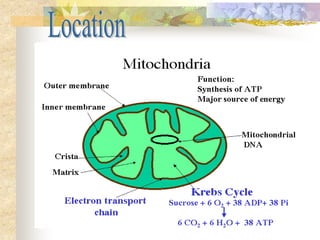
•Location: 
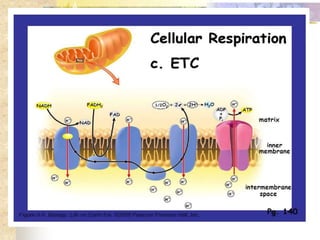
Inner mitochondrial membrane 
(showing my mammalian bias)
ETC 
 The majority of the energy conserved during 
catabolism reactions occurs near the end of the 
metabolic series of reactions in the electron 
transport chain. 
 The electron transport or respiratory chain 
gets its name from the fact electrons are 
transported to meet up with oxygen from 
respiration at the end of the chain. 
 The overall electron chain transport reaction is: 
2 H+ + 2 e+ + 1/2 O2 ---> H2O + energy
ETC 
 Notice that 2 hydrogen ions, 2 electrons, 
and an oxygen molecule react to form as a 
product water with energy released in an 
exothermic reaction. 
 This relatively straight forward reaction 
actually requires eight or more steps. The 
energy released is coupled with the 
formation of three ATP molecules per every 
use of the electron transport chain
ETC 
 The Electron transport system contains 
mainly six components arranged in the 
following sequence 
1.NAD (Nicotinamide adino dehydragenase) 
2.FAD ( Flavo adino dehydragenase) 
3.cytochrome B 
4.cytochrome C 
5.cytochrome A and 
6.cytochrome A3
Initiation of Electron Transport Chain: 
 Once the NADH has been made from a 
metabolite in the citric acid cycle inside of the 
mitochondria, it interacts with the first complex 1 
enzyme, known as NADH reductase. 
 This complex 1 contains a coenzyme flavin 
mononucleotide (FMN) which is similar to FAD. 
 The sequence of events is that the NADH, plus 
another hydrogen ion enter the enzyme complex 
and pass along the 2 hydrogen ions, ultimately to 
an interspace in the mitochondria.
 These hydrogen ions, acting as a pump, are 
utilized by ATP synthetase to produce an 
ATP for every two hydrogen ions produced. 
 Three complexes (1, 3, 4) act in this 
manner to produce 2 hydrogen ions each, 
and thus will produce 3 ATP for every use 
of the complete electron transport chain.
Oxidation of FAD & NADH 
occurs by the following steps 
Step1: 
The initiation of electron transport system is 
the removal of hydrogen from the substrate 
by enzyme dehydrogenase 
2H 2H+ + 2e-the 
hydrogen atom becomes ionized into 
protons+ and electrons-
 Step2: 
The hydrogen ion reduces the co-enzyme NAD 
NAD + 2H+  NADH +H+ 
 Step3: 
NADH is oxidized into NAD by transferring its 
hydrogen ion to FAD which act as the hydrogen 
carrier. 
 Step4: 
From FAD each hydrogen ion is discharged in 
the cell fluid and electrons are passed on the 
cytochromes B,C,A and A3
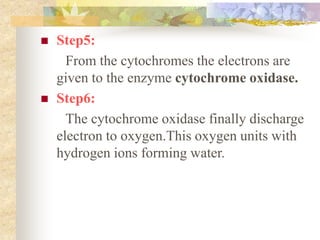
 Step5: 
From the cytochromes the electrons are 
given to the enzyme cytochrome oxidase. 
 Step6: 
The cytochrome oxidase finally discharge 
electron to oxygen.This oxygen units with 
hydrogen ions forming water.
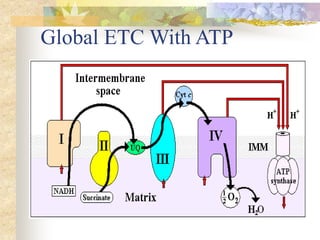
Global ETC With ATP
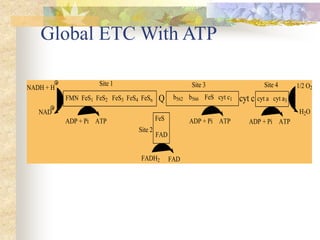
Global ETC With ATP 
Site 1 
NADH + H 
NAD 
FMN FeS1 FeS2 FeS3 FeS4 FeSn Q b562 b566 FeS cyt c1 cyt c 
FeS 
FAD 
Site 2 
FADH2 FAD 
Site 3 Site 4 
cyt a cyt a3 
1/2 O2 
H2O 
ADP + Pi ATP ADP + Pi ATP ADP + Pi ATP
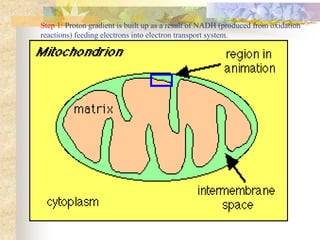
Step 1: Proton gradient is built up as a result of NADH (produced from oxidation 
reactions) feeding electrons into electron transport system.
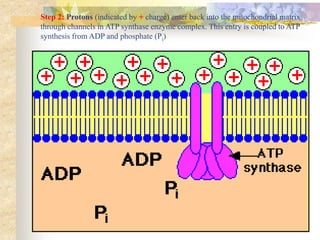
Step 2: Protons (indicated by + charge) enter back into the mitochondrial matrix 
through channels in ATP synthase enzyme complex. This entry is coupled to ATP 
synthesis from ADP and phosphate (Pi)
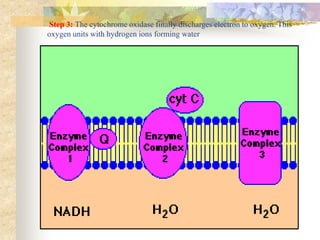
Step 3: The cytochrome oxidase finally discharges electron to oxygen. This 
oxygen units with hydrogen ions forming water
Conclusion 
1. Protons are translocated across the membrane, from the 
matrix to the intermembrane space 
2. Electrons are transported along the membrane, through a 
series of protein carriers 
3. Oxygen is the terminal electron acceptor, combining 
with electrons and H+ ions to produce water 
4. As NADH delivers more H+ and electrons into the ETS, 
the proton gradient increases, with H+ building up 
outside the inner mitochondrial membrane, and OH-inside 
the membrane.
THANK YOU 
Presentation by 
R.Vijayarangan

401201 634105410925951615

  • 1.
  • 2.
    Introduction Discovery In 1961, an American biochemist, Albert Lehninger, discovered that the citric acid cycle and the electron-transfer chain of enzymes (where 1 NADH makes 3 ATPs) are located within each cell’s mitochondria.  And each cell has many mitochondrion power plants that produce an energy output which can be measured.
  • 3.
    Importance and Location •Importance: These are the mechanism by which NADH plus H+ and FADH2 are used to generate ATP •Location: Inner mitochondrial membrane (showing my mammalian bias)
  • 5.
    ETC  Themajority of the energy conserved during catabolism reactions occurs near the end of the metabolic series of reactions in the electron transport chain.  The electron transport or respiratory chain gets its name from the fact electrons are transported to meet up with oxygen from respiration at the end of the chain.  The overall electron chain transport reaction is: 2 H+ + 2 e+ + 1/2 O2 ---> H2O + energy
  • 6.
    ETC  Noticethat 2 hydrogen ions, 2 electrons, and an oxygen molecule react to form as a product water with energy released in an exothermic reaction.  This relatively straight forward reaction actually requires eight or more steps. The energy released is coupled with the formation of three ATP molecules per every use of the electron transport chain
  • 7.
    ETC  TheElectron transport system contains mainly six components arranged in the following sequence 1.NAD (Nicotinamide adino dehydragenase) 2.FAD ( Flavo adino dehydragenase) 3.cytochrome B 4.cytochrome C 5.cytochrome A and 6.cytochrome A3
  • 9.
    Initiation of ElectronTransport Chain:  Once the NADH has been made from a metabolite in the citric acid cycle inside of the mitochondria, it interacts with the first complex 1 enzyme, known as NADH reductase.  This complex 1 contains a coenzyme flavin mononucleotide (FMN) which is similar to FAD.  The sequence of events is that the NADH, plus another hydrogen ion enter the enzyme complex and pass along the 2 hydrogen ions, ultimately to an interspace in the mitochondria.
  • 10.
     These hydrogenions, acting as a pump, are utilized by ATP synthetase to produce an ATP for every two hydrogen ions produced.  Three complexes (1, 3, 4) act in this manner to produce 2 hydrogen ions each, and thus will produce 3 ATP for every use of the complete electron transport chain.
  • 11.
    Oxidation of FAD& NADH occurs by the following steps Step1: The initiation of electron transport system is the removal of hydrogen from the substrate by enzyme dehydrogenase 2H 2H+ + 2e-the hydrogen atom becomes ionized into protons+ and electrons-
  • 12.
     Step2: Thehydrogen ion reduces the co-enzyme NAD NAD + 2H+  NADH +H+  Step3: NADH is oxidized into NAD by transferring its hydrogen ion to FAD which act as the hydrogen carrier.  Step4: From FAD each hydrogen ion is discharged in the cell fluid and electrons are passed on the cytochromes B,C,A and A3
  • 13.
     Step5: Fromthe cytochromes the electrons are given to the enzyme cytochrome oxidase.  Step6: The cytochrome oxidase finally discharge electron to oxygen.This oxygen units with hydrogen ions forming water.
  • 14.
  • 15.
    Global ETC WithATP Site 1 NADH + H NAD FMN FeS1 FeS2 FeS3 FeS4 FeSn Q b562 b566 FeS cyt c1 cyt c FeS FAD Site 2 FADH2 FAD Site 3 Site 4 cyt a cyt a3 1/2 O2 H2O ADP + Pi ATP ADP + Pi ATP ADP + Pi ATP
  • 16.
    Step 1: Protongradient is built up as a result of NADH (produced from oxidation reactions) feeding electrons into electron transport system.
  • 17.
    Step 2: Protons(indicated by + charge) enter back into the mitochondrial matrix through channels in ATP synthase enzyme complex. This entry is coupled to ATP synthesis from ADP and phosphate (Pi)
  • 18.
    Step 3: Thecytochrome oxidase finally discharges electron to oxygen. This oxygen units with hydrogen ions forming water
  • 19.
    Conclusion 1. Protonsare translocated across the membrane, from the matrix to the intermembrane space 2. Electrons are transported along the membrane, through a series of protein carriers 3. Oxygen is the terminal electron acceptor, combining with electrons and H+ ions to produce water 4. As NADH delivers more H+ and electrons into the ETS, the proton gradient increases, with H+ building up outside the inner mitochondrial membrane, and OH-inside the membrane.
  • 20.
    THANK YOU Presentationby R.Vijayarangan