1
GYCOLYSIS
Mr. RAJENDRA SINGH Jr.
Biotechnology Network
2
Synopsis: -
1. Introduction
2. History
3. Carbohydrate Metabolism
4. Biological significance.
5.References
1. GLYCOLYSIS
INTRODUCTION:
* Glycolysis is derived from greek word (glycose-
glucose, lysis-breakdown).
* During this process one molecules of glucose is
degraded into two molecules of pyruvate.
* Free energy is released in this process and is stored as
two molecules of “ATP” and two molecules of NADH.
3
2. HISTORY:
•Glycolysis was the very 1st biochemistry studied and it is the 1st metabolic
pathway discovered.
•Louis pasture(1854-1864): observed that fermentation is caused by micro-
organisms and also found that aerobic growth requires less glucose than
anaerobic condition.
•Buchner(1897): found that reaction of glycolysis can be carried out in a cell-free
yeast extract.
•Harden and young(1905): found that (1). Inorganic phosphate is required
fermentation.
(2). Yeast extract could be separated in
small molecular weight essential coenzymes and bigger molecules called zymase.
4
5
• There is 60% of ingested food consist of polysaccharide carbohydrates,
while the disaccharide carbohydrates like sucrose and lactose are important
in the diet of infants.
• The end product of carbohydrate digestion is mainly glucose, fructose and
galactose.
• These simple sugars are absorbed in the intestine and are carried to the liver
through the blood stream. Here they are transferred into glycogen through
glucose-6-phosphate.
• The glycogen is stored in the liver.
• The carbohydrate metabolism or digestion of carbohydrate is takes by two
steps:
1. Catabolism
2. Anabolism
1. Catabolism:
* In catabolism degradation of complex
organic molecules into simpler molecules.
* In this process energy is released.
2. Anabolism:
* Anabolism is the process of biosynthesis in
which complex molecules are produced from simpler
molecules.
* In this process energy is required.
6
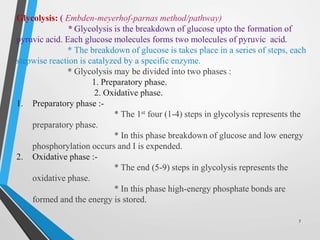
Glycolysis: ( Embden-meyerhof-parnas method/pathway)
* Glycolysis is the breakdown of glucose upto the formation of
pyruvic acid. Each glucose molecules forms two molecules of pyruvic acid.
* The breakdown of glucose is takes place in a series of steps, each
stepwise reaction is catalyzed by a specific enzyme.
* Glycolysis may be divided into two phases :
1. Preparatory phase.
2. Oxidative phase.
1. Preparatory phase :-
* The 1st four (1-4) steps in glycolysis represents the
preparatory phase.
* In this phase breakdown of glucose and low energy
phosphorylation occurs and I is expended.
2. Oxidative phase :-
* The end (5-9) steps in glycolysis represents the
oxidative phase.
* In this phase high-energy phosphate bonds are
formed and the energy is stored.
7
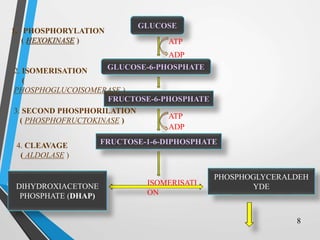
GLUCOSE
GLUCOSE-6-PHOSPHATE
FRUCTOSE-6-PHOSPHATE
FRUCTOSE-1-6-DIPHOSPHATE
DIHYDROXIACETONE
PHOSPHATE (DHAP)
PHOSPHOGLYCERALDEH
YDE
ATP
ADP
ATP
ADP
ISOMERISATI
ON
1. PHOSPHORYLATION
( HEXOKINASE )
2. ISOMERISATION
(
PHOSPHOGLUCOISOMERASE )
3. SECOND PHOSPHORILATION
( PHOSPHOFRUCTOKINASE )
4. CLEAVAGE
( ALDOLASE )
8
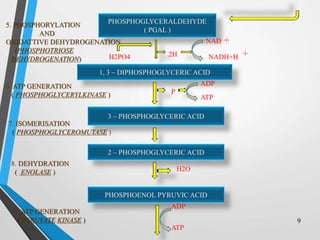
PHOSPHOGLYCERALDEHYDE
( PGAL )
1, 3 – DIPHOSPHOGLYCERIC ACID
3 – PHOSPHOGLYCERIC ACID
2 – PHOSPHOGLYCERIC ACID
PHOSPHOENOL PYRUVIC ACID
H2PO4 2H
NAD
NADH+H
P
ADP
ATP
H2O
ADP
ATP
5. PHOSPHORYLATION
AND
OXIDATTIVE DEHYDROGENATION
(PHOSPHOTRIOSE
DEHYDROGENATION)
6. ATP GENERATION
( PHOSPHOGLYCERYLKINASE )
7. ISOMERISATION
( PHOSPHOGLYCEROMUTASE )
8. DEHYDRATION
( ENOLASE )
9. ATP GENERATION
( PYRUVATE KINASE ) 9
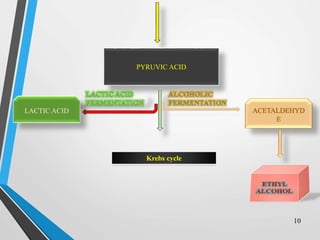
PYRUVIC ACID
LACTIC ACID ACETALDEHYD
E
Krebs cycle
10
Steps involved in Glycolysis :-
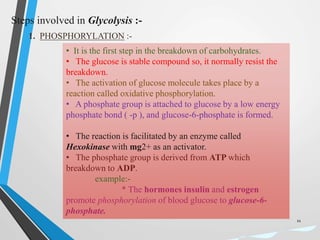
• It is the first step in the breakdown of carbohydrates.
• The glucose is stable compound so, it normally resist the
breakdown.
• The activation of glucose molecule takes place by a
reaction called oxidative phosphorylation.
• A phosphate group is attached to glucose by a low energy
phosphate bond ( -p ), and glucose-6-phosphate is formed.
• The reaction is facilitated by an enzyme called
Hexokinase with mg2+ as an activator.
• The phosphate group is derived from ATP which
breakdown to ADP.
example:-
* The hormones insulin and estrogen
promote phosphorylation of blood glucose to glucose-6-
phosphate.
11
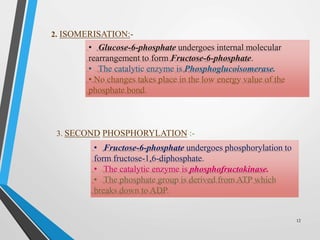
2. ISOMERISATION:-
• Glucose-6-phosphate undergoes internal molecular
rearrangement to form Fructose-6-phosphate.
• The catalytic enzyme is Phosphoglucoisomerase.
• No changes takes place in the low energy value of the
phosphate bond.
3. SECOND PHOSPHORYLATION :-
• Fructose-6-phosphate undergoes phosphorylation to
form fructose-1,6-diphosphate.
• The catalytic enzyme is phosphofructokinase.
• The phosphate group is derived from ATP which
breaks down to ADP.
12
4. CLEAVAGE:-
• Fructose-1,6-diphosphate splits into two halves between
carbon atom 3 and 4 under the action of enzyme Aldolase.
• The two halves phosphates, each contain three carbon
atoms, but are not identical.
• The one half is dihyroxyacetone phosphate (DHAP )
and the other is 3-phosphoglyceraldehyde.
• These molecules undergoes isomerization and become
identical 3-phosphoglyceraldehyde (PGAL ) molecules.
• The catalyzing enzyme is Triosephosphate isomerase.
.
5. PHOSPHORYLATION AND OXIDATIVE DEHYDROGENATION :-
• The phosphoglyceraldehyde ( PGAL ) undergoes
simultaneous phosphorylation and oxidative dehydrogenation.
• The PGAL molecule has a phosphate group attached to the
one end by a low energy bond ( -p ).
• During phosphorylation, under the catalyzing action of
enzyme phosphotriose dehydrogenase, a second phosphate
group is added to the other end.
• The phosphorylating agent which provides the phosphate
group is phosphoric acid.
• Oxidative dehydrogenation takes place simultaneously. Two
atoms of hydrogen are removed and are accepted by NAD+
(nicotinamide adenine dinucleotide), which is converted into
NADH+H+ .
• The newly added phosphate group acquires a high energy
phosphate bond ( ~ P ). The end product is 1, 3-
diphosphoglyceric acid, an energy rich compound is formed. .
6. ATP GENERATION :-
• 1, 3-diphosphoglyceric acid now transfer its phosphate with
high energy bond to ADP, 3-phosphoglyceric acid ( PGAL ).
• The catalytic enzyme is phosphoglyceryl kinase.
• ADP acquires the high energy bond phosphate and becomes
ATP,
7. ISOMERIZATION :-
• The 3-phosphoglyceric acid molecules undergoes internal
rearrangement and becomes 2-phosphoglyceric acid.
• The catalyzing enzyme is phosphoglyceromutase.
8. DEHYDRATION:-
• The 2-phosphoglyceric acid molecules loses hydrogen and
oxygen in the form of water ( dehydration ), to form phosphoenol
pyruvic acid.
• The step is catalyzed by an enzyme Enolase.
9. ATP GENERATION :-
• The phosphoenol pyruvic acid molecules transfers its
high energy phosphate bond to ADP, which is converted
into ATP, and pyruvic
acid is formed.
• The reaction is catalyzed by an enzyme called Pyruvate
kinase.
• It should be noted that two molecules of pyruvic acid are
formed per molecules of glucose metabolished.
16
17
4. BIOLOGICAL SIGNIFICANCE:-
* In the absence of oxygen pyruvic acid is converted into either
ethyl alcohol or lactic acid.
* Pyruvic and lactic acids may be returned to the liver where they
can be resynthesized to form glucose or glycogen by reverse
anaerobic glycolysis.
* Lactic and pyruvic acids may also be broken down in the liver
to yield carbon dioxide and water through kreb’s cycle .
18
5. References:-
I. Lehninger’s Principle of Biochemistry (5th) Edition - David L.
Nelson & Michael M. Cox.
II. Fundamentals of Biochemistry – J.L.JAIN 2005 S. CHAND &
COMPANY LTD. RAM NAGAR, NEW DELHI-110 055
III. https://en.wikipedia.org/wiki/Glycolysis
19
Prepared by :
KIRAN KUMAR H
SHWETA TIWARI
RAJENDER SINGH

Glycolysis

  • 1.
    1 GYCOLYSIS Mr. RAJENDRA SINGHJr. Biotechnology Network
  • 2.
    2 Synopsis: - 1. Introduction 2.History 3. Carbohydrate Metabolism 4. Biological significance. 5.References
  • 3.
    1. GLYCOLYSIS INTRODUCTION: * Glycolysisis derived from greek word (glycose- glucose, lysis-breakdown). * During this process one molecules of glucose is degraded into two molecules of pyruvate. * Free energy is released in this process and is stored as two molecules of “ATP” and two molecules of NADH. 3
  • 4.
    2. HISTORY: •Glycolysis wasthe very 1st biochemistry studied and it is the 1st metabolic pathway discovered. •Louis pasture(1854-1864): observed that fermentation is caused by micro- organisms and also found that aerobic growth requires less glucose than anaerobic condition. •Buchner(1897): found that reaction of glycolysis can be carried out in a cell-free yeast extract. •Harden and young(1905): found that (1). Inorganic phosphate is required fermentation. (2). Yeast extract could be separated in small molecular weight essential coenzymes and bigger molecules called zymase. 4
  • 5.
    5 • There is60% of ingested food consist of polysaccharide carbohydrates, while the disaccharide carbohydrates like sucrose and lactose are important in the diet of infants. • The end product of carbohydrate digestion is mainly glucose, fructose and galactose. • These simple sugars are absorbed in the intestine and are carried to the liver through the blood stream. Here they are transferred into glycogen through glucose-6-phosphate. • The glycogen is stored in the liver. • The carbohydrate metabolism or digestion of carbohydrate is takes by two steps: 1. Catabolism 2. Anabolism
  • 6.
    1. Catabolism: * Incatabolism degradation of complex organic molecules into simpler molecules. * In this process energy is released. 2. Anabolism: * Anabolism is the process of biosynthesis in which complex molecules are produced from simpler molecules. * In this process energy is required. 6
  • 7.
    Glycolysis: ( Embden-meyerhof-parnasmethod/pathway) * Glycolysis is the breakdown of glucose upto the formation of pyruvic acid. Each glucose molecules forms two molecules of pyruvic acid. * The breakdown of glucose is takes place in a series of steps, each stepwise reaction is catalyzed by a specific enzyme. * Glycolysis may be divided into two phases : 1. Preparatory phase. 2. Oxidative phase. 1. Preparatory phase :- * The 1st four (1-4) steps in glycolysis represents the preparatory phase. * In this phase breakdown of glucose and low energy phosphorylation occurs and I is expended. 2. Oxidative phase :- * The end (5-9) steps in glycolysis represents the oxidative phase. * In this phase high-energy phosphate bonds are formed and the energy is stored. 7
  • 8.
    GLUCOSE GLUCOSE-6-PHOSPHATE FRUCTOSE-6-PHOSPHATE FRUCTOSE-1-6-DIPHOSPHATE DIHYDROXIACETONE PHOSPHATE (DHAP) PHOSPHOGLYCERALDEH YDE ATP ADP ATP ADP ISOMERISATI ON 1. PHOSPHORYLATION (HEXOKINASE ) 2. ISOMERISATION ( PHOSPHOGLUCOISOMERASE ) 3. SECOND PHOSPHORILATION ( PHOSPHOFRUCTOKINASE ) 4. CLEAVAGE ( ALDOLASE ) 8
  • 9.
    PHOSPHOGLYCERALDEHYDE ( PGAL ) 1,3 – DIPHOSPHOGLYCERIC ACID 3 – PHOSPHOGLYCERIC ACID 2 – PHOSPHOGLYCERIC ACID PHOSPHOENOL PYRUVIC ACID H2PO4 2H NAD NADH+H P ADP ATP H2O ADP ATP 5. PHOSPHORYLATION AND OXIDATTIVE DEHYDROGENATION (PHOSPHOTRIOSE DEHYDROGENATION) 6. ATP GENERATION ( PHOSPHOGLYCERYLKINASE ) 7. ISOMERISATION ( PHOSPHOGLYCEROMUTASE ) 8. DEHYDRATION ( ENOLASE ) 9. ATP GENERATION ( PYRUVATE KINASE ) 9
  • 10.
    PYRUVIC ACID LACTIC ACIDACETALDEHYD E Krebs cycle 10
  • 11.
    Steps involved inGlycolysis :- • It is the first step in the breakdown of carbohydrates. • The glucose is stable compound so, it normally resist the breakdown. • The activation of glucose molecule takes place by a reaction called oxidative phosphorylation. • A phosphate group is attached to glucose by a low energy phosphate bond ( -p ), and glucose-6-phosphate is formed. • The reaction is facilitated by an enzyme called Hexokinase with mg2+ as an activator. • The phosphate group is derived from ATP which breakdown to ADP. example:- * The hormones insulin and estrogen promote phosphorylation of blood glucose to glucose-6- phosphate. 11
  • 12.
    2. ISOMERISATION:- • Glucose-6-phosphateundergoes internal molecular rearrangement to form Fructose-6-phosphate. • The catalytic enzyme is Phosphoglucoisomerase. • No changes takes place in the low energy value of the phosphate bond. 3. SECOND PHOSPHORYLATION :- • Fructose-6-phosphate undergoes phosphorylation to form fructose-1,6-diphosphate. • The catalytic enzyme is phosphofructokinase. • The phosphate group is derived from ATP which breaks down to ADP. 12
  • 13.
    4. CLEAVAGE:- • Fructose-1,6-diphosphatesplits into two halves between carbon atom 3 and 4 under the action of enzyme Aldolase. • The two halves phosphates, each contain three carbon atoms, but are not identical. • The one half is dihyroxyacetone phosphate (DHAP ) and the other is 3-phosphoglyceraldehyde. • These molecules undergoes isomerization and become identical 3-phosphoglyceraldehyde (PGAL ) molecules. • The catalyzing enzyme is Triosephosphate isomerase. .
  • 14.
    5. PHOSPHORYLATION ANDOXIDATIVE DEHYDROGENATION :- • The phosphoglyceraldehyde ( PGAL ) undergoes simultaneous phosphorylation and oxidative dehydrogenation. • The PGAL molecule has a phosphate group attached to the one end by a low energy bond ( -p ). • During phosphorylation, under the catalyzing action of enzyme phosphotriose dehydrogenase, a second phosphate group is added to the other end. • The phosphorylating agent which provides the phosphate group is phosphoric acid. • Oxidative dehydrogenation takes place simultaneously. Two atoms of hydrogen are removed and are accepted by NAD+ (nicotinamide adenine dinucleotide), which is converted into NADH+H+ . • The newly added phosphate group acquires a high energy phosphate bond ( ~ P ). The end product is 1, 3- diphosphoglyceric acid, an energy rich compound is formed. .
  • 15.
    6. ATP GENERATION:- • 1, 3-diphosphoglyceric acid now transfer its phosphate with high energy bond to ADP, 3-phosphoglyceric acid ( PGAL ). • The catalytic enzyme is phosphoglyceryl kinase. • ADP acquires the high energy bond phosphate and becomes ATP, 7. ISOMERIZATION :- • The 3-phosphoglyceric acid molecules undergoes internal rearrangement and becomes 2-phosphoglyceric acid. • The catalyzing enzyme is phosphoglyceromutase. 8. DEHYDRATION:- • The 2-phosphoglyceric acid molecules loses hydrogen and oxygen in the form of water ( dehydration ), to form phosphoenol pyruvic acid. • The step is catalyzed by an enzyme Enolase.
  • 16.
    9. ATP GENERATION:- • The phosphoenol pyruvic acid molecules transfers its high energy phosphate bond to ADP, which is converted into ATP, and pyruvic acid is formed. • The reaction is catalyzed by an enzyme called Pyruvate kinase. • It should be noted that two molecules of pyruvic acid are formed per molecules of glucose metabolished. 16
  • 17.
    17 4. BIOLOGICAL SIGNIFICANCE:- *In the absence of oxygen pyruvic acid is converted into either ethyl alcohol or lactic acid. * Pyruvic and lactic acids may be returned to the liver where they can be resynthesized to form glucose or glycogen by reverse anaerobic glycolysis. * Lactic and pyruvic acids may also be broken down in the liver to yield carbon dioxide and water through kreb’s cycle .
  • 18.
    18 5. References:- I. Lehninger’sPrinciple of Biochemistry (5th) Edition - David L. Nelson & Michael M. Cox. II. Fundamentals of Biochemistry – J.L.JAIN 2005 S. CHAND & COMPANY LTD. RAM NAGAR, NEW DELHI-110 055 III. https://en.wikipedia.org/wiki/Glycolysis
  • 19.
    19 Prepared by : KIRANKUMAR H SHWETA TIWARI RAJENDER SINGH