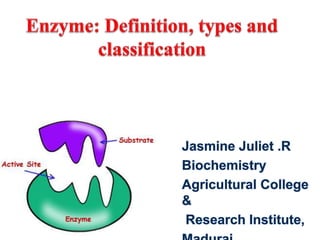
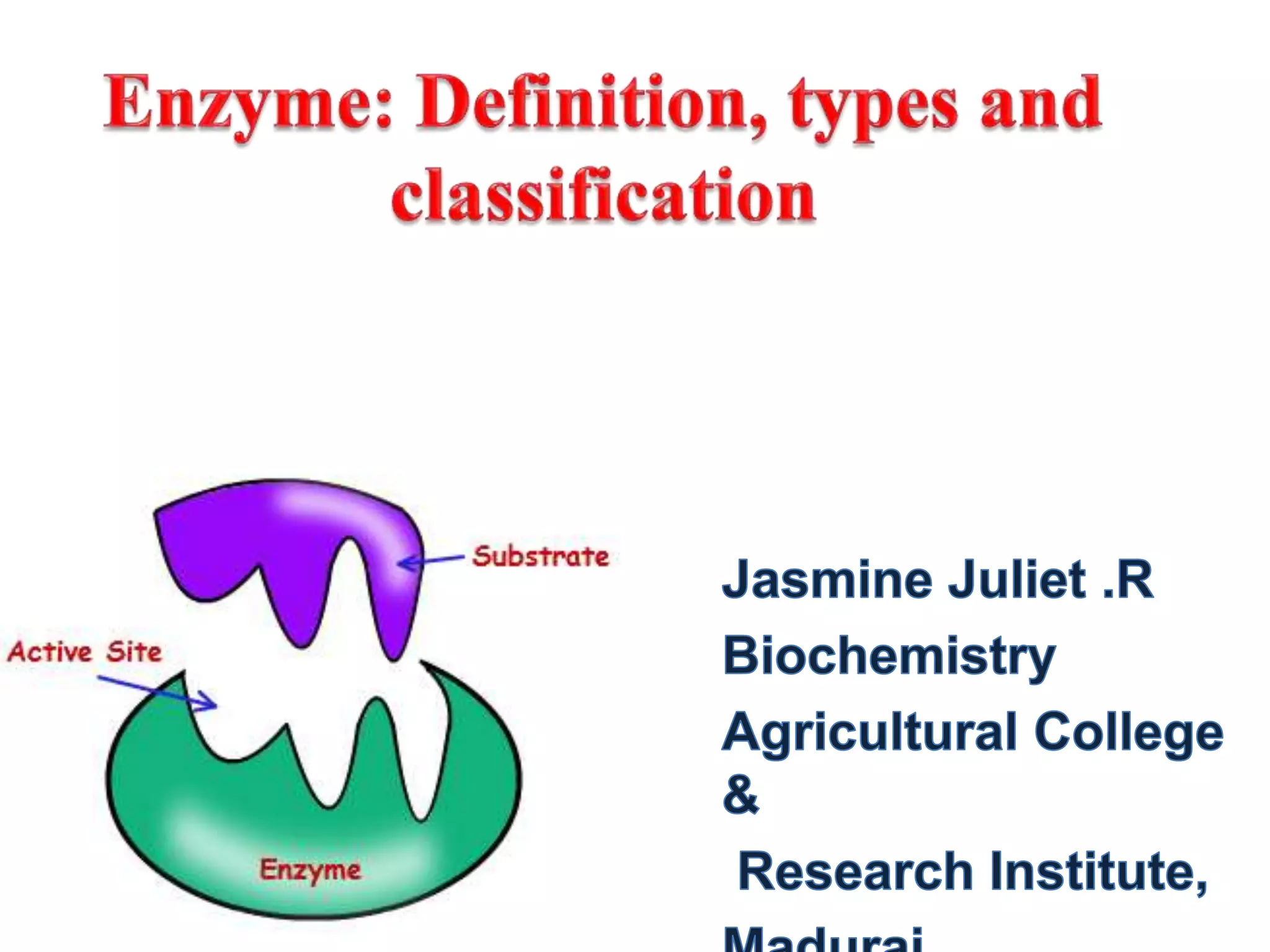
Enzymes - Introduction
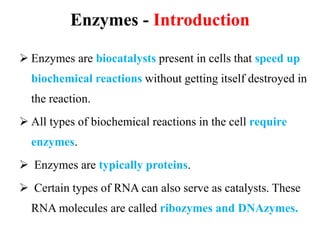
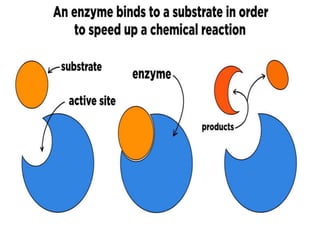
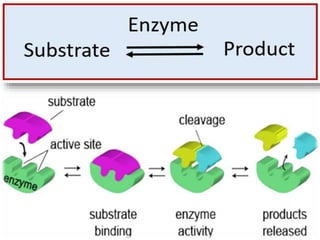
 Enzymes are biocatalysts present in cells that speed up
biochemical reactions without getting itself destroyed in
the reaction.
 All types of biochemical reactions in the cell require
enzymes.
 Enzymes are typically proteins.
 Certain types of RNA can also serve as catalysts. These
RNA molecules are called ribozymes and DNAzymes.
Nomenclature and Classification of Enzymes
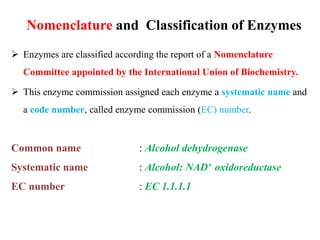
 Enzymes are classified according the report of a Nomenclature
Committee appointed by the International Union of Biochemistry.
 This enzyme commission assigned each enzyme a systematic name and
a code number, called enzyme commission (EC) number.
Common name : Alcohol dehydrogenase
Systematic name : Alcohol: NAD+ oxidoreductase
EC number : EC 1.1.1.1
Nomenclature and Classification of
Enzymes
The code numbers, prefixed by EC, which are now widely in use,
contain four elements separated by points, with the following
meaning:
(i) the first number shows to which of the six main classes the enzyme
belongs,
(ii) the second figure indicates the subclass,
(iii) the third figure gives the sub-subclass,
(iv) the fourth figure is the serial number of the enzyme in its sub-
subclass.
Nomenclature and Classification of Enzymes
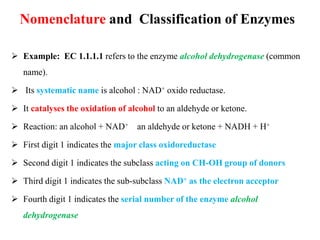
 Example: EC 1.1.1.1 refers to the enzyme alcohol dehydrogenase (common
name).
 Its systematic name is alcohol : NAD+ oxido reductase.
 It catalyses the oxidation of alcohol to an aldehyde or ketone.
 Reaction: an alcohol + NAD+ an aldehyde or ketone + NADH + H+
 First digit 1 indicates the major class oxidoreductase
 Second digit 1 indicates the subclass acting on CH-OH group of donors
 Third digit 1 indicates the sub-subclass NAD+ as the electron acceptor
 Fourth digit 1 indicates the serial number of the enzyme alcohol
dehydrogenase
Enzyme - Classification
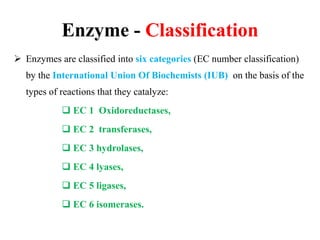
 Enzymes are classified into six categories (EC number classification)
by the International Union Of Biochemists (IUB) on the basis of the
types of reactions that they catalyze:
 EC 1 Oxidoreductases,
 EC 2 transferases,
 EC 3 hydrolases,
 EC 4 lyases,
 EC 5 ligases,
 EC 6 isomerases.
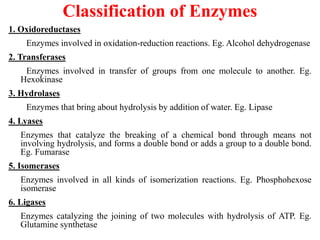
Classification of Enzymes
1. Oxidoreductases
Enzymes involved in oxidation-reduction reactions. Eg. Alcohol dehydrogenase
2. Transferases
Enzymes involved in transfer of groups from one molecule to another. Eg.
Hexokinase
3. Hydrolases
Enzymes that bring about hydrolysis by addition of water. Eg. Lipase
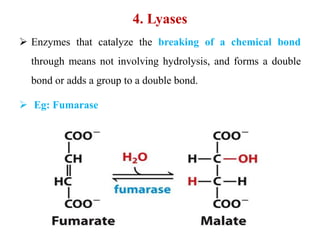
4. Lyases
Enzymes that catalyze the breaking of a chemical bond through means not
involving hydrolysis, and forms a double bond or adds a group to a double bond.
Eg. Fumarase
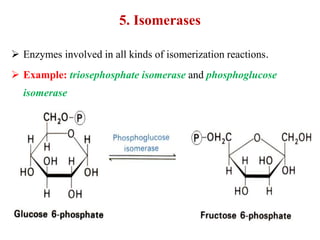
5. Isomerases
Enzymes involved in all kinds of isomerization reactions. Eg. Phosphohexose
isomerase
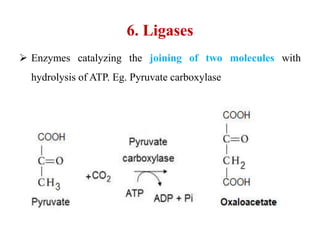
6. Ligases
Enzymes catalyzing the joining of two molecules with hydrolysis of ATP. Eg.
Glutamine synthetase
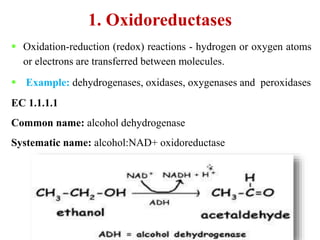
1. Oxidoreductases
 Oxidation-reduction (redox) reactions - hydrogen or oxygen atoms
or electrons are transferred between molecules.
 Example: dehydrogenases, oxidases, oxygenases and peroxidases
EC 1.1.1.1
Common name: alcohol dehydrogenase
Systematic name: alcohol:NAD+ oxidoreductase
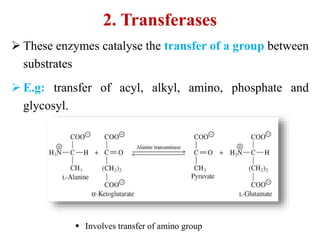
2. Transferases
 These enzymes catalyse the transfer of a group between
substrates
 E.g: transfer of acyl, alkyl, amino, phosphate and
glycosyl.
 Involves transfer of amino group
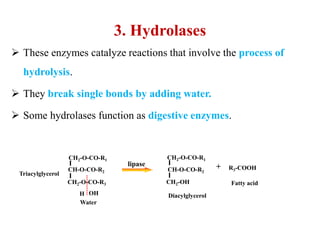
3. Hydrolases
 These enzymes catalyze reactions that involve the process of
hydrolysis.
 They break single bonds by adding water.
 Some hydrolases function as digestive enzymes.
CH-O-CO-R2
CH2-O-CO-R1
CH2-O-CO-R3
+
CH2-OH
CH-O-CO-R2
R3-COOH
lipase
OH
Triacylglycerol
Diacylglycerol
Fatty acid
CH2-O-CO-R1
H
Water
 Enzymes that catalyze the breaking of a chemical bond
through means not involving hydrolysis, and forms a double
bond or adds a group to a double bond.
 Eg: Fumarase
4. Lyases
 Enzymes involved in all kinds of isomerization reactions.
 Example: triosephosphate isomerase and phosphoglucose
isomerase
5. Isomerases
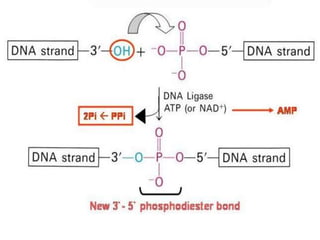
 Enzymes catalyzing the joining of two molecules with
hydrolysis of ATP. Eg. Pyruvate carboxylase
6. Ligases
Enzymes   definitions, types & classification

Enzymes definitions, types & classification

  • 2.
    Enzymes - Introduction Enzymes are biocatalysts present in cells that speed up biochemical reactions without getting itself destroyed in the reaction.  All types of biochemical reactions in the cell require enzymes.  Enzymes are typically proteins.  Certain types of RNA can also serve as catalysts. These RNA molecules are called ribozymes and DNAzymes.
  • 5.
    Nomenclature and Classificationof Enzymes  Enzymes are classified according the report of a Nomenclature Committee appointed by the International Union of Biochemistry.  This enzyme commission assigned each enzyme a systematic name and a code number, called enzyme commission (EC) number. Common name : Alcohol dehydrogenase Systematic name : Alcohol: NAD+ oxidoreductase EC number : EC 1.1.1.1
  • 6.
    Nomenclature and Classificationof Enzymes The code numbers, prefixed by EC, which are now widely in use, contain four elements separated by points, with the following meaning: (i) the first number shows to which of the six main classes the enzyme belongs, (ii) the second figure indicates the subclass, (iii) the third figure gives the sub-subclass, (iv) the fourth figure is the serial number of the enzyme in its sub- subclass.
  • 7.
    Nomenclature and Classificationof Enzymes  Example: EC 1.1.1.1 refers to the enzyme alcohol dehydrogenase (common name).  Its systematic name is alcohol : NAD+ oxido reductase.  It catalyses the oxidation of alcohol to an aldehyde or ketone.  Reaction: an alcohol + NAD+ an aldehyde or ketone + NADH + H+  First digit 1 indicates the major class oxidoreductase  Second digit 1 indicates the subclass acting on CH-OH group of donors  Third digit 1 indicates the sub-subclass NAD+ as the electron acceptor  Fourth digit 1 indicates the serial number of the enzyme alcohol dehydrogenase
  • 8.
    Enzyme - Classification Enzymes are classified into six categories (EC number classification) by the International Union Of Biochemists (IUB) on the basis of the types of reactions that they catalyze:  EC 1 Oxidoreductases,  EC 2 transferases,  EC 3 hydrolases,  EC 4 lyases,  EC 5 ligases,  EC 6 isomerases.
  • 9.
    Classification of Enzymes 1.Oxidoreductases Enzymes involved in oxidation-reduction reactions. Eg. Alcohol dehydrogenase 2. Transferases Enzymes involved in transfer of groups from one molecule to another. Eg. Hexokinase 3. Hydrolases Enzymes that bring about hydrolysis by addition of water. Eg. Lipase 4. Lyases Enzymes that catalyze the breaking of a chemical bond through means not involving hydrolysis, and forms a double bond or adds a group to a double bond. Eg. Fumarase 5. Isomerases Enzymes involved in all kinds of isomerization reactions. Eg. Phosphohexose isomerase 6. Ligases Enzymes catalyzing the joining of two molecules with hydrolysis of ATP. Eg. Glutamine synthetase
  • 10.
    1. Oxidoreductases  Oxidation-reduction(redox) reactions - hydrogen or oxygen atoms or electrons are transferred between molecules.  Example: dehydrogenases, oxidases, oxygenases and peroxidases EC 1.1.1.1 Common name: alcohol dehydrogenase Systematic name: alcohol:NAD+ oxidoreductase
  • 11.
    2. Transferases  Theseenzymes catalyse the transfer of a group between substrates  E.g: transfer of acyl, alkyl, amino, phosphate and glycosyl.  Involves transfer of amino group
  • 12.
    3. Hydrolases  Theseenzymes catalyze reactions that involve the process of hydrolysis.  They break single bonds by adding water.  Some hydrolases function as digestive enzymes. CH-O-CO-R2 CH2-O-CO-R1 CH2-O-CO-R3 + CH2-OH CH-O-CO-R2 R3-COOH lipase OH Triacylglycerol Diacylglycerol Fatty acid CH2-O-CO-R1 H Water
  • 13.
     Enzymes thatcatalyze the breaking of a chemical bond through means not involving hydrolysis, and forms a double bond or adds a group to a double bond.  Eg: Fumarase 4. Lyases
  • 14.
     Enzymes involvedin all kinds of isomerization reactions.  Example: triosephosphate isomerase and phosphoglucose isomerase 5. Isomerases
  • 15.
     Enzymes catalyzingthe joining of two molecules with hydrolysis of ATP. Eg. Pyruvate carboxylase 6. Ligases