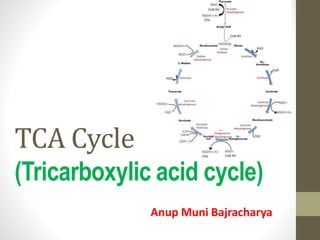
TCA Cycle
(Tricarboxylic acid cycle)
Anup Muni Bajracharya
TCA cycle
• TCA cycle stands for Tricarboxylic acid cycle
• It is also called the Krebs cycle, after Hans Krebs, who first
proposed its cyclic nature.
• Simply it is called as the citric acid cycle which is the central
metabolic hub of the cell.
• The TCA cycle is part of the larger glucose metabolism
whereby glucose is oxidized to form pyruvate, which is then
oxidized and enters the TCA cycle as acetyl-CoA.
• It is the gateway to the aerobic metabolism of any molecule
that can be transformed into an acetyl group or dicarboxylic
acid.
Tricarboxylic acid cycle
• More precise defination
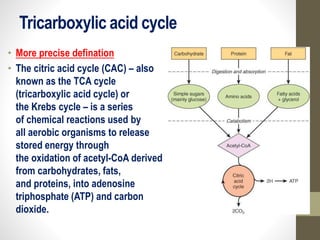
• The citric acid cycle (CAC) – also
known as the TCA cycle
(tricarboxylic acid cycle) or
the Krebs cycle – is a series
of chemical reactions used by
all aerobic organisms to release
stored energy through
the oxidation of acetyl-CoA derived
from carbohydrates, fats,
and proteins, into adenosine
triphosphate (ATP) and carbon
dioxide.
Occurence
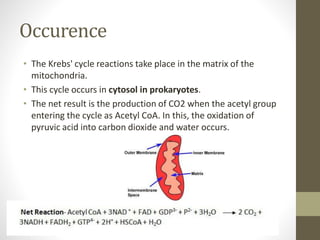
• The Krebs' cycle reactions take place in the matrix of the
mitochondria.
• This cycle occurs in cytosol in prokaryotes.
• The net result is the production of CO2 when the acetyl group
entering the cycle as Acetyl CoA. In this, the oxidation of
pyruvic acid into carbon dioxide and water occurs.
Why TCA is called Amphibolic pathway?
• It is quite obvious that there are both catabolic, and anabolic
pathways thus it is not easy to state which one dominates (it is
not possible to denote the TCA cycle as either catabolic, or
anabolic).
• This is the reason why it is described as amphibolic pathway
Synthesis of important molecules like
succinyl CoA (precursor molecule of heme),
oxaloacetate (early intermediate molecule in
gluconeogenesis and substrate for amino acid
synthesis)
Breakdown of carbohydrates
Pre TCA cycle
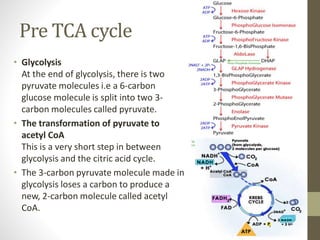
• Glycolysis
At the end of glycolysis, there is two
pyruvate molecules i.e a 6-carbon
glucose molecule is split into two 3-
carbon molecules called pyruvate.
• The transformation of pyruvate to
acetyl CoA
This is a very short step in between
glycolysis and the citric acid cycle.
• The 3-carbon pyruvate molecule made in
glycolysis loses a carbon to produce a
new, 2-carbon molecule called acetyl
CoA.
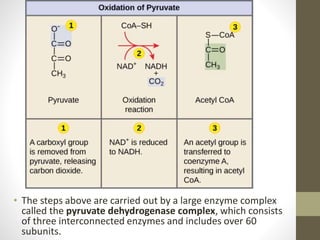
• The steps above are carried out by a large enzyme complex
called the pyruvate dehydrogenase complex, which consists
of three interconnected enzymes and includes over 60
subunits.
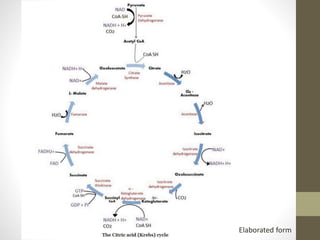
Elaborated form
Combined form
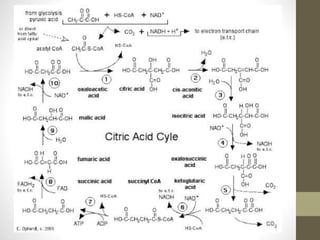
The citric acid cycle
• The citric acid cycle is called a cycle because the starting
molecule, oxaloacetate (which has 4 carbons), is regenerated
at the end of the cycle.
• Throughout the citric acid cycle, oxaloacetate is progressively
transformed into several different molecules (as carbon atoms
are added to and removed from it), but at the end of the cycle
it always turns back into oxaloacetate to be used again.
• The released energy is captured as the electron shuttles
(NAD and FAD) are reduced to NADH and FADH
Reaction 1: Synthesis of Citric
Acid
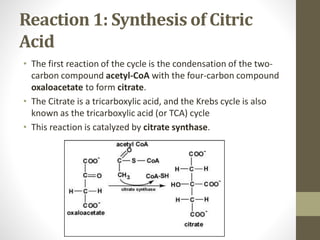
• The first reaction of the cycle is the condensation of the two-
carbon compound acetyl-CoA with the four-carbon compound
oxaloacetate to form citrate.
• The Citrate is a tricarboxylic acid, and the Krebs cycle is also
known as the tricarboxylic acid (or TCA) cycle
• This reaction is catalyzed by citrate synthase.
Reaction 2: Isomerization of
Citrate
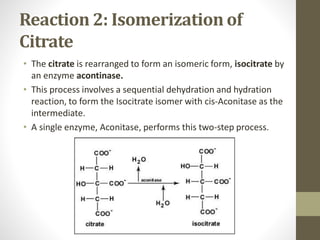
• The citrate is rearranged to form an isomeric form, isocitrate by
an enzyme acontinase.
• This process involves a sequential dehydration and hydration
reaction, to form the Isocitrate isomer with cis-Aconitase as the
intermediate.
• A single enzyme, Aconitase, performs this two-step process.
Reaction 3: Oxidation of Isocitrate to
α-Ketoglutarate
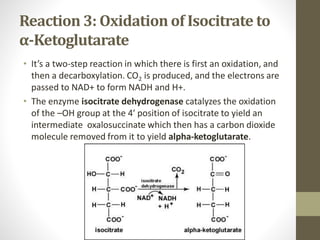
• It’s a two-step reaction in which there is first an oxidation, and
then a decarboxylation. CO2 is produced, and the electrons are
passed to NAD+ to form NADH and H+.
• The enzyme isocitrate dehydrogenase catalyzes the oxidation
of the –OH group at the 4′ position of isocitrate to yield an
intermediate oxalosuccinate which then has a carbon dioxide
molecule removed from it to yield alpha-ketoglutarate.
Reaction 4: Oxidation of α-Ketoglutarate
to Succinyl-CoA
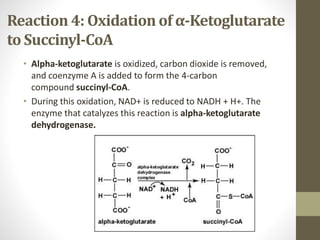
• Alpha-ketoglutarate is oxidized, carbon dioxide is removed,
and coenzyme A is added to form the 4-carbon
compound succinyl-CoA.
• During this oxidation, NAD+ is reduced to NADH + H+. The
enzyme that catalyzes this reaction is alpha-ketoglutarate
dehydrogenase.
Reaction 5: Conversion of Succinyl-CoA
to Succinate
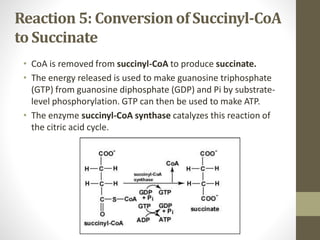
• CoA is removed from succinyl-CoA to produce succinate.
• The energy released is used to make guanosine triphosphate
(GTP) from guanosine diphosphate (GDP) and Pi by substrate-
level phosphorylation. GTP can then be used to make ATP.
• The enzyme succinyl-CoA synthase catalyzes this reaction of
the citric acid cycle.
Reaction 6: Oxidation of Succinate to
Fumarate
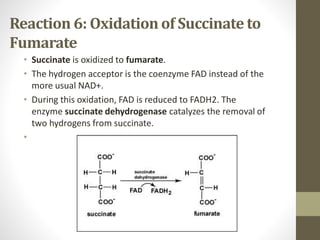
• Succinate is oxidized to fumarate.
• The hydrogen acceptor is the coenzyme FAD instead of the
more usual NAD+.
• During this oxidation, FAD is reduced to FADH2. The
enzyme succinate dehydrogenase catalyzes the removal of
two hydrogens from succinate.
•
Reaction 7: Hydration of Fumarate to
Malate
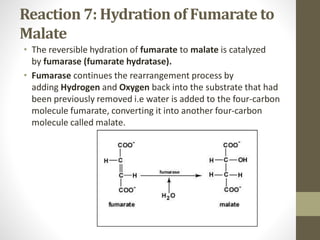
• The reversible hydration of fumarate to malate is catalyzed
by fumarase (fumarate hydratase).
• Fumarase continues the rearrangement process by
adding Hydrogen and Oxygen back into the substrate that had
been previously removed i.e water is added to the four-carbon
molecule fumarate, converting it into another four-carbon
molecule called malate.
Reaction 8: Oxidation of Malate to
Oxaloacetate
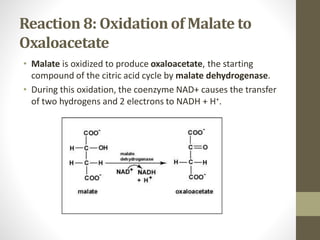
• Malate is oxidized to produce oxaloacetate, the starting
compound of the citric acid cycle by malate dehydrogenase.
• During this oxidation, the coenzyme NAD+ causes the transfer
of two hydrogens and 2 electrons to NADH + H+.
Significance of Krebs Cycle
• Formation of NADH and FADH2 for entrance into the electron
transport chain and subsequent ATP generation.
• Krebs cycle (citric Acid cycle) releases plenty of energy (ATP)
required for various metabolic activities of cell.
• Intermediate compounds formed during Krebs cycle are used
for the synthesis of biomolecules like amino acids,
nucleotides, chlorophyll, cytochromes and fats etc.
• Intermediate like succinyl CoA takes part in the formation of
chlorophyll.
• Amino Acids are formed from α- Ketoglutaric acid, pyruvic
acids and oxaloacetic acid.
TCA cycle (Tricarboxylic acid cycle)

TCA cycle (Tricarboxylic acid cycle)

  • 1.
    TCA Cycle (Tricarboxylic acidcycle) Anup Muni Bajracharya
  • 2.
    TCA cycle • TCAcycle stands for Tricarboxylic acid cycle • It is also called the Krebs cycle, after Hans Krebs, who first proposed its cyclic nature. • Simply it is called as the citric acid cycle which is the central metabolic hub of the cell. • The TCA cycle is part of the larger glucose metabolism whereby glucose is oxidized to form pyruvate, which is then oxidized and enters the TCA cycle as acetyl-CoA. • It is the gateway to the aerobic metabolism of any molecule that can be transformed into an acetyl group or dicarboxylic acid.
  • 3.
    Tricarboxylic acid cycle •More precise defination • The citric acid cycle (CAC) – also known as the TCA cycle (tricarboxylic acid cycle) or the Krebs cycle – is a series of chemical reactions used by all aerobic organisms to release stored energy through the oxidation of acetyl-CoA derived from carbohydrates, fats, and proteins, into adenosine triphosphate (ATP) and carbon dioxide.
  • 4.
    Occurence • The Krebs'cycle reactions take place in the matrix of the mitochondria. • This cycle occurs in cytosol in prokaryotes. • The net result is the production of CO2 when the acetyl group entering the cycle as Acetyl CoA. In this, the oxidation of pyruvic acid into carbon dioxide and water occurs.
  • 5.
    Why TCA iscalled Amphibolic pathway? • It is quite obvious that there are both catabolic, and anabolic pathways thus it is not easy to state which one dominates (it is not possible to denote the TCA cycle as either catabolic, or anabolic). • This is the reason why it is described as amphibolic pathway Synthesis of important molecules like succinyl CoA (precursor molecule of heme), oxaloacetate (early intermediate molecule in gluconeogenesis and substrate for amino acid synthesis) Breakdown of carbohydrates
  • 6.
    Pre TCA cycle •Glycolysis At the end of glycolysis, there is two pyruvate molecules i.e a 6-carbon glucose molecule is split into two 3- carbon molecules called pyruvate. • The transformation of pyruvate to acetyl CoA This is a very short step in between glycolysis and the citric acid cycle. • The 3-carbon pyruvate molecule made in glycolysis loses a carbon to produce a new, 2-carbon molecule called acetyl CoA.
  • 7.
    • The stepsabove are carried out by a large enzyme complex called the pyruvate dehydrogenase complex, which consists of three interconnected enzymes and includes over 60 subunits.
  • 8.
  • 9.
  • 10.
    The citric acidcycle • The citric acid cycle is called a cycle because the starting molecule, oxaloacetate (which has 4 carbons), is regenerated at the end of the cycle. • Throughout the citric acid cycle, oxaloacetate is progressively transformed into several different molecules (as carbon atoms are added to and removed from it), but at the end of the cycle it always turns back into oxaloacetate to be used again. • The released energy is captured as the electron shuttles (NAD and FAD) are reduced to NADH and FADH
  • 11.
    Reaction 1: Synthesisof Citric Acid • The first reaction of the cycle is the condensation of the two- carbon compound acetyl-CoA with the four-carbon compound oxaloacetate to form citrate. • The Citrate is a tricarboxylic acid, and the Krebs cycle is also known as the tricarboxylic acid (or TCA) cycle • This reaction is catalyzed by citrate synthase.
  • 12.
    Reaction 2: Isomerizationof Citrate • The citrate is rearranged to form an isomeric form, isocitrate by an enzyme acontinase. • This process involves a sequential dehydration and hydration reaction, to form the Isocitrate isomer with cis-Aconitase as the intermediate. • A single enzyme, Aconitase, performs this two-step process.
  • 13.
    Reaction 3: Oxidationof Isocitrate to α-Ketoglutarate • It’s a two-step reaction in which there is first an oxidation, and then a decarboxylation. CO2 is produced, and the electrons are passed to NAD+ to form NADH and H+. • The enzyme isocitrate dehydrogenase catalyzes the oxidation of the –OH group at the 4′ position of isocitrate to yield an intermediate oxalosuccinate which then has a carbon dioxide molecule removed from it to yield alpha-ketoglutarate.
  • 14.
    Reaction 4: Oxidationof α-Ketoglutarate to Succinyl-CoA • Alpha-ketoglutarate is oxidized, carbon dioxide is removed, and coenzyme A is added to form the 4-carbon compound succinyl-CoA. • During this oxidation, NAD+ is reduced to NADH + H+. The enzyme that catalyzes this reaction is alpha-ketoglutarate dehydrogenase.
  • 15.
    Reaction 5: Conversionof Succinyl-CoA to Succinate • CoA is removed from succinyl-CoA to produce succinate. • The energy released is used to make guanosine triphosphate (GTP) from guanosine diphosphate (GDP) and Pi by substrate- level phosphorylation. GTP can then be used to make ATP. • The enzyme succinyl-CoA synthase catalyzes this reaction of the citric acid cycle.
  • 16.
    Reaction 6: Oxidationof Succinate to Fumarate • Succinate is oxidized to fumarate. • The hydrogen acceptor is the coenzyme FAD instead of the more usual NAD+. • During this oxidation, FAD is reduced to FADH2. The enzyme succinate dehydrogenase catalyzes the removal of two hydrogens from succinate. •
  • 17.
    Reaction 7: Hydrationof Fumarate to Malate • The reversible hydration of fumarate to malate is catalyzed by fumarase (fumarate hydratase). • Fumarase continues the rearrangement process by adding Hydrogen and Oxygen back into the substrate that had been previously removed i.e water is added to the four-carbon molecule fumarate, converting it into another four-carbon molecule called malate.
  • 18.
    Reaction 8: Oxidationof Malate to Oxaloacetate • Malate is oxidized to produce oxaloacetate, the starting compound of the citric acid cycle by malate dehydrogenase. • During this oxidation, the coenzyme NAD+ causes the transfer of two hydrogens and 2 electrons to NADH + H+.
  • 20.
    Significance of KrebsCycle • Formation of NADH and FADH2 for entrance into the electron transport chain and subsequent ATP generation. • Krebs cycle (citric Acid cycle) releases plenty of energy (ATP) required for various metabolic activities of cell. • Intermediate compounds formed during Krebs cycle are used for the synthesis of biomolecules like amino acids, nucleotides, chlorophyll, cytochromes and fats etc. • Intermediate like succinyl CoA takes part in the formation of chlorophyll. • Amino Acids are formed from α- Ketoglutaric acid, pyruvic acids and oxaloacetic acid.