Data Analysis & Interpretation 
Experiment Design: Eliminating Variables & Bias 
EExxpplloorriinngg CCrreeaattiioonn wwiitthh GGeenneerraall SScciieennccee 
Science is Organized Knowledge
Review Quiz 
In your lab notebook, please answer as best you can: 
1. What is the scientific method (definition)? 
2. Name the four basic steps of the scientific method. 
3. What is an experimental variable? 
4. What is an experimental control? 
5. What should you do before forming a hypothesis? 
(Three parts of the “Observation” step.) 
Bonus Question: What is the difference between a scientific fact and a 
scientific observation?
Review Quiz 
In your lab notebook, please answer as best you can: 
1. What is the scientific method (definition)? 
• A step-by-step method for solving problems. 
2. Name the four basic steps of the scientific method. 
• Observation, Hypothesis, Experiment, Conclusion 
3. What is an experimental variable? 
• Something which changes during the course of the experiment. 
4. What is an experimental control? 
• The parts of an experiment which do not change to which all other results 
can be compared. 
4. What should you do before forming a hypothesis? 
(Three parts of the “Observation” step.) 
• Form a question (problem/objective/curiosity), make observations or 
think about what you already know, and research the topic. 
Bonus Question: There is NO difference between a scientific fact and observation!
Fact - Theory - Law 
F = ma 
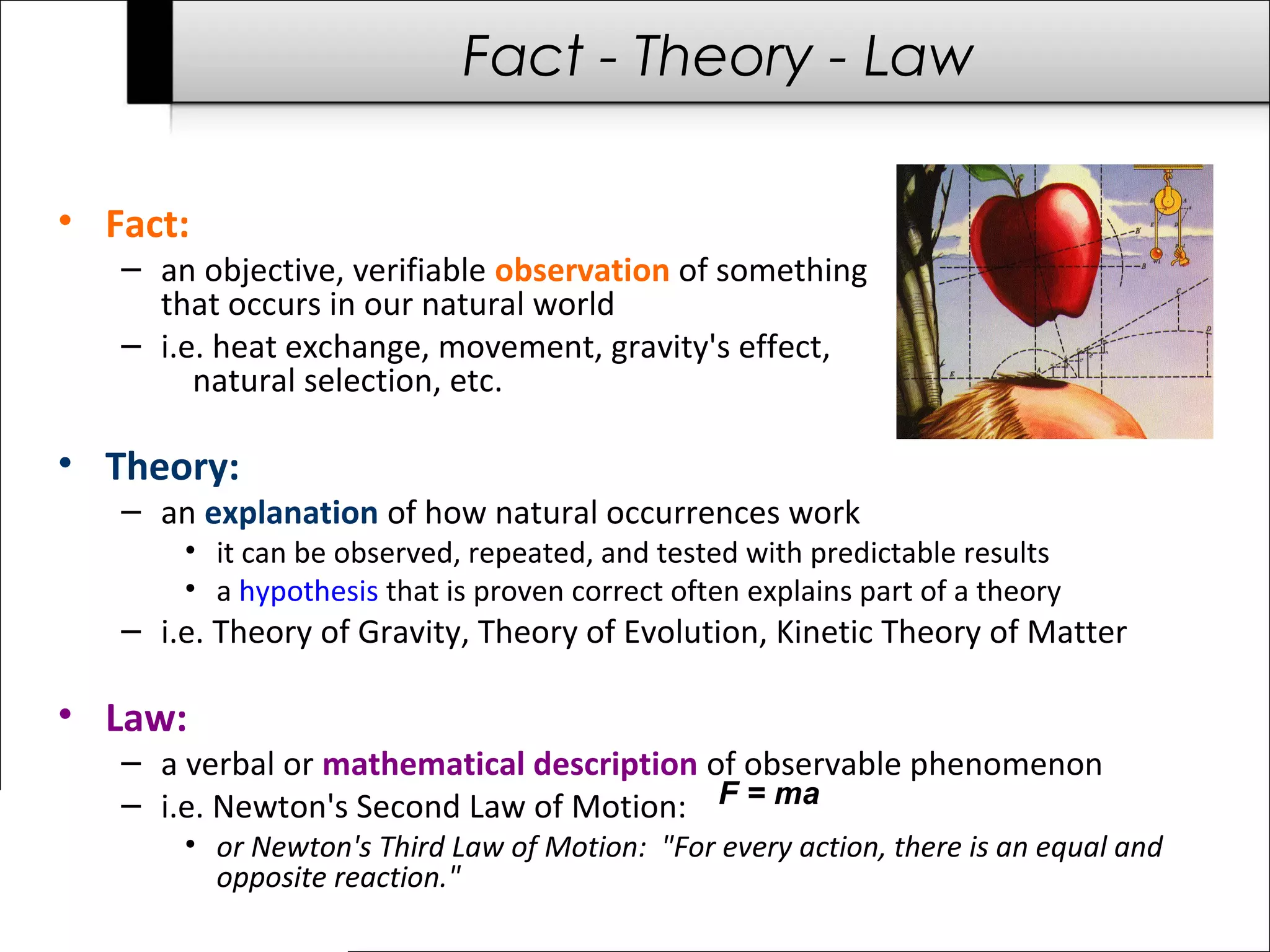
• Fact: 
– an objective, verifiable observation of something 
that occurs in our natural world 
– i.e. heat exchange, movement, gravity's effect, 
natural selection, etc. 
• Theory: 
– an explanation of how natural occurrences work 
• it can be observed, repeated, and tested with predictable results 
• a hypothesis that is proven correct often explains part of a theory 
– i.e. Theory of Gravity, Theory of Evolution, Kinetic Theory of Matter 
• Law: 
– a verbal or mathematical description of observable phenomenon 
– i.e. Newton's Second Law of Motion: 
• or Newton's Third Law of Motion: "For every action, there is an equal and 
opposite reaction."
Scientific Law 
• Definition: A law in science is a generalized rule to 
explain a body of observations in the form of a verbal 
or mathematical statement. 
– Scientific laws imply a cause and effect between the 
observed elements and must always apply under the same 
conditions. 
– Scientific laws do not try to explain 'why' the observed 
event happens, but only that the event actually occurs the 
same way over and over.
"A Fair Test" Experiment 
Who is the Fastest?
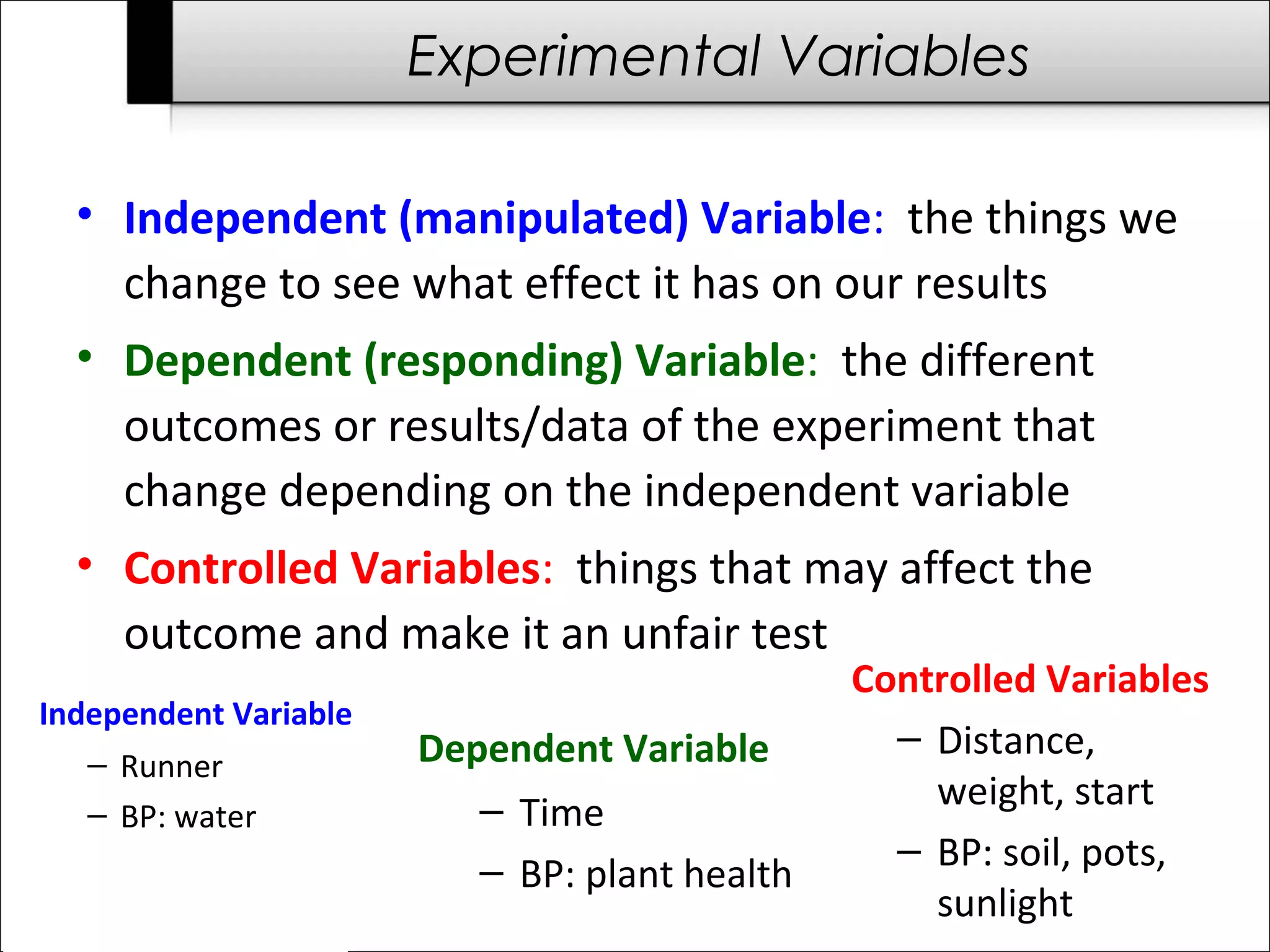
Experimental Variables 
• Independent (manipulated) Variable: the things we 
change to see what effect it has on our results 
• Dependent (responding) Variable: the different 
outcomes or results/data of the experiment that 
change depending on the independent variable 
• Controlled Variables: things that may affect the 
outcome and make it an unfair test 
Independent Variable 
– Runner 
– BP: water 
Dependent Variable 
– Time 
– BP: plant health 
Controlled Variables 
– Distance, 
weight, start 
– BP: soil, pots, 
sunlight
Experimental Controls 
• Controlled Variables: things that might affect the outcome 
and make it an unfair test. 
• Control Group: the group that is studied with no 
change in the independent variable 
– example: when a new drug is studied, some subjects do 
not receive the medicine so that the new drugs effect can 
be compared to something 
• Researcher Bias: preconceived ideas that affect how 
data is collected 
– Scientists always try to fit their data into a framework that 
makes sense with their personal beliefs (worldview).
Data Collection 
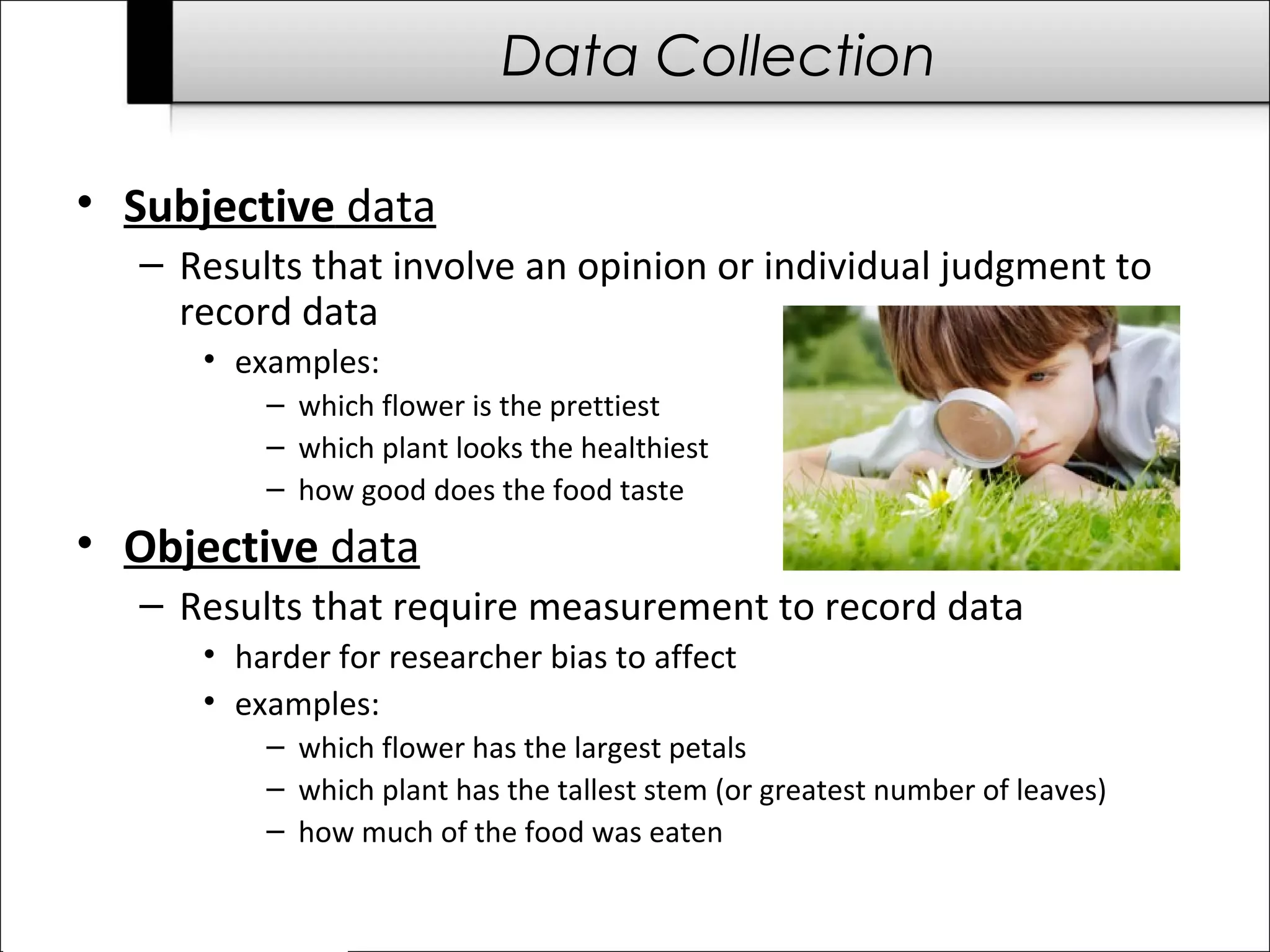
• Subjective data 
– Results that involve an opinion or individual judgment to 
record data 
• examples: 
– which flower is the prettiest 
– which plant looks the healthiest 
– how good does the food taste 
• Objective data 
– Results that require measurement to record data 
• harder for researcher bias to affect 
• examples: 
– which flower has the largest petals 
– which plant has the tallest stem (or greatest number of leaves) 
– how much of the food was eaten
Controlling Bias 
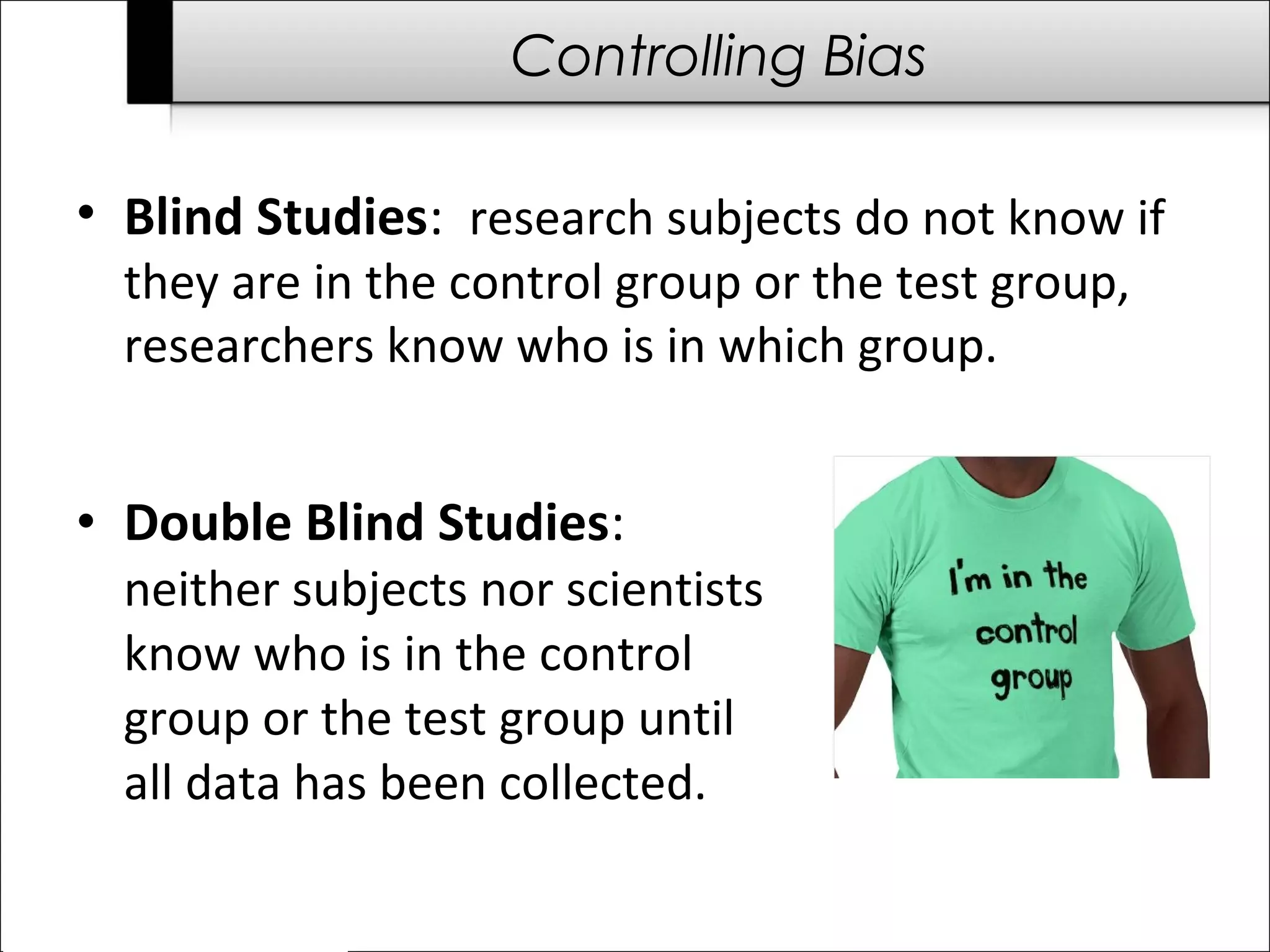
• Blind Studies: research subjects do not know if 
they are in the control group or the test group, 
researchers know who is in which group. 
• Double Blind Studies: 
neither subjects nor scientists 
know who is in the control 
group or the test group until 
all data has been collected.
Bias in Scientific Research 
• Hypothesizing requires speculation 
– bias is an assumed belief that affect the way you see and 
understand things 
– bias is always present when formulating a hypothesis 
• The Scientific Method forces only the 
facts to be considered 
– seeks to eliminate variables that can skew 
results 
– encourages collaboration & accountability 
• shared results, repeated studies 
– still, bias is ALWAYS present & affects 
many research outcomes
Interpreting Data 
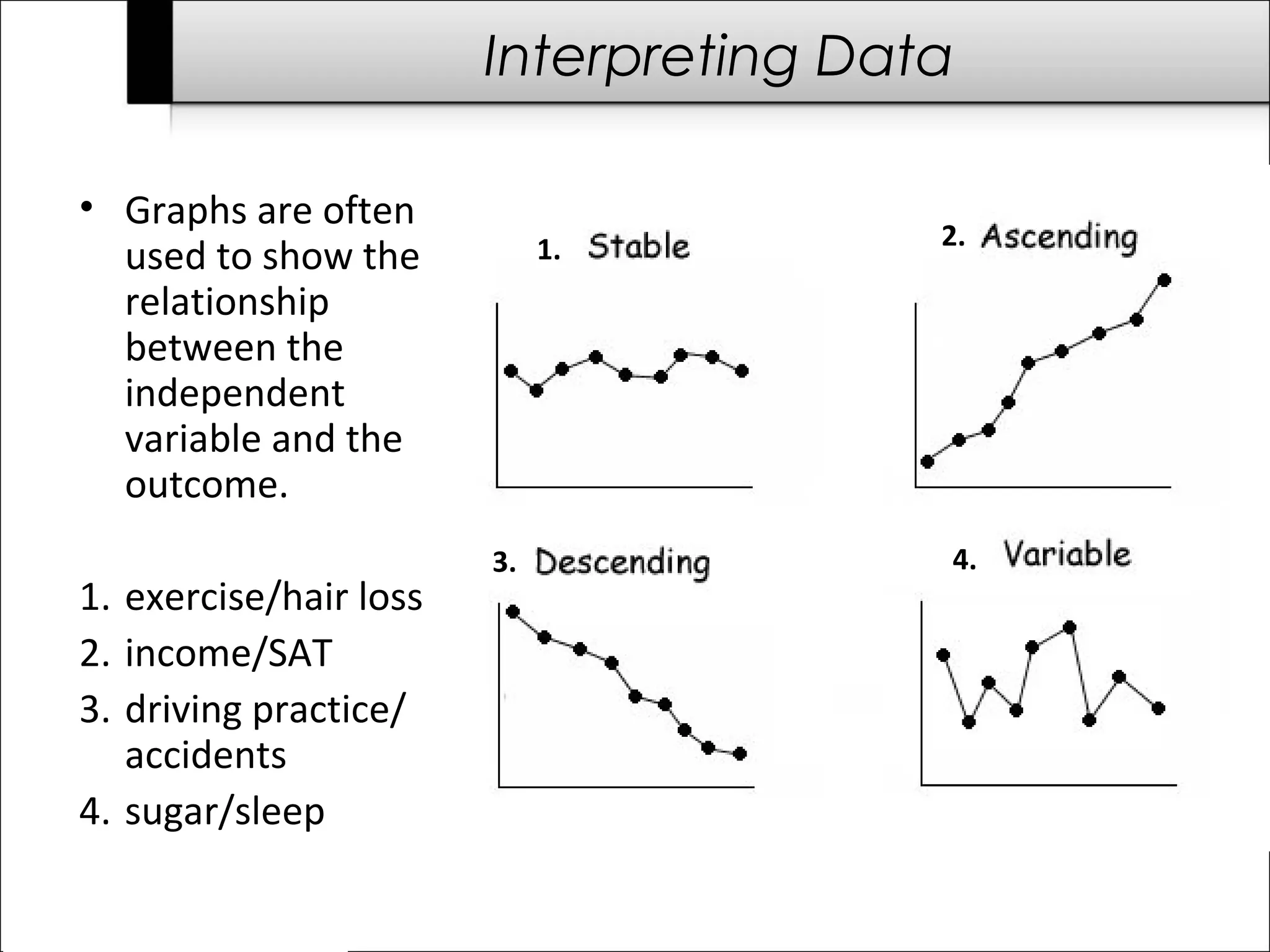
• Graphs are often 
used to show the 
relationship 
between the 
independent 
variable and the 
outcome. 
1. exercise/hair loss 
2. income/SAT 
3. driving practice/ 
accidents 
4. sugar/sleep 
1. 2. 
3. 4.
Experiments 3.2, 3.3, & 3.4 
Surface Tension Demo

ECGS Module 3B

  • 1.
    Data Analysis &Interpretation Experiment Design: Eliminating Variables & Bias EExxpplloorriinngg CCrreeaattiioonn wwiitthh GGeenneerraall SScciieennccee Science is Organized Knowledge
  • 2.
    Review Quiz Inyour lab notebook, please answer as best you can: 1. What is the scientific method (definition)? 2. Name the four basic steps of the scientific method. 3. What is an experimental variable? 4. What is an experimental control? 5. What should you do before forming a hypothesis? (Three parts of the “Observation” step.) Bonus Question: What is the difference between a scientific fact and a scientific observation?
  • 3.
    Review Quiz Inyour lab notebook, please answer as best you can: 1. What is the scientific method (definition)? • A step-by-step method for solving problems. 2. Name the four basic steps of the scientific method. • Observation, Hypothesis, Experiment, Conclusion 3. What is an experimental variable? • Something which changes during the course of the experiment. 4. What is an experimental control? • The parts of an experiment which do not change to which all other results can be compared. 4. What should you do before forming a hypothesis? (Three parts of the “Observation” step.) • Form a question (problem/objective/curiosity), make observations or think about what you already know, and research the topic. Bonus Question: There is NO difference between a scientific fact and observation!
  • 4.
    Fact - Theory- Law F = ma • Fact: – an objective, verifiable observation of something that occurs in our natural world – i.e. heat exchange, movement, gravity's effect, natural selection, etc. • Theory: – an explanation of how natural occurrences work • it can be observed, repeated, and tested with predictable results • a hypothesis that is proven correct often explains part of a theory – i.e. Theory of Gravity, Theory of Evolution, Kinetic Theory of Matter • Law: – a verbal or mathematical description of observable phenomenon – i.e. Newton's Second Law of Motion: • or Newton's Third Law of Motion: "For every action, there is an equal and opposite reaction."
  • 5.
    Scientific Law •Definition: A law in science is a generalized rule to explain a body of observations in the form of a verbal or mathematical statement. – Scientific laws imply a cause and effect between the observed elements and must always apply under the same conditions. – Scientific laws do not try to explain 'why' the observed event happens, but only that the event actually occurs the same way over and over.
  • 6.
    "A Fair Test"Experiment Who is the Fastest?
  • 7.
    Experimental Variables •Independent (manipulated) Variable: the things we change to see what effect it has on our results • Dependent (responding) Variable: the different outcomes or results/data of the experiment that change depending on the independent variable • Controlled Variables: things that may affect the outcome and make it an unfair test Independent Variable – Runner – BP: water Dependent Variable – Time – BP: plant health Controlled Variables – Distance, weight, start – BP: soil, pots, sunlight
  • 8.
    Experimental Controls •Controlled Variables: things that might affect the outcome and make it an unfair test. • Control Group: the group that is studied with no change in the independent variable – example: when a new drug is studied, some subjects do not receive the medicine so that the new drugs effect can be compared to something • Researcher Bias: preconceived ideas that affect how data is collected – Scientists always try to fit their data into a framework that makes sense with their personal beliefs (worldview).
  • 9.
    Data Collection •Subjective data – Results that involve an opinion or individual judgment to record data • examples: – which flower is the prettiest – which plant looks the healthiest – how good does the food taste • Objective data – Results that require measurement to record data • harder for researcher bias to affect • examples: – which flower has the largest petals – which plant has the tallest stem (or greatest number of leaves) – how much of the food was eaten
  • 10.
    Controlling Bias •Blind Studies: research subjects do not know if they are in the control group or the test group, researchers know who is in which group. • Double Blind Studies: neither subjects nor scientists know who is in the control group or the test group until all data has been collected.
  • 11.
    Bias in ScientificResearch • Hypothesizing requires speculation – bias is an assumed belief that affect the way you see and understand things – bias is always present when formulating a hypothesis • The Scientific Method forces only the facts to be considered – seeks to eliminate variables that can skew results – encourages collaboration & accountability • shared results, repeated studies – still, bias is ALWAYS present & affects many research outcomes
  • 12.
    Interpreting Data •Graphs are often used to show the relationship between the independent variable and the outcome. 1. exercise/hair loss 2. income/SAT 3. driving practice/ accidents 4. sugar/sleep 1. 2. 3. 4.
  • 13.
    Experiments 3.2, 3.3,& 3.4 Surface Tension Demo

Editor's Notes

  • #5 NOT theory becomes law becomes fact *example: we SEE a rock rolling down a hill that smashes into a brick wall, we EXPLAIN what we saw by theorizing about gravity (an unseen force that pulls the rock down the hill), and we DESCRIBE the motion of the rock by using the formula F=ma
  • #13 IV on X axis, DV (outcome) on Y axis Stable: subjects who exercised more every month over a year had the same amount of hair loss as those who worked out less Ascending: as income level increases, SAT scores also increase Descending: as driving practice hours increase, occurance of accidents decreases Variable: as the amount of sugar consumed increases, hours of sleep is variable