The Scientific
Method
&
Experimental
Design
• The scientific
method is a
systematic way to
help us find
answers to the
questions we
have
• There are 5 main
steps
• In science, we only
deal with facts
– From observations
– From experiments
Step 1
• Observation and
Research
–See
–Hear
–Smell
–Taste
–Feel
• For example:
I got home from school
and I smelled gas
when I walked in my
house.
Step 1, continued
• Observations lead to
questions
• For example: Why does
it smell like gas in my
house?
Step 2
• Form a hypothesis
– a statement that predicts a relationship between
cause and effect
• A good hypothesis will follow the “if…then”
format
• Example: If I smell gas, then there is a gas
leak.
Step 2, continued
• A hypothesis must be testable.
• For example: I can collect data (do a test) to
see if there is a gas leak.
• But if I said, If I wear perfume, then I will
smell good
• I can’t test that
Step 3
• Gather
data/experiment
• You can do this by
designing an
experiment, making
more observations,
taking
measurements, etc.
Step 4• Analyze and
interpret your data
• Look at the facts
you collected and
see if they mean
anything or give
you any answers.
Step 5
• Conclusion – Do you accept your hypothesis
or reject it?
• If your data supports the hypothesis, you
accept it
• If your data does not support it (even a tiny bit), you
reject it and start over
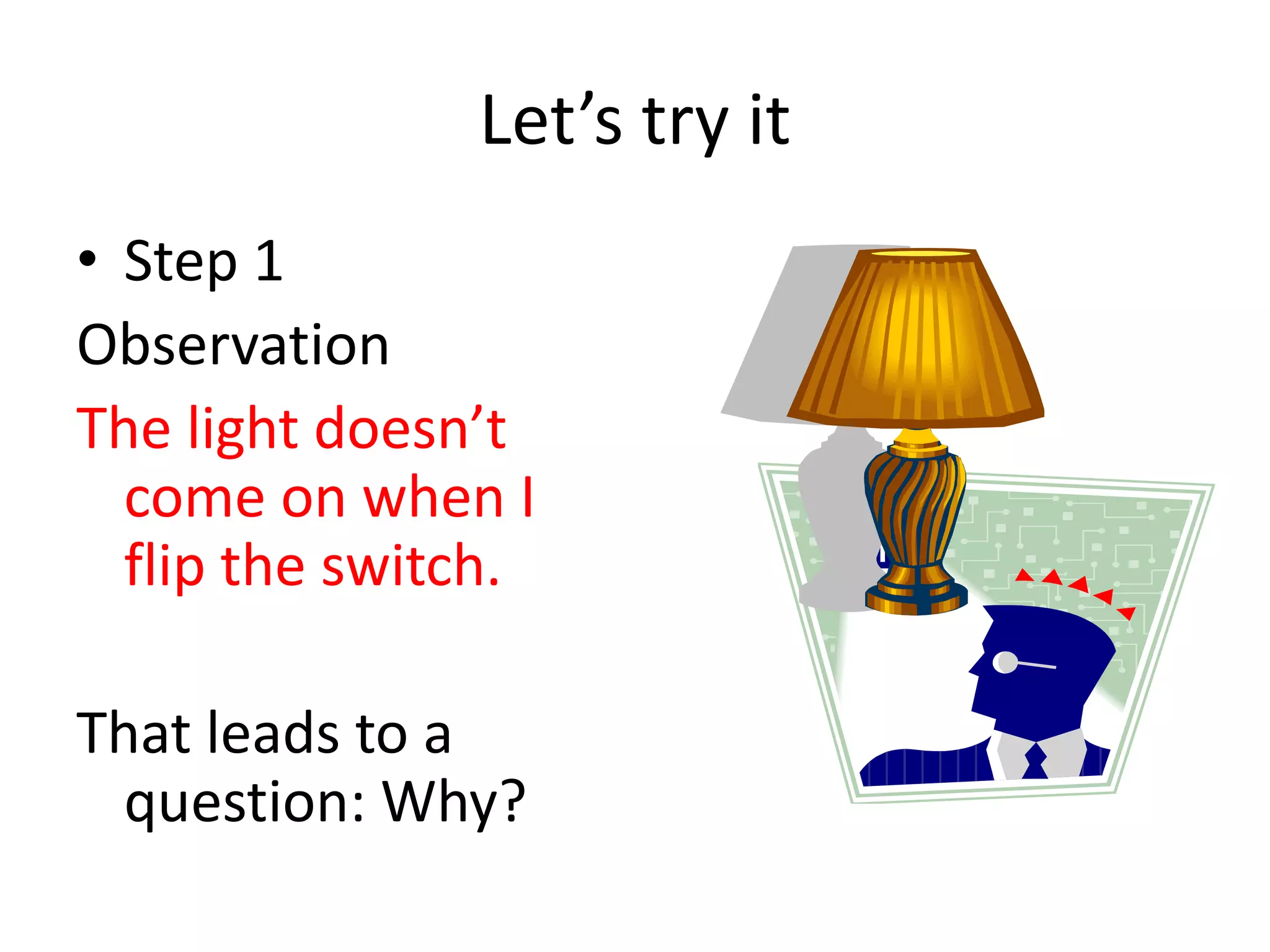
Let’s try it
• Step 1
Observation
The light doesn’t
come on when I
flip the switch.
That leads to a
question: Why?
• Step 2
Hypothesis
Use the “if…then” formula
If the light doesn’t come
on, then
The bulb is burned out
The lamp is unplugged
The power is out
Finish the hypothesis on
your whiteboard
• Step 3
Experiment
You can check the bulb or
the plug, try other
switches in the house,
etc. You are gathering
data to help you
answer your question.
What experiment or
data would you do
or gather?
on your whiteboard
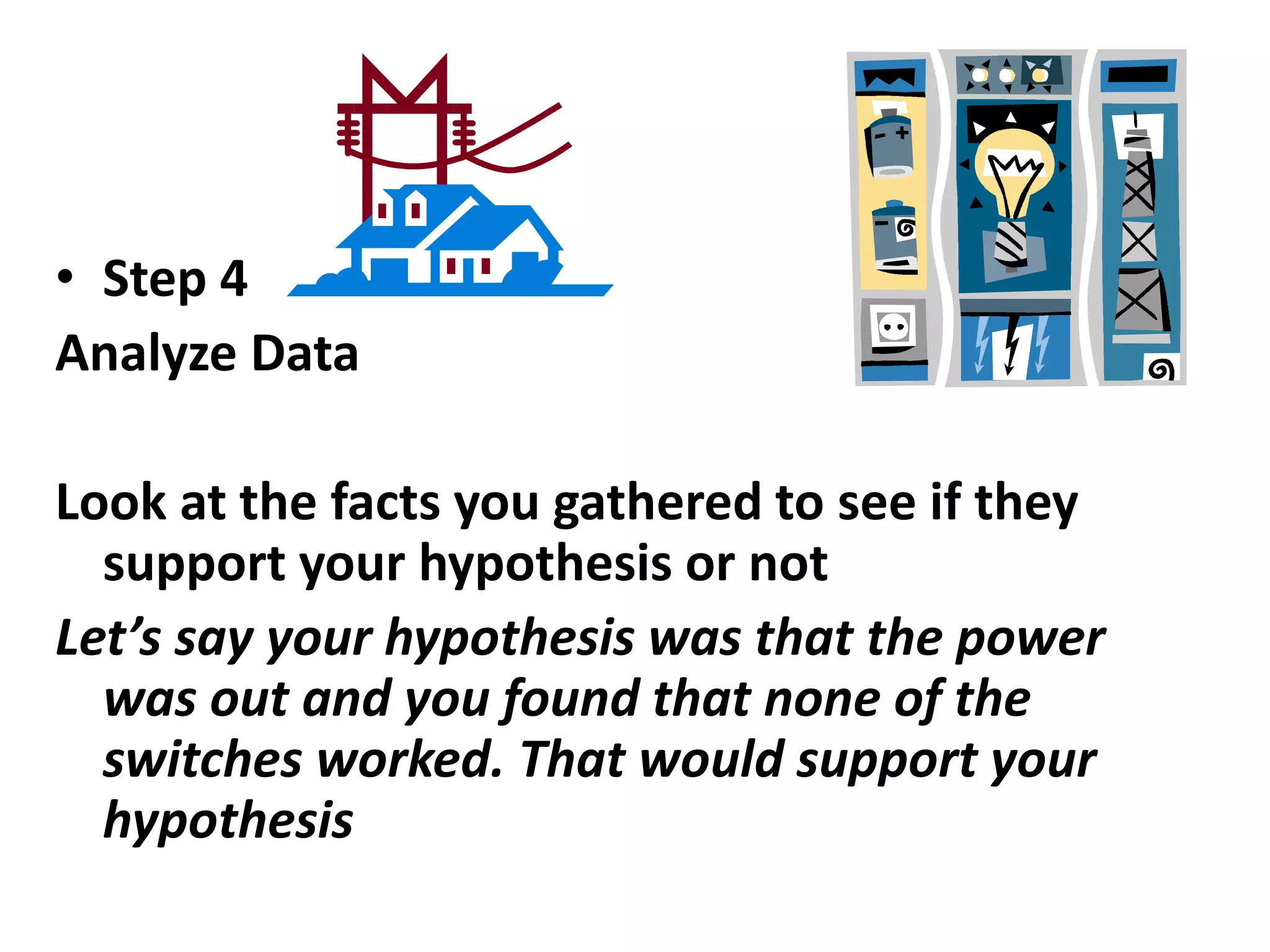
• Step 4
Analyze Data
Look at the facts you gathered to see if they
support your hypothesis or not
Let’s say your hypothesis was that the power
was out and you found that none of the
switches worked. That would support your
hypothesis
• Step 5
• Conclusion
• Accept the hypothesis
• But if you found that the
other switches did work,
reject the hypothesis and
make a new one
Experimental Design
• When scientists design experiments, they must
follow certain rules.
• A good experimental design has:
– One independent variable
– A dependent variable
– A control group
Experiments
The independent variable is the thing you
change in the experiment
Experiments
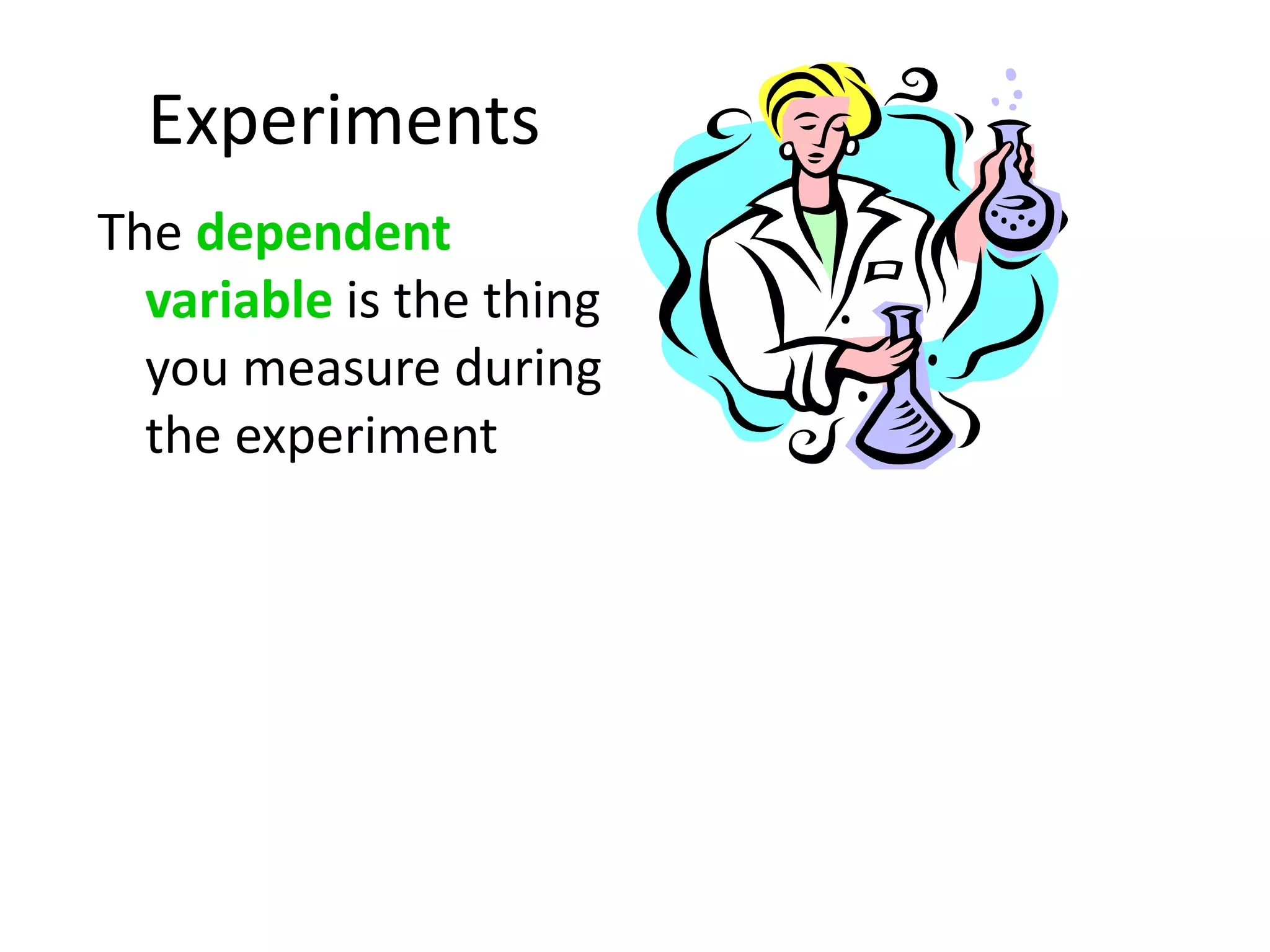
The dependent
variable is the thing
you measure during
the experiment
Experiments
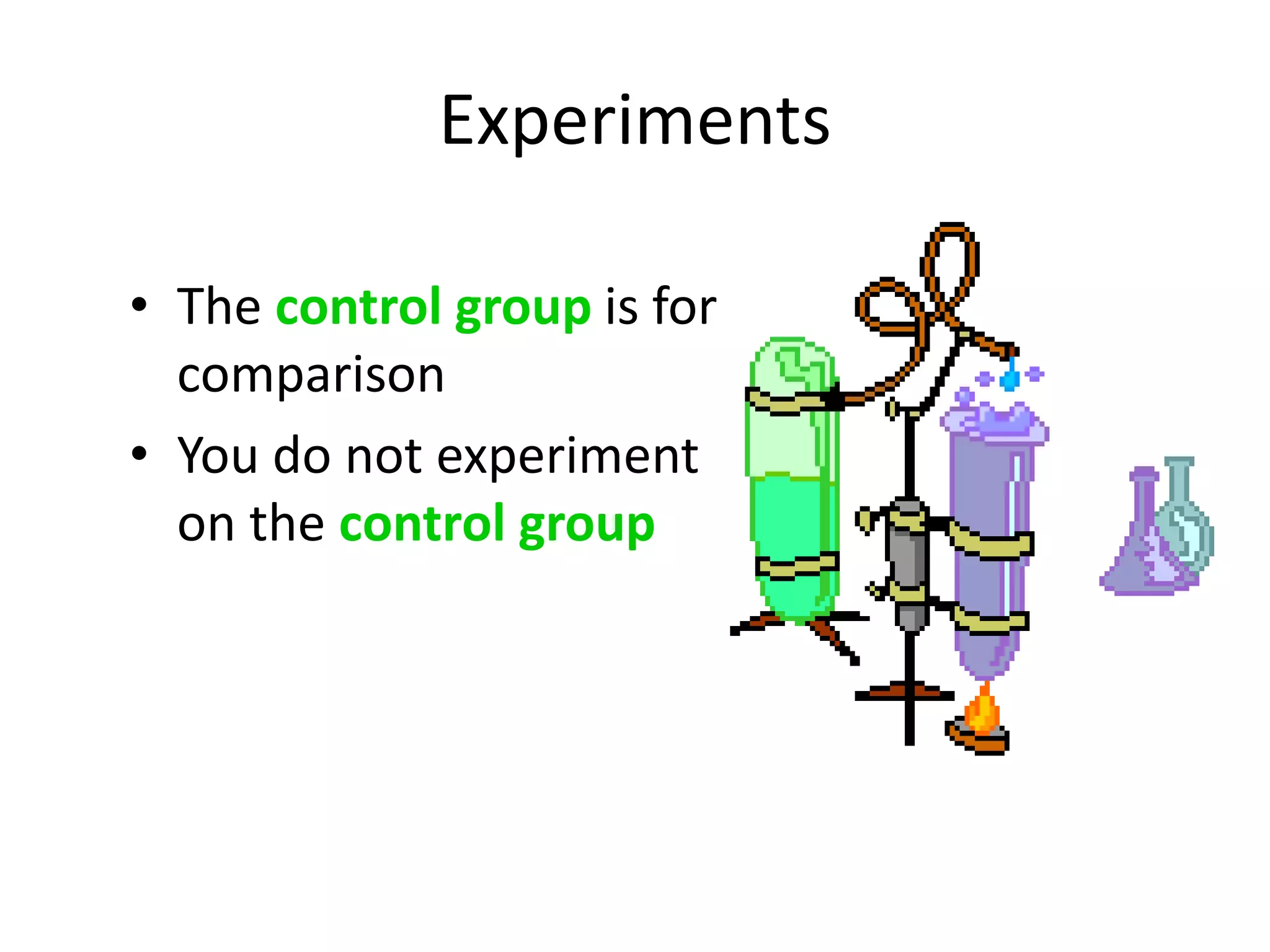
• The control group is for
comparison
• You do not experiment
on the control group
Let’s practice – first watch me
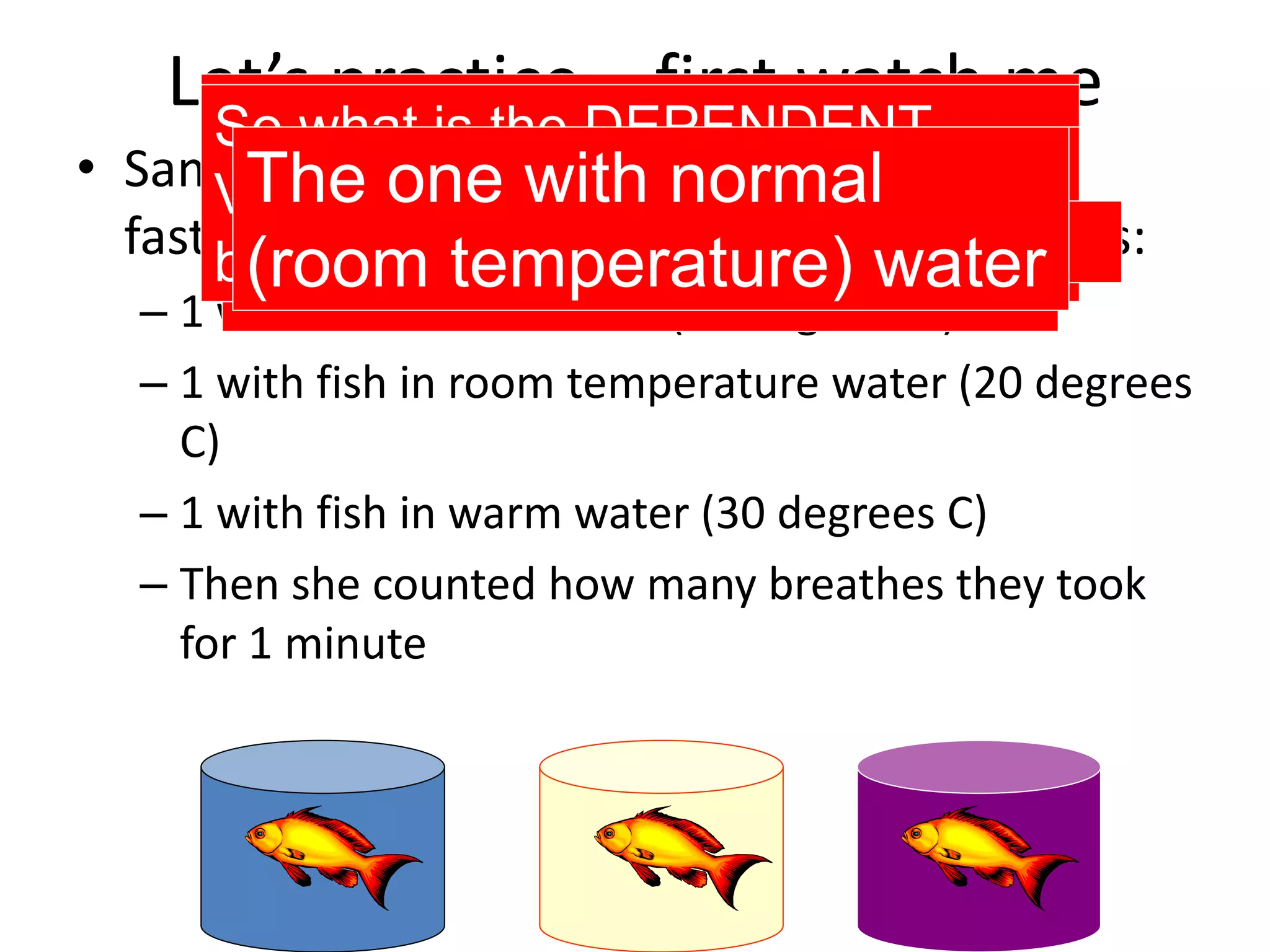
• Samantha wanted to know if fish breathe
faster in warm water. She set up three tanks:
– 1 with fish in cold water (10 degrees C)
– 1 with fish in room temperature water (20 degrees
C)
– 1 with fish in warm water (30 degrees C)
– Then she counted how many breathes they took
for 1 minute
So what is the INDEPENDENT
VARIABLE? (the one thing that is
different?)
The temperature of the
water
So what is the DEPENDENT
VARIABLE? (the thing that is
being measured?)
The number of breaths
Which tank is the control tank?
The one with normal
(room temperature) water
Let’s practice
• I want to know what kind
of fertilizer will make me
get the most strawberries
on my plants.
• Remember: Independent
Variable is what I control
• Remember: Dependent is
what I am looking for
• Remember: the control
group does not get the
independent variable
• What will be my
independent variable?
• The type of fertilizer
• What will be my dependent
variable?
• The number of strawberries
on each plant.
• What will be my control
group?
• Strawberry plants with no
fertilizer
Data
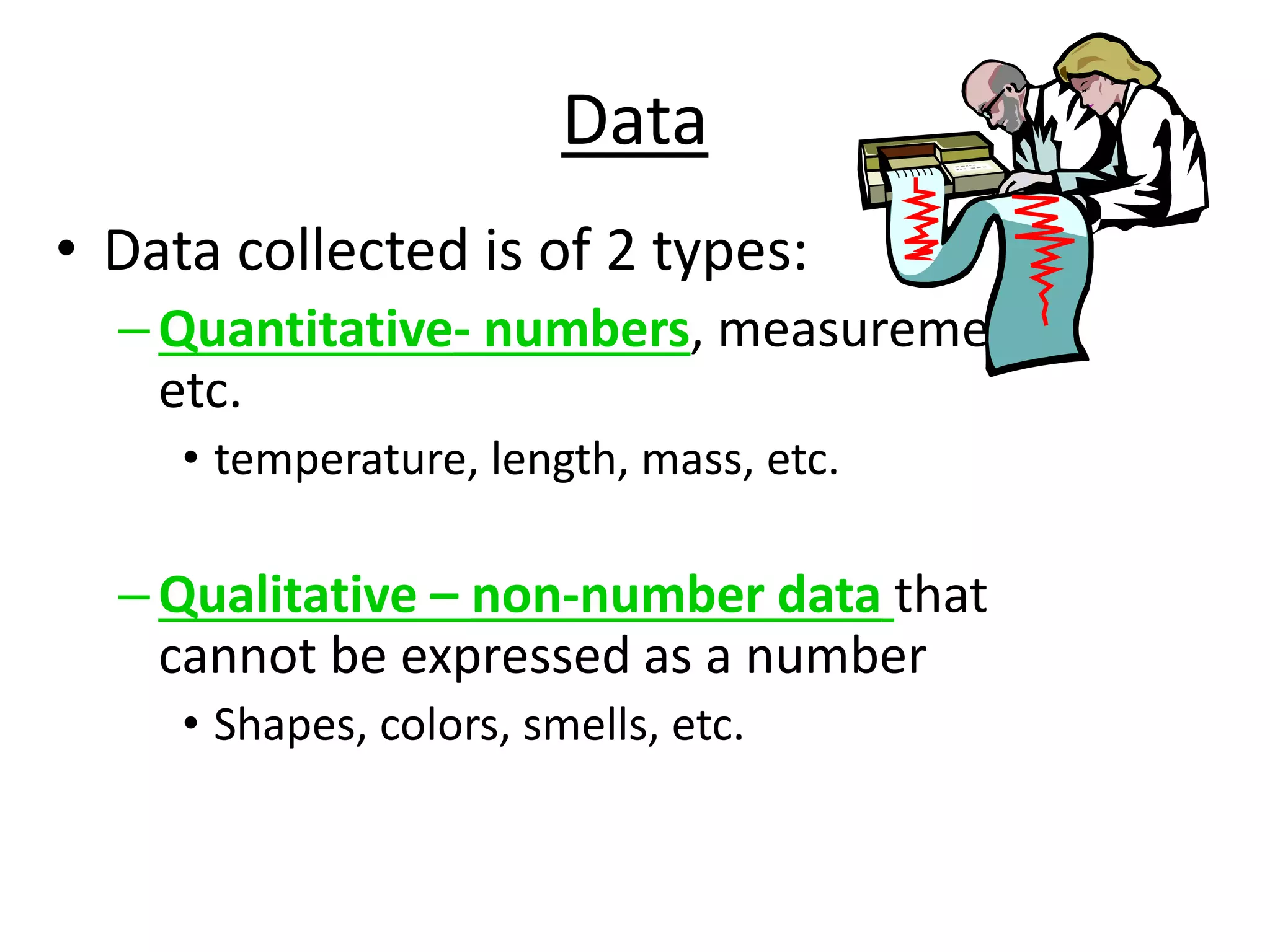
• Data collected is of 2 types:
–Quantitative- numbers, measurements,
etc.
• temperature, length, mass, etc.
–Qualitative – non-number data that
cannot be expressed as a number
• Shapes, colors, smells, etc.
Data practice...
• What kind of data
would I have collected
in my strawberry
experiment?
• Quantitative
• Why?
• Because I was counting
the number of
strawberries
Scientific Errors
• Poor measuring techniques
• Researcher bias
• Poor experimental design

The scientific method and experimental design 9th grade biology

  • 1.
  • 2.
    • The scientific methodis a systematic way to help us find answers to the questions we have • There are 5 main steps
  • 3.
    • In science,we only deal with facts – From observations – From experiments
  • 4.
    Step 1 • Observationand Research –See –Hear –Smell –Taste –Feel • For example: I got home from school and I smelled gas when I walked in my house.
  • 5.
    Step 1, continued •Observations lead to questions • For example: Why does it smell like gas in my house?
  • 6.
    Step 2 • Forma hypothesis – a statement that predicts a relationship between cause and effect • A good hypothesis will follow the “if…then” format • Example: If I smell gas, then there is a gas leak.
  • 7.
    Step 2, continued •A hypothesis must be testable. • For example: I can collect data (do a test) to see if there is a gas leak. • But if I said, If I wear perfume, then I will smell good • I can’t test that
  • 8.
    Step 3 • Gather data/experiment •You can do this by designing an experiment, making more observations, taking measurements, etc.
  • 9.
    Step 4• Analyzeand interpret your data • Look at the facts you collected and see if they mean anything or give you any answers.
  • 10.
    Step 5 • Conclusion– Do you accept your hypothesis or reject it? • If your data supports the hypothesis, you accept it • If your data does not support it (even a tiny bit), you reject it and start over
  • 11.
    Let’s try it •Step 1 Observation The light doesn’t come on when I flip the switch. That leads to a question: Why?
  • 12.
    • Step 2 Hypothesis Usethe “if…then” formula If the light doesn’t come on, then The bulb is burned out The lamp is unplugged The power is out Finish the hypothesis on your whiteboard
  • 13.
    • Step 3 Experiment Youcan check the bulb or the plug, try other switches in the house, etc. You are gathering data to help you answer your question. What experiment or data would you do or gather? on your whiteboard
  • 14.
    • Step 4 AnalyzeData Look at the facts you gathered to see if they support your hypothesis or not Let’s say your hypothesis was that the power was out and you found that none of the switches worked. That would support your hypothesis
  • 15.
    • Step 5 •Conclusion • Accept the hypothesis • But if you found that the other switches did work, reject the hypothesis and make a new one
  • 16.
    Experimental Design • Whenscientists design experiments, they must follow certain rules. • A good experimental design has: – One independent variable – A dependent variable – A control group
  • 17.
    Experiments The independent variableis the thing you change in the experiment
  • 18.
    Experiments The dependent variable isthe thing you measure during the experiment
  • 19.
    Experiments • The controlgroup is for comparison • You do not experiment on the control group
  • 20.
    Let’s practice –first watch me • Samantha wanted to know if fish breathe faster in warm water. She set up three tanks: – 1 with fish in cold water (10 degrees C) – 1 with fish in room temperature water (20 degrees C) – 1 with fish in warm water (30 degrees C) – Then she counted how many breathes they took for 1 minute So what is the INDEPENDENT VARIABLE? (the one thing that is different?) The temperature of the water So what is the DEPENDENT VARIABLE? (the thing that is being measured?) The number of breaths Which tank is the control tank? The one with normal (room temperature) water
  • 21.
    Let’s practice • Iwant to know what kind of fertilizer will make me get the most strawberries on my plants. • Remember: Independent Variable is what I control • Remember: Dependent is what I am looking for • Remember: the control group does not get the independent variable • What will be my independent variable? • The type of fertilizer • What will be my dependent variable? • The number of strawberries on each plant. • What will be my control group? • Strawberry plants with no fertilizer
  • 22.
    Data • Data collectedis of 2 types: –Quantitative- numbers, measurements, etc. • temperature, length, mass, etc. –Qualitative – non-number data that cannot be expressed as a number • Shapes, colors, smells, etc.
  • 23.
    Data practice... • Whatkind of data would I have collected in my strawberry experiment? • Quantitative • Why? • Because I was counting the number of strawberries
  • 24.
    Scientific Errors • Poormeasuring techniques • Researcher bias • Poor experimental design