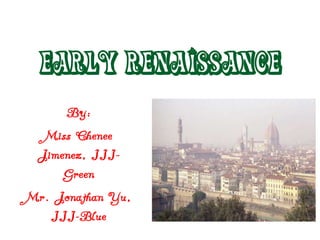
Early Renaissance
     By:
  Miss Chenee
 Jimenez, III-
     Green
Mr. Jonathan Yu,
   III-Blue
Current Events
• DOH: After leptospirosis, dengue may
    hit 'Sendong' victims
• January 3, 2012 8:32am
After leptospirosis, dengue may be the next
   disease to hound victims of tropical storm
   "Sendong" (Washi), especially in hard-hit
   areas like Cagayan de Oro and Iligan cities.

Health officials are bracing for the rise in
  dengue cases in evacuation centers about
  two weeks from now, according to
  National Epidemiology Center head Dr. Eric
  Tayag.
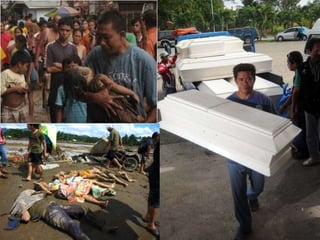
Think about it…

 IF WE ARE IN MEDIEVAL TIMES,
     HOW WOULD THE PEOPLE
   INTERPRET THIS CATASTROPHY?
  (Remember the Bubonic Plague!)


How would an atheist intepret
     this catastrophy?
           Why?
TARGET…
• Define Rennaisance
• Analyze the factor that paved
  the way for Rennaisance
• Appreciate the uniqueness of
  every person/individual
The Legend of the Phoenix
• The legend of the Phoenix has
  been around for centuries. There
  are a few variations, but the
  basic idea is this: The Phoenix is
  a supernatural creature, living
  for 1000 years. Once that time is
  over, it builds its own funeral
  pyre, and throws itself into the
  flames. As it dies, it is reborn
  anew, and rises from the ashes
  to live another 1000 years.
  Alternatively, it lays an egg in the
  burning coals of the fire which
  hatches into a new Phoenix, and
  the life cycle repeats.
What was the Renaissance?

Period following the middle ages (1450-1550)
• French word which means “Rebirth” of classical
      Greece and Rome
• Began in Italy
• Moved to northern Europe


The Vitruvian Man by Da Vinci epitomizes
the spirit of Renaissance
Objectives of Renaissance
• During the middle
  ages:
• –Find God
• – Prove pre-conceived
  ideas
Objectives of Renaissance
• During the
  Renaissance
• –Find man
• – Promote learning
"The Renaissance gave birth to the
             modern era, in that it was in this era that
                human beings first began to think of
               themselves as individuals. In the early
              Middle Ages, people had been happy to
                 see themselves simply as parts of a
             greater whole – for example, as members
              of a great family, trade guild, nation, or
             Church. This communal consciousness of
            the Middle Ages gradually gave way to the
                   individual consciousness of the
                             Renaissance."
• – McGrath, Alister, In the Beginning, Anchor Books (2001), p.38.
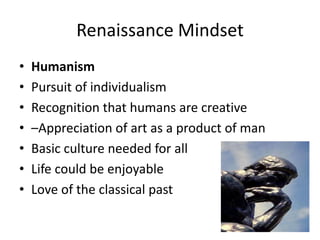
Renaissance Mindset
•   Humanism
•   Pursuit of individualism
•   Recognition that humans are creative
•   –Appreciation of art as a product of man
•   Basic culture needed for all
•   Life could be enjoyable
•   Love of the classical past
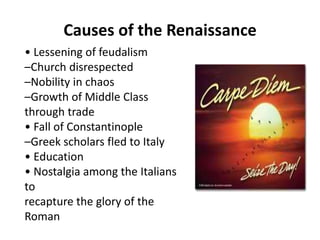
Causes of the Renaissance
• Lessening of feudalism
–Church disrespected
–Nobility in chaos
–Growth of Middle Class
through trade
• Fall of Constantinople
–Greek scholars fled to Italy
• Education
• Nostalgia among the Italians
to
recapture the glory of the
Roman
Italian Background
• Major city centers
– Venice: Republic
ruled by oligarchy,
Byzantine origins
– Milan: Visconti and
Sforza families
– Florence (Tuscany):
Republic ruled by
the Medici
– Papal States: Ruled
by the Pope
– Kingdom of Naples:
King of Aragon
Italian Background
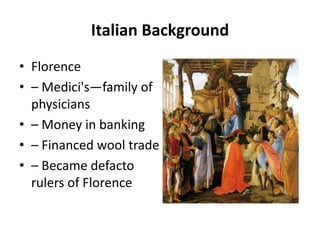
• Florence
• – Medici's—family of
  physicians
• – Money in banking
• – Financed wool trade
• – Became defacto
  rulers of Florence
Italian Background
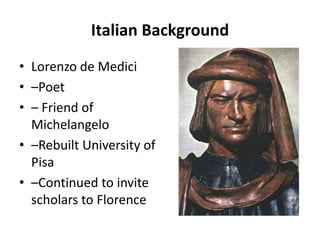
• Lorenzo de Medici
• –Poet
• – Friend of
  Michelangelo
• –Rebuilt University of
  Pisa
• –Continued to invite
  scholars to Florence
PETRARCH
• Father of humanism
• Secularism- stresses man’s
  interest in his or her way of
  life based on what was
  material, particularly the
  accumulation of wealth
  through trade.
• Individualism- perseverance of
  a person in the utmost of his
  or her ability to achieve goals
  in life
Renaissance Man
• Broad knowledge
  about many things
  in different fields
• Deep knowledge of
  skill in one area
• Able to link areas and
  create new
  knowledge
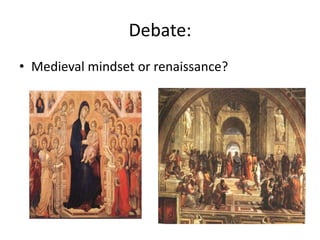
Debate:
• Medieval mindset or renaissance?

Early renaissance 3

  • 1.
    Early Renaissance By: Miss Chenee Jimenez, III- Green Mr. Jonathan Yu, III-Blue
  • 2.
    Current Events • DOH:After leptospirosis, dengue may hit 'Sendong' victims • January 3, 2012 8:32am After leptospirosis, dengue may be the next disease to hound victims of tropical storm "Sendong" (Washi), especially in hard-hit areas like Cagayan de Oro and Iligan cities. Health officials are bracing for the rise in dengue cases in evacuation centers about two weeks from now, according to National Epidemiology Center head Dr. Eric Tayag.
  • 4.
    Think about it… IF WE ARE IN MEDIEVAL TIMES, HOW WOULD THE PEOPLE INTERPRET THIS CATASTROPHY? (Remember the Bubonic Plague!) How would an atheist intepret this catastrophy? Why?
  • 5.
    TARGET… • Define Rennaisance •Analyze the factor that paved the way for Rennaisance • Appreciate the uniqueness of every person/individual
  • 6.
    The Legend ofthe Phoenix • The legend of the Phoenix has been around for centuries. There are a few variations, but the basic idea is this: The Phoenix is a supernatural creature, living for 1000 years. Once that time is over, it builds its own funeral pyre, and throws itself into the flames. As it dies, it is reborn anew, and rises from the ashes to live another 1000 years. Alternatively, it lays an egg in the burning coals of the fire which hatches into a new Phoenix, and the life cycle repeats.
  • 7.
    What was theRenaissance? Period following the middle ages (1450-1550) • French word which means “Rebirth” of classical Greece and Rome • Began in Italy • Moved to northern Europe The Vitruvian Man by Da Vinci epitomizes the spirit of Renaissance
  • 8.
    Objectives of Renaissance •During the middle ages: • –Find God • – Prove pre-conceived ideas
  • 9.
    Objectives of Renaissance •During the Renaissance • –Find man • – Promote learning
  • 10.
    "The Renaissance gavebirth to the modern era, in that it was in this era that human beings first began to think of themselves as individuals. In the early Middle Ages, people had been happy to see themselves simply as parts of a greater whole – for example, as members of a great family, trade guild, nation, or Church. This communal consciousness of the Middle Ages gradually gave way to the individual consciousness of the Renaissance." • – McGrath, Alister, In the Beginning, Anchor Books (2001), p.38.
  • 11.
    Renaissance Mindset • Humanism • Pursuit of individualism • Recognition that humans are creative • –Appreciation of art as a product of man • Basic culture needed for all • Life could be enjoyable • Love of the classical past
  • 12.
    Causes of theRenaissance • Lessening of feudalism –Church disrespected –Nobility in chaos –Growth of Middle Class through trade • Fall of Constantinople –Greek scholars fled to Italy • Education • Nostalgia among the Italians to recapture the glory of the Roman
  • 13.
    Italian Background • Majorcity centers – Venice: Republic ruled by oligarchy, Byzantine origins – Milan: Visconti and Sforza families – Florence (Tuscany): Republic ruled by the Medici – Papal States: Ruled by the Pope – Kingdom of Naples: King of Aragon
  • 14.
    Italian Background • Florence •– Medici's—family of physicians • – Money in banking • – Financed wool trade • – Became defacto rulers of Florence
  • 15.
    Italian Background • Lorenzode Medici • –Poet • – Friend of Michelangelo • –Rebuilt University of Pisa • –Continued to invite scholars to Florence
  • 16.
    PETRARCH • Father ofhumanism • Secularism- stresses man’s interest in his or her way of life based on what was material, particularly the accumulation of wealth through trade. • Individualism- perseverance of a person in the utmost of his or her ability to achieve goals in life
  • 17.
    Renaissance Man • Broadknowledge about many things in different fields • Deep knowledge of skill in one area • Able to link areas and create new knowledge
  • 18.