History of Europe:
Renaissance to 1815
Imagine! The great
generosity of God! The
happiness of man! To man it
is allowed to be whatever
he chooses to be!
∼ Pico della Mirandola, Oration on the
Dignity of Man, 15th c.
The Italian Renaissance
Origins & the Arts
Renaissance
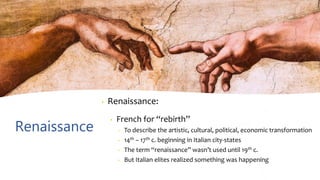
• Renaissance:
• French for “rebirth”
• To describe the artistic, cultural, political, economic transformation
• 14th – 17th c. beginning in Italian city-states
• The term “renaissance” wasn’t used until 19th c.
• But Italian elites realized something was happening
Renaissance
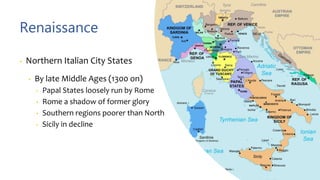
• Northern Italian City States
• By late Middle Ages (1300 on)
• Papal States loosely run by Rome
• Rome a shadow of former glory
• Southern regions poorer than North
• Sicily in decline
Renaissance
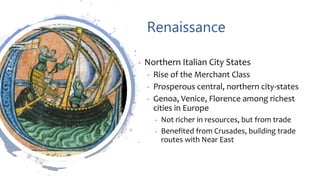
• Northern Italian City States
• Rise of the Merchant Class
• Prosperous central, northern city-states
• Genoa, Venice, Florence among richest
cities in Europe
• Not richer in resources, but from trade
• Benefited from Crusades, building trade
routes with Near East
Renaissance
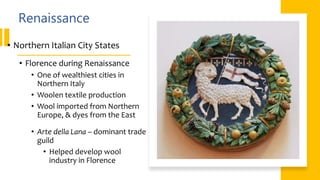
• Northern Italian City States
• Florence during Renaissance
• One of wealthiest cities in
Northern Italy
• Woolen textile production
• Wool imported from Northern
Europe, & dyes from the East
• Arte della Lana – dominant trade
guild
• Helped develop wool
industry in Florence
Renaissance
• Northern Italian City States
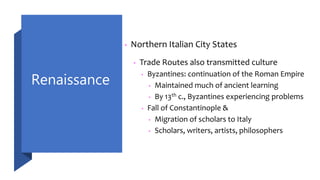
• Trade Routes also transmitted culture
• Byzantines: continuation of the Roman Empire
• Maintained much of ancient learning
• By 13th c., Byzantines experiencing problems
• Fall of Constantinople &
• Migration of scholars to Italy
• Scholars, writers, artists, philosophers
Renaissance
• Northern Italian City States
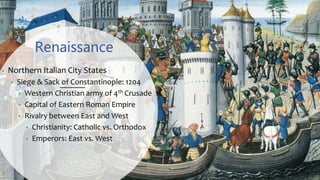
• Siege & Sack of Constantinople: 1204
• Western Christian army of 4th Crusade
• Capital of Eastern Roman Empire
• Rivalry between East and West
• Christianity: Catholic vs. Orthodox
• Emperors: East vs. West
Renaissance
• Northern Italian City States
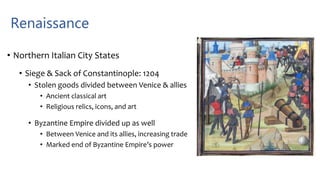
• Siege & Sack of Constantinople: 1204
• Stolen goods divided between Venice & allies
• Ancient classical art
• Religious relics, icons, and art
• Byzantine Empire divided up as well
• Between Venice and its allies, increasing trade
• Marked end of Byzantine Empire’s power
Humanism
Beauty & Value of the Individual
Renaissance
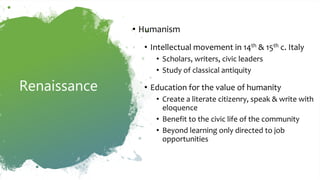
• Humanism
• Intellectual movement in 14th & 15th c. Italy
• Scholars, writers, civic leaders
• Study of classical antiquity
• Education for the value of humanity
• Create a literate citizenry, speak & write with
eloquence
• Benefit to the civic life of the community
• Beyond learning only directed to job
opportunities
Renaissance
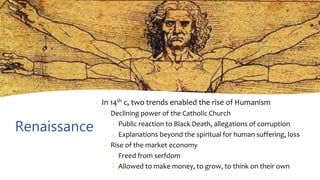
• In 14th c, two trends enabled the rise of Humanism
• Declining power of the Catholic Church
• Public reaction to Black Death, allegations of corruption
• Explanations beyond the spiritual for human suffering, loss
• Rise of the market economy
• Freed from serfdom
• Allowed to make money, to grow, to think on their own
Renaissance
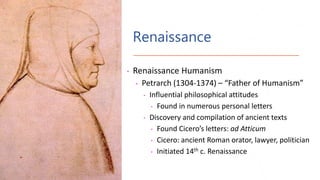
• Renaissance Humanism
• Petrarch (1304-1374) – “Father of Humanism”
• Influential philosophical attitudes
• Found in numerous personal letters
• Discovery and compilation of ancient texts
• Found Cicero’s letters: ad Atticum
• Cicero: ancient Roman orator, lawyer, politician
• Initiated 14th c. Renaissance
Renaissance
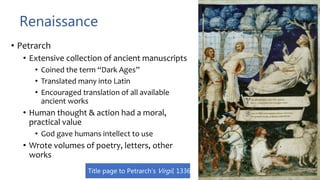
• Petrarch
• Extensive collection of ancient manuscripts
• Coined the term “Dark Ages”
• Translated many into Latin
• Encouraged translation of all available
ancient works
• Human thought & action had a moral,
practical value
• God gave humans intellect to use
• Wrote volumes of poetry, letters, other
works
Title page to Petrarch’s Virgil, 1336
Renaissance
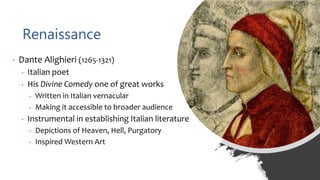
• Dante Alighieri (1265-1321)
• Italian poet
• His Divine Comedy one of great works
• Written in Italian vernacular
• Making it accessible to broader audience
• Instrumental in establishing Italian literature
• Depictions of Heaven, Hell, Purgatory
• Inspired Western Art
Renaissance
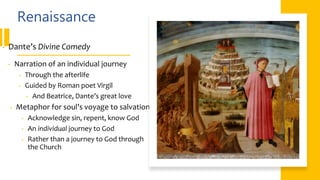
• Dante’s Divine Comedy
• Narration of an individual journey
• Through the afterlife
• Guided by Roman poet Virgil
• And Beatrice, Dante’s great love
• Metaphor for soul’s voyage to salvation
• Acknowledge sin, repent, know God
• An individual journey to God
• Rather than a journey to God through
the Church
Renaissance
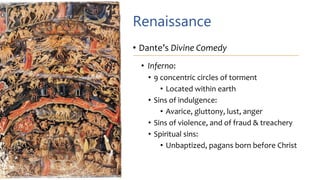
• Dante’s Divine Comedy
• Inferno:
• 9 concentric circles of torment
• Located within earth
• Sins of indulgence:
• Avarice, gluttony, lust, anger
• Sins of violence, and of fraud & treachery
• Spiritual sins:
• Unbaptized, pagans born before Christ
Renaissance
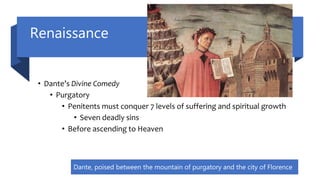
• Dante’s Divine Comedy
• Purgatory
• Penitents must conquer 7 levels of suffering and spiritual growth
• Seven deadly sins
• Before ascending to Heaven
Dante, poised between the mountain of purgatory and the city of Florence
Renaissance
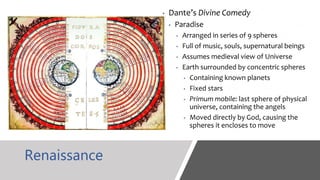
• Dante’s Divine Comedy
• Paradise
• Arranged in series of 9 spheres
• Full of music, souls, supernatural beings
• Assumes medieval view of Universe
• Earth surrounded by concentric spheres
• Containing known planets
• Fixed stars
• Primum mobile: last sphere of physical
universe, containing the angels
• Moved directly by God, causing the
spheres it encloses to move
Early Renaissance Art
Florence & the Birth of the Renaissance
Renaissance
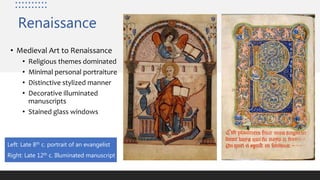
• Medieval Art to Renaissance
• Religious themes dominated
• Minimal personal portraiture
• Distinctive stylized manner
• Decorative illuminated
manuscripts
• Stained glass windows
Left: Late 8th c. portrait of an evangelist
Right: Late 12th c. Illuminated manuscript
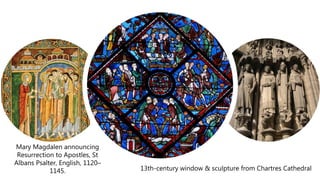
13th-century window & sculpture from Chartres Cathedral
Mary Magdalen announcing
Resurrection to Apostles, St
Albans Psalter, English, 1120–
1145.
Renaissance
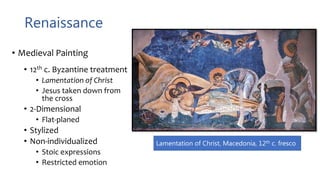
• Medieval Painting
• 12th c. Byzantine treatment
• Lamentation of Christ
• Jesus taken down from
the cross
• 2-Dimensional
• Flat-planed
• Stylized
• Non-individualized
• Stoic expressions
• Restricted emotion
Lamentation of Christ, Macedonia, 12th c. fresco
Renaissance
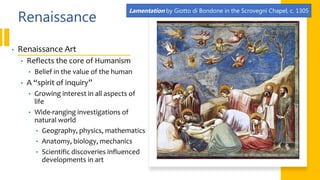
• Renaissance Art
• Reflects the core of Humanism
• Belief in the value of the human
• A “spirit of inquiry”
• Growing interest in all aspects of
life
• Wide-ranging investigations of
natural world
• Geography, physics, mathematics
• Anatomy, biology, mechanics
• Scientific discoveries influenced
developments in art
Lamentation by Giotto di Bondone in the Scrovegni Chapel, c. 1305
Renaissance
• Florence – birthplace of the Renaissance
• Despite devastation of the Black Death
• Economic strength based on banking & powerful
mercantile guilds
• Led to influx of immigrants energizing city
• Dozens of artists’ guilds
• Artists, scholars, writers sponsored by wealthy
Florentine citizens
• Especially the powerful Medici family
• More on that family next time
• Drew era’s most influential & talented artists &
humanists
Renaissance
• Early Renaissance Painting
• See influence of Humanist philosophy
• New topics
• Church no longer had a monopoly on thinking
• Human relationships with the world, the
universe, God
• Subjects beyond religious stories
• Including battle scenes, portraits, images of
ordinary people
Renaissance
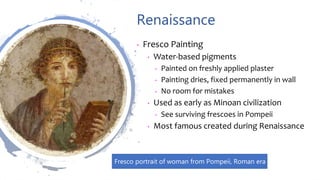
• Fresco Painting
• Water-based pigments
• Painted on freshly applied plaster
• Painting dries, fixed permanently in wall
• No room for mistakes
• Used as early as Minoan civilization
• See surviving frescoes in Pompeii
• Most famous created during Renaissance
Fresco portrait of woman from Pompeii, Roman era
Renaissance
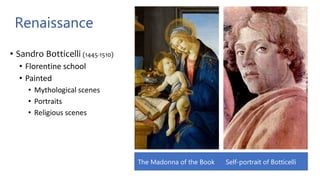
• Sandro Botticelli (1445-1510)
• Florentine school
• Painted
• Mythological scenes
• Portraits
• Religious scenes
The Madonna of the Book Self-portrait of Botticelli
Renaissance
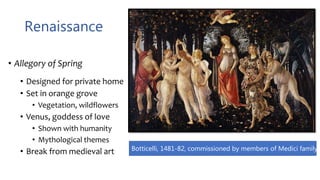
• Allegory of Spring
• Designed for private home
• Set in orange grove
• Vegetation, wildflowers
• Venus, goddess of love
• Shown with humanity
• Mythological themes
• Break from medieval art Botticelli, 1481-82, commissioned by members of Medici family
Renaissance
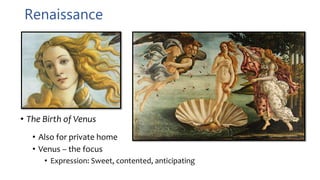
• The Birth of Venus
• Also for private home
• Venus – the focus
• Expression: Sweet, contented, anticipating
Renaissance
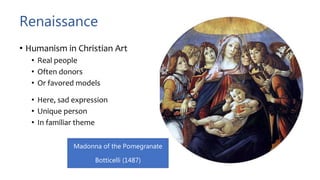
• Humanism in Christian Art
• Real people
• Often donors
• Or favored models
• Here, sad expression
• Unique person
• In familiar theme
Madonna of the Pomegranate
Botticelli (1487)
Renaissance
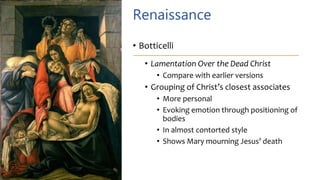
• Botticelli
• Lamentation Over the Dead Christ
• Compare with earlier versions
• Grouping of Christ’s closest associates
• More personal
• Evoking emotion through positioning of
bodies
• In almost contorted style
• Shows Mary mourning Jesus’ death
Renaissance
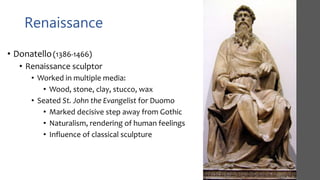
• Donatello(1386-1466)
• Renaissance sculptor
• Worked in multiple media:
• Wood, stone, clay, stucco, wax
• Seated St. John the Evangelist for Duomo
• Marked decisive step away from Gothic
• Naturalism, rendering of human feelings
• Influence of classical sculpture
Renaissance
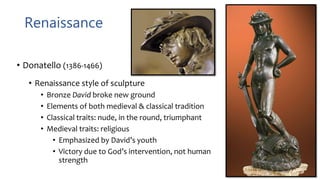
• Donatello (1386-1466)
• Renaissance style of sculpture
• Bronze David broke new ground
• Elements of both medieval & classical tradition
• Classical traits: nude, in the round, triumphant
• Medieval traits: religious
• Emphasized by David’s youth
• Victory due to God’s intervention, not human
strength
Renaissance
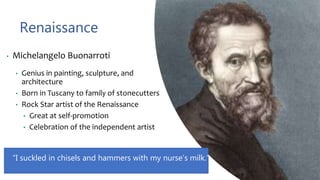
• Michelangelo Buonarroti
• Genius in painting, sculpture, and
architecture
• Born in Tuscany to family of stonecutters
• Rock Star artist of the Renaissance
• Great at self-promotion
• Celebration of the independent artist
“I suckled in chisels and hammers with my nurse’s milk.”
Renaissance
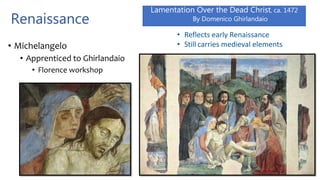
• Michelangelo
• Apprenticed to Ghirlandaio
• Florence workshop
Lamentation Over the Dead Christ, ca. 1472
By Domenico Ghirlandaio
• Reflects early Renaissance
• Still carries medieval elements
Renaissance
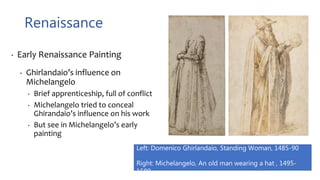
• Early Renaissance Painting
• Ghirlandaio’s influence on
Michelangelo
• Brief apprenticeship, full of conflict
• Michelangelo tried to conceal
Ghirandaio’s influence on his work
• But see in Michelangelo’s early
painting
Left: Domenico Ghirlandaio, Standing Woman, 1485-90
Right: Michelangelo, An old man wearing a hat , 1495-
1500
Renaissance
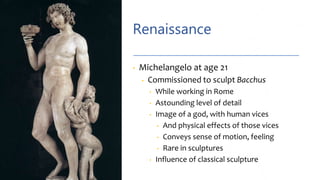
• Michelangelo at age 21
• Commissioned to sculpt Bacchus
• While working in Rome
• Astounding level of detail
• Image of a god, with human vices
• And physical effects of those vices
• Conveys sense of motion, feeling
• Rare in sculptures
• Influence of classical sculpture
Renaissance
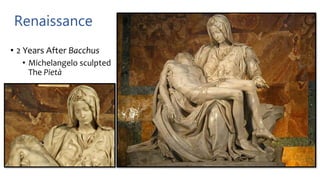
• 2 Years After Bacchus
• Michelangelo sculpted
The Pietà
Renaissance
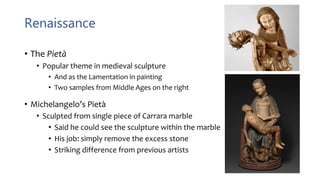
• The Pietà
• Popular theme in medieval sculpture
• And as the Lamentation in painting
• Two samples from Middle Ages on the right
• Michelangelo’s Pietà
• Sculpted from single piece of Carrara marble
• Said he could see the sculpture within the marble
• His job: simply remove the excess stone
• Striking difference from previous artists
Renaissance
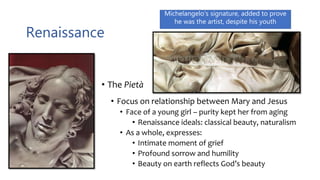
• The Pietà
• Focus on relationship between Mary and Jesus
• Face of a young girl – purity kept her from aging
• Renaissance ideals: classical beauty, naturalism
• As a whole, expresses:
• Intimate moment of grief
• Profound sorrow and humility
• Beauty on earth reflects God’s beauty
Michelangelo’s signature, added to prove
he was the artist, despite his youth
Renaissance
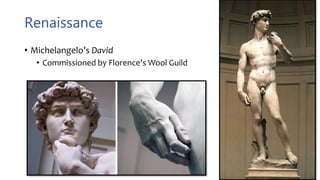
• Michelangelo’s David
• Commissioned by Florence’s Wool Guild
Renaissance
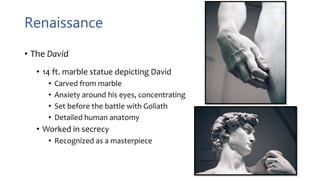
• The David
• 14 ft. marble statue depicting David
• Carved from marble
• Anxiety around his eyes, concentrating
• Set before the battle with Goliath
• Detailed human anatomy
• Worked in secrecy
• Recognized as a masterpiece
Renaissance
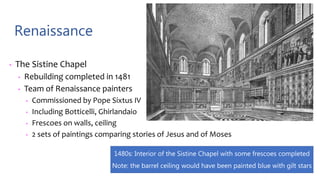
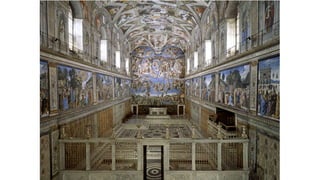
• The Sistine Chapel
• Rebuilding completed in 1481
• Team of Renaissance painters
• Commissioned by Pope Sixtus IV
• Including Botticelli, Ghirlandaio
• Frescoes on walls, ceiling
• 2 sets of paintings comparing stories of Jesus and of Moses
1480s: Interior of the Sistine Chapel with some frescoes completed
Note: the barrel ceiling would have been painted blue with gilt stars
Renaissance
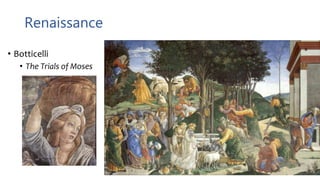
• Botticelli
• The Trials of Moses
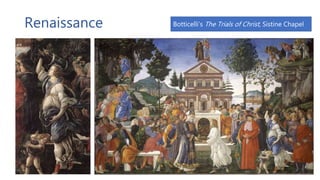
Renaissance Botticelli’s The Trials of Christ, Sistine Chapel
Renaissance
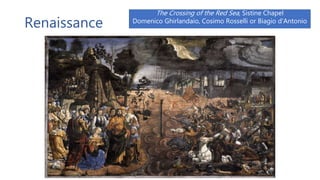
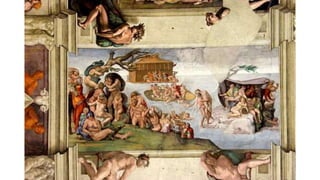
The Crossing of the Red Sea, Sistine Chapel
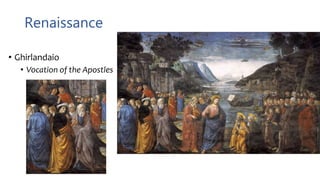
Domenico Ghirlandaio, Cosimo Rosselli or Biagio d'Antonio
Renaissance
• Ghirlandaio
• Vocation of the Apostles
Renaissance
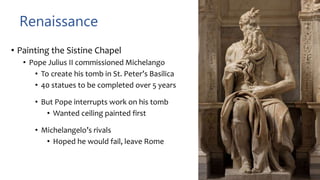
• Painting the Sistine Chapel
• Pope Julius II commissioned Michelango
• To create his tomb in St. Peter’s Basilica
• 40 statues to be completed over 5 years
• But Pope interrupts work on his tomb
• Wanted ceiling painted first
• Michelangelo’s rivals
• Hoped he would fail, leave Rome
Renaissance
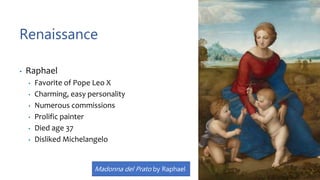
• Raphael
• Favorite of Pope Leo X
• Charming, easy personality
• Numerous commissions
• Prolific painter
• Died age 37
• Disliked Michelangelo
Madonna del Prato by Raphael
Renaissance
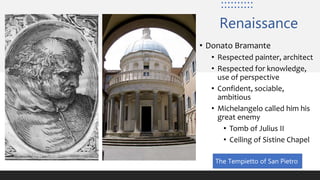
• Donato Bramante
• Respected painter, architect
• Respected for knowledge,
use of perspective
• Confident, sociable,
ambitious
• Michelangelo called him his
great enemy
• Tomb of Julius II
• Ceiling of Sistine Chapel
The Tempietto of San Pietro
Renaissance
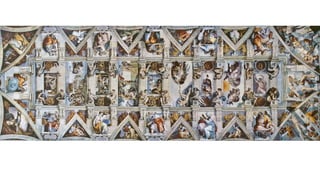
• Michelangelo Paints a Ceiling
• Tradition – painted lying on his back
• Reality – upright position, with head tilted
upwards
• Had never painted in fresco, except for
apprenticeship
• Let alone an entire ceiling or wall
• Which makes the work all the more amazing
Renaissance
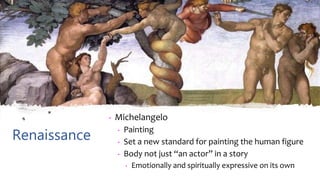
• Michelangelo
• Painting
• Set a new standard for painting the human figure
• Body not just “an actor” in a story
• Emotionally and spiritually expressive on its own
Renaissance
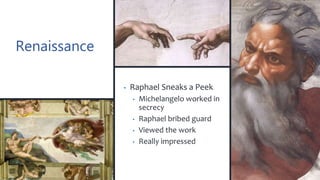
• Raphael Sneaks a Peek
• Michelangelo worked in
secrecy
• Raphael bribed guard
• Viewed the work
• Really impressed
Renaissance
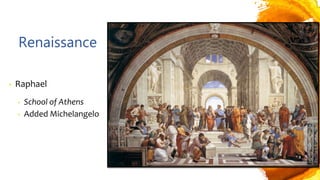
• Raphael
• School of Athens
• Added Michelangelo
Renaissance
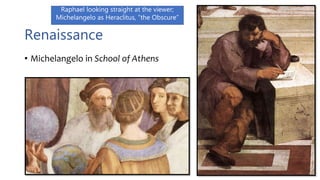
• Michelangelo in School of Athens
Raphael looking straight at the viewer;
Michelangelo as Heraclitus, “the Obscure”
Renaissance
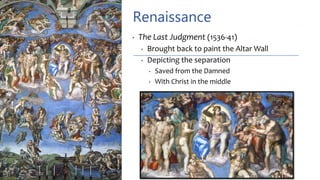
• The Last Judgment (1536-41)
• Brought back to paint the Altar Wall
• Depicting the separation
• Saved from the Damned
• With Christ in the middle
Renaissance
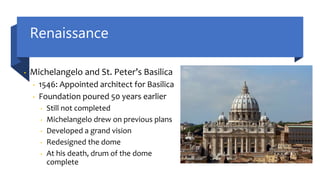
• Michelangelo and St. Peter’s Basilica
• 1546: Appointed architect for Basilica
• Foundation poured 50 years earlier
• Still not completed
• Michelangelo drew on previous plans
• Developed a grand vision
• Redesigned the dome
• At his death, drum of the dome
complete

2. The Renaissance

  • 1.
  • 2.
    Imagine! The great generosityof God! The happiness of man! To man it is allowed to be whatever he chooses to be! ∼ Pico della Mirandola, Oration on the Dignity of Man, 15th c.
  • 3.
  • 4.
    Renaissance • Renaissance: • Frenchfor “rebirth” • To describe the artistic, cultural, political, economic transformation • 14th – 17th c. beginning in Italian city-states • The term “renaissance” wasn’t used until 19th c. • But Italian elites realized something was happening
  • 5.
    Renaissance • Northern ItalianCity States • By late Middle Ages (1300 on) • Papal States loosely run by Rome • Rome a shadow of former glory • Southern regions poorer than North • Sicily in decline
  • 6.
    Renaissance • Northern ItalianCity States • Rise of the Merchant Class • Prosperous central, northern city-states • Genoa, Venice, Florence among richest cities in Europe • Not richer in resources, but from trade • Benefited from Crusades, building trade routes with Near East
  • 7.
    Renaissance • Northern ItalianCity States • Florence during Renaissance • One of wealthiest cities in Northern Italy • Woolen textile production • Wool imported from Northern Europe, & dyes from the East • Arte della Lana – dominant trade guild • Helped develop wool industry in Florence
  • 8.
    Renaissance • Northern ItalianCity States • Trade Routes also transmitted culture • Byzantines: continuation of the Roman Empire • Maintained much of ancient learning • By 13th c., Byzantines experiencing problems • Fall of Constantinople & • Migration of scholars to Italy • Scholars, writers, artists, philosophers
  • 9.
    Renaissance • Northern ItalianCity States • Siege & Sack of Constantinople: 1204 • Western Christian army of 4th Crusade • Capital of Eastern Roman Empire • Rivalry between East and West • Christianity: Catholic vs. Orthodox • Emperors: East vs. West
  • 10.
    Renaissance • Northern ItalianCity States • Siege & Sack of Constantinople: 1204 • Stolen goods divided between Venice & allies • Ancient classical art • Religious relics, icons, and art • Byzantine Empire divided up as well • Between Venice and its allies, increasing trade • Marked end of Byzantine Empire’s power
  • 11.
    Humanism Beauty & Valueof the Individual
  • 12.
    Renaissance • Humanism • Intellectualmovement in 14th & 15th c. Italy • Scholars, writers, civic leaders • Study of classical antiquity • Education for the value of humanity • Create a literate citizenry, speak & write with eloquence • Benefit to the civic life of the community • Beyond learning only directed to job opportunities
  • 13.
    Renaissance • In 14thc, two trends enabled the rise of Humanism • Declining power of the Catholic Church • Public reaction to Black Death, allegations of corruption • Explanations beyond the spiritual for human suffering, loss • Rise of the market economy • Freed from serfdom • Allowed to make money, to grow, to think on their own
  • 14.
    Renaissance • Renaissance Humanism •Petrarch (1304-1374) – “Father of Humanism” • Influential philosophical attitudes • Found in numerous personal letters • Discovery and compilation of ancient texts • Found Cicero’s letters: ad Atticum • Cicero: ancient Roman orator, lawyer, politician • Initiated 14th c. Renaissance
  • 15.
    Renaissance • Petrarch • Extensivecollection of ancient manuscripts • Coined the term “Dark Ages” • Translated many into Latin • Encouraged translation of all available ancient works • Human thought & action had a moral, practical value • God gave humans intellect to use • Wrote volumes of poetry, letters, other works Title page to Petrarch’s Virgil, 1336
  • 16.
    Renaissance • Dante Alighieri(1265-1321) • Italian poet • His Divine Comedy one of great works • Written in Italian vernacular • Making it accessible to broader audience • Instrumental in establishing Italian literature • Depictions of Heaven, Hell, Purgatory • Inspired Western Art
  • 17.
    Renaissance • Dante’s DivineComedy • Narration of an individual journey • Through the afterlife • Guided by Roman poet Virgil • And Beatrice, Dante’s great love • Metaphor for soul’s voyage to salvation • Acknowledge sin, repent, know God • An individual journey to God • Rather than a journey to God through the Church
  • 18.
    Renaissance • Dante’s DivineComedy • Inferno: • 9 concentric circles of torment • Located within earth • Sins of indulgence: • Avarice, gluttony, lust, anger • Sins of violence, and of fraud & treachery • Spiritual sins: • Unbaptized, pagans born before Christ
  • 19.
    Renaissance • Dante’s DivineComedy • Purgatory • Penitents must conquer 7 levels of suffering and spiritual growth • Seven deadly sins • Before ascending to Heaven Dante, poised between the mountain of purgatory and the city of Florence
  • 20.
    Renaissance • Dante’s DivineComedy • Paradise • Arranged in series of 9 spheres • Full of music, souls, supernatural beings • Assumes medieval view of Universe • Earth surrounded by concentric spheres • Containing known planets • Fixed stars • Primum mobile: last sphere of physical universe, containing the angels • Moved directly by God, causing the spheres it encloses to move
  • 21.
    Early Renaissance Art Florence& the Birth of the Renaissance
  • 22.
    Renaissance • Medieval Artto Renaissance • Religious themes dominated • Minimal personal portraiture • Distinctive stylized manner • Decorative illuminated manuscripts • Stained glass windows Left: Late 8th c. portrait of an evangelist Right: Late 12th c. Illuminated manuscript
  • 23.
    13th-century window &sculpture from Chartres Cathedral Mary Magdalen announcing Resurrection to Apostles, St Albans Psalter, English, 1120– 1145.
  • 24.
    Renaissance • Medieval Painting •12th c. Byzantine treatment • Lamentation of Christ • Jesus taken down from the cross • 2-Dimensional • Flat-planed • Stylized • Non-individualized • Stoic expressions • Restricted emotion Lamentation of Christ, Macedonia, 12th c. fresco
  • 25.
    Renaissance • Renaissance Art •Reflects the core of Humanism • Belief in the value of the human • A “spirit of inquiry” • Growing interest in all aspects of life • Wide-ranging investigations of natural world • Geography, physics, mathematics • Anatomy, biology, mechanics • Scientific discoveries influenced developments in art Lamentation by Giotto di Bondone in the Scrovegni Chapel, c. 1305
  • 26.
    Renaissance • Florence –birthplace of the Renaissance • Despite devastation of the Black Death • Economic strength based on banking & powerful mercantile guilds • Led to influx of immigrants energizing city • Dozens of artists’ guilds • Artists, scholars, writers sponsored by wealthy Florentine citizens • Especially the powerful Medici family • More on that family next time • Drew era’s most influential & talented artists & humanists
  • 27.
    Renaissance • Early RenaissancePainting • See influence of Humanist philosophy • New topics • Church no longer had a monopoly on thinking • Human relationships with the world, the universe, God • Subjects beyond religious stories • Including battle scenes, portraits, images of ordinary people
  • 28.
    Renaissance • Fresco Painting •Water-based pigments • Painted on freshly applied plaster • Painting dries, fixed permanently in wall • No room for mistakes • Used as early as Minoan civilization • See surviving frescoes in Pompeii • Most famous created during Renaissance Fresco portrait of woman from Pompeii, Roman era
  • 29.
    Renaissance • Sandro Botticelli(1445-1510) • Florentine school • Painted • Mythological scenes • Portraits • Religious scenes The Madonna of the Book Self-portrait of Botticelli
  • 30.
    Renaissance • Allegory ofSpring • Designed for private home • Set in orange grove • Vegetation, wildflowers • Venus, goddess of love • Shown with humanity • Mythological themes • Break from medieval art Botticelli, 1481-82, commissioned by members of Medici family
  • 31.
    Renaissance • The Birthof Venus • Also for private home • Venus – the focus • Expression: Sweet, contented, anticipating
  • 32.
    Renaissance • Humanism inChristian Art • Real people • Often donors • Or favored models • Here, sad expression • Unique person • In familiar theme Madonna of the Pomegranate Botticelli (1487)
  • 33.
    Renaissance • Botticelli • LamentationOver the Dead Christ • Compare with earlier versions • Grouping of Christ’s closest associates • More personal • Evoking emotion through positioning of bodies • In almost contorted style • Shows Mary mourning Jesus’ death
  • 34.
    Renaissance • Donatello(1386-1466) • Renaissancesculptor • Worked in multiple media: • Wood, stone, clay, stucco, wax • Seated St. John the Evangelist for Duomo • Marked decisive step away from Gothic • Naturalism, rendering of human feelings • Influence of classical sculpture
  • 35.
    Renaissance • Donatello (1386-1466) •Renaissance style of sculpture • Bronze David broke new ground • Elements of both medieval & classical tradition • Classical traits: nude, in the round, triumphant • Medieval traits: religious • Emphasized by David’s youth • Victory due to God’s intervention, not human strength
  • 36.
    Renaissance • Michelangelo Buonarroti •Genius in painting, sculpture, and architecture • Born in Tuscany to family of stonecutters • Rock Star artist of the Renaissance • Great at self-promotion • Celebration of the independent artist “I suckled in chisels and hammers with my nurse’s milk.”
  • 37.
    Renaissance • Michelangelo • Apprenticedto Ghirlandaio • Florence workshop Lamentation Over the Dead Christ, ca. 1472 By Domenico Ghirlandaio • Reflects early Renaissance • Still carries medieval elements
  • 38.
    Renaissance • Early RenaissancePainting • Ghirlandaio’s influence on Michelangelo • Brief apprenticeship, full of conflict • Michelangelo tried to conceal Ghirandaio’s influence on his work • But see in Michelangelo’s early painting Left: Domenico Ghirlandaio, Standing Woman, 1485-90 Right: Michelangelo, An old man wearing a hat , 1495- 1500
  • 39.
    Renaissance • Michelangelo atage 21 • Commissioned to sculpt Bacchus • While working in Rome • Astounding level of detail • Image of a god, with human vices • And physical effects of those vices • Conveys sense of motion, feeling • Rare in sculptures • Influence of classical sculpture
  • 40.
    Renaissance • 2 YearsAfter Bacchus • Michelangelo sculpted The Pietà
  • 41.
    Renaissance • The Pietà •Popular theme in medieval sculpture • And as the Lamentation in painting • Two samples from Middle Ages on the right • Michelangelo’s Pietà • Sculpted from single piece of Carrara marble • Said he could see the sculpture within the marble • His job: simply remove the excess stone • Striking difference from previous artists
  • 42.
    Renaissance • The Pietà •Focus on relationship between Mary and Jesus • Face of a young girl – purity kept her from aging • Renaissance ideals: classical beauty, naturalism • As a whole, expresses: • Intimate moment of grief • Profound sorrow and humility • Beauty on earth reflects God’s beauty Michelangelo’s signature, added to prove he was the artist, despite his youth
  • 43.
    Renaissance • Michelangelo’s David •Commissioned by Florence’s Wool Guild
  • 44.
    Renaissance • The David •14 ft. marble statue depicting David • Carved from marble • Anxiety around his eyes, concentrating • Set before the battle with Goliath • Detailed human anatomy • Worked in secrecy • Recognized as a masterpiece
  • 45.
    Renaissance • The SistineChapel • Rebuilding completed in 1481 • Team of Renaissance painters • Commissioned by Pope Sixtus IV • Including Botticelli, Ghirlandaio • Frescoes on walls, ceiling • 2 sets of paintings comparing stories of Jesus and of Moses 1480s: Interior of the Sistine Chapel with some frescoes completed Note: the barrel ceiling would have been painted blue with gilt stars
  • 46.
  • 47.
    Renaissance Botticelli’s TheTrials of Christ, Sistine Chapel
  • 48.
    Renaissance The Crossing ofthe Red Sea, Sistine Chapel Domenico Ghirlandaio, Cosimo Rosselli or Biagio d'Antonio
  • 49.
  • 50.
    Renaissance • Painting theSistine Chapel • Pope Julius II commissioned Michelango • To create his tomb in St. Peter’s Basilica • 40 statues to be completed over 5 years • But Pope interrupts work on his tomb • Wanted ceiling painted first • Michelangelo’s rivals • Hoped he would fail, leave Rome
  • 51.
    Renaissance • Raphael • Favoriteof Pope Leo X • Charming, easy personality • Numerous commissions • Prolific painter • Died age 37 • Disliked Michelangelo Madonna del Prato by Raphael
  • 52.
    Renaissance • Donato Bramante •Respected painter, architect • Respected for knowledge, use of perspective • Confident, sociable, ambitious • Michelangelo called him his great enemy • Tomb of Julius II • Ceiling of Sistine Chapel The Tempietto of San Pietro
  • 53.
    Renaissance • Michelangelo Paintsa Ceiling • Tradition – painted lying on his back • Reality – upright position, with head tilted upwards • Had never painted in fresco, except for apprenticeship • Let alone an entire ceiling or wall • Which makes the work all the more amazing
  • 56.
    Renaissance • Michelangelo • Painting •Set a new standard for painting the human figure • Body not just “an actor” in a story • Emotionally and spiritually expressive on its own
  • 58.
    Renaissance • Raphael Sneaksa Peek • Michelangelo worked in secrecy • Raphael bribed guard • Viewed the work • Really impressed
  • 59.
    Renaissance • Raphael • Schoolof Athens • Added Michelangelo
  • 60.
    Renaissance • Michelangelo inSchool of Athens Raphael looking straight at the viewer; Michelangelo as Heraclitus, “the Obscure”
  • 61.
    Renaissance • The LastJudgment (1536-41) • Brought back to paint the Altar Wall • Depicting the separation • Saved from the Damned • With Christ in the middle
  • 62.
    Renaissance • Michelangelo andSt. Peter’s Basilica • 1546: Appointed architect for Basilica • Foundation poured 50 years earlier • Still not completed • Michelangelo drew on previous plans • Developed a grand vision • Redesigned the dome • At his death, drum of the dome complete