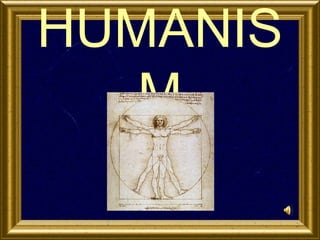

HUMANIS
M
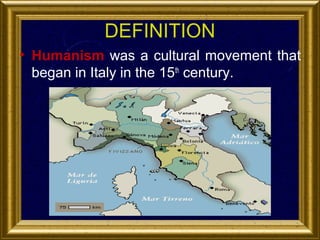
DEFINITION
• Humanism was a cultural movement that
began in Italy in the 15th century.
MAIN CHARACTERISTICS
• Importance of the human being. Human
being will be the new centre of the
Universe.
• Interest
in
scientific
and
and
technological progress, based in
observation and experimentation.
• Interest in Greek and Latin classical
cultures.
• Use of the languages of each country.
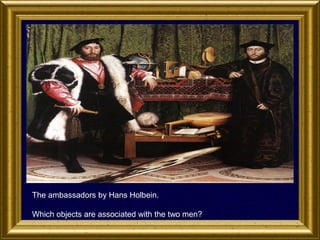
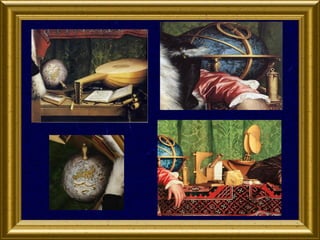
The ambassadors by Hans Holbein.
Which objects are associated with the two men?
THE SPREAD OF HUMANISM
• Schools and Universities were the
driving force behing humanist thought.
• Schools were supported by patrons, who
offered economic support.
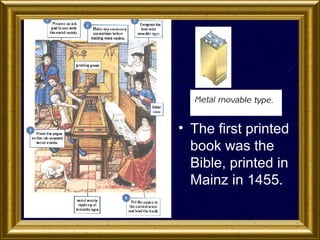
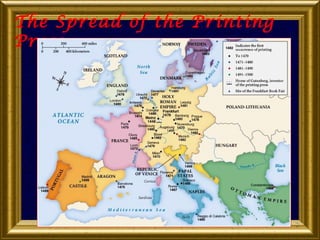
• The invention of the printing press by
Juan Gutemberg (1450) was the most
important contribution to the spread of
humanist ideas.
• The first printed
book was the
Bible, printed in
Mainz in 1455.
The Spread of the Printing
Press
LET’S REMEMBER THE WAY OF THINGKING
• The human being is, after God, in a privileged
place in the Universe.
• Human being are free and they can decide their
own destination.
• God created man in his image and likeness.
Man must aspire to the highest.
¿QUÉ ES EL HUMANISMO?
• FUE UN MOVIMIENTO INTELECTUAL
QUE SE DIFUNDIÓ DESDE ITALIA AL
RESTO DE EUROPA
• LOS PILARES DE ESTE MOVIMIENTO
FUERON LA REVALORIZACIÓN DEL
ANTIGUO MUNDO CLÁSICO Y LA
EXALTACIÓN DEL SER HUMANO.
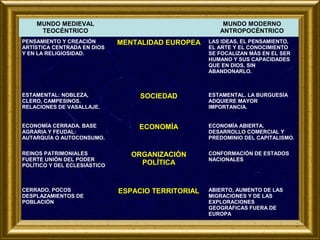
MUNDO MEDIEVAL
TEOCÉNTRICO

MUNDO MODERNO
ANTROPOCÉNTRICO

MENTALIDAD EUROPEA

LAS IDEAS, EL PENSAMIENTO,
EL ARTE Y EL CONOCIMIENTO
SE FOCALIZAN MÁS EN EL SER
HUMANO Y SUS CAPACIDADES
QUE EN DIOS, SIN
ABANDONARLO.

ESTAMENTAL: NOBLEZA,
CLERO, CAMPESINOS.
RELACIONES DE VASALLAJE.

SOCIEDAD

ESTAMENTAL. LA BURGUESÍA
ADQUIERE MAYOR
IMPORTANCIA.

ECONOMÍA CERRADA. BASE
AGRARIA Y FEUDAL:
AUTARQUÍA O AUTOCONSUMO.

ECONOMÍA

ECONOMÍA ABIERTA.
DESARROLLO COMERCIAL Y
PREDOMINIO DEL CAPITALISMO.

REINOS PATRIMONIALES
FUERTE UNIÓN DEL PODER
POLÍTICO Y DEL ECLESIÁSTICO

ORGANIZACIÓN
POLÍTICA

PENSAMIENTO Y CREACIÓN
ARTÍSTICA CENTRADA EN DIOS
Y EN LA RELIGIOSIDAD.

CERRADO, POCOS
DESPLAZAMIENTOS DE
POBLACIÓN

ESPACIO TERRITORIAL

CONFORMACIÓN DE ESTADOS
NACIONALES

ABIERTO, AUMENTO DE LAS
MIGRACIONES Y DE LAS
EXPLORACIONES
GEOGRÁFICAS FUERA DE
EUROPA
SEVERAL EVENTS
•
•
•
•
•
•
•
•

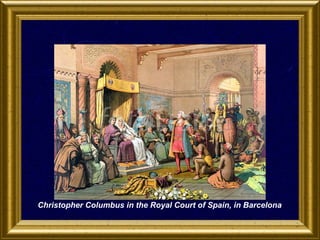
1492 : Columbus discovered América
1503-1507 : La Gioconda, de Da Vinci
1515-1547 : reign of François 1er
1519 : Cortés conquered México – first world tour by
Magallanes and Elcano.
1532 : Pizarro conquered Peru. Pantagruel, by Rabelais
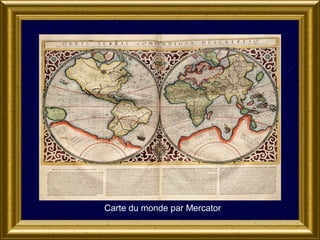
1538 : Mercator prepared the first world map.
1543 : Copérnico did his theory heliocentric of the
Universe.
1547 : Miguel Ángel built the dome of San Pedro in The
Vatican.
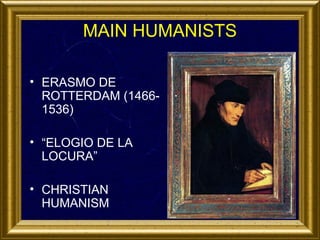
MAIN HUMANISTS
• ERASMO DE
ROTTERDAM (14661536)
• “ELOGIO DE LA
LOCURA”
• CHRISTIAN
HUMANISM
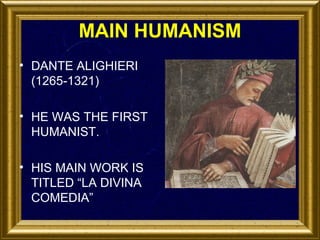
MAIN HUMANISM
• DANTE ALIGHIERI
(1265-1321)
• HE WAS THE FIRST
HUMANIST.
• HIS MAIN WORK IS
TITLED “LA DIVINA
COMEDIA”
MAIN HUMANISTS
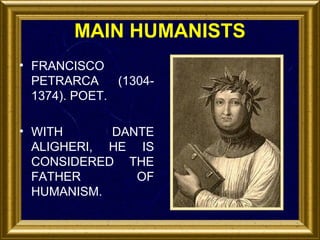
• FRANCISCO
PETRARCA
(13041374). POET.
• WITH
DANTE
ALIGHERI, HE IS
CONSIDERED THE
FATHER
OF
HUMANISM.
MAIN HUMANISTS
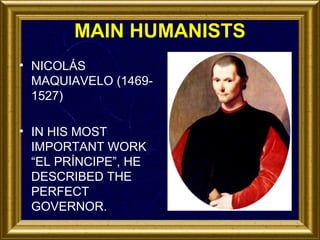
• NICOLÁS
MAQUIAVELO (14691527)
• IN HIS MOST
IMPORTANT WORK
“EL PRÍNCIPE”, HE
DESCRIBED THE
PERFECT
GOVERNOR.
MAIN HUMANISTS
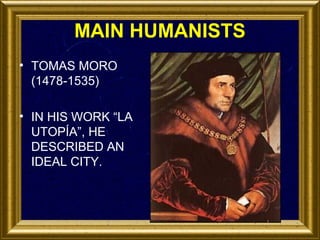
• TOMAS MORO
(1478-1535)
• IN HIS WORK “LA
UTOPÍA”, HE
DESCRIBED AN
IDEAL CITY.
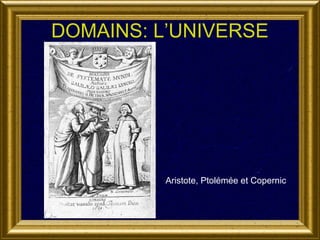
DOMAINS: L’UNIVERSE

Aristote, Ptolémée et Copernic
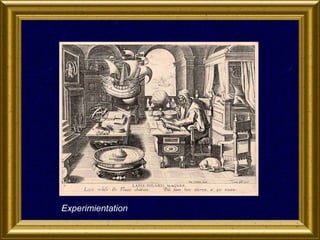
Experimientation
Carte du monde par Mercator
Christopher Columbus in the Royal Court of Spain, in Barcelona
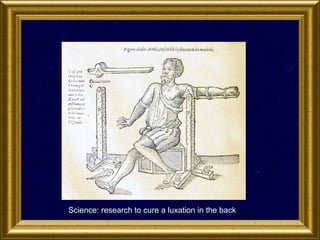
Science: research to cure a luxation in the back
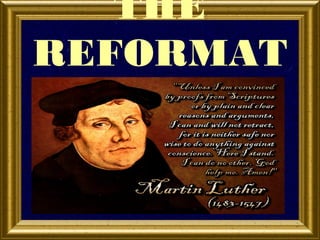
THE
REFORMAT
ION
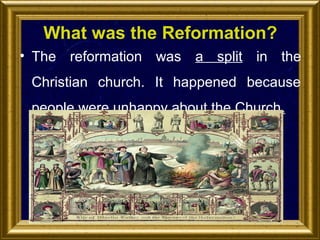
What was the Reformation?
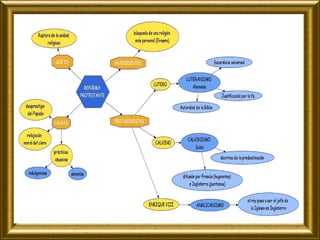
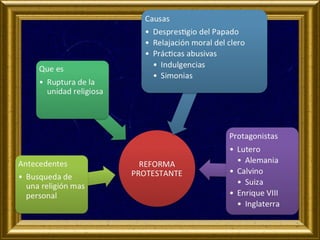
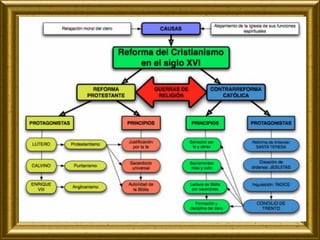
• The reformation was a split in the
Christian church. It happened because
people were unhappy about the Church.
What was the Reformation?
• They
are
called
Protestants because
they protested and
started a new religion.
• It
is
called
the
Reformation because
they set out to reform
the Church.
CAUSES OF THE REFORMATION
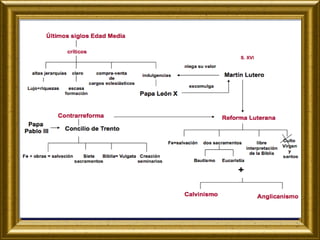
• Attitudes of the high clergy: luxurious
lifestyles, lack of chastity.
• Lack of preparation of clergy.
• The sale of ecclesiastical charges.
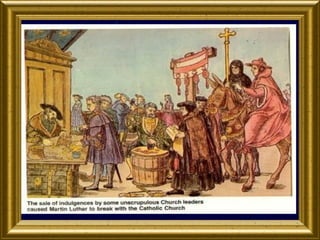
• The sale of indulgences: payments
received for pardoning sins.
• The sale of bulas: documents that allowed
to do things that were prohibited by the
Church.
Why Reform?
• Popes corrupted by power & lose focus of
spiritual leadership
• People wanted to know how to save souls
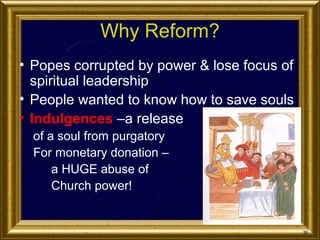
• Indulgences –a release
of a soul from purgatory
For monetary donation –
a HUGE abuse of
Church power!

30
The Pope’s Corruption
• The Pope spent too much money on the
arts
• Spent on personal pleasure
• Fought Wars
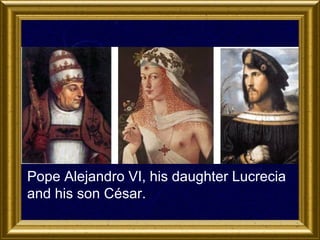
• Pope Alexander VI fathered several
children
• Priests were uneducated, drank, and
gambled
http://www.history.com/videos/martin-luther-sparks-arevolution#martin-luther-sparks-a-revolution

31
31
Pope Alejandro VI, his daughter Lucrecia
and his son César.
Abuses in the Church:
a. Ignorant priests who didn’t even
understand the mass
b. Wealthy bishops who had more interest
in money than religion
c. Immoral popes like Alexander VI who
had mistresses and 7 children and Sixtus
who planned to assassinate Lorenzo de
Medici
d. Also,
simony,
nepotism
and
absenteesim
Simony

To bribe people to elect you to
high position in the church

Nepotism

To give important jobs in the
church to your relatives

Absenteeism

To neglect your parish or
dioceses because you don’t
live there
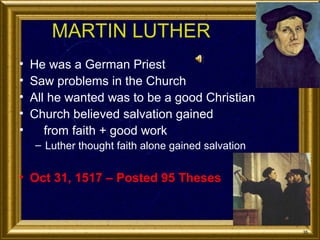
MARTIN LUTHER
•
•
•
•
•

He was a German Priest
Saw problems in the Church
All he wanted was to be a good Christian
Church believed salvation gained
from faith + good work
– Luther thought faith alone gained salvation

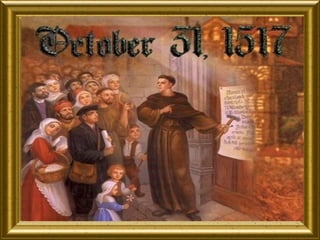
• Oct 31, 1517 – Posted 95 Theses

35
95 Thesis
• Attacked the “Pardon Merchants”
• Lead to the Founding of Christian
Churches that did not accept the Pope’s
authority
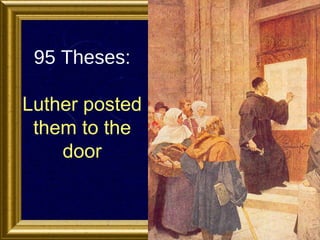
• Posted on church door in Wittenburg,
Germany
• Thousands of copies distributed
throughout Germany
36
36
95 Theses:
Luther posted
them to the
door
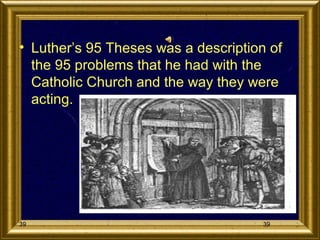
• Luther’s 95 Theses was a description of
the 95 problems that he had with the
Catholic Church and the way they were
acting.

39

39
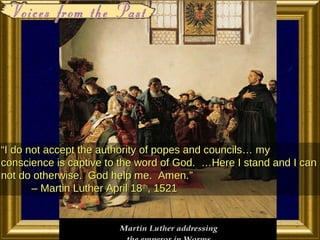
“I do not accept the authority of popes and councils… my
conscience is captive to the word of God. …Here I stand and I can
not do otherwise. God help me. Amen.”
– Martin Luther April 18th, 1521
The Pope & Luther
• The Pope issued a papal bull or bula (a
papal bull is an official document from the
pope)
• He warned Luther to give up his ideas
• Luther burned the bull in public
• The
Pope
responded
by
excommunicating Luther and declaring
him a heretic
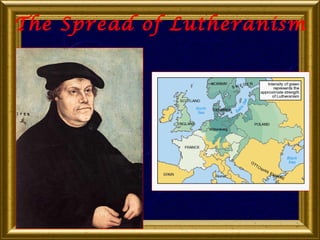
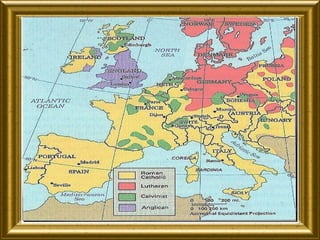
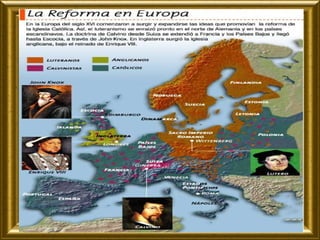
Spread of Lutheranism
• Some German princes liked Luther’s ideas.
• German states were run by princes but were part of the
Holy Roman Empire
• Emperor Charles V called a meeting of the princes
called the Diet of Worms. Luther refused to give up his
ideas.
• Charles V issued the Edict of Worms which said Luther
was an outlaw.
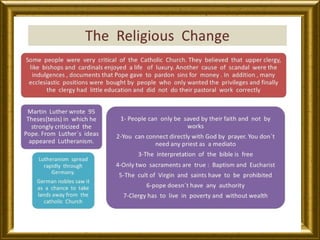
PRINCIPLES OF LUTHERANISM
• Lutheranism was based on three
fundamental principles:
Salvation through faith alone.
Universal priesthood.
The authority and free interpretation of the
Bible.
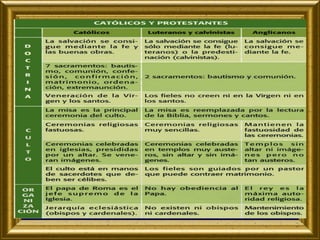
CARACTERÍSTICAS DEL LUTERANISMO
• Las personas se salvaban por la fe, no
por las obras.
• La fuente de verdad eran los libros
sagrados.
• Sólo hay dos sacramentos: el bautismo y
la eucaristía.
• El culto a la Virgen y los santos debe
prohibirse.
• Negaba la autoridad del Papa.
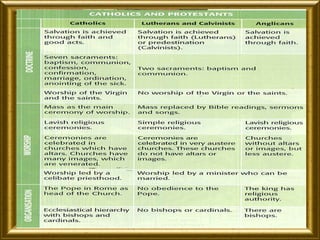
DIFFERENCES

Lutheran
• Only faith in Jesus saves
your soul (Justification by
faith alone)
• Religious truth is in the
Bible
• 2 sacraments exist:
baptism and communion
• The local prince rules the
church
• Priests can marry

Catholic
• Faith in God and good
works saves your soul
• Religious truth is in
the Bible and church
teaching
• 7 sacraments exist
• The head of the church is
the Pope in Rome
• Priests must not marry
The Differences: Churches
Protestant
• Protestant churches
were plain and simple
• No statues or art
• Priests wore plain
garments
• The service was in
the vernacular
language, not Latin

Catholic
• Catholic Churches
were richly decorated
• Lots of statues and
art work
• Priests wore rich
garments
• They said mass in
Latin
The Spread of Lutheranism
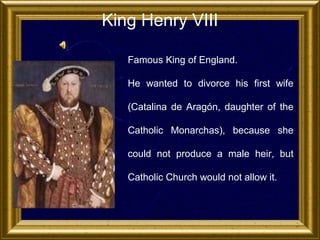
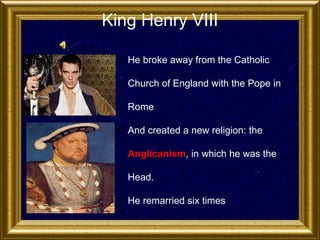
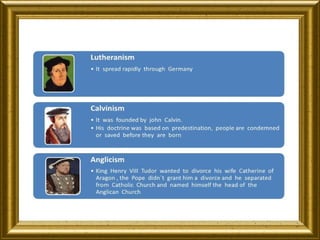
King Henry VIII
• Famous King of England.
• He wanted to divorce his first wife
(Catalina de Aragón, daughter of the
Catholic Monarchas), because she
could not produce a male heir, but
Catholic Church would not allow it.
King Henry VIII
• He broke away from the Catholic
Church of England with the Pope in
Rome
• And created a new religion: the
Anglicanism, in which he was the
Head.
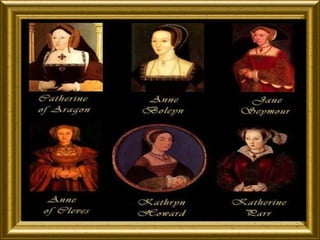
• He remarried six times
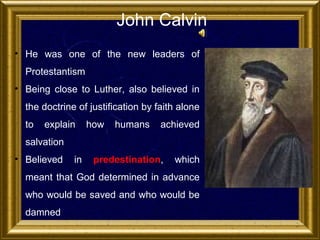
John Calvin
• He was one of the new leaders of
Protestantism
• Being close to Luther, also believed in
the doctrine of justification by faith alone
to

explain

how

humans

achieved

salvation
• Believed

in

predestination,

which

meant that God determined in advance
who would be saved and who would be
damned
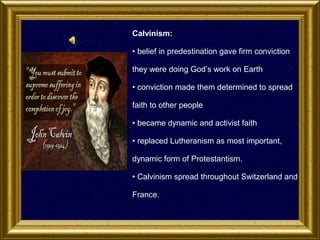
Calvinism:
• belief in predestination gave firm conviction
they were doing God’s work on Earth
• conviction made them determined to spread
faith to other people
• became dynamic and activist faith
• replaced Lutheranism as most important,
dynamic form of Protestantism.
• Calvinism spread throughout Switzerland and
France.
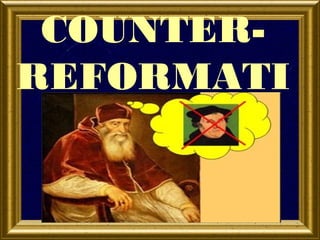
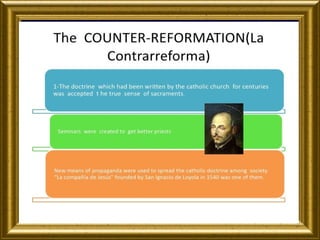
COUNTERREFORMATI
ON
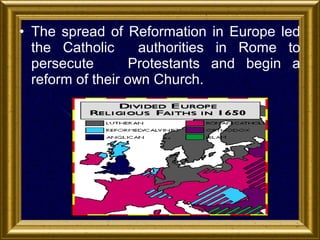
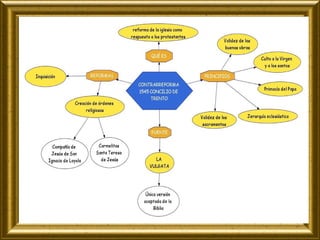
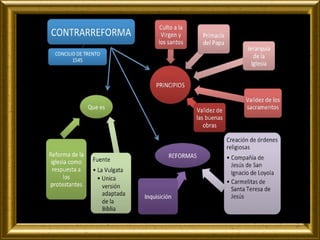
• The spread of Reformation in Europe led
the Catholic
authorities in Rome to
persecute
Protestants and begin a
reform of their own Church.
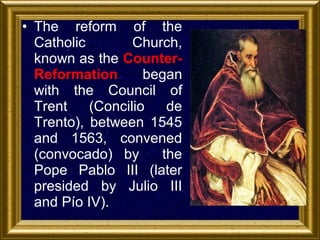
• The reform of the
Catholic
Church,
known as the CounterReformation
began
with the Council of
Trent
(Concilio
de
Trento), between 1545
and 1563, convened
(convocado) by
the
Pope Pablo III (later
presided by Julio III
and Pío IV).
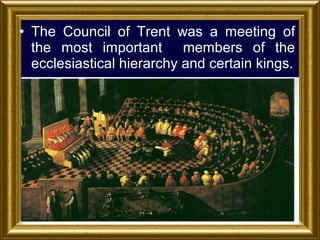
• The Council of Trent was a meeting of
the most important members of the
ecclesiastical hierarchy and certain kings.
• The Council reaffirmed
dogmas of Catholicism:

the

main

 Faith and validity of good deeds (buenas
obras) to get salvation.
 The santity of Mass.
 The seven sacraments.
 The worship of the Virgin Mary and the
saints.
 Reaffirmed the authority of the Pope.
 The only admitted version of the Bible will be
the Vulgata by San Jerónimo.
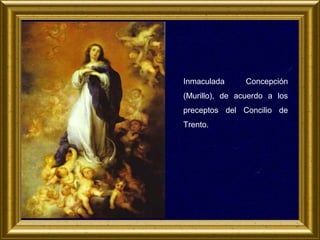
Inmaculada

Concepción

(Murillo), de acuerdo a los
preceptos del Concilio de
Trento.
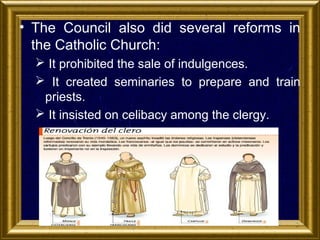
• The Council also did several reforms in
the Catholic Church:
 It prohibited the sale of indulgences.
 It created seminaries to prepare and train
priests.
 It insisted on celibacy among the clergy.
• These reforms were carried out in many
Catholic religious orders, such us the
Carmelites (reformed by Saint Teresa de
Jesús).
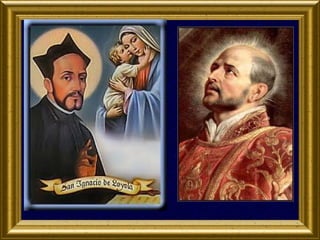
• New orders were created, such as la
Compañía de Jesús or los Jesuitas (the
Society of Jesus or the Jesuits), founded
by Saint Ignacio de Loyola.
• The Churh encouraged the role of the
Court of the Inquisition, to judge the cases
of heresy (acts against the faith, for
example, to become protestant).
https://www.youtube.com/watch?
feature=player_embedded&v=qd_nTF3Lrpo
Humanism and Reformation. 2º ESO (bil. inglés).

Humanism and Reformation. 2º ESO (bil. inglés).

  • 2.
  • 3.
    DEFINITION • Humanism wasa cultural movement that began in Italy in the 15th century.
  • 4.
    MAIN CHARACTERISTICS • Importanceof the human being. Human being will be the new centre of the Universe. • Interest in scientific and and technological progress, based in observation and experimentation. • Interest in Greek and Latin classical cultures. • Use of the languages of each country.
  • 5.
    The ambassadors byHans Holbein. Which objects are associated with the two men?
  • 7.
    THE SPREAD OFHUMANISM • Schools and Universities were the driving force behing humanist thought. • Schools were supported by patrons, who offered economic support. • The invention of the printing press by Juan Gutemberg (1450) was the most important contribution to the spread of humanist ideas.
  • 8.
    • The firstprinted book was the Bible, printed in Mainz in 1455.
  • 9.
    The Spread ofthe Printing Press
  • 10.
    LET’S REMEMBER THEWAY OF THINGKING • The human being is, after God, in a privileged place in the Universe. • Human being are free and they can decide their own destination. • God created man in his image and likeness. Man must aspire to the highest.
  • 11.
    ¿QUÉ ES ELHUMANISMO? • FUE UN MOVIMIENTO INTELECTUAL QUE SE DIFUNDIÓ DESDE ITALIA AL RESTO DE EUROPA • LOS PILARES DE ESTE MOVIMIENTO FUERON LA REVALORIZACIÓN DEL ANTIGUO MUNDO CLÁSICO Y LA EXALTACIÓN DEL SER HUMANO.
  • 12.
    MUNDO MEDIEVAL TEOCÉNTRICO MUNDO MODERNO ANTROPOCÉNTRICO MENTALIDADEUROPEA LAS IDEAS, EL PENSAMIENTO, EL ARTE Y EL CONOCIMIENTO SE FOCALIZAN MÁS EN EL SER HUMANO Y SUS CAPACIDADES QUE EN DIOS, SIN ABANDONARLO. ESTAMENTAL: NOBLEZA, CLERO, CAMPESINOS. RELACIONES DE VASALLAJE. SOCIEDAD ESTAMENTAL. LA BURGUESÍA ADQUIERE MAYOR IMPORTANCIA. ECONOMÍA CERRADA. BASE AGRARIA Y FEUDAL: AUTARQUÍA O AUTOCONSUMO. ECONOMÍA ECONOMÍA ABIERTA. DESARROLLO COMERCIAL Y PREDOMINIO DEL CAPITALISMO. REINOS PATRIMONIALES FUERTE UNIÓN DEL PODER POLÍTICO Y DEL ECLESIÁSTICO ORGANIZACIÓN POLÍTICA PENSAMIENTO Y CREACIÓN ARTÍSTICA CENTRADA EN DIOS Y EN LA RELIGIOSIDAD. CERRADO, POCOS DESPLAZAMIENTOS DE POBLACIÓN ESPACIO TERRITORIAL CONFORMACIÓN DE ESTADOS NACIONALES ABIERTO, AUMENTO DE LAS MIGRACIONES Y DE LAS EXPLORACIONES GEOGRÁFICAS FUERA DE EUROPA
  • 14.
    SEVERAL EVENTS • • • • • • • • 1492 :Columbus discovered América 1503-1507 : La Gioconda, de Da Vinci 1515-1547 : reign of François 1er 1519 : Cortés conquered México – first world tour by Magallanes and Elcano. 1532 : Pizarro conquered Peru. Pantagruel, by Rabelais 1538 : Mercator prepared the first world map. 1543 : Copérnico did his theory heliocentric of the Universe. 1547 : Miguel Ángel built the dome of San Pedro in The Vatican.
  • 15.
    MAIN HUMANISTS • ERASMODE ROTTERDAM (14661536) • “ELOGIO DE LA LOCURA” • CHRISTIAN HUMANISM
  • 16.
    MAIN HUMANISM • DANTEALIGHIERI (1265-1321) • HE WAS THE FIRST HUMANIST. • HIS MAIN WORK IS TITLED “LA DIVINA COMEDIA”
  • 17.
    MAIN HUMANISTS • FRANCISCO PETRARCA (13041374).POET. • WITH DANTE ALIGHERI, HE IS CONSIDERED THE FATHER OF HUMANISM.
  • 18.
    MAIN HUMANISTS • NICOLÁS MAQUIAVELO(14691527) • IN HIS MOST IMPORTANT WORK “EL PRÍNCIPE”, HE DESCRIBED THE PERFECT GOVERNOR.
  • 19.
    MAIN HUMANISTS • TOMASMORO (1478-1535) • IN HIS WORK “LA UTOPÍA”, HE DESCRIBED AN IDEAL CITY.
  • 20.
  • 21.
  • 22.
    Carte du mondepar Mercator
  • 23.
    Christopher Columbus inthe Royal Court of Spain, in Barcelona
  • 24.
    Science: research tocure a luxation in the back
  • 25.
  • 26.
    What was theReformation? • The reformation was a split in the Christian church. It happened because people were unhappy about the Church.
  • 27.
    What was theReformation? • They are called Protestants because they protested and started a new religion. • It is called the Reformation because they set out to reform the Church.
  • 28.
    CAUSES OF THEREFORMATION • Attitudes of the high clergy: luxurious lifestyles, lack of chastity. • Lack of preparation of clergy. • The sale of ecclesiastical charges. • The sale of indulgences: payments received for pardoning sins. • The sale of bulas: documents that allowed to do things that were prohibited by the Church.
  • 30.
    Why Reform? • Popescorrupted by power & lose focus of spiritual leadership • People wanted to know how to save souls • Indulgences –a release of a soul from purgatory For monetary donation – a HUGE abuse of Church power! 30
  • 31.
    The Pope’s Corruption •The Pope spent too much money on the arts • Spent on personal pleasure • Fought Wars • Pope Alexander VI fathered several children • Priests were uneducated, drank, and gambled http://www.history.com/videos/martin-luther-sparks-arevolution#martin-luther-sparks-a-revolution 31 31
  • 32.
    Pope Alejandro VI,his daughter Lucrecia and his son César.
  • 33.
    Abuses in theChurch: a. Ignorant priests who didn’t even understand the mass b. Wealthy bishops who had more interest in money than religion c. Immoral popes like Alexander VI who had mistresses and 7 children and Sixtus who planned to assassinate Lorenzo de Medici d. Also, simony, nepotism and absenteesim
  • 34.
    Simony To bribe peopleto elect you to high position in the church Nepotism To give important jobs in the church to your relatives Absenteeism To neglect your parish or dioceses because you don’t live there
  • 35.
    MARTIN LUTHER • • • • • He wasa German Priest Saw problems in the Church All he wanted was to be a good Christian Church believed salvation gained from faith + good work – Luther thought faith alone gained salvation • Oct 31, 1517 – Posted 95 Theses 35
  • 36.
    95 Thesis • Attackedthe “Pardon Merchants” • Lead to the Founding of Christian Churches that did not accept the Pope’s authority • Posted on church door in Wittenburg, Germany • Thousands of copies distributed throughout Germany 36 36
  • 38.
  • 39.
    • Luther’s 95Theses was a description of the 95 problems that he had with the Catholic Church and the way they were acting. 39 39
  • 40.
    “I do notaccept the authority of popes and councils… my conscience is captive to the word of God. …Here I stand and I can not do otherwise. God help me. Amen.” – Martin Luther April 18th, 1521
  • 41.
    The Pope &Luther • The Pope issued a papal bull or bula (a papal bull is an official document from the pope) • He warned Luther to give up his ideas • Luther burned the bull in public • The Pope responded by excommunicating Luther and declaring him a heretic
  • 42.
    Spread of Lutheranism •Some German princes liked Luther’s ideas. • German states were run by princes but were part of the Holy Roman Empire • Emperor Charles V called a meeting of the princes called the Diet of Worms. Luther refused to give up his ideas. • Charles V issued the Edict of Worms which said Luther was an outlaw.
  • 43.
    PRINCIPLES OF LUTHERANISM •Lutheranism was based on three fundamental principles: Salvation through faith alone. Universal priesthood. The authority and free interpretation of the Bible.
  • 44.
    CARACTERÍSTICAS DEL LUTERANISMO •Las personas se salvaban por la fe, no por las obras. • La fuente de verdad eran los libros sagrados. • Sólo hay dos sacramentos: el bautismo y la eucaristía. • El culto a la Virgen y los santos debe prohibirse. • Negaba la autoridad del Papa.
  • 45.
    DIFFERENCES Lutheran • Only faithin Jesus saves your soul (Justification by faith alone) • Religious truth is in the Bible • 2 sacraments exist: baptism and communion • The local prince rules the church • Priests can marry Catholic • Faith in God and good works saves your soul • Religious truth is in the Bible and church teaching • 7 sacraments exist • The head of the church is the Pope in Rome • Priests must not marry
  • 46.
    The Differences: Churches Protestant •Protestant churches were plain and simple • No statues or art • Priests wore plain garments • The service was in the vernacular language, not Latin Catholic • Catholic Churches were richly decorated • Lots of statues and art work • Priests wore rich garments • They said mass in Latin
  • 47.
    The Spread ofLutheranism
  • 48.
    King Henry VIII •Famous King of England. • He wanted to divorce his first wife (Catalina de Aragón, daughter of the Catholic Monarchas), because she could not produce a male heir, but Catholic Church would not allow it.
  • 49.
    King Henry VIII •He broke away from the Catholic Church of England with the Pope in Rome • And created a new religion: the Anglicanism, in which he was the Head. • He remarried six times
  • 51.
    John Calvin • Hewas one of the new leaders of Protestantism • Being close to Luther, also believed in the doctrine of justification by faith alone to explain how humans achieved salvation • Believed in predestination, which meant that God determined in advance who would be saved and who would be damned
  • 52.
    Calvinism: • belief inpredestination gave firm conviction they were doing God’s work on Earth • conviction made them determined to spread faith to other people • became dynamic and activist faith • replaced Lutheranism as most important, dynamic form of Protestantism. • Calvinism spread throughout Switzerland and France.
  • 59.
  • 60.
    • The spreadof Reformation in Europe led the Catholic authorities in Rome to persecute Protestants and begin a reform of their own Church.
  • 61.
    • The reformof the Catholic Church, known as the CounterReformation began with the Council of Trent (Concilio de Trento), between 1545 and 1563, convened (convocado) by the Pope Pablo III (later presided by Julio III and Pío IV).
  • 62.
    • The Councilof Trent was a meeting of the most important members of the ecclesiastical hierarchy and certain kings.
  • 63.
    • The Councilreaffirmed dogmas of Catholicism: the main  Faith and validity of good deeds (buenas obras) to get salvation.  The santity of Mass.  The seven sacraments.  The worship of the Virgin Mary and the saints.  Reaffirmed the authority of the Pope.  The only admitted version of the Bible will be the Vulgata by San Jerónimo.
  • 64.
    Inmaculada Concepción (Murillo), de acuerdoa los preceptos del Concilio de Trento.
  • 65.
    • The Councilalso did several reforms in the Catholic Church:  It prohibited the sale of indulgences.  It created seminaries to prepare and train priests.  It insisted on celibacy among the clergy.
  • 66.
    • These reformswere carried out in many Catholic religious orders, such us the Carmelites (reformed by Saint Teresa de Jesús). • New orders were created, such as la Compañía de Jesús or los Jesuitas (the Society of Jesus or the Jesuits), founded by Saint Ignacio de Loyola.
  • 68.
    • The Churhencouraged the role of the Court of the Inquisition, to judge the cases of heresy (acts against the faith, for example, to become protestant).
  • 74.