COMPARISON
BETWEEN MIDDLE
AGES-RENAISSANCE
Maria Fernanda Galeano
Maria Camila Rodriguez
Laura Morales
OBJECTIVE
To analyze and compare social and cultural
aspects from Renaissance and Middle Ages;
according to pages 205-208.
CONTEXT
 The Middle Ages is known as a period of time between
the 5th and the 15th century. It was the lapse of time that
lasted since the fall of the Roman Empire till Renaissance.
People described this period as a stage in which life was
very hard. They used feudalism as a social system, thus they
were classified in social classes (slavery was permitted).
About cultural aspects, people wasn`t able to access into
education; this made the impact of the church bigger.
CONTEXT
The Renaissance was a period of time between
14th to 17th century. As a cultural movement it
brought new ways to perceive the world, it innovated
techniques in art, literature, politics, science among
others. It changed society`s point of view towards:
women role, fashion, church`s impact and many
others.
Criteria
Middle
Ages Renaissance
Women`s
role
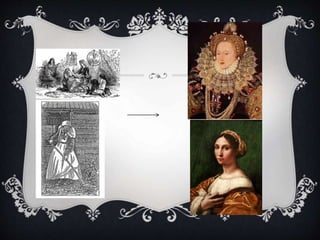
• Women`s role was very
limited and depended
entirely on their husbands
and father`s social status.
• Women had no rights.
• Women must achieve
housework., child hearing
and fieldwork.
• Women had more empowerment
and voice, one clear example is
Elizabeth I, she was one of the
most successful monarchs in
history ; she rejected the Pope`s
authority and reestablished the
church of England. She was
characterized by being intelligent
and independent. (Page 205)
Criteria
Middle
Ages
Renaissance
Gender Equality
• “The woman is subjected to
man on account of the
weakness of her nature”-
Bible extract.
• Taking into account that
society was attached to the
Bible commandments; it
shows the way women were
socially inferior than men.
They didn`t have any rights
or possibilities to emerge in
society.
• Because of society`s idea od
“learning spread” women of
the upper classes became
beneficiary of it. This fact
shows the transition of an
era in which women didn`t
have any type od education,
to a new culture in which
women didn`t have any type
of education, to a mew
culture in which they had
access to a kind of learning.
• It was the beginning of
gender equality.
Criteria
Middle
Ages Renaissance
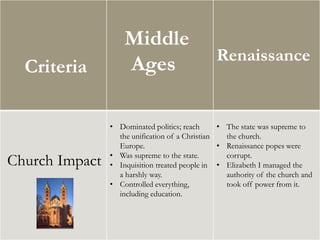
Church Impact
• Dominated politics; reach
the unification of a Christian
Europe.
• Was supreme to the state.
• Inquisition treated people in
a harshly way.
• Controlled everything,
including education.
• The state was supreme to
the church.
• Renaissance popes were
corrupt.
• Elizabeth I managed the
authority of the church and
took off power from it.
Criteria Middle
Ages Renaissance
Fashion
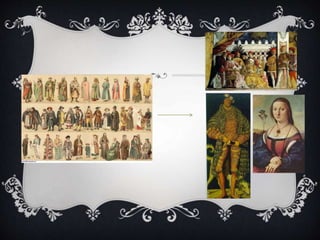
• Men mostly wore tunics
down to their knees, but
old men and monks wore
their tunics down to the
ground, and so kings and
noblemen for parties and
ceremonies. They also
wore wool pants under
their tunics.
• Especially noblemen,
wore socks under their
tunics. Outside, if it was
cold, men wore wool
layers.
• They insisted on rich
fabrics, such as fur.
• A wealthy person would
have a variety of clothes
made from fine materials,
furs, and silks.
• Men wore colorful tights
or stockings with a shirt
and coat.
Criteria
Middle
Ages
Renaissance
Fashion
• Women also wore different
kinds of clothes All women
wore at least one tunic down
to their ankles. Many women
wore a linen under-tunic and
a woolen over-tunic, and
often a wool cloak over that
if they were going outside.
On their legs women
sometimes wore woven
socks, but women never
wore pants.
• Noblewomen often wore
fancy tall hats, sometimes
with streamers coming off
them. Sometimes they
plucked the hair from their
foreheads to give themselves
• They curled their hair,
perfumed their gloves and
sometimes men wore
makeup.
• They liked pearls in
jewelry, wealthy women
would have elaborate
jewelry made of gold
• Starched linen neck ruffs
from shoulder to shoulder.
• Exaggerated use of
clothes.
• Women corseted their
waists.
• Colors had a meaning, for
example green meant love.
• Women wore long dresses.
CONCLUSION
 After analyzing the difference between the Middle Ages and the renaissance period,
we infer that the renaissance took “culture into another dimension”. This means that it
changed the way people perceived the world. Using different criteria, such as women
role in society, gender equality, the church´s role, among others; we deduce that by the
time of the 15th century (beginnings of renaissance) people started to think into
another way; education was very important, church wasn´t the center of their lives, and
in political terms the state was more important than religion. Changes that led women
take place in the society; gave them a kind of new status where they would be able to
emerge as a rational human being, and start making bigger achievements, that latter
would led to a whole women revolution, and standardization of their
CONCLUSION
 It is evident that life from the Middle Ages was very different towards life
from Renaissance. In the first one, everything worked around feudalism, fact
that implies living with the simplicity but social difference that represented this
system. This can be analyzed on their artworks, in this case in their fashion,
which was neither much detailed nor extravagant. Meanwhile, the Renaissance
as its name expresses it, is the rebirth, thus it was an era of extreme changes;
were fashion, art, among other types of expression took place; making clothes
and symbols a relevant element on their daily life, making tributes to the
fabrics, colors, and others.

Comparison between Middle Ages and Renaissance

  • 1.
    COMPARISON BETWEEN MIDDLE AGES-RENAISSANCE Maria FernandaGaleano Maria Camila Rodriguez Laura Morales
  • 2.
    OBJECTIVE To analyze andcompare social and cultural aspects from Renaissance and Middle Ages; according to pages 205-208.
  • 3.
    CONTEXT  The MiddleAges is known as a period of time between the 5th and the 15th century. It was the lapse of time that lasted since the fall of the Roman Empire till Renaissance. People described this period as a stage in which life was very hard. They used feudalism as a social system, thus they were classified in social classes (slavery was permitted). About cultural aspects, people wasn`t able to access into education; this made the impact of the church bigger.
  • 4.
    CONTEXT The Renaissance wasa period of time between 14th to 17th century. As a cultural movement it brought new ways to perceive the world, it innovated techniques in art, literature, politics, science among others. It changed society`s point of view towards: women role, fashion, church`s impact and many others.
  • 5.
    Criteria Middle Ages Renaissance Women`s role • Women`srole was very limited and depended entirely on their husbands and father`s social status. • Women had no rights. • Women must achieve housework., child hearing and fieldwork. • Women had more empowerment and voice, one clear example is Elizabeth I, she was one of the most successful monarchs in history ; she rejected the Pope`s authority and reestablished the church of England. She was characterized by being intelligent and independent. (Page 205)
  • 7.
    Criteria Middle Ages Renaissance Gender Equality • “Thewoman is subjected to man on account of the weakness of her nature”- Bible extract. • Taking into account that society was attached to the Bible commandments; it shows the way women were socially inferior than men. They didn`t have any rights or possibilities to emerge in society. • Because of society`s idea od “learning spread” women of the upper classes became beneficiary of it. This fact shows the transition of an era in which women didn`t have any type od education, to a new culture in which women didn`t have any type of education, to a mew culture in which they had access to a kind of learning. • It was the beginning of gender equality.
  • 8.
    Criteria Middle Ages Renaissance Church Impact •Dominated politics; reach the unification of a Christian Europe. • Was supreme to the state. • Inquisition treated people in a harshly way. • Controlled everything, including education. • The state was supreme to the church. • Renaissance popes were corrupt. • Elizabeth I managed the authority of the church and took off power from it.
  • 9.
    Criteria Middle Ages Renaissance Fashion •Men mostly wore tunics down to their knees, but old men and monks wore their tunics down to the ground, and so kings and noblemen for parties and ceremonies. They also wore wool pants under their tunics. • Especially noblemen, wore socks under their tunics. Outside, if it was cold, men wore wool layers. • They insisted on rich fabrics, such as fur. • A wealthy person would have a variety of clothes made from fine materials, furs, and silks. • Men wore colorful tights or stockings with a shirt and coat.
  • 10.
    Criteria Middle Ages Renaissance Fashion • Women alsowore different kinds of clothes All women wore at least one tunic down to their ankles. Many women wore a linen under-tunic and a woolen over-tunic, and often a wool cloak over that if they were going outside. On their legs women sometimes wore woven socks, but women never wore pants. • Noblewomen often wore fancy tall hats, sometimes with streamers coming off them. Sometimes they plucked the hair from their foreheads to give themselves • They curled their hair, perfumed their gloves and sometimes men wore makeup. • They liked pearls in jewelry, wealthy women would have elaborate jewelry made of gold • Starched linen neck ruffs from shoulder to shoulder. • Exaggerated use of clothes. • Women corseted their waists. • Colors had a meaning, for example green meant love. • Women wore long dresses.
  • 12.
    CONCLUSION  After analyzingthe difference between the Middle Ages and the renaissance period, we infer that the renaissance took “culture into another dimension”. This means that it changed the way people perceived the world. Using different criteria, such as women role in society, gender equality, the church´s role, among others; we deduce that by the time of the 15th century (beginnings of renaissance) people started to think into another way; education was very important, church wasn´t the center of their lives, and in political terms the state was more important than religion. Changes that led women take place in the society; gave them a kind of new status where they would be able to emerge as a rational human being, and start making bigger achievements, that latter would led to a whole women revolution, and standardization of their
  • 13.
    CONCLUSION  It isevident that life from the Middle Ages was very different towards life from Renaissance. In the first one, everything worked around feudalism, fact that implies living with the simplicity but social difference that represented this system. This can be analyzed on their artworks, in this case in their fashion, which was neither much detailed nor extravagant. Meanwhile, the Renaissance as its name expresses it, is the rebirth, thus it was an era of extreme changes; were fashion, art, among other types of expression took place; making clothes and symbols a relevant element on their daily life, making tributes to the fabrics, colors, and others.