20th Century Spain
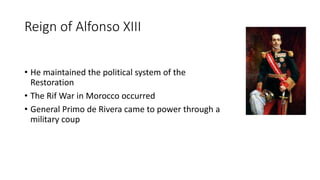
Reign of Alfonso XIII
• He maintained the political system of the
Restoration
• The Rif War in Morocco occurred
• General Primo de Rivera came to power through a
military coup
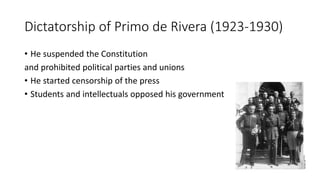
Dictatorship of Primo de Rivera (1923-1930)
• He suspended the Constitution
and prohibited political parties and unions
• He started censorship of the press
• Students and intellectuals opposed his government
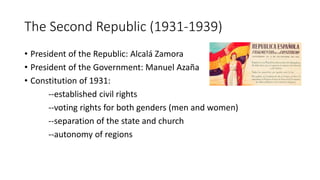
The Second Republic (1931-1939)
• President of the Republic: Alcalá Zamora
• President of the Government: Manuel Azaña
• Constitution of 1931:
--established civil rights
--voting rights for both genders (men and women)
--separation of the state and church
--autonomy of regions
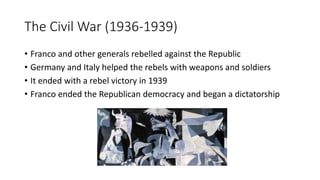
The Civil War (1936-1939)
• Franco and other generals rebelled against the Republic
• Germany and Italy helped the rebels with weapons and soldiers
• It ended with a rebel victory in 1939
• Franco ended the Republican democracy and began a dictatorship
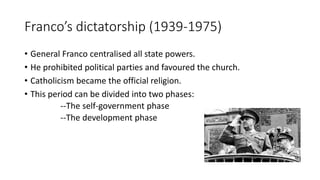
Franco’s dictatorship (1939-1975)
• General Franco centralised all state powers.
• He prohibited political parties and favoured the church.
• Catholicism became the official religion.
• This period can be divided into two phases:
--The self-government phase
--The development phase
The self-government phase
• A period of international isolation
• It lasted until the 1950s
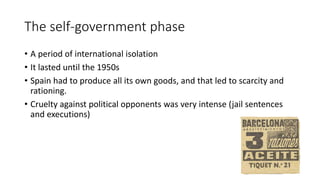
• Spain had to produce all its own goods, and that led to scarcity and
rationing.
• Cruelty against political opponents was very intense (jail sentences
and executions)
The development phase
• During the 1960s and 1970s
• Ended the isolationism
• Good for economic development
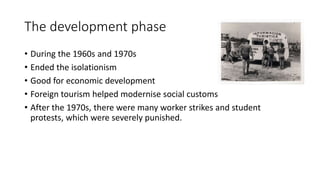
• Foreign tourism helped modernise social customs
• After the 1970s, there were many worker strikes and student
protests, which were severely punished.
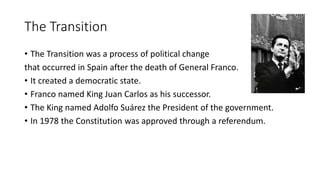
The Transition
• The Transition was a process of political change
that occurred in Spain after the death of General Franco.
• It created a democratic state.
• Franco named King Juan Carlos as his successor.
• The King named Adolfo Suárez the President of the government.
• In 1978 the Constitution was approved through a referendum.
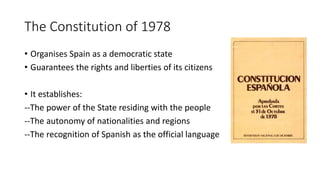
The Constitution of 1978
• Organises Spain as a democratic state
• Guarantees the rights and liberties of its citizens
• It establishes:
--The power of the State residing with the people
--The autonomy of nationalities and regions
--The recognition of Spanish as the official language
Rights and obligations
• Can you name three rights in the current
Constitution?
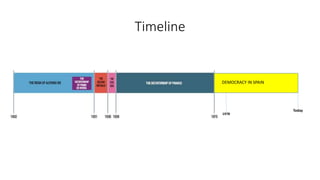
Timeline
DEMOCRACY IN SPAIN
1978
Today

20th century Spain

  • 1.
  • 2.
    Reign of AlfonsoXIII • He maintained the political system of the Restoration • The Rif War in Morocco occurred • General Primo de Rivera came to power through a military coup
  • 3.
    Dictatorship of Primode Rivera (1923-1930) • He suspended the Constitution and prohibited political parties and unions • He started censorship of the press • Students and intellectuals opposed his government
  • 4.
    The Second Republic(1931-1939) • President of the Republic: Alcalá Zamora • President of the Government: Manuel Azaña • Constitution of 1931: --established civil rights --voting rights for both genders (men and women) --separation of the state and church --autonomy of regions
  • 5.
    The Civil War(1936-1939) • Franco and other generals rebelled against the Republic • Germany and Italy helped the rebels with weapons and soldiers • It ended with a rebel victory in 1939 • Franco ended the Republican democracy and began a dictatorship
  • 6.
    Franco’s dictatorship (1939-1975) •General Franco centralised all state powers. • He prohibited political parties and favoured the church. • Catholicism became the official religion. • This period can be divided into two phases: --The self-government phase --The development phase
  • 7.
    The self-government phase •A period of international isolation • It lasted until the 1950s • Spain had to produce all its own goods, and that led to scarcity and rationing. • Cruelty against political opponents was very intense (jail sentences and executions)
  • 8.
    The development phase •During the 1960s and 1970s • Ended the isolationism • Good for economic development • Foreign tourism helped modernise social customs • After the 1970s, there were many worker strikes and student protests, which were severely punished.
  • 9.
    The Transition • TheTransition was a process of political change that occurred in Spain after the death of General Franco. • It created a democratic state. • Franco named King Juan Carlos as his successor. • The King named Adolfo Suárez the President of the government. • In 1978 the Constitution was approved through a referendum.
  • 10.
    The Constitution of1978 • Organises Spain as a democratic state • Guarantees the rights and liberties of its citizens • It establishes: --The power of the State residing with the people --The autonomy of nationalities and regions --The recognition of Spanish as the official language
  • 11.
    Rights and obligations •Can you name three rights in the current Constitution?
  • 12.