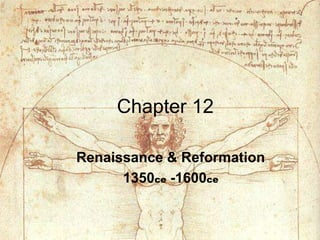
Chapter 12

Renaissance & Reformation
      1350ce -1600ce
Renaissance
 • Renaissance means rebirth; the Renaissance was a period of
   rebirth in Europe, it was a new age of learning and art.
 • The Renaissance began with the emergence of a
   secular, urban society in the wealthy city-states of Italy.
    – Milan, Venice, and Florence were particularly prosperous trading
      centers.
    – Italy was very wealthy
 • Society became more secular, or worldly (not church based).
 • Society recovered from the plague, wars, and instability of the
   previous hundred years
 • A new view of humanity emerged, emphasizing individual
   ability; a high regard for the value of human worth and
   achievement created a new social ideal
    – This new ideal was reflected in art, literature, and architecture of the
      time.
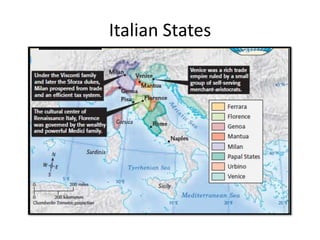
Italian States
Italian States
• The Italian States: Instead of having Rome as the center of
  civilization in Italy, other cities became important during the
  Renaissance. Italy had city-states again. The city-states prospered
  because of increased trade and wealth.
    – Milan: Northern Italy, in 1447 Francesco Sforza took over (he was a
      paid fighter, a mercenary) He had a good tax system that helped the
      government generate revenues.
    – Venice: Had an elected leader called a Doge, Trade was important and
      the government was really run by the merchants; Venice was an
      international power because of trade.
    – Florence: Merchants ran government, The de ’Medici family took
      control (Cosimo & Lorenzo). A preacher named Savonarola came into
      power by criticizing wealth. After placing strict rules on the people, he
      lost power and was sentenced to death for heresy. The Medici’s
      returned to power
• The Italian Wars: 1494-1527, fought between France vs. Italy/Spain.
  The soldiers were mercenaries. Spain ended up in Italy as the
  dominant political force.
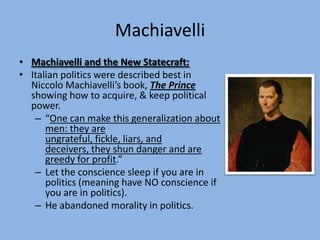
Machiavelli
• Machiavelli and the New Statecraft:
• Italian politics were described best in
  Niccolo Machiavelli’s book, The Prince
  showing how to acquire, & keep political
  power.
   – “One can make this generalization about
      men: they are
      ungrateful, fickle, liars, and
      deceivers, they shun danger and are
      greedy for profit.”
   – Let the conscience sleep if you are in
      politics (meaning have NO conscience if
      you are in politics).
   – He abandoned morality in politics.
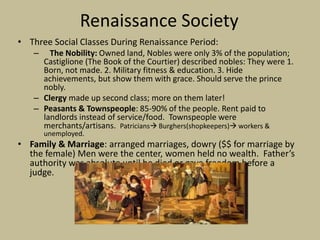
Renaissance Society
• Three Social Classes During Renaissance Period:
   –   The Nobility: Owned land, Nobles were only 3% of the population;
     Castiglione (The Book of the Courtier) described nobles: They were 1.
     Born, not made. 2. Military fitness & education. 3. Hide
     achievements, but show them with grace. Should serve the prince
     nobly.
   – Clergy made up second class; more on them later!
   – Peasants & Townspeople: 85-90% of the people. Rent paid to
     landlords instead of service/food. Townspeople were
     merchants/artisans. Patricians Burghers(shopkeepers) workers &
       unemployed.
• Family & Marriage: arranged marriages, dowry ($$ for marriage by
  the female) Men were the center, women held no wealth. Father’s
  authority was absolute until he died or gave freedom before a
  judge.
Italian Renaissance: Humanism
• Humanism was a key intellectual movement of the
  Renaissance, focusing on the study of the ancient Greek and Roman
  classics.
    • While early humanists emphasized solitary learning, fifteenth
      century humanists stressed intellectualism in the service of the
      state.
    • Humanism encouraged the use of classical Latin.
      However, European writers such as Dante and Chaucer wrote in the
      vernacular. Humanist schools taught a broad range of liberal
      studies.
• Petrarch was called the “father of Italian Renaissance humanism”
  because he devoted his life to finding lost manuscripts and emphasized
  studying classical Latin.
Vernacular Literature
• Vernacular Literature: Language that is
  spoken in your region.
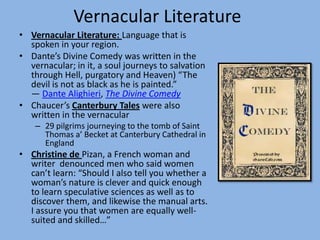
• Dante’s Divine Comedy was written in the
  vernacular; in it, a soul journeys to salvation
  through Hell, purgatory and Heaven) “The
  devil is not as black as he is painted.”
  ― Dante Alighieri, The Divine Comedy
• Chaucer’s Canterbury Tales were also
  written in the vernacular
    – 29 pilgrims journeying to the tomb of Saint
      Thomas a’ Becket at Canterbury Cathedral in
      England
• Christine de Pizan, a French woman and
  writer denounced men who said women
  can’t learn: “Should I also tell you whether a
  woman’s nature is clever and quick enough
  to learn speculative sciences as well as to
  discover them, and likewise the manual arts.
  I assure you that women are equally well-
  suited and skilled…”
Education in the Renaissance
• Education in the Renaissance:
• Students studied the liberal arts:
    –   history,
    –   moral philosophy,
    –   eloquence,
    –   grammar & logic,
    –   poetry,
    –   mathematics,
    –   astronomy and
    –   music.
• Educate to follow virtue and wisdom. Lasted until the 20th century
  to make complete citizens (not great scholars)
• Women did not really attend school; they were primarily taught
  religion and morals, but some studied art, music, and history
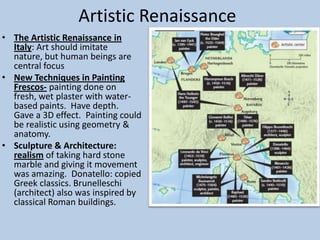
Artistic Renaissance
• The Artistic Renaissance in
  Italy: Art should imitate
  nature, but human beings are
  central focus
• New Techniques in Painting
  Frescos- painting done on
  fresh, wet plaster with water-
  based paints. Have depth.
  Gave a 3D effect. Painting could
  be realistic using geometry &
  anatomy.
• Sculpture & Architecture:
  realism of taking hard stone
  marble and giving it movement
  was amazing. Donatello: copied
  Greek classics. Brunelleschi
  (architect) also was inspired by
  classical Roman buildings.
Renaissance Art
The arts are a reflection of the new humanist spirit
Medieval artists—had idealized and symbolic representations;
Renaissance artists depicted what they observed in nature, attempted
to achieve realistic art
       Patrons of the Arts               Competition Among Patrons
• Medieval times, anonymous artists    • Wealthy individuals
  who worked for church created art      competed, displaying
• Renaissance artists worked for         wealth, modernity through
  whoever offered them highest price     purchase of artworks

• Buyers of art, patrons, might be     • Florence, Lorenzo de Medici
  wealthy individuals, city              supported most talented artists
  governments, or church               • Milan, ruling Sforza family
                                         benefactors of artists, others
Renaissance artists wanted to paint the natural world as realistically as
possible.
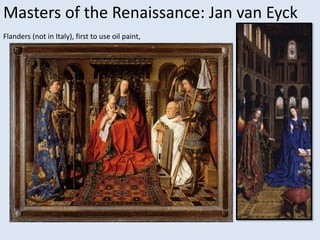
Masters of the Renaissance: Jan van Eyck
Flanders (not in Italy), first to use oil paint,
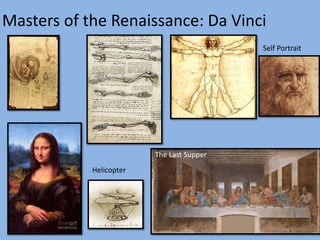
Masters of the Renaissance: Da Vinci
                                           Self Portrait


                         The Last Supper
            Helicopter
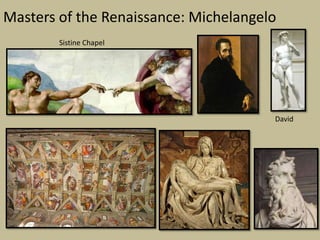
Masters of the Renaissance: Michelangelo
        Sistine Chapel


                                       David
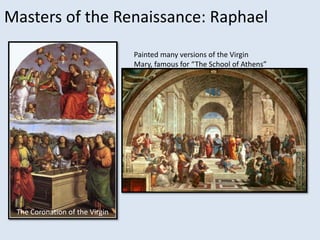
Masters of the Renaissance: Raphael
                                Painted many versions of the Virgin
                                Mary, famous for “The School of Athens”


 The Coronation of the Virgin
Renaissance Summary
• Rise of secular humanism: faith in science, less
  faith in the church; questioning of church’s
  role in life
• Return to scholarly life of Greeks and Romans;
  classical Latin returns, books are written in the
  vernacular for the first time
• Artistic expression explodes;
  art, literature, sculpture, painting, architecture
  , etc.

Renaissance

  • 1.
    Chapter 12 Renaissance &Reformation 1350ce -1600ce
  • 2.
    Renaissance • Renaissancemeans rebirth; the Renaissance was a period of rebirth in Europe, it was a new age of learning and art. • The Renaissance began with the emergence of a secular, urban society in the wealthy city-states of Italy. – Milan, Venice, and Florence were particularly prosperous trading centers. – Italy was very wealthy • Society became more secular, or worldly (not church based). • Society recovered from the plague, wars, and instability of the previous hundred years • A new view of humanity emerged, emphasizing individual ability; a high regard for the value of human worth and achievement created a new social ideal – This new ideal was reflected in art, literature, and architecture of the time.
  • 3.
  • 4.
    Italian States • TheItalian States: Instead of having Rome as the center of civilization in Italy, other cities became important during the Renaissance. Italy had city-states again. The city-states prospered because of increased trade and wealth. – Milan: Northern Italy, in 1447 Francesco Sforza took over (he was a paid fighter, a mercenary) He had a good tax system that helped the government generate revenues. – Venice: Had an elected leader called a Doge, Trade was important and the government was really run by the merchants; Venice was an international power because of trade. – Florence: Merchants ran government, The de ’Medici family took control (Cosimo & Lorenzo). A preacher named Savonarola came into power by criticizing wealth. After placing strict rules on the people, he lost power and was sentenced to death for heresy. The Medici’s returned to power • The Italian Wars: 1494-1527, fought between France vs. Italy/Spain. The soldiers were mercenaries. Spain ended up in Italy as the dominant political force.
  • 5.
    Machiavelli • Machiavelli andthe New Statecraft: • Italian politics were described best in Niccolo Machiavelli’s book, The Prince showing how to acquire, & keep political power. – “One can make this generalization about men: they are ungrateful, fickle, liars, and deceivers, they shun danger and are greedy for profit.” – Let the conscience sleep if you are in politics (meaning have NO conscience if you are in politics). – He abandoned morality in politics.
  • 6.
    Renaissance Society • ThreeSocial Classes During Renaissance Period: – The Nobility: Owned land, Nobles were only 3% of the population; Castiglione (The Book of the Courtier) described nobles: They were 1. Born, not made. 2. Military fitness & education. 3. Hide achievements, but show them with grace. Should serve the prince nobly. – Clergy made up second class; more on them later! – Peasants & Townspeople: 85-90% of the people. Rent paid to landlords instead of service/food. Townspeople were merchants/artisans. Patricians Burghers(shopkeepers) workers & unemployed. • Family & Marriage: arranged marriages, dowry ($$ for marriage by the female) Men were the center, women held no wealth. Father’s authority was absolute until he died or gave freedom before a judge.
  • 7.
    Italian Renaissance: Humanism •Humanism was a key intellectual movement of the Renaissance, focusing on the study of the ancient Greek and Roman classics. • While early humanists emphasized solitary learning, fifteenth century humanists stressed intellectualism in the service of the state. • Humanism encouraged the use of classical Latin. However, European writers such as Dante and Chaucer wrote in the vernacular. Humanist schools taught a broad range of liberal studies. • Petrarch was called the “father of Italian Renaissance humanism” because he devoted his life to finding lost manuscripts and emphasized studying classical Latin.
  • 8.
    Vernacular Literature • VernacularLiterature: Language that is spoken in your region. • Dante’s Divine Comedy was written in the vernacular; in it, a soul journeys to salvation through Hell, purgatory and Heaven) “The devil is not as black as he is painted.” ― Dante Alighieri, The Divine Comedy • Chaucer’s Canterbury Tales were also written in the vernacular – 29 pilgrims journeying to the tomb of Saint Thomas a’ Becket at Canterbury Cathedral in England • Christine de Pizan, a French woman and writer denounced men who said women can’t learn: “Should I also tell you whether a woman’s nature is clever and quick enough to learn speculative sciences as well as to discover them, and likewise the manual arts. I assure you that women are equally well- suited and skilled…”
  • 9.
    Education in theRenaissance • Education in the Renaissance: • Students studied the liberal arts: – history, – moral philosophy, – eloquence, – grammar & logic, – poetry, – mathematics, – astronomy and – music. • Educate to follow virtue and wisdom. Lasted until the 20th century to make complete citizens (not great scholars) • Women did not really attend school; they were primarily taught religion and morals, but some studied art, music, and history
  • 10.
    Artistic Renaissance • TheArtistic Renaissance in Italy: Art should imitate nature, but human beings are central focus • New Techniques in Painting Frescos- painting done on fresh, wet plaster with water- based paints. Have depth. Gave a 3D effect. Painting could be realistic using geometry & anatomy. • Sculpture & Architecture: realism of taking hard stone marble and giving it movement was amazing. Donatello: copied Greek classics. Brunelleschi (architect) also was inspired by classical Roman buildings.
  • 11.
    Renaissance Art The artsare a reflection of the new humanist spirit Medieval artists—had idealized and symbolic representations; Renaissance artists depicted what they observed in nature, attempted to achieve realistic art Patrons of the Arts Competition Among Patrons • Medieval times, anonymous artists • Wealthy individuals who worked for church created art competed, displaying • Renaissance artists worked for wealth, modernity through whoever offered them highest price purchase of artworks • Buyers of art, patrons, might be • Florence, Lorenzo de Medici wealthy individuals, city supported most talented artists governments, or church • Milan, ruling Sforza family benefactors of artists, others Renaissance artists wanted to paint the natural world as realistically as possible.
  • 12.
    Masters of theRenaissance: Jan van Eyck Flanders (not in Italy), first to use oil paint,
  • 13.
    Masters of theRenaissance: Da Vinci Self Portrait The Last Supper Helicopter
  • 14.
    Masters of theRenaissance: Michelangelo Sistine Chapel David
  • 15.
    Masters of theRenaissance: Raphael Painted many versions of the Virgin Mary, famous for “The School of Athens” The Coronation of the Virgin
  • 16.
    Renaissance Summary • Riseof secular humanism: faith in science, less faith in the church; questioning of church’s role in life • Return to scholarly life of Greeks and Romans; classical Latin returns, books are written in the vernacular for the first time • Artistic expression explodes; art, literature, sculpture, painting, architecture , etc.