BAROQUE PAINTING
Revision
Painting
• Subjects: religious and profane (mythological, allegorical,
historical or portraits)
• Composition: complicated; taste for big groups, with different
centres of attention. Portraits are just essential
• Lines: dynamic and complicate. Diagonal is the most used or
combinations of horizontal and vertical
• Colour: rich, with great effects due to the use of oil and
contrast depending on the areas
• Strange elements: secondary plans, mirrors
Painting
• Kinds of depiction:
– Religious: martyrdoms, sufferance and blood
– Mythological: generally developed with contemporary
characters
– Allegorical: virtues and sins portrayed as humans
– Portraits: royal, bourgeois (doelen), beggars, handicapped
– Customs: every day’s life
– Historical: bear witness of historical events
– Landscapes: never quiet sceneries
– Still-life: food and vegetables, flowers, animals
– Vanities or vanitas: remainders of the egalitarian role of death
Painting: Italy
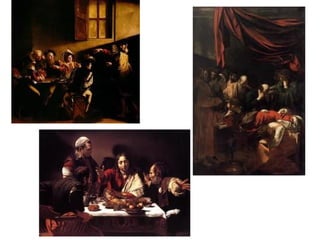
• Caravaggio
–
–
–
–
–
–

Very naturalist
Theologically incorrect
Enormous contrasts of light
Difficult compositions
Known as the creator of tenebrism
Works: Supper at Emmaus, the Death of the Virgin,
Saint Mathew’s Conversion
Painting: Italy
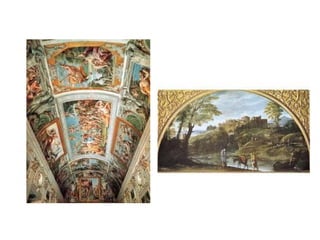
• Carracci
–
–
–
–

He received Caravaggio’s influence
Naturalism
Perfect and idealised world
His works are completely different from those of
Caravaggio
– Works: Cerasi Chapel
Painting: Flanders
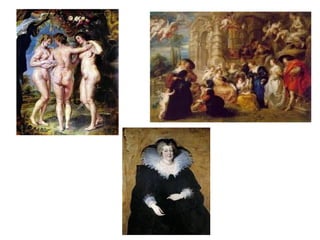
• Rubens
– He was a complete artist
– Gifted with organization and a sense for realism and
idealism
– He enjoyed harmony’s enviable balance of opposites
– Romantic but rooted in classical tradition
– Works: The Three Graces, The Garden of Love, Catalina
of Medici’s Portrait
Painting: Flanders
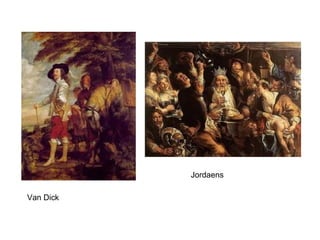
• Van Dyck
–
–
–
–

He was Rubens’ s student
In his works there in a languid melancholic mood
Portraits of the aristocracy
Works: Charles I

• Jordaens
–
–
–
–

Specialized in genre and banquet scenes
Strong contrasts of light and shade
Realistic images
Works: The King Drinks
Jordaens
Van Dick
Painting: Netherlands
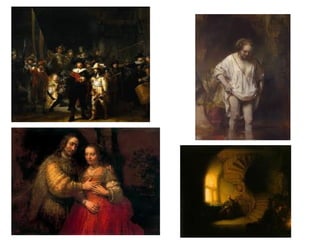
• Rembrant
–
–
–
–
–
–
–
–

Thunderous use of light and shade
Dramatic figures filling the picture surface
Fluid and vigorous brushwork
He substituted the exact imitation of form by the
suggestion of it: painting looked to be unfinished
Limited palette but able to depict colours
He worked in complex layers
Great care to the physical qualities of the medium
Works: The Night’s Ronda, Saskia having a Bath, The
Jew Bridegroom, The Philosopher
Painting: Netherlands
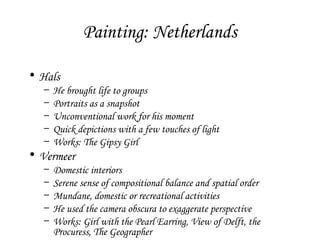
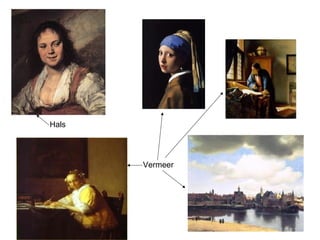
• Hals
–
–
–
–
–

He brought life to groups
Portraits as a snapshot
Unconventional work for his moment
Quick depictions with a few touches of light
Works: The Gipsy Girl

• Vermeer
–
–
–
–
–

Domestic interiors
Serene sense of compositional balance and spatial order
Mundane, domestic or recreational activities
He used the camera obscura to exaggerate perspective
Works: Girl with the Pearl Earring, View of Delft, the
Procuress, The Geographer
Hals

Vermeer
Painting: France
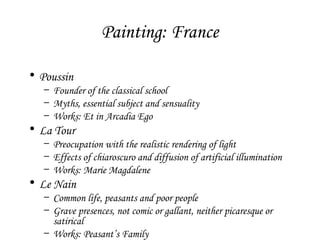
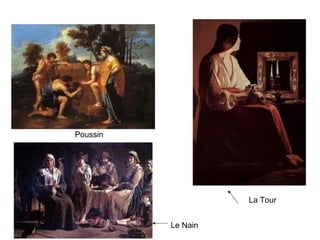
• Poussin

– Founder of the classical school
– Myths, essential subject and sensuality
– Works: Et in Arcadia Ego

• La Tour

– Preocupation with the realistic rendering of light
– Effects of chiaroscuro and diffusion of artificial illumination
– Works: Marie Magdalene

• Le Nain

– Common life, peasants and poor people
– Grave presences, not comic or gallant, neither picaresque or
satirical
– Works: Peasant’s Family
Poussin

La Tour
Le Nain
Painting: Spain
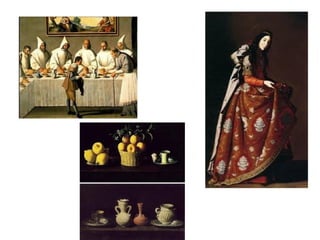
• Zurbarán
–
–
–
–
–

He was a portrait painter
Main subjects: religious (saints, monastic orders’ members)
Austere, harsh, hard edged style
Still-lives
Works: Paintings of the Guadalupe Monastery, Sainte
Casilde, Still-life with lemons
Painting: Spain
• Velázquez
– He painted any kind of subjects
– He was Court Painter and travelled to Italy to buy art
works and he knew classical masters’ works
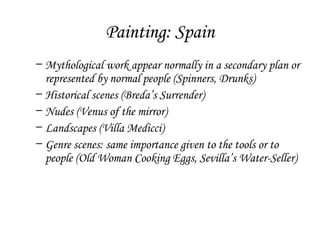
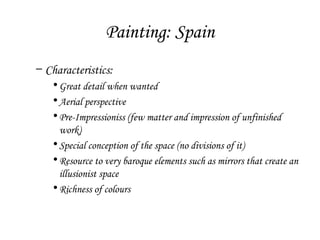
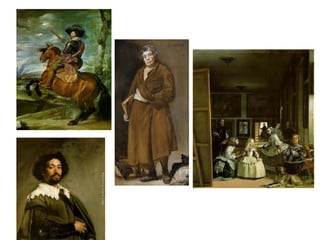
– Portraits: include royal family and nobility, some of them
equestrian, but also normal people of the court or even
beggars (Olivares, Juan de Pareja, Esopo, Meninas)
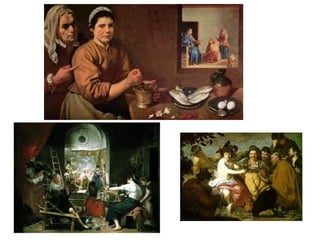
– Religious paintings are treated as common subjects, with
great importance given to daily life objects (Christ in
Martha and Mary’s house)
Painting: Spain
– Mythological work appear normally in a secondary plan or
represented by normal people (Spinners, Drunks)
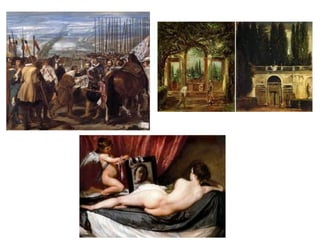
– Historical scenes (Breda’s Surrender)
– Nudes (Venus of the mirror)
– Landscapes (Villa Medicci)
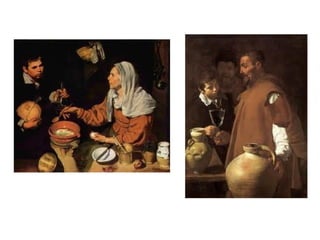
– Genre scenes: same importance given to the tools or to
people (Old Woman Cooking Eggs, Sevilla’s Water-Seller)
Painting: Spain
– Characteristics:
• Great detail when wanted
• Aerial perspective
• Pre-Impressioniss (few matter and impression of unfinished
work)
• Special conception of the space (no divisions of it)
• Resource to very baroque elements such as mirrors that create an
illusionist space
• Richness of colours
Painting: Spain
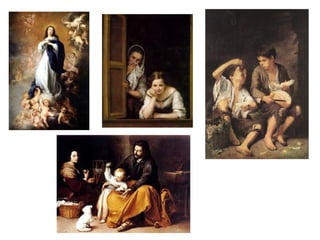
• Murillo
– His work is not strong but his images are convincing
– Realism but a bit idealistic
– He is reputed as children painter, works in which beggars and poor
children are depicted
– He created a model of Immaculate, moved by the wind and with a
lot of putti
– Works: Children Eating Fruit, Two Women at a Window, the Holy
Family of the Bird, Immaculate
Rococo Painting
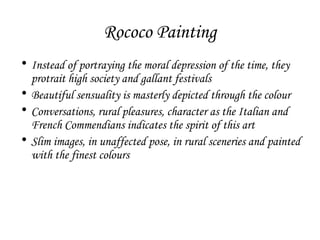
• Instead of portraying the moral depression of the time, they
protrait high society and gallant festivals
• Beautiful sensuality is masterly depicted through the colour
• Conversations, rural pleasures, character as the Italian and
French Commendians indicates the spirit of this art
• Slim images, in unaffected pose, in rural sceneries and painted
with the finest colours
Rococo Painting
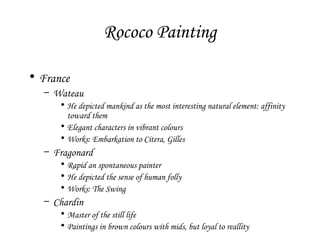
• France
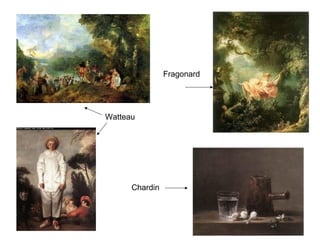
– Wateau
• He depicted mankind as the most interesting natural element: affinity
toward them
• Elegant characters in vibrant colours
• Works: Embarkation to Citera, Gilles

– Fragonard
• Rapid an spontaneous painter
• He depicted the sense of human folly
• Works: The Swing

– Chardin
• Master of the still life
• Paintings in brown colours with mids, but loyal to reallity
Fragonard

Watteau

Chardin
Rococo Painting
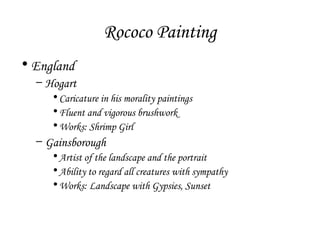
• England
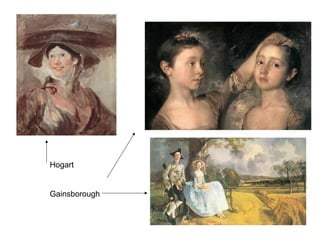
– Hogart
• Caricature in his morality paintings
• Fluent and vigorous brushwork
• Works: Shrimp Girl

– Gainsborough
• Artist of the landscape and the portrait
• Ability to regard all creatures with sympathy
• Works: Landscape with Gypsies, Sunset
Hogart

Gainsborough
Rococo Painting
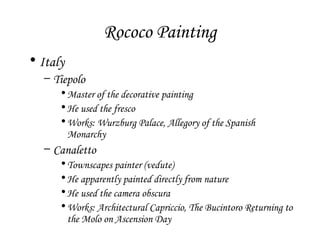
• Italy
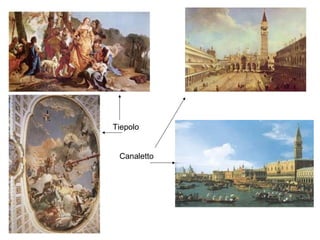
– Tiepolo
• Master of the decorative painting
• He used the fresco
• Works: Wurzburg Palace, Allegory of the Spanish
Monarchy

– Canaletto
• Townscapes painter (vedute)
• He apparently painted directly from nature
• He used the camera obscura
• Works: Architectural Capriccio, The Bucintoro Returning to
the Molo on Ascension Day
Tiepolo

Canaletto

Baroque painting

  • 1.
  • 2.
    Painting • Subjects: religiousand profane (mythological, allegorical, historical or portraits) • Composition: complicated; taste for big groups, with different centres of attention. Portraits are just essential • Lines: dynamic and complicate. Diagonal is the most used or combinations of horizontal and vertical • Colour: rich, with great effects due to the use of oil and contrast depending on the areas • Strange elements: secondary plans, mirrors
  • 3.
    Painting • Kinds ofdepiction: – Religious: martyrdoms, sufferance and blood – Mythological: generally developed with contemporary characters – Allegorical: virtues and sins portrayed as humans – Portraits: royal, bourgeois (doelen), beggars, handicapped – Customs: every day’s life – Historical: bear witness of historical events – Landscapes: never quiet sceneries – Still-life: food and vegetables, flowers, animals – Vanities or vanitas: remainders of the egalitarian role of death
  • 4.
    Painting: Italy • Caravaggio – – – – – – Verynaturalist Theologically incorrect Enormous contrasts of light Difficult compositions Known as the creator of tenebrism Works: Supper at Emmaus, the Death of the Virgin, Saint Mathew’s Conversion
  • 6.
    Painting: Italy • Carracci – – – – Hereceived Caravaggio’s influence Naturalism Perfect and idealised world His works are completely different from those of Caravaggio – Works: Cerasi Chapel
  • 8.
    Painting: Flanders • Rubens –He was a complete artist – Gifted with organization and a sense for realism and idealism – He enjoyed harmony’s enviable balance of opposites – Romantic but rooted in classical tradition – Works: The Three Graces, The Garden of Love, Catalina of Medici’s Portrait
  • 10.
    Painting: Flanders • VanDyck – – – – He was Rubens’ s student In his works there in a languid melancholic mood Portraits of the aristocracy Works: Charles I • Jordaens – – – – Specialized in genre and banquet scenes Strong contrasts of light and shade Realistic images Works: The King Drinks
  • 11.
  • 12.
    Painting: Netherlands • Rembrant – – – – – – – – Thunderoususe of light and shade Dramatic figures filling the picture surface Fluid and vigorous brushwork He substituted the exact imitation of form by the suggestion of it: painting looked to be unfinished Limited palette but able to depict colours He worked in complex layers Great care to the physical qualities of the medium Works: The Night’s Ronda, Saskia having a Bath, The Jew Bridegroom, The Philosopher
  • 14.
    Painting: Netherlands • Hals – – – – – Hebrought life to groups Portraits as a snapshot Unconventional work for his moment Quick depictions with a few touches of light Works: The Gipsy Girl • Vermeer – – – – – Domestic interiors Serene sense of compositional balance and spatial order Mundane, domestic or recreational activities He used the camera obscura to exaggerate perspective Works: Girl with the Pearl Earring, View of Delft, the Procuress, The Geographer
  • 15.
  • 16.
    Painting: France • Poussin –Founder of the classical school – Myths, essential subject and sensuality – Works: Et in Arcadia Ego • La Tour – Preocupation with the realistic rendering of light – Effects of chiaroscuro and diffusion of artificial illumination – Works: Marie Magdalene • Le Nain – Common life, peasants and poor people – Grave presences, not comic or gallant, neither picaresque or satirical – Works: Peasant’s Family
  • 17.
  • 18.
    Painting: Spain • Zurbarán – – – – – Hewas a portrait painter Main subjects: religious (saints, monastic orders’ members) Austere, harsh, hard edged style Still-lives Works: Paintings of the Guadalupe Monastery, Sainte Casilde, Still-life with lemons
  • 20.
    Painting: Spain • Velázquez –He painted any kind of subjects – He was Court Painter and travelled to Italy to buy art works and he knew classical masters’ works – Portraits: include royal family and nobility, some of them equestrian, but also normal people of the court or even beggars (Olivares, Juan de Pareja, Esopo, Meninas) – Religious paintings are treated as common subjects, with great importance given to daily life objects (Christ in Martha and Mary’s house)
  • 21.
    Painting: Spain – Mythologicalwork appear normally in a secondary plan or represented by normal people (Spinners, Drunks) – Historical scenes (Breda’s Surrender) – Nudes (Venus of the mirror) – Landscapes (Villa Medicci) – Genre scenes: same importance given to the tools or to people (Old Woman Cooking Eggs, Sevilla’s Water-Seller)
  • 22.
    Painting: Spain – Characteristics: •Great detail when wanted • Aerial perspective • Pre-Impressioniss (few matter and impression of unfinished work) • Special conception of the space (no divisions of it) • Resource to very baroque elements such as mirrors that create an illusionist space • Richness of colours
  • 27.
    Painting: Spain • Murillo –His work is not strong but his images are convincing – Realism but a bit idealistic – He is reputed as children painter, works in which beggars and poor children are depicted – He created a model of Immaculate, moved by the wind and with a lot of putti – Works: Children Eating Fruit, Two Women at a Window, the Holy Family of the Bird, Immaculate
  • 29.
    Rococo Painting • Insteadof portraying the moral depression of the time, they protrait high society and gallant festivals • Beautiful sensuality is masterly depicted through the colour • Conversations, rural pleasures, character as the Italian and French Commendians indicates the spirit of this art • Slim images, in unaffected pose, in rural sceneries and painted with the finest colours
  • 30.
    Rococo Painting • France –Wateau • He depicted mankind as the most interesting natural element: affinity toward them • Elegant characters in vibrant colours • Works: Embarkation to Citera, Gilles – Fragonard • Rapid an spontaneous painter • He depicted the sense of human folly • Works: The Swing – Chardin • Master of the still life • Paintings in brown colours with mids, but loyal to reallity
  • 31.
  • 32.
    Rococo Painting • England –Hogart • Caricature in his morality paintings • Fluent and vigorous brushwork • Works: Shrimp Girl – Gainsborough • Artist of the landscape and the portrait • Ability to regard all creatures with sympathy • Works: Landscape with Gypsies, Sunset
  • 33.
  • 34.
    Rococo Painting • Italy –Tiepolo • Master of the decorative painting • He used the fresco • Works: Wurzburg Palace, Allegory of the Spanish Monarchy – Canaletto • Townscapes painter (vedute) • He apparently painted directly from nature • He used the camera obscura • Works: Architectural Capriccio, The Bucintoro Returning to the Molo on Ascension Day
  • 35.