Copyright ©2012 Pearson Inc.
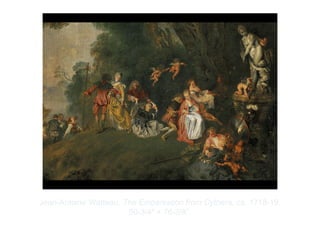
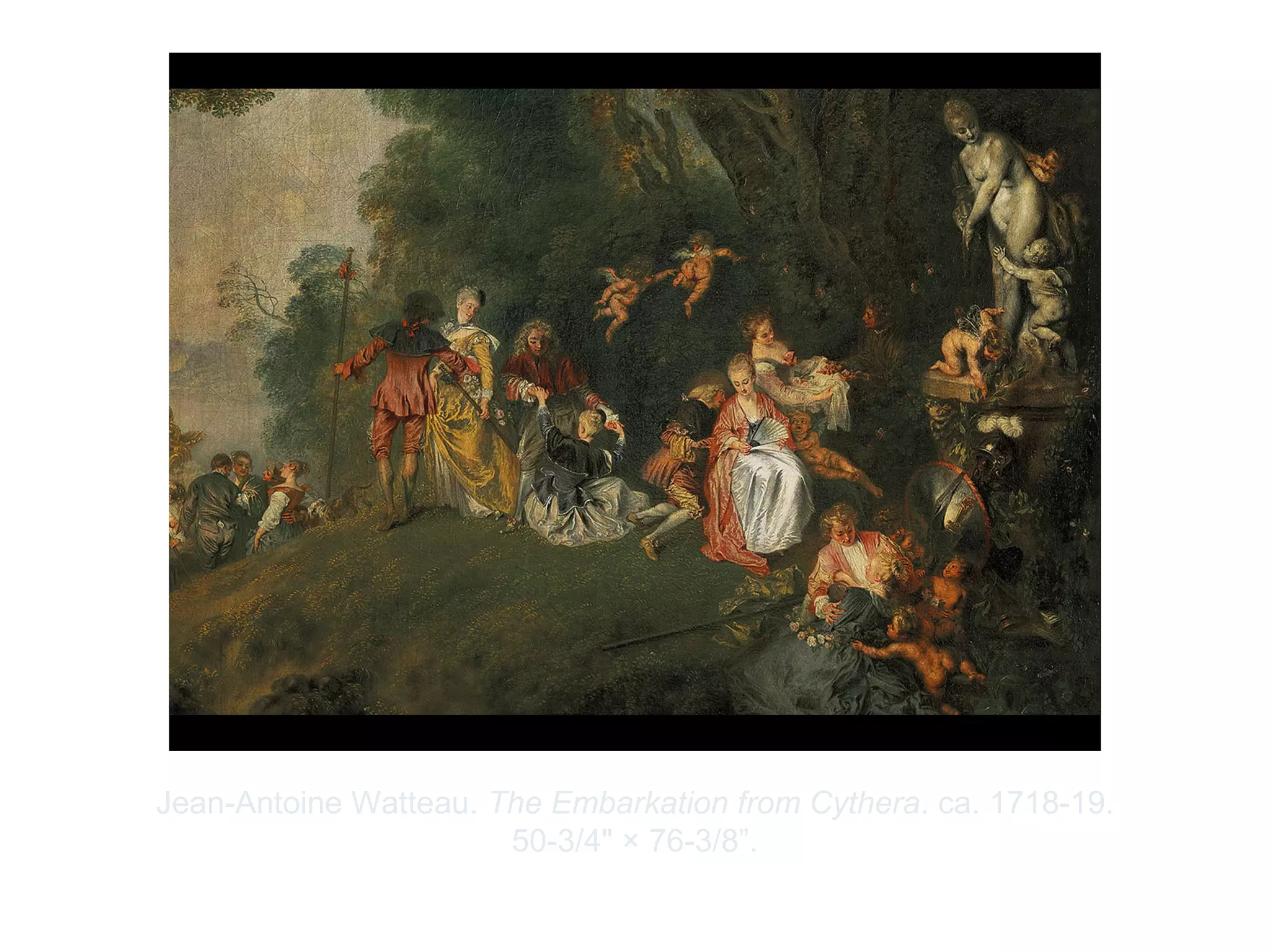
Jean-Antoine Watteau. The Embarkation from Cythera. ca. 1718-19.
50-3/4" × 76-3/8”.
Copyright ©2012 Pearson Inc.
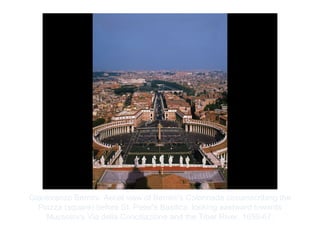
Gianlorenzo Bernini. Aerial view of Bernini's Colonnade circumscribing the
Piazza (square) before St. Peter's Basilica, looking eastward towards
Mussolini's Via della Conciliazione and the Tiber River. 1656-67.
Copyright ©2012 Pearson Inc.
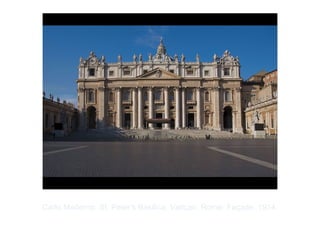
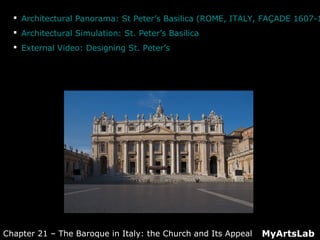
Carlo Maderno. St. Peter's Basilica, Vatican, Rome: Façade. 1914.
Copyright ©2012 Pearson Inc.
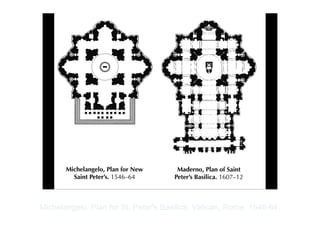
Michelangelo. Plan for St. Peter's Basilica, Vatican, Rome. 1546-64.
Copyright ©2012 Pearson Inc.
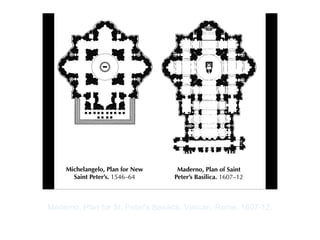
Maderno. Plan for St. Peter's Basilica, Vatican, Rome. 1607-12.
 Architectural Panorama: St Peter’s Basilica (ROME, ITALY, FAÇADE 1607-1
 Architectural Simulation: St. Peter’s Basilica
 External Video: Designing St. Peter’s
MyArtsLabChapter 21 – The Baroque in Italy: the Church and Its Appeal
Copyright ©2012 Pearson Inc.
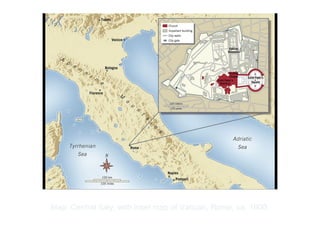
Map: Central Italy, with inset map of Vatican, Rome, ca. 1600.
Baroque Style and the Counter-Reformation
What is the Baroque?
• Sculpture and Architecture: Bernini and His Followers —
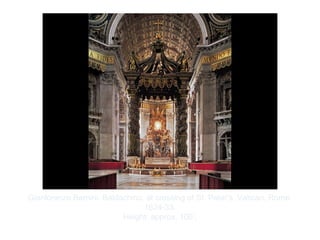
Bernini’s baldachino helps to define the altar space of Saint Peter’s
Basilica. Probably no image sums up the Baroque movement better
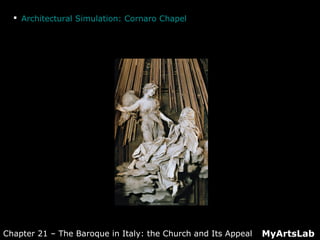
than Bernini’s sculptural program for the Cornaro Chapel. His theme is
a pivotal moment in the life of Teresa of Avila. Action is central to
Baroque representation as seen in hi David. Bernini is responsible for
a series of figurative fountains that changed the face of Rome.
• The Society of Jesus — Founded by Ignatius of Loyola, the Jesuits,
as they were known, led the Counter-Reformation. All agreed that the
purpose of religious art was to teach and inspire the faithful, that it
should always be intelligible and realistic, and that it should be an
emotional stimulus to piety.
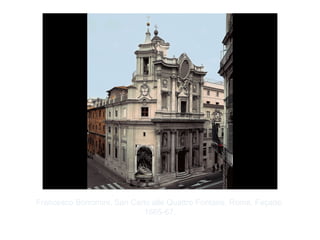
• Another feature of the Baroque is surprise as can be seen in the
Church of San Carlo alle Quattro Fontane.
• Discussion Question: What architectural features constitute the
“grandeur” of Saint Peter’s?
Copyright ©2012 Pearson Inc.
Gianlorenzo Bernini. Baldachino, at crossing of St. Peter's, Vatican, Rome.
1624-33.
Height: approx. 100’.
 Architectural Simulation: Cornaro Chapel
MyArtsLabChapter 21 – The Baroque in Italy: the Church and Its Appeal
Copyright ©2012 Pearson Inc.
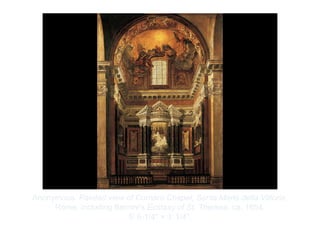
Anonymous. Painted view of Cornaro Chapel, Santa Maria della Vittoria,
Rome, including Bernini's Ecstasy of St. Theresa. ca. 1654.
5’ 6-1/4" × 3’ 1/4”.
Copyright ©2012 Pearson Inc.
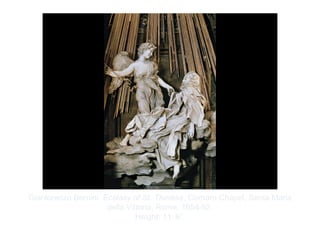
Gianlorenzo Bernini. Ecstasy of St. Theresa, Cornaro Chapel, Santa Maria
della Vittoria, Rome. 1654-52.
Height: 11’ 6”.
Copyright ©2012 Pearson Inc.
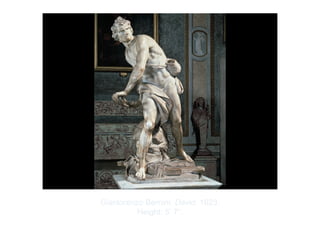
Gianlorenzo Bernini. David. 1623.
Height: 5’ 7”.
Copyright ©2012 Pearson Inc.
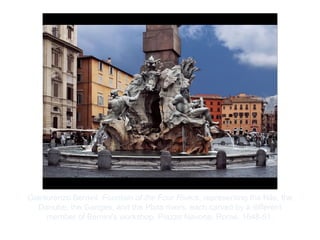
Gianlorenzo Bernini. Fountain of the Four Rivers, representing the Nile, the
Danube, the Ganges, and the Plata rivers, each carved by a different
member of Bernini's workshop. Piazza Navona, Rome. 1648-51.
Copyright ©2012 Pearson Inc.
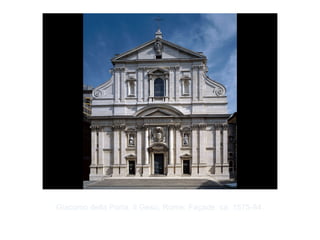
Giacomo della Porta. Il Gesù, Rome: Façade. ca. 1575-84.
Copyright ©2012 Pearson Inc.
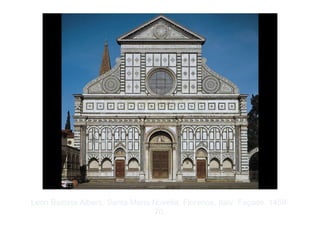
Leon Battista Alberti. Santa Maria Novella, Florence, Italy: Façade. 1458-
70.
Copyright ©2012 Pearson Inc.
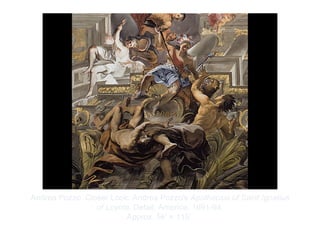
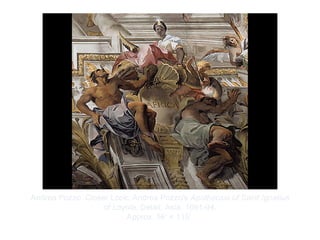
Andrea Pozzo. Closer Look: Andrea Pozzo's Apotheosis of Saint Ignatius
of Loyola. Detail, America. 1691-94.
Approx. 56' × 115’.
Copyright ©2012 Pearson Inc.
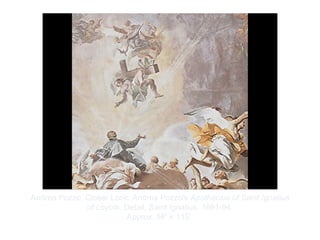
Andrea Pozzo. Closer Look: Andrea Pozzo's Apotheosis of Saint Ignatius
of Loyola. Detail, Saint Ignatius. 1691-94.
Approx. 56' × 115’.
Copyright ©2012 Pearson Inc.
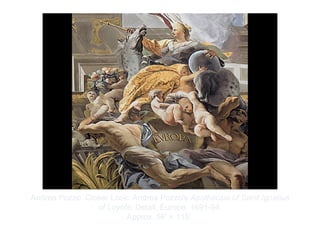
Andrea Pozzo. Closer Look: Andrea Pozzo's Apotheosis of Saint Ignatius
of Loyola. Detail, Europe. 1691-94.
Approx. 56' × 115’.
Copyright ©2012 Pearson Inc.
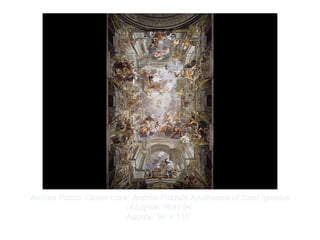
Andrea Pozzo. Closer Look: Andrea Pozzo's Apotheosis of Saint Ignatius
of Loyola. 1691-94.
Approx. 56' × 115’.
Copyright ©2012 Pearson Inc.
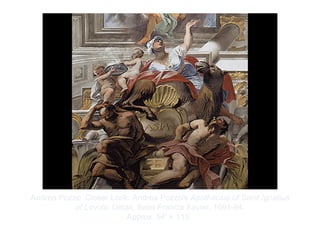
Andrea Pozzo. Closer Look: Andrea Pozzo's Apotheosis of Saint Ignatius
of Loyola. Detail, Africa. 1691-94.
Approx. 56' × 115’.
Copyright ©2012 Pearson Inc.
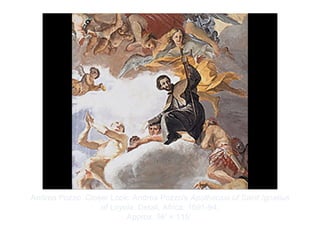
Andrea Pozzo. Closer Look: Andrea Pozzo's Apotheosis of Saint Ignatius
of Loyola. Detail, Saint Francia Xavier. 1691-94.
Approx. 56' × 115’.
Copyright ©2012 Pearson Inc.
Andrea Pozzo. Closer Look: Andrea Pozzo's Apotheosis of Saint Ignatius
of Loyola. Detail, Asia. 1691-94.
Approx. 56' × 115’.
Copyright ©2012 Pearson Inc.
Francesco Borromini. San Carlo alle Quattro Fontane, Rome. Façade.
1665-67.
Copyright ©2012 Pearson Inc.
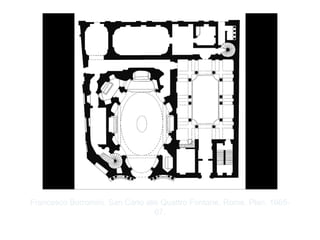
Francesco Borromini. San Carlo alle Quattro Fontane, Rome. Plan. 1665-
67.
Copyright ©2012 Pearson Inc.
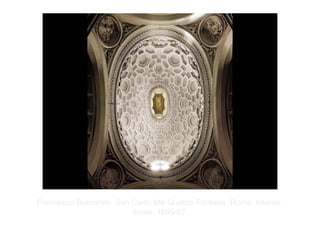
Francesco Borromini. San Carlo alle Quattro Fontane, Rome. Interior,
dome. 1665-67.
The Drama of Painting: Caravaggio and the
Carravaggisti
How does the Baroque style manifest itself in painting?
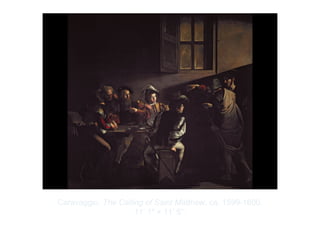
• Master of Light and Dark: Caravaggio — The most dramatic
element of The Calling of Saint Matthew is light. The revelatory power
of light is analogous to the transformative power of faith. One of the
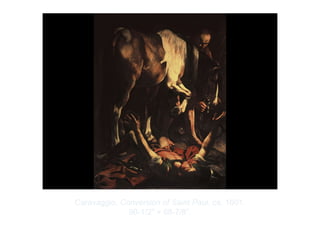
clearest instances of Caravaggio’s uses of light to dramatize moments
of conversion is the Conversion of Saint Paul.
• Elisabetta Sirani and Artemisia Gentileschi: Caravaggisti
Women — Caravaggio had a profound influence on other artists of the
seventeenth century. Sirani painted portraits, religious works,
allegorical works, and occasionally mythological works and stories from
ancient history. Gentileschi was one of the first women artists to
achieve an international reputation. She painted five separate versions
of the biblical story of Judith and Holofernes.
• Discussion Question: Discuss the revolutionary innovations of
Caravaggio’s style, and his influence.
Copyright ©2012 Pearson Inc.
Caravaggio. The Calling of Saint Matthew. ca. 1599-1600.
11’ 1" × 11’ 5”.
Copyright ©2012 Pearson Inc.
Caravaggio. Conversion of Saint Paul. ca. 1601.
90-1/2" × 68-7/8”.
Copyright ©2012 Pearson Inc.
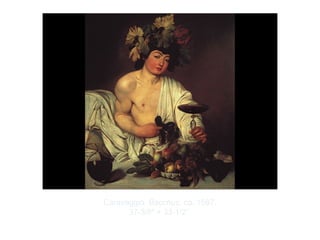
Caravaggio. Bacchus. ca. 1597.
37-3/8" × 33-1/2”.
Copyright ©2012 Pearson Inc.
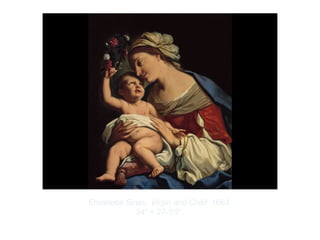
Elisabetta Sirani. Virgin and Child. 1663.
34" × 27-1/2”.
Copyright ©2012 Pearson Inc.
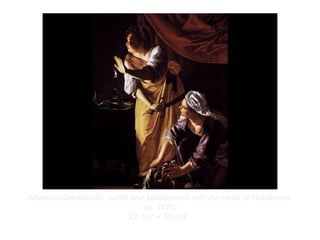
Artemisia Gentileschi. Judith and Maidservant with the Head of Holofernes.
ca. 1625.
72-1/2" × 55-3/4”.
 Active Listening Guide: A. Gabrieli: Ricercar
a 4 del duodecimo tuono
MyArtsLabChapter 21 – The Baroque in Italy: the Church and Its Appeal
Venice and Baroque Music
How is the Baroque style manifest in music, particularly in Venice?
• Giovanni Gabrieli and the Drama of Harmony — Venice earned
its place at the center of the musical world largely through the efforts of
Gabrieli. He was among the first to write religious music intended
specifically for wind ensemble.
• Claudio Monteverdi and the Birth of Opera — Monteverdi was
the musical director at Saint Mark’s in Venice where he mastered a
new, text-based musical form, the opera. The inspiration for his first
opera, Orfeo, was the musical drama of ancient Greek theater.
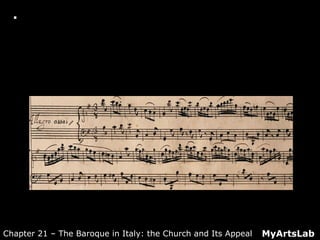
• Arcangelo Corelli and the Sonata — In Italian, sonata simply
means “that which is sounded,” or played by instruments, as opposed
to that which is sung, the cantata.
• Antonio Vivaldi and the Concerto — Corelli’s instrumental flair
influenced Venice’s most important composer, Vivaldi. Many of his
works were written specifically for performance by girl choirs and
instrumental ensembles. Vivaldi specialized in composing concertos, a
three-movement secular form of instrumental music.
• Discussion Question: How does Baroque music differ from the music of
the Renaissance?
Copyright ©2012 Pearson Inc.
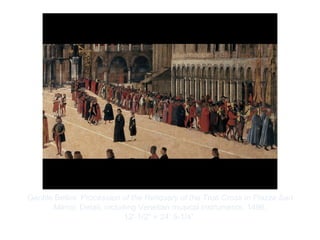
Gentile Bellini. Procession of the Reliquary of the True Cross in Piazza San
Marco. Detail, including Venetian musical instruments. 1496.
12'-1/2" × 24’ 5-1/4”.
 Closer Look: The Violin
MyArtsLabChapter 21 – The Baroque in Italy: the Church and Its Appeal
 Active Listening Guide: Monteverdi: "Tu se'
morta" from Orfeo
MyArtsLabChapter 21 – The Baroque in Italy: the Church and Its Appeal
Copyright ©2012 Pearson Inc.
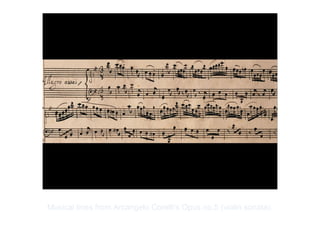
Musical lines from Arcangelo Corelli's Opus no.5 (violin sonata).
Copyright ©2012 Pearson Inc.
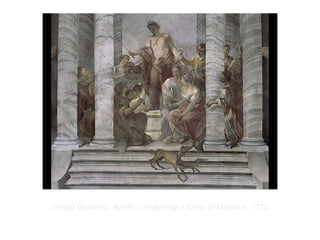
Jacopo Guarana. Apollo Conducting a Choir of Maidens. 1776.
Copyright ©2012 Pearson Inc.
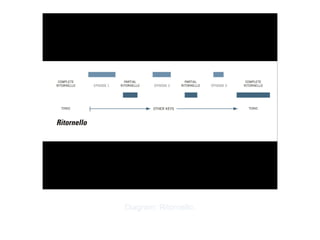
Diagram: Ritornello.
 Active Listening Guide: Vivaldi: Spring, I
from The Four Seasons
MyArtsLabChapter 21 – The Baroque in Italy: the Church and Its Appeal
Copyright ©2012 Pearson Inc.
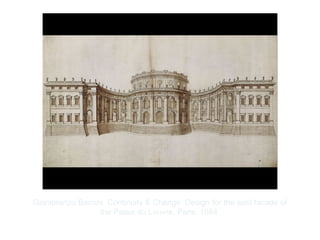
Gianlorenzo Bernini. Continuity & Change: Design for the east facade of
the Palais du Louvre, Paris. 1664.
Copyright ©2012 Pearson Inc.
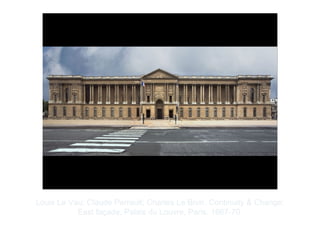
Louis Le Vau; Claude Perrault; Charles Le Brun. Continuity & Change:
East façade, Palais du Louvre, Paris. 1667-70.

Sayre2e ch21 integrated_lecture_pp_ts-150652

  • 1.
    Copyright ©2012 PearsonInc. Jean-Antoine Watteau. The Embarkation from Cythera. ca. 1718-19. 50-3/4" × 76-3/8”.
  • 2.
    Copyright ©2012 PearsonInc. Gianlorenzo Bernini. Aerial view of Bernini's Colonnade circumscribing the Piazza (square) before St. Peter's Basilica, looking eastward towards Mussolini's Via della Conciliazione and the Tiber River. 1656-67.
  • 3.
    Copyright ©2012 PearsonInc. Carlo Maderno. St. Peter's Basilica, Vatican, Rome: Façade. 1914.
  • 4.
    Copyright ©2012 PearsonInc. Michelangelo. Plan for St. Peter's Basilica, Vatican, Rome. 1546-64.
  • 5.
    Copyright ©2012 PearsonInc. Maderno. Plan for St. Peter's Basilica, Vatican, Rome. 1607-12.
  • 6.
     Architectural Panorama:St Peter’s Basilica (ROME, ITALY, FAÇADE 1607-1  Architectural Simulation: St. Peter’s Basilica  External Video: Designing St. Peter’s MyArtsLabChapter 21 – The Baroque in Italy: the Church and Its Appeal
  • 7.
    Copyright ©2012 PearsonInc. Map: Central Italy, with inset map of Vatican, Rome, ca. 1600.
  • 8.
    Baroque Style andthe Counter-Reformation What is the Baroque? • Sculpture and Architecture: Bernini and His Followers — Bernini’s baldachino helps to define the altar space of Saint Peter’s Basilica. Probably no image sums up the Baroque movement better than Bernini’s sculptural program for the Cornaro Chapel. His theme is a pivotal moment in the life of Teresa of Avila. Action is central to Baroque representation as seen in hi David. Bernini is responsible for a series of figurative fountains that changed the face of Rome. • The Society of Jesus — Founded by Ignatius of Loyola, the Jesuits, as they were known, led the Counter-Reformation. All agreed that the purpose of religious art was to teach and inspire the faithful, that it should always be intelligible and realistic, and that it should be an emotional stimulus to piety.
  • 9.
    • Another featureof the Baroque is surprise as can be seen in the Church of San Carlo alle Quattro Fontane. • Discussion Question: What architectural features constitute the “grandeur” of Saint Peter’s?
  • 10.
    Copyright ©2012 PearsonInc. Gianlorenzo Bernini. Baldachino, at crossing of St. Peter's, Vatican, Rome. 1624-33. Height: approx. 100’.
  • 11.
     Architectural Simulation:Cornaro Chapel MyArtsLabChapter 21 – The Baroque in Italy: the Church and Its Appeal
  • 12.
    Copyright ©2012 PearsonInc. Anonymous. Painted view of Cornaro Chapel, Santa Maria della Vittoria, Rome, including Bernini's Ecstasy of St. Theresa. ca. 1654. 5’ 6-1/4" × 3’ 1/4”.
  • 13.
    Copyright ©2012 PearsonInc. Gianlorenzo Bernini. Ecstasy of St. Theresa, Cornaro Chapel, Santa Maria della Vittoria, Rome. 1654-52. Height: 11’ 6”.
  • 14.
    Copyright ©2012 PearsonInc. Gianlorenzo Bernini. David. 1623. Height: 5’ 7”.
  • 15.
    Copyright ©2012 PearsonInc. Gianlorenzo Bernini. Fountain of the Four Rivers, representing the Nile, the Danube, the Ganges, and the Plata rivers, each carved by a different member of Bernini's workshop. Piazza Navona, Rome. 1648-51.
  • 16.
    Copyright ©2012 PearsonInc. Giacomo della Porta. Il Gesù, Rome: Façade. ca. 1575-84.
  • 17.
    Copyright ©2012 PearsonInc. Leon Battista Alberti. Santa Maria Novella, Florence, Italy: Façade. 1458- 70.
  • 18.
    Copyright ©2012 PearsonInc. Andrea Pozzo. Closer Look: Andrea Pozzo's Apotheosis of Saint Ignatius of Loyola. Detail, America. 1691-94. Approx. 56' × 115’.
  • 19.
    Copyright ©2012 PearsonInc. Andrea Pozzo. Closer Look: Andrea Pozzo's Apotheosis of Saint Ignatius of Loyola. Detail, Saint Ignatius. 1691-94. Approx. 56' × 115’.
  • 20.
    Copyright ©2012 PearsonInc. Andrea Pozzo. Closer Look: Andrea Pozzo's Apotheosis of Saint Ignatius of Loyola. Detail, Europe. 1691-94. Approx. 56' × 115’.
  • 21.
    Copyright ©2012 PearsonInc. Andrea Pozzo. Closer Look: Andrea Pozzo's Apotheosis of Saint Ignatius of Loyola. 1691-94. Approx. 56' × 115’.
  • 22.
    Copyright ©2012 PearsonInc. Andrea Pozzo. Closer Look: Andrea Pozzo's Apotheosis of Saint Ignatius of Loyola. Detail, Africa. 1691-94. Approx. 56' × 115’.
  • 23.
    Copyright ©2012 PearsonInc. Andrea Pozzo. Closer Look: Andrea Pozzo's Apotheosis of Saint Ignatius of Loyola. Detail, Saint Francia Xavier. 1691-94. Approx. 56' × 115’.
  • 24.
    Copyright ©2012 PearsonInc. Andrea Pozzo. Closer Look: Andrea Pozzo's Apotheosis of Saint Ignatius of Loyola. Detail, Asia. 1691-94. Approx. 56' × 115’.
  • 25.
    Copyright ©2012 PearsonInc. Francesco Borromini. San Carlo alle Quattro Fontane, Rome. Façade. 1665-67.
  • 26.
    Copyright ©2012 PearsonInc. Francesco Borromini. San Carlo alle Quattro Fontane, Rome. Plan. 1665- 67.
  • 27.
    Copyright ©2012 PearsonInc. Francesco Borromini. San Carlo alle Quattro Fontane, Rome. Interior, dome. 1665-67.
  • 28.
    The Drama ofPainting: Caravaggio and the Carravaggisti How does the Baroque style manifest itself in painting? • Master of Light and Dark: Caravaggio — The most dramatic element of The Calling of Saint Matthew is light. The revelatory power of light is analogous to the transformative power of faith. One of the clearest instances of Caravaggio’s uses of light to dramatize moments of conversion is the Conversion of Saint Paul. • Elisabetta Sirani and Artemisia Gentileschi: Caravaggisti Women — Caravaggio had a profound influence on other artists of the seventeenth century. Sirani painted portraits, religious works, allegorical works, and occasionally mythological works and stories from ancient history. Gentileschi was one of the first women artists to achieve an international reputation. She painted five separate versions of the biblical story of Judith and Holofernes. • Discussion Question: Discuss the revolutionary innovations of Caravaggio’s style, and his influence.
  • 29.
    Copyright ©2012 PearsonInc. Caravaggio. The Calling of Saint Matthew. ca. 1599-1600. 11’ 1" × 11’ 5”.
  • 30.
    Copyright ©2012 PearsonInc. Caravaggio. Conversion of Saint Paul. ca. 1601. 90-1/2" × 68-7/8”.
  • 31.
    Copyright ©2012 PearsonInc. Caravaggio. Bacchus. ca. 1597. 37-3/8" × 33-1/2”.
  • 32.
    Copyright ©2012 PearsonInc. Elisabetta Sirani. Virgin and Child. 1663. 34" × 27-1/2”.
  • 33.
    Copyright ©2012 PearsonInc. Artemisia Gentileschi. Judith and Maidservant with the Head of Holofernes. ca. 1625. 72-1/2" × 55-3/4”.
  • 34.
     Active ListeningGuide: A. Gabrieli: Ricercar a 4 del duodecimo tuono MyArtsLabChapter 21 – The Baroque in Italy: the Church and Its Appeal
  • 35.
    Venice and BaroqueMusic How is the Baroque style manifest in music, particularly in Venice? • Giovanni Gabrieli and the Drama of Harmony — Venice earned its place at the center of the musical world largely through the efforts of Gabrieli. He was among the first to write religious music intended specifically for wind ensemble. • Claudio Monteverdi and the Birth of Opera — Monteverdi was the musical director at Saint Mark’s in Venice where he mastered a new, text-based musical form, the opera. The inspiration for his first opera, Orfeo, was the musical drama of ancient Greek theater.
  • 36.
    • Arcangelo Corelliand the Sonata — In Italian, sonata simply means “that which is sounded,” or played by instruments, as opposed to that which is sung, the cantata. • Antonio Vivaldi and the Concerto — Corelli’s instrumental flair influenced Venice’s most important composer, Vivaldi. Many of his works were written specifically for performance by girl choirs and instrumental ensembles. Vivaldi specialized in composing concertos, a three-movement secular form of instrumental music. • Discussion Question: How does Baroque music differ from the music of the Renaissance?
  • 37.
    Copyright ©2012 PearsonInc. Gentile Bellini. Procession of the Reliquary of the True Cross in Piazza San Marco. Detail, including Venetian musical instruments. 1496. 12'-1/2" × 24’ 5-1/4”.
  • 38.
     Closer Look:The Violin MyArtsLabChapter 21 – The Baroque in Italy: the Church and Its Appeal
  • 39.
     Active ListeningGuide: Monteverdi: "Tu se' morta" from Orfeo MyArtsLabChapter 21 – The Baroque in Italy: the Church and Its Appeal
  • 40.
    Copyright ©2012 PearsonInc. Musical lines from Arcangelo Corelli's Opus no.5 (violin sonata).
  • 41.
    Copyright ©2012 PearsonInc. Jacopo Guarana. Apollo Conducting a Choir of Maidens. 1776.
  • 42.
    Copyright ©2012 PearsonInc. Diagram: Ritornello.
  • 43.
     Active ListeningGuide: Vivaldi: Spring, I from The Four Seasons MyArtsLabChapter 21 – The Baroque in Italy: the Church and Its Appeal
  • 44.
    Copyright ©2012 PearsonInc. Gianlorenzo Bernini. Continuity & Change: Design for the east facade of the Palais du Louvre, Paris. 1664.
  • 45.
    Copyright ©2012 PearsonInc. Louis Le Vau; Claude Perrault; Charles Le Brun. Continuity & Change: East façade, Palais du Louvre, Paris. 1667-70.

Editor's Notes

  • #2 Jean-Antoine Watteau. The Embarkation from Cythera . ca. 1718-19. 50-3/4" × 76-3/8”.
  • #3 Gianlorenzo Bernini. Aerial view of Bernini's Colonnade circumscribing the Piazza (square) before St. Peter's Basilica, looking eastward towards Mussolini's Via della Conciliazione and the Tiber River. 1656-67.
  • #4 Carlo Maderno. St. Peter's Basilica, Vatican, Rome: Façade. 1914.
  • #5 Michelangelo. Plan for St. Peter's Basilica, Vatican, Rome. 1546-64.
  • #6 Maderno. Plan for St. Peter's Basilica, Vatican, Rome. 1607-12.
  • #8 Map: Central Italy, with inset map of Vatican, Rome, ca. 1600.
  • #9 What is the Baroque? As part of its strategy to respond to the Protestant Reformation, the Catholic Church in Rome championed a new Baroque style of art that appealed to the range of human emotion and feeling, not just the intellect. Bernini’s majestic new colonnade for the square in front of Saint Peter’s in Rome helped to reveal the grandeur of the basilica itself, creating the dramatic effect of the Church embracing its flock. How does his sculptural program for the Cornaro Chapel in Rome epitomize the Baroque? How are Baroque sensibilities reflected in his sculpture of the biblical hero David? How do action, excitement, and sensuality fulfill the Counter-Reformation objectives in Baroque religious art? What role do the senses play in the theological writings of Saint Ignatius? What role does art play in his set of “Rules”? How is this reflected in Andrea Pozzo’s ceiling for the church of Sant’Ignazio? One of the most influential pieces of Baroque architecture is Francesco Borromini’s Church of San Carlo alle Quattro Fontane in Rome. Borromini replaces the traditions of Renaissance architecture with a facade of dramatic oppositions and visual surprises. How does the architecture of Bernini and Borromini express the theatrical urge to draw the viewer into the drama?
  • #11 Gianlorenzo Bernini. Baldachino, at crossing of St. Peter's, Vatican, Rome. 1624-33. Height: approx. 100’.
  • #13 Anonymous. Painted view of Cornaro Chapel, Santa Maria della Vittoria , Rome, including Bernini's Ecstasy of St. Theresa . ca. 1654. 5’ 6-1/4" × 3’ 1/4”.
  • #14 Gianlorenzo Bernini. Ecstasy of St. Theresa , Cornaro Chapel, Santa Maria della Vittoria, Rome. 1654-52. Height: 11’ 6”.
  • #15 Gianlorenzo Bernini. David . 1623. Height: 5’ 7”.
  • #16 Gianlorenzo Bernini. Fountain of the Four Rivers , representing the Nile, the Danube, the Ganges, and the Plata rivers, each carved by a different member of Bernini's workshop. Piazza Navona, Rome. 1648-51.
  • #17 Giacomo della Porta. Il Gesù, Rome: Façade. ca. 1575-84.
  • #18 Leon Battista Alberti. Santa Maria Novella, Florence, Italy: Façade. 1458-70.
  • #19 Andrea Pozzo. Closer Look: Andrea Pozzo's Apotheosis of Saint Ignatius of Loyola . Detail, America. 1691-94. Approx. 56' × 115’.
  • #20 Andrea Pozzo. Closer Look: Andrea Pozzo's Apotheosis of Saint Ignatius of Loyola . Detail, Saint Ignatius. 1691-94. Approx. 56' × 115’.
  • #21 Andrea Pozzo. Closer Look: Andrea Pozzo's Apotheosis of Saint Ignatius of Loyola . Detail, Europe. 1691-94. Approx. 56' × 115’.
  • #22 Andrea Pozzo. Closer Look: Andrea Pozzo's Apotheosis of Saint Ignatius of Loyola . 1691-94. Approx. 56' × 115’.
  • #23 Andrea Pozzo. Closer Look: Andrea Pozzo's Apotheosis of Saint Ignatius of Loyola . Detail, Africa. 1691-94. Approx. 56' × 115’.
  • #24 Andrea Pozzo. Closer Look: Andrea Pozzo's Apotheosis of Saint Ignatius of Loyola . Detail, Saint Francia Xavier. 1691-94. Approx. 56' × 115’.
  • #25 Andrea Pozzo. Closer Look: Andrea Pozzo's Apotheosis of Saint Ignatius of Loyola . Detail, Asia. 1691-94. Approx. 56' × 115’.
  • #26 Francesco Borromini. San Carlo alle Quattro Fontane, Rome. Façade. 1665-67.
  • #27 Francesco Borromini. San Carlo alle Quattro Fontane, Rome. Plan. 1665-67.
  • #28 Francesco Borromini. San Carlo alle Quattro Fontane, Rome. Interior, dome. 1665-67.
  • #29 How does the Baroque style manifest itself in painting? Caravaggio used the play of light and dark to create paintings of stunning drama and energy that reveal a new Baroque taste for vividly realistic detail. His followers, among them Elisabetta Sirani and Artemisia Gentileschi, inherited his interest in realism and the dramatic. What does Caravaggio share with the mystical writings of Teresa of Ávila and the poetry of Englishman John Donne? What social conditions and aesthetic values of the Italian Baroque particularly interested the artists Elisabetta Sirani and Artemisia Gentileschi?
  • #30 Caravaggio. The Calling of Saint Matthew . ca. 1599-1600. 11’ 1" × 11’ 5”.
  • #31 Caravaggio. Conversion of Saint Paul . ca. 1601. 90-1/2" × 68-7/8”.
  • #32 Caravaggio. Bacchus . ca. 1597. 37-3/8" × 33-1/2”.
  • #33 Elisabetta Sirani. Virgin and Child . 1663. 34" × 27-1/2”.
  • #34 Artemisia Gentileschi. Judith and Maidservant with the Head of Holofernes . ca. 1625. 72-1/2" × 55-3/4”.
  • #36 How is the Baroque style manifest in music, particularly in Venice? If Rome was the center of Baroque art and architecture, Venice was the center of Baroque music. Giovanni Gabrieli took advantage of the sonority of Saint Mark’s Cathedral to create canzonas in which he carefully controlled the dynamics (loud/soft) of the composition and its tempo. What is a canzona? It was in Venice that a new form of musical drama known as opera was born in the hands of Claudio Monteverdi, who gave text precedence over harmony for the first time in the history of Western music. His opera Orfeo successfully married music and drama. What is an opera? The sonata, popularized as an instrumental genre by virtuoso violinist Arcangelo Corelli, provided a model for all instrumental music. Finally, Antonio Vivaldi perfected the concerto as a genre, and many of his concertos were performed by the women at the Ospedale della Pietà, where he was musical director. What are the chief features of the concerto? In general, what features of Venetian Baroque music are analogous to Baroque painting and sculpture?
  • #38 Gentile Bellini. Procession of the Reliquary of the True Cross in Piazza San Marco . Detail, including Venetian musical instruments. 1496. 12'-1/2" × 24’ 5-1/4”.
  • #41 Musical lines from Arcangelo Corelli's Opus no.5 (violin sonata).
  • #42 Jacopo Guarana. Apollo Conducting a Choir of Maidens . 1776.
  • #43 Diagram: Ritornello.
  • #44 Check this link…
  • #45 Gianlorenzo Bernini. Continuity & Change: Design for the east facade of the Palais du Louvre, Paris. 1664.
  • #46 Louis Le Vau; Claude Perrault; Charles Le Brun. Continuity & Change: East façade, Palais du Louvre, Paris. 1667-70.