The
The
Renaissance
Renaissance
Era
Era
Prelude to
the
Renaissance
Renaissance
Four Great
Disasters
• The Black Death
• Ottoman Turks take
Constantinople in 1453
• Church Problems
• Wars
The Black Death 1347
• 1/3 of Europe’s population died
• Decrease in the number of serfs and workers
increased wages, debased currency due to
inflation, and created a new peasant class
• Made more land, jobs and products available
• Sought labor saving ideas
• Changed attitudes
• Grim Reaper came into being
Ottoman Turks take
Constantinople in 1453
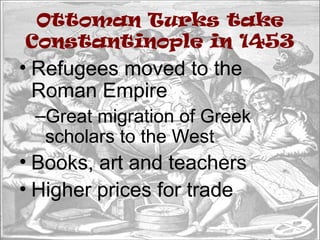
• Refugees moved to the
Roman Empire
–Great migration of Greek
scholars to the West
• Books, art and teachers
• Higher prices for trade
Church Problems
• Bureaucracy working to protect itself
rather then faith
• Trouble with kings
– Boniface VIII v. Edward (bequeathing property to
church and taxing church; eventual compromise
– Unum Sanctum (no salvation outside of Church
and everyone including king subject to pontiff) by
Boniface VIII
– Great Schism (2 popes elected, one in France
and one in Rome; Both popes had to raise more
money so they devised annates from Bishops and
indulgences
Church Problems
(continued)
• Dissidents
– William Langland – wrote about the hypocrisy
and extravagance of the Church. His followers
formed the Lollards
– John Wycliff – said Bible alone is the final
authority, not the Pope. Translated the Bible
into English
• Councilor Movement
– Quarrel over supremacy, councils v. Pope
– Councils met to force all appointed popes to resign,
and elected another
– Councils ended in 1449 unless called; Pope supreme,
but “who was true religious authority” –Pope, councils
or Bible?
Hundred Years’ War
1337-1453
– England and France fought over French land
– Effects of the War
• French had national pride
• French developed strong loyalty to the king
• French king could raise taxes to support army
• By 1483, French king was an absolute monarch
• English king was stronger
• English Parliament stronger – gained privileges from kings who
needed money for wars
• New dynasty in England
• France and England no longer attached
• Peasants Revolted because of the long war
The Renaissance
• French for “rebirth”
• Intellectual and economic changes that occurred in
Europe from the 14th
-16th
centuries
• Europe emerged from the economic stagnation of
the Middle Ages and experienced a time of financial
growth
• An age in which artistic, social, scientific and
political thought in new directions.
• Rediscovery of the Greek and Roman tradition
helped artists reproduce visual images accurately.
• Marks the entry of civilization into “modern times”,
the period in which we live in today
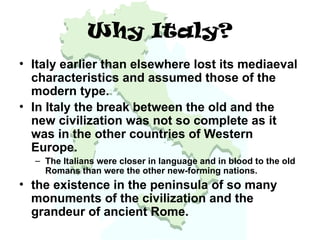
Why Italy?
• Italy earlier than elsewhere lost its mediaeval
characteristics and assumed those of the
modern type.
• In Italy the break between the old and the
new civilization was not so complete as it
was in the other countries of Western
Europe.
– The Italians were closer in language and in blood to the old
Romans than were the other new-forming nations.
• the existence in the peninsula of so many
monuments of the civilization and the
grandeur of ancient Rome.
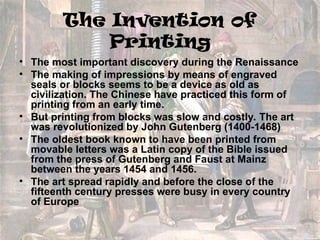
The Invention of
Printing
• The most important discovery during the Renaissance
• The making of impressions by means of engraved
seals or blocks seems to be a device as old as
civilization. The Chinese have practiced this form of
printing from an early time.
• But printing from blocks was slow and costly. The art
was revolutionized by John Gutenberg (1400-1468)
• The oldest book known to have been printed from
movable letters was a Latin copy of the Bible issued
from the press of Gutenberg and Faust at Mainz
between the years 1454 and 1456.
• The art spread rapidly and before the close of the
fifteenth century presses were busy in every country
of Europe
Social Classes during
the Renaissance
• Nobles
– owned much of the land
– lived on large estates outside the city walls
– Behaved according to the rules of chivalry
• Merchants
– Newly rich from industry
– Sought to control wealthy by controlling government and marrying into
noble families
– Patrons of the arts
• Middle Class
– Shopkeepers and professionals
• Workers
– No job protection
– Dependent on employers
– Urban workers better off than peasants
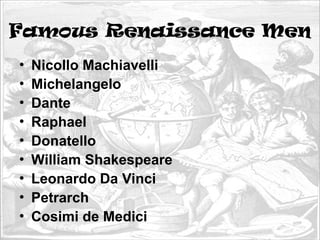
Famous Renaissance Men
• Nicollo Machiavelli
• Michelangelo
• Dante
• Raphael
• Donatello
• William Shakespeare
• Leonardo Da Vinci
• Petrarch
• Cosimi de Medici
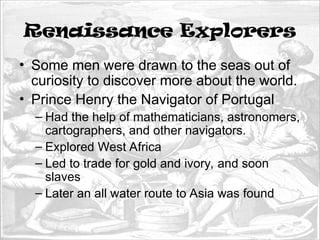
Renaissance Explorers
• Some men were drawn to the seas out of
curiosity to discover more about the world.
• Prince Henry the Navigator of Portugal
– Had the help of mathematicians, astronomers,
cartographers, and other navigators.
– Explored West Africa
– Led to trade for gold and ivory, and soon
slaves
– Later an all water route to Asia was found
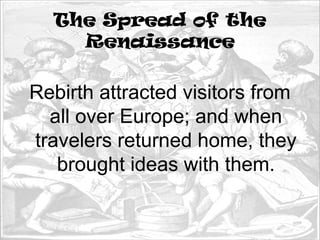
The Spread of the
Renaissance
Rebirth attracted visitors from
all over Europe; and when
travelers returned home, they
brought ideas with them.
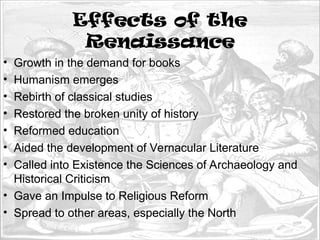
Effects of the
Renaissance
• Growth in the demand for books
• Humanism emerges
• Rebirth of classical studies
• Restored the broken unity of history
• Reformed education
• Aided the development of Vernacular Literature
• Called into Existence the Sciences of Archaeology and
Historical Criticism
• Gave an Impulse to Religious Reform
• Spread to other areas, especially the North
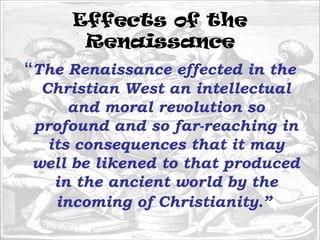
Effects of the
Renaissance
“The Renaissance effected in the
Christian West an intellectual
and moral revolution so
profound and so far-reaching in
its consequences that it may
well be likened to that produced
in the ancient world by the
incoming of Christianity.”
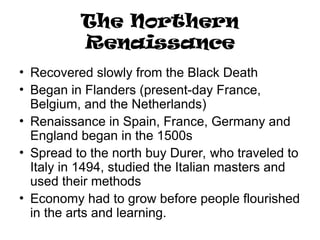
The Northern
Renaissance
• Recovered slowly from the Black Death
• Began in Flanders (present-day France,
Belgium, and the Netherlands)
• Renaissance in Spain, France, Germany and
England began in the 1500s
• Spread to the north buy Durer, who traveled to
Italy in 1494, studied the Italian masters and
used their methods
• Economy had to grow before people flourished
in the arts and learning.
Task 3: Italian v.
Northern
Italian
Renaissance
Northern
Renaissance
Subject
matter
Classical mythology,
religious scenes.
Domestic interiors,
portraits, religious scenes
Style Symmetrical, balanced,
good sense of mass,
linear perspective.
Attention to surface
detail, naturalism.
Known for Figures with mass and
volume, knowledge of
underlying anatomy.
Minute surface detail
Example Michelangelo, Creation of
Adam from the Sistine
Chapel ceiling.
Jan van Eyck, Arnolfini
Wedding Portrait.
Rennaisance PPT.pptRennaisance PPT.ppt__

Rennaisance PPT.pptRennaisance PPT.ppt__

  • 1.
  • 2.
  • 3.
    Four Great Disasters • TheBlack Death • Ottoman Turks take Constantinople in 1453 • Church Problems • Wars
  • 4.
    The Black Death1347 • 1/3 of Europe’s population died • Decrease in the number of serfs and workers increased wages, debased currency due to inflation, and created a new peasant class • Made more land, jobs and products available • Sought labor saving ideas • Changed attitudes • Grim Reaper came into being
  • 5.
    Ottoman Turks take Constantinoplein 1453 • Refugees moved to the Roman Empire –Great migration of Greek scholars to the West • Books, art and teachers • Higher prices for trade
  • 6.
    Church Problems • Bureaucracyworking to protect itself rather then faith • Trouble with kings – Boniface VIII v. Edward (bequeathing property to church and taxing church; eventual compromise – Unum Sanctum (no salvation outside of Church and everyone including king subject to pontiff) by Boniface VIII – Great Schism (2 popes elected, one in France and one in Rome; Both popes had to raise more money so they devised annates from Bishops and indulgences
  • 7.
    Church Problems (continued) • Dissidents –William Langland – wrote about the hypocrisy and extravagance of the Church. His followers formed the Lollards – John Wycliff – said Bible alone is the final authority, not the Pope. Translated the Bible into English • Councilor Movement – Quarrel over supremacy, councils v. Pope – Councils met to force all appointed popes to resign, and elected another – Councils ended in 1449 unless called; Pope supreme, but “who was true religious authority” –Pope, councils or Bible?
  • 8.
    Hundred Years’ War 1337-1453 –England and France fought over French land – Effects of the War • French had national pride • French developed strong loyalty to the king • French king could raise taxes to support army • By 1483, French king was an absolute monarch • English king was stronger • English Parliament stronger – gained privileges from kings who needed money for wars • New dynasty in England • France and England no longer attached • Peasants Revolted because of the long war
  • 9.
    The Renaissance • Frenchfor “rebirth” • Intellectual and economic changes that occurred in Europe from the 14th -16th centuries • Europe emerged from the economic stagnation of the Middle Ages and experienced a time of financial growth • An age in which artistic, social, scientific and political thought in new directions. • Rediscovery of the Greek and Roman tradition helped artists reproduce visual images accurately. • Marks the entry of civilization into “modern times”, the period in which we live in today
  • 10.
    Why Italy? • Italyearlier than elsewhere lost its mediaeval characteristics and assumed those of the modern type. • In Italy the break between the old and the new civilization was not so complete as it was in the other countries of Western Europe. – The Italians were closer in language and in blood to the old Romans than were the other new-forming nations. • the existence in the peninsula of so many monuments of the civilization and the grandeur of ancient Rome.
  • 11.
    The Invention of Printing •The most important discovery during the Renaissance • The making of impressions by means of engraved seals or blocks seems to be a device as old as civilization. The Chinese have practiced this form of printing from an early time. • But printing from blocks was slow and costly. The art was revolutionized by John Gutenberg (1400-1468) • The oldest book known to have been printed from movable letters was a Latin copy of the Bible issued from the press of Gutenberg and Faust at Mainz between the years 1454 and 1456. • The art spread rapidly and before the close of the fifteenth century presses were busy in every country of Europe
  • 12.
    Social Classes during theRenaissance • Nobles – owned much of the land – lived on large estates outside the city walls – Behaved according to the rules of chivalry • Merchants – Newly rich from industry – Sought to control wealthy by controlling government and marrying into noble families – Patrons of the arts • Middle Class – Shopkeepers and professionals • Workers – No job protection – Dependent on employers – Urban workers better off than peasants
  • 13.
    Famous Renaissance Men •Nicollo Machiavelli • Michelangelo • Dante • Raphael • Donatello • William Shakespeare • Leonardo Da Vinci • Petrarch • Cosimi de Medici
  • 15.
    Renaissance Explorers • Somemen were drawn to the seas out of curiosity to discover more about the world. • Prince Henry the Navigator of Portugal – Had the help of mathematicians, astronomers, cartographers, and other navigators. – Explored West Africa – Led to trade for gold and ivory, and soon slaves – Later an all water route to Asia was found
  • 16.
    The Spread ofthe Renaissance Rebirth attracted visitors from all over Europe; and when travelers returned home, they brought ideas with them.
  • 17.
    Effects of the Renaissance •Growth in the demand for books • Humanism emerges • Rebirth of classical studies • Restored the broken unity of history • Reformed education • Aided the development of Vernacular Literature • Called into Existence the Sciences of Archaeology and Historical Criticism • Gave an Impulse to Religious Reform • Spread to other areas, especially the North
  • 18.
    Effects of the Renaissance “TheRenaissance effected in the Christian West an intellectual and moral revolution so profound and so far-reaching in its consequences that it may well be likened to that produced in the ancient world by the incoming of Christianity.”
  • 19.
    The Northern Renaissance • Recoveredslowly from the Black Death • Began in Flanders (present-day France, Belgium, and the Netherlands) • Renaissance in Spain, France, Germany and England began in the 1500s • Spread to the north buy Durer, who traveled to Italy in 1494, studied the Italian masters and used their methods • Economy had to grow before people flourished in the arts and learning.
  • 20.
    Task 3: Italianv. Northern Italian Renaissance Northern Renaissance Subject matter Classical mythology, religious scenes. Domestic interiors, portraits, religious scenes Style Symmetrical, balanced, good sense of mass, linear perspective. Attention to surface detail, naturalism. Known for Figures with mass and volume, knowledge of underlying anatomy. Minute surface detail Example Michelangelo, Creation of Adam from the Sistine Chapel ceiling. Jan van Eyck, Arnolfini Wedding Portrait.

Editor's Notes

  • #21 Complete as a class
  • #22 Complete individually, and then discuss as a group.