The Renaissance
“rebirth”
The Crusades, the Black Death, and
the Hundred Years’ War all brought
about changes that led to a new way
of thinking.
Economic Foundations of the
Renaissance
• Trade flourished in Italy during the Middle
Ages and the Renaissance, creating
unprecedented wealth in Florence, Genoa,
and Venice.
– Italy was separated into city-states and enjoyed a
democratic atmosphere- republics
• Florence was known for banking and textiles
and was the center of the Italian Renaissance
• Usury: charging interest on money loaned
(church did not allow)
• Credit: “buy now, pay later”
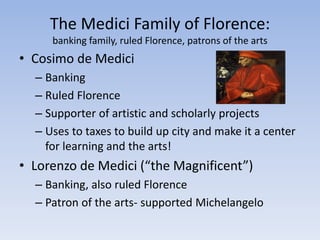
The Medici Family of Florence:
banking family, ruled Florence, patrons of the arts
• Cosimo de Medici
– Banking
– Ruled Florence
– Supporter of artistic and scholarly projects
– Uses to taxes to build up city and make it a center
for learning and the arts!
• Lorenzo de Medici (“the Magnificent”)
– Banking, also ruled Florence
– Patron of the arts- supported Michelangelo
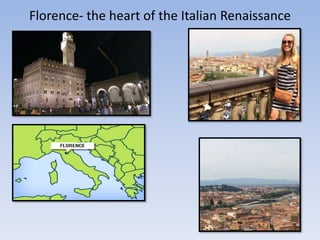
Florence- the heart of the Italian Renaissance
Sforza Family- Milan
• Caterina Sforza ruled Milan
Isabella D-Esta of Mantua
• Sketch of Isabella by da Vinci
• Patron of the arts
Intellectual Movements
Humanism:
Intellectual
movement at the
heart of the Italian
Renaissance
Classicism:
Return to the ideals of
Greece and Rome
Secularism:
Interest in non-religious
world and enjoyment of
worldly pleasures
Celebrating the glory and
power of humans and the
individual!
Seen in the intellectual
thought, art, and
architecture of the time
Renaissance Literature
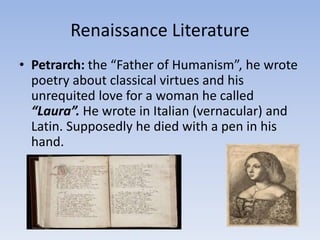
• Petrarch: the “Father of Humanism”, he wrote
poetry about classical virtues and his
unrequited love for a woman he called
“Laura”. He wrote in Italian (vernacular) and
Latin. Supposedly he died with a pen in his
hand.
Renaissance Literature
• Dante Alighieri: The Divine Comedy,
emphasized politics and human interested,
wrote in the vernacular instead of Latin
Renaissance Literature
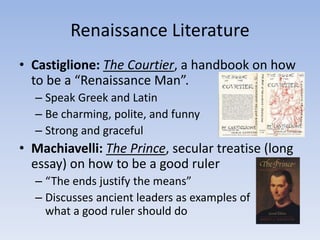
• Castiglione: The Courtier, a handbook on how
to be a “Renaissance Man”.
– Speak Greek and Latin
– Be charming, polite, and funny
– Strong and graceful
• Machiavelli: The Prince, secular treatise (long
essay) on how to be a good ruler
– “The ends justify the means”
– Discusses ancient leaders as examples of
what a good ruler should do
Renaissance Literature
• Erasmus: The Praise of Folly- poked fun at the
clergy, scholars, and merchants. He was from
Flanders- Northern Renaissance
• Shakespeare: English playwright, wrote about
the human condition in both tragedies and
comedies
Art- Early Renaissance
• Giotto di Bondone- carved frescos on human
figures that show depth and emotion
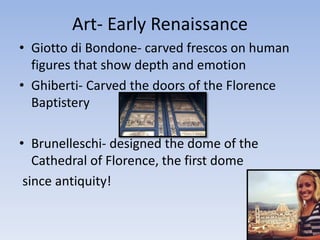
• Ghiberti- Carved the doors of the Florence
Baptistery
• Brunelleschi- designed the dome of the
Cathedral of Florence, the first dome
since antiquity!
Art- Early Renaissance
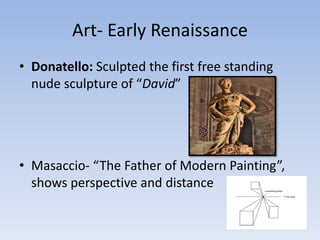
• Donatello: Sculpted the first free standing
nude sculpture of “David”
• Masaccio- “The Father of Modern Painting”,
shows perspective and distance
• Michelangelo
– The “David”
– The “Pieta”
– Sistine Chapel ceiling- “The Last Judgment”
– Dome on St. Peter’s Cathedral in Rome
Art- High (later) Renaissance
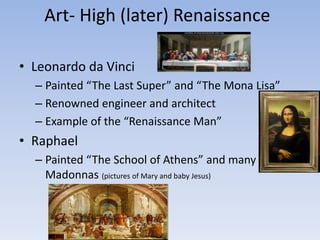
• Leonardo da Vinci
– Painted “The Last Super” and “The Mona Lisa”
– Renowned engineer and architect
– Example of the “Renaissance Man”
• Raphael
– Painted “The School of Athens” and many
Madonnas (pictures of Mary and baby Jesus)
Art- Northern Renaissance
• Durer- woodcuts and engravings
• Hans Holbein the younger- portraits (“Henry VIII”)
• Van Eyck- painting with vivid color and detail
– Example: “The Marriage Portrait”
• Peter Bruegel the Elder- paintings of
weddings, festivals, and peasant life
Cultural Centers of the Renaissance
• 1400s- Center of the Italian Renaissance was
Florence Italy
• 1500s- Rome became a center of art with Pope
Julius II
– Loved art and power and built St. Peters Cathedral
with the help of Michelangelo
• Renaissance ideas spread north through trade
and travel.
• Flanders- present day region of Belgium was the
center of the Northern Renaissance
The Northern Renaissance
• Northern Renaissance= Humanism +
Christianity
• Art and writing is more infused with
Christianity
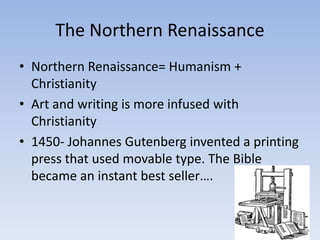
• 1450- Johannes Gutenberg invented a printing
press that used movable type. The Bible
became an instant best seller….
Protestant Reformation
• People start reading the Bible for themselves
and questioning the Catholic Church
• Martin Luther breaks away from the Catholic
Church. 1517 posts 95 Theses
• 1536 Henry VIII separates from
the Catholic Church creating the
Church of England or the Anglican Church
• Sir Thomas More wrote “Utopia” about a
perfect society. He was executed by Henry VIII
for refusing to admit king > God.

Renaissance Notes

  • 1.
    The Renaissance “rebirth” The Crusades,the Black Death, and the Hundred Years’ War all brought about changes that led to a new way of thinking.
  • 2.
    Economic Foundations ofthe Renaissance • Trade flourished in Italy during the Middle Ages and the Renaissance, creating unprecedented wealth in Florence, Genoa, and Venice. – Italy was separated into city-states and enjoyed a democratic atmosphere- republics • Florence was known for banking and textiles and was the center of the Italian Renaissance
  • 3.
    • Usury: charginginterest on money loaned (church did not allow) • Credit: “buy now, pay later”
  • 4.
    The Medici Familyof Florence: banking family, ruled Florence, patrons of the arts • Cosimo de Medici – Banking – Ruled Florence – Supporter of artistic and scholarly projects – Uses to taxes to build up city and make it a center for learning and the arts! • Lorenzo de Medici (“the Magnificent”) – Banking, also ruled Florence – Patron of the arts- supported Michelangelo
  • 5.
    Florence- the heartof the Italian Renaissance
  • 6.
    Sforza Family- Milan •Caterina Sforza ruled Milan Isabella D-Esta of Mantua • Sketch of Isabella by da Vinci • Patron of the arts
  • 7.
    Intellectual Movements Humanism: Intellectual movement atthe heart of the Italian Renaissance Classicism: Return to the ideals of Greece and Rome Secularism: Interest in non-religious world and enjoyment of worldly pleasures Celebrating the glory and power of humans and the individual! Seen in the intellectual thought, art, and architecture of the time
  • 8.
    Renaissance Literature • Petrarch:the “Father of Humanism”, he wrote poetry about classical virtues and his unrequited love for a woman he called “Laura”. He wrote in Italian (vernacular) and Latin. Supposedly he died with a pen in his hand.
  • 9.
    Renaissance Literature • DanteAlighieri: The Divine Comedy, emphasized politics and human interested, wrote in the vernacular instead of Latin
  • 10.
    Renaissance Literature • Castiglione:The Courtier, a handbook on how to be a “Renaissance Man”. – Speak Greek and Latin – Be charming, polite, and funny – Strong and graceful • Machiavelli: The Prince, secular treatise (long essay) on how to be a good ruler – “The ends justify the means” – Discusses ancient leaders as examples of what a good ruler should do
  • 11.
    Renaissance Literature • Erasmus:The Praise of Folly- poked fun at the clergy, scholars, and merchants. He was from Flanders- Northern Renaissance • Shakespeare: English playwright, wrote about the human condition in both tragedies and comedies
  • 12.
    Art- Early Renaissance •Giotto di Bondone- carved frescos on human figures that show depth and emotion • Ghiberti- Carved the doors of the Florence Baptistery • Brunelleschi- designed the dome of the Cathedral of Florence, the first dome since antiquity!
  • 13.
    Art- Early Renaissance •Donatello: Sculpted the first free standing nude sculpture of “David” • Masaccio- “The Father of Modern Painting”, shows perspective and distance
  • 14.
    • Michelangelo – The“David” – The “Pieta” – Sistine Chapel ceiling- “The Last Judgment” – Dome on St. Peter’s Cathedral in Rome
  • 15.
    Art- High (later)Renaissance • Leonardo da Vinci – Painted “The Last Super” and “The Mona Lisa” – Renowned engineer and architect – Example of the “Renaissance Man” • Raphael – Painted “The School of Athens” and many Madonnas (pictures of Mary and baby Jesus)
  • 16.
    Art- Northern Renaissance •Durer- woodcuts and engravings • Hans Holbein the younger- portraits (“Henry VIII”) • Van Eyck- painting with vivid color and detail – Example: “The Marriage Portrait” • Peter Bruegel the Elder- paintings of weddings, festivals, and peasant life
  • 17.
    Cultural Centers ofthe Renaissance • 1400s- Center of the Italian Renaissance was Florence Italy • 1500s- Rome became a center of art with Pope Julius II – Loved art and power and built St. Peters Cathedral with the help of Michelangelo • Renaissance ideas spread north through trade and travel. • Flanders- present day region of Belgium was the center of the Northern Renaissance
  • 18.
    The Northern Renaissance •Northern Renaissance= Humanism + Christianity • Art and writing is more infused with Christianity • 1450- Johannes Gutenberg invented a printing press that used movable type. The Bible became an instant best seller….
  • 19.
    Protestant Reformation • Peoplestart reading the Bible for themselves and questioning the Catholic Church • Martin Luther breaks away from the Catholic Church. 1517 posts 95 Theses • 1536 Henry VIII separates from the Catholic Church creating the Church of England or the Anglican Church • Sir Thomas More wrote “Utopia” about a perfect society. He was executed by Henry VIII for refusing to admit king > God.

Editor's Notes

  • #3 Traded wool leather silk
  • #10 Lots of political fighting He was kicked out of Florence
  • #11 Lots of political fighting He was kicked out of Florence
  • #12 Lots of political fighting He was kicked out of Florence