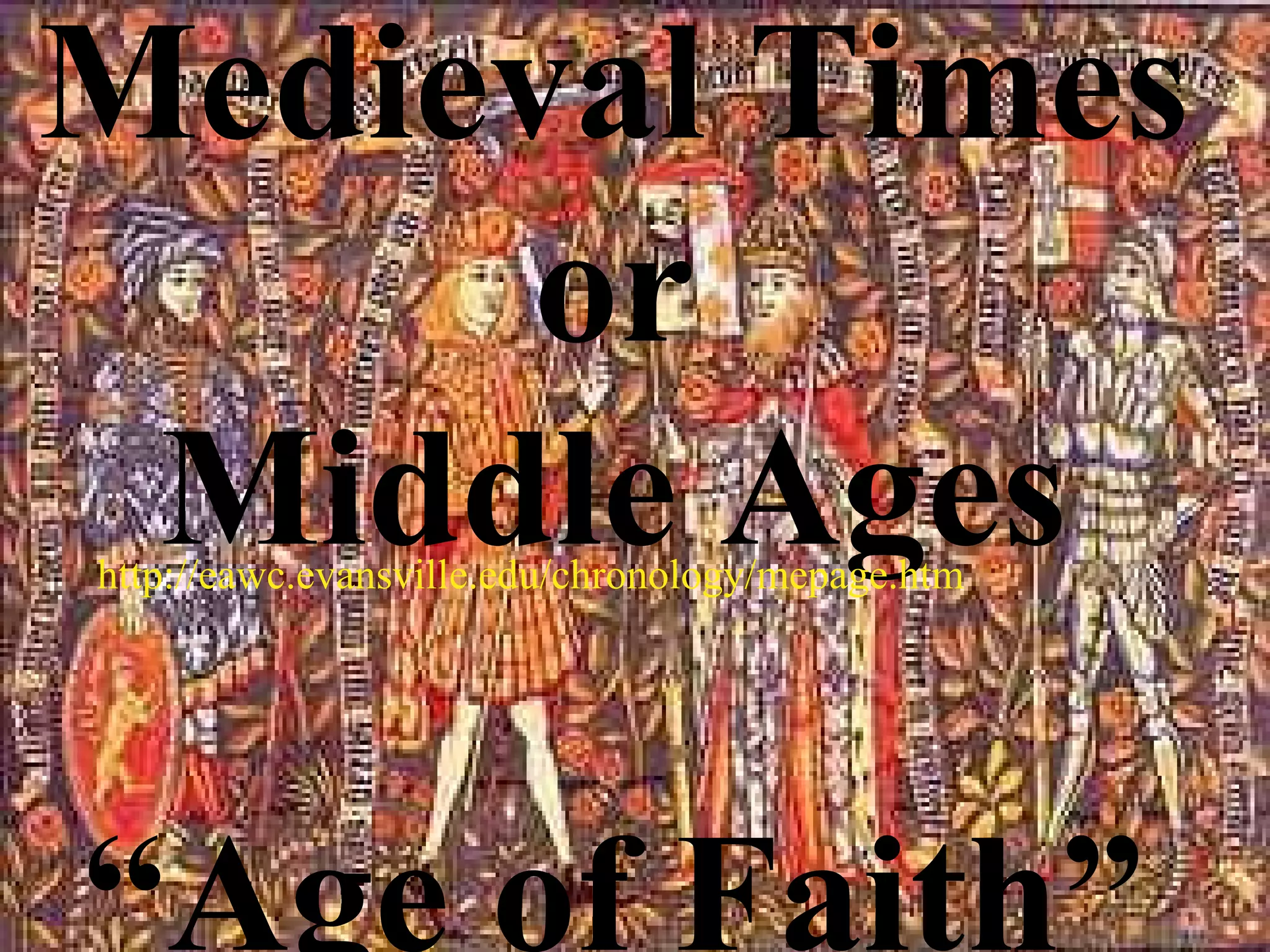
Medieval Times
or
Middle Ages
“Age of Faith”
http://eawc.evansville.edu/chronology/mepage.htm
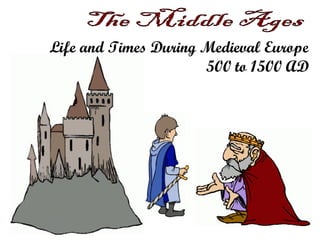
Life and Times During Medieval Europe
500 to 1500 AD
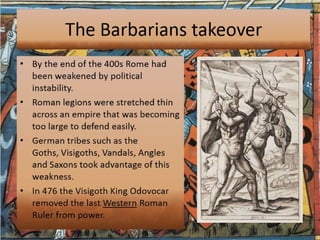
Started with the collapse of
Roman Empire
• Crumbling started in earnest 190 CE
• 476 Last Western Roman Empire leader
dethroned.
Warriors and Warbands in the West
• Period of change in Western Europe as barbarians
were migrating in to areas given up by Romans
• As more barbarians moved westward, other tribes
were forced to move
• Groups categorized by languages and little else
• Celtic: Gauls, Britons, Bretons
• Germanic: Goths, Frank, Vandals, Saxons
• Slavic: Wends
• Repeated invasions and constant
warfare ended the Western Roman
Empire:
– Disruption of Trade--Merchants
faced invasions from land and sea.
Businesses collapse and money
becomes scarce.
– Downfall of Cities--Cities were
abandoned.
– Population Shift--Population moves
from cities to countryside (rural).
• People turned to church for order and
security.
– Church offered structure.
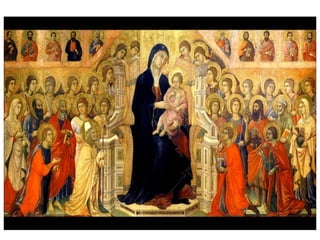
– Church provided services, such as
orphanages, education, etc.
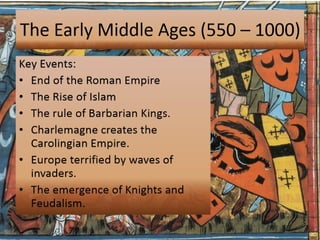
Early Middle
Ages
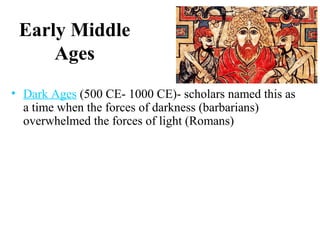
• Dark Ages (500 CE- 1000 CE)- scholars named this as
a time when the forces of darkness (barbarians)
overwhelmed the forces of light (Romans)
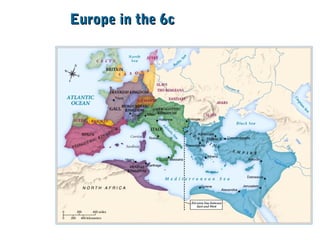
Europe in the 6cEurope in the 6c
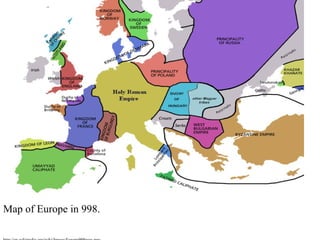
Map of Europe in 998.
PeriodizationPeriodization
Early Middle Ages: 500 – 1000
High Middle Ages: 1000 – 1250
Late Middle Ages: 1250 - 1500
Expanding Influence of the Church
• Christian Church has become an important political,
economic, spiritual and cultural force in Europe
• Leading officials of Church were the Pope and
Patriarch
• Banning of heresy (holding beliefs that contradict the
official religion)
• conversion by force
• Eventually in 11th
Century, Church split into two
independent branches Eastern Orthodox (Greek)
based in Constantinople and Roman Catholic in
Rome
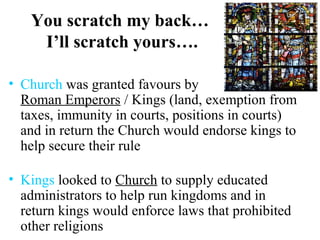
You scratch my back…
I’ll scratch yours….
• Church was granted favours by
Roman Emperors / Kings (land, exemption from
taxes, immunity in courts, positions in courts)
and in return the Church would endorse kings to
help secure their rule
• Kings looked to Church to supply educated
administrators to help run kingdoms and in
return kings would enforce laws that prohibited
other religions
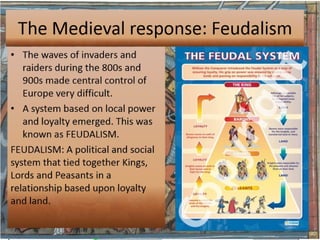
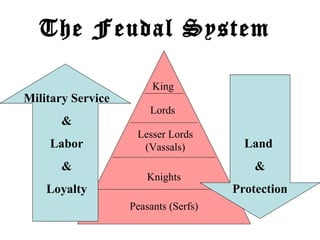
The Feudal System
King
Lords
Lesser Lords
(Vassals)
Knights
Peasants (Serfs)
Military Service
&
Labor
&
Loyalty
Land
&
Protection
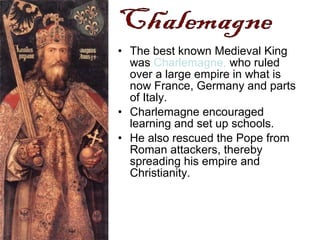
• The best known Medieval King
was Charlemagne, who ruled
over a large empire in what is
now France, Germany and parts
of Italy.
• Charlemagne encouraged
learning and set up schools.
• He also rescued the Pope from
Roman attackers, thereby
spreading his empire and
Christianity.
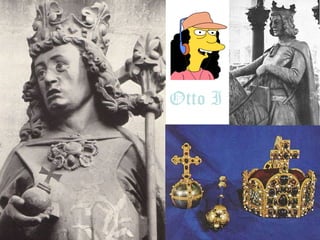
Otto I
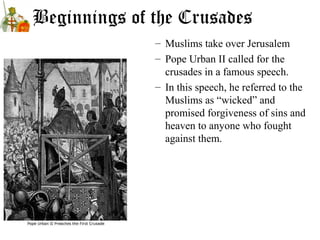
Beginnings of the Crusades
– Muslims take over Jerusalem
– Pope Urban II called for the
crusades in a famous speech.
– In this speech, he referred to the
Muslims as “wicked” and
promised forgiveness of sins and
heaven to anyone who fought
against them.
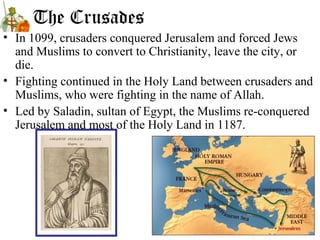
The Crusades
• In 1099, crusaders conquered Jerusalem and forced Jews
and Muslims to convert to Christianity, leave the city, or
die.
• Fighting continued in the Holy Land between crusaders and
Muslims, who were fighting in the name of Allah.
• Led by Saladin, sultan of Egypt, the Muslims re-conquered
Jerusalem and most of the Holy Land in 1187.
Muslim Products
• Universities, libraries, schools
• Use of zero & Arabic numerals
• Algebra & Geometry
• Chemical medicines
• Performed surgery
• Wrote medical textbooks
• Astronomy Records
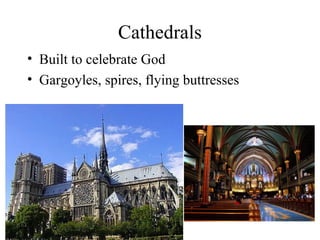
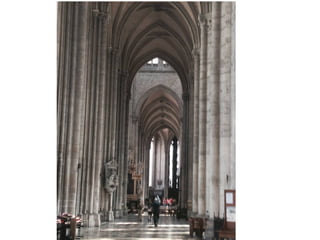
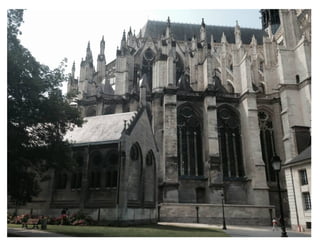
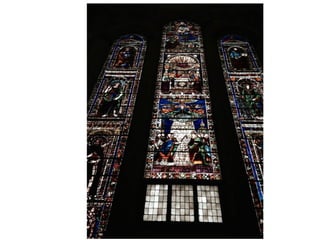
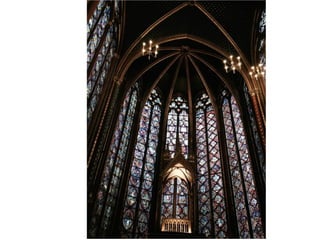
Cathedrals
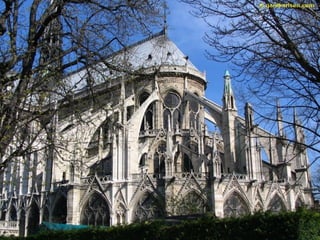
• Built to celebrate God
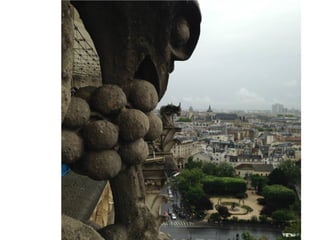
• Gargoyles, spires, flying buttresses
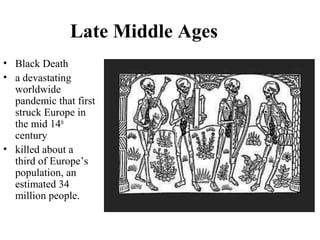
Late Middle Ages
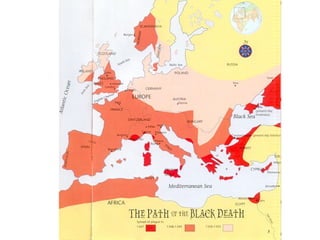
• Black Death
• a devastating
worldwide
pandemic that first
struck Europe in
the mid 14th
century
• killed about a
third of Europe’s
population, an
estimated 34
million people.
Black Death Begins
• Began in Europe around 1350, 1 in 3
people died
• Caused by a germ found on fleas from
rats (Cats could have helped)
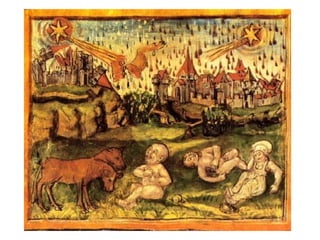
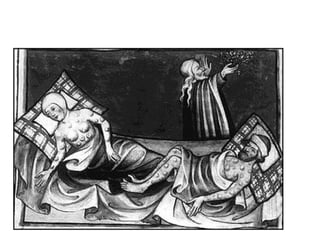
Illustration of the Black Death from the Toggenburg Bible (1411).
Age of Faith v Renaissance
• Group
• Survival & self-
awareness
• Simple lifestyle
(survival)
• Celebrated the
Individual
• Ideas of Ancient
Greece & Rome
reappear
• People enjoy
worldly pleasures
Renaissance
• Scientific Revolution
• Industrial Revolution
• Enlightenment ( Revolution of Ideas)
• Cultural Revolution
• Political Revolutions
• Democratic Revolutions
Bibliography
• http://eawc.evansville.edu/chronology/mepage.htm
• http://www.insecta-inspecta.com/fleas/bdeath/bdeath.html
• http://www.cybersleuth-
kids.com/sleuth/History/Ancient_Civilizations/Rome/index.htm
• People Through the Ages (grade 8 textbook)
• https://www.slideshare.net/Halligan/the-
middle-ages-introduction-and-overview?
from_action=save (most copied from here)

The middle ages

  • 1.
    Medieval Times or Middle Ages “Ageof Faith” http://eawc.evansville.edu/chronology/mepage.htm
  • 2.
    Life and TimesDuring Medieval Europe 500 to 1500 AD
  • 3.
    Started with thecollapse of Roman Empire • Crumbling started in earnest 190 CE • 476 Last Western Roman Empire leader dethroned.
  • 5.
    Warriors and Warbandsin the West • Period of change in Western Europe as barbarians were migrating in to areas given up by Romans • As more barbarians moved westward, other tribes were forced to move • Groups categorized by languages and little else • Celtic: Gauls, Britons, Bretons • Germanic: Goths, Frank, Vandals, Saxons • Slavic: Wends
  • 6.
    • Repeated invasionsand constant warfare ended the Western Roman Empire: – Disruption of Trade--Merchants faced invasions from land and sea. Businesses collapse and money becomes scarce. – Downfall of Cities--Cities were abandoned. – Population Shift--Population moves from cities to countryside (rural).
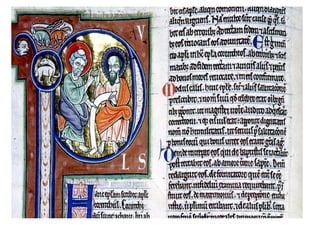
  • 7.
    • People turnedto church for order and security. – Church offered structure. – Church provided services, such as orphanages, education, etc.
  • 8.
    Early Middle Ages • DarkAges (500 CE- 1000 CE)- scholars named this as a time when the forces of darkness (barbarians) overwhelmed the forces of light (Romans)
  • 9.
    Europe in the6cEurope in the 6c
  • 10.
  • 11.
    PeriodizationPeriodization Early Middle Ages:500 – 1000 High Middle Ages: 1000 – 1250 Late Middle Ages: 1250 - 1500
  • 19.
    Expanding Influence ofthe Church • Christian Church has become an important political, economic, spiritual and cultural force in Europe • Leading officials of Church were the Pope and Patriarch • Banning of heresy (holding beliefs that contradict the official religion) • conversion by force • Eventually in 11th Century, Church split into two independent branches Eastern Orthodox (Greek) based in Constantinople and Roman Catholic in Rome
  • 20.
    You scratch myback… I’ll scratch yours…. • Church was granted favours by Roman Emperors / Kings (land, exemption from taxes, immunity in courts, positions in courts) and in return the Church would endorse kings to help secure their rule • Kings looked to Church to supply educated administrators to help run kingdoms and in return kings would enforce laws that prohibited other religions
  • 22.
    The Feudal System King Lords LesserLords (Vassals) Knights Peasants (Serfs) Military Service & Labor & Loyalty Land & Protection
  • 26.
    • The bestknown Medieval King was Charlemagne, who ruled over a large empire in what is now France, Germany and parts of Italy. • Charlemagne encouraged learning and set up schools. • He also rescued the Pope from Roman attackers, thereby spreading his empire and Christianity.
  • 27.
  • 28.
    Beginnings of theCrusades – Muslims take over Jerusalem – Pope Urban II called for the crusades in a famous speech. – In this speech, he referred to the Muslims as “wicked” and promised forgiveness of sins and heaven to anyone who fought against them.
  • 29.
    The Crusades • In1099, crusaders conquered Jerusalem and forced Jews and Muslims to convert to Christianity, leave the city, or die. • Fighting continued in the Holy Land between crusaders and Muslims, who were fighting in the name of Allah. • Led by Saladin, sultan of Egypt, the Muslims re-conquered Jerusalem and most of the Holy Land in 1187.
  • 30.
    Muslim Products • Universities,libraries, schools • Use of zero & Arabic numerals • Algebra & Geometry • Chemical medicines • Performed surgery • Wrote medical textbooks • Astronomy Records
  • 31.
    Cathedrals • Built tocelebrate God • Gargoyles, spires, flying buttresses
  • 47.
    Late Middle Ages •Black Death • a devastating worldwide pandemic that first struck Europe in the mid 14th century • killed about a third of Europe’s population, an estimated 34 million people.
  • 48.
    Black Death Begins •Began in Europe around 1350, 1 in 3 people died • Caused by a germ found on fleas from rats (Cats could have helped)
  • 54.
    Illustration of theBlack Death from the Toggenburg Bible (1411).
  • 55.
    Age of Faithv Renaissance • Group • Survival & self- awareness • Simple lifestyle (survival) • Celebrated the Individual • Ideas of Ancient Greece & Rome reappear • People enjoy worldly pleasures
  • 56.
    Renaissance • Scientific Revolution •Industrial Revolution • Enlightenment ( Revolution of Ideas) • Cultural Revolution • Political Revolutions • Democratic Revolutions
  • 57.
    Bibliography • http://eawc.evansville.edu/chronology/mepage.htm • http://www.insecta-inspecta.com/fleas/bdeath/bdeath.html •http://www.cybersleuth- kids.com/sleuth/History/Ancient_Civilizations/Rome/index.htm • People Through the Ages (grade 8 textbook) • https://www.slideshare.net/Halligan/the- middle-ages-introduction-and-overview? from_action=save (most copied from here)

Editor's Notes

  • #20 Christian Church has become an important political, economic, spiritual and cultural force in Europe Leading officials of Church were the bishops of Rome (Pope) and Constantinople (Patriarch) As influence grew, laws were passed to forced people to become Christians and banned heresy (holding beliefs that contradict the official religion) Fines were given against heretics, then harsher penalties and even death Eventually, conversion by force Eventually in 11th Century, Church split into two independent branches Eastern Orthodox (Greek) based in Constantinople and Roman Catholic in Rome