The Renaissance


Politics, Literature, and Arts
PNoy warns of terror threat during
 Black Nazarene procession
MANILA, Philippines - Terrorists could carry out an
attack during the procession for the Feast of the
Black Nazarene in Manila on Monday, President
Aquino warned on Sunday.
"In any open democracy, there will always be
challenge coming from extremist elements. The sad
reality of the world today is that terrorists want to
disrupt the ability of people to live their lives the way
they want to , including the freedom to worship," he
said in a press conference.
"Lately, we have been getting some information that
led us to believe that there is a heightened risk that
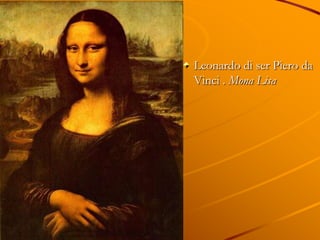
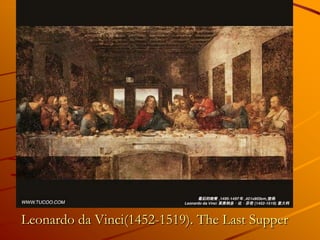
leads us to take the necessary precautions,
especially given the nature of the procession for the
Black Nazarene which involves quite a huge number
of people," he added.
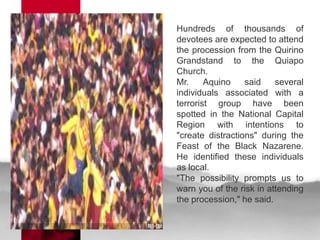
Hundreds of thousands of
devotees are expected to attend
the procession from the Quirino
Grandstand to the Quiapo
Church.
Mr.     Aquino    said    several
individuals associated with a
terrorist group have been
spotted in the National Capital
Region with intentions to
"create distractions" during the
Feast of the Black Nazarene.
He identified these individuals
as local.
"The possibility prompts us to
warn you of the risk in attending
the procession," he said.
1.The Renaissance in Italy


A Renaissance historian has described the Renaissance
as the ―Prototype of the modern world.‖ This was the
period in which people began to adopt a rational,
objective, and statistical approach to reality and to
rediscover the importance of the individual and his or
her artistic creativity.
(2).The Background of the Italian
             Renaissance
Italy:Birthplace of the Renaissance
The city-states of northern Italy that spawned the
Renaissance were developed urban centers, where
people had the wealth, freedom, and inclination to
cultivate the arts to enjoy the fruits of worldly life.
In Italy ,reminders of ancient Rome’s grandeur were
everywhere.
With the expansion of commerce and industry, Italian
feudal values of birth, military prowess, and a fixed
hierarchy of lords and vassals decayed in favor of
ambition and individual achievement.
(3). Humanism and Individualism
  The most characteristic intellectual movement of the
Renaissance was humanism, an educational and cultural
program based on the study of ancient Greek and Roman
literature. Humanism is the term generally applied to the
predominant social philosophy and intellectual and literary
currents of the period from c. 1350 to c.1600. The return to
favor of classics stimulated the philosophy of secularism, the
appreciation of worldly pleasures, and above all intensified the
assertion of personal independence and individual expression.
Individualism is the moral stance, political philosophy, or
social outlook that stresses indepenpence, self-reliance and
individual liberty.
(4). Renaissance Literature
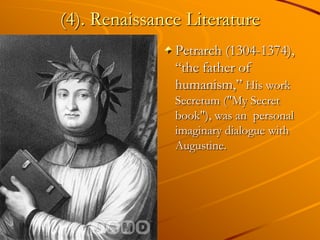
               Petrarch (1304-1374),
               ―the father of
               humanism,‖ His work
               Secretum ("My Secret
               book"), was an personal
               imaginary dialogue with
               Augustine.
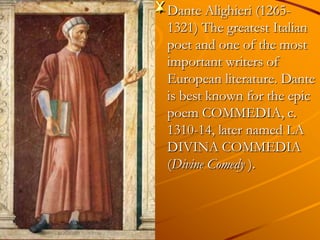
x Dante Alighieri (1265-
  1321) The greatest Italian
  poet and one of the most
  important writers of
  European literature. Dante
  is best known for the epic
  poem COMMEDIA, c.
  1310-14, later named LA
  DIVINA COMMEDIA
  (Divine Comedy ).
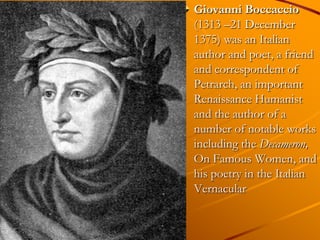
Giovanni Boccaccio
(1313 –21 December
1375) was an Italian
author and poet, a friend
and correspondent of
Petrarch, an important
Renaissance Humanist
and the author of a
number of notable works
including the Decameron,
On Famous Women, and
his poetry in the Italian
Vernacular
(5). Secular Politics-Machiavelli and the
             New Statecraft

No one gave better expression the Renaissance
preoccupation with political power than Niccolo
Machiavelli (1469-1527).
             ―MIGHT MAKES RIGHT‖
       ―THE END JUSTIFY THE MEANS‖
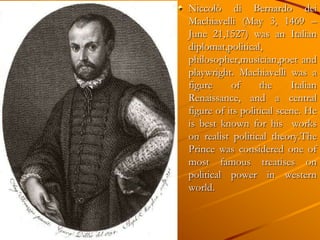
Niccolò di Bernardo dei
Machiavelli (May 3, 1469 –
June 21,1527) was an Italian
diplomat,political,
philosopher,musician,poet and
playwright. Machiavelli was a
figure     of      the     Italian
Renaissance, and a central
figure of its political scene. He
is best known for his works
on realist political theory.The
Prince was considered one of
most famous treatises on
political power in western
world.
2:The High Renaissance inside and
           outside of Italy
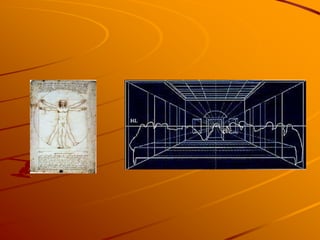
(1) Renaissance Art
The essential meanings of the Renaissance is
conveyed through its art, particularly
architecture, sculpture, and painting.
Renaissance examples of all three art forms
reflect a style that stressed proportion, balance,
and harmony.
The great Renaissance artists included Leonardo
da Vinci(1452-1519),Michelangelo Buonarroti
(1475-1564), and Raphael Santi (1483-1520).
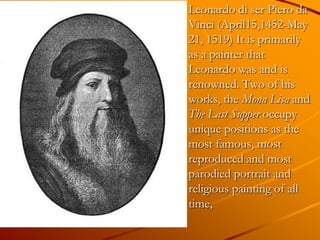
Leonardo di ser Piero da
Vinci (April15,1452-May
21, 1519) It is primarily
as a painter that
Leonardo was and is
renowned. Two of his
works, the Mona Lisa and
The Last Supper occupy
unique positions as the
most famous, most
reproduced and most
parodied portrait and
religious painting of all
time,
Leonardo di ser Piero da
Vinci . Mona Lisa
Leonardo da Vinci(1452-1519). The Last Supper
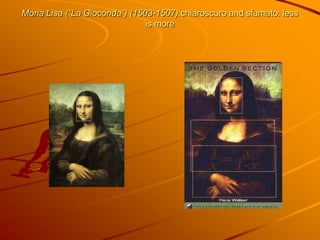
Mona Lisa (“La Gioconda”) (1503-1507):chiaroscuro and sfumato: less
                              is more
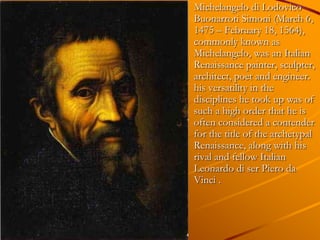
Michelangelo di Lodovico
Buonarroti Simoni (March 6,
1475 – February 18, 1564),
commonly known as
Michelangelo, was an Italian
Renaissance painter, sculpter,
architect, poet and engineer.
his versatility in the
disciplines he took up was of
such a high order that he is
often considered a contender
for the title of the archetypal
Renaissance, along with his
rival and fellow Italian
Leonardo di ser Piero da
Vinci .
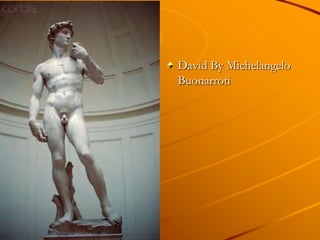
David By Michelangelo
Buonarroti
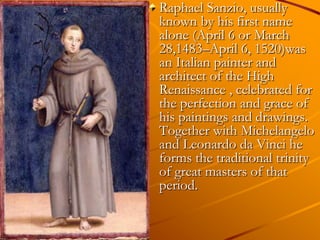
Raphael Sanzio, usually
known by his first name
alone (April 6 or March
28,1483–April 6, 1520)was
an Italian painter and
architect of the High
Renaissance , celebrated for
the perfection and grace of
his paintings and drawings.
Together with Michelangelo
and Leonardo da Vinci he
forms the traditional trinity
of great masters of that
period.
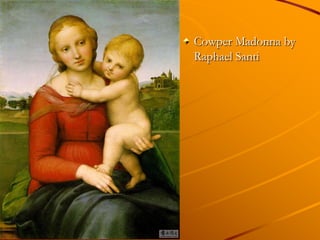
Cowper Madonna by
Raphael Santi
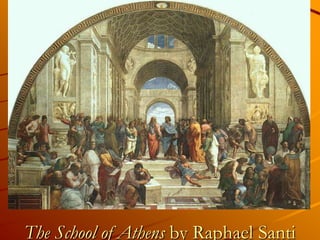
The School of Athens by Raphael Santi
(2): The Spread of the Renaissance
Aided by the invention of printing, the Renaissance
spread to Germany, France, England, and Spain in the
late fifteenth and the sixteenth centuries. In its
migration northward, Renaissance culture adapted
itself to conditions different from those in Italy—
particularly the strength of lay piety.
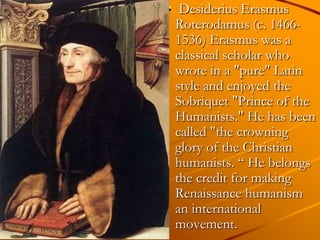
Desiderius Erasmus
Roterodamus (c. 1466-
1536) Erasmus was a
classical scholar who
wrote in a "pure" Latin
style and enjoyed the
Sobriquet "Prince of the
Humanists." He has been
called "the crowning
glory of the Christian
humanists. ― He belongs
the credit for making
Renaissance humanism
an international
movement.
French and English Humanism
Francois Rabelais (c. 1494-c. 1553), a former monk,
exemplified the humanist spirit in France. In response
to religious dogmatism, Rabelais asserted the essential
goodness of the individual and the right to enjoy the
world rather than be bound by the fear of a punishing
God.
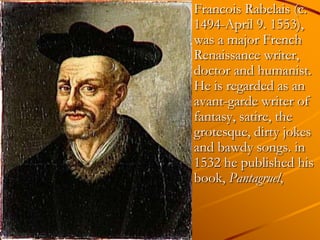
Francois Rabelais (c.
1494-April 9. 1553),
was a major French
Renaissance writer,
doctor and humanist.
He is regarded as an
avant-garde writer of
fantasy, satire, the
grotesque, dirty jokes
and bawdy songs. in
1532 he published his
book, Pantagruel,
The most influential humanist of the early English
Renaissance was Sir Thomas More (1478-1535). His
most famous book is Utopia, the first major utopian
treatise to be written in the West since Plato’s republic
and one of the most original works on the entire
Renaissance.
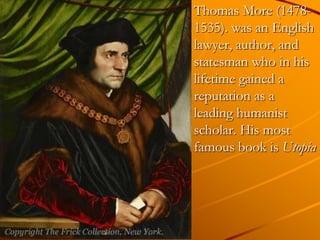
Thomas More (1478-
1535). was an English
lawyer, author, and
statesman who in his
lifetime gained a
reputation as a
leading humanist
scholar. His most
famous book is Utopia
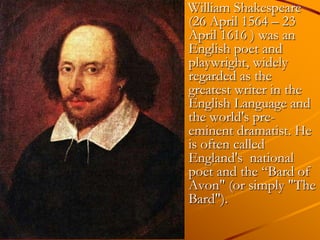
William Shakespeare (1564-1616), widely considered
the greatest playwright the world has ever produced,
gave expression to Renaissance values—honor,
heroism, and the struggle against fate and fortune.
William Shakespeare
(26 April 1564 – 23
April 1616 ) was an
English poet and
playwright, widely
regarded as the
greatest writer in the
English Language and
the world's pre-
eminent dramatist. He
is often called
England's national
poet and the ―Bard of
Avon" (or simply "The
Bard").
(3): The Renaissance and the Modern
                 Age
The renaissance, then, marks the birth of modernity;
in art; in the idea of the individual’s role in history and
in nature; and in society, politics, war, and diplomacy.
The revival of antiquity by the humanists did not
mean, however, that they identified completely with it.
The revival itself was done too self-consciously for
that.

The renaissance

  • 1.
  • 2.
    PNoy warns ofterror threat during Black Nazarene procession MANILA, Philippines - Terrorists could carry out an attack during the procession for the Feast of the Black Nazarene in Manila on Monday, President Aquino warned on Sunday. "In any open democracy, there will always be challenge coming from extremist elements. The sad reality of the world today is that terrorists want to disrupt the ability of people to live their lives the way they want to , including the freedom to worship," he said in a press conference. "Lately, we have been getting some information that led us to believe that there is a heightened risk that leads us to take the necessary precautions, especially given the nature of the procession for the Black Nazarene which involves quite a huge number of people," he added.
  • 3.
    Hundreds of thousandsof devotees are expected to attend the procession from the Quirino Grandstand to the Quiapo Church. Mr. Aquino said several individuals associated with a terrorist group have been spotted in the National Capital Region with intentions to "create distractions" during the Feast of the Black Nazarene. He identified these individuals as local. "The possibility prompts us to warn you of the risk in attending the procession," he said.
  • 5.
    1.The Renaissance inItaly A Renaissance historian has described the Renaissance as the ―Prototype of the modern world.‖ This was the period in which people began to adopt a rational, objective, and statistical approach to reality and to rediscover the importance of the individual and his or her artistic creativity.
  • 6.
    (2).The Background ofthe Italian Renaissance Italy:Birthplace of the Renaissance The city-states of northern Italy that spawned the Renaissance were developed urban centers, where people had the wealth, freedom, and inclination to cultivate the arts to enjoy the fruits of worldly life. In Italy ,reminders of ancient Rome’s grandeur were everywhere.
  • 7.
    With the expansionof commerce and industry, Italian feudal values of birth, military prowess, and a fixed hierarchy of lords and vassals decayed in favor of ambition and individual achievement.
  • 8.
    (3). Humanism andIndividualism The most characteristic intellectual movement of the Renaissance was humanism, an educational and cultural program based on the study of ancient Greek and Roman literature. Humanism is the term generally applied to the predominant social philosophy and intellectual and literary currents of the period from c. 1350 to c.1600. The return to favor of classics stimulated the philosophy of secularism, the appreciation of worldly pleasures, and above all intensified the assertion of personal independence and individual expression. Individualism is the moral stance, political philosophy, or social outlook that stresses indepenpence, self-reliance and individual liberty.
  • 9.
    (4). Renaissance Literature Petrarch (1304-1374), ―the father of humanism,‖ His work Secretum ("My Secret book"), was an personal imaginary dialogue with Augustine.
  • 10.
    x Dante Alighieri(1265- 1321) The greatest Italian poet and one of the most important writers of European literature. Dante is best known for the epic poem COMMEDIA, c. 1310-14, later named LA DIVINA COMMEDIA (Divine Comedy ).
  • 11.
    Giovanni Boccaccio (1313 –21December 1375) was an Italian author and poet, a friend and correspondent of Petrarch, an important Renaissance Humanist and the author of a number of notable works including the Decameron, On Famous Women, and his poetry in the Italian Vernacular
  • 12.
    (5). Secular Politics-Machiavelliand the New Statecraft No one gave better expression the Renaissance preoccupation with political power than Niccolo Machiavelli (1469-1527). ―MIGHT MAKES RIGHT‖ ―THE END JUSTIFY THE MEANS‖
  • 13.
    Niccolò di Bernardodei Machiavelli (May 3, 1469 – June 21,1527) was an Italian diplomat,political, philosopher,musician,poet and playwright. Machiavelli was a figure of the Italian Renaissance, and a central figure of its political scene. He is best known for his works on realist political theory.The Prince was considered one of most famous treatises on political power in western world.
  • 14.
    2:The High Renaissanceinside and outside of Italy (1) Renaissance Art The essential meanings of the Renaissance is conveyed through its art, particularly architecture, sculpture, and painting. Renaissance examples of all three art forms reflect a style that stressed proportion, balance, and harmony.
  • 15.
    The great Renaissanceartists included Leonardo da Vinci(1452-1519),Michelangelo Buonarroti (1475-1564), and Raphael Santi (1483-1520).
  • 16.
    Leonardo di serPiero da Vinci (April15,1452-May 21, 1519) It is primarily as a painter that Leonardo was and is renowned. Two of his works, the Mona Lisa and The Last Supper occupy unique positions as the most famous, most reproduced and most parodied portrait and religious painting of all time,
  • 17.
    Leonardo di serPiero da Vinci . Mona Lisa
  • 18.
  • 20.
    Mona Lisa (“LaGioconda”) (1503-1507):chiaroscuro and sfumato: less is more
  • 21.
    Michelangelo di Lodovico BuonarrotiSimoni (March 6, 1475 – February 18, 1564), commonly known as Michelangelo, was an Italian Renaissance painter, sculpter, architect, poet and engineer. his versatility in the disciplines he took up was of such a high order that he is often considered a contender for the title of the archetypal Renaissance, along with his rival and fellow Italian Leonardo di ser Piero da Vinci .
  • 22.
  • 23.
    Raphael Sanzio, usually knownby his first name alone (April 6 or March 28,1483–April 6, 1520)was an Italian painter and architect of the High Renaissance , celebrated for the perfection and grace of his paintings and drawings. Together with Michelangelo and Leonardo da Vinci he forms the traditional trinity of great masters of that period.
  • 24.
  • 25.
    The School ofAthens by Raphael Santi
  • 26.
    (2): The Spreadof the Renaissance Aided by the invention of printing, the Renaissance spread to Germany, France, England, and Spain in the late fifteenth and the sixteenth centuries. In its migration northward, Renaissance culture adapted itself to conditions different from those in Italy— particularly the strength of lay piety.
  • 27.
    Desiderius Erasmus Roterodamus (c.1466- 1536) Erasmus was a classical scholar who wrote in a "pure" Latin style and enjoyed the Sobriquet "Prince of the Humanists." He has been called "the crowning glory of the Christian humanists. ― He belongs the credit for making Renaissance humanism an international movement.
  • 28.
    French and EnglishHumanism Francois Rabelais (c. 1494-c. 1553), a former monk, exemplified the humanist spirit in France. In response to religious dogmatism, Rabelais asserted the essential goodness of the individual and the right to enjoy the world rather than be bound by the fear of a punishing God.
  • 29.
    Francois Rabelais (c. 1494-April9. 1553), was a major French Renaissance writer, doctor and humanist. He is regarded as an avant-garde writer of fantasy, satire, the grotesque, dirty jokes and bawdy songs. in 1532 he published his book, Pantagruel,
  • 30.
    The most influentialhumanist of the early English Renaissance was Sir Thomas More (1478-1535). His most famous book is Utopia, the first major utopian treatise to be written in the West since Plato’s republic and one of the most original works on the entire Renaissance.
  • 31.
    Thomas More (1478- 1535).was an English lawyer, author, and statesman who in his lifetime gained a reputation as a leading humanist scholar. His most famous book is Utopia
  • 32.
    William Shakespeare (1564-1616),widely considered the greatest playwright the world has ever produced, gave expression to Renaissance values—honor, heroism, and the struggle against fate and fortune.
  • 33.
    William Shakespeare (26 April1564 – 23 April 1616 ) was an English poet and playwright, widely regarded as the greatest writer in the English Language and the world's pre- eminent dramatist. He is often called England's national poet and the ―Bard of Avon" (or simply "The Bard").
  • 34.
    (3): The Renaissanceand the Modern Age The renaissance, then, marks the birth of modernity; in art; in the idea of the individual’s role in history and in nature; and in society, politics, war, and diplomacy. The revival of antiquity by the humanists did not mean, however, that they identified completely with it. The revival itself was done too self-consciously for that.