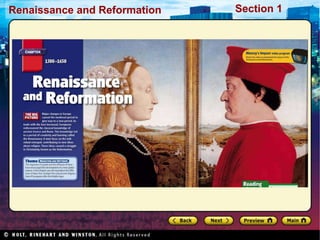
Renaissance and Reformation

Section 1
Renaissance and Reformation

Section 1

The Italian Renaissance
Preview
• Starting Points Map: Europe
• Main Idea / Reading Focus
• The Beginning of the Renaissance

• Renaissance Ideas
• Quick Facts: Causes of the Renaissance
• Renaissance Art
• Faces of History: Two Renaissance Masters
Renaissance and Reformation
Click the icon to play
Listen to History
audio.

Click the icon below
to connect to the
Interactive Maps.

Section 1
Renaissance and Reformation

Section 1

The Italian Renaissance
Main Idea
1. In Italy the growth of wealthy trading cities and new ways of
thinking helped lead to a rebirth of the arts and learning. This era
became known as the Renaissance.

Reading Focus
• What changes in society and in cities stimulated the beginning
of the Renaissance?
• What ideas formed the foundation of the Italian Renaissance?
• What contributions did artists make to the Renaissance?
Renaissance and Reformation

Section 1

The Beginning of the Renaissance
Michelangelo’s painting was different from the art of the Middle Ages, and
only one way in which European society began changing after the 1300s.

Changes in Society

The Rise of City-States

• 1300, Black Death, starvation,
warfare had overtaken Europe

• Urban areas specialized,
particularly in Italy

• Catastrophic events, enormous
loss of life may have led to
changes of the 1300s

• Italy divided into several large
city-states in north, various
kingdoms, Papal States south

• Decrease in population led to:

• Catholic Church, nobles,
merchants, artisans dominated
society in city-states

– Increase in food production
– Decline in food prices

– More money to spend
– Specialization in products

• Many sought to display new
wealth with knowledge of arts
Renaissance and Reformation

Section 1

Venice
• With access to sea, Venice built economy, reputation on trade
• Had long history of trading with other ports on Mediterranean Sea
• Shipbuilding prospered, sailors traveled to Near East

• Wealthy Venetian merchants built unique city, ―work of art‖

Milan, Florence
• Milan, west of Venice, based economy on agriculture, silk, weapons

• Florence, to south, famous for banking, cloth
• Monarchs appealed to Florentine bankers for money to fund wars
• Merchants refined raw wool into fine cloth
• Bankers, merchants created city to rival any in Europe
Renaissance and Reformation

Section 1

Find the Main Idea
How did society and cities change in the
1300s?
Answer(s): Specialization in agriculture
increased, resulting in more trade; urban areas
became centers of commerce; merchants and
artisans became important; some cities became
displays of wealth.
Section 1

Renaissance and Reformation

Renaissance Ideas
2. As the economy and society changed, new ideas began to appear.
This period of interest and developments in art, literature, science and
learning is known as the Renaissance, French for ―rebirth.‖

Inspiration from the
Ancients
• Venetian ships
carried goods for
trade and Greek
scholars seeking
refuge
• Scholars brought
ancient works
thought to be lost

New World of Ideas
• Italians who could
read looked for
more information
• Read Arabic
translations of
original texts
• Searched
libraries, found lost
texts

Different
Viewpoints
• As they read,
began to think
about philosophy,
art, science in
different ways
• Began to believe in
human capacity to
create, achieve
Section 1

Renaissance and Reformation

Humanism
Humanities
• Interest in ancient Greek,
Roman culture
• Characteristics of good
education
• Scholastic education gave way
to classics: rhetoric, grammar,
poetry, history, Latin, Greek
• Subjects came to be known as
humanities, movement they
inspired known as humanism
• Humanists emphasized
individual accomplishment

Roots
• Roots traced to work of Dante;
work contained glimpses of
what would become focus on
human nature
• Historians believe Renaissance
began with two humanists who
lived after Dante—Giovanni
Boccaccio, Francesco Petrarch
• Both wrote literature in
everyday language not Latin
• Advances were made in
medicine, as well as astronomy
Section 1

Renaissance and Reformation

Secular Writers
• Early 1500s life in Italy seemed insecure, precarious
• Church no longer served as source of stability, peace
• Form of humanism developed from Petrarch’s ideas; focus was
secular, was worldly rather than spiritual

Service
• Humanists argued that
individual achievement,
education could be fully
expressed only if people used
talents, abilities in service of
cities.

Renaissance Man
• Ideal Renaissance man came to
be ―universal man,‖
accomplished in classics, but
also man of action, who could
respond to all situations.
Renaissance and Reformation

Section 1

Examples of Renaissance Men
How to Act
• Italian diplomat Baldassare Castiglione wrote book, The Courtier
• Described how perfect Renaissance gentleman, gentlewoman should act
• Book includes fictional conversation between duke, guests

Castiglione’s Advice
• Castiglione gave nobles new rules for refined behavior in humanist society
• Speak of serious, as well of amusing subjects; know Latin, Greek
• Be well-acquainted with poetry, history; be able to write prose, poetry

How to Rule
• Philosopher, statesman Niccolò Machiavelli also wrote influential book
• Experiences with violent politics influenced opinions on how governments
should rule in The Prince
Renaissance and Reformation

Section 1

Machiavelli
Machiavellian advice seemed to encourage harsh
treatment of citizens, rival states

• Describes men as ―ungrateful, fickle, liars, and deceivers‖
• Advises rulers to separate morals from politics
– Power, ruthlessness more useful than idealism
– Ruler must do whatever necessary to maintain political power,
even if cruel

• Machiavelli’s theory that ―the end justifies the means‖
deviated from accepted views of correct behavior
• Idea that state an entity in itself, separate from its ruler,
became foundation for later political philosophy
Renaissance and Reformation

Section 1

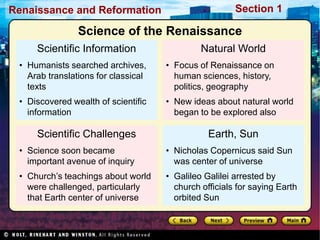
Science of the Renaissance
Scientific Information

Natural World

• Humanists searched archives,
Arab translations for classical
texts

• Focus of Renaissance on
human sciences, history,
politics, geography

• Discovered wealth of scientific
information

• New ideas about natural world
began to be explored also

Scientific Challenges

Earth, Sun

• Science soon became
important avenue of inquiry

• Nicholas Copernicus said Sun
was center of universe

• Church’s teachings about world
were challenged, particularly
that Earth center of universe

• Galileo Galilei arrested by
church officials for saying Earth
orbited Sun
Renaissance and Reformation

Section 1
Renaissance and Reformation

Section 1

Draw Conclusions

What were some important new ideas of the
Renaissance?
Answer(s): inspiration from the ancient Greeks
and Romans; humanism; secular focus; new
theories in science
Section 1

Renaissance and Reformation

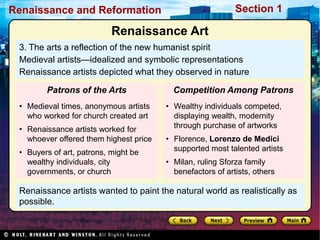
Renaissance Art
3. The arts a reflection of the new humanist spirit
Medieval artists—idealized and symbolic representations
Renaissance artists depicted what they observed in nature
Patrons of the Arts
• Medieval times, anonymous artists
who worked for church created art
• Renaissance artists worked for
whoever offered them highest price
• Buyers of art, patrons, might be
wealthy individuals, city
governments, or church

Competition Among Patrons
• Wealthy individuals competed,
displaying wealth, modernity
through purchase of artworks

• Florence, Lorenzo de Medici
supported most talented artists
• Milan, ruling Sforza family
benefactors of artists, others

Renaissance artists wanted to paint the natural world as realistically as
possible.
Section 1

Renaissance and Reformation

Styles and Techniques
Artists Methods

Classical Influence

• Studied perspective,
represented threedimensional objects

• Religious paintings
focused on personality

• Experimented with using
color to portray shapes,
textures
• Subject matter changed;
artists began to paint,
sculpt scenes from Greek,
Roman myths

• Humanist interest in
classical learning, human
nature
• Building design reflected
humanist reverence for
Greek, Roman culture
• Classical architecture
favored
Section 1

Renaissance and Reformation

Leonardo da Vinci
• Highly talented in all fields
• His paintings are still studied and admired
• Wrote out ideas, filling 20,000 pages of notes
• His interests, enthusiasm boundless

Michelangelo

Sculpture, Painting

• Studied anatomy

• Marble statue of David

• Age 24, won fame with Pietà,
sculpture of Jesus’ mother Mary
holding son’s dead body

• Most famous painting, artwork
on ceiling of Sistine Chapel

• Sculpture communicates grief,
love, acceptance, immortality

• Scenes from Old Testament
considered one of greatest
achievements in art history
Section 1

Renaissance and Reformation

Other Artists
Raphael
• Raffaello Sanzio, became
known as Raphael
• Renowned painter,
accomplished architect
• Most famous work, The School
of Athens, fresco—painting
made on fresh, moist plaster
• Also well known for many
paintings of the Madonna,
mother of Jesus

Bramante
• Renaissance architecture
reached height with work of
Donato Bramante
• Had already achieved fame
when chosen architect of Rome
• Design for St. Peter’s Basilica
influenced appearance of many
smaller churches
Renaissance and Reformation

Section 1
Renaissance and Reformation

Section 1

Find the Main Idea

What was the ideal of Renaissance art?
Answer(s): capturing human
personality, realism, human form

World History Ch. 15 Section 1 Notes

  • 1.
  • 2.
    Renaissance and Reformation Section1 The Italian Renaissance Preview • Starting Points Map: Europe • Main Idea / Reading Focus • The Beginning of the Renaissance • Renaissance Ideas • Quick Facts: Causes of the Renaissance • Renaissance Art • Faces of History: Two Renaissance Masters
  • 3.
    Renaissance and Reformation Clickthe icon to play Listen to History audio. Click the icon below to connect to the Interactive Maps. Section 1
  • 4.
    Renaissance and Reformation Section1 The Italian Renaissance Main Idea 1. In Italy the growth of wealthy trading cities and new ways of thinking helped lead to a rebirth of the arts and learning. This era became known as the Renaissance. Reading Focus • What changes in society and in cities stimulated the beginning of the Renaissance? • What ideas formed the foundation of the Italian Renaissance? • What contributions did artists make to the Renaissance?
  • 5.
    Renaissance and Reformation Section1 The Beginning of the Renaissance Michelangelo’s painting was different from the art of the Middle Ages, and only one way in which European society began changing after the 1300s. Changes in Society The Rise of City-States • 1300, Black Death, starvation, warfare had overtaken Europe • Urban areas specialized, particularly in Italy • Catastrophic events, enormous loss of life may have led to changes of the 1300s • Italy divided into several large city-states in north, various kingdoms, Papal States south • Decrease in population led to: • Catholic Church, nobles, merchants, artisans dominated society in city-states – Increase in food production – Decline in food prices – More money to spend – Specialization in products • Many sought to display new wealth with knowledge of arts
  • 6.
    Renaissance and Reformation Section1 Venice • With access to sea, Venice built economy, reputation on trade • Had long history of trading with other ports on Mediterranean Sea • Shipbuilding prospered, sailors traveled to Near East • Wealthy Venetian merchants built unique city, ―work of art‖ Milan, Florence • Milan, west of Venice, based economy on agriculture, silk, weapons • Florence, to south, famous for banking, cloth • Monarchs appealed to Florentine bankers for money to fund wars • Merchants refined raw wool into fine cloth • Bankers, merchants created city to rival any in Europe
  • 7.
    Renaissance and Reformation Section1 Find the Main Idea How did society and cities change in the 1300s? Answer(s): Specialization in agriculture increased, resulting in more trade; urban areas became centers of commerce; merchants and artisans became important; some cities became displays of wealth.
  • 8.
    Section 1 Renaissance andReformation Renaissance Ideas 2. As the economy and society changed, new ideas began to appear. This period of interest and developments in art, literature, science and learning is known as the Renaissance, French for ―rebirth.‖ Inspiration from the Ancients • Venetian ships carried goods for trade and Greek scholars seeking refuge • Scholars brought ancient works thought to be lost New World of Ideas • Italians who could read looked for more information • Read Arabic translations of original texts • Searched libraries, found lost texts Different Viewpoints • As they read, began to think about philosophy, art, science in different ways • Began to believe in human capacity to create, achieve
  • 9.
    Section 1 Renaissance andReformation Humanism Humanities • Interest in ancient Greek, Roman culture • Characteristics of good education • Scholastic education gave way to classics: rhetoric, grammar, poetry, history, Latin, Greek • Subjects came to be known as humanities, movement they inspired known as humanism • Humanists emphasized individual accomplishment Roots • Roots traced to work of Dante; work contained glimpses of what would become focus on human nature • Historians believe Renaissance began with two humanists who lived after Dante—Giovanni Boccaccio, Francesco Petrarch • Both wrote literature in everyday language not Latin • Advances were made in medicine, as well as astronomy
  • 10.
    Section 1 Renaissance andReformation Secular Writers • Early 1500s life in Italy seemed insecure, precarious • Church no longer served as source of stability, peace • Form of humanism developed from Petrarch’s ideas; focus was secular, was worldly rather than spiritual Service • Humanists argued that individual achievement, education could be fully expressed only if people used talents, abilities in service of cities. Renaissance Man • Ideal Renaissance man came to be ―universal man,‖ accomplished in classics, but also man of action, who could respond to all situations.
  • 11.
    Renaissance and Reformation Section1 Examples of Renaissance Men How to Act • Italian diplomat Baldassare Castiglione wrote book, The Courtier • Described how perfect Renaissance gentleman, gentlewoman should act • Book includes fictional conversation between duke, guests Castiglione’s Advice • Castiglione gave nobles new rules for refined behavior in humanist society • Speak of serious, as well of amusing subjects; know Latin, Greek • Be well-acquainted with poetry, history; be able to write prose, poetry How to Rule • Philosopher, statesman Niccolò Machiavelli also wrote influential book • Experiences with violent politics influenced opinions on how governments should rule in The Prince
  • 12.
    Renaissance and Reformation Section1 Machiavelli Machiavellian advice seemed to encourage harsh treatment of citizens, rival states • Describes men as ―ungrateful, fickle, liars, and deceivers‖ • Advises rulers to separate morals from politics – Power, ruthlessness more useful than idealism – Ruler must do whatever necessary to maintain political power, even if cruel • Machiavelli’s theory that ―the end justifies the means‖ deviated from accepted views of correct behavior • Idea that state an entity in itself, separate from its ruler, became foundation for later political philosophy
  • 13.
    Renaissance and Reformation Section1 Science of the Renaissance Scientific Information Natural World • Humanists searched archives, Arab translations for classical texts • Focus of Renaissance on human sciences, history, politics, geography • Discovered wealth of scientific information • New ideas about natural world began to be explored also Scientific Challenges Earth, Sun • Science soon became important avenue of inquiry • Nicholas Copernicus said Sun was center of universe • Church’s teachings about world were challenged, particularly that Earth center of universe • Galileo Galilei arrested by church officials for saying Earth orbited Sun
  • 14.
  • 15.
    Renaissance and Reformation Section1 Draw Conclusions What were some important new ideas of the Renaissance? Answer(s): inspiration from the ancient Greeks and Romans; humanism; secular focus; new theories in science
  • 16.
    Section 1 Renaissance andReformation Renaissance Art 3. The arts a reflection of the new humanist spirit Medieval artists—idealized and symbolic representations Renaissance artists depicted what they observed in nature Patrons of the Arts • Medieval times, anonymous artists who worked for church created art • Renaissance artists worked for whoever offered them highest price • Buyers of art, patrons, might be wealthy individuals, city governments, or church Competition Among Patrons • Wealthy individuals competed, displaying wealth, modernity through purchase of artworks • Florence, Lorenzo de Medici supported most talented artists • Milan, ruling Sforza family benefactors of artists, others Renaissance artists wanted to paint the natural world as realistically as possible.
  • 17.
    Section 1 Renaissance andReformation Styles and Techniques Artists Methods Classical Influence • Studied perspective, represented threedimensional objects • Religious paintings focused on personality • Experimented with using color to portray shapes, textures • Subject matter changed; artists began to paint, sculpt scenes from Greek, Roman myths • Humanist interest in classical learning, human nature • Building design reflected humanist reverence for Greek, Roman culture • Classical architecture favored
  • 18.
    Section 1 Renaissance andReformation Leonardo da Vinci • Highly talented in all fields • His paintings are still studied and admired • Wrote out ideas, filling 20,000 pages of notes • His interests, enthusiasm boundless Michelangelo Sculpture, Painting • Studied anatomy • Marble statue of David • Age 24, won fame with Pietà, sculpture of Jesus’ mother Mary holding son’s dead body • Most famous painting, artwork on ceiling of Sistine Chapel • Sculpture communicates grief, love, acceptance, immortality • Scenes from Old Testament considered one of greatest achievements in art history
  • 19.
    Section 1 Renaissance andReformation Other Artists Raphael • Raffaello Sanzio, became known as Raphael • Renowned painter, accomplished architect • Most famous work, The School of Athens, fresco—painting made on fresh, moist plaster • Also well known for many paintings of the Madonna, mother of Jesus Bramante • Renaissance architecture reached height with work of Donato Bramante • Had already achieved fame when chosen architect of Rome • Design for St. Peter’s Basilica influenced appearance of many smaller churches
  • 20.
  • 21.
    Renaissance and Reformation Section1 Find the Main Idea What was the ideal of Renaissance art? Answer(s): capturing human personality, realism, human form