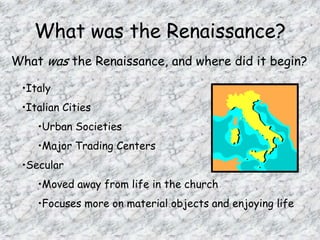
What was the Renaissance?What was the Renaissance, and where did it begin?Italy
Italian Cities
Urban Societies
Major Trading Centers
Secular
Moved away from life in the church
Focuses more on material objects and enjoying lifeThe Renaissance was a time of renewalRenaissance means rebirth and Europe was recovering from the Dark ages and the plague.People had lost their faith in the church and began to put more focus on human beings.
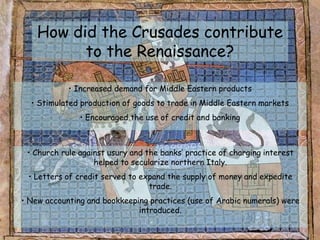
How did the Crusades contribute to the Renaissance?• Increased demand for Middle Eastern products• Stimulated production of goods to trade in Middle Eastern markets• Encouraged the use of credit and banking• Church rule against usury and the banks’ practice of charging interest helped to secularize northern Italy.• Letters of credit served to expand the supply of money and expedite trade.• New accounting and bookkeeping practices (use of Arabic numerals) were introduced.
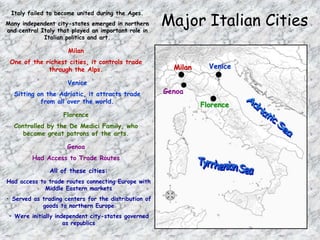
Major Italian CitiesItaly failed to become united during the Ages.Many independent city-states emerged in northern and central Italy that played an important role in Italian politics and art.MilanOne of the richest cities, it controls trade through the Alps.VeniceMilanVeniceSitting on the Adriatic, it attracts trade from all over the world. GenoaFlorenceFlorenceControlled by the De Medici Family, who became great patrons of the arts.Adriatic SeaGenoaHad Access to Trade RoutesTyrrhenian SeaAll of these cities:Had access to trade routes connecting Europe with Middle Eastern markets• Served as trading centers for the distribution of goods to northern Europe• Were initially independent city-states governed as republics
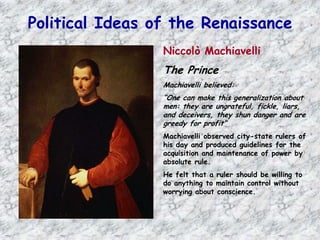
Political Ideas of the RenaissanceNiccolò MachiavelliThe PrinceMachiavelli believed:“One can make this generalization about men: they are ungrateful, fickle, liars, and deceivers, they shun danger and are greedy for profit”Machiavelli observed city-state rulers of his day and produced guidelines for the acquisition and maintenance of power by absolute rule.He felt that a ruler should be willing to do anything to maintain control without worrying about conscience.
Better for a ruler to be feared than to be lovedRuler should be quick and decisive in decision makingRuler keeps power by any means necessaryThe end justifies the meansBe good when possible, and evil when necessary
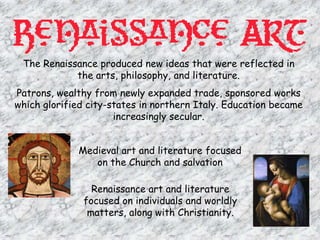
The Renaissance produced new ideas that were reflected in the arts, philosophy, and literature. Patrons, wealthy from newly expanded trade, sponsored works which glorified city-states in northern Italy. Education became increasingly secular.Medieval art and literature focused on the Church and salvationRenaissance art and literature focused on individuals and worldly matters, along with Christianity.
Renaissance Artists embraced some of the ideals of Greece and Rome in their artThey wanted their subjects to be realistic and focused on humanity and emotionNew Techniques also emergedFrescos: Painting done on wet plaster became popular because it gave depth to the paintings Sculpture emphasized realism and the human formArchitecture reached new heights of design
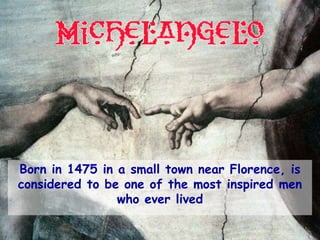
Born in 1475 in a small town near Florence, is considered to be one of the most inspired men who ever lived
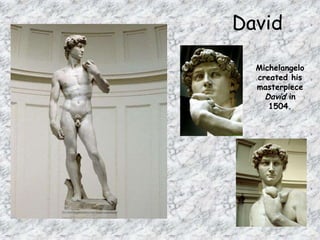
DavidMichelangelo created his masterpiece David in 1504.
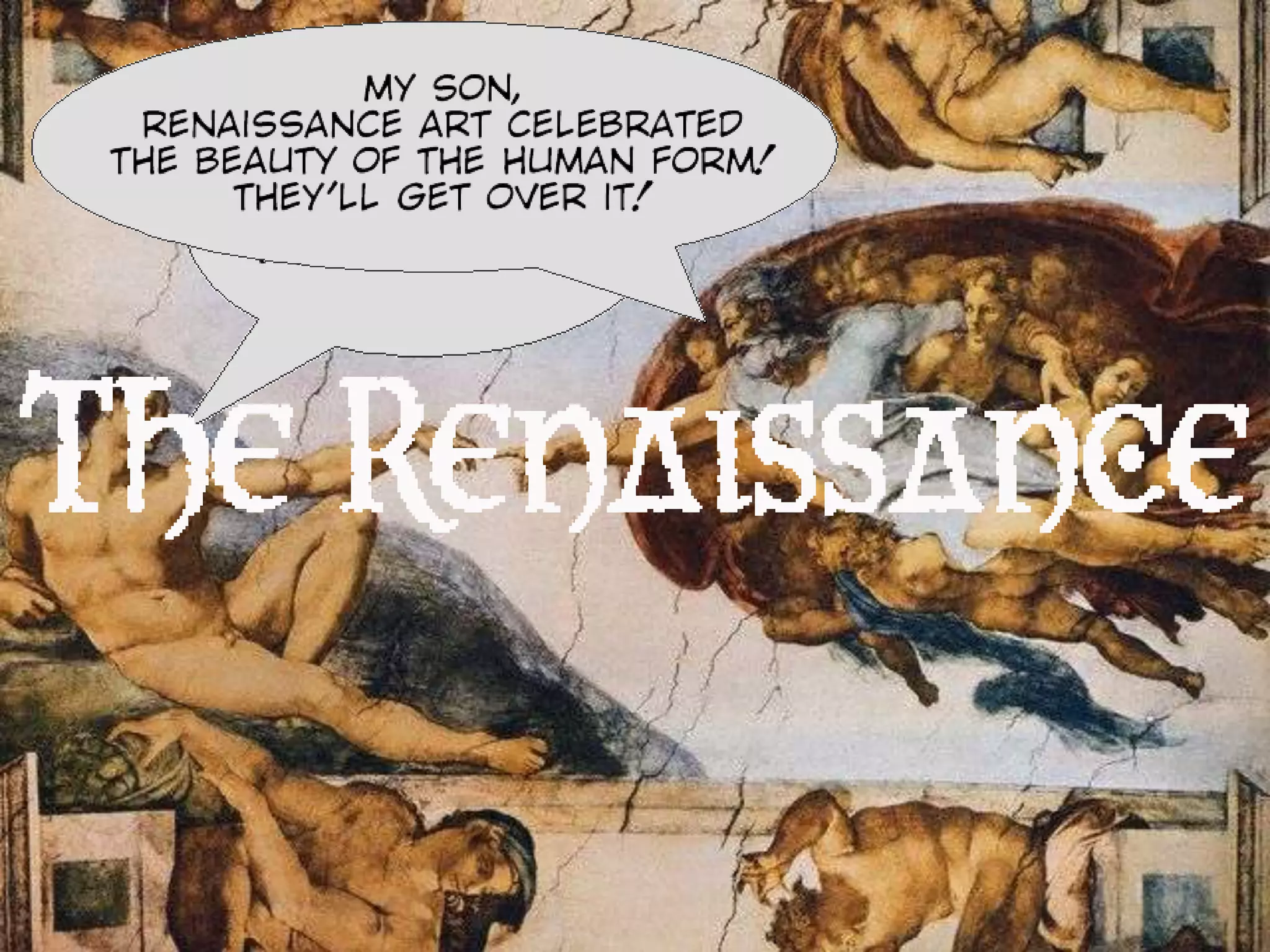
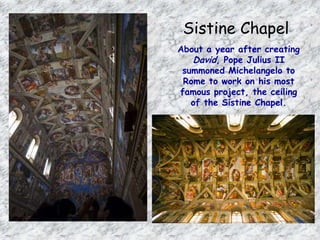
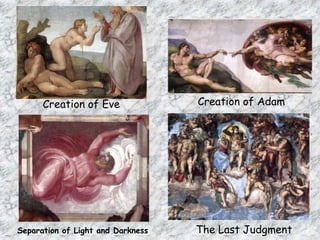
Sistine ChapelAbout a year after creating David, Pope Julius II summoned Michelangelo to Rome to work on his most famous project, the ceiling of the Sistine Chapel.
Creation of AdamCreation of EveThe Last JudgmentSeparation of Light and Darkness
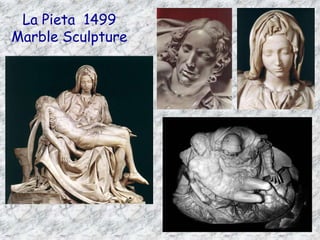
La Pieta  1499Marble Sculpture
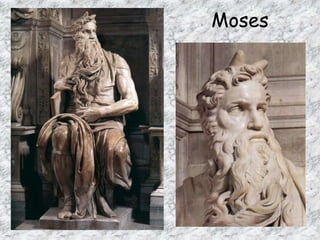
Moses
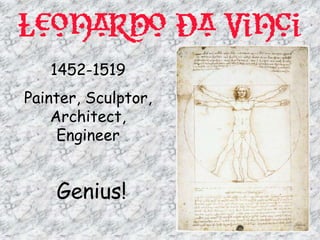
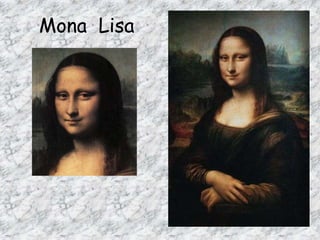
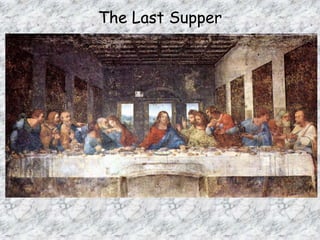
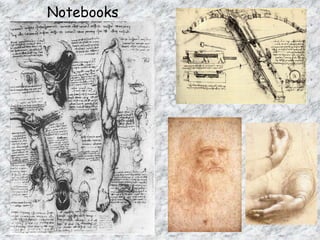
1452-1519Painter, Sculptor, Architect, EngineerGenius!
Mona  Lisa
The Last Supper
Notebooks
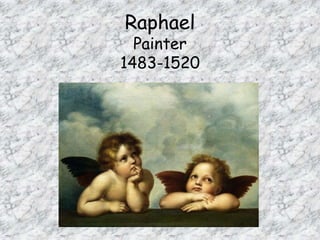
RaphaelPainter1483-1520
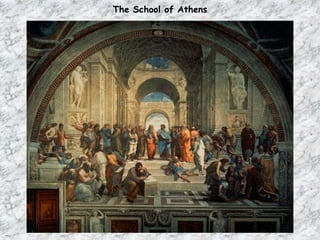
The School of Athens
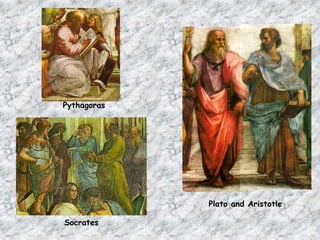
PythagorasPlato and AristotleSocrates
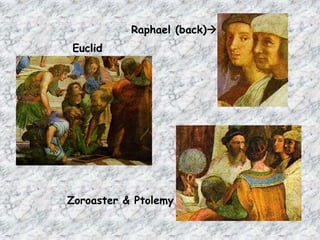
Raphael (back)EuclidZoroaster & Ptolemy
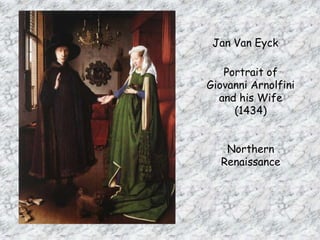
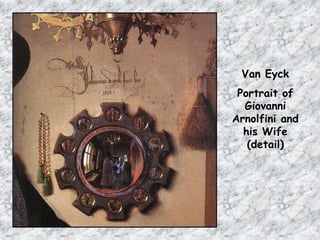
Jan Van EyckPortrait of Giovanni Arnolfini and his Wife (1434)Northern Renaissance
Van EyckPortrait of Giovanni Arnolfini and his Wife (detail)
How did classical knowledge of the ancient Greeks and Romans foster humanism in the Italian Renaissance?Humanism• Celebrated the individual• Stimulated the study of Greek and Roman literature and culture• Was supported by wealthy patrons
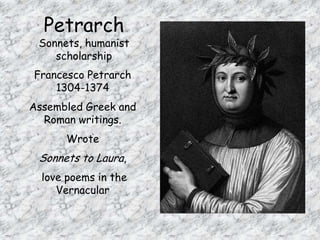
PetrarchSonnets, humanistscholarshipFrancesco Petrarch  1304-1374Assembled Greek and Roman writings.Wrote Sonnets to Laura, love poems in the Vernacular

Renaissance

  • 2.
    What was theRenaissance?What was the Renaissance, and where did it begin?Italy
  • 3.
  • 4.
  • 5.
  • 6.
  • 7.
    Moved away fromlife in the church
  • 8.
    Focuses more onmaterial objects and enjoying lifeThe Renaissance was a time of renewalRenaissance means rebirth and Europe was recovering from the Dark ages and the plague.People had lost their faith in the church and began to put more focus on human beings.
  • 9.
    How did theCrusades contribute to the Renaissance?• Increased demand for Middle Eastern products• Stimulated production of goods to trade in Middle Eastern markets• Encouraged the use of credit and banking• Church rule against usury and the banks’ practice of charging interest helped to secularize northern Italy.• Letters of credit served to expand the supply of money and expedite trade.• New accounting and bookkeeping practices (use of Arabic numerals) were introduced.
  • 10.
    Major Italian CitiesItalyfailed to become united during the Ages.Many independent city-states emerged in northern and central Italy that played an important role in Italian politics and art.MilanOne of the richest cities, it controls trade through the Alps.VeniceMilanVeniceSitting on the Adriatic, it attracts trade from all over the world. GenoaFlorenceFlorenceControlled by the De Medici Family, who became great patrons of the arts.Adriatic SeaGenoaHad Access to Trade RoutesTyrrhenian SeaAll of these cities:Had access to trade routes connecting Europe with Middle Eastern markets• Served as trading centers for the distribution of goods to northern Europe• Were initially independent city-states governed as republics
  • 11.
    Political Ideas ofthe RenaissanceNiccolò MachiavelliThe PrinceMachiavelli believed:“One can make this generalization about men: they are ungrateful, fickle, liars, and deceivers, they shun danger and are greedy for profit”Machiavelli observed city-state rulers of his day and produced guidelines for the acquisition and maintenance of power by absolute rule.He felt that a ruler should be willing to do anything to maintain control without worrying about conscience.
  • 12.
    Better for aruler to be feared than to be lovedRuler should be quick and decisive in decision makingRuler keeps power by any means necessaryThe end justifies the meansBe good when possible, and evil when necessary
  • 13.
    The Renaissance producednew ideas that were reflected in the arts, philosophy, and literature. Patrons, wealthy from newly expanded trade, sponsored works which glorified city-states in northern Italy. Education became increasingly secular.Medieval art and literature focused on the Church and salvationRenaissance art and literature focused on individuals and worldly matters, along with Christianity.
  • 14.
    Renaissance Artists embracedsome of the ideals of Greece and Rome in their artThey wanted their subjects to be realistic and focused on humanity and emotionNew Techniques also emergedFrescos: Painting done on wet plaster became popular because it gave depth to the paintings Sculpture emphasized realism and the human formArchitecture reached new heights of design
  • 15.
    Born in 1475in a small town near Florence, is considered to be one of the most inspired men who ever lived
  • 16.
    DavidMichelangelo created hismasterpiece David in 1504.
  • 17.
    Sistine ChapelAbout ayear after creating David, Pope Julius II summoned Michelangelo to Rome to work on his most famous project, the ceiling of the Sistine Chapel.
  • 18.
    Creation of AdamCreationof EveThe Last JudgmentSeparation of Light and Darkness
  • 19.
    La Pieta 1499Marble Sculpture
  • 20.
  • 21.
  • 22.
  • 23.
  • 24.
  • 25.
  • 26.
  • 27.
  • 28.
  • 29.
    Jan Van EyckPortraitof Giovanni Arnolfini and his Wife (1434)Northern Renaissance
  • 30.
    Van EyckPortrait ofGiovanni Arnolfini and his Wife (detail)
  • 31.
    How did classicalknowledge of the ancient Greeks and Romans foster humanism in the Italian Renaissance?Humanism• Celebrated the individual• Stimulated the study of Greek and Roman literature and culture• Was supported by wealthy patrons
  • 32.
    PetrarchSonnets, humanistscholarshipFrancesco Petrarch 1304-1374Assembled Greek and Roman writings.Wrote Sonnets to Laura, love poems in the Vernacular