 Operations that can be performed in a drilling
machine are
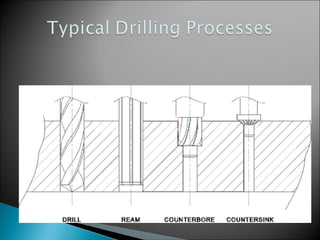
 Drilling
 Reaming
 Boring
 Counter boring
 Countersinking
 Spot Facing
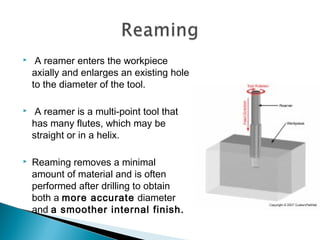
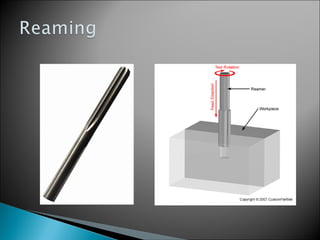
 A reamer enters the workpiece
axially and enlarges an existing hole
to the diameter of the tool.
 A reamer is a multi-point tool that
has many flutes, which may be
straight or in a helix.
 Reaming removes a minimal
amount of material and is often
performed after drilling to obtain
both a more accurate diameter
and a smoother internal finish.
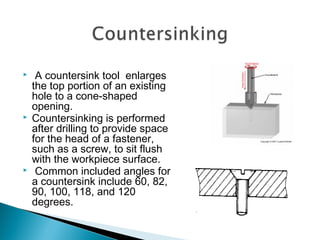
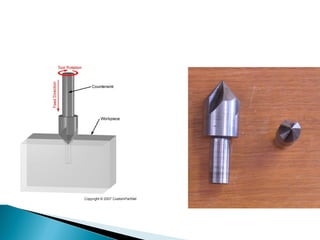
 A countersink tool enlarges
the top portion of an existing
hole to a cone-shaped
opening.
 Countersinking is performed
after drilling to provide space
for the head of a fastener,
such as a screw, to sit flush
with the workpiece surface.
 Common included angles for
a countersink include 60, 82,
90, 100, 118, and 120
degrees.
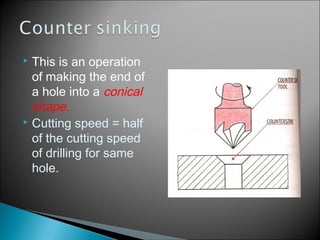
 This is an operation
of making the end of
a hole into a conical
shape.
 Cutting speed = half
of the cutting speed
of drilling for same
hole.
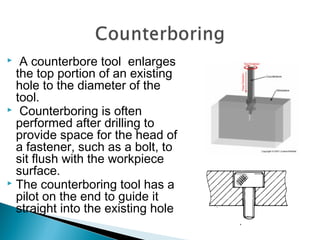
 A counterbore tool enlarges
the top portion of an existing
hole to the diameter of the
tool.
 Counterboring is often
performed after drilling to
provide space for the head of
a fastener, such as a bolt, to
sit flush with the workpiece
surface.
 The counterboring tool has a
pilot on the end to guide it
straight into the existing hole
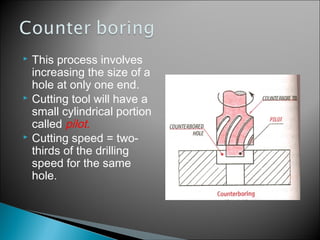
 This process involves
increasing the size of a
hole at only one end.
 Cutting tool will have a
small cylindrical portion
called pilot.
 Cutting speed = two-
thirds of the drilling
speed for the same
hole.
 Spotfacing provides a seat or flat surface at the
entrance and surrounding area of a hole.
 This flat surface allows the bottom of a screw or
bolt to seat squarely with the material.
 Spotfacing is commonly done on castings where
irregular surfaces are found.
 Spotfacing may be performed on a drill press
with a counterbore of suitable size for the
operation.
 A proper size pilot must be used whenever this
is done on the drill press.
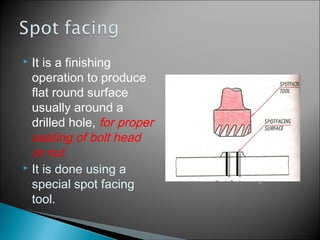
 It is a finishing
operation to produce
flat round surface
usually around a
drilled hole, for proper
seating of bolt head
or nut.
 It is done using a
special spot facing
tool.
 Where holes in two parts are required to line up
with each other, a technique known as ‘spotting’ is
carried out. The top part is marked out and drilled.
 The two parts are then carefully positioned and
clamped together.
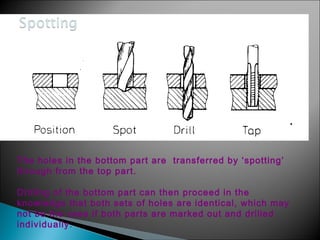
The holes in the bottom part are transferred by ‘spotting’
through from the top part.
Drilling of the bottom part can then proceed in the
knowledge that both sets of holes are identical, which may
not be the case if both parts are marked out and drilled
individually.

Drilling operations final

  • 2.
     Operations thatcan be performed in a drilling machine are  Drilling  Reaming  Boring  Counter boring  Countersinking  Spot Facing
  • 4.
     A reamerenters the workpiece axially and enlarges an existing hole to the diameter of the tool.  A reamer is a multi-point tool that has many flutes, which may be straight or in a helix.  Reaming removes a minimal amount of material and is often performed after drilling to obtain both a more accurate diameter and a smoother internal finish.
  • 6.
     A countersinktool enlarges the top portion of an existing hole to a cone-shaped opening.  Countersinking is performed after drilling to provide space for the head of a fastener, such as a screw, to sit flush with the workpiece surface.  Common included angles for a countersink include 60, 82, 90, 100, 118, and 120 degrees.
  • 7.
     This isan operation of making the end of a hole into a conical shape.  Cutting speed = half of the cutting speed of drilling for same hole.
  • 9.
     A counterboretool enlarges the top portion of an existing hole to the diameter of the tool.  Counterboring is often performed after drilling to provide space for the head of a fastener, such as a bolt, to sit flush with the workpiece surface.  The counterboring tool has a pilot on the end to guide it straight into the existing hole
  • 10.
     This processinvolves increasing the size of a hole at only one end.  Cutting tool will have a small cylindrical portion called pilot.  Cutting speed = two- thirds of the drilling speed for the same hole.
  • 11.
     Spotfacing providesa seat or flat surface at the entrance and surrounding area of a hole.  This flat surface allows the bottom of a screw or bolt to seat squarely with the material.  Spotfacing is commonly done on castings where irregular surfaces are found.  Spotfacing may be performed on a drill press with a counterbore of suitable size for the operation.  A proper size pilot must be used whenever this is done on the drill press.
  • 12.
     It isa finishing operation to produce flat round surface usually around a drilled hole, for proper seating of bolt head or nut.  It is done using a special spot facing tool.
  • 13.
     Where holesin two parts are required to line up with each other, a technique known as ‘spotting’ is carried out. The top part is marked out and drilled.  The two parts are then carefully positioned and clamped together.
  • 14.
    The holes inthe bottom part are transferred by ‘spotting’ through from the top part. Drilling of the bottom part can then proceed in the knowledge that both sets of holes are identical, which may not be the case if both parts are marked out and drilled individually.