Mechanical Engineering
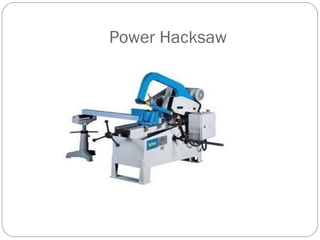
Power Hacksaw
Objectives
State safety precautions associated with
power saw
Identify the main parts of the saw
Set up work and select speeds and feeds
Perform cutting operations (square cutting,
angular cutting)
Power Saws
Power saw are used to cut stock to the desired
length. It is more accurate than hand saws.
Power Hacksaw
Power hacksaws are used to cut large sizes
(sections) of metals such as steel. Cutting
diameters of more than 10/15mm is very hard
work with a normal hand held hacksaw. Therefore
power hacksaws have been developed to carry out
the difficult and time consuming work. The power
hacksaws main feature is its reciprocating frame.
The heavy ‘arm’ moves backwards and forwards,
cutting on the backwards stroke with the help of a
downward force.
Parts of the Power Hacksaw
Base
A mechanism causing the saw frame to
reciprocate
Clamping Vice
Frame
Table
Feed knob
Coolant pump
Types of Power Hacksaws
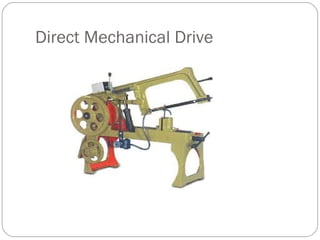
Direct Mechanical drive
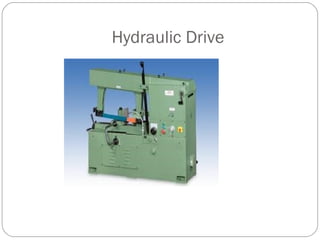
Hydraulic drive
Direct Mechanical Drive
Hydraulic Drive
Feed Mechanism
The feed mechanism regulates the amount
of downward pressure the blade applies on
the material during the forward stroke.
Types of Feed Pressure
Mechanical Feed- light
feed pressure on soft
materials and work with
small cross-section.
Hydraulic Feed- constant
pressure but designed that
when hard spots
encountered, the feed stop
or decrease the pressure
until the hard spot has
been cut through
Gravity Feed-
which provides for
the weights on the
saw frame. These
weights can be
shifted to increase
or decrease the
pressure
Operating the Power Hacksaw
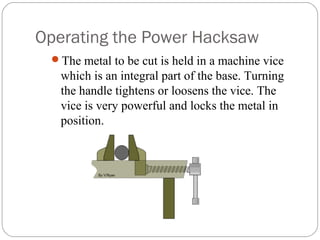
The metal to be cut is held in a machine vice
which is an integral part of the base. Turning
the handle tightens or loosens the vice. The
vice is very powerful and locks the metal in
position.
Operating the Saw
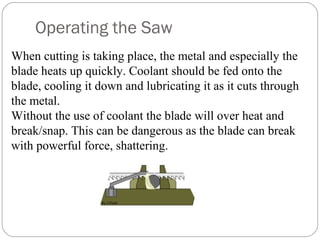
When cutting is taking place, the metal and especially the
blade heats up quickly. Coolant should be fed onto the
blade, cooling it down and lubricating it as it cuts through
the metal.
Without the use of coolant the blade will over heat and
break/snap. This can be dangerous as the blade can break
with powerful force, shattering.
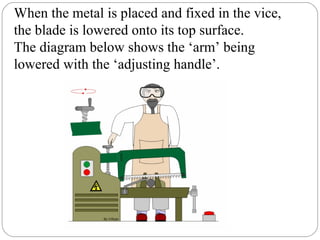
When the metal is placed and fixed in the vice,
the blade is lowered onto its top surface.
The diagram below shows the ‘arm’ being
lowered with the ‘adjusting handle’.
Driving Mechanism
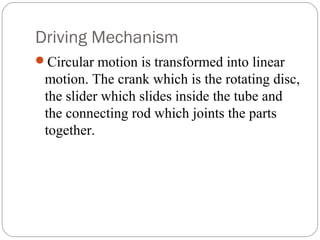
Circular motion is transformed into linear
motion. The crank which is the rotating disc,
the slider which slides inside the tube and
the connecting rod which joints the parts
together.
Driving Mechanism
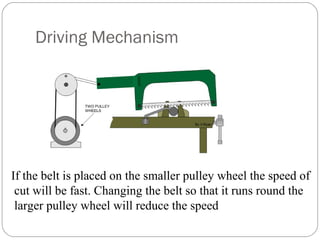
If the belt is placed on the smaller pulley wheel the speed of
cut will be fast. Changing the belt so that it runs round the
larger pulley wheel will reduce the speed
Types Of Blade
When selecting the
blade at least three
teeth must be in
contact with the
work at all times.
Flexible- used for
cutting odd shapes
and is shatter proff.
All hard- straight
and accurate cutting
but shatter when
breaks.
Blade Pitch
The correct pitch of teeth is determined by:
The size of the section,
The material to be cut
Type of Pitch
Coarse- soft steel, cast iron and bronze
Regular- anneal high carbon steel and high
speed steel
Medium- for solid brass stock, iron pipe,
and heavy tubing
Fine- thin tubing and sheet metals
Safety
Never attempt to mount, measure or remove
work unless machine is turned off
Guard long materials at both ends
Use cutting fluid whenever possible
Hold thin materials flat in the vice to
prevent breaking of blades

Mechanical engineering power saw

  • 1.
  • 2.
  • 3.
    Objectives State safety precautionsassociated with power saw Identify the main parts of the saw Set up work and select speeds and feeds Perform cutting operations (square cutting, angular cutting)
  • 4.
    Power Saws Power saware used to cut stock to the desired length. It is more accurate than hand saws.
  • 5.
    Power Hacksaw Power hacksawsare used to cut large sizes (sections) of metals such as steel. Cutting diameters of more than 10/15mm is very hard work with a normal hand held hacksaw. Therefore power hacksaws have been developed to carry out the difficult and time consuming work. The power hacksaws main feature is its reciprocating frame. The heavy ‘arm’ moves backwards and forwards, cutting on the backwards stroke with the help of a downward force.
  • 6.
    Parts of thePower Hacksaw Base A mechanism causing the saw frame to reciprocate Clamping Vice Frame Table Feed knob Coolant pump
  • 7.
    Types of PowerHacksaws Direct Mechanical drive Hydraulic drive
  • 8.
  • 9.
  • 10.
    Feed Mechanism The feedmechanism regulates the amount of downward pressure the blade applies on the material during the forward stroke.
  • 11.
    Types of FeedPressure Mechanical Feed- light feed pressure on soft materials and work with small cross-section. Hydraulic Feed- constant pressure but designed that when hard spots encountered, the feed stop or decrease the pressure until the hard spot has been cut through Gravity Feed- which provides for the weights on the saw frame. These weights can be shifted to increase or decrease the pressure
  • 12.
    Operating the PowerHacksaw The metal to be cut is held in a machine vice which is an integral part of the base. Turning the handle tightens or loosens the vice. The vice is very powerful and locks the metal in position.
  • 13.
    Operating the Saw Whencutting is taking place, the metal and especially the blade heats up quickly. Coolant should be fed onto the blade, cooling it down and lubricating it as it cuts through the metal. Without the use of coolant the blade will over heat and break/snap. This can be dangerous as the blade can break with powerful force, shattering.
  • 14.
    When the metalis placed and fixed in the vice, the blade is lowered onto its top surface. The diagram below shows the ‘arm’ being lowered with the ‘adjusting handle’.
  • 15.
    Driving Mechanism Circular motionis transformed into linear motion. The crank which is the rotating disc, the slider which slides inside the tube and the connecting rod which joints the parts together.
  • 16.
    Driving Mechanism If thebelt is placed on the smaller pulley wheel the speed of cut will be fast. Changing the belt so that it runs round the larger pulley wheel will reduce the speed
  • 17.
    Types Of Blade Whenselecting the blade at least three teeth must be in contact with the work at all times. Flexible- used for cutting odd shapes and is shatter proff. All hard- straight and accurate cutting but shatter when breaks.
  • 18.
    Blade Pitch The correctpitch of teeth is determined by: The size of the section, The material to be cut
  • 19.
    Type of Pitch Coarse-soft steel, cast iron and bronze Regular- anneal high carbon steel and high speed steel Medium- for solid brass stock, iron pipe, and heavy tubing Fine- thin tubing and sheet metals
  • 20.
    Safety Never attempt tomount, measure or remove work unless machine is turned off Guard long materials at both ends Use cutting fluid whenever possible Hold thin materials flat in the vice to prevent breaking of blades