Design Principles
Design Principles
• The Principles are concepts used to organize
or arrange the structural elements of design.
Again, the way in which these principles are
applied affects the expressive content, or the
message of the work.
Design Principles
The principles are:
• Balance
• Rhythm
• Proportion
• Harmony
• Emphasis
Balance
• Balance is the concept of visual equilibrium,
and relates to our physical sense of balance. It
is a reconciliation of opposing forces in a
composition that results in visual stability.
Most successful compositions achieve balance
in one of two ways: symmetrically or
asymmetrically. Balance in a three
dimensional object is easy to understand; if
balance isn't achieved, the object tips over.
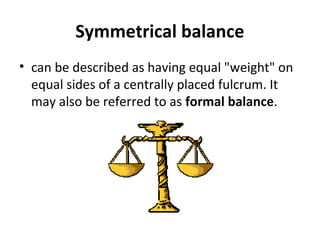
Symmetrical balance
• can be described as having equal "weight" on
equal sides of a centrally placed fulcrum. It
may also be referred to as formal balance.
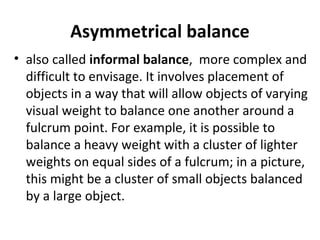
Asymmetrical balance
• also called informal balance, more complex and
difficult to envisage. It involves placement of
objects in a way that will allow objects of varying
visual weight to balance one another around a
fulcrum point. For example, it is possible to
balance a heavy weight with a cluster of lighter
weights on equal sides of a fulcrum; in a picture,
this might be a cluster of small objects balanced
by a large object.
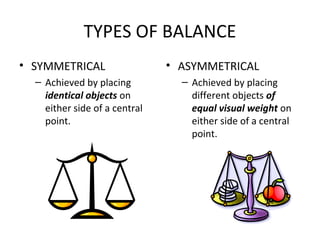
TYPES OF BALANCE
• SYMMETRICAL
– Achieved by placing
identical objects on
either side of a central
point.
• ASYMMETRICAL
– Achieved by placing
different objects of
equal visual weight on
either side of a central
point.
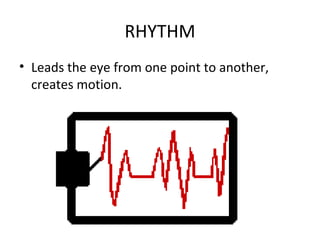
RHYTHM
• Leads the eye from one point to another,
creates motion.
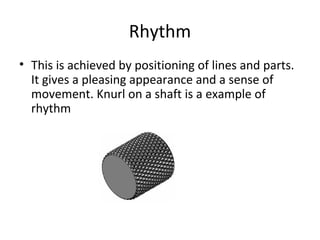
Rhythm
• This is achieved by positioning of lines and parts.
It gives a pleasing appearance and a sense of
movement. Knurl on a shaft is a example of
rhythm
Proportion
• Proportion refers to the relative size and scale
of the various elements in a design. The issue
is the relationship between objects, or parts,
of a whole. This means that it is necessary to
discuss proportion in terms of the context or
standard used to determine proportions.
Harmony
• There are 2 types of harmony.
–Unity
–Variety
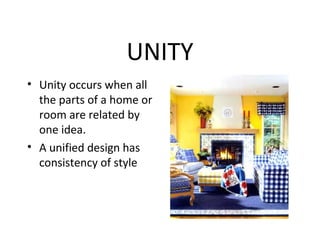
UNITY
• Unity occurs when all
the parts of a home or
room are related by
one idea.
• A unified design has
consistency of style
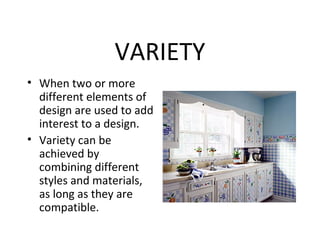
VARIETY
• When two or more
different elements of
design are used to add
interest to a design.
• Variety can be
achieved by
combining different
styles and materials,
as long as they are
compatible.
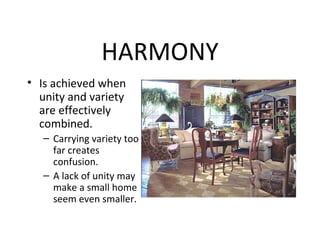
HARMONY
• Is achieved when
unity and variety
are effectively
combined.
– Carrying variety too
far creates
confusion.
– A lack of unity may
make a small home
seem even smaller.
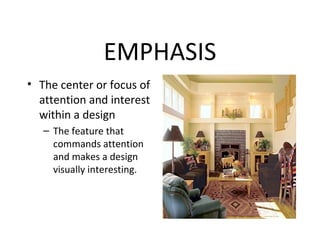
EMPHASIS
• The center or focus of
attention and interest
within a design
– The feature that
commands attention
and makes a design
visually interesting.
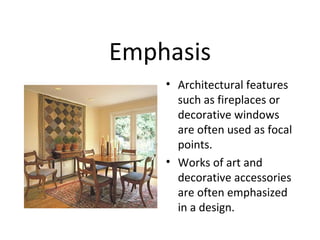
Emphasis
• Architectural features
such as fireplaces or
decorative windows
are often used as focal
points.
• Works of art and
decorative accessories
are often emphasized
in a design.
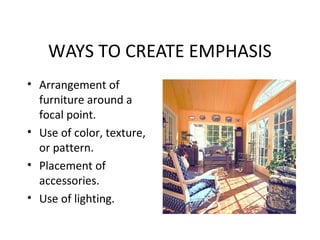
WAYS TO CREATE EMPHASIS
• Arrangement of
furniture around a
focal point.
• Use of color, texture,
or pattern.
• Placement of
accessories.
• Use of lighting.
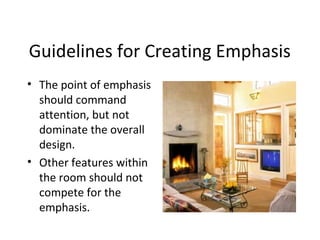
Guidelines for Creating Emphasis
• The point of emphasis
should command
attention, but not
dominate the overall
design.
• Other features within
the room should not
compete for the
emphasis.

Design principles final

  • 1.
  • 2.
    Design Principles • ThePrinciples are concepts used to organize or arrange the structural elements of design. Again, the way in which these principles are applied affects the expressive content, or the message of the work.
  • 3.
    Design Principles The principlesare: • Balance • Rhythm • Proportion • Harmony • Emphasis
  • 4.
    Balance • Balance isthe concept of visual equilibrium, and relates to our physical sense of balance. It is a reconciliation of opposing forces in a composition that results in visual stability. Most successful compositions achieve balance in one of two ways: symmetrically or asymmetrically. Balance in a three dimensional object is easy to understand; if balance isn't achieved, the object tips over.
  • 5.
    Symmetrical balance • canbe described as having equal "weight" on equal sides of a centrally placed fulcrum. It may also be referred to as formal balance.
  • 6.
    Asymmetrical balance • alsocalled informal balance, more complex and difficult to envisage. It involves placement of objects in a way that will allow objects of varying visual weight to balance one another around a fulcrum point. For example, it is possible to balance a heavy weight with a cluster of lighter weights on equal sides of a fulcrum; in a picture, this might be a cluster of small objects balanced by a large object.
  • 7.
    TYPES OF BALANCE •SYMMETRICAL – Achieved by placing identical objects on either side of a central point. • ASYMMETRICAL – Achieved by placing different objects of equal visual weight on either side of a central point.
  • 8.
    RHYTHM • Leads theeye from one point to another, creates motion.
  • 9.
    Rhythm • This isachieved by positioning of lines and parts. It gives a pleasing appearance and a sense of movement. Knurl on a shaft is a example of rhythm
  • 10.
    Proportion • Proportion refersto the relative size and scale of the various elements in a design. The issue is the relationship between objects, or parts, of a whole. This means that it is necessary to discuss proportion in terms of the context or standard used to determine proportions.
  • 11.
    Harmony • There are2 types of harmony. –Unity –Variety
  • 12.
    UNITY • Unity occurswhen all the parts of a home or room are related by one idea. • A unified design has consistency of style
  • 13.
    VARIETY • When twoor more different elements of design are used to add interest to a design. • Variety can be achieved by combining different styles and materials, as long as they are compatible.
  • 14.
    HARMONY • Is achievedwhen unity and variety are effectively combined. – Carrying variety too far creates confusion. – A lack of unity may make a small home seem even smaller.
  • 15.
    EMPHASIS • The centeror focus of attention and interest within a design – The feature that commands attention and makes a design visually interesting.
  • 16.
    Emphasis • Architectural features suchas fireplaces or decorative windows are often used as focal points. • Works of art and decorative accessories are often emphasized in a design.
  • 17.
    WAYS TO CREATEEMPHASIS • Arrangement of furniture around a focal point. • Use of color, texture, or pattern. • Placement of accessories. • Use of lighting.
  • 18.
    Guidelines for CreatingEmphasis • The point of emphasis should command attention, but not dominate the overall design. • Other features within the room should not compete for the emphasis.