Gandhinagar Institute ofTechnology
Broaching Machine
Mehta Chintan B.
D1-14
3rd SEM. Mech. D
Guided By:- Prof. H. S. Raghu
Manufacturing Process-1 (2131903)
What is Broaching?
• Broaching is a machining operation in which a tool used is called as broach
having series of cutting teeth.
• In this operation broach is either Pulled or Pushed with the help of
broaching machine on the workpiece surface.
• Parts that is produced by the broaching have good surface finish and
dimensional accuracy.
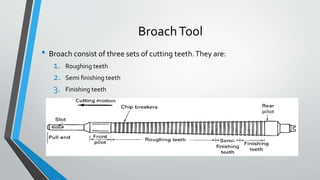
BroachTool
• Broach consist of three sets of cutting teeth.They are:
1. Roughing teeth
2. Semi finishing teeth
3. Finishing teeth
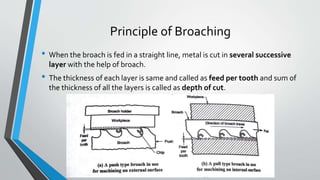
Principle of Broaching
• When the broach is fed in a straight line, metal is cut in several successive
layer with the help of broach.
• The thickness of each layer is same and called as feed per tooth and sum of
the thickness of all the layers is called as depth of cut.
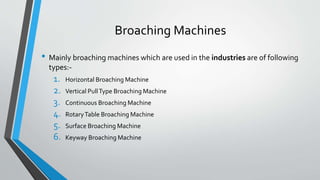
Broaching Machines
• Mainly broaching machines which are used in the industries are of following
types:-
1. Horizontal Broaching Machine
2. Vertical PullType Broaching Machine
3. Continuous Broaching Machine
4. RotaryTable Broaching Machine
5. Surface Broaching Machine
6. Keyway Broaching Machine
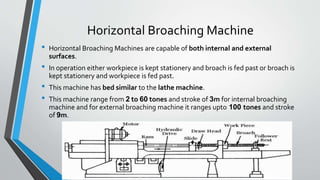
Horizontal Broaching Machine
• Horizontal Broaching Machines are capable of both internal and external
surfaces.
• In operation either workpiece is kept stationery and broach is fed past or broach is
kept stationery and workpiece is fed past.
• This machine has bed similar to the lathe machine.
• This machine range from 2 to 60 tones and stroke of 3m for internal broaching
machine and for external broaching machine it ranges upto 100 tones and stroke
of 9m.
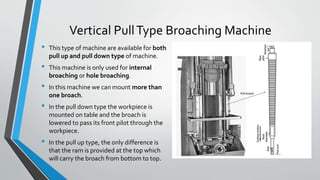
Vertical PullType Broaching Machine
• This type of machine are available for both
pull up and pull down type of machine.
• This machine is only used for internal
broaching or hole broaching.
• In this machine we can mount more than
one broach.
• In the pull down type the workpiece is
mounted on table and the broach is
lowered to pass its front pilot through the
workpiece.
• In the pull up type, the only difference is
that the ram is provided at the top which
will carry the broach from bottom to top.
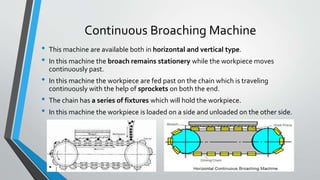
Continuous Broaching Machine
• This machine are available both in horizontal and vertical type.
• In this machine the broach remains stationery while the workpiece moves
continuously past.
• In this machine the workpiece are fed past on the chain which is traveling
continuously with the help of sprockets on both the end.
• The chain has a series of fixtures which will hold the workpiece.
• In this machine the workpiece is loaded on a side and unloaded on the other side.
RotaryTable Broaching Machine
• This machine is also used as a
Continuous Broaching Machine.
• In this machine a table is provided which
continuously rotates about a vertical
axis.
• On this the fixtures are mounted and
broach is held tightly on broach holder.
• The shape of the broach is same as of the
table.
• As the table rotates the workpieces are
loaded, machined and unloaded.
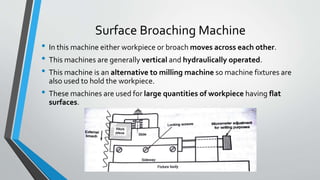
Surface Broaching Machine
• In this machine either workpiece or broach moves across each other.
• This machines are generally vertical and hydraulically operated.
• This machine is an alternative to milling machine so machine fixtures are
also used to hold the workpiece.
• These machines are used for large quantities of workpiece having flat
surfaces.
Keyway Broaching Machine
• This machine is the simplest type of machine and it can be used for general
purpose also.
• If multiple keyways or splines are to be cut the single broach can be used
with the workpiece and indexed after each other.
• This machines method is the oldest methods of all.
Advantages of Broaching
• Broach has a longer life than other tools.
• Broach can perform roughing and finishing operations.
• High skilled operator is not required.
• Interchangeable components can be produced at faster rate.
Disadvantages of Broaching
• In this process, all jobs need a fixture.
• Sharpening of broach is difficult and expensive.
• With the help of broaching, it is difficult to produce blind holes.
• Initial cost of broach and broaching machine is very high.
Applications of Broaching
• Broaching used for producing the variety of shapes, internal and external,
regular and irregular profiles.
• The examples of components produced by broaching are as follows:
1. Bearing caps
2. Bearing bodies
3. Cylinder blocks
4. Connecting rods
5. Gears andTurbine
6. Keyways
7. Splines
References
• Manufacturing process-1(technical publication) by Anup gohel
• www.youtube.com
• https://www.Wikipedia.org>wiki>broaching_(metalworking)
• www.americanbroach.com
ThankYou

Broaching machine

  • 1.
    Gandhinagar Institute ofTechnology BroachingMachine Mehta Chintan B. D1-14 3rd SEM. Mech. D Guided By:- Prof. H. S. Raghu Manufacturing Process-1 (2131903)
  • 2.
    What is Broaching? •Broaching is a machining operation in which a tool used is called as broach having series of cutting teeth. • In this operation broach is either Pulled or Pushed with the help of broaching machine on the workpiece surface. • Parts that is produced by the broaching have good surface finish and dimensional accuracy.
  • 3.
    BroachTool • Broach consistof three sets of cutting teeth.They are: 1. Roughing teeth 2. Semi finishing teeth 3. Finishing teeth
  • 4.
    Principle of Broaching •When the broach is fed in a straight line, metal is cut in several successive layer with the help of broach. • The thickness of each layer is same and called as feed per tooth and sum of the thickness of all the layers is called as depth of cut.
  • 5.
    Broaching Machines • Mainlybroaching machines which are used in the industries are of following types:- 1. Horizontal Broaching Machine 2. Vertical PullType Broaching Machine 3. Continuous Broaching Machine 4. RotaryTable Broaching Machine 5. Surface Broaching Machine 6. Keyway Broaching Machine
  • 6.
    Horizontal Broaching Machine •Horizontal Broaching Machines are capable of both internal and external surfaces. • In operation either workpiece is kept stationery and broach is fed past or broach is kept stationery and workpiece is fed past. • This machine has bed similar to the lathe machine. • This machine range from 2 to 60 tones and stroke of 3m for internal broaching machine and for external broaching machine it ranges upto 100 tones and stroke of 9m.
  • 7.
    Vertical PullType BroachingMachine • This type of machine are available for both pull up and pull down type of machine. • This machine is only used for internal broaching or hole broaching. • In this machine we can mount more than one broach. • In the pull down type the workpiece is mounted on table and the broach is lowered to pass its front pilot through the workpiece. • In the pull up type, the only difference is that the ram is provided at the top which will carry the broach from bottom to top.
  • 8.
    Continuous Broaching Machine •This machine are available both in horizontal and vertical type. • In this machine the broach remains stationery while the workpiece moves continuously past. • In this machine the workpiece are fed past on the chain which is traveling continuously with the help of sprockets on both the end. • The chain has a series of fixtures which will hold the workpiece. • In this machine the workpiece is loaded on a side and unloaded on the other side.
  • 9.
    RotaryTable Broaching Machine •This machine is also used as a Continuous Broaching Machine. • In this machine a table is provided which continuously rotates about a vertical axis. • On this the fixtures are mounted and broach is held tightly on broach holder. • The shape of the broach is same as of the table. • As the table rotates the workpieces are loaded, machined and unloaded.
  • 10.
    Surface Broaching Machine •In this machine either workpiece or broach moves across each other. • This machines are generally vertical and hydraulically operated. • This machine is an alternative to milling machine so machine fixtures are also used to hold the workpiece. • These machines are used for large quantities of workpiece having flat surfaces.
  • 11.
    Keyway Broaching Machine •This machine is the simplest type of machine and it can be used for general purpose also. • If multiple keyways or splines are to be cut the single broach can be used with the workpiece and indexed after each other. • This machines method is the oldest methods of all.
  • 12.
    Advantages of Broaching •Broach has a longer life than other tools. • Broach can perform roughing and finishing operations. • High skilled operator is not required. • Interchangeable components can be produced at faster rate.
  • 13.
    Disadvantages of Broaching •In this process, all jobs need a fixture. • Sharpening of broach is difficult and expensive. • With the help of broaching, it is difficult to produce blind holes. • Initial cost of broach and broaching machine is very high.
  • 14.
    Applications of Broaching •Broaching used for producing the variety of shapes, internal and external, regular and irregular profiles. • The examples of components produced by broaching are as follows: 1. Bearing caps 2. Bearing bodies 3. Cylinder blocks 4. Connecting rods 5. Gears andTurbine 6. Keyways 7. Splines
  • 15.
    References • Manufacturing process-1(technicalpublication) by Anup gohel • www.youtube.com • https://www.Wikipedia.org>wiki>broaching_(metalworking) • www.americanbroach.com
  • 16.