Machine Operations
Machine Operations
• Machine operations are the activities or job a
machine can perform. This presentation looks
at the following machines:
Lathe Machine
Drill Press
Milling Machine
Lathe Machine Operation
• Turning
• Knurling
• Drilling/boring
• Facing
• etc
Turning
Turning is a machining process in which a
cutting tool, typically a non-rotary tool bit,
describes a helix toolpath by moving more or
less linearly while the workpiece rotates.
Two type of turning
Parallel
Taper
https://www.youtube.com/watch?
v=8EsAxOnzEms
Knurling
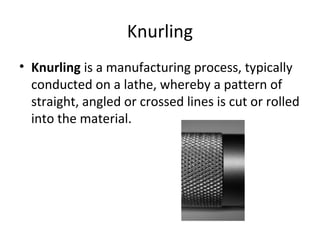
• Knurling is a manufacturing process, typically
conducted on a lathe, whereby a pattern of
straight, angled or crossed lines is cut or rolled
into the material.
Drilling
• The process of creating a hole in the work
piece
• https://www.youtube.com/watch?
v=OgqsjZJwce8
Facing
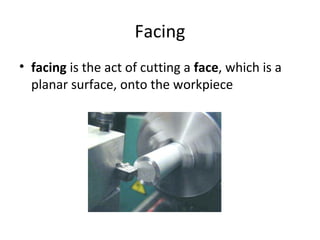
• facing is the act of cutting a face, which is a
planar surface, onto the workpiece
Drill Press
• Operations that can be performed in a drilling
machine are
 Drilling
 Reaming
 Boring
 Counter boring
 Countersinking
 Tapping
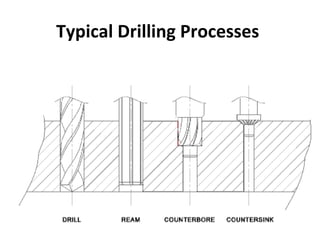
Typical Drilling Processes
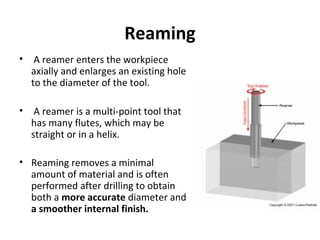
Reaming
• A reamer enters the workpiece
axially and enlarges an existing hole
to the diameter of the tool.
• A reamer is a multi-point tool that
has many flutes, which may be
straight or in a helix.
• Reaming removes a minimal
amount of material and is often
performed after drilling to obtain
both a more accurate diameter and
a smoother internal finish.
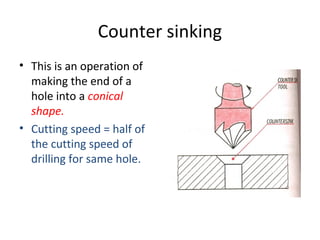
Counter sinking
• This is an operation of
making the end of a
hole into a conical
shape.
• Cutting speed = half of
the cutting speed of
drilling for same hole.
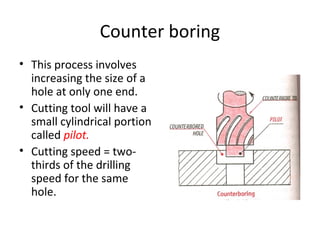
Counter boring
• This process involves
increasing the size of a
hole at only one end.
• Cutting tool will have a
small cylindrical portion
called pilot.
• Cutting speed = two-
thirds of the drilling
speed for the same
hole.
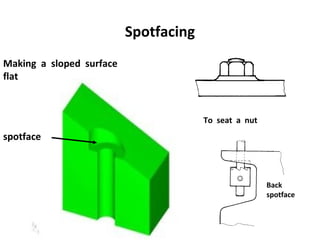
Spotfacing
spotface
Making a sloped surface
flat
To seat a nut
Back
spotface
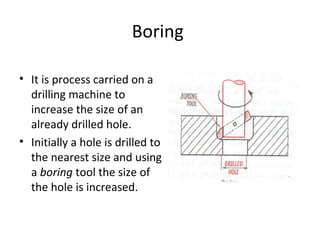
Boring
• It is process carried on a
drilling machine to
increase the size of an
already drilled hole.
• Initially a hole is drilled to
the nearest size and using
a boring tool the size of
the hole is increased.
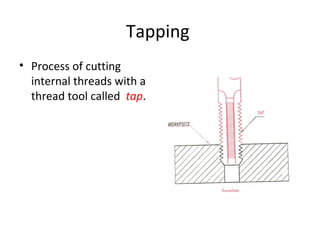
Tapping
• Process of cutting
internal threads with a
thread tool called tap.
Milling Machine
• Used to produce one or more machined
surfaces accurately on work piece
– One or more rotary milling cutters
• Work piece held on work table or holding
device and brought into contact with cutter.
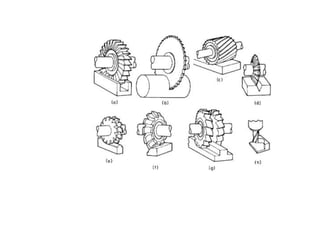
Operation done
• Face milling
• End milling
• Keyway cutting
• Dovetail cutting
• T-slot and circular
slot cutting
• Gear cutting
• Drilling
• Boring
• Jig boring
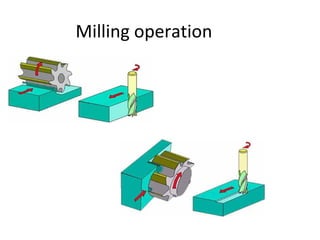
Milling operation
Machine operations

Machine operations

  • 1.
  • 2.
    Machine Operations • Machineoperations are the activities or job a machine can perform. This presentation looks at the following machines: Lathe Machine Drill Press Milling Machine
  • 3.
    Lathe Machine Operation •Turning • Knurling • Drilling/boring • Facing • etc
  • 4.
    Turning Turning is amachining process in which a cutting tool, typically a non-rotary tool bit, describes a helix toolpath by moving more or less linearly while the workpiece rotates. Two type of turning Parallel Taper https://www.youtube.com/watch? v=8EsAxOnzEms
  • 5.
    Knurling • Knurling isa manufacturing process, typically conducted on a lathe, whereby a pattern of straight, angled or crossed lines is cut or rolled into the material.
  • 6.
    Drilling • The processof creating a hole in the work piece • https://www.youtube.com/watch? v=OgqsjZJwce8
  • 7.
    Facing • facing isthe act of cutting a face, which is a planar surface, onto the workpiece
  • 8.
    Drill Press • Operationsthat can be performed in a drilling machine are  Drilling  Reaming  Boring  Counter boring  Countersinking  Tapping
  • 9.
  • 10.
    Reaming • A reamerenters the workpiece axially and enlarges an existing hole to the diameter of the tool. • A reamer is a multi-point tool that has many flutes, which may be straight or in a helix. • Reaming removes a minimal amount of material and is often performed after drilling to obtain both a more accurate diameter and a smoother internal finish.
  • 11.
    Counter sinking • Thisis an operation of making the end of a hole into a conical shape. • Cutting speed = half of the cutting speed of drilling for same hole.
  • 12.
    Counter boring • Thisprocess involves increasing the size of a hole at only one end. • Cutting tool will have a small cylindrical portion called pilot. • Cutting speed = two- thirds of the drilling speed for the same hole.
  • 13.
    Spotfacing spotface Making a slopedsurface flat To seat a nut Back spotface
  • 14.
    Boring • It isprocess carried on a drilling machine to increase the size of an already drilled hole. • Initially a hole is drilled to the nearest size and using a boring tool the size of the hole is increased.
  • 15.
    Tapping • Process ofcutting internal threads with a thread tool called tap.
  • 16.
    Milling Machine • Usedto produce one or more machined surfaces accurately on work piece – One or more rotary milling cutters • Work piece held on work table or holding device and brought into contact with cutter.
  • 17.
    Operation done • Facemilling • End milling • Keyway cutting • Dovetail cutting • T-slot and circular slot cutting • Gear cutting • Drilling • Boring • Jig boring
  • 18.