MACHINING PROCESS
LATHE
• Lathe is the most general purpose machine tool.
• The work piece is held and rotated against suitable cutting tool.
• It has provision to hold the workpiece and to rotate it about an axis.
• If the cutting tool is moved parallel to the axis of rotation of the
work, then a cylindrical surface is produced
• If the tool is moved perpendicular to the axis of rotation of the work,
then flat surface is obtained.
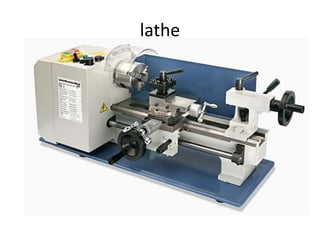
lathe
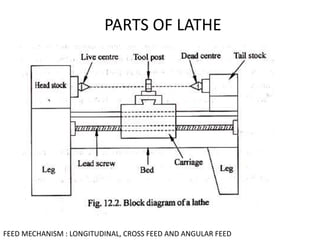
PARTS OF LATHE
FEED MECHANISM : LONGITUDINAL, CROSS FEED AND ANGULAR FEED
Tail stock
chuck
Lead screw bed
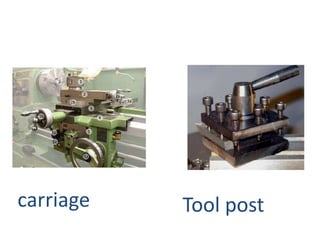
carriage Tool post
SPECIFICATION OF LATHE
• The overall length of bed
• Largest diameter of the work piece that can be rotated (height of live and
dead center above the bed)
• Distance between the centers (max w/p length)
• Range of spindle speed
• Power rating of electric motor
• Diameter of lead screw and number and range of threads that can be cut.
OPERATIONS PERFORMED ON LATHE
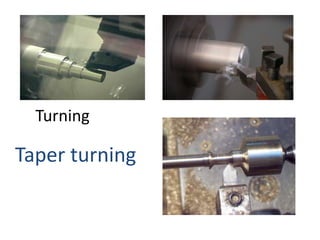
1. TURNING- Obtaining cylindrical surface
2. TAPER TURNING
METHODS
1. FORMING TOOL METHODE
HOLDING OF W/P - CHUCK AND LATHE CENTERS
2. TAIL STOCK SET OVER METHODE
The principle of this method is to shift the axis of rotation of the w/p at
an angle to the lathe axis and feeding the tool parallel to the lathe axis.
The taper angle will be twice the inclination of the axis.
• 3. COMPOUND REST METHOD
Swiveling angle
should be half of
the taper angle
Turning
Taper turning
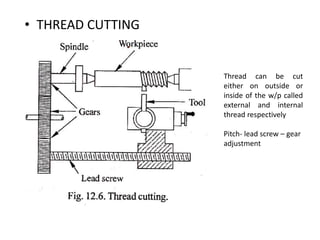
• THREAD CUTTING
Thread can be cut
either on outside or
inside of the w/p called
external and internal
thread respectively
Pitch- lead screw – gear
adjustment
Thread cutting
• KNURLING
ROUGHENING A SMOOTH
SURFACE
knurling
SHAPING MACHINE
Function- production of flat
surface
Single point tool
Tool reciprocates
Frwd stroke—cut
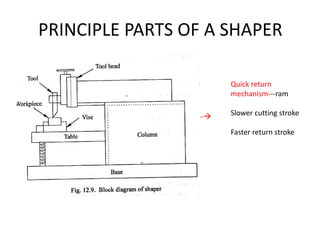
PRINCIPLE PARTS OF A SHAPER
-----
RAM
Quick return
mechanism---ram
Slower cutting stroke
Faster return stroke
Shaping machine
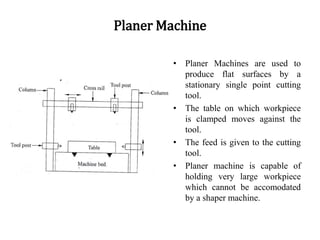
Planer Machine
• Planer Machines are used to
produce flat surfaces by a
stationary single point cutting
tool.
• The table on which workpiece
is clamped moves against the
tool.
• The feed is given to the cutting
tool.
• Planer machine is capable of
holding very large workpiece
which cannot be accomodated
by a shaper machine.
Slotter Machine
• In slotter machine the
tool reciprocates in
vertical axis.
• Cutting action is only
during the downward
stroke.
• It operates on the
same principle as that
of shaper
DRILLING MACHINE
• Drilling is the operation of
making holes in a workpiece
by forcing a rotating tool
called drill against it.
• Main parts are:
 Base
 Column
 Table
 Drill Head
Drilling machine
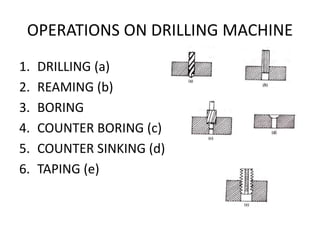
OPERATIONS ON DRILLING MACHINE
1. DRILLING (a)
2. REAMING (b)
3. BORING
4. COUNTER BORING (c)
5. COUNTER SINKING (d)
6. TAPING (e)
Drilling:
It Is the Operation of producing circular hole using a drill by removing
metal from the workpiece.
Reaming:
It Is the Operation of finishing a hole using a reamer.
Boring:
It Is the Opreation of enlarging a hole.
Counter Boring:
It is the operation of increasing the diameter of a hole for a certain distance.
Counter Sinking:
It is the operation of creating a cone shape at the end of a hole.
Taping:
It is the operation of cutting internal threads by means of a tool called TAP.
MILLING
UP MILLING
(Conventional Milling)
DOWN MILLING
(Climb Milling)
• Milling is the process of removing metal by feeding the workpiece
against a rotating multipoint cutter. As the cutter rotates, each
cutting edge removes a small amount of material from the
workpiece.
In up milling the workpiece is fed
against the rotating milling
cutter.
In down milling the workpiece is
fed in the same direction of that
of rotating milling cutter.
Milling machine
Milling machines can be classified as
1. Horizontal Milling Machine
2. Vertical Milling Machine
Horizontal Milling Machine
Vertical Milling Machine
MILLING OPERATIONS
1. PLAIN MILLING 2. FACE MILLING
• 3. SIDE MILLING 4. END MILLING
• 5. T SLOT MILLING 6. ANGULAR MILLING
• 7. FORM MILLING 8. GEAR CUTTING
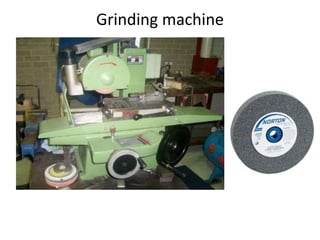
GRINDING
Grinding is the process of metal
removal in which the cutting tool used
is an abrasive wheel.
It is used for the following purposes
1. To remove small amount of metal
from workpiece.
2. To obtain better surface finish
3. To machine hard surfaces
4. To sharpen cutting tools
Grinding machine
TYPES OF GRINDING
• 1. CYLINDRICAL GRINDING
 Grinding wheels
Made of abrasive materials
bonded together.
2 types
1. Natural : sand stone,
emery, diamonds etc.
2. Artificial : silicon
Carbide, Aluminium
oxide, boron carbide
etc.
• 2. SURFACE GRINDING 3. FORM GRINDING
NC Machines
• It is the method of controlling
manufacturing operations by means
of numerical instructions.
• A programme is prepared by the
programmer after product drawing
and process planning
• This programme is recorded in a
magnetic tape and fed to the control
unit.
• This unit sends signals to the
machine through position command
unit.
CNC Machines
• It is the method of controlling
manufacturing operations by
means of a computer.
• A CNC code is generated by the
computer after product drawing
and process planning
• The computer send signals to the
machine as per the CNC code.

Machining

  • 1.
  • 2.
    LATHE • Lathe isthe most general purpose machine tool. • The work piece is held and rotated against suitable cutting tool. • It has provision to hold the workpiece and to rotate it about an axis. • If the cutting tool is moved parallel to the axis of rotation of the work, then a cylindrical surface is produced • If the tool is moved perpendicular to the axis of rotation of the work, then flat surface is obtained.
  • 3.
  • 4.
    PARTS OF LATHE FEEDMECHANISM : LONGITUDINAL, CROSS FEED AND ANGULAR FEED
  • 5.
  • 6.
  • 7.
    SPECIFICATION OF LATHE •The overall length of bed • Largest diameter of the work piece that can be rotated (height of live and dead center above the bed) • Distance between the centers (max w/p length) • Range of spindle speed • Power rating of electric motor • Diameter of lead screw and number and range of threads that can be cut.
  • 8.
    OPERATIONS PERFORMED ONLATHE 1. TURNING- Obtaining cylindrical surface 2. TAPER TURNING METHODS 1. FORMING TOOL METHODE HOLDING OF W/P - CHUCK AND LATHE CENTERS
  • 9.
    2. TAIL STOCKSET OVER METHODE The principle of this method is to shift the axis of rotation of the w/p at an angle to the lathe axis and feeding the tool parallel to the lathe axis. The taper angle will be twice the inclination of the axis.
  • 10.
    • 3. COMPOUNDREST METHOD Swiveling angle should be half of the taper angle
  • 11.
  • 12.
    • THREAD CUTTING Threadcan be cut either on outside or inside of the w/p called external and internal thread respectively Pitch- lead screw – gear adjustment
  • 13.
  • 14.
  • 15.
  • 16.
    SHAPING MACHINE Function- productionof flat surface Single point tool Tool reciprocates Frwd stroke—cut
  • 17.
    PRINCIPLE PARTS OFA SHAPER ----- RAM Quick return mechanism---ram Slower cutting stroke Faster return stroke
  • 18.
  • 19.
    Planer Machine • PlanerMachines are used to produce flat surfaces by a stationary single point cutting tool. • The table on which workpiece is clamped moves against the tool. • The feed is given to the cutting tool. • Planer machine is capable of holding very large workpiece which cannot be accomodated by a shaper machine.
  • 20.
    Slotter Machine • Inslotter machine the tool reciprocates in vertical axis. • Cutting action is only during the downward stroke. • It operates on the same principle as that of shaper
  • 21.
    DRILLING MACHINE • Drillingis the operation of making holes in a workpiece by forcing a rotating tool called drill against it. • Main parts are:  Base  Column  Table  Drill Head
  • 22.
  • 23.
    OPERATIONS ON DRILLINGMACHINE 1. DRILLING (a) 2. REAMING (b) 3. BORING 4. COUNTER BORING (c) 5. COUNTER SINKING (d) 6. TAPING (e)
  • 24.
    Drilling: It Is theOperation of producing circular hole using a drill by removing metal from the workpiece. Reaming: It Is the Operation of finishing a hole using a reamer. Boring: It Is the Opreation of enlarging a hole. Counter Boring: It is the operation of increasing the diameter of a hole for a certain distance. Counter Sinking: It is the operation of creating a cone shape at the end of a hole. Taping: It is the operation of cutting internal threads by means of a tool called TAP.
  • 25.
    MILLING UP MILLING (Conventional Milling) DOWNMILLING (Climb Milling) • Milling is the process of removing metal by feeding the workpiece against a rotating multipoint cutter. As the cutter rotates, each cutting edge removes a small amount of material from the workpiece. In up milling the workpiece is fed against the rotating milling cutter. In down milling the workpiece is fed in the same direction of that of rotating milling cutter.
  • 26.
    Milling machine Milling machinescan be classified as 1. Horizontal Milling Machine 2. Vertical Milling Machine
  • 27.
  • 28.
  • 29.
    MILLING OPERATIONS 1. PLAINMILLING 2. FACE MILLING
  • 30.
    • 3. SIDEMILLING 4. END MILLING
  • 31.
    • 5. TSLOT MILLING 6. ANGULAR MILLING
  • 32.
    • 7. FORMMILLING 8. GEAR CUTTING
  • 33.
    GRINDING Grinding is theprocess of metal removal in which the cutting tool used is an abrasive wheel. It is used for the following purposes 1. To remove small amount of metal from workpiece. 2. To obtain better surface finish 3. To machine hard surfaces 4. To sharpen cutting tools
  • 34.
  • 35.
    TYPES OF GRINDING •1. CYLINDRICAL GRINDING  Grinding wheels Made of abrasive materials bonded together. 2 types 1. Natural : sand stone, emery, diamonds etc. 2. Artificial : silicon Carbide, Aluminium oxide, boron carbide etc.
  • 36.
    • 2. SURFACEGRINDING 3. FORM GRINDING
  • 37.
    NC Machines • Itis the method of controlling manufacturing operations by means of numerical instructions. • A programme is prepared by the programmer after product drawing and process planning • This programme is recorded in a magnetic tape and fed to the control unit. • This unit sends signals to the machine through position command unit.
  • 38.
    CNC Machines • Itis the method of controlling manufacturing operations by means of a computer. • A CNC code is generated by the computer after product drawing and process planning • The computer send signals to the machine as per the CNC code.

Editor's Notes

  • #5 FEED MECHANISM MOVEMENT OF TOOL RELATIVE TO WORK PIECE IS KNOWN AS FEED
  • #9 HOLDING OF WP
  • #10 THE PRINCIPLE OF THIS METHODE IS TO SHIFT THE AXIS OF ROTATION OF THE WP AT AN ANGLE TO THE LATHE AXIS AND FEEDING THE TOOL PARALLEL TO THE LATHE AXIS
  • #11 SWIVELLING ANGLE SHOULD BE HALF OF THE TAPER ANGLE
  • #13 THREAD CAN BE CUT OUTSIDE AND INSIDE OF THE WP CALLED EXTERNAL AND INTERNAL THREAD REPC
  • #15 ROUGHENING A SMOOTH SURFACE
  • #17 FUNCTION- PRODUCTION OF FLAT SURFACE
  • #18 RAM
  • #24 TAP TOOL
  • #26 UP MILLING