DRILLING MACHINES
MANUFACTURING PROCESS – 1(2131903)
By Kaushal Patel
Drilling
Process
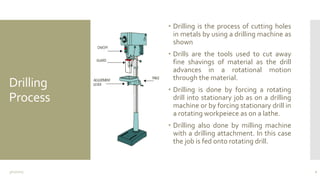
• Drilling is the process of cutting holes
in metals by using a drilling machine as
shown
• Drills are the tools used to cut away
fine shavings of material as the drill
advances in a rotational motion
through the material.
• Drilling is done by forcing a rotating
drill into stationary job as on a drilling
machine or by forcing stationary drill in
a rotating workpeiece as on a lathe.
• Drilling also done by milling machine
with a drilling attachment. In this case
the job is fed onto rotating drill.
3/11/2015 2
Classification
of Drilling
Machines
 Drilling machines are classified according to their
construction into the following categories:
1. Portable drilling machine
2. Sensitive drilling machine
3. Radial drilling machine
4. Gang drilling machine
5. Multi-spindle drilling press
6. Automatic drilling machine
7. Turret drilling machine
8. Numerically controlled drilling machine
9. Upright drilling machine
3/11/2015 3
Portable
Drilling
machine
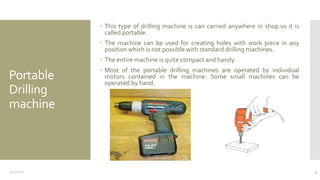
 This type of drilling machine is can carried anywhere in shop.so it is
called portable.
 The machine can be used for creating holes with work piece in any
position which is not possible with standard drilling machines.
 The entire machine is quite compact and handy.
 Most of the portable drilling machines are operated by individual
motors contained in the machine. Some small machines can be
operated by hand.
3/11/2015 4
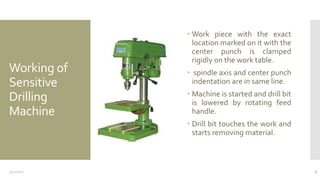
Sensitive
Drilling
Machines
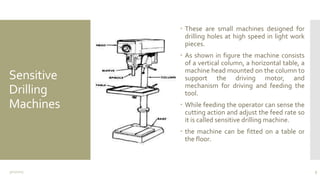
 These are small machines designed for
drilling holes at high speed in light work
pieces.
 As shown in figure the machine consists
of a vertical column, a horizontal table, a
machine head mounted on the column to
support the driving motor, and
mechanism for driving and feeding the
tool.
 While feeding the operator can sense the
cutting action and adjust the feed rate so
it is called sensitive drilling machine.
 the machine can be fitted on a table or
the floor.
3/11/2015 5
Working of
Sensitive
Drilling
Machine
 Work piece with the exact
location marked on it with the
center punch is clamped
rigidly on the work table.
 spindle axis and center punch
indentation are in same line.
 Machine is started and drill bit
is lowered by rotating feed
handle.
 Drill bit touches the work and
starts removing material.
3/11/2015 6
Radial
Drilling
Machine
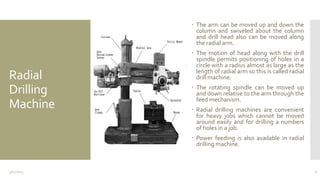
 The arm can be moved up and down the
column and swiveled about the column
and drill head also can be moved along
the radial arm.
 The motion of head along with the drill
spindle permits positioning of holes in a
circle with a radius almost as large as the
length of radial arm so this is called radial
drill machine.
 The rotating spindle can be moved up
and down relative to the arm through the
feed mechanism.
 Radial drilling machines are convenient
for heavy jobs which cannot be moved
around easily and for drilling a numbers
of holes in a job.
 Power feeding is also available in radial
drilling machine.
3/11/2015 7
Gang Drilling
Machine
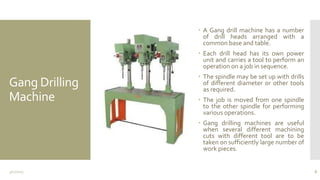
 A Gang drill machine has a number
of drill heads arranged with a
common base and table.
 Each drill head has its own power
unit and carries a tool to perform an
operation on a job in sequence.
 The spindle may be set up with drills
of different diameter or other tools
as required.
 The job is moved from one spindle
to the other spindle for performing
various operations.
 Gang drilling machines are useful
when several different machining
cuts with different tool are to be
taken on sufficiently large number of
work pieces.
3/11/2015 8
Multi-spindle
Drilling
Machine
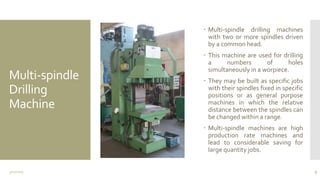
 Multi-spindle drilling machines
with two or more spindles driven
by a common head.
 This machine are used for drilling
a numbers of holes
simultaneously in a worpiece.
 They may be built as specific jobs
with their spindles fixed in specific
positions or as general purpose
machines in which the relative
distance between the spindles can
be changed within a range.
 Multi-spindle machines are high
production rate machines and
lead to considerable saving for
large quantity jobs.
3/11/2015 9
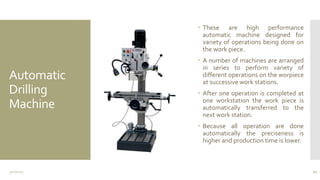
Automatic
Drilling
Machine
 These are high performance
automatic machine designed for
variety of operations being done on
the work piece.
 A number of machines are arranged
in series to perform variety of
different operations on the worpiece
at successive work stations.
 After one operation is completed at
one workstation the work piece is
automatically transferred to the
next work station.
 Because all operation are done
automatically the preciseness is
higher and production time is lower.
3/11/2015 10
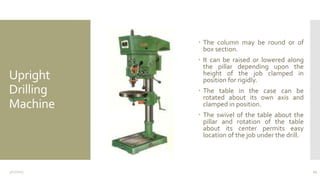
Upright
Drilling
Machine
 The column may be round or of
box section.
 It can be raised or lowered along
the pillar depending upon the
height of the job clamped in
position for rigidly.
 The table in the case can be
rotated about its own axis and
clamped in position.
 The swivel of the table about the
pillar and rotation of the table
about its center permits easy
location of the job under the drill.
3/11/2015 11
Drill Machine
Specifications
 The specification of size of the drilling machine varies with type of
machine.
 A portable drilling machine is specific by the maximum diameter
of the drill that it can be hold.
 Sensitive and upright drilling machine are specified by the
diameter of the largest work piece on the center of which a hole
can be drilled; also by the maximum size of the drill held in steel or
cast iron.
 The size of radial machine is specified by the diameter of the
column and length of arm.
 Other particular of the machine that may sometimes be specified
are the table size, maximum spindle travel, spindle speeds and
feed available, power of the machine, floor space required etc.
3/11/2015 12
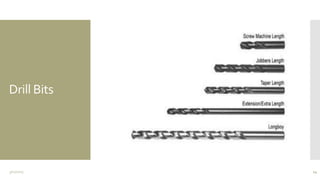
Drill Bits
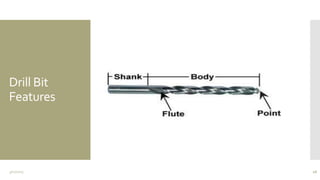
 A drill bit is a multi-point tool and typically has a pointed end. A
twist drill is the most common type used.
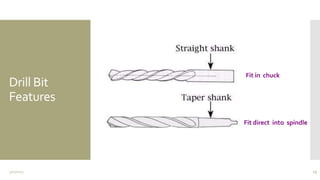
 Twist drills are available with parallel shanks up to 16mm diameter
and with taper shanks up to 100mm diameter and are made from
high-speed steel.
 Standard lengths are known as jobber-series twist drills, short
drills are known as stub series, and long drills as long series and
extra long series.
 Different helix angles are available for drilling a range of
materials.
 Flutes are incorporated to carry away the chips of metal and the
outside surface is relieved to produce a cutting edge along the
leading side of each flute.
3/11/2015 13
Drill Bits
3/11/2015 14
Drill Bit
Features
3/11/2015 15
Fit in chuck
Fit direct into spindle
Drill Bit
Features
3/11/2015 16
Drill Bit
Features
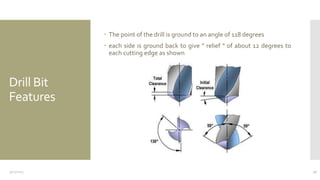
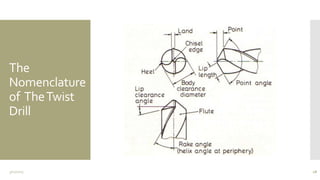
 The point of the drill is ground to an angle of 118 degrees
 each side is ground back to give " relief " of about 12 degrees to
each cutting edge as shown
3/11/2015 17
The
Nomenclature
of TheTwist
Drill
3/11/2015 18
Subland
Drills
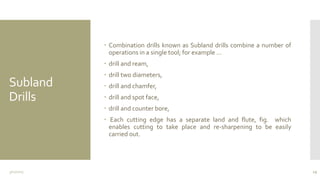
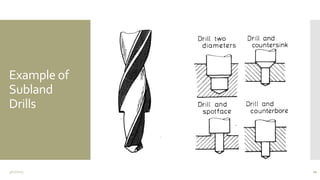
 Combination drills known as Subland drills combine a number of
operations in a single tool; for example …
 drill and ream,
 drill two diameters,
 drill and chamfer,
 drill and spot face,
 drill and counter bore,
 Each cutting edge has a separate land and flute, fig. which
enables cutting to take place and re-sharpening to be easily
carried out.
3/11/2015 19
Example of
Subland
Drills
3/11/2015 20
Tool Holding
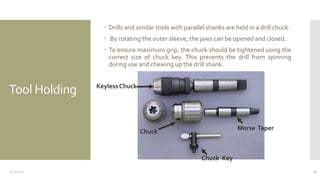
 Drills and similar tools with parallel shanks are held in a drill chuck.
 By rotating the outer sleeve, the jaws can be opened and closed.
 To ensure maximum grip, the chuck should be tightened using the
correct size of chuck key. This prevents the drill from spinning
during use and chewing up the drill shank.
3/11/2015 21
Chuck
Morse Taper
Chuck Key
Keyless Chuck
Tool Holding
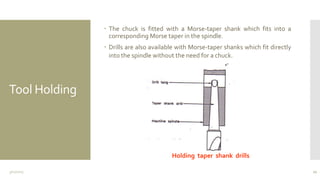
 The chuck is fitted with a Morse-taper shank which fits into a
corresponding Morse taper in the spindle.
 Drills are also available with Morse-taper shanks which fit directly
into the spindle without the need for a chuck.
3/11/2015 22
Holding taper shank drills
Tool Holding
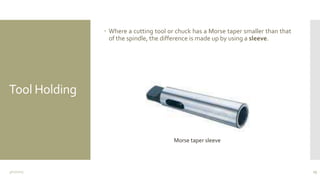
 Where a cutting tool or chuck has a Morse taper smaller than that
of the spindle, the difference is made up by using a sleeve.
3/11/2015 23
Morse taper sleeve
Work
Holding
Devices
 When drilling a hole on a drilling it is important that the
workpiece be secured rigidly to the machine table or
base.
 Not properly secured work piece may be dangerous
except in the case of small drills and very large work
pieces.
 The workpiece can be secured in many ways depending
upon the size of the job and the accuracy desired.
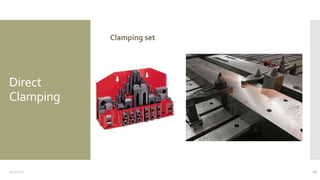
 A workpiece may be stopped from turning by fixing an
obstruction on its way or it may be clamped to the
machine table by using bolts or straps.
3/11/2015 24
Drilling
MachineVice
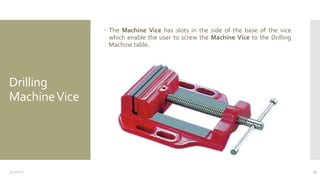
 The Machine Vice has slots in the side of the base of the vice
which enable the user to screw the Machine Vice to the Drilling
Machine table.
3/11/2015 25
Direct
Clamping
Clamping set
3/11/2015 26
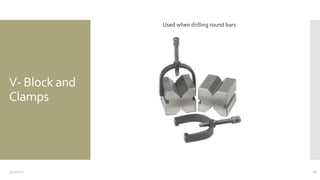
V- Block and
Clamps
3/11/2015 27
Used when drilling round bars
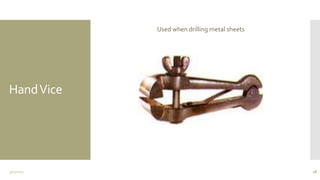
HandVice
Used when drilling metal sheets
3/11/2015 28
Drilling
Machine
Operations
 On drilling machine bellows operation can be
done:
1. Drilling
2. Reaming
3. Boring
4. Counter boring
5. Counter sinking
6. Spot facing
7. Tapping
8. Trepanning
3/11/2015 29
Drilling
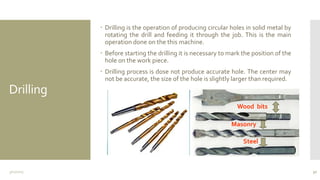
 Drilling is the operation of producing circular holes in solid metal by
rotating the drill and feeding it through the job. This is the main
operation done on the this machine.
 Before starting the drilling it is necessary to mark the position of the
hole on the work piece.
 Drilling process is dose not produce accurate hole. The center may
not be accurate, the size of the hole is slightly larger than required.
3/11/2015 30
Wood bits
Masonry
Steel
Reaming
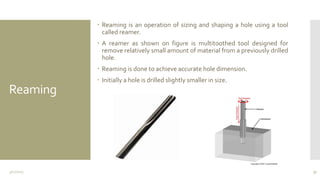
 Reaming is an operation of sizing and shaping a hole using a tool
called reamer.
 A reamer as shown on figure is multitoothed tool designed for
remove relatively small amount of material from a previously drilled
hole.
 Reaming is done to achieve accurate hole dimension.
 Initially a hole is drilled slightly smaller in size.
3/11/2015 31
Boring
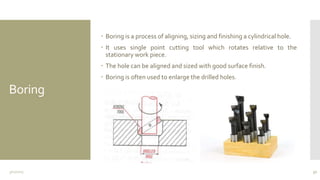
 Boring is a process of aligning, sizing and finishing a cylindrical hole.
 It uses single point cutting tool which rotates relative to the
stationary work piece.
 The hole can be aligned and sized with good surface finish.
 Boring is often used to enlarge the drilled holes.
3/11/2015 32
Counter
Boring
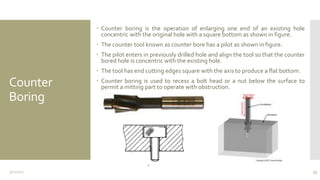
 Counter boring is the operation of enlarging one end of an existing hole
concentric with the original hole with a square bottom as shown in figure.
 The counter tool known as counter bore has a pilot as shown in figure.
 The pilot enters in previously drilled hole and align the tool so that the counter
bored hole is concentric with the existing hole.
 The tool has end cutting edges square with the axis to produce a flat bottom.
 Counter boring is used to recess a bolt head or a nut below the surface to
permit a mitting part to operate with obstruction.
3/11/2015 33
Counter
Sinking
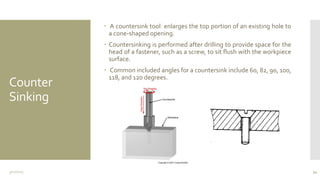
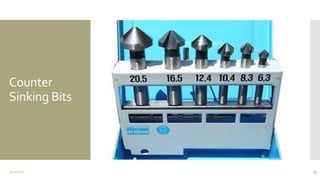
 A countersink tool enlarges the top portion of an existing hole to
a cone-shaped opening.
 Countersinking is performed after drilling to provide space for the
head of a fastener, such as a screw, to sit flush with the workpiece
surface.
 Common included angles for a countersink include 60, 82, 90, 100,
118, and 120 degrees.
3/11/2015 34
Counter
Sinking Bits
3/11/2015 35
Spot Facing
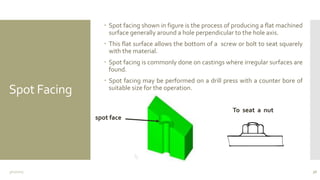
 Spot facing shown in figure is the process of producing a flat machined
surface generally around a hole perpendicular to the hole axis.
 This flat surface allows the bottom of a screw or bolt to seat squarely
with the material.
 Spot facing is commonly done on castings where irregular surfaces are
found.
 Spot facing may be performed on a drill press with a counter bore of
suitable size for the operation.
3/11/2015 36
spot face
To seat a nut
Tapping
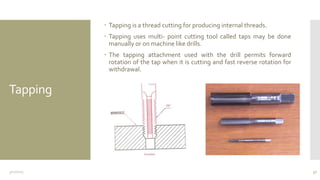
 Tapping is a thread cutting for producing internal threads.
 Tapping uses multi- point cutting tool called taps may be done
manually or on machine like drills.
 The tapping attachment used with the drill permits forward
rotation of the tap when it is cutting and fast reverse rotation for
withdrawal.
3/11/2015 37
Trepanning
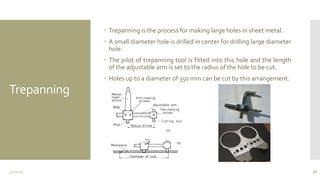
 Trepanning is the process for making large holes in sheet metal.
 A small diameter hole is drilled in center for drilling large diameter
hole.
 The pilot of trepanning tool is fitted into this hole and the length
of the adjustable arm is set to the radius of the hole to be cut.
 Holes up to a diameter of 350 mm can be cut by this arrangement.
3/11/2015 38
THANKTOU

Drilling machines-manufacturing process-1

  • 1.
    DRILLING MACHINES MANUFACTURING PROCESS– 1(2131903) By Kaushal Patel
  • 2.
    Drilling Process • Drilling isthe process of cutting holes in metals by using a drilling machine as shown • Drills are the tools used to cut away fine shavings of material as the drill advances in a rotational motion through the material. • Drilling is done by forcing a rotating drill into stationary job as on a drilling machine or by forcing stationary drill in a rotating workpeiece as on a lathe. • Drilling also done by milling machine with a drilling attachment. In this case the job is fed onto rotating drill. 3/11/2015 2
  • 3.
    Classification of Drilling Machines  Drillingmachines are classified according to their construction into the following categories: 1. Portable drilling machine 2. Sensitive drilling machine 3. Radial drilling machine 4. Gang drilling machine 5. Multi-spindle drilling press 6. Automatic drilling machine 7. Turret drilling machine 8. Numerically controlled drilling machine 9. Upright drilling machine 3/11/2015 3
  • 4.
    Portable Drilling machine  This typeof drilling machine is can carried anywhere in shop.so it is called portable.  The machine can be used for creating holes with work piece in any position which is not possible with standard drilling machines.  The entire machine is quite compact and handy.  Most of the portable drilling machines are operated by individual motors contained in the machine. Some small machines can be operated by hand. 3/11/2015 4
  • 5.
    Sensitive Drilling Machines  These aresmall machines designed for drilling holes at high speed in light work pieces.  As shown in figure the machine consists of a vertical column, a horizontal table, a machine head mounted on the column to support the driving motor, and mechanism for driving and feeding the tool.  While feeding the operator can sense the cutting action and adjust the feed rate so it is called sensitive drilling machine.  the machine can be fitted on a table or the floor. 3/11/2015 5
  • 6.
    Working of Sensitive Drilling Machine  Workpiece with the exact location marked on it with the center punch is clamped rigidly on the work table.  spindle axis and center punch indentation are in same line.  Machine is started and drill bit is lowered by rotating feed handle.  Drill bit touches the work and starts removing material. 3/11/2015 6
  • 7.
    Radial Drilling Machine  The armcan be moved up and down the column and swiveled about the column and drill head also can be moved along the radial arm.  The motion of head along with the drill spindle permits positioning of holes in a circle with a radius almost as large as the length of radial arm so this is called radial drill machine.  The rotating spindle can be moved up and down relative to the arm through the feed mechanism.  Radial drilling machines are convenient for heavy jobs which cannot be moved around easily and for drilling a numbers of holes in a job.  Power feeding is also available in radial drilling machine. 3/11/2015 7
  • 8.
    Gang Drilling Machine  AGang drill machine has a number of drill heads arranged with a common base and table.  Each drill head has its own power unit and carries a tool to perform an operation on a job in sequence.  The spindle may be set up with drills of different diameter or other tools as required.  The job is moved from one spindle to the other spindle for performing various operations.  Gang drilling machines are useful when several different machining cuts with different tool are to be taken on sufficiently large number of work pieces. 3/11/2015 8
  • 9.
    Multi-spindle Drilling Machine  Multi-spindle drillingmachines with two or more spindles driven by a common head.  This machine are used for drilling a numbers of holes simultaneously in a worpiece.  They may be built as specific jobs with their spindles fixed in specific positions or as general purpose machines in which the relative distance between the spindles can be changed within a range.  Multi-spindle machines are high production rate machines and lead to considerable saving for large quantity jobs. 3/11/2015 9
  • 10.
    Automatic Drilling Machine  These arehigh performance automatic machine designed for variety of operations being done on the work piece.  A number of machines are arranged in series to perform variety of different operations on the worpiece at successive work stations.  After one operation is completed at one workstation the work piece is automatically transferred to the next work station.  Because all operation are done automatically the preciseness is higher and production time is lower. 3/11/2015 10
  • 11.
    Upright Drilling Machine  The columnmay be round or of box section.  It can be raised or lowered along the pillar depending upon the height of the job clamped in position for rigidly.  The table in the case can be rotated about its own axis and clamped in position.  The swivel of the table about the pillar and rotation of the table about its center permits easy location of the job under the drill. 3/11/2015 11
  • 12.
    Drill Machine Specifications  Thespecification of size of the drilling machine varies with type of machine.  A portable drilling machine is specific by the maximum diameter of the drill that it can be hold.  Sensitive and upright drilling machine are specified by the diameter of the largest work piece on the center of which a hole can be drilled; also by the maximum size of the drill held in steel or cast iron.  The size of radial machine is specified by the diameter of the column and length of arm.  Other particular of the machine that may sometimes be specified are the table size, maximum spindle travel, spindle speeds and feed available, power of the machine, floor space required etc. 3/11/2015 12
  • 13.
    Drill Bits  Adrill bit is a multi-point tool and typically has a pointed end. A twist drill is the most common type used.  Twist drills are available with parallel shanks up to 16mm diameter and with taper shanks up to 100mm diameter and are made from high-speed steel.  Standard lengths are known as jobber-series twist drills, short drills are known as stub series, and long drills as long series and extra long series.  Different helix angles are available for drilling a range of materials.  Flutes are incorporated to carry away the chips of metal and the outside surface is relieved to produce a cutting edge along the leading side of each flute. 3/11/2015 13
  • 14.
  • 15.
    Drill Bit Features 3/11/2015 15 Fitin chuck Fit direct into spindle
  • 16.
  • 17.
    Drill Bit Features  Thepoint of the drill is ground to an angle of 118 degrees  each side is ground back to give " relief " of about 12 degrees to each cutting edge as shown 3/11/2015 17
  • 18.
  • 19.
    Subland Drills  Combination drillsknown as Subland drills combine a number of operations in a single tool; for example …  drill and ream,  drill two diameters,  drill and chamfer,  drill and spot face,  drill and counter bore,  Each cutting edge has a separate land and flute, fig. which enables cutting to take place and re-sharpening to be easily carried out. 3/11/2015 19
  • 20.
  • 21.
    Tool Holding  Drillsand similar tools with parallel shanks are held in a drill chuck.  By rotating the outer sleeve, the jaws can be opened and closed.  To ensure maximum grip, the chuck should be tightened using the correct size of chuck key. This prevents the drill from spinning during use and chewing up the drill shank. 3/11/2015 21 Chuck Morse Taper Chuck Key Keyless Chuck
  • 22.
    Tool Holding  Thechuck is fitted with a Morse-taper shank which fits into a corresponding Morse taper in the spindle.  Drills are also available with Morse-taper shanks which fit directly into the spindle without the need for a chuck. 3/11/2015 22 Holding taper shank drills
  • 23.
    Tool Holding  Wherea cutting tool or chuck has a Morse taper smaller than that of the spindle, the difference is made up by using a sleeve. 3/11/2015 23 Morse taper sleeve
  • 24.
    Work Holding Devices  When drillinga hole on a drilling it is important that the workpiece be secured rigidly to the machine table or base.  Not properly secured work piece may be dangerous except in the case of small drills and very large work pieces.  The workpiece can be secured in many ways depending upon the size of the job and the accuracy desired.  A workpiece may be stopped from turning by fixing an obstruction on its way or it may be clamped to the machine table by using bolts or straps. 3/11/2015 24
  • 25.
    Drilling MachineVice  The MachineVice has slots in the side of the base of the vice which enable the user to screw the Machine Vice to the Drilling Machine table. 3/11/2015 25
  • 26.
  • 27.
    V- Block and Clamps 3/11/201527 Used when drilling round bars
  • 28.
    HandVice Used when drillingmetal sheets 3/11/2015 28
  • 29.
    Drilling Machine Operations  On drillingmachine bellows operation can be done: 1. Drilling 2. Reaming 3. Boring 4. Counter boring 5. Counter sinking 6. Spot facing 7. Tapping 8. Trepanning 3/11/2015 29
  • 30.
    Drilling  Drilling isthe operation of producing circular holes in solid metal by rotating the drill and feeding it through the job. This is the main operation done on the this machine.  Before starting the drilling it is necessary to mark the position of the hole on the work piece.  Drilling process is dose not produce accurate hole. The center may not be accurate, the size of the hole is slightly larger than required. 3/11/2015 30 Wood bits Masonry Steel
  • 31.
    Reaming  Reaming isan operation of sizing and shaping a hole using a tool called reamer.  A reamer as shown on figure is multitoothed tool designed for remove relatively small amount of material from a previously drilled hole.  Reaming is done to achieve accurate hole dimension.  Initially a hole is drilled slightly smaller in size. 3/11/2015 31
  • 32.
    Boring  Boring isa process of aligning, sizing and finishing a cylindrical hole.  It uses single point cutting tool which rotates relative to the stationary work piece.  The hole can be aligned and sized with good surface finish.  Boring is often used to enlarge the drilled holes. 3/11/2015 32
  • 33.
    Counter Boring  Counter boringis the operation of enlarging one end of an existing hole concentric with the original hole with a square bottom as shown in figure.  The counter tool known as counter bore has a pilot as shown in figure.  The pilot enters in previously drilled hole and align the tool so that the counter bored hole is concentric with the existing hole.  The tool has end cutting edges square with the axis to produce a flat bottom.  Counter boring is used to recess a bolt head or a nut below the surface to permit a mitting part to operate with obstruction. 3/11/2015 33
  • 34.
    Counter Sinking  A countersinktool enlarges the top portion of an existing hole to a cone-shaped opening.  Countersinking is performed after drilling to provide space for the head of a fastener, such as a screw, to sit flush with the workpiece surface.  Common included angles for a countersink include 60, 82, 90, 100, 118, and 120 degrees. 3/11/2015 34
  • 35.
  • 36.
    Spot Facing  Spotfacing shown in figure is the process of producing a flat machined surface generally around a hole perpendicular to the hole axis.  This flat surface allows the bottom of a screw or bolt to seat squarely with the material.  Spot facing is commonly done on castings where irregular surfaces are found.  Spot facing may be performed on a drill press with a counter bore of suitable size for the operation. 3/11/2015 36 spot face To seat a nut
  • 37.
    Tapping  Tapping isa thread cutting for producing internal threads.  Tapping uses multi- point cutting tool called taps may be done manually or on machine like drills.  The tapping attachment used with the drill permits forward rotation of the tap when it is cutting and fast reverse rotation for withdrawal. 3/11/2015 37
  • 38.
    Trepanning  Trepanning isthe process for making large holes in sheet metal.  A small diameter hole is drilled in center for drilling large diameter hole.  The pilot of trepanning tool is fitted into this hole and the length of the adjustable arm is set to the radius of the hole to be cut.  Holes up to a diameter of 350 mm can be cut by this arrangement. 3/11/2015 38
  • 39.