Welding, Cutting, and Brazing
MODULE 16
2 ©2006 TEEX
Hazards of Welding Operations
 Fire hazards
 Metal splatter
 Electric shock
 Explosion hazards
 Released gases
 Radiant energy
 Where would these hazards be found
on oil and gas well sites?
3 ©2006 TEEX
Three Basic Types of Welding
 Gas – Slower and easier to control than
electric arc. Uses gas flame over metals until
molten puddle is formed. Most popular fuels
used with oxygen include acetylene, mapp
gas, and hydrogen.
 Arc – Two metals are joined by generating an
electric arc between a covered metal
electrode and the base metal.
 Oxygen and Arc Cutting – Metal cutting in
welding is the severing or removal of metal by
a flame or arc.
4 ©2006 TEEX
Oxygen and arc cutting
 Most common cutting processes :
 Oxygen Cutting: Metal is heated by gas
flame and an oxygen jet does the cutting.
 Arc Cutting: Intense heat of electric arc
melts away the metal.
5 ©2006 TEEX
Regulations
 29 CFR 1910 Subpart Q
 General Industry
 29 CFR 1926 Subpart J
 Construction
 API RP 54 Section 20
 Hotwork, Welding, and Flame Cutting
Operations
General Requirements
29 CFR 1910.252
7 ©2006 TEEX
Fire Prevention Safeguards
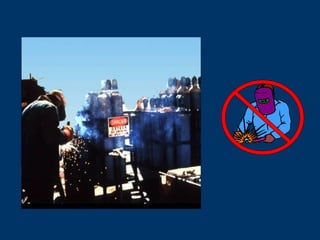
 Fire Hazards should be removed if the
welded object cannot be readily moved.
 Guards should be used if removing fire
hazards is not possible.
 Restrictions apply (no cutting or
welding allowed) if none of the above is
possible.
Subtitles & Transitions
FOR EXAMPLE…
9 ©2006 TEEX
Special Precautions
 Protect nearby combustible materials from
sparks that might escape through openings in
floors or walls.
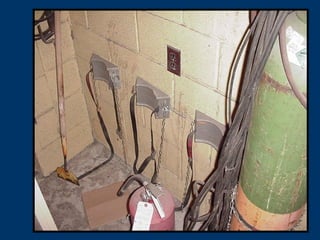
 Fire Extinguishers must be ready for instant
use.
 Fire Watch lasting at least 30 min after
welding or cutting operations is required if
more than a minor fire might develop and if
certain combustible materials are present.
10 ©2006 TEEX
Special Precautions
 Authorization: A responsible individual
must inspect the area and designate
precautions, preferably by written
permit.
 Floors: Combustible materials must be
swept 35 feet away; combustible floors
must be wetted or protected (while
preventing arc welding shock)
11 ©2006 TEEX
Special Precautions
 Prohibited areas for welding:
 Unauthorized by management
 Where sprinklers are impaired
 Explosive atmospheres
 Near storage of large quantities of readily
ignitable materials
 Relocation of Combustibles:
Combustibles shall be moved 35 feet
away or properly protected or shielded.
12 ©2006 TEEX
Special Precautions
 Ducts: Ducts & conveyor systems that might
carry sparks must be shut down.
 Combustible walls must be shielded or
guarded.
 Noncombustible walls, partitions or ceilings
(when welded) require opposite-side moving
of combustibles or a fire watch.
 Combustible cover: No welding on certain
metal building components having
combustible covers or layers.
13 ©2006 TEEX
Special Precautions
 Pipes (or any metal) close enough to
combustibles to cause ignition by
conduction may not be cut or welded.
 Management responsibilities:
 Establish proper areas and procedures
 Designate responsible individual
 Ensure training
 Advise contractors of hazards
14 ©2006 TEEX
Special Precautions
 Supervisor responsibilities:
 Safety of equipment & procedures
 Determine combustibles & hazardous areas
 Protect combustibles from ignition through
moving, shielding and scheduling
 Secure authorizations
 Give go-ahead to cutter or welder
 Ensure fire protection
 Ensure fire watches if required
15 ©2006 TEEX
Welding or Cutting Containers
 Used containers must be cleaned of
flammable materials or other materials
that could release toxic of flammable
vapors when heated.
 Venting & purging is required for
hollow spaces or cavities.
16 ©2006 TEEX
Confined Spaces
 Precautions must be taken during long*
pauses in arc welding to prevent
 accidental contact of electrodes
 torch valve gas leaks in gas welding.
*During lunch or overnight
17 ©2006 TEEX
Protection of Personnel
 Railing or other suitable fall protection
must be provided as required.
 Welding cable and other equipment
must be kept clear of passageways,
ladders and stairways.
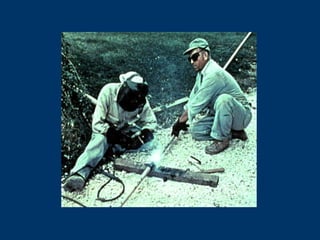
 Eye protection and protective
equipment of specific appropriate types
must be worn. Nearby workers must be
protected from arc welding rays.
Subtitles & Transitions
FOR EXAMPLE…
19 ©2006 TEEX
Protection of Personnel
 Work in confined spaces requires
consideration of:
 Ventilation
 Securing cylinders and machinery
 Lifelines
 Electrode removal (arc welding)
 Gas cylinder shutoff (gas welding &
cutting)
 Warning signs for hot metal
20 ©2006 TEEX
Health Protection & Ventilation
 General requirements for protecting
welders are based on 3 factors:
 Dimensions of space (especially ceiling
height) in which welding is to be done
 Number of welders
 Possible evolution of hazardous fumes,
gases, or dust according to the metals
involved.
21 ©2006 TEEX
Natural and Mechanical
Ventilation
 Must not be restricted by screens
 Sufficient to keep concentrations <PEL
 Mechanical ventilation required for:
 Metals not described here
 Spaces <10,000 feet per welder
 Rooms with ceilings lower than 16 feet
 Confined spaces or areas with barriers to
natural cross ventilation
22 ©2006 TEEX
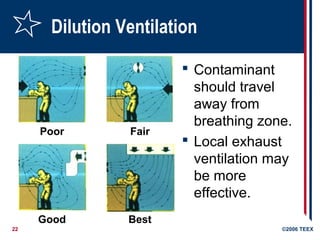
Dilution Ventilation
 Contaminant
should travel
away from
breathing zone.
 Local exhaust
ventilation may
be more
effective.
Poor Fair
Good Best
23 ©2006 TEEX
Ventilation
 Confined space: ventilation first;
respirators if ventilation impossible
 Specific rules for specific chemicals
 Outdoors: Just stay below PEL
24 ©2006 TEEX
Transmission pipeline
 Special rules in 1910.252(d)(1)
 Special electric shock protection for wet
conditions
 Pressure testing: Worker and public
protection against blowing out or loose dirt
 Construction: API Std. 1104-1968
 Flammable substance lines: API Std. PSD
No. 2201-1963
 X-ray inspection: ANSI Z54.1-1963
25 ©2006 TEEX
Oxygen-Fuel Gas
Welding & Cutting
 General Requirements
 Flammable mixtures of fuel gases and air
or oxygen must be guarded against.
 Maximum pressures of 15 psi for
acetylene must be observed (with certain
rare exceptions).
 Approved apparatus.
 Competent personnel in charge of supply
equipment
26 ©2006 TEEX
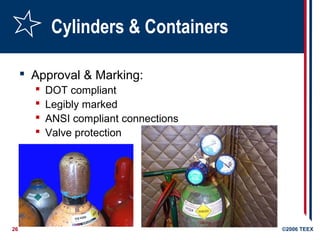
Cylinders & Containers
 Approval & Marking:
 DOT compliant
 Legibly marked
 ANSI compliant connections
 Valve protection
27 ©2006 TEEX
Cylinders & Containers: Storage
 Away from heat sources (such as radiators)
 When inside buildings:
 Well-protected, ventilated, dry location at least 20
ft from combustibles
 Assigned storage spaces, protected from damage
& tampering
 When empty: closed valves
 When not in use: hand-tight valve protection
caps
28 ©2006 TEEX
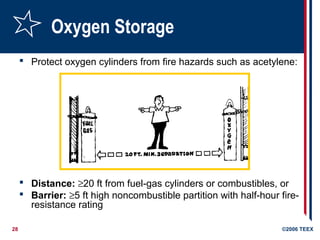
Oxygen Storage
 Protect oxygen cylinders from fire hazards such as acetylene:
 Distance: ≥20 ft from fuel-gas cylinders or combustibles, or
 Barrier: ≥5 ft high noncombustible partition with half-hour fire-
resistance rating
29 ©2006 TEEX
Arc Welding & Cutting
 Use compliant equipment
 Special design for exposure to weather,
flammable gases, marine conditions…
 Workmen who operate or maintain arc
welding equipment shall be acquainted
with the requirements of 1910.254 and
1910.252
30 ©2006 TEEX
Arc Welding & Cutting
 Electrode holders when not in use must be
kept from shocking people and objects.
 Protect against electric shock:
 Never use cables with splices within 10 feet (3 m)
of the holder
 The welder should not coil or loop welding
electrode cable around parts of his body
 Maintenance must ensure safety:
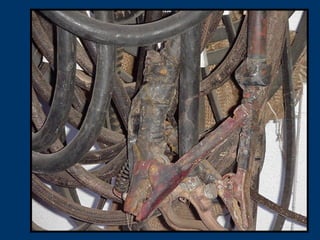
 Damaged cables & equipment must be replaced.
 Work and cables must be joined properly and
have adequate insulation.
31 ©2006 TEEX
Operating procedures
 Cylinders, cylinder valves, couplings,
regulators, hose, and apparatus kept
free from oily or greasy substances
 Oxygen cylinders shall not be handled
with oily hands or gloves
 A jet of oxygen must never be permitted
to strike an oily surface, greasy clothes,
or enter a fuel oil or other storage tank
37 ©2006 TEEX
Operating procedures
 Before connecting a regulator to a
cylinder valve:
 Open the valve slightly; close immediately
 Open the valve while standing to one
side of the outlet; never in front of it
 Never crack a fuel-gas cylinder valve
near other welding work or near sparks,
flame, or other possible sources of
ignition
38 ©2006 TEEX
Operating procedures
 Always open the cylinder valve slowly
 Never open an acetylene cylinder valve
more than 1.5 turns of the spindle, and
preferably no more than 3/4 of a turn
39 ©2006 TEEX
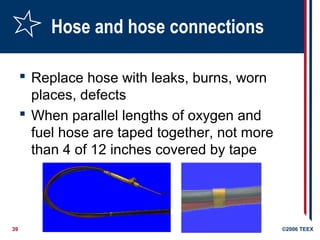
Hose and hose connections
 Replace hose with leaks, burns, worn
places, defects
 When parallel lengths of oxygen and
fuel hose are taped together, not more
than 4 of 12 inches covered by tape
40 ©2006 TEEX
Test Your Knowledge
 How long must a fire
watch continue?
 A radius of 35 feet. How far away must
combustible materials
be kept from welding?
 Who is responsible for
making fire watchers
available?
 During work in confined
spaces, what must be
left outside?
 Gas cylinders & welding
machines.
 Supervisor.
 At least 30 minutes.
41 ©2006 TEEX
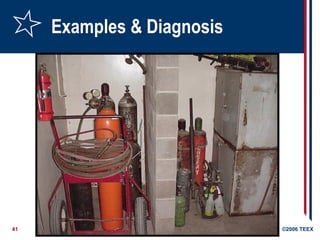
Examples & Diagnosis
Subtitles & Transitions
FOR EXAMPLE…
Subtitles & Transitions
FOR EXAMPLE…
Subtitles & Transitions
FOR EXAMPLE…
Subtitles & Transitions
FOR EXAMPLE…
Subtitles & Transitions
FOR EXAMPLE…
Subtitles & Transitions
FOR EXAMPLE…

Welding safety

  • 1.
    Welding, Cutting, andBrazing MODULE 16
  • 2.
    2 ©2006 TEEX Hazardsof Welding Operations  Fire hazards  Metal splatter  Electric shock  Explosion hazards  Released gases  Radiant energy  Where would these hazards be found on oil and gas well sites?
  • 3.
    3 ©2006 TEEX ThreeBasic Types of Welding  Gas – Slower and easier to control than electric arc. Uses gas flame over metals until molten puddle is formed. Most popular fuels used with oxygen include acetylene, mapp gas, and hydrogen.  Arc – Two metals are joined by generating an electric arc between a covered metal electrode and the base metal.  Oxygen and Arc Cutting – Metal cutting in welding is the severing or removal of metal by a flame or arc.
  • 4.
    4 ©2006 TEEX Oxygenand arc cutting  Most common cutting processes :  Oxygen Cutting: Metal is heated by gas flame and an oxygen jet does the cutting.  Arc Cutting: Intense heat of electric arc melts away the metal.
  • 5.
    5 ©2006 TEEX Regulations 29 CFR 1910 Subpart Q  General Industry  29 CFR 1926 Subpart J  Construction  API RP 54 Section 20  Hotwork, Welding, and Flame Cutting Operations
  • 6.
  • 7.
    7 ©2006 TEEX FirePrevention Safeguards  Fire Hazards should be removed if the welded object cannot be readily moved.  Guards should be used if removing fire hazards is not possible.  Restrictions apply (no cutting or welding allowed) if none of the above is possible.
  • 8.
  • 9.
    9 ©2006 TEEX SpecialPrecautions  Protect nearby combustible materials from sparks that might escape through openings in floors or walls.  Fire Extinguishers must be ready for instant use.  Fire Watch lasting at least 30 min after welding or cutting operations is required if more than a minor fire might develop and if certain combustible materials are present.
  • 10.
    10 ©2006 TEEX SpecialPrecautions  Authorization: A responsible individual must inspect the area and designate precautions, preferably by written permit.  Floors: Combustible materials must be swept 35 feet away; combustible floors must be wetted or protected (while preventing arc welding shock)
  • 11.
    11 ©2006 TEEX SpecialPrecautions  Prohibited areas for welding:  Unauthorized by management  Where sprinklers are impaired  Explosive atmospheres  Near storage of large quantities of readily ignitable materials  Relocation of Combustibles: Combustibles shall be moved 35 feet away or properly protected or shielded.
  • 12.
    12 ©2006 TEEX SpecialPrecautions  Ducts: Ducts & conveyor systems that might carry sparks must be shut down.  Combustible walls must be shielded or guarded.  Noncombustible walls, partitions or ceilings (when welded) require opposite-side moving of combustibles or a fire watch.  Combustible cover: No welding on certain metal building components having combustible covers or layers.
  • 13.
    13 ©2006 TEEX SpecialPrecautions  Pipes (or any metal) close enough to combustibles to cause ignition by conduction may not be cut or welded.  Management responsibilities:  Establish proper areas and procedures  Designate responsible individual  Ensure training  Advise contractors of hazards
  • 14.
    14 ©2006 TEEX SpecialPrecautions  Supervisor responsibilities:  Safety of equipment & procedures  Determine combustibles & hazardous areas  Protect combustibles from ignition through moving, shielding and scheduling  Secure authorizations  Give go-ahead to cutter or welder  Ensure fire protection  Ensure fire watches if required
  • 15.
    15 ©2006 TEEX Weldingor Cutting Containers  Used containers must be cleaned of flammable materials or other materials that could release toxic of flammable vapors when heated.  Venting & purging is required for hollow spaces or cavities.
  • 16.
    16 ©2006 TEEX ConfinedSpaces  Precautions must be taken during long* pauses in arc welding to prevent  accidental contact of electrodes  torch valve gas leaks in gas welding. *During lunch or overnight
  • 17.
    17 ©2006 TEEX Protectionof Personnel  Railing or other suitable fall protection must be provided as required.  Welding cable and other equipment must be kept clear of passageways, ladders and stairways.  Eye protection and protective equipment of specific appropriate types must be worn. Nearby workers must be protected from arc welding rays.
  • 18.
  • 19.
    19 ©2006 TEEX Protectionof Personnel  Work in confined spaces requires consideration of:  Ventilation  Securing cylinders and machinery  Lifelines  Electrode removal (arc welding)  Gas cylinder shutoff (gas welding & cutting)  Warning signs for hot metal
  • 20.
    20 ©2006 TEEX HealthProtection & Ventilation  General requirements for protecting welders are based on 3 factors:  Dimensions of space (especially ceiling height) in which welding is to be done  Number of welders  Possible evolution of hazardous fumes, gases, or dust according to the metals involved.
  • 21.
    21 ©2006 TEEX Naturaland Mechanical Ventilation  Must not be restricted by screens  Sufficient to keep concentrations <PEL  Mechanical ventilation required for:  Metals not described here  Spaces <10,000 feet per welder  Rooms with ceilings lower than 16 feet  Confined spaces or areas with barriers to natural cross ventilation
  • 22.
    22 ©2006 TEEX DilutionVentilation  Contaminant should travel away from breathing zone.  Local exhaust ventilation may be more effective. Poor Fair Good Best
  • 23.
    23 ©2006 TEEX Ventilation Confined space: ventilation first; respirators if ventilation impossible  Specific rules for specific chemicals  Outdoors: Just stay below PEL
  • 24.
    24 ©2006 TEEX Transmissionpipeline  Special rules in 1910.252(d)(1)  Special electric shock protection for wet conditions  Pressure testing: Worker and public protection against blowing out or loose dirt  Construction: API Std. 1104-1968  Flammable substance lines: API Std. PSD No. 2201-1963  X-ray inspection: ANSI Z54.1-1963
  • 25.
    25 ©2006 TEEX Oxygen-FuelGas Welding & Cutting  General Requirements  Flammable mixtures of fuel gases and air or oxygen must be guarded against.  Maximum pressures of 15 psi for acetylene must be observed (with certain rare exceptions).  Approved apparatus.  Competent personnel in charge of supply equipment
  • 26.
    26 ©2006 TEEX Cylinders& Containers  Approval & Marking:  DOT compliant  Legibly marked  ANSI compliant connections  Valve protection
  • 27.
    27 ©2006 TEEX Cylinders& Containers: Storage  Away from heat sources (such as radiators)  When inside buildings:  Well-protected, ventilated, dry location at least 20 ft from combustibles  Assigned storage spaces, protected from damage & tampering  When empty: closed valves  When not in use: hand-tight valve protection caps
  • 28.
    28 ©2006 TEEX OxygenStorage  Protect oxygen cylinders from fire hazards such as acetylene:  Distance: ≥20 ft from fuel-gas cylinders or combustibles, or  Barrier: ≥5 ft high noncombustible partition with half-hour fire- resistance rating
  • 29.
    29 ©2006 TEEX ArcWelding & Cutting  Use compliant equipment  Special design for exposure to weather, flammable gases, marine conditions…  Workmen who operate or maintain arc welding equipment shall be acquainted with the requirements of 1910.254 and 1910.252
  • 30.
    30 ©2006 TEEX ArcWelding & Cutting  Electrode holders when not in use must be kept from shocking people and objects.  Protect against electric shock:  Never use cables with splices within 10 feet (3 m) of the holder  The welder should not coil or loop welding electrode cable around parts of his body  Maintenance must ensure safety:  Damaged cables & equipment must be replaced.  Work and cables must be joined properly and have adequate insulation.
  • 31.
    31 ©2006 TEEX Operatingprocedures  Cylinders, cylinder valves, couplings, regulators, hose, and apparatus kept free from oily or greasy substances  Oxygen cylinders shall not be handled with oily hands or gloves  A jet of oxygen must never be permitted to strike an oily surface, greasy clothes, or enter a fuel oil or other storage tank
  • 32.
    37 ©2006 TEEX Operatingprocedures  Before connecting a regulator to a cylinder valve:  Open the valve slightly; close immediately  Open the valve while standing to one side of the outlet; never in front of it  Never crack a fuel-gas cylinder valve near other welding work or near sparks, flame, or other possible sources of ignition
  • 33.
    38 ©2006 TEEX Operatingprocedures  Always open the cylinder valve slowly  Never open an acetylene cylinder valve more than 1.5 turns of the spindle, and preferably no more than 3/4 of a turn
  • 34.
    39 ©2006 TEEX Hoseand hose connections  Replace hose with leaks, burns, worn places, defects  When parallel lengths of oxygen and fuel hose are taped together, not more than 4 of 12 inches covered by tape
  • 35.
    40 ©2006 TEEX TestYour Knowledge  How long must a fire watch continue?  A radius of 35 feet. How far away must combustible materials be kept from welding?  Who is responsible for making fire watchers available?  During work in confined spaces, what must be left outside?  Gas cylinders & welding machines.  Supervisor.  At least 30 minutes.
  • 36.
  • 37.
  • 38.
  • 39.
  • 40.
  • 41.
  • 42.