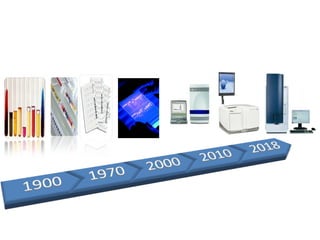
Molecular techniques for quality
control of meat and meat products
Dr Ravi Kant Agrawal, MVSc, PhD
Senior Scientist (Veterinary Microbiology)
Food Microbiology Laboratory
Division of Livestock Products Technology
ICAR-Indian Veterinary Research Institute
Izatnagar 243122 (UP) India
 India- Immense livestock wealth: World’s largest livestock
population of 512.06 million - 214 million cattle, 115.42 million
buffaloes, 75.5 million sheep, 162 million goats, 9.5 million pigs
and 950 million poultry (FAO, 2014).
 Total meat production in India: 6.29 million tonnes (FAO, 2014).
 India Rank 5th
in meat production
 Contributes ~ 30% to Agricultural GDP (2014-15), 4.18% to total
GDP (DAHD&F, 2012).
 Meat- 4.4% of total output from livestock sector
(Central survey organization)
 Export of Livestock Products: Rs. 32,593 crore (5.01 billion USD)
– 1.4% of World share (APEDA, 2015)
 Meat & Meat Products: >90% of livestock export vol
 >30% of meat products- exported
 Buffalo Meat: top agri-export (4.8 billion USD)
 Milk production- 137.7 MT
 Rank No. 1 in milk production
Animal Products: Milk and MeatAnimal Products: Milk and Meat
Food SafetyFood Safety
 Food safety has emerged as an important global issue due to
international trade and public health implications.
 Despite advances in hygiene, consumer knowledge, food
treatment and processing, FBDs still represent a significant
threat to public health, worldwide.
 The term FBDs covers illnesses acquired through consumption
of contaminated food.
 FBDs - caused by bacteria and bacterial toxins, viruses, zoonotic
parasites, fungi and fungal toxins, pesticide residues, heavy
metals, drug residues, food adulterants, food additives etc.
 In response to the increasing number of food borne illnesses,
governments all over the world are intensifying their efforts to
improve food safety.
Importance of Food SafetyImportance of Food Safety
 Due to widespread poverty and malnutrition in developing
countries, programs directed towards the promotion of
adequate access to food that satisfy calorie needs and minimize
hunger have precedence over programs designed to ensure
wholesomeness and quality of food. In short, the emphasis so
far has been more on food adequacy rather than on food quality.
 Therefore, the World Health Assembly adopted a resolution
(WHA 53.15) in which, the World Health Organization (WHO) was
asked “to give greater emphasis on food safety.
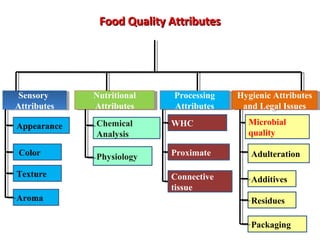
Food Quality AttributesFood Quality Attributes
Sensory
Attributes
Sensory
Attributes
Nutritional
Attributes
Nutritional
Attributes
Color
Appearance
Texture
Chemical
Analysis
Physiology
Microbial
quality
Additives
Adulteration
Residues
Hygienic Attributes
and Legal Issues
Hygienic Attributes
and Legal Issues
Packaging
Aroma
WHC
Proximate
Connective
tissue
Processing
Attributes
Processing
Attributes
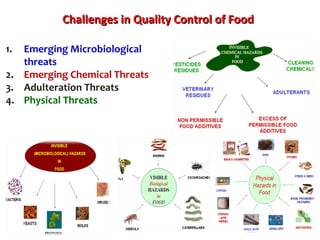
Challenges in Quality Control of FoodChallenges in Quality Control of Food
1. Emerging Microbiological
threats
2. Emerging Chemical Threats
3. Adulteration Threats
4. Physical Threats
Challenges inChallenges in Microbiological Food SafetyMicrobiological Food Safety
Growing international trade, migration and
travel - increased the spread of dangerous
pathogens and contaminants in food.
Due to globalization of food marketing and
distribution - both accidentally or
deliberately contaminated food can affect
health of people in many countries at the
same time.
In today’s interconnected and
interdependent world - local FBD outbreaks
may become a potential threat to the entire
globe.
In 1991, cholera which was thought to have
originated from contaminated seafood
harvested off the coast of Peru, rapidly
spread across Latin America resulting in
approximately 400,000 reported cases and
more than 4000 deaths in several countries.
Importance of Microbiological Food SafetyImportance of Microbiological Food Safety
The identification of one single
contaminated food ingredient can lead to
the recall of tonnes of food products
leading to considerable economic losses in
production and from trade embargoes, as
well as damage to the tourist industry.
In early 2008, an outbreak of avian influenza
in Bangalore, India, led to an import ban of
Indian poultry products in the Middle East,
resulting in losses totaling hundreds of
thousands of US Dollars to the Indian
economy.
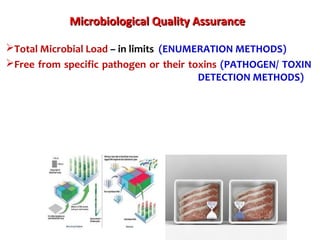
Microbiological Quality AssuranceMicrobiological Quality Assurance
Total Microbial Load – in limits (ENUMERATION METHODS)
Free from specific pathogen or their toxins (PATHOGEN/ TOXIN
DETECTION METHODS)
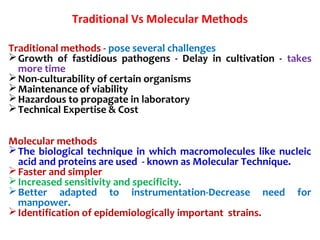
Traditional Vs Molecular Methods
Traditional methods - pose several challenges
Growth of fastidious pathogens - Delay in cultivation - takes
more time
Non-culturability of certain organisms
Maintenance of viability
Hazardous to propagate in laboratory
Technical Expertise & Cost
Molecular methods
The biological technique in which macromolecules like nucleic
acid and proteins are used - known as Molecular Technique.
Faster and simpler
Increased sensitivity and specificity.
Better adapted to instrumentation-Decrease need for
manpower.
Identification of epidemiologically important strains.
Recent Research FocusRecent Research Focus
Rapid MethodsRapid Methods
Quantification of microbial load
Detection of Foodborne pathogens and their toxins
Species Identification
Intelligent packaging applications
Residue Analysis: Pesticide residues, veterinary drug residues,
heavy metals, Food Additives, Contaminants
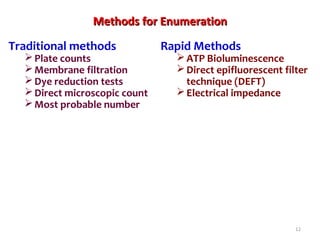
Rapid Methods
ATP Bioluminescence
Direct epifluorescent filter
technique (DEFT)
Electrical impedance
Traditional methods
Plate counts
Membrane filtration
Dye reduction tests
Direct microscopic count
Most probable number
12
Methods for EnumerationMethods for Enumeration
13
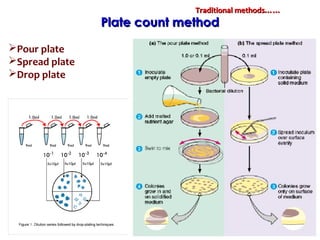
Plate count methodPlate count method
Pour plate
Spread plate
Drop plate
Traditional methods……Traditional methods……
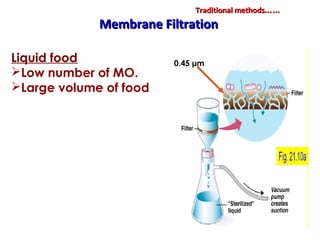
Membrane FiltrationMembrane Filtration
0.45 μmLiquid food
Low number of MO.
Large volume of food
Traditional methods……Traditional methods……
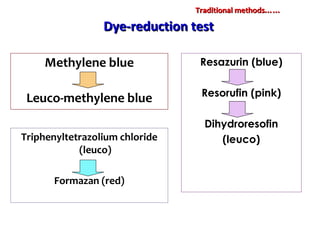
Dye-reduction testDye-reduction test
Methylene blue
Leuco-methylene blue
Resazurin (blue)
Resorufin (pink)
Dihydroresofin
(leuco)Triphenyltetrazolium chloride
(leuco)
Formazan (red)
Traditional methods……Traditional methods……
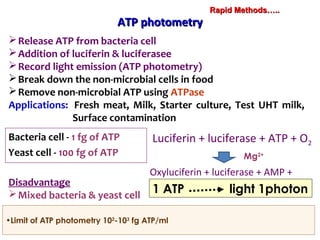
ATP photometryATP photometry
Release ATP from bacteria cell
Addition of luciferin & luciferasee
Record light emission (ATP photometry)
Break down the non-microbial cells in food
Remove non-microbial ATP using ATPase
Applications: Fresh meat, Milk, Starter culture, Test UHT milk,
Surface contamination
Luciferin + luciferase + ATP + O2
Oxyluciferin + luciferase + AMP +
light
Mg2+
1 ATP light 1photon
Bacteria cell - 1 fg of ATP
Yeast cell - 100 fg of ATP
•Limit of ATP photometry 102
-103
fg ATP/ml
Rapid Methods…..Rapid Methods…..
Disadvantage
Mixed bacteria & yeast cell
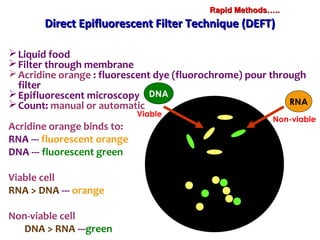
Direct Epifluorescent Filter Technique (DEFT)Direct Epifluorescent Filter Technique (DEFT)
Liquid food
Filter through membrane
Acridine orange : fluorescent dye (fluorochrome) pour through
filter
Epifluorescent microscopy
Count: manual or automatic
Acridine orange binds to:
RNA --- fluorescent orange
DNA --- fluorescent green
Viable cell
RNA > DNA --- orange
Non-viable cell
DNA > RNA ---green
RNA
DNA
Non-viable
Viable
Rapid Methods…..Rapid Methods…..
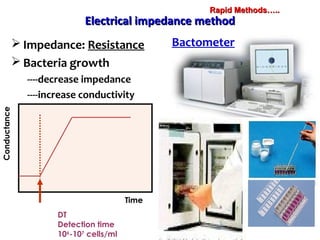
Electrical impedance methodElectrical impedance method
 Impedance: Resistance
 Bacteria growth
----decrease impedance
----increase conductivity
Conductance
Time
DT
Detection time
106
-107
cells/ml
Bactometer
Rapid Methods…..Rapid Methods…..
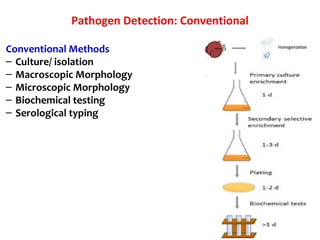
Pathogen Detection: Conventional
Conventional Methods
– Culture/ isolation
– Macroscopic Morphology
– Microscopic Morphology
– Biochemical testing
– Serological typing
Pathogen Detection: Rapid Methods
Pathogen Detection….
1. Automated Growth-Based Technologies
 Measurement of biochemical or physiological parameters that
reflect growth of microorganisms; include: Colorimetric
detection of CO2 production: BACTEC (BD); BacT/Alert
(bioMerieux)
 Simplest, use classical method for processing sample, then
detect colorimetric change to spot growth earlier than visual
detection e.g. VITEK (bioMerieux), Phoenix (BD)
2. Molecular Methods/ Technologies
 Polymerase chain reaction and other nucleic acid amplification
technologies (NAATs)
 DNA probes: Gene-Trak; Gene-Probe
 Molecular typing
 Sequencing including NGS technology
3. Cellular Component-Based Technologies
 Detection of a specific cellular component:
Fatty acid profiles
Mass spectrometry
Rapid Diagnostics??
Rapid Diagnostic Test: A rapid diagnostic test (RDT) is a
diagnostic test that is quick and easy to perform. They provide
same-day results within two hours, typically in approximately 20
minutes (WHO, 2014; CDC, 2014).
WHO recommends that an ideal diagnostic test suitable for
developing, underdeveloped and undeveloped countries should
be
“ASSURED”
☻Affordable
☻ Sensitive
☻ Specific
☻ User-friendly
☻ Robust and rapid
☻ Equipment free
☻Deliverable to the end user
(Mabey et al.,2004)
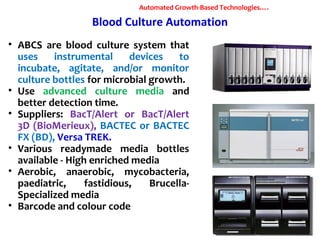
Blood Culture Automation
• ABCS are blood culture system that
uses instrumental devices to
incubate, agitate, and/or monitor
culture bottles for microbial growth.
• Use advanced culture media and
better detection time.
• Suppliers: BacT/Alert or BacT/Alert
3D (BioMerieux), BACTEC or BACTEC
FX (BD), Versa TREK.
• Various readymade media bottles
available - High enriched media
• Aerobic, anaerobic, mycobacteria,
paediatric, fastidious, Brucella-
Specialized media
• Barcode and colour code
Automated Growth-Based Technologies….
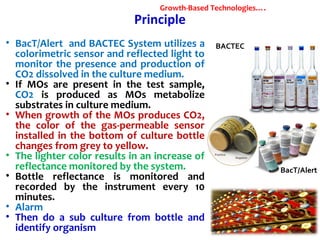
Principle
• BacT/Alert and BACTEC System utilizes a
colorimetric sensor and reflected light to
monitor the presence and production of
CO2 dissolved in the culture medium.
• If MOs are present in the test sample,
CO2 is produced as MOs metabolize
substrates in culture medium.
• When growth of the MOs produces CO2,
the color of the gas-permeable sensor
installed in the bottom of culture bottle
changes from grey to yellow.
• The lighter color results in an increase of
reflectance monitored by the system.
• Bottle reflectance is monitored and
recorded by the instrument every 10
minutes.
• Alarm
• Then do a sub culture from bottle and
identify organism
BACTEC
BacT/Alert
Growth-Based Technologies….
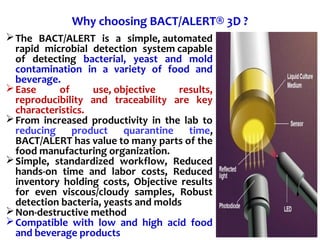
Why choosing BACT/ALERT® 3D ?
The BACT/ALERT is a simple, automated
rapid microbial detection system capable
of detecting bacterial, yeast and mold
contamination in a variety of food and
beverage.
Ease of use, objective results,
reproducibility and traceability are key
characteristics.
From increased productivity in the lab to
reducing product quarantine time,
BACT/ALERT has value to many parts of the
food manufacturing organization.
Simple, standardized workflow, Reduced
hands-on time and labor costs, Reduced
inventory holding costs, Objective results
for even viscous/cloudy samples, Robust
detection bacteria, yeasts and molds
Non-destructive method
Compatible with low and high acid food
and beverage products
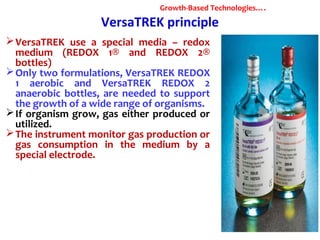
VersaTREK principle
VersaTREK use a special media – redox
medium (REDOX 1® and REDOX 2®
bottles)
Only two formulations, VersaTREK REDOX
1 aerobic and VersaTREK REDOX 2
anaerobic bottles, are needed to support
the growth of a wide range of organisms.
If organism grow, gas either produced or
utilized.
The instrument monitor gas production or
gas consumption in the medium by a
special electrode.
Growth-Based Technologies….
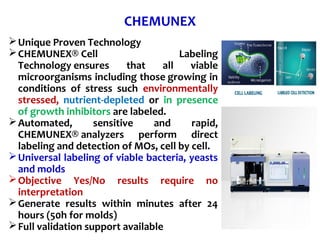
CHEMUNEX
Unique Proven Technology
CHEMUNEX® Cell Labeling
Technology ensures that all viable
microorganisms including those growing in
conditions of stress such environmentally
stressed, nutrient-depleted or in presence
of growth inhibitors are labeled.
Automated, sensitive and rapid,
CHEMUNEX® analyzers perform direct
labeling and detection of MOs, cell by cell.
Universal labeling of viable bacteria, yeasts
and molds
Objective Yes/No results require no
interpretation
Generate results within minutes after 24
hours (50h for molds)
​Full validation support available
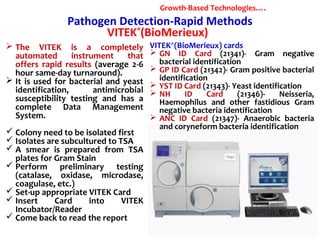
VITEK®
(BioMerieux)
 The VITEK is a completely
automated instrument that
offers rapid results (average 2-6
hour same-day turnaround).
 It is used for bacterial and yeast
identification, antimicrobial
susceptibility testing and has a
complete Data Management
System.
 Colony need to be isolated first
 Isolates are subcultured to TSA
 A smear is prepared from TSA
plates for Gram Stain
 Perform preliminary testing
(catalase, oxidase, microdase,
coagulase, etc.)
 Set-up appropriate VITEK Card
 Insert Card into VITEK
Incubator/Reader
 Come back to read the report
VITEK®
(BioMerieux) cards
 GN ID Card (21341)- Gram negative
bacterial identification
 GP ID Card (21342)- Gram positive bacterial
identification
 YST ID Card (21343)- Yeast identification
 NH ID Card (21346)- Neisseria,
Haemophilus and other fastidious Gram
negative bacteria identification
 ANC ID Card (21347)- Anaerobic bacteria
and coryneform bacteria identification
Pathogen Detection-Rapid Methods
Growth-Based Technologies….
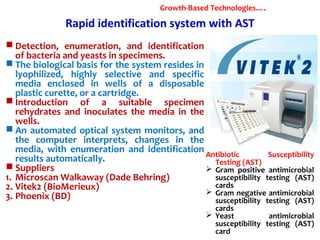
Rapid identification system with AST
 Detection, enumeration, and identification
of bacteria and yeasts in specimens.
 The biological basis for the system resides in
lyophilized, highly selective and specific
media enclosed in wells of a disposable
plastic curette, or a cartridge.
 Introduction of a suitable specimen
rehydrates and inoculates the media in the
wells.
 An automated optical system monitors, and
the computer interprets, changes in the
media, with enumeration and identification
results automatically.
 Suppliers
1. Microscan Walkaway (Dade Behring)
2. Vitek2 (BioMerieux)
3. Phoenix (BD)
Growth-Based Technologies….
Antibiotic Susceptibility
Testing (AST)
 Gram positive antimicrobial
susceptibility testing (AST)
cards
 Gram negative antimicrobial
susceptibility testing (AST)
cards
 Yeast antimicrobial
susceptibility testing (AST)
card
Phoenix BD
Phoenix BD
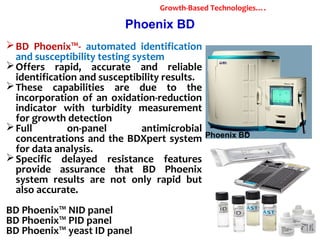
BD Phoenix™- automated identification
and susceptibility testing system
Offers rapid, accurate and reliable
identification and susceptibility results.
These capabilities are due to the
incorporation of an oxidation-reduction
indicator with turbidity measurement
for growth detection
Full on-panel antimicrobial
concentrations and the BDXpert system
for data analysis.
Specific delayed resistance features
provide assurance that BD Phoenix
system results are not only rapid but
also accurate.
BD Phoenix™ NID panel
BD Phoenix™ PID panel
BD Phoenix™ yeast ID panel
Growth-Based Technologies….
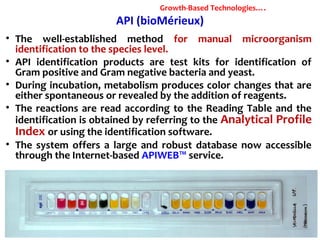
API (bioMérieux)
• The well-established method for manual microorganism
identification to the species level.
• API identification products are test kits for identification of
Gram positive and Gram negative bacteria and yeast.
• During incubation, metabolism produces color changes that are
either spontaneous or revealed by the addition of reagents.
• The reactions are read according to the Reading Table and the
identification is obtained by referring to the Analytical Profile
Index or using the identification software.
• The system offers a large and robust database now accessible
through the Internet-based APIWEB™ service.
Growth-Based Technologies….
API for product safety applications
API Gram negative Identification
 API 20E – Species/subspecies identification of Enterobacteriaceae and
group/species identification of non-fermenting Gram -ve bacteria
 API Rapid 20E – 4 h identification of Enterobacteriaceae
 API 20NE – 24 – 48h identification of Gram -ve non-Enterobacteriaceae
 API Campy – 24-hour identification of Campylobacter species
API Gram positive Identification
 API Staph – Overnight identification of clinical staphylococci and
micrococci
 API 20 Strep – 4 or 24-hour identification of streptococci and
enterococci
 API Coryne – 24-hour identification of Corynebacteria and coryne-like
organisms
 API Listeria – 24-hour identification of all Listeria species
API Anaerobe Identification
 API 20A – 24-hour identification of anaerobes
 Rapid ID 32 A – 4-hour identification of anaerobes
API Yeast Identification
 API 20C AUX – 48 to 72-hour identification of yeasts
 ID 32 C – 24-hour identification of yeasts
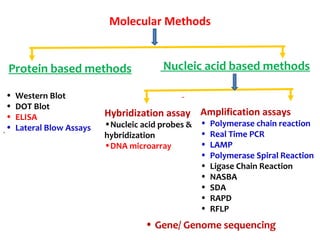
Molecular Methods
Protein based methods Nucleic acid based methods
.
Hybridization assay
•Nucleic acid probes &
hybridization
•DNA microarray
Amplification assays
• Polymerase chain reaction
• Real Time PCR
• LAMP
• Polymerase Spiral Reaction
• Ligase Chain Reaction
• NASBA
• SDA
• RAPD
• RFLP
• Western Blot
• DOT Blot
• ELISA
• Lateral Blow Assays
• Gene/ Genome sequencing
WHY NA AMPLIFICATION ASSAYS (NAATs)?
 If sufficient target nucleic acid is not present in the reaction,
hybridization can give false negative results.
 To circumvent this, nucleic acid amplification is used
 How to amplify the nucleic acid?
 By allowing repeated replication of target nucleic acid by the
specific primer.
Nucleic Acid Based Mthods
NA Amplification Methods….
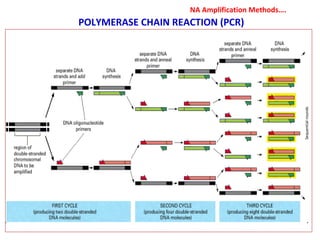
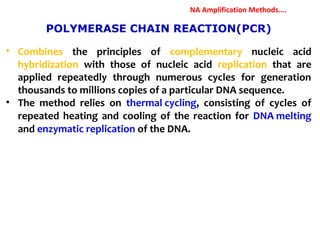
POLYMERASE CHAIN REACTION(PCR)
• Combines the principles of complementary nucleic acid
hybridization with those of nucleic acid replication that are
applied repeatedly through numerous cycles for generation
thousands to millions copies of a particular DNA sequence.
• The method relies on thermal cycling, consisting of cycles of
repeated heating and cooling of the reaction for DNA melting
and enzymatic replication of the DNA.
NA Amplification Methods….
PCR REQUIREMENT
 DNA template that contains the DNA region
(target) to be amplified.
 Primers that are complementary to the 3'
(three prime) ends of each of the
sense and anti-sense strand of the DNA
target.
 Taq polymerase or other DNA polymerase
with a temperature optimum at around
70 °C.
 Deoxynucleotide the building blocks from
which the DNA polymerases synthesizes a
new DNA strand.
 Buffer solution, providing a suitable
chemical environment for optimum
activity and stability of the DNA
polymerase.
 Divalent cations, magnesium or manganese
ions
 Monovalent cation potassium ions.
 To maintain continuous reaction cycles,
programmable thermal cyclers are used
Basic steps:
Denaturation of the target (dsDNA)
Annealing of primers
Extension of primer-target Duplex
Detection of PCR products
Visualization and Recording of
results
NA Amplification Methods….
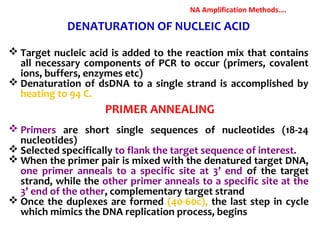
DENATURATION OF NUCLEIC ACID
 Target nucleic acid is added to the reaction mix that contains
all necessary components of PCR to occur (primers, covalent
ions, buffers, enzymes etc)
 Denaturation of dsDNA to a single strand is accomplished by
heating to 94 C.
 Primers are short single sequences of nucleotides (18-24
nucleotides)
 Selected specifically to flank the target sequence of interest.
 When the primer pair is mixed with the denatured target DNA,
one primer anneals to a specific site at 3’ end of the target
strand, while the other primer anneals to a specific site at the
3’ end of the other, complementary target strand
 Once the duplexes are formed (40-60c), the last step in cycle
which mimics the DNA replication process, begins
PRIMER ANNEALING
NA Amplification Methods….
 TAQ POLYMERASE is the enzyme commonly used for primer
extension, which occurs at 720
C.
 It can function efficiently at elevated temperature & withstand
the denaturing temperature of 94 C through several cycles.
 Annealing of primers to target sequence provides the
necessary template format that allows DNA polymerase to add
nucleotides to 3’ end of each primer & produce by extension a
sequence complementary to target sequence.
 For each target sequence originally present in the PCR mixture,
2 double stranded fragments containing the target sequence
are produced after one cycle
 At the beginning of the second cycle of PCR, denaturation then
produces 4 templates to which the primers will anneal.
 Following extension at the end of the second cycle, there will
be 4 double stranded fragments containing target nucleic acid
 After 30 to 40 cycles, 107
to 108
target copies will be present in
the reaction mixture
EXTENSION OF PRIMER
NA Amplification Methods….
POLYMERASE CHAIN REACTION (PCR)
Sequentialrounds
NA Amplification Methods….
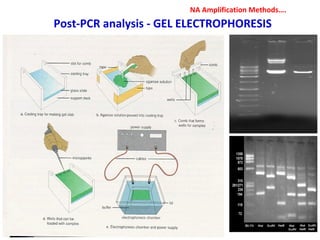
Post-PCR analysis - GEL ELECTROPHORESIS
NA Amplification Methods….
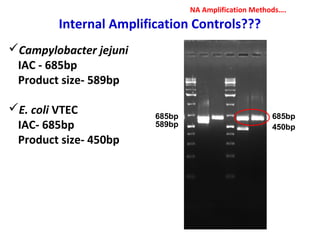
Internal Amplification Controls???
Campylobacter jejuni
IAC - 685bp
Product size- 589bp
E. coli VTEC
IAC- 685bp
Product size- 450bp
685bp
450bp
685bp
589bp
NA Amplification Methods….
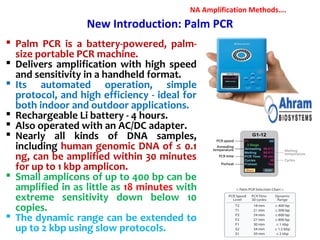
New Introduction: Palm PCR
 Palm PCR is a battery-powered, palm-
size portable PCR machine.
 Delivers amplification with high speed
and sensitivity in a handheld format.
 Its automated operation, simple
protocol, and high efficiency - ideal for
both indoor and outdoor applications.
 Rechargeable Li battery - 4 hours.
 Also operated with an AC/DC adapter.
 Nearly all kinds of DNA samples,
including human genomic DNA of ≤ 0.1
ng, can be amplified within 30 minutes
for up to 1 kbp amplicon.
 Small amplicons of up to 400 bp can be
amplified in as little as 18 minutes with
extreme sensitivity down below 10
copies.
 The dynamic range can be extended to
up to 2 kbp using slow protocols.
NA Amplification Methods….
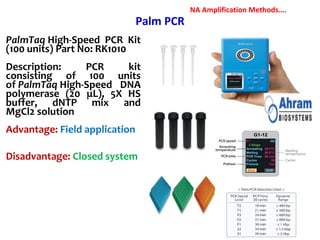
Palm PCR
PalmTaq High-Speed PCR Kit
(100 units) Part No: RK1010
Description: PCR kit
consisting of 100 units
of PalmTaq High-Speed DNA
polymerase (20 μL), 5X HS
buffer, dNTP mix and
MgCl2 solution
Advantage: Field application
Disadvantage: Closed system
NA Amplification Methods….
Variations of PCR
 Multiplex PCR
 Real Time PCR
 Colony PCR
 Reverse Transcriptase PCR
 Nested PCR
 Hot Start PCR
 In Situ PCR
 AFLP PCR
 Inverse PCR
 Asymmetric PCR
 Long PCR
 Long Accurate PCR
 Allele specific PCR
 Broad range PCR
NA Amplification Methods….
REAL TIME PCR
Real-time PCR, also called Q-PCR/qPCR or kinetic PCR.
RT PCR is used to amplify and simultaneously quantify targeted
DNA.
Its key feature is that the amplified DNA is detected as the
reaction progresses in real time.
Two different methods are used.
Method -1:-Real-time PCR using double-stranded DNA dyes.
• In addition to PCR mix dsDNA dyes such as SYBR Green I is
added.
• Dye will bind to dsDNA PCR products.
Method -2:-Fluorescent reporter probe method
• In addition to the all the PCR mix, Fluorescent probes are added.
• During annealing stage, both probe and primers anneal to the
DNA target.
• As polymerization of a new DNA strand is started, either 5'-3-
exonuclease degrades the probe or displaced the probe,
physically separating the fluorescent reporter resulting in an
increase in fluorescence.
NA Amplification Methods….
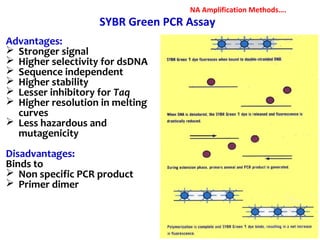
SYBR Green PCR Assay
Advantages:
 Stronger signal
 Higher selectivity for dsDNA
 Sequence independent
 Higher stability
 Lesser inhibitory for Taq
 Higher resolution in melting
curves
 Less hazardous and
mutagenicity
Disadvantages:
Binds to
 Non specific PCR product
 Primer dimer
NA Amplification Methods….
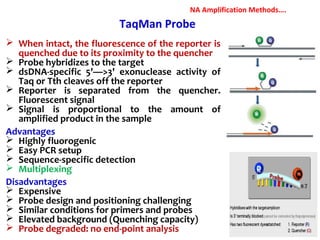
 When intact, the fluorescence of the reporter is
quenched due to its proximity to the quencher
 Probe hybridizes to the target
 dsDNA-specific 5'—>3' exonuclease activity of
Taq or Tth cleaves off the reporter
 Reporter is separated from the quencher.
Fluorescent signal
 Signal is proportional to the amount of
amplified product in the sample
Advantages
 Highly fluorogenic
 Easy PCR setup
 Sequence-specific detection
 Multiplexing
Disadvantages
 Expensive
 Probe design and positioning challenging
 Similar conditions for primers and probes
 Elevated background (Quenching capacity)
 Probe degraded: no end-point analysis
TaqMan Probe
NA Amplification Methods….
Loop
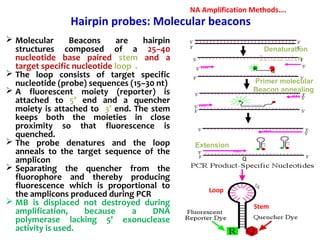
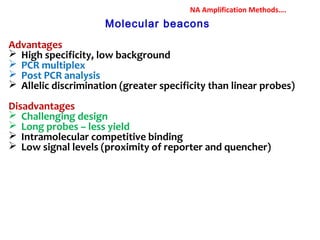
 Molecular Beacons are hairpin
structures composed of a 25–40
nucleotide base paired stem and a
target specific nucleotide loop .
 The loop consists of target specific
nucleotide (probe) sequences (15–30 nt)
 A fluorescent moiety (reporter) is
attached to 5’ end and a quencher
moiety is attached to 3’ end. The stem
keeps both the moieties in close
proximity so that fluorescence is
quenched.
 The probe denatures and the loop
anneals to the target sequence of the
amplicon
 Separating the quencher from the
fluorophore and thereby producing
fluorescence which is proportional to
the amplicons produced during PCR
 MB is displaced not destroyed during
amplification, because a DNA
polymerase lacking 5' exonuclease
activity is used.
Stem
Hairpin probes: Molecular beacons
Denaturation
Primer molecular
Beacon annealing
Extension
5’3’
Q
3’5’
5’
5’
3’
3’
5’
5’3’
3’5’
5’
3’5’
5’3’
5’
5’
5’
QR
5’
Denaturation
NA Amplification Methods….
Molecular beacons
Advantages
 High specificity, low background
 PCR multiplex
 Post PCR analysis
 Allelic discrimination (greater specificity than linear probes)
Disadvantages
 Challenging design
 Long probes – less yield
 Intramolecular competitive binding
 Low signal levels (proximity of reporter and quencher)
NA Amplification Methods….
Scorpion PrimersScorpion Primers
3’ Quencher
Blocker
5’ Reporter
Complementary sequence
PCR
primer
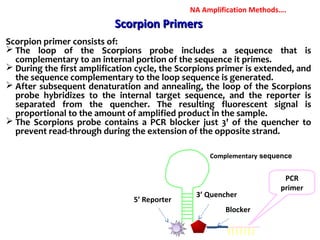
Scorpion primer consists of:
 The loop of the Scorpions probe includes a sequence that is
complementary to an internal portion of the sequence it primes.
 During the first amplification cycle, the Scorpions primer is extended, and
the sequence complementary to the loop sequence is generated.
 After subsequent denaturation and annealing, the loop of the Scorpions
probe hybridizes to the internal target sequence, and the reporter is
separated from the quencher. The resulting fluorescent signal is
proportional to the amount of amplified product in the sample.
 The Scorpions probe contains a PCR blocker just 3' of the quencher to
prevent read-through during the extension of the opposite strand.
NA Amplification Methods….
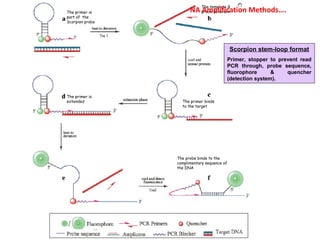
The primer is
part of the
Scorpion probe
The primer is
extended
The template &
probe denature
The primer binds
to the target
Scorpion stem-loop format
Primer, stopper to prevent read
PCR through, probe sequence,
fluorophore & quencher
(detection system).
The probe binds to the
complimentary sequence of
the DNA
NA Amplification Methods….
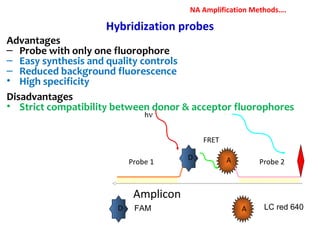
Hybridization Probes
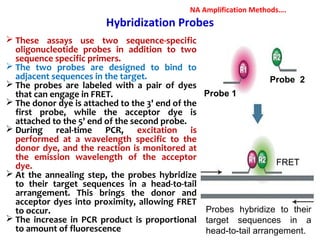
 These assays use two sequence-specific
oligonucleotide probes in addition to two
sequence specific primers.
 The two probes are designed to bind to
adjacent sequences in the target.
 The probes are labeled with a pair of dyes
that can engage in FRET.
 The donor dye is attached to the 3' end of the
first probe, while the acceptor dye is
attached to the 5' end of the second probe.
 During real-time PCR, excitation is
performed at a wavelength specific to the
donor dye, and the reaction is monitored at
the emission wavelength of the acceptor
dye.
 At the annealing step, the probes hybridize
to their target sequences in a head-to-tail
arrangement. This brings the donor and
acceptor dyes into proximity, allowing FRET
to occur.
 The increase in PCR product is proportional
to amount of fluorescence
Probe 2
Probes hybridize to their
target sequences in a
head-to-tail arrangement.
FRET
Probe 1
NA Amplification Methods….
Hybridization probes
hν
AD
FRET
Amplicon
Probe 1 Probe 2
D FAM A LC red 640
Advantages
– Probe with only one fluorophore
– Easy synthesis and quality controls
– Reduced background fluorescence
• High specificity
Disadvantages
• Strict compatibility between donor & acceptor fluorophores
NA Amplification Methods….
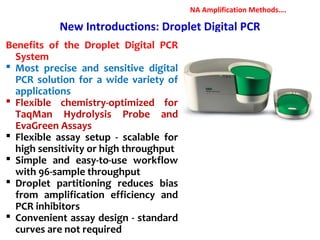
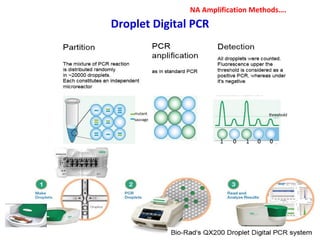
New Introductions: Droplet Digital PCR
Benefits of the Droplet Digital PCR
System
 Most precise and sensitive digital
PCR solution for a wide variety of
applications
 Flexible chemistry-optimized for
TaqMan Hydrolysis Probe and
EvaGreen Assays
 Flexible assay setup - scalable for
high sensitivity or high throughput
 Simple and easy-to-use workflow
with 96-sample throughput
 Droplet partitioning reduces bias
from amplification efficiency and
PCR inhibitors
 Convenient assay design - standard
curves are not required
NA Amplification Methods….
Droplet Digital PCR
NA Amplification Methods….
Applications of Droplet Digital PCR System
 Pathogen detection:Employ the extreme precision of the QX200
System to quantify small fold changes in target DNA or RNA molecules
in pathogen detection and monitoring.
 Food testing: Perform routine evaluation of genetically modified
organisms (GMO) using validated ddPCR methods.
 Cancer biomarker studies and copy number variation:
Measure varying degrees of cancer mutations, detect rare DNA target
copies, and resolve copy number variation with superior sensitivity
and resolution.
 Next generation sequencing: Perform accurate quantification and
qualification of NGS libraries without the use of a standard curve.
 Gene expression analysis: Achieve reliable and reproducible
measurements of small fold changes for low abundance of mRNA and
miRNA.
 Environmental monitoring: Test a wide variety of environmental
samples like soil and water.
NA Amplification Methods….
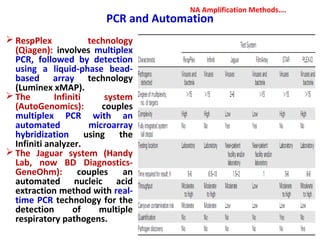
PCR and Automation
 RespPlex technology
(Qiagen): involves multiplex
PCR, followed by detection
using a liquid-phase bead-
based array technology
(Luminex xMAP).
 The Infiniti system
(AutoGenomics): couples
multiplex PCR with an
automated microarray
hybridization using the
Infiniti analyzer.
 The Jaguar system (Handy
Lab, now BD Diagnostics-
GeneOhm): couples an
automated nucleic acid
extraction method with real-
time PCR technology for the
detection of multiple
respiratory pathogens.
NA Amplification Methods….
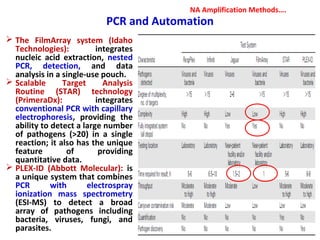
PCR and Automation
 The FilmArray system (Idaho
Technologies): integrates
nucleic acid extraction, nested
PCR, detection, and data
analysis in a single-use pouch.
 Scalable Target Analysis
Routine (STAR) technology
(PrimeraDx): integrates
conventional PCR with capillary
electrophoresis, providing the
ability to detect a large number
of pathogens (>20) in a single
reaction; it also has the unique
feature of providing
quantitative data.
 PLEX-ID (Abbott Molecular): is
a unique system that combines
PCR with electrospray
ionization mass spectrometry
(ESI-MS) to detect a broad
array of pathogens including
bacteria, viruses, fungi, and
parasites.
NA Amplification Methods….
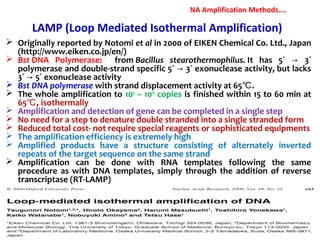
LAMP (Loop Mediated Isothermal Amplification)
 Originally reported by Notomi et al in 2000 of EIKEN Chemical Co. Ltd., Japan
(http://www.eiken.co.jp/en/)
 Bst DNA Polymerase: from Bacillus stearothermophilus. It has 5´ 3´→
polymerase and double-strand specific 5´ 3´ exonuclease activity, but lacks→
3´ 5´ exonuclease activity→
 Bst DNA polymerase with strand displacement activity at 65 .℃
 The whole amplification to 109
– 1010
copies is finished within 15 to 60 min at
65 , isothermally℃
 Amplification and detection of gene can be completed in a single step
 No need for a step to denature double stranded into a single stranded form
 Reduced total cost- not require special reagents or sophisticated equipments
 The amplification efficiency is extremely high
 Amplified products have a structure consisting of alternately inverted
repeats of the target sequence on the same strand
 Amplification can be done with RNA templates following the same
procedure as with DNA templates, simply through the addition of reverse
transcriptase (RT-LAMP)
NA Amplification Methods….
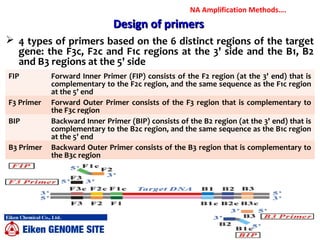
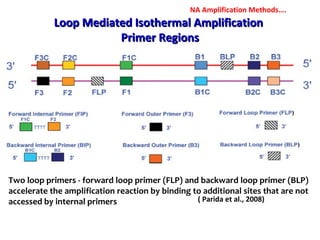
Design of primersDesign of primers
 4 types of primers based on the 6 distinct regions of the target
gene: the F3c, F2c and F1c regions at the 3' side and the B1, B2
and B3 regions at the 5' side
FIP Forward Inner Primer (FIP) consists of the F2 region (at the 3' end) that is
complementary to the F2c region, and the same sequence as the F1c region
at the 5' end
F3 Primer Forward Outer Primer consists of the F3 region that is complementary to
the F3c region
BIP Backward Inner Primer (BIP) consists of the B2 region (at the 3' end) that is
complementary to the B2c region, and the same sequence as the B1c region
at the 5' end
B3 Primer Backward Outer Primer consists of the B3 region that is complementary to
the B3c region
NA Amplification Methods….
Loop Mediated Isothermal AmplificationLoop Mediated Isothermal Amplification
Primer RegionsPrimer Regions
( Parida et al., 2008)
Two loop primers - forward loop primer (FLP) and backward loop primer (BLP)
accelerate the amplification reaction by binding to additional sites that are not
accessed by internal primers
NA Amplification Methods….
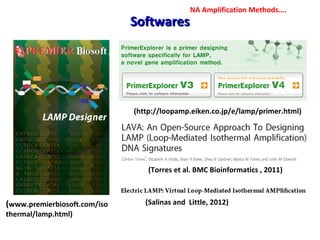
SoftwaresSoftwares
(www.premierbiosoft.com/iso
thermal/lamp.html)
(http://loopamp.eiken.co.jp/e/lamp/primer.html)
(Torres et al. BMC Bioinformatics , 2011)
(Salinas and Little, 2012)
NA Amplification Methods….
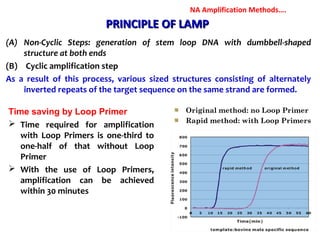
PRINCIPLE OF LAMPPRINCIPLE OF LAMP
(A) Non-Cyclic Steps: generation of stem loop DNA with dumbbell-shaped
structure at both ends
(B) Cyclic amplification step
As a result of this process, various sized structures consisting of alternately
inverted repeats of the target sequence on the same strand are formed.
Original method: no Loop Primer
Rapid method: with Loop Primers
Time saving by Loop Primer
 Time required for amplification
with Loop Primers is one-third to
one-half of that without Loop
Primer
 With the use of Loop Primers,
amplification can be achieved
within 30 minutes
NA Amplification Methods….
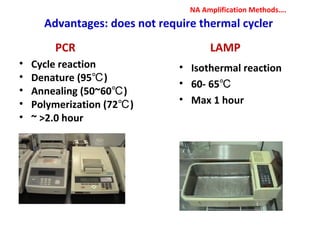
Advantages: does not require thermal cycler
• Cycle reaction
• Denature (95 )℃
• Annealing (50~60 )℃
• Polymerization (72 )℃
• ~ >2.0 hour
• Isothermal reaction
• 60- 65℃
• Max 1 hour
PCR LAMP
NA Amplification Methods….
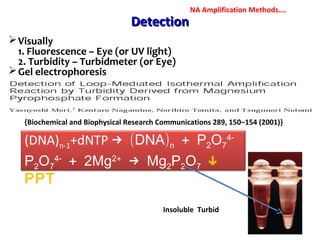
DetectionDetection
Visually
1. Fluorescence – Eye (or UV light)
2. Turbidity – Turbidmeter (or Eye)
Gel electrophoresis
(DNA)n-1+dNTP → ( )DNA n + P2O7
-4
P2O7
-4
+ 2Mg +2
→ Mg2P2O7 ↓
PPT
{Biochemical and Biophysical Research Communications 289, 150–154 (2001)}
Insoluble Turbid
NA Amplification Methods….
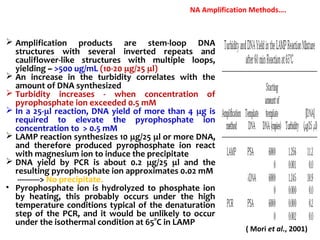
 Amplification products are stem-loop DNA
structures with several inverted repeats and
cauliflower-like structures with multiple loops,
yielding ~ >500 ug/mL (10-20 μg/25 μl)
 An increase in the turbidity correlates with the
amount of DNA synthesized
 Turbidity increases - when concentration of
pyrophosphate ion exceeded 0.5 mM
 In a 25-μl reaction, DNA yield of more than 4 μg is
required to elevate the pyrophosphate ion
concentration to > 0.5 mM
 LAMP reaction synthesizes 10 μg/25 μl or more DNA,
and therefore produced pyrophosphate ion react
with magnesium ion to induce the precipitate
 DNA yield by PCR is about 0.2 μg/25 μl and the
resulting pyrophosphate ion approximates 0.02 mM
----------> No precipitate.
• Pyrophosphate ion is hydrolyzed to phosphate ion
by heating, this probably occurs under the high
temperature conditions typical of the denaturation
step of the PCR, and it would be unlikely to occur
under the isothermal condition at 65°C in LAMP
( Mori et al., 2001)
NA Amplification Methods….
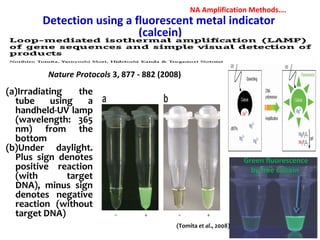
Nature Protocols 3, 877 - 882 (2008)
Detection using a fluorescent metal indicator
(calcein)
Green fluorescence
by free calcein
(a)Irradiating the
tube using a
handheld-UV lamp
(wavelength: 365
nm) from the
bottom
(b)Under daylight.
Plus sign denotes
positive reaction
(with target
DNA), minus sign
denotes negative
reaction (without
target DNA)
(Tomita et al., 2008)
NA Amplification Methods….
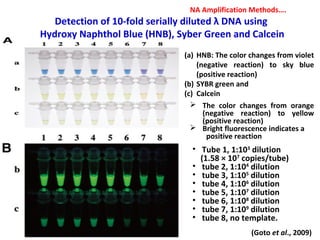
(a) HNB: The color changes from violet
(negative reaction) to sky blue
(positive reaction)
(b) SYBR green and
(c) Calcein
Detection of 10-fold serially diluted λ DNA using
Hydroxy Naphthol Blue (HNB), Syber Green and Calcein
(Goto et al., 2009)
 The color changes from orange
(negative reaction) to yellow
(positive reaction)
 Bright fluorescence indicates a
positive reaction
• Tube 1, 1:103
dilution
(1.58 × 10⁷
copies/tube)
• tube 2, 1:104
dilution
• tube 3, 1:105
dilution
• tube 4, 1:106
dilution
• tube 5, 1:107
dilution
• tube 6, 1:108
dilution
• tube 7, 1:109
dilution
• tube 8, no template.
NA Amplification Methods….
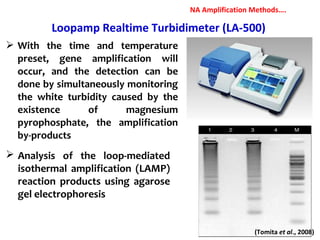
Loopamp Realtime Turbidimeter (LA-500)
 With the time and temperature
preset, gene amplification will
occur, and the detection can be
done by simultaneously monitoring
the white turbidity caused by the
existence of magnesium
pyrophosphate, the amplification
by-products
 Analysis of the loop-mediated
isothermal amplification (LAMP)
reaction products using agarose
gel electrophoresis
(Tomita et al., 2008)
NA Amplification Methods….
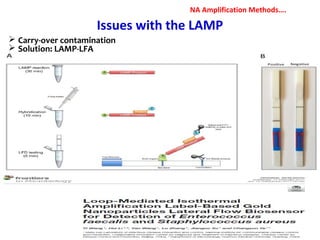
Issues with the LAMP
 Carry-over contamination
 Solution: LAMP-LFA
NA Amplification Methods….
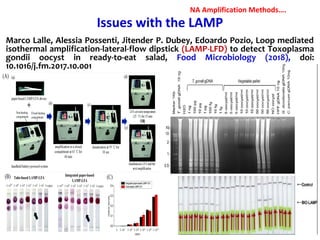
Marco Lalle, Alessia Possenti, Jitender P. Dubey, Edoardo Pozio, Loop mediated
isothermal amplification-lateral-flow dipstick (LAMP-LFD) to detect Toxoplasma
gondii oocyst in ready-to-eat salad, Food Microbiology (2018), doi:
10.1016/j.fm.2017.10.001
Issues with the LAMP
NA Amplification Methods….
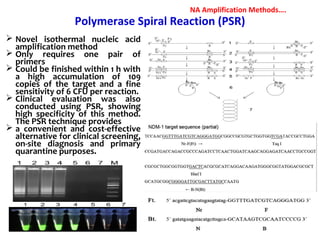
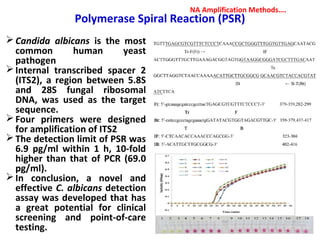
Polymerase Spiral Reaction (PSR)
 Novel isothermal nucleic acid
amplification method
 Only requires one pair of
primers
 Could be finished within 1 h with
a high accumulation of 109
copies of the target and a fine
sensitivity of 6 CFU per reaction.
 Clinical evaluation was also
conducted using PSR, showing
high specificity of this method.
The PSR technique provides
 a convenient and cost-effective
alternative for clinical screening,
on-site diagnosis and primary
quarantine purposes.
NA Amplification Methods….
Polymerase Spiral Reaction (PSR)
Candida albicans is the most
common human yeast
pathogen
Internal transcribed spacer 2
(ITS2), a region between 5.8S
and 28S fungal ribosomal
DNA, was used as the target
sequence.
Four primers were designed
for amplification of ITS2
The detection limit of PSR was
6.9 pg/ml within 1 h, 10-fold
higher than that of PCR (69.0
pg/ml).
In conclusion, a novel and
effective C. albicans detection
assay was developed that has
a great potential for clinical
screening and point-of-care
testing.
NA Amplification Methods….
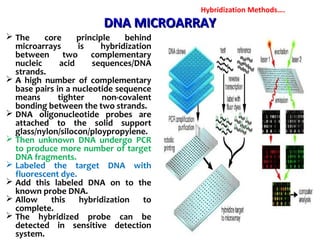
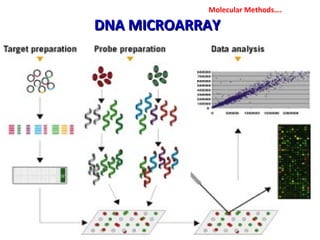
DNA MICROARRAYDNA MICROARRAY
 The core principle behind
microarrays is hybridization
between two complementary
nucleic acid sequences/DNA
strands.
 A high number of complementary
base pairs in a nucleotide sequence
means tighter non-covalent
bonding between the two strands.
 DNA oligonucleotide probes are
attached to the solid support
glass/nylon/silocon/ploypropylene.
 Then unknown DNA undergo PCR
to produce more number of target
DNA fragments.
 Labeled the target DNA with
fluorescent dye.
 Add this labeled DNA on to the
known probe DNA.
 Allow this hybridization to
complete.
 The hybridized probe can be
detected in sensitive detection
system.
Hybridization Methods….
DNA MICROARRAYDNA MICROARRAY
Molecular Methods….
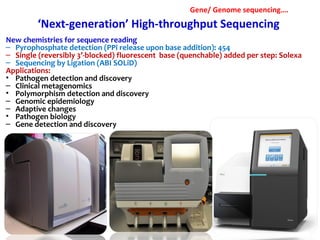
‘Next-generation’ High-throughput Sequencing
New chemistries for sequence reading
– Pyrophosphate detection (PPi release upon base addition): 454
– Single (reversibly 3’-blocked) fluorescent base (quenchable) added per step: Solexa
– Sequencing by Ligation (ABI SOLiD)
Applications:
• Pathogen detection and discovery
– Clinical metagenomics
• Polymorphism detection and discovery
– Genomic epidemiology
– Adaptive changes
• Pathogen biology
– Gene detection and discovery
Gene/ Genome sequencing….
Advantages:
• ~100x faster, ~100x cheaper than conventional approaches
• Clonal template populations obtained by new methods:
– amplification on solid phase to grow a ‘molecular colony’
– Massive increase in number of ‘clones’ but shorter read length
• Genome sequencing brings the advantages of
– open-endedness (revealing the “unknown unknowns”),
– universal applicability
– ultimate in resolution
• Bench-top sequencing platforms now generate data sufficiently
quickly and cheaply to have an impact on real-world clinical and
epidemiological problems
http://pathogenomics.bham.ac.uk/blog/2011/08/are-diagnostic-and-
public-health-bacteriology-ready-to-become-branches-of-genomic-
medicine/
Gene/ Genome sequencing….
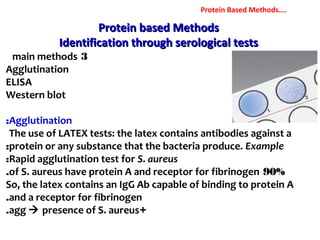
3main methods
Agglutination
ELISA
Western blot
Agglutination:
The use of LATEX tests: the latex contains antibodies against a
protein or any substance that the bacteria produce. Example:
Rapid agglutination test for S. aureus:
90%of S. aureus have protein A and receptor for fibrinogen.
So, the latex contains an IgG Ab capable of binding to protein A
and a receptor for fibrinogen.
+agg  presence of S. aureus.
Protein based MethodsProtein based Methods
Identification through serological testsIdentification through serological tests
Protein Based Methods….
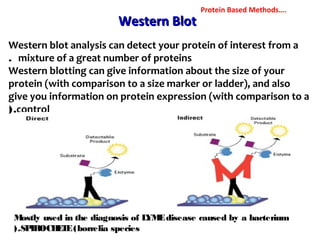
Western blot analysis can detect your protein of interest from a
mixture of a great number of proteins. 
Western blotting can give information about the size of your
protein (with comparison to a size marker or ladder), and also
give you information on protein expression (with comparison to a
control(.
Mostly used in the diagnosis of LYMEdisease caused by a bacterium
SPIROCHETE(borrelia species(.
Western BlotWestern Blot
Protein Based Methods….
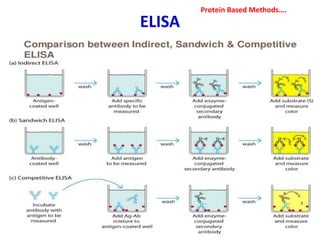
ELISA
Protein Based Methods….
Methods to enhance sensitivity
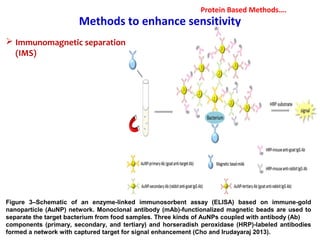
 Immunomagnetic separation
(IMS)
Figure 3–Schematic of an enzyme-linked immunosorbent assay (ELISA) based on immune-gold
nanoparticle (AuNP) network. Monoclonal antibody (mAb)-functionalized magnetic beads are used to
separate the target bacterium from food samples. Three kinds of AuNPs coupled with antibody (Ab)
components (primary, secondary, and tertiary) and horseradish peroxidase (HRP)-labeled antibodies
formed a network with captured target for signal enhancement (Cho and Irudayaraj 2013).
Protein Based Methods….
Automated systems for Food Pathogen Detection
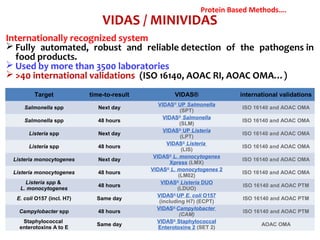
VIDAS / MINIVIDAS: PATHOGEN DETECTION
 The VIDAS® test system uses a single-dose, ready-
to-use reagent strip system
 The SPR® (Solid Phase Receptacle) is coated with
antibodies, antigens and/or phage proteins.
 The Strip contains all the reagents required for
the reaction.
 The SPR acts as a pipetting and reagent transfer
device. At each stage of the reaction, it aspirates
the reagents in and out. This original concept
prevents any inter-reagent or inter-sample
contamination. In addition, the absence of
tubing, syringes and needles reduces system
maintenance to a minimum.
 The VIDAS system uses the ELFA assay principle,
combining the ELISA test method with a final
fluorescent reading. This technology ensures
excellent result sensitivity and specificity.
USES
 For Food Quality Control
 For Personal Care Testing
Protein Based Methods….
VIDAS / MINIVIDAS
Internationally recognized system
 Fully automated, robust and reliable detection of the pathogens in
food products.
 Used by more than 3500 laboratories
 >40 international validations (ISO 16140, AOAC RI, AOAC OMA…)
Target time-to-result VIDAS® international validations
Salmonella spp Next day
VIDAS®
UP Salmonella
(SPT)
ISO 16140 and AOAC OMA
Salmonella spp 48 hours
VIDAS®
Salmonella
(SLM)
ISO 16140 and AOAC OMA
Listeria spp Next day
VIDAS®
UP Listeria
(LPT)
ISO 16140 and AOAC OMA
Listeria spp 48 hours
VIDAS®
Listeria 
(LIS)
ISO 16140 and AOAC OMA
Listeria monocytogenes Next day
VIDAS®
L. monocytogenes
Xpress (LMX)
ISO 16140 and AOAC OMA
Listeria monocytogenes 48 hours
VIDAS®
L. monocytogenes 2
(LM02)
ISO 16140 and AOAC OMA
Listeria spp &
L. monocytogenes
48 hours
VIDAS®
Listeria DUO
(LDUO)
ISO 16140 and AOAC PTM
E. coli O157 (incl. H7) Same day
VIDAS®
UP E. coli O157
(including H7) (ECPT)
ISO 16140 and AOAC PTM
Campylobacter spp 48 hours
VIDAS®
Campylobacter 
(CAM)
ISO 16140 and AOAC PTM
Staphylococcal
enterotoxins A to E
Same day
VIDAS®
Staphylococcal
Enterotoxins 2 (SET 2)
AOAC OMA
Protein Based Methods….
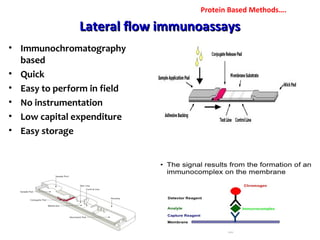
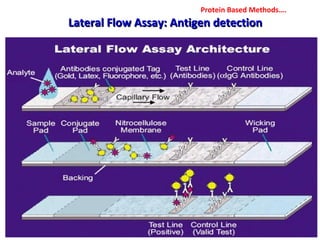
Lateral flow immunoassaysLateral flow immunoassays
• Immunochromatography
based
• Quick
• Easy to perform in field
• No instrumentation
• Low capital expenditure
• Easy storage
Protein Based Methods….
Lateral Flow Assay: Antigen detectionLateral Flow Assay: Antigen detection
Protein Based Methods….
Lateral Flow Assays for Toxins - Aflatoxins
 Aflatoxins are highly toxic and carcinogenic metabolites. The most toxic and
diffuse is the aflatoxin B1 (AFB1), classified as a GROUP I CARCINOGEN by the
International Agency for Research on Cancer (IARC).
 AFB1 contamination affect a variety of crops, including cereals used as feed.
 Once ingested, it is rapidly absorbed and transformed into a hydroxylated
metabolite named aflatoxin M1 (AFM1), which is secreted into the milk.
 The hepatotoxicity and carcinogenic effects of aflatoxin M1 have also been
demonstrated.
 Levels of aflatoxin M1 in milk, which varies from 50 ng L−1 established by the
EU to the 500 ng L−1 established by US FDA. In addition, the European Union
have set up maximum permissible levels of 25 ng L−1 for baby food.
 A high sensitive immunoassay-based lateral flow device for Ultra-sensitive
assessment of AFM1 contamination at nanograms per litre level (LOD 20 ng
L−1
Molecular Methods….
Molecular Methods….
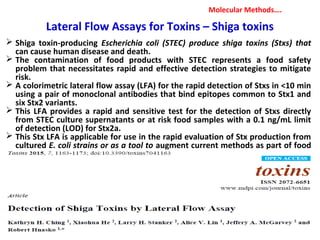
 Shiga toxin-producing Escherichia coli (STEC) produce shiga toxins (Stxs) that
can cause human disease and death.
 The contamination of food products with STEC represents a food safety
problem that necessitates rapid and effective detection strategies to mitigate
risk.
 A colorimetric lateral flow assay (LFA) for the rapid detection of Stxs in <10 min
using a pair of monoclonal antibodies that bind epitopes common to Stx1 and
six Stx2 variants.
 This LFA provides a rapid and sensitive test for the detection of Stxs directly
from STEC culture supernatants or at risk food samples with a 0.1 ng/mL limit
of detection (LOD) for Stx2a.
 This Stx LFA is applicable for use in the rapid evaluation of Stx production from
cultured E. coli strains or as a tool to augment current methods as part of food
safety testing.
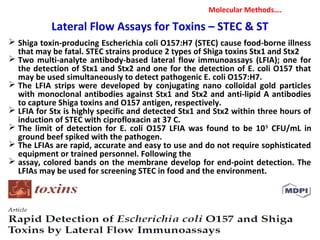
Lateral Flow Assays for Toxins – Shiga toxins
 Shiga toxin-producing Escherichia coli O157:H7 (STEC) cause food-borne illness
that may be fatal. STEC strains produce 2 types of Shiga toxins Stx1 and Stx2
 Two multi-analyte antibody-based lateral flow immunoassays (LFIA); one for
the detection of Stx1 and Stx2 and one for the detection of E. coli O157 that
may be used simultaneously to detect pathogenic E. coli O157:H7.
 The LFIA strips were developed by conjugating nano colloidal gold particles
with monoclonal antibodies against Stx1 and Stx2 and anti-lipid A antibodies
to capture Shiga toxins and O157 antigen, respectively.
 LFIA for Stx is highly specific and detected Stx1 and Stx2 within three hours of
induction of STEC with ciprofloxacin at 37 C.
 The limit of detection for E. coli O157 LFIA was found to be 105
CFU/mL in
ground beef spiked with the pathogen.
 The LFIAs are rapid, accurate and easy to use and do not require sophisticated
equipment or trained personnel. Following the
 assay, colored bands on the membrane develop for end-point detection. The
LFIAs may be used for screening STEC in food and the environment.
Molecular Methods….
Lateral Flow Assays for Toxins – STEC & ST
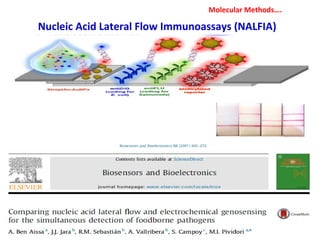
Nucleic Acid Lateral Flow Immunoassays (NALFIA)
Molecular Methods….
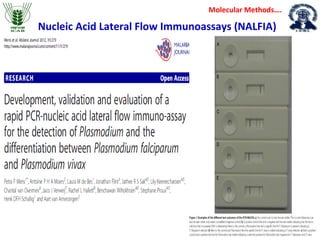
Nucleic Acid Lateral Flow Immunoassays (NALFIA)
Molecular Methods….
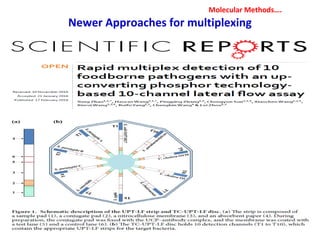
Newer Approaches for multiplexing
Molecular Methods….
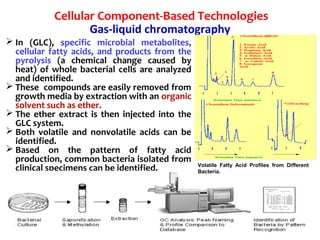
Gas-liquid chromatography
 In (GLC), specific microbial metabolites,
cellular fatty acids, and products from the
pyrolysis (a chemical change caused by
heat) of whole bacterial cells are analyzed
and identified.
 These compounds are easily removed from
growth media by extraction with an organic
solvent such as ether.
 The ether extract is then injected into the
GLC system.
 Both volatile and nonvolatile acids can be
identified.
 Based on the pattern of fatty acid
production, common bacteria isolated from
clinical specimens can be identified. Volatile Fatty Acid Profiles from Different
Bacteria.
Cellular Component-Based Technologies
FAME
 FAME stand for Fatty Acid Methyl Ester.
 FAME is produced by transesterification.
 In transesterification, a glyceride reacts with an alcohol in the
presence of a catalyst, forming a mixture of fatty acids esters and an
alcohol.
 This is widely used in characterizing new species of bacteria, and is
useful for identifying pathogenic strains.
 Organisms have different, Quality and Quantity of Fatty Acid
 Gas chromatography (GC) used due to the volatility and thermal
stability of the FAME.
Cellular Component-Based Technologies…
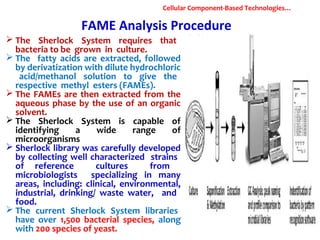
FAME Analysis Procedure
 The Sherlock System requires that
bacteria to be grown in culture.
 The fatty acids are extracted, followed
by derivatization with dilute hydrochloric
acid/methanol solution to give the
respective methyl esters (FAMEs).
 The FAMEs are then extracted from the
aqueous phase by the use of an organic
solvent.
 The Sherlock System is capable of
identifying a wide range of
microorganisms
 Sherlock library was carefully developed
by collecting well characterized strains
of reference cultures from
microbiologists specializing in many
areas, including: clinical, environmental,
industrial, drinking/ waste water, and
food.
 The current Sherlock System libraries
have over 1,500 bacterial species, along
with 200 species of yeast.
Cellular Component-Based Technologies…
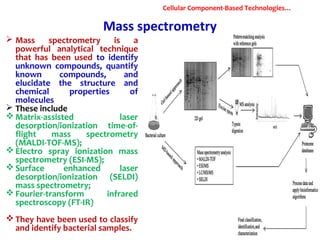
Mass spectrometry
 Mass spectrometry is a
powerful analytical technique
that has been used to identify
unknown compounds, quantify
known compounds, and
elucidate the structure and
chemical properties of
molecules
 These include
 Matrix-assisted laser
desorption/ionization time-of-
flight mass spectrometry
(MALDI-TOF-MS);
 Electro spray ionization mass
spectrometry (ESI-MS);
 Surface enhanced laser
desorption/ionization (SELDI)
mass spectrometry;
 Fourier-transform infrared
spectroscopy (FT-IR)
 They have been used to classify
and identify bacterial samples.
Cellular Component-Based Technologies…
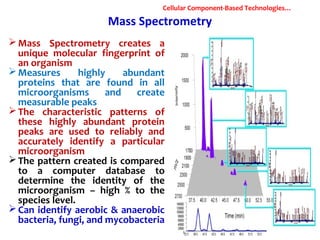
Mass Spectrometry
Mass Spectrometry creates a
unique molecular fingerprint of
an organism
Measures highly abundant
proteins that are found in all
microorganisms and create
measurable peaks
The characteristic patterns of
these highly abundant protein
peaks are used to reliably and
accurately identify a particular
microorganism
The pattern created is compared
to a computer database to
determine the identity of the
microorganism – high % to the
species level.
Can identify aerobic & anaerobic
bacteria, fungi, and mycobacteria
Cellular Component-Based Technologies…
Matrix-assisted laser desorption/ionization
Time-of-Flight Mass Spectrometry
(MALDI-TOF-MS)
Most commonly used mass spectral method for bacterial analysis
because
 It can be used to analyze whole bacterial cells directly;
 It can produce relatively simple, reproducible spectra patterns
over a broad mass range;
 The spectra patterns contain characteristic information that can
be used to identify and characterize bacterial species by
comparing the spectra fingerprints of the unknown species with
known library fingerprints;
 A number of known, taxonomically important protein markers
can be used directly for identifying bacterial species.
Cellular Component-Based Technologies…
MALDI-TOF Testing Performance
 Requires only 1 colony of bacteria or yeast
 Age of colony can be 18 hr – 3 days old
 No need to Gram stain – MALDI does not determine results by
Gram stain reaction
 Smear organism on one circle of target plate
 Add one drop of matrix solution (alpha cyano 4
hydroxycinnamnic acid) onto each circle
 Dry at room temp
 Place target plate in the MALDI instrument
Cellular Component-Based Technologies…
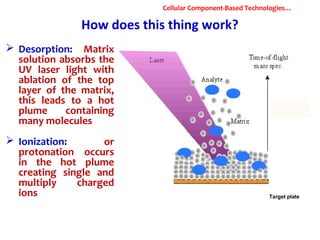
How does this thing work?
Target plate
 Desorption: Matrix
solution absorbs the
UV laser light with
ablation of the top
layer of the matrix,
this leads to a hot
plume containing
many molecules
 Ionization: or
protonation occurs
in the hot plume
creating single and
multiply charged
ions
Cellular Component-Based Technologies…
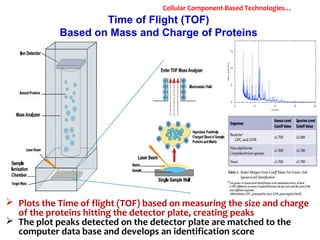
Time of Flight (TOF)
Based on Mass and Charge of Proteins
 Plots the Time of flight (TOF) based on measuring the size and charge
of the proteins hitting the detector plate, creating peaks
 The plot peaks detected on the detector plate are matched to the
computer data base and develops an identification score
Cellular Component-Based Technologies…
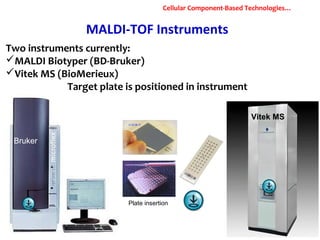
MALDI-TOF Instruments
Two instruments currently:
MALDI Biotyper (BD-Bruker)
Vitek MS (BioMerieux)
Target plate is positioned in instrument
Plate insertion
Bruker
Vitek MS
Cellular Component-Based Technologies…
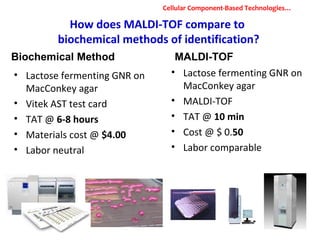
How does MALDI-TOF compare to
biochemical methods of identification?
• Lactose fermenting GNR on
MacConkey agar
• Vitek AST test card
• TAT @ 6-8 hours
• Materials cost @ $4.00
• Labor neutral
• Lactose fermenting GNR on
MacConkey agar
• MALDI-TOF
• TAT @ 10 min
• Cost @ $ 0.50
• Labor comparable
Biochemical Method MALDI-TOF
Cellular Component-Based Technologies…
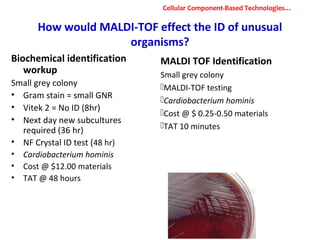
How would MALDI-TOF effect the ID of unusual
organisms?
Biochemical identification
workup
Small grey colony
• Gram stain = small GNR
• Vitek 2 = No ID (8hr)
• Next day new subcultures
required (36 hr)
• NF Crystal ID test (48 hr)
• Cardiobacterium hominis
• Cost @ $12.00 materials
• TAT @ 48 hours
MALDI TOF Identification
Small grey colony
MALDI-TOF testing
Cardiobacterium hominis
Cost @ $ 0.25-0.50 materials
TAT 10 minutes
Cellular Component-Based Technologies…
Is MALDI perfect?
No! But it is very good!
The purchase price of the instrument is HIGH but very little
expense in specimen testing
Few inexpensive consumables (pipette tips, chemicals)
Disposable target plates (Vitek MS only)
Maintenance agreement
Still need growth on plated media for organism identification (18
hr delay) – large enough colonies to spot onto target plate
The data base spans most disciplines of microbiology – so you do
not need other instruments or kits to identify unusual organisms.
Simplifies inventory and ordering of testing supplies.
Cellular Component-Based Technologies…
MALDI-TOF
Strengths
• Cost effective – low consumable costs
• Green
• Rapid turnaround time and high throughput
• Easy to perform/ instrument requires virtually no maintenance
• Automated, inter-laboratory reproducibility
• Single colony requirement
• Low exposure risk – due to sample inactivation
• Identifies aerobic and anaerobic bacteria, fungi, and Mycobacteria
Limitations
• Still need growth on plated media for organism identification (18 hr
delay)
• No susceptibility information
• No current protocols for direct testing of clinical specimens
• Sometimes need repeat analyses
• Databases need to be updated/maintained
• Financial loss on purchased equipment
• Equipment cost can limit laboratory purchase
• Potential instrument downtime (single instrument owned by
laboratory due to cost)
Cellular Component-Based Technologies…
The global in-vitro diagnostics (IVD) market was valued at $44
billion ($ 4400 Crore= Rs. 272800 Crore) in 2011 and is expected
to have a modest growth.
Increased patient awareness, patient self testing, rapidly aging
population globally and automated testing due to technical
advances are the major growth drivers of this market.
IVD market include Clinical Chemistry, Molecular diagnostics,
Immunoassays, Hematology and Microbiology.
Clinical chemistry dominates global IVD market while molecular
diagnostics is expected to register the highest growth.
The U.S. represented the biggest market for IVD equipments
accounting for about a half of the total market.
The molecular methods are a promising alternative that can
substitute or complement the current reference methods used.
Sample preparation problem, contamination, entrenched
attitude slow but cannot stop adoption of the molecular
method of diagnosis.
Thanks
Acknowledgement: All the material/presentations available online on the subject
are duly acknowledged.
Disclaimer: The author bear no responsibility with regard to the source and
authenticity of the content.
Questions???

Rapid pathogen detection methods

  • 1.
    Molecular techniques forquality control of meat and meat products Dr Ravi Kant Agrawal, MVSc, PhD Senior Scientist (Veterinary Microbiology) Food Microbiology Laboratory Division of Livestock Products Technology ICAR-Indian Veterinary Research Institute Izatnagar 243122 (UP) India
  • 2.
     India- Immenselivestock wealth: World’s largest livestock population of 512.06 million - 214 million cattle, 115.42 million buffaloes, 75.5 million sheep, 162 million goats, 9.5 million pigs and 950 million poultry (FAO, 2014).  Total meat production in India: 6.29 million tonnes (FAO, 2014).  India Rank 5th in meat production  Contributes ~ 30% to Agricultural GDP (2014-15), 4.18% to total GDP (DAHD&F, 2012).  Meat- 4.4% of total output from livestock sector (Central survey organization)  Export of Livestock Products: Rs. 32,593 crore (5.01 billion USD) – 1.4% of World share (APEDA, 2015)  Meat & Meat Products: >90% of livestock export vol  >30% of meat products- exported  Buffalo Meat: top agri-export (4.8 billion USD)  Milk production- 137.7 MT  Rank No. 1 in milk production Animal Products: Milk and MeatAnimal Products: Milk and Meat
  • 3.
    Food SafetyFood Safety Food safety has emerged as an important global issue due to international trade and public health implications.  Despite advances in hygiene, consumer knowledge, food treatment and processing, FBDs still represent a significant threat to public health, worldwide.  The term FBDs covers illnesses acquired through consumption of contaminated food.  FBDs - caused by bacteria and bacterial toxins, viruses, zoonotic parasites, fungi and fungal toxins, pesticide residues, heavy metals, drug residues, food adulterants, food additives etc.  In response to the increasing number of food borne illnesses, governments all over the world are intensifying their efforts to improve food safety.
  • 4.
    Importance of FoodSafetyImportance of Food Safety  Due to widespread poverty and malnutrition in developing countries, programs directed towards the promotion of adequate access to food that satisfy calorie needs and minimize hunger have precedence over programs designed to ensure wholesomeness and quality of food. In short, the emphasis so far has been more on food adequacy rather than on food quality.  Therefore, the World Health Assembly adopted a resolution (WHA 53.15) in which, the World Health Organization (WHO) was asked “to give greater emphasis on food safety.
  • 5.
    Food Quality AttributesFoodQuality Attributes Sensory Attributes Sensory Attributes Nutritional Attributes Nutritional Attributes Color Appearance Texture Chemical Analysis Physiology Microbial quality Additives Adulteration Residues Hygienic Attributes and Legal Issues Hygienic Attributes and Legal Issues Packaging Aroma WHC Proximate Connective tissue Processing Attributes Processing Attributes
  • 6.
    Challenges in QualityControl of FoodChallenges in Quality Control of Food 1. Emerging Microbiological threats 2. Emerging Chemical Threats 3. Adulteration Threats 4. Physical Threats
  • 7.
    Challenges inChallenges inMicrobiological Food SafetyMicrobiological Food Safety Growing international trade, migration and travel - increased the spread of dangerous pathogens and contaminants in food. Due to globalization of food marketing and distribution - both accidentally or deliberately contaminated food can affect health of people in many countries at the same time. In today’s interconnected and interdependent world - local FBD outbreaks may become a potential threat to the entire globe. In 1991, cholera which was thought to have originated from contaminated seafood harvested off the coast of Peru, rapidly spread across Latin America resulting in approximately 400,000 reported cases and more than 4000 deaths in several countries.
  • 8.
    Importance of MicrobiologicalFood SafetyImportance of Microbiological Food Safety The identification of one single contaminated food ingredient can lead to the recall of tonnes of food products leading to considerable economic losses in production and from trade embargoes, as well as damage to the tourist industry. In early 2008, an outbreak of avian influenza in Bangalore, India, led to an import ban of Indian poultry products in the Middle East, resulting in losses totaling hundreds of thousands of US Dollars to the Indian economy.
  • 9.
    Microbiological Quality AssuranceMicrobiologicalQuality Assurance Total Microbial Load – in limits (ENUMERATION METHODS) Free from specific pathogen or their toxins (PATHOGEN/ TOXIN DETECTION METHODS)
  • 10.
    Traditional Vs MolecularMethods Traditional methods - pose several challenges Growth of fastidious pathogens - Delay in cultivation - takes more time Non-culturability of certain organisms Maintenance of viability Hazardous to propagate in laboratory Technical Expertise & Cost Molecular methods The biological technique in which macromolecules like nucleic acid and proteins are used - known as Molecular Technique. Faster and simpler Increased sensitivity and specificity. Better adapted to instrumentation-Decrease need for manpower. Identification of epidemiologically important strains.
  • 11.
    Recent Research FocusRecentResearch Focus Rapid MethodsRapid Methods Quantification of microbial load Detection of Foodborne pathogens and their toxins Species Identification Intelligent packaging applications Residue Analysis: Pesticide residues, veterinary drug residues, heavy metals, Food Additives, Contaminants
  • 12.
    Rapid Methods ATP Bioluminescence Directepifluorescent filter technique (DEFT) Electrical impedance Traditional methods Plate counts Membrane filtration Dye reduction tests Direct microscopic count Most probable number 12 Methods for EnumerationMethods for Enumeration
  • 13.
    13 Plate count methodPlatecount method Pour plate Spread plate Drop plate Traditional methods……Traditional methods……
  • 14.
    Membrane FiltrationMembrane Filtration 0.45μmLiquid food Low number of MO. Large volume of food Traditional methods……Traditional methods……
  • 15.
    Dye-reduction testDye-reduction test Methyleneblue Leuco-methylene blue Resazurin (blue) Resorufin (pink) Dihydroresofin (leuco)Triphenyltetrazolium chloride (leuco) Formazan (red) Traditional methods……Traditional methods……
  • 16.
    ATP photometryATP photometry ReleaseATP from bacteria cell Addition of luciferin & luciferasee Record light emission (ATP photometry) Break down the non-microbial cells in food Remove non-microbial ATP using ATPase Applications: Fresh meat, Milk, Starter culture, Test UHT milk, Surface contamination Luciferin + luciferase + ATP + O2 Oxyluciferin + luciferase + AMP + light Mg2+ 1 ATP light 1photon Bacteria cell - 1 fg of ATP Yeast cell - 100 fg of ATP •Limit of ATP photometry 102 -103 fg ATP/ml Rapid Methods…..Rapid Methods….. Disadvantage Mixed bacteria & yeast cell
  • 17.
    Direct Epifluorescent FilterTechnique (DEFT)Direct Epifluorescent Filter Technique (DEFT) Liquid food Filter through membrane Acridine orange : fluorescent dye (fluorochrome) pour through filter Epifluorescent microscopy Count: manual or automatic Acridine orange binds to: RNA --- fluorescent orange DNA --- fluorescent green Viable cell RNA > DNA --- orange Non-viable cell DNA > RNA ---green RNA DNA Non-viable Viable Rapid Methods…..Rapid Methods…..
  • 18.
    Electrical impedance methodElectricalimpedance method  Impedance: Resistance  Bacteria growth ----decrease impedance ----increase conductivity Conductance Time DT Detection time 106 -107 cells/ml Bactometer Rapid Methods…..Rapid Methods…..
  • 19.
    Pathogen Detection: Conventional ConventionalMethods – Culture/ isolation – Macroscopic Morphology – Microscopic Morphology – Biochemical testing – Serological typing
  • 20.
    Pathogen Detection: RapidMethods Pathogen Detection…. 1. Automated Growth-Based Technologies  Measurement of biochemical or physiological parameters that reflect growth of microorganisms; include: Colorimetric detection of CO2 production: BACTEC (BD); BacT/Alert (bioMerieux)  Simplest, use classical method for processing sample, then detect colorimetric change to spot growth earlier than visual detection e.g. VITEK (bioMerieux), Phoenix (BD) 2. Molecular Methods/ Technologies  Polymerase chain reaction and other nucleic acid amplification technologies (NAATs)  DNA probes: Gene-Trak; Gene-Probe  Molecular typing  Sequencing including NGS technology 3. Cellular Component-Based Technologies  Detection of a specific cellular component: Fatty acid profiles Mass spectrometry
  • 21.
    Rapid Diagnostics?? Rapid DiagnosticTest: A rapid diagnostic test (RDT) is a diagnostic test that is quick and easy to perform. They provide same-day results within two hours, typically in approximately 20 minutes (WHO, 2014; CDC, 2014). WHO recommends that an ideal diagnostic test suitable for developing, underdeveloped and undeveloped countries should be “ASSURED” ☻Affordable ☻ Sensitive ☻ Specific ☻ User-friendly ☻ Robust and rapid ☻ Equipment free ☻Deliverable to the end user (Mabey et al.,2004)
  • 22.
    Blood Culture Automation •ABCS are blood culture system that uses instrumental devices to incubate, agitate, and/or monitor culture bottles for microbial growth. • Use advanced culture media and better detection time. • Suppliers: BacT/Alert or BacT/Alert 3D (BioMerieux), BACTEC or BACTEC FX (BD), Versa TREK. • Various readymade media bottles available - High enriched media • Aerobic, anaerobic, mycobacteria, paediatric, fastidious, Brucella- Specialized media • Barcode and colour code Automated Growth-Based Technologies….
  • 23.
    Principle • BacT/Alert andBACTEC System utilizes a colorimetric sensor and reflected light to monitor the presence and production of CO2 dissolved in the culture medium. • If MOs are present in the test sample, CO2 is produced as MOs metabolize substrates in culture medium. • When growth of the MOs produces CO2, the color of the gas-permeable sensor installed in the bottom of culture bottle changes from grey to yellow. • The lighter color results in an increase of reflectance monitored by the system. • Bottle reflectance is monitored and recorded by the instrument every 10 minutes. • Alarm • Then do a sub culture from bottle and identify organism BACTEC BacT/Alert Growth-Based Technologies….
  • 24.
    Why choosing BACT/ALERT®3D ? The BACT/ALERT is a simple, automated rapid microbial detection system capable of detecting bacterial, yeast and mold contamination in a variety of food and beverage. Ease of use, objective results, reproducibility and traceability are key characteristics. From increased productivity in the lab to reducing product quarantine time, BACT/ALERT has value to many parts of the food manufacturing organization. Simple, standardized workflow, Reduced hands-on time and labor costs, Reduced inventory holding costs, Objective results for even viscous/cloudy samples, Robust detection bacteria, yeasts and molds Non-destructive method Compatible with low and high acid food and beverage products
  • 25.
    VersaTREK principle VersaTREK usea special media – redox medium (REDOX 1® and REDOX 2® bottles) Only two formulations, VersaTREK REDOX 1 aerobic and VersaTREK REDOX 2 anaerobic bottles, are needed to support the growth of a wide range of organisms. If organism grow, gas either produced or utilized. The instrument monitor gas production or gas consumption in the medium by a special electrode. Growth-Based Technologies….
  • 26.
    CHEMUNEX Unique Proven Technology CHEMUNEX®Cell Labeling Technology ensures that all viable microorganisms including those growing in conditions of stress such environmentally stressed, nutrient-depleted or in presence of growth inhibitors are labeled. Automated, sensitive and rapid, CHEMUNEX® analyzers perform direct labeling and detection of MOs, cell by cell. Universal labeling of viable bacteria, yeasts and molds Objective Yes/No results require no interpretation Generate results within minutes after 24 hours (50h for molds) ​Full validation support available
  • 27.
    VITEK® (BioMerieux)  The VITEKis a completely automated instrument that offers rapid results (average 2-6 hour same-day turnaround).  It is used for bacterial and yeast identification, antimicrobial susceptibility testing and has a complete Data Management System.  Colony need to be isolated first  Isolates are subcultured to TSA  A smear is prepared from TSA plates for Gram Stain  Perform preliminary testing (catalase, oxidase, microdase, coagulase, etc.)  Set-up appropriate VITEK Card  Insert Card into VITEK Incubator/Reader  Come back to read the report VITEK® (BioMerieux) cards  GN ID Card (21341)- Gram negative bacterial identification  GP ID Card (21342)- Gram positive bacterial identification  YST ID Card (21343)- Yeast identification  NH ID Card (21346)- Neisseria, Haemophilus and other fastidious Gram negative bacteria identification  ANC ID Card (21347)- Anaerobic bacteria and coryneform bacteria identification Pathogen Detection-Rapid Methods Growth-Based Technologies….
  • 28.
    Rapid identification systemwith AST  Detection, enumeration, and identification of bacteria and yeasts in specimens.  The biological basis for the system resides in lyophilized, highly selective and specific media enclosed in wells of a disposable plastic curette, or a cartridge.  Introduction of a suitable specimen rehydrates and inoculates the media in the wells.  An automated optical system monitors, and the computer interprets, changes in the media, with enumeration and identification results automatically.  Suppliers 1. Microscan Walkaway (Dade Behring) 2. Vitek2 (BioMerieux) 3. Phoenix (BD) Growth-Based Technologies…. Antibiotic Susceptibility Testing (AST)  Gram positive antimicrobial susceptibility testing (AST) cards  Gram negative antimicrobial susceptibility testing (AST) cards  Yeast antimicrobial susceptibility testing (AST) card
  • 29.
    Phoenix BD Phoenix BD BDPhoenix™- automated identification and susceptibility testing system Offers rapid, accurate and reliable identification and susceptibility results. These capabilities are due to the incorporation of an oxidation-reduction indicator with turbidity measurement for growth detection Full on-panel antimicrobial concentrations and the BDXpert system for data analysis. Specific delayed resistance features provide assurance that BD Phoenix system results are not only rapid but also accurate. BD Phoenix™ NID panel BD Phoenix™ PID panel BD Phoenix™ yeast ID panel Growth-Based Technologies….
  • 30.
    API (bioMérieux) • Thewell-established method for manual microorganism identification to the species level. • API identification products are test kits for identification of Gram positive and Gram negative bacteria and yeast. • During incubation, metabolism produces color changes that are either spontaneous or revealed by the addition of reagents. • The reactions are read according to the Reading Table and the identification is obtained by referring to the Analytical Profile Index or using the identification software. • The system offers a large and robust database now accessible through the Internet-based APIWEB™ service. Growth-Based Technologies….
  • 31.
    API for productsafety applications API Gram negative Identification  API 20E – Species/subspecies identification of Enterobacteriaceae and group/species identification of non-fermenting Gram -ve bacteria  API Rapid 20E – 4 h identification of Enterobacteriaceae  API 20NE – 24 – 48h identification of Gram -ve non-Enterobacteriaceae  API Campy – 24-hour identification of Campylobacter species API Gram positive Identification  API Staph – Overnight identification of clinical staphylococci and micrococci  API 20 Strep – 4 or 24-hour identification of streptococci and enterococci  API Coryne – 24-hour identification of Corynebacteria and coryne-like organisms  API Listeria – 24-hour identification of all Listeria species API Anaerobe Identification  API 20A – 24-hour identification of anaerobes  Rapid ID 32 A – 4-hour identification of anaerobes API Yeast Identification  API 20C AUX – 48 to 72-hour identification of yeasts  ID 32 C – 24-hour identification of yeasts
  • 32.
    Molecular Methods Protein basedmethods Nucleic acid based methods . Hybridization assay •Nucleic acid probes & hybridization •DNA microarray Amplification assays • Polymerase chain reaction • Real Time PCR • LAMP • Polymerase Spiral Reaction • Ligase Chain Reaction • NASBA • SDA • RAPD • RFLP • Western Blot • DOT Blot • ELISA • Lateral Blow Assays • Gene/ Genome sequencing
  • 33.
    WHY NA AMPLIFICATIONASSAYS (NAATs)?  If sufficient target nucleic acid is not present in the reaction, hybridization can give false negative results.  To circumvent this, nucleic acid amplification is used  How to amplify the nucleic acid?  By allowing repeated replication of target nucleic acid by the specific primer. Nucleic Acid Based Mthods NA Amplification Methods….
  • 34.
    POLYMERASE CHAIN REACTION(PCR) •Combines the principles of complementary nucleic acid hybridization with those of nucleic acid replication that are applied repeatedly through numerous cycles for generation thousands to millions copies of a particular DNA sequence. • The method relies on thermal cycling, consisting of cycles of repeated heating and cooling of the reaction for DNA melting and enzymatic replication of the DNA. NA Amplification Methods….
  • 35.
    PCR REQUIREMENT  DNAtemplate that contains the DNA region (target) to be amplified.  Primers that are complementary to the 3' (three prime) ends of each of the sense and anti-sense strand of the DNA target.  Taq polymerase or other DNA polymerase with a temperature optimum at around 70 °C.  Deoxynucleotide the building blocks from which the DNA polymerases synthesizes a new DNA strand.  Buffer solution, providing a suitable chemical environment for optimum activity and stability of the DNA polymerase.  Divalent cations, magnesium or manganese ions  Monovalent cation potassium ions.  To maintain continuous reaction cycles, programmable thermal cyclers are used Basic steps: Denaturation of the target (dsDNA) Annealing of primers Extension of primer-target Duplex Detection of PCR products Visualization and Recording of results NA Amplification Methods….
  • 36.
    DENATURATION OF NUCLEICACID  Target nucleic acid is added to the reaction mix that contains all necessary components of PCR to occur (primers, covalent ions, buffers, enzymes etc)  Denaturation of dsDNA to a single strand is accomplished by heating to 94 C.  Primers are short single sequences of nucleotides (18-24 nucleotides)  Selected specifically to flank the target sequence of interest.  When the primer pair is mixed with the denatured target DNA, one primer anneals to a specific site at 3’ end of the target strand, while the other primer anneals to a specific site at the 3’ end of the other, complementary target strand  Once the duplexes are formed (40-60c), the last step in cycle which mimics the DNA replication process, begins PRIMER ANNEALING NA Amplification Methods….
  • 37.
     TAQ POLYMERASEis the enzyme commonly used for primer extension, which occurs at 720 C.  It can function efficiently at elevated temperature & withstand the denaturing temperature of 94 C through several cycles.  Annealing of primers to target sequence provides the necessary template format that allows DNA polymerase to add nucleotides to 3’ end of each primer & produce by extension a sequence complementary to target sequence.  For each target sequence originally present in the PCR mixture, 2 double stranded fragments containing the target sequence are produced after one cycle  At the beginning of the second cycle of PCR, denaturation then produces 4 templates to which the primers will anneal.  Following extension at the end of the second cycle, there will be 4 double stranded fragments containing target nucleic acid  After 30 to 40 cycles, 107 to 108 target copies will be present in the reaction mixture EXTENSION OF PRIMER NA Amplification Methods….
  • 38.
  • 39.
    POLYMERASE CHAIN REACTION(PCR) Sequentialrounds NA Amplification Methods….
  • 40.
    Post-PCR analysis -GEL ELECTROPHORESIS NA Amplification Methods….
  • 41.
    Internal Amplification Controls??? Campylobacterjejuni IAC - 685bp Product size- 589bp E. coli VTEC IAC- 685bp Product size- 450bp 685bp 450bp 685bp 589bp NA Amplification Methods….
  • 42.
    New Introduction: PalmPCR  Palm PCR is a battery-powered, palm- size portable PCR machine.  Delivers amplification with high speed and sensitivity in a handheld format.  Its automated operation, simple protocol, and high efficiency - ideal for both indoor and outdoor applications.  Rechargeable Li battery - 4 hours.  Also operated with an AC/DC adapter.  Nearly all kinds of DNA samples, including human genomic DNA of ≤ 0.1 ng, can be amplified within 30 minutes for up to 1 kbp amplicon.  Small amplicons of up to 400 bp can be amplified in as little as 18 minutes with extreme sensitivity down below 10 copies.  The dynamic range can be extended to up to 2 kbp using slow protocols. NA Amplification Methods….
  • 43.
    Palm PCR PalmTaq High-SpeedPCR Kit (100 units) Part No: RK1010 Description: PCR kit consisting of 100 units of PalmTaq High-Speed DNA polymerase (20 μL), 5X HS buffer, dNTP mix and MgCl2 solution Advantage: Field application Disadvantage: Closed system NA Amplification Methods….
  • 44.
    Variations of PCR Multiplex PCR  Real Time PCR  Colony PCR  Reverse Transcriptase PCR  Nested PCR  Hot Start PCR  In Situ PCR  AFLP PCR  Inverse PCR  Asymmetric PCR  Long PCR  Long Accurate PCR  Allele specific PCR  Broad range PCR NA Amplification Methods….
  • 45.
    REAL TIME PCR Real-timePCR, also called Q-PCR/qPCR or kinetic PCR. RT PCR is used to amplify and simultaneously quantify targeted DNA. Its key feature is that the amplified DNA is detected as the reaction progresses in real time. Two different methods are used. Method -1:-Real-time PCR using double-stranded DNA dyes. • In addition to PCR mix dsDNA dyes such as SYBR Green I is added. • Dye will bind to dsDNA PCR products. Method -2:-Fluorescent reporter probe method • In addition to the all the PCR mix, Fluorescent probes are added. • During annealing stage, both probe and primers anneal to the DNA target. • As polymerization of a new DNA strand is started, either 5'-3- exonuclease degrades the probe or displaced the probe, physically separating the fluorescent reporter resulting in an increase in fluorescence. NA Amplification Methods….
  • 46.
    SYBR Green PCRAssay Advantages:  Stronger signal  Higher selectivity for dsDNA  Sequence independent  Higher stability  Lesser inhibitory for Taq  Higher resolution in melting curves  Less hazardous and mutagenicity Disadvantages: Binds to  Non specific PCR product  Primer dimer NA Amplification Methods….
  • 47.
     When intact,the fluorescence of the reporter is quenched due to its proximity to the quencher  Probe hybridizes to the target  dsDNA-specific 5'—>3' exonuclease activity of Taq or Tth cleaves off the reporter  Reporter is separated from the quencher. Fluorescent signal  Signal is proportional to the amount of amplified product in the sample Advantages  Highly fluorogenic  Easy PCR setup  Sequence-specific detection  Multiplexing Disadvantages  Expensive  Probe design and positioning challenging  Similar conditions for primers and probes  Elevated background (Quenching capacity)  Probe degraded: no end-point analysis TaqMan Probe NA Amplification Methods….
  • 48.
    Loop  Molecular Beaconsare hairpin structures composed of a 25–40 nucleotide base paired stem and a target specific nucleotide loop .  The loop consists of target specific nucleotide (probe) sequences (15–30 nt)  A fluorescent moiety (reporter) is attached to 5’ end and a quencher moiety is attached to 3’ end. The stem keeps both the moieties in close proximity so that fluorescence is quenched.  The probe denatures and the loop anneals to the target sequence of the amplicon  Separating the quencher from the fluorophore and thereby producing fluorescence which is proportional to the amplicons produced during PCR  MB is displaced not destroyed during amplification, because a DNA polymerase lacking 5' exonuclease activity is used. Stem Hairpin probes: Molecular beacons Denaturation Primer molecular Beacon annealing Extension 5’3’ Q 3’5’ 5’ 5’ 3’ 3’ 5’ 5’3’ 3’5’ 5’ 3’5’ 5’3’ 5’ 5’ 5’ QR 5’ Denaturation NA Amplification Methods….
  • 49.
    Molecular beacons Advantages  Highspecificity, low background  PCR multiplex  Post PCR analysis  Allelic discrimination (greater specificity than linear probes) Disadvantages  Challenging design  Long probes – less yield  Intramolecular competitive binding  Low signal levels (proximity of reporter and quencher) NA Amplification Methods….
  • 50.
    Scorpion PrimersScorpion Primers 3’Quencher Blocker 5’ Reporter Complementary sequence PCR primer Scorpion primer consists of:  The loop of the Scorpions probe includes a sequence that is complementary to an internal portion of the sequence it primes.  During the first amplification cycle, the Scorpions primer is extended, and the sequence complementary to the loop sequence is generated.  After subsequent denaturation and annealing, the loop of the Scorpions probe hybridizes to the internal target sequence, and the reporter is separated from the quencher. The resulting fluorescent signal is proportional to the amount of amplified product in the sample.  The Scorpions probe contains a PCR blocker just 3' of the quencher to prevent read-through during the extension of the opposite strand. NA Amplification Methods….
  • 51.
    The primer is partof the Scorpion probe The primer is extended The template & probe denature The primer binds to the target Scorpion stem-loop format Primer, stopper to prevent read PCR through, probe sequence, fluorophore & quencher (detection system). The probe binds to the complimentary sequence of the DNA NA Amplification Methods….
  • 52.
    Hybridization Probes  Theseassays use two sequence-specific oligonucleotide probes in addition to two sequence specific primers.  The two probes are designed to bind to adjacent sequences in the target.  The probes are labeled with a pair of dyes that can engage in FRET.  The donor dye is attached to the 3' end of the first probe, while the acceptor dye is attached to the 5' end of the second probe.  During real-time PCR, excitation is performed at a wavelength specific to the donor dye, and the reaction is monitored at the emission wavelength of the acceptor dye.  At the annealing step, the probes hybridize to their target sequences in a head-to-tail arrangement. This brings the donor and acceptor dyes into proximity, allowing FRET to occur.  The increase in PCR product is proportional to amount of fluorescence Probe 2 Probes hybridize to their target sequences in a head-to-tail arrangement. FRET Probe 1 NA Amplification Methods….
  • 53.
    Hybridization probes hν AD FRET Amplicon Probe 1Probe 2 D FAM A LC red 640 Advantages – Probe with only one fluorophore – Easy synthesis and quality controls – Reduced background fluorescence • High specificity Disadvantages • Strict compatibility between donor & acceptor fluorophores NA Amplification Methods….
  • 54.
    New Introductions: DropletDigital PCR Benefits of the Droplet Digital PCR System  Most precise and sensitive digital PCR solution for a wide variety of applications  Flexible chemistry-optimized for TaqMan Hydrolysis Probe and EvaGreen Assays  Flexible assay setup - scalable for high sensitivity or high throughput  Simple and easy-to-use workflow with 96-sample throughput  Droplet partitioning reduces bias from amplification efficiency and PCR inhibitors  Convenient assay design - standard curves are not required NA Amplification Methods….
  • 55.
    Droplet Digital PCR NAAmplification Methods….
  • 56.
    Applications of DropletDigital PCR System  Pathogen detection:Employ the extreme precision of the QX200 System to quantify small fold changes in target DNA or RNA molecules in pathogen detection and monitoring.  Food testing: Perform routine evaluation of genetically modified organisms (GMO) using validated ddPCR methods.  Cancer biomarker studies and copy number variation: Measure varying degrees of cancer mutations, detect rare DNA target copies, and resolve copy number variation with superior sensitivity and resolution.  Next generation sequencing: Perform accurate quantification and qualification of NGS libraries without the use of a standard curve.  Gene expression analysis: Achieve reliable and reproducible measurements of small fold changes for low abundance of mRNA and miRNA.  Environmental monitoring: Test a wide variety of environmental samples like soil and water. NA Amplification Methods….
  • 57.
    PCR and Automation RespPlex technology (Qiagen): involves multiplex PCR, followed by detection using a liquid-phase bead- based array technology (Luminex xMAP).  The Infiniti system (AutoGenomics): couples multiplex PCR with an automated microarray hybridization using the Infiniti analyzer.  The Jaguar system (Handy Lab, now BD Diagnostics- GeneOhm): couples an automated nucleic acid extraction method with real- time PCR technology for the detection of multiple respiratory pathogens. NA Amplification Methods….
  • 58.
    PCR and Automation The FilmArray system (Idaho Technologies): integrates nucleic acid extraction, nested PCR, detection, and data analysis in a single-use pouch.  Scalable Target Analysis Routine (STAR) technology (PrimeraDx): integrates conventional PCR with capillary electrophoresis, providing the ability to detect a large number of pathogens (>20) in a single reaction; it also has the unique feature of providing quantitative data.  PLEX-ID (Abbott Molecular): is a unique system that combines PCR with electrospray ionization mass spectrometry (ESI-MS) to detect a broad array of pathogens including bacteria, viruses, fungi, and parasites. NA Amplification Methods….
  • 59.
    LAMP (Loop MediatedIsothermal Amplification)  Originally reported by Notomi et al in 2000 of EIKEN Chemical Co. Ltd., Japan (http://www.eiken.co.jp/en/)  Bst DNA Polymerase: from Bacillus stearothermophilus. It has 5´ 3´→ polymerase and double-strand specific 5´ 3´ exonuclease activity, but lacks→ 3´ 5´ exonuclease activity→  Bst DNA polymerase with strand displacement activity at 65 .℃  The whole amplification to 109 – 1010 copies is finished within 15 to 60 min at 65 , isothermally℃  Amplification and detection of gene can be completed in a single step  No need for a step to denature double stranded into a single stranded form  Reduced total cost- not require special reagents or sophisticated equipments  The amplification efficiency is extremely high  Amplified products have a structure consisting of alternately inverted repeats of the target sequence on the same strand  Amplification can be done with RNA templates following the same procedure as with DNA templates, simply through the addition of reverse transcriptase (RT-LAMP) NA Amplification Methods….
  • 60.
    Design of primersDesignof primers  4 types of primers based on the 6 distinct regions of the target gene: the F3c, F2c and F1c regions at the 3' side and the B1, B2 and B3 regions at the 5' side FIP Forward Inner Primer (FIP) consists of the F2 region (at the 3' end) that is complementary to the F2c region, and the same sequence as the F1c region at the 5' end F3 Primer Forward Outer Primer consists of the F3 region that is complementary to the F3c region BIP Backward Inner Primer (BIP) consists of the B2 region (at the 3' end) that is complementary to the B2c region, and the same sequence as the B1c region at the 5' end B3 Primer Backward Outer Primer consists of the B3 region that is complementary to the B3c region NA Amplification Methods….
  • 61.
    Loop Mediated IsothermalAmplificationLoop Mediated Isothermal Amplification Primer RegionsPrimer Regions ( Parida et al., 2008) Two loop primers - forward loop primer (FLP) and backward loop primer (BLP) accelerate the amplification reaction by binding to additional sites that are not accessed by internal primers NA Amplification Methods….
  • 62.
  • 63.
    PRINCIPLE OF LAMPPRINCIPLEOF LAMP (A) Non-Cyclic Steps: generation of stem loop DNA with dumbbell-shaped structure at both ends (B) Cyclic amplification step As a result of this process, various sized structures consisting of alternately inverted repeats of the target sequence on the same strand are formed. Original method: no Loop Primer Rapid method: with Loop Primers Time saving by Loop Primer  Time required for amplification with Loop Primers is one-third to one-half of that without Loop Primer  With the use of Loop Primers, amplification can be achieved within 30 minutes NA Amplification Methods….
  • 64.
    Advantages: does notrequire thermal cycler • Cycle reaction • Denature (95 )℃ • Annealing (50~60 )℃ • Polymerization (72 )℃ • ~ >2.0 hour • Isothermal reaction • 60- 65℃ • Max 1 hour PCR LAMP NA Amplification Methods….
  • 65.
    DetectionDetection Visually 1. Fluorescence –Eye (or UV light) 2. Turbidity – Turbidmeter (or Eye) Gel electrophoresis (DNA)n-1+dNTP → ( )DNA n + P2O7 -4 P2O7 -4 + 2Mg +2 → Mg2P2O7 ↓ PPT {Biochemical and Biophysical Research Communications 289, 150–154 (2001)} Insoluble Turbid NA Amplification Methods….
  • 66.
     Amplification productsare stem-loop DNA structures with several inverted repeats and cauliflower-like structures with multiple loops, yielding ~ >500 ug/mL (10-20 μg/25 μl)  An increase in the turbidity correlates with the amount of DNA synthesized  Turbidity increases - when concentration of pyrophosphate ion exceeded 0.5 mM  In a 25-μl reaction, DNA yield of more than 4 μg is required to elevate the pyrophosphate ion concentration to > 0.5 mM  LAMP reaction synthesizes 10 μg/25 μl or more DNA, and therefore produced pyrophosphate ion react with magnesium ion to induce the precipitate  DNA yield by PCR is about 0.2 μg/25 μl and the resulting pyrophosphate ion approximates 0.02 mM ----------> No precipitate. • Pyrophosphate ion is hydrolyzed to phosphate ion by heating, this probably occurs under the high temperature conditions typical of the denaturation step of the PCR, and it would be unlikely to occur under the isothermal condition at 65°C in LAMP ( Mori et al., 2001) NA Amplification Methods….
  • 67.
    Nature Protocols 3,877 - 882 (2008) Detection using a fluorescent metal indicator (calcein) Green fluorescence by free calcein (a)Irradiating the tube using a handheld-UV lamp (wavelength: 365 nm) from the bottom (b)Under daylight. Plus sign denotes positive reaction (with target DNA), minus sign denotes negative reaction (without target DNA) (Tomita et al., 2008) NA Amplification Methods….
  • 68.
    (a) HNB: Thecolor changes from violet (negative reaction) to sky blue (positive reaction) (b) SYBR green and (c) Calcein Detection of 10-fold serially diluted λ DNA using Hydroxy Naphthol Blue (HNB), Syber Green and Calcein (Goto et al., 2009)  The color changes from orange (negative reaction) to yellow (positive reaction)  Bright fluorescence indicates a positive reaction • Tube 1, 1:103 dilution (1.58 × 10⁷ copies/tube) • tube 2, 1:104 dilution • tube 3, 1:105 dilution • tube 4, 1:106 dilution • tube 5, 1:107 dilution • tube 6, 1:108 dilution • tube 7, 1:109 dilution • tube 8, no template. NA Amplification Methods….
  • 69.
    Loopamp Realtime Turbidimeter(LA-500)  With the time and temperature preset, gene amplification will occur, and the detection can be done by simultaneously monitoring the white turbidity caused by the existence of magnesium pyrophosphate, the amplification by-products  Analysis of the loop-mediated isothermal amplification (LAMP) reaction products using agarose gel electrophoresis (Tomita et al., 2008) NA Amplification Methods….
  • 70.
    Issues with theLAMP  Carry-over contamination  Solution: LAMP-LFA NA Amplification Methods….
  • 71.
    Marco Lalle, AlessiaPossenti, Jitender P. Dubey, Edoardo Pozio, Loop mediated isothermal amplification-lateral-flow dipstick (LAMP-LFD) to detect Toxoplasma gondii oocyst in ready-to-eat salad, Food Microbiology (2018), doi: 10.1016/j.fm.2017.10.001 Issues with the LAMP NA Amplification Methods….
  • 72.
    Polymerase Spiral Reaction(PSR)  Novel isothermal nucleic acid amplification method  Only requires one pair of primers  Could be finished within 1 h with a high accumulation of 109 copies of the target and a fine sensitivity of 6 CFU per reaction.  Clinical evaluation was also conducted using PSR, showing high specificity of this method. The PSR technique provides  a convenient and cost-effective alternative for clinical screening, on-site diagnosis and primary quarantine purposes. NA Amplification Methods….
  • 73.
    Polymerase Spiral Reaction(PSR) Candida albicans is the most common human yeast pathogen Internal transcribed spacer 2 (ITS2), a region between 5.8S and 28S fungal ribosomal DNA, was used as the target sequence. Four primers were designed for amplification of ITS2 The detection limit of PSR was 6.9 pg/ml within 1 h, 10-fold higher than that of PCR (69.0 pg/ml). In conclusion, a novel and effective C. albicans detection assay was developed that has a great potential for clinical screening and point-of-care testing. NA Amplification Methods….
  • 74.
    DNA MICROARRAYDNA MICROARRAY The core principle behind microarrays is hybridization between two complementary nucleic acid sequences/DNA strands.  A high number of complementary base pairs in a nucleotide sequence means tighter non-covalent bonding between the two strands.  DNA oligonucleotide probes are attached to the solid support glass/nylon/silocon/ploypropylene.  Then unknown DNA undergo PCR to produce more number of target DNA fragments.  Labeled the target DNA with fluorescent dye.  Add this labeled DNA on to the known probe DNA.  Allow this hybridization to complete.  The hybridized probe can be detected in sensitive detection system. Hybridization Methods….
  • 75.
  • 76.
    ‘Next-generation’ High-throughput Sequencing Newchemistries for sequence reading – Pyrophosphate detection (PPi release upon base addition): 454 – Single (reversibly 3’-blocked) fluorescent base (quenchable) added per step: Solexa – Sequencing by Ligation (ABI SOLiD) Applications: • Pathogen detection and discovery – Clinical metagenomics • Polymorphism detection and discovery – Genomic epidemiology – Adaptive changes • Pathogen biology – Gene detection and discovery Gene/ Genome sequencing….
  • 77.
    Advantages: • ~100x faster,~100x cheaper than conventional approaches • Clonal template populations obtained by new methods: – amplification on solid phase to grow a ‘molecular colony’ – Massive increase in number of ‘clones’ but shorter read length • Genome sequencing brings the advantages of – open-endedness (revealing the “unknown unknowns”), – universal applicability – ultimate in resolution • Bench-top sequencing platforms now generate data sufficiently quickly and cheaply to have an impact on real-world clinical and epidemiological problems http://pathogenomics.bham.ac.uk/blog/2011/08/are-diagnostic-and- public-health-bacteriology-ready-to-become-branches-of-genomic- medicine/ Gene/ Genome sequencing….
  • 78.
    3main methods Agglutination ELISA Western blot Agglutination: Theuse of LATEX tests: the latex contains antibodies against a protein or any substance that the bacteria produce. Example: Rapid agglutination test for S. aureus: 90%of S. aureus have protein A and receptor for fibrinogen. So, the latex contains an IgG Ab capable of binding to protein A and a receptor for fibrinogen. +agg  presence of S. aureus. Protein based MethodsProtein based Methods Identification through serological testsIdentification through serological tests Protein Based Methods….
  • 79.
    Western blot analysiscan detect your protein of interest from a mixture of a great number of proteins.  Western blotting can give information about the size of your protein (with comparison to a size marker or ladder), and also give you information on protein expression (with comparison to a control(. Mostly used in the diagnosis of LYMEdisease caused by a bacterium SPIROCHETE(borrelia species(. Western BlotWestern Blot Protein Based Methods….
  • 80.
  • 81.
    Methods to enhancesensitivity  Immunomagnetic separation (IMS) Figure 3–Schematic of an enzyme-linked immunosorbent assay (ELISA) based on immune-gold nanoparticle (AuNP) network. Monoclonal antibody (mAb)-functionalized magnetic beads are used to separate the target bacterium from food samples. Three kinds of AuNPs coupled with antibody (Ab) components (primary, secondary, and tertiary) and horseradish peroxidase (HRP)-labeled antibodies formed a network with captured target for signal enhancement (Cho and Irudayaraj 2013). Protein Based Methods….
  • 82.
    Automated systems forFood Pathogen Detection VIDAS / MINIVIDAS: PATHOGEN DETECTION  The VIDAS® test system uses a single-dose, ready- to-use reagent strip system  The SPR® (Solid Phase Receptacle) is coated with antibodies, antigens and/or phage proteins.  The Strip contains all the reagents required for the reaction.  The SPR acts as a pipetting and reagent transfer device. At each stage of the reaction, it aspirates the reagents in and out. This original concept prevents any inter-reagent or inter-sample contamination. In addition, the absence of tubing, syringes and needles reduces system maintenance to a minimum.  The VIDAS system uses the ELFA assay principle, combining the ELISA test method with a final fluorescent reading. This technology ensures excellent result sensitivity and specificity. USES  For Food Quality Control  For Personal Care Testing Protein Based Methods….
  • 83.
    VIDAS / MINIVIDAS Internationallyrecognized system  Fully automated, robust and reliable detection of the pathogens in food products.  Used by more than 3500 laboratories  >40 international validations (ISO 16140, AOAC RI, AOAC OMA…) Target time-to-result VIDAS® international validations Salmonella spp Next day VIDAS® UP Salmonella (SPT) ISO 16140 and AOAC OMA Salmonella spp 48 hours VIDAS® Salmonella (SLM) ISO 16140 and AOAC OMA Listeria spp Next day VIDAS® UP Listeria (LPT) ISO 16140 and AOAC OMA Listeria spp 48 hours VIDAS® Listeria  (LIS) ISO 16140 and AOAC OMA Listeria monocytogenes Next day VIDAS® L. monocytogenes Xpress (LMX) ISO 16140 and AOAC OMA Listeria monocytogenes 48 hours VIDAS® L. monocytogenes 2 (LM02) ISO 16140 and AOAC OMA Listeria spp & L. monocytogenes 48 hours VIDAS® Listeria DUO (LDUO) ISO 16140 and AOAC PTM E. coli O157 (incl. H7) Same day VIDAS® UP E. coli O157 (including H7) (ECPT) ISO 16140 and AOAC PTM Campylobacter spp 48 hours VIDAS® Campylobacter  (CAM) ISO 16140 and AOAC PTM Staphylococcal enterotoxins A to E Same day VIDAS® Staphylococcal Enterotoxins 2 (SET 2) AOAC OMA Protein Based Methods….
  • 84.
    Lateral flow immunoassaysLateralflow immunoassays • Immunochromatography based • Quick • Easy to perform in field • No instrumentation • Low capital expenditure • Easy storage Protein Based Methods….
  • 85.
    Lateral Flow Assay:Antigen detectionLateral Flow Assay: Antigen detection Protein Based Methods….
  • 86.
    Lateral Flow Assaysfor Toxins - Aflatoxins  Aflatoxins are highly toxic and carcinogenic metabolites. The most toxic and diffuse is the aflatoxin B1 (AFB1), classified as a GROUP I CARCINOGEN by the International Agency for Research on Cancer (IARC).  AFB1 contamination affect a variety of crops, including cereals used as feed.  Once ingested, it is rapidly absorbed and transformed into a hydroxylated metabolite named aflatoxin M1 (AFM1), which is secreted into the milk.  The hepatotoxicity and carcinogenic effects of aflatoxin M1 have also been demonstrated.  Levels of aflatoxin M1 in milk, which varies from 50 ng L−1 established by the EU to the 500 ng L−1 established by US FDA. In addition, the European Union have set up maximum permissible levels of 25 ng L−1 for baby food.  A high sensitive immunoassay-based lateral flow device for Ultra-sensitive assessment of AFM1 contamination at nanograms per litre level (LOD 20 ng L−1 Molecular Methods….
  • 87.
    Molecular Methods….  Shigatoxin-producing Escherichia coli (STEC) produce shiga toxins (Stxs) that can cause human disease and death.  The contamination of food products with STEC represents a food safety problem that necessitates rapid and effective detection strategies to mitigate risk.  A colorimetric lateral flow assay (LFA) for the rapid detection of Stxs in <10 min using a pair of monoclonal antibodies that bind epitopes common to Stx1 and six Stx2 variants.  This LFA provides a rapid and sensitive test for the detection of Stxs directly from STEC culture supernatants or at risk food samples with a 0.1 ng/mL limit of detection (LOD) for Stx2a.  This Stx LFA is applicable for use in the rapid evaluation of Stx production from cultured E. coli strains or as a tool to augment current methods as part of food safety testing. Lateral Flow Assays for Toxins – Shiga toxins
  • 88.
     Shiga toxin-producingEscherichia coli O157:H7 (STEC) cause food-borne illness that may be fatal. STEC strains produce 2 types of Shiga toxins Stx1 and Stx2  Two multi-analyte antibody-based lateral flow immunoassays (LFIA); one for the detection of Stx1 and Stx2 and one for the detection of E. coli O157 that may be used simultaneously to detect pathogenic E. coli O157:H7.  The LFIA strips were developed by conjugating nano colloidal gold particles with monoclonal antibodies against Stx1 and Stx2 and anti-lipid A antibodies to capture Shiga toxins and O157 antigen, respectively.  LFIA for Stx is highly specific and detected Stx1 and Stx2 within three hours of induction of STEC with ciprofloxacin at 37 C.  The limit of detection for E. coli O157 LFIA was found to be 105 CFU/mL in ground beef spiked with the pathogen.  The LFIAs are rapid, accurate and easy to use and do not require sophisticated equipment or trained personnel. Following the  assay, colored bands on the membrane develop for end-point detection. The LFIAs may be used for screening STEC in food and the environment. Molecular Methods…. Lateral Flow Assays for Toxins – STEC & ST
  • 89.
    Nucleic Acid LateralFlow Immunoassays (NALFIA) Molecular Methods….
  • 90.
    Nucleic Acid LateralFlow Immunoassays (NALFIA) Molecular Methods….
  • 91.
    Newer Approaches formultiplexing Molecular Methods….
  • 92.
    Gas-liquid chromatography  In(GLC), specific microbial metabolites, cellular fatty acids, and products from the pyrolysis (a chemical change caused by heat) of whole bacterial cells are analyzed and identified.  These compounds are easily removed from growth media by extraction with an organic solvent such as ether.  The ether extract is then injected into the GLC system.  Both volatile and nonvolatile acids can be identified.  Based on the pattern of fatty acid production, common bacteria isolated from clinical specimens can be identified. Volatile Fatty Acid Profiles from Different Bacteria. Cellular Component-Based Technologies
  • 93.
    FAME  FAME standfor Fatty Acid Methyl Ester.  FAME is produced by transesterification.  In transesterification, a glyceride reacts with an alcohol in the presence of a catalyst, forming a mixture of fatty acids esters and an alcohol.  This is widely used in characterizing new species of bacteria, and is useful for identifying pathogenic strains.  Organisms have different, Quality and Quantity of Fatty Acid  Gas chromatography (GC) used due to the volatility and thermal stability of the FAME. Cellular Component-Based Technologies…
  • 94.
    FAME Analysis Procedure The Sherlock System requires that bacteria to be grown in culture.  The fatty acids are extracted, followed by derivatization with dilute hydrochloric acid/methanol solution to give the respective methyl esters (FAMEs).  The FAMEs are then extracted from the aqueous phase by the use of an organic solvent.  The Sherlock System is capable of identifying a wide range of microorganisms  Sherlock library was carefully developed by collecting well characterized strains of reference cultures from microbiologists specializing in many areas, including: clinical, environmental, industrial, drinking/ waste water, and food.  The current Sherlock System libraries have over 1,500 bacterial species, along with 200 species of yeast. Cellular Component-Based Technologies…
  • 95.
    Mass spectrometry  Massspectrometry is a powerful analytical technique that has been used to identify unknown compounds, quantify known compounds, and elucidate the structure and chemical properties of molecules  These include  Matrix-assisted laser desorption/ionization time-of- flight mass spectrometry (MALDI-TOF-MS);  Electro spray ionization mass spectrometry (ESI-MS);  Surface enhanced laser desorption/ionization (SELDI) mass spectrometry;  Fourier-transform infrared spectroscopy (FT-IR)  They have been used to classify and identify bacterial samples. Cellular Component-Based Technologies…
  • 96.
    Mass Spectrometry Mass Spectrometrycreates a unique molecular fingerprint of an organism Measures highly abundant proteins that are found in all microorganisms and create measurable peaks The characteristic patterns of these highly abundant protein peaks are used to reliably and accurately identify a particular microorganism The pattern created is compared to a computer database to determine the identity of the microorganism – high % to the species level. Can identify aerobic & anaerobic bacteria, fungi, and mycobacteria Cellular Component-Based Technologies…
  • 97.
    Matrix-assisted laser desorption/ionization Time-of-FlightMass Spectrometry (MALDI-TOF-MS) Most commonly used mass spectral method for bacterial analysis because  It can be used to analyze whole bacterial cells directly;  It can produce relatively simple, reproducible spectra patterns over a broad mass range;  The spectra patterns contain characteristic information that can be used to identify and characterize bacterial species by comparing the spectra fingerprints of the unknown species with known library fingerprints;  A number of known, taxonomically important protein markers can be used directly for identifying bacterial species. Cellular Component-Based Technologies…
  • 98.
    MALDI-TOF Testing Performance Requires only 1 colony of bacteria or yeast  Age of colony can be 18 hr – 3 days old  No need to Gram stain – MALDI does not determine results by Gram stain reaction  Smear organism on one circle of target plate  Add one drop of matrix solution (alpha cyano 4 hydroxycinnamnic acid) onto each circle  Dry at room temp  Place target plate in the MALDI instrument Cellular Component-Based Technologies…
  • 99.
    How does thisthing work? Target plate  Desorption: Matrix solution absorbs the UV laser light with ablation of the top layer of the matrix, this leads to a hot plume containing many molecules  Ionization: or protonation occurs in the hot plume creating single and multiply charged ions Cellular Component-Based Technologies…
  • 100.
    Time of Flight(TOF) Based on Mass and Charge of Proteins  Plots the Time of flight (TOF) based on measuring the size and charge of the proteins hitting the detector plate, creating peaks  The plot peaks detected on the detector plate are matched to the computer data base and develops an identification score Cellular Component-Based Technologies…
  • 101.
    MALDI-TOF Instruments Two instrumentscurrently: MALDI Biotyper (BD-Bruker) Vitek MS (BioMerieux) Target plate is positioned in instrument Plate insertion Bruker Vitek MS Cellular Component-Based Technologies…
  • 102.
    How does MALDI-TOFcompare to biochemical methods of identification? • Lactose fermenting GNR on MacConkey agar • Vitek AST test card • TAT @ 6-8 hours • Materials cost @ $4.00 • Labor neutral • Lactose fermenting GNR on MacConkey agar • MALDI-TOF • TAT @ 10 min • Cost @ $ 0.50 • Labor comparable Biochemical Method MALDI-TOF Cellular Component-Based Technologies…
  • 103.
    How would MALDI-TOFeffect the ID of unusual organisms? Biochemical identification workup Small grey colony • Gram stain = small GNR • Vitek 2 = No ID (8hr) • Next day new subcultures required (36 hr) • NF Crystal ID test (48 hr) • Cardiobacterium hominis • Cost @ $12.00 materials • TAT @ 48 hours MALDI TOF Identification Small grey colony MALDI-TOF testing Cardiobacterium hominis Cost @ $ 0.25-0.50 materials TAT 10 minutes Cellular Component-Based Technologies…
  • 104.
    Is MALDI perfect? No!But it is very good! The purchase price of the instrument is HIGH but very little expense in specimen testing Few inexpensive consumables (pipette tips, chemicals) Disposable target plates (Vitek MS only) Maintenance agreement Still need growth on plated media for organism identification (18 hr delay) – large enough colonies to spot onto target plate The data base spans most disciplines of microbiology – so you do not need other instruments or kits to identify unusual organisms. Simplifies inventory and ordering of testing supplies. Cellular Component-Based Technologies…
  • 105.
    MALDI-TOF Strengths • Cost effective– low consumable costs • Green • Rapid turnaround time and high throughput • Easy to perform/ instrument requires virtually no maintenance • Automated, inter-laboratory reproducibility • Single colony requirement • Low exposure risk – due to sample inactivation • Identifies aerobic and anaerobic bacteria, fungi, and Mycobacteria Limitations • Still need growth on plated media for organism identification (18 hr delay) • No susceptibility information • No current protocols for direct testing of clinical specimens • Sometimes need repeat analyses • Databases need to be updated/maintained • Financial loss on purchased equipment • Equipment cost can limit laboratory purchase • Potential instrument downtime (single instrument owned by laboratory due to cost) Cellular Component-Based Technologies…
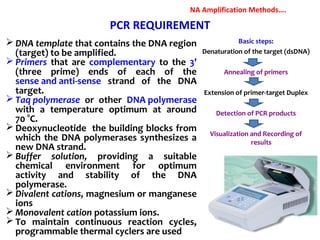
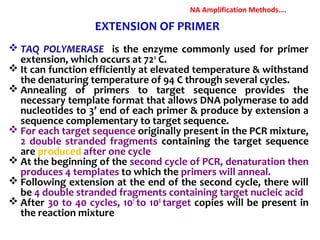
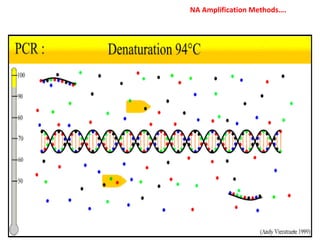
  • 106.
    The global in-vitrodiagnostics (IVD) market was valued at $44 billion ($ 4400 Crore= Rs. 272800 Crore) in 2011 and is expected to have a modest growth. Increased patient awareness, patient self testing, rapidly aging population globally and automated testing due to technical advances are the major growth drivers of this market. IVD market include Clinical Chemistry, Molecular diagnostics, Immunoassays, Hematology and Microbiology. Clinical chemistry dominates global IVD market while molecular diagnostics is expected to register the highest growth. The U.S. represented the biggest market for IVD equipments accounting for about a half of the total market. The molecular methods are a promising alternative that can substitute or complement the current reference methods used. Sample preparation problem, contamination, entrenched attitude slow but cannot stop adoption of the molecular method of diagnosis.
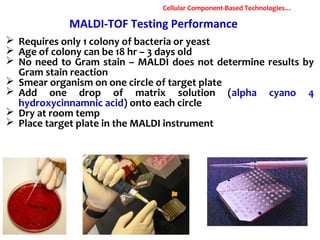
  • 108.
    Thanks Acknowledgement: All thematerial/presentations available online on the subject are duly acknowledged. Disclaimer: The author bear no responsibility with regard to the source and authenticity of the content. Questions???

Editor's Notes

  • #22 Robust: Resilient---the ability of a [system] to resist change without adapting its initial stable configuration Sensitivity : relates to the test&amp;apos;s ability to identify positive results who are known to have a disease condition Specificity: relates to the test&amp;apos;s ability to identify negative results…… how commonly negative results happen in people who do not have a disease condition
  • #40 Denaturation-94 c Annealing 40-60 c Elongatin-72c,Taq polymerase,dATP. dGTP, dCTP, dTTP
  • #60 Innovation is the development of new values through solutions that meet new requirements and inarticulate needs
  • #61 Forward Inner Primer (FIP) , Forward Outer Primer (F3 Primer), Backward Inner Primer (BIP), Backward Outer Primer (B3 Primer)
  • #68 In the DNA amplification process by DNA polymerase, pyrophosphate ions are produced as a by-product from the reaction substrate dNTPs. The calcein in the reaction mixture initially combines with manganous ion (Mn2+) so as to remain quenched. When the amplification reaction proceeds, manganous ion is deprived of calcein by the generated pyrophosphate ion (P2O74- ), which results in the emission of fluorescence. And the free calcein is apt to combine with residual magnesium ion (Mg2+) in the reaction mixture, so that it strengthens the fluorescence emission.
  • #70 Loopamp Realtime Turbidimeter (LA-500) is an equipment specifically for the LAMP (Loop-mediated Isothermal Amplification) method, a novel gene amplification method.With the time and temperature preset, gene amplification will occur, and the detection can be done by simultaneously monitoring the white turbidity caused by the existence of magnesium pyrophosphate, the amplification by-products. 1.Samples are amplified and monitored every 6 seconds simultaneously. 2.With the arrangement of 8 samples / block, the block temperature can be set individually. 3.The control unit can control up to 6 amplification units (one amplification unit can conduct 16 samples). 4.Uses hot bonnet to prevent sample from vaporizing. 5.With the control unit, simple operation is possible. 6.The control unit is capable of evaluating the amplification reaction starting time and various parameters. 7.LA-500 is CE marked and UL-approved.