UNIT – 2
Enzymes used in
Genetic Engineering
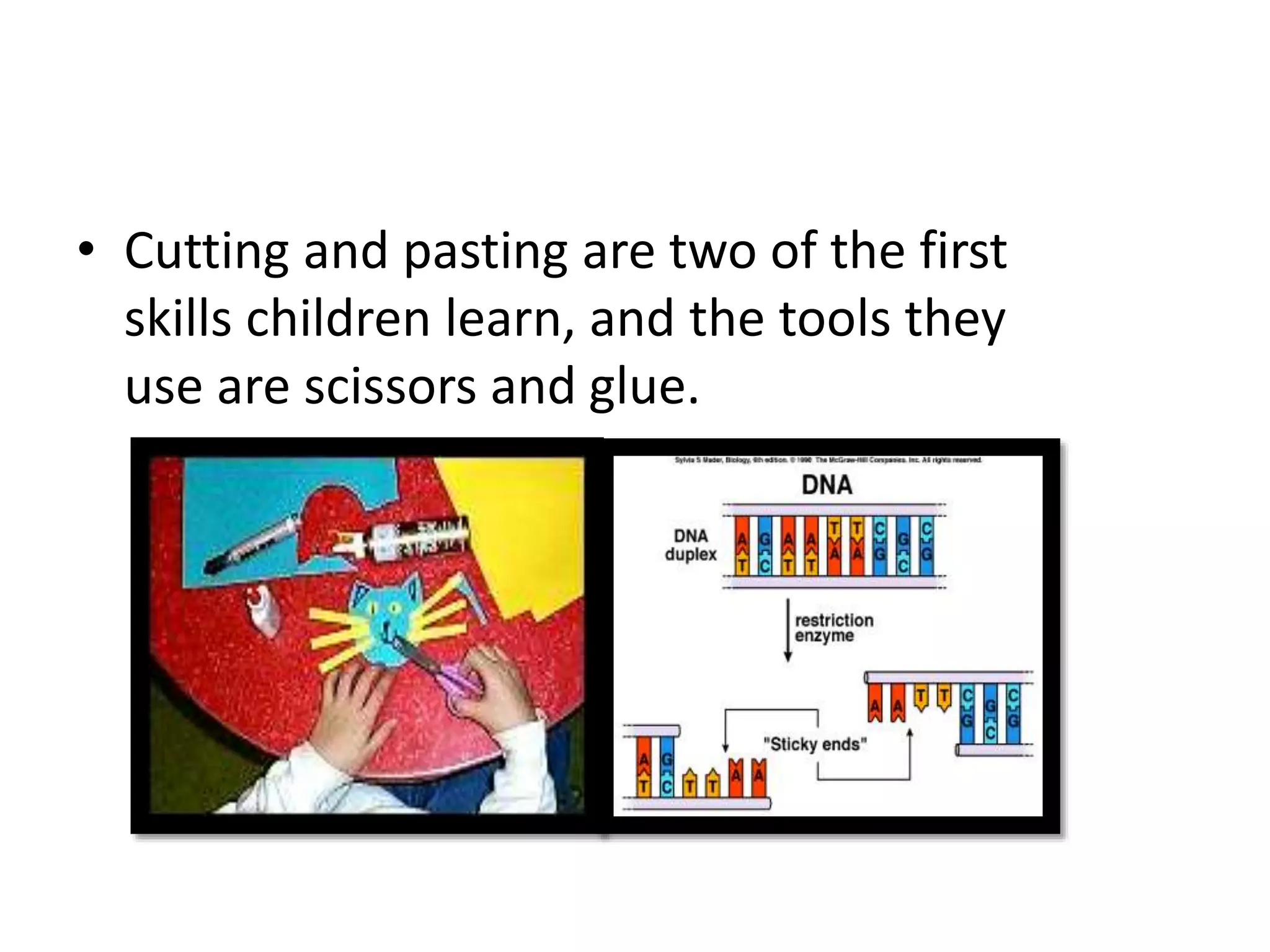
• Cutting and pasting are two of the first
skills children learn, and the tools they
use are scissors and glue.
• Similarly, cutting DNA and pasting DNA
fragments together typically are among
the first techniques learned in the
molecular biology lab and are
fundamental to all recombinant DNA
work.
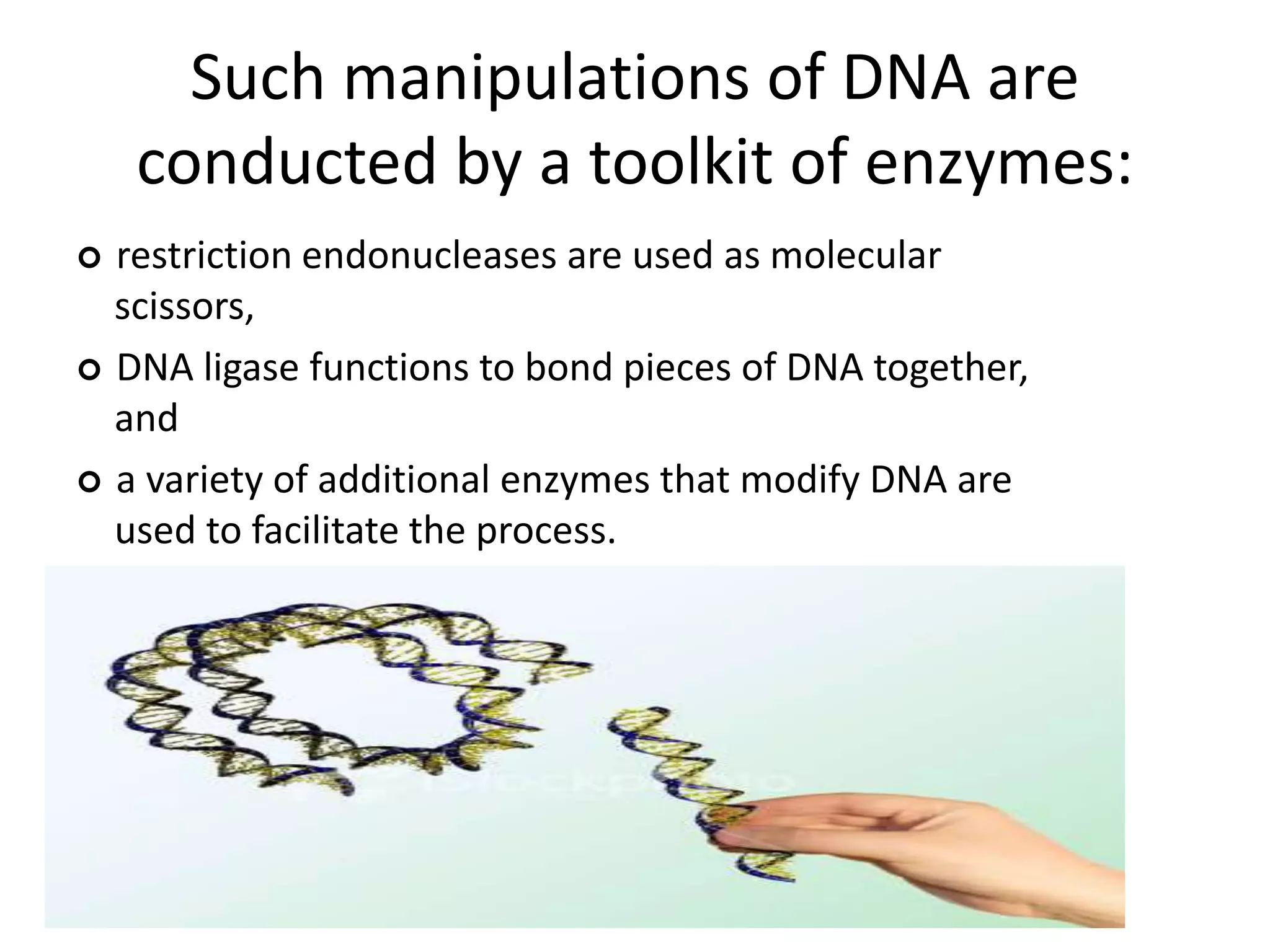
Such manipulations of DNA are
conducted by a toolkit of enzymes:
 restriction endonucleases are used as molecular
scissors,
 DNA ligase functions to bond pieces of DNA together,
and
 a variety of additional enzymes that modify DNA are
used to facilitate the process.
DNA modifying enzymes
• Restriction enzymes and DNA ligases represent
the cutting and joining functions in DNA
manipulation.
• All other enzymes involved in genetic engineering
fall under the broad category of enzymes known
as DNA modifying enzymes.
• These enzymes are involved in the degradation,
synthesis and alteration of the nucleic acids.
Types of Modifying
Enzymes
Nucleases
• Nuclease enzymes degrade nucleic acids by
breaking the phosphodiester bond that holds
the nucleotides together.
• Restriction enzymes are good examples of
endonucleases, which cut within a DNA
strand.
• A second group of nucleases, which degrade
DNA from the termini of the molecule, are
known as exonucleases.
• Apart from restriction enzymes, there are four
useful nucleases that are often used in genetic
engineering.
• These are
– Bal 31 and
– Exonuclease III (exonucleases), and
– Deoxyribonuclease I (DNase I) and
– S1-nuclease (endonucleases).
• These enzymes differ in their precise mode of
action and provide the genetic engineer with a
variety of strategies for attacking DNA.
Mode of action
(a) Nuclease Bal 31 is a complex enzyme. Its primary
activity is a fast-acting 3’ exonuclease, which is
coupled with a slow-acting endonuclease. When Bal
31 is present at a high concentration these activities
effectively shorten DNA molecules from both termini.
(b) Exonuclease III is a 3’ exonuclease that generates
molecules with protruding 5’ termini.
(c) DNase I cuts either single-stranded or double-
stranded DNA at essentially random sites.
(d) Nuclease S1 is specific for single-stranded RNA or
DNA.
Mode of action of various
nucleases.
(a)Nuclease Bal 31 is a complex enzyme.
Its primary activity is a fast-acting 3’
exonuclease, which is coupled with a slow-
acting endonuclease. When Bal 31 is present
at a high concentration these activities
effectively shorten DNA molecules from both
termini.
(b) Exonuclease III is a 3’ exonuclease that
generates molecules with protruding 5’
termini.
(c) DNase I cuts either single-stranded or
double-stranded DNA at essentially random
sites.
(d) Nuclease S1 is specific for single-stranded
RNA or DNA.
• In addition to DNA-specific nucleases, there are
ribonucleases (RNases), which act on RNA.
• These may be required for many of the stages in the
preparation and analysis of recombinants and are
usually used to get rid of unwanted RNA in the
preparation.
• However, as well as being useful, ribonucleases can
pose some unwanted problems.
• They are remarkably difficult to inactivate and can
be secreted in sweat.
Polymerases
• Polymerase enzymes synthesise copies of nucleic acid
molecules and are used in many genetic engineering
procedures.
• When describing a polymerase enzyme, the terms ‘DNA-
dependent’ or ‘RNA-dependent’ may be used to indicate
the type of nucleic acid template that the enzyme uses.
• Thus, a
– DNA-dependent DNA polymerase copies DNA into DNA,
– an RNA-dependent DNA polymerase copies RNA into
DNA, and
– a DNA-dependent RNA polymerase transcribes DNA into
RNA.
• These enzymes synthesise nucleic acids by joining
together nucleotides whose bases are
complementary to the template strand bases.
• The synthesis proceeds in a 5’→3’ direction, as
each subsequent nucleotide addition requires a
free 3’-OH group for the formation of the
phosphodiester bond.
• This requirement also means that a short double-
stranded region with an exposed 3’-OH (a primer)
is necessary for synthesis to begin.
• Polymerases are the copying enzymes of the
cell;
• These enzymes are template-dependent and
can be used to copy long stretches of DNA or
RNA.
• The enzyme DNA polymerase I has, in addition
to its polymerase function, 5’→3’ and 3’→5’
exonuclease activities.
• A major use of this enzyme is in the nick
translation procedure for radiolabelling DNA.
• Nick translation (or Head Translation) was
developed in 1977 by Rigby and Paul Berg.
• It is a tagging technique in molecular biology in
which DNA Polymerase I is used to replace some of
the nucleotides of a DNA sequence with their
labelled analogues, creating a tagged DNA sequence
which can be used as a probe in Fluorescent in situ
hybridization or blotting techniques.
• It can also be used for radiolabeling
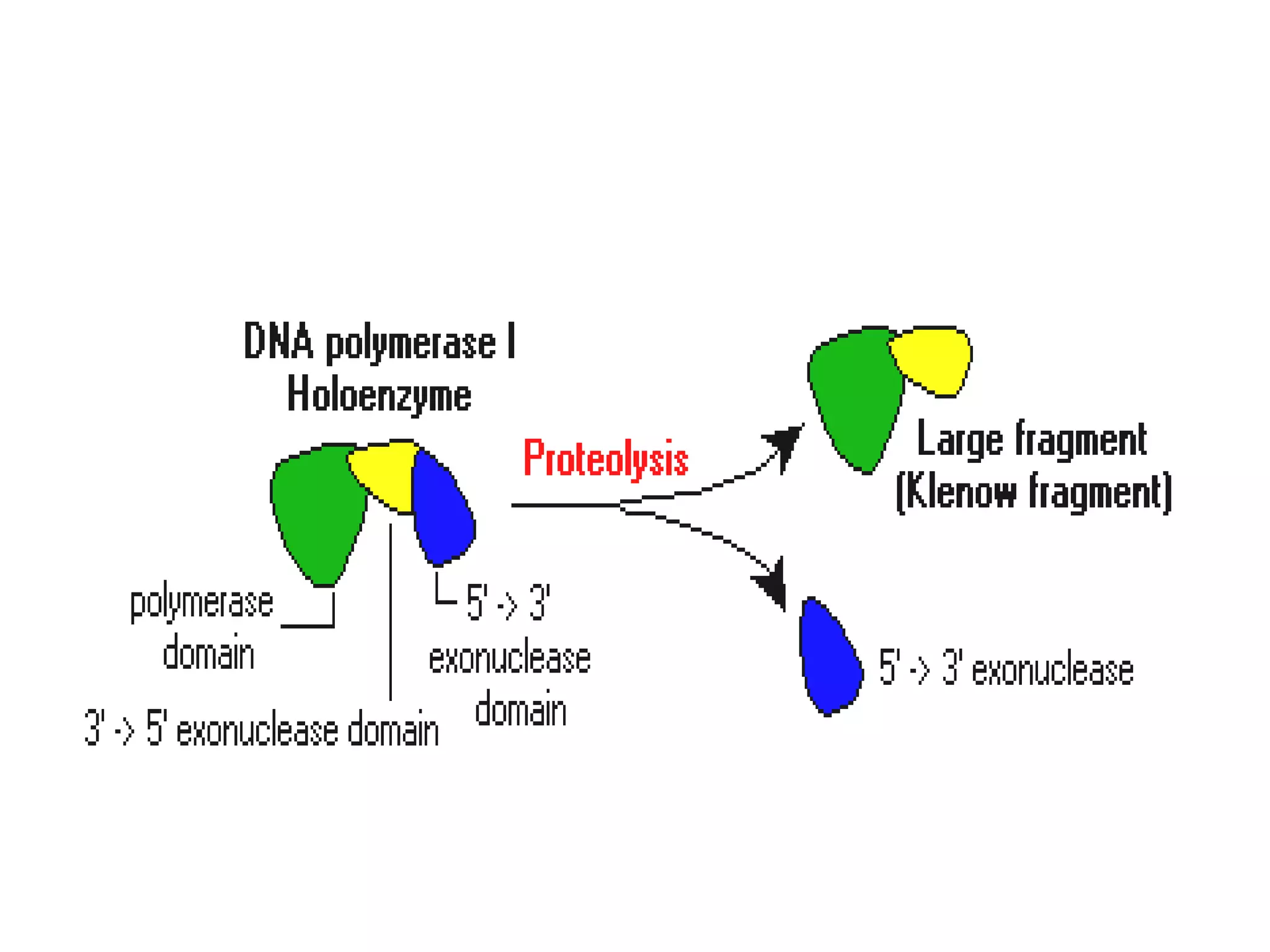
• The 5’→3’ exonuclease function of DNA
polymerase I can be removed by cleaving the
enzyme to produce what is known as the
Klenow fragment.
• This retains the polymerase and 3’→5’
exonuclease activities.
• The Klenow fragment is used where a single-
stranded DNA molecule needs to be copied;
because the 5’→3’ exonuclease function is
missing, the enzyme cannot degrade the non-
template strand of dsDNA during synthesis of
the new DNA.
• Therefore, the large or klenow fragment of
DNA Polymerase I has DNA Ploymerase &
3’→5’ Exonuclease activities, and is widely
used in molecular biology
DNA Polymerase I
• DNA Polymerase I, a template-dependent
DNA polymerase, catalyzes 5'→3' synthesis of
DNA.
• The enzyme also exhibits 3'→5' exonuclease
(proofreading) activity, 5'→3' exonuclease
activity.
Klenow Fragment
• Klenow Fragment is the large fragment
of DNA polymerase I.
• It exhibits 5'→3' polymerase activity and
3'→5' exonuclease (proofreading)
activity, but lacks 5'→3' exonuclease
activity of DNA polymerase I.
Synthesis of double-stranded DNA
from single-stranded templates:
T4 DNA Polymerase
• T4 DNA Polymerase, a template-dependent
DNA polymerase, catalyzes 5'-3' synthesis
from primed single-stranded DNA.
• The enzyme has a 3'-5' exonuclease activity,
but lacks 5'-3' exonuclease activity.
T4 DNA Polymerase
Highlights:
• Stronger 3'-5' exonuclease activity on single-
stranded than on double-stranded DNA and
greater (more than 200 times) than DNA
polymerase I and Klenow fragment
• Active in restriction enzyme, PCR, RT and T4
DNA Ligase buffers
Applications
• Blunting of DNA ends: fill-in of 5'-overhangs
or/and removal of 3'-overhangs
• Synthesis of labelled DNA probes by the
replacement reaction
T7 DNA Polymerase
• T7 DNA Polymerase, a template dependent
DNA polymerase, catalyzes DNA synthesis in
the 5'=>3' direction.
• It is a highly processive DNA polymerase
allowing continuous synthesis of long
stretches of DNA.
• The enzyme also exhibits a high 3'=>5'
exonuclease activity towards single and
double-stranded DNA.
• Assays at 37°C require only short incubation
times
Highlights:
• Strong 3’=>5’ exonuclease activity,
approximately 1000-fold greater than Klenow
Fragment.
• Active in restriction enzyme buffers
Terminal Deoxynucleotidyl
Transferase
• Terminal Deoxynucleotidyl Transferase (TdT),
• Template-independent DNA polymerase, catalyzes
the repetitive addition of deoxyribonucleotides to
the 3'-OH of oligodeoxyribonucleotides and single-
stranded and double-stranded DNA .
• TdT requires an oligonucleotide of at
least three nucleotides to serve as a
primer.
Reverse transcriptase
• (RTase) is an RNA-dependent DNA
polymerase, and therefore produces a DNA
strand from an RNA template.
• It has no associated exonuclease activity.
• The enzyme is used mainly for copying mRNA
molecules in the preparation of cDNA
(complementary or copy DNA) for cloning,
although it will also act on DNA templates.
• Reverse transcriptase is a key enzyme in the
generation of cDNA; the enzyme is an RNA-
dependent DNA polymerase, which produces
a DNA copy of an mRNA molecule.
Enzymes that modify the ends of
DNA molecules
• The enzymes alkaline phosphatase,
polynucleotide kinase (T4 polynucleotide
kinase), and terminal transferase act on
the termini of DNA molecules and provide
important functions that are used in a
variety of ways.
• The phosphatase and kinase enzymes, as their
names suggest, are involved in the removal or
addition of phosphate groups respectively.
• Bacterial alkaline phosphatase (there is also a
similar enzyme, calf intestinal alkaline
phosphatase) removes phosphate groups
from the 5’ ends of DNA.
• The enzyme is used to prevent unwanted
ligation of DNA molecules, which can be a
problem in certain cloning procedures.
• Terminal transferase (terminal deoxynucleotidyl
transferase) repeatedly adds nucleotides to any
available 3 terminus.
• The enzyme is mainly used to add
homopolymer tails to DNA molecules prior to
the construction of recombinants.
• In many applications it is often necessary to
modify the ends of DNA molecules using
enzymes such as phosphatases, kinases, and
transferases.
DNA ligase – joining DNA molecules
• DNA ligase is an important cellular enzyme, as
its function is to repair broken phosphodiester
bonds that may occur at random or as a
consequence of DNA replication or
recombination.
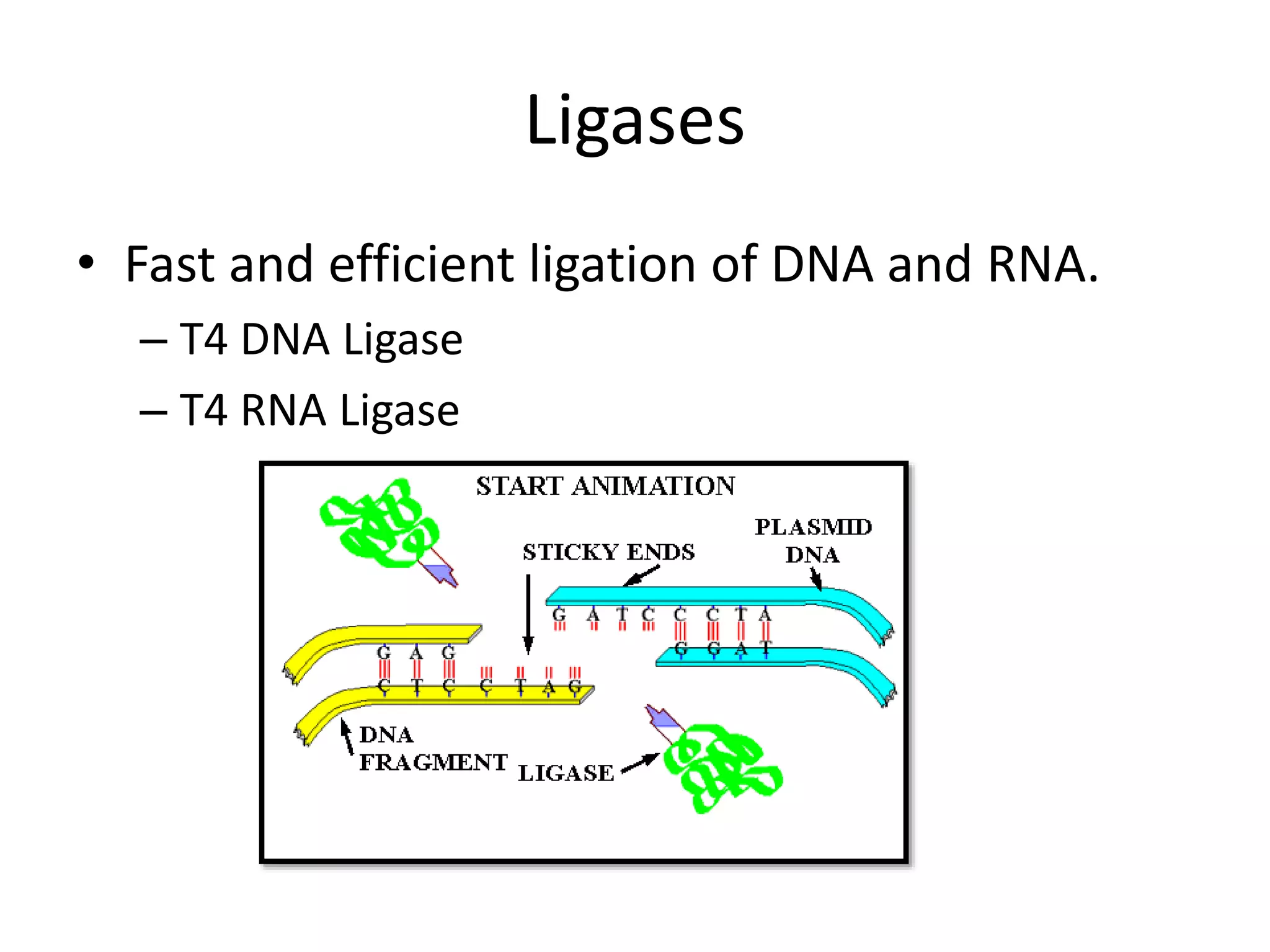
• In genetic engineering it is used to seal
discontinuities in the sugar—phosphate
chains that arise when recombinant DNA is
made by joining DNA molecules from different
sources.
• It can therefore be thought of as molecular
glue, which is used to stick pieces of DNA
together.
• This function is crucial to the success of many
experiments, and DNA ligase is therefore a key
enzyme in genetic engineering.
• The enzyme used most often in experiments is
T4 DNA ligase, which is purified from E. coli cells
infected with bacteriophage T4
• Although the enzyme is most efficient when
sealing gaps in fragments that are held
together by cohesive ends, it will also join
blunt-ended DNA molecules together under
appropriate conditions.
• The enzyme works best at 37◦C, but is often used
at much lower temperatures (4--15◦C) to prevent
thermal denaturation of the short base-paired
regions that hold the cohesive ends of DNA
molecules together.
• The ability to cut, modify, and join DNA
molecules gives the genetic engineer the freedom
to create recombinant DNA molecules.
• However, once a recombinant DNA fragment has
been generated in vitro, it usually has to be
amplified so that enough material is available for
subsequent manipulation and analysis.
• Amplification usually requires a biological
system, unless the polymerase chain reaction
(PCR) is used.
• We must, therefore, examine the types of
living systems that can be used for the
propagation of recombinant DNA molecules.
• DNA ligase is essentially ‘molecular glue’; with
restriction enzymes, it provides the tools for
cutting and joining DNA molecules.
Ligases
• Fast and efficient ligation of DNA and RNA.
– T4 DNA Ligase
– T4 RNA Ligase
T4 DNA Ligase
• T4 DNA Ligase catalyzes the formation of a
phosphodiester bond between 5'-phosphate
and 3'-hydroxyl termini in duplex DNA or RNA.
• The enzyme repairs single-strand nicks in
duplex DNA, RNA, or DNA/RNA hybrids.
• It also joins DNA fragments with either
cohesive or blunt termini, but has no activity
on single-stranded nucleic acids.
• The T4 DNA Ligase requires ATP as a cofactor.
T4 RNA Ligase
• T4 RNA Ligase catalyzes the ATP-dependent
intra- and intermolecular formation of
phosphodiester bonds between 5'-phosphate
and 3'-hydroxyl termini of oligonucleotides,
single-stranded RNA and DNA.
Conclusion
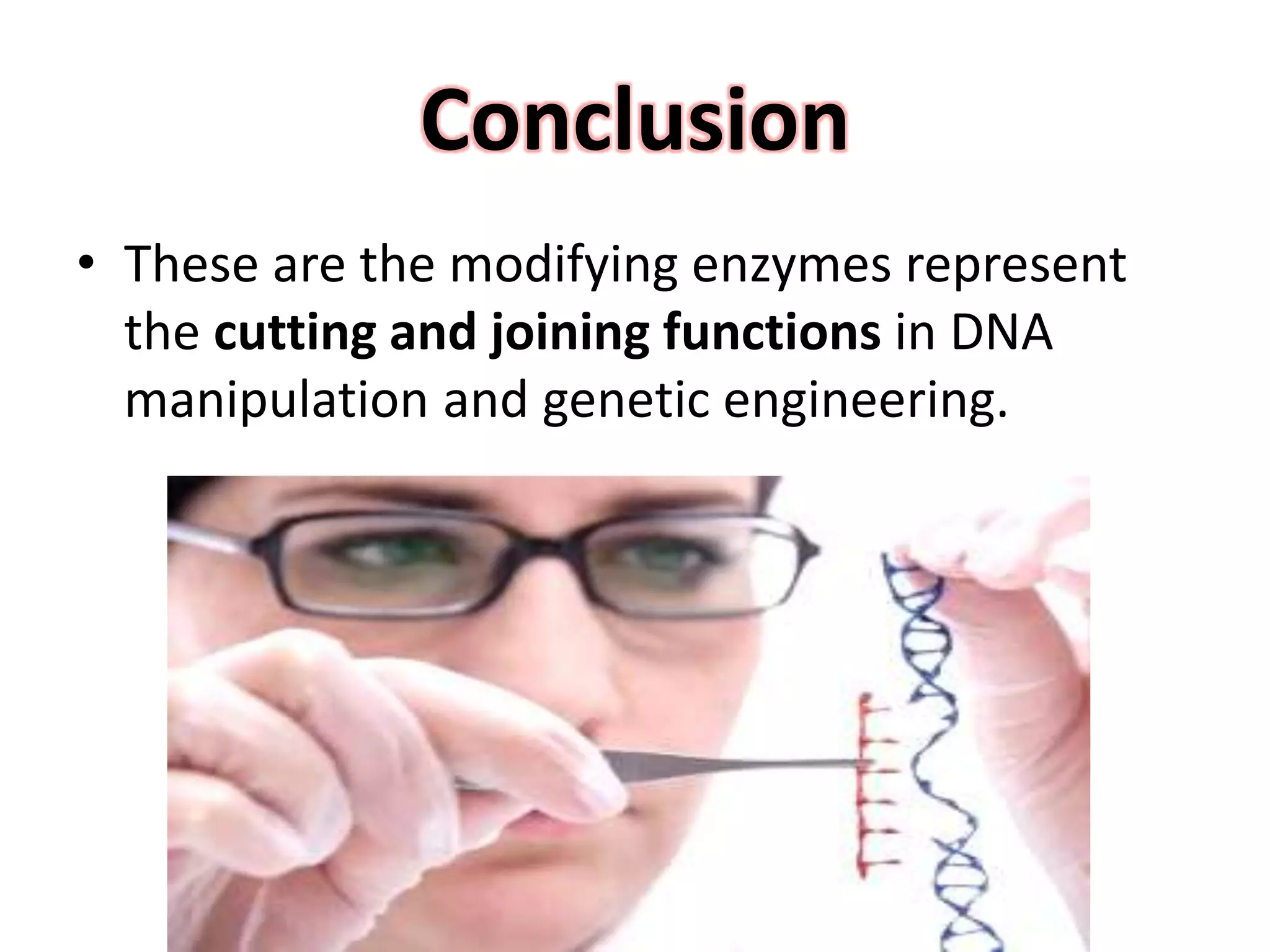
• These are the modifying enzymes represent
the cutting and joining functions in DNA
manipulation and genetic engineering.
WHAT IS AN ENZYME?
• Enzymes are proteins and certain class of RNA
(ribozymes) which enhance the rate of a
thermodynamically feasible reaction and are
not permanently altered in the process.
Molecular Scissors
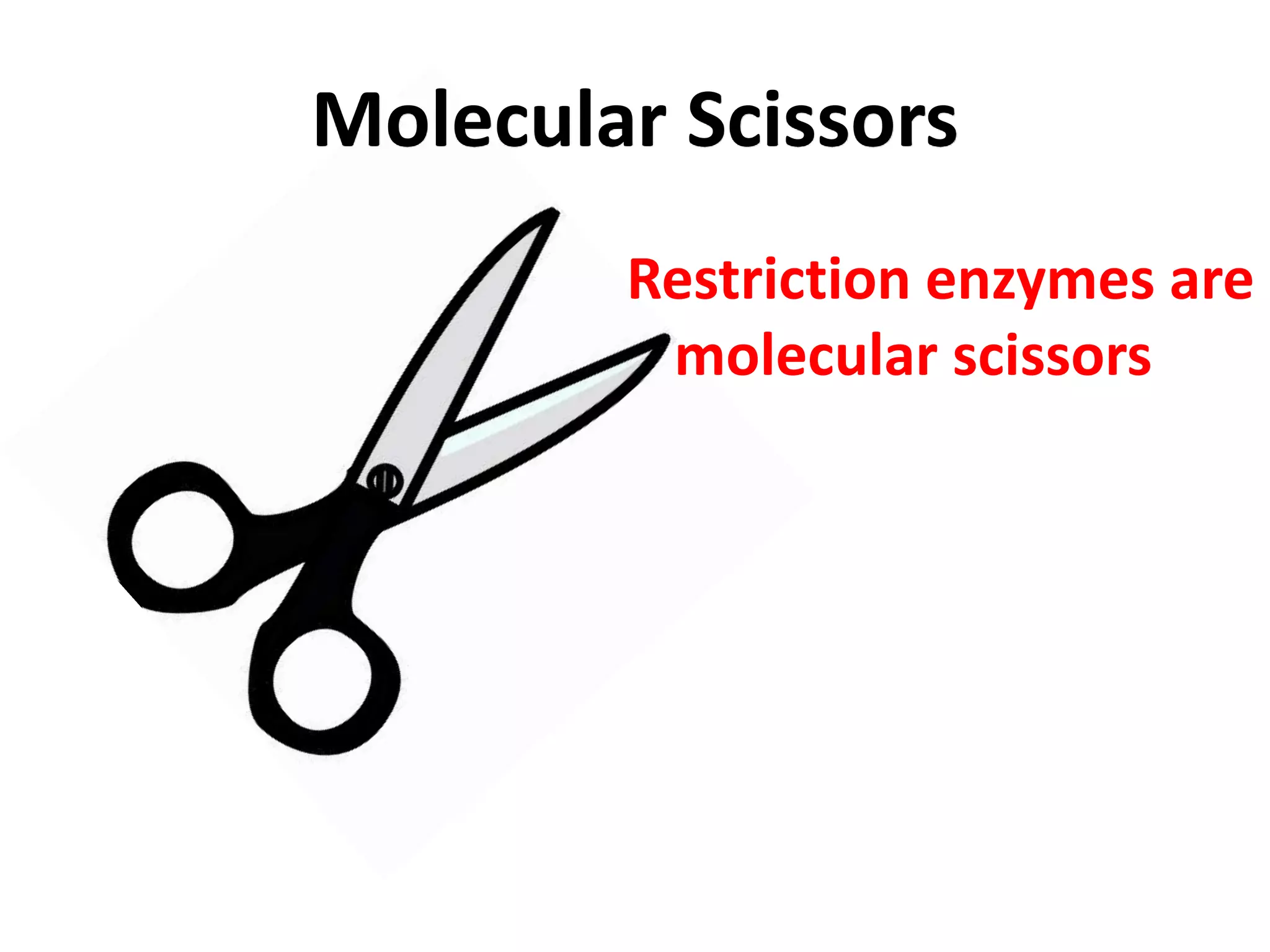
Restriction enzymes are
molecular scissors
RESTRICTION ENZYMES
• A restriction enzyme (or restriction
endonuclease) is an enzyme that cuts double-
stranded or single stranded DNA at specific
recognition nucleotide sequences known as
restriction sites.
Property of restriction
enzymes
• They
that link adjacent nucleotides in DNA
molecules.
HOW RESTRICTION ENZYMES
WORKS?
• Restriction enzymes recognize a specific
sequence of nucleotides, and produce a
double-stranded cut in the DNA, these cuts
are of two types:
• BLUNT ENDS.
• STICKY ENDS.
Blunt end
Sticky end
BLUNT ENDS
• These blunt ended fragments can be joined to
any other DNA fragment with blunt ends.
• Enzymes useful for certain types of DNA
cloning experiments
“STICKY ENDS” ARE USEFUL
DNA fragments with
complimentary sticky ends
can be combined to create
new molecules which
allows the creation and
manipulation of DNA
sequences from
different sources.
• While recognition sequences vary
widely , with lengths between 4 and
8 nucleotides, many of them are
palindromic.
PALINDROMES IN DNA SEQUENCES
Genetic palindromes
are similar to verbal
palindromes. A
palindromic sequence
in DNA is one in
which the 5’ to 3’
base pair sequence is
identical on both
strands (the 5’ and 3’
ends refers to the
chemical structure of
the DNA).
PALINDROME SEQUENCES
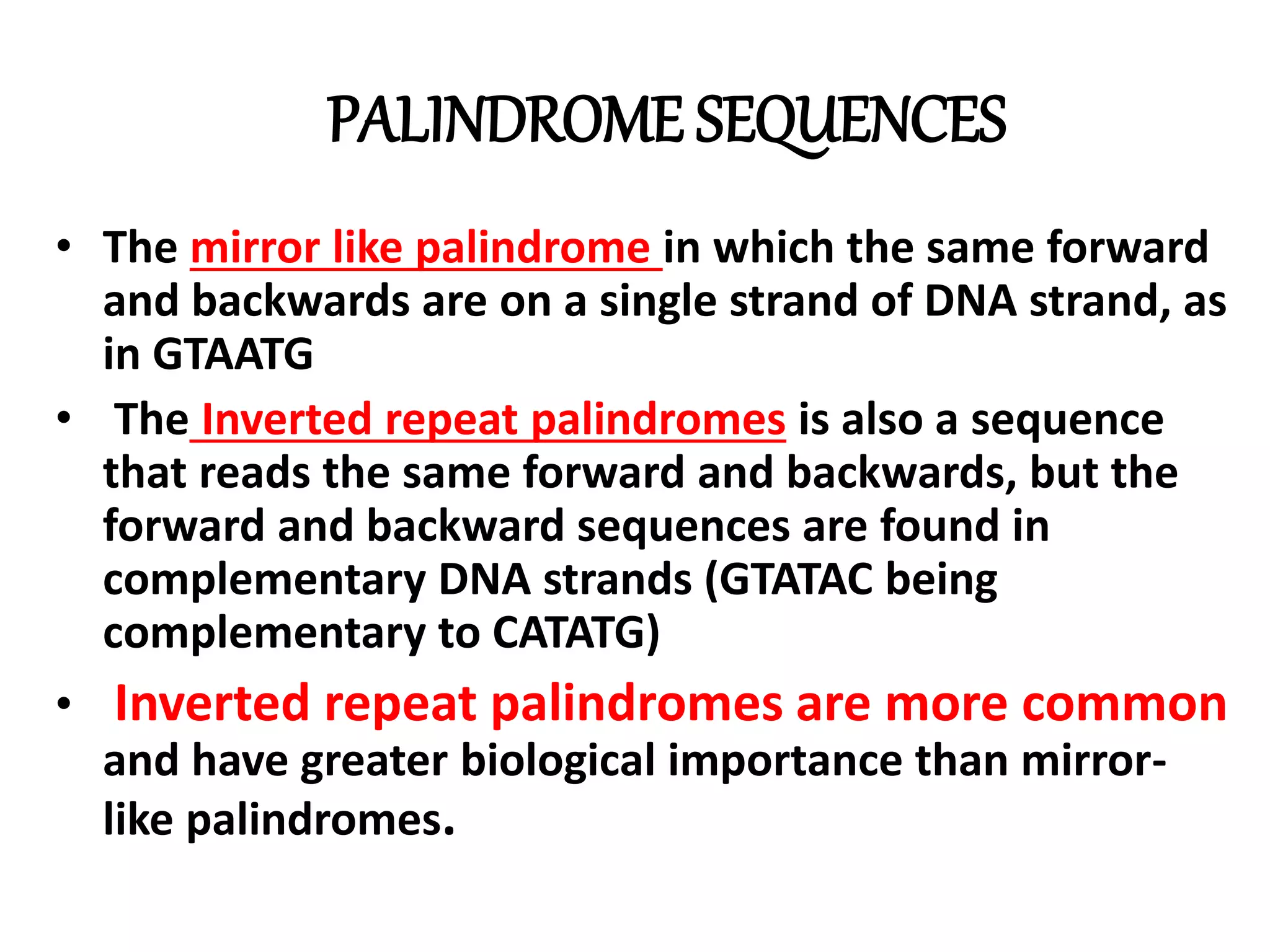
• The mirror like palindrome in which the same forward
and backwards are on a single strand of DNA strand, as
in GTAATG
• The Inverted repeat palindromes is also a sequence
that reads the same forward and backwards, but the
forward and backward sequences are found in
complementary DNA strands (GTATAC being
complementary to CATATG)
• Inverted repeat palindromes are more common
and have greater biological importance than mirror-
like palindromes.
Star effect
• Optimum conditions are necessary for the
expected result.
• Under extreme conditions such as elevated pH
or low ionic strength, RE are capable of cleaving
sequences which are similar but not identical
to their recognition sequence.
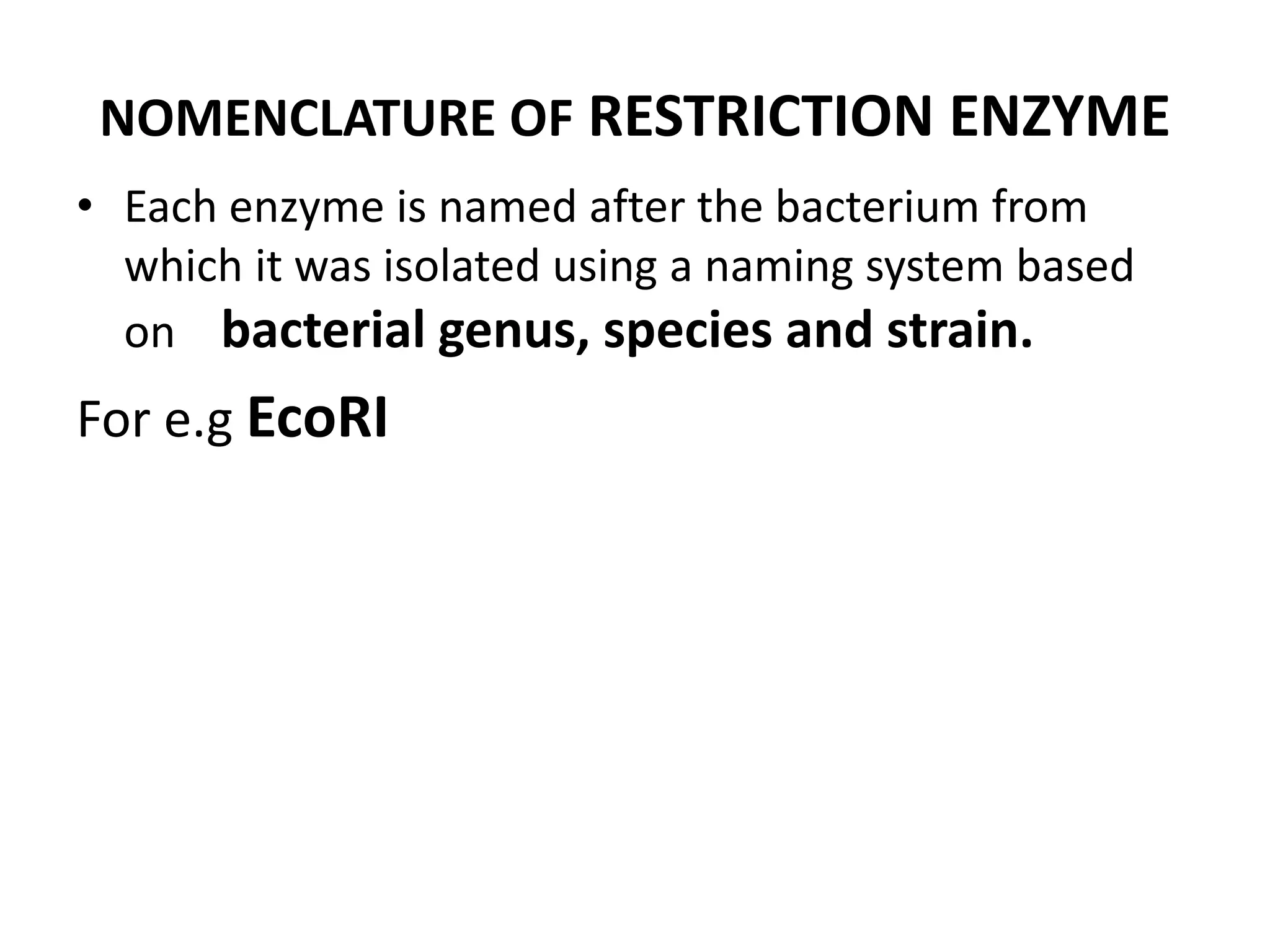
NOMENCLATURE OF RESTRICTION ENZYME
• Each enzyme is named after the bacterium from
which it was isolated using a naming system based
on bacterial genus, species and strain.
For e.g EcoRI
Derivation of the EcoRI name
Abbreviation Meaning Description
E Escherichia genus
co coli species
R RY13 strain
I First identified
order of identification
in the bacterium
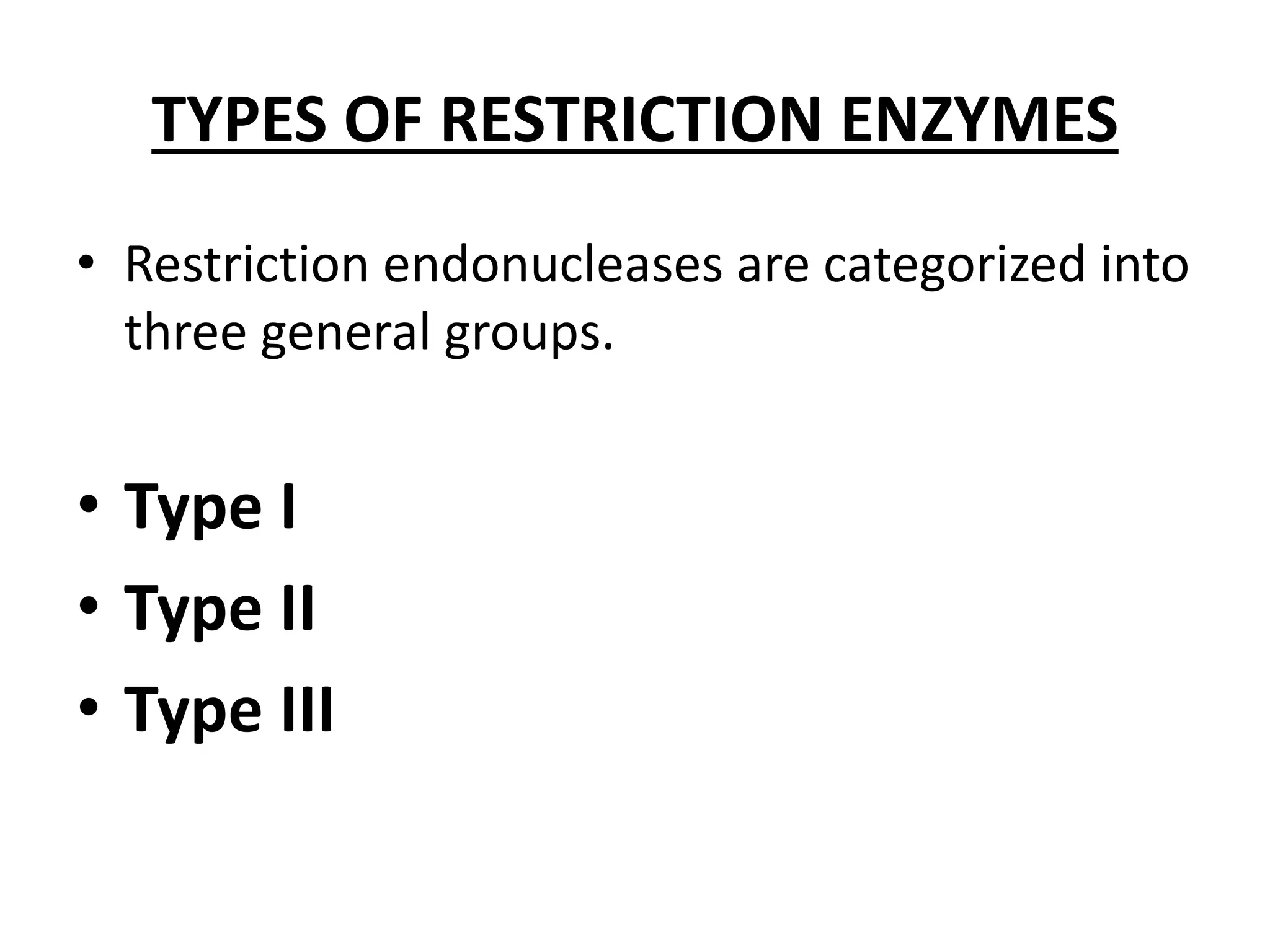
TYPES OF RESTRICTION ENZYMES
• Restriction endonucleases are categorized into
three general groups.
• Type I
• Type II
• Type III
TYPES OF RESTRICTION ENZYMES
Type I Type II Type III
Type IV
Artificial
restriction
enzymes
continue…..
These types are categorization based on:
• Their composition.
• Enzyme co-factor requirement.
• The nature of their target sequence.
• Position of their DNA cleavage site relative to
the target sequence.
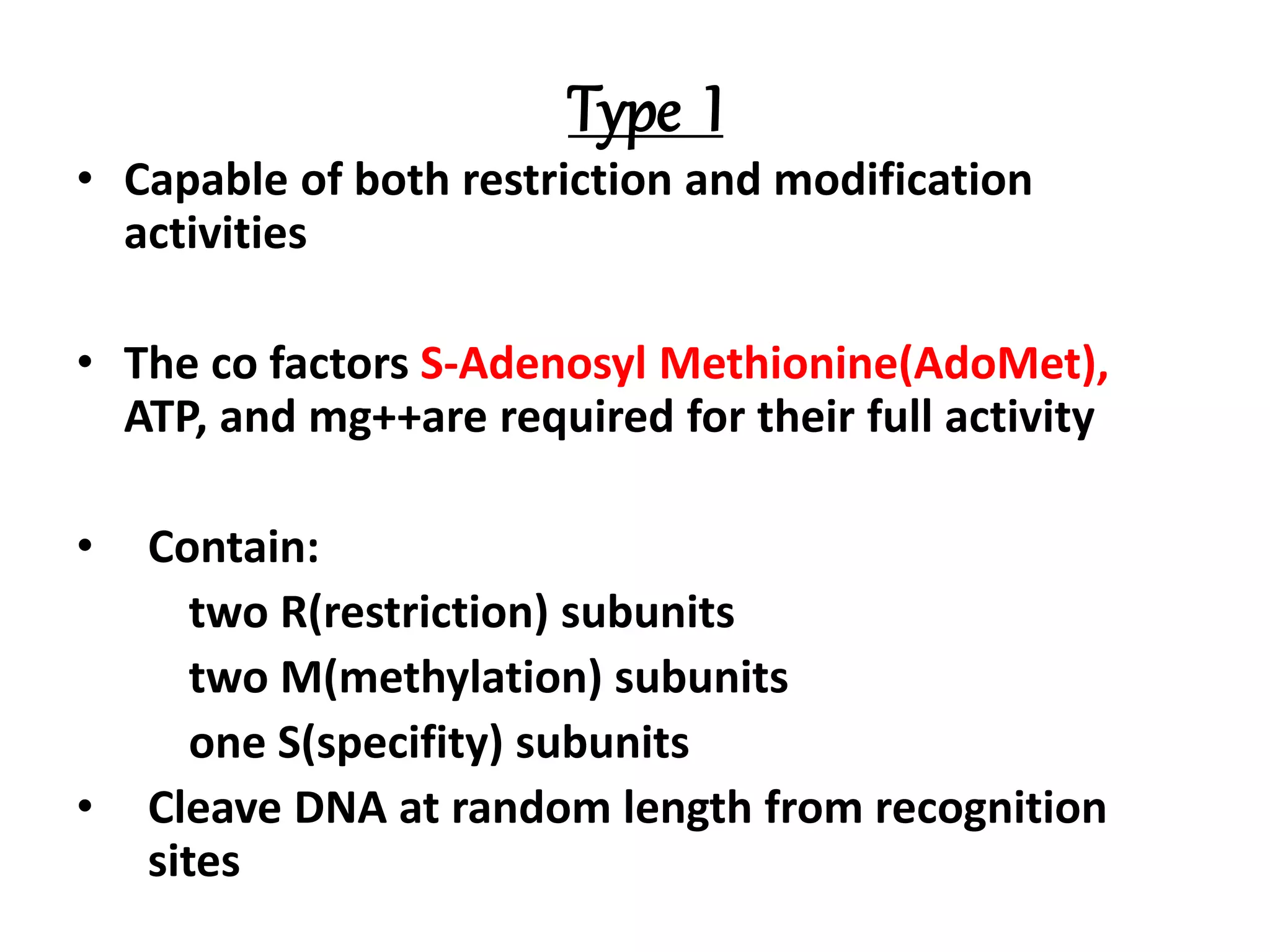
Type I
• Capable of both restriction and modification
activities
• The co factors S-Adenosyl Methionine(AdoMet),
ATP, and mg++are required for their full activity
• Contain:
two R(restriction) subunits
two M(methylation) subunits
one S(specifity) subunits
• Cleave DNA at random length from recognition
sites
Type II
• These are the most commonly available and used
restriction enzymes
• They are composed of only one subunit.
• Their recognition sites are usually undivided and
palindromic and 4-8 nucleotides in length,
• They recognize and cleave DNA at the same site.
• They do not use ATP for their activity
• They usually require only mg2+ as a cofactor.
Type III
• Type III restriction enzymes cut DNA about 20-30
base pairs after the recognition site.
• These enzymes contain more than one subunit.
• And require AdoMet and ATP cofactors for their
roles in DNA methylation and restriction
Type IV
• Cleave only normal and modified DNA
(methylated, hydroxymethylated and
glucosyl-hydroxymethylated bases).
• Recognition sequences have not been well
defined
• Cleavage takes place ~30 bp away from one
of the sites
ARTIFICIAL RESTRICTION ENZYMES
• Generated by fusing a natural or engineered
DNA binding domain to a nuclease domain
• can target large DNA sites (up to 36 bp)
• can be engineered to bind to desired DNA
sequences
Examples of Type II restriction
enzymes
EcoRI E = genus Escherichia
co = species coli
R = strain RY13
I= first endonuclease
isolated
BamHI B = genus Bacillus
am = species
amyloliquefaciens
H = strain H
I = first endonuclease
isolated
HindIII H = genus Haemophilus
in = species influenzae
d = strain Rd
III = third endonuclease
isolated
Isoschizomer
• Restriction enzymes specific to the
same recognition sequence. For
example, SphI (CGTAC/G) and BbuI
(CGTAC/G) are isoschizomers of each
other.
Neoschizomer
• Enzyme that recognizes the same
sequence but cuts it differently is
a neoschizomer.
• For example, SmaI(CCC/GGG) and XmaI
(C/CCGGG) are neoschizomers of each
other.
APPLICATIONS
They are used in
gene cloning
and protein
expression
experiments
Detection
of RFLPs
Restriction
enzymes are
most widely used
in recombinant
DNA technology.
DNA
Mapping
Genotype a
DNA sample
by SNP
Genetic
Engineering
Vectors
• The second step in molecular cloning is to join
the passenger DNA to the DNA of a suitable
cloning vehicle.
• These vehicles (or vectors) have the property
that they replicate themselves and any
attached passenger DNA so that the
passenger is amplified and can be eventually
isolated.
Plasmids
 Relatively Small
 Double-stranded, closed-circular DNA molecules
that exist apart from the chromosomes of their
hosts
 Naturally occurring plasmids carry one or more
genes
 For example, some plasmids carry genes which
confer resistance to certain antibiotics. Some
plasmids may bear genes that code for the
restriction and modification enzymes that were
discussed previously
• Some may carry genes that direct the
synthesis of enzymes that aid in the
production of bacterial poisons or antibiotics.
• The most important property of plasmids is
that they bear a special region of DNA called
an origin of replication, or more simply
an origin.
Desirable properties of
plasmids
• It should be small
(small plasmids replicate faster and require
less energy for replication than large ones.
Finally, small plasmids are easier to purify
than large ones because they are less fragile.)
• Its DNA sequence should be known
• It should grow to high copy number in the
host cell.
• It should contain a selectable marker that
allows cells containing the plasmid to be
isolated
• There should be a large number of unique
restriction sites
Plasmid purification
The most common method for purifying
plasmid DNA involves three steps:
• First, the bacteria are broken open and then
it’s DNA isolated.
• Then the DNA is denatured.
• Finally, the DNA is renatured and centrifuged.
Some popular plasmids
• pBR 322: The first really useful plasmid for
genetic engineering.
• The "B" stands for Bolivar and the "R" for
Rodriguez, another scientist in Boyer's
laboratory).
• It contains an ampicillin resistance gene and a
tetracycline resistance gene
• In addition it has a relaxed origin of
replication
• pUC Plasmid:
• About 2.7 kilobase pairs.
• These pUC (pronounced PUCK) plasmids
• Carry an ampicillin resistance gene and
an origin of replication, both from
pBR322
• They also bear a multiple cloning site -- a
sequence of DNA that carries many restriction
sites (13, in the case of pUC18)
• Multiple cloning site of the pUC plasmids is
special because it also codes for a small
peptide. This peptide will correct a specific
mutation in the chromosomal gene that codes
for the enzyme beta-galactosidase.
• Cells that harbor an active beta-galactosidase
enzyme can be made to turn blue in the
presence of certain substrates.
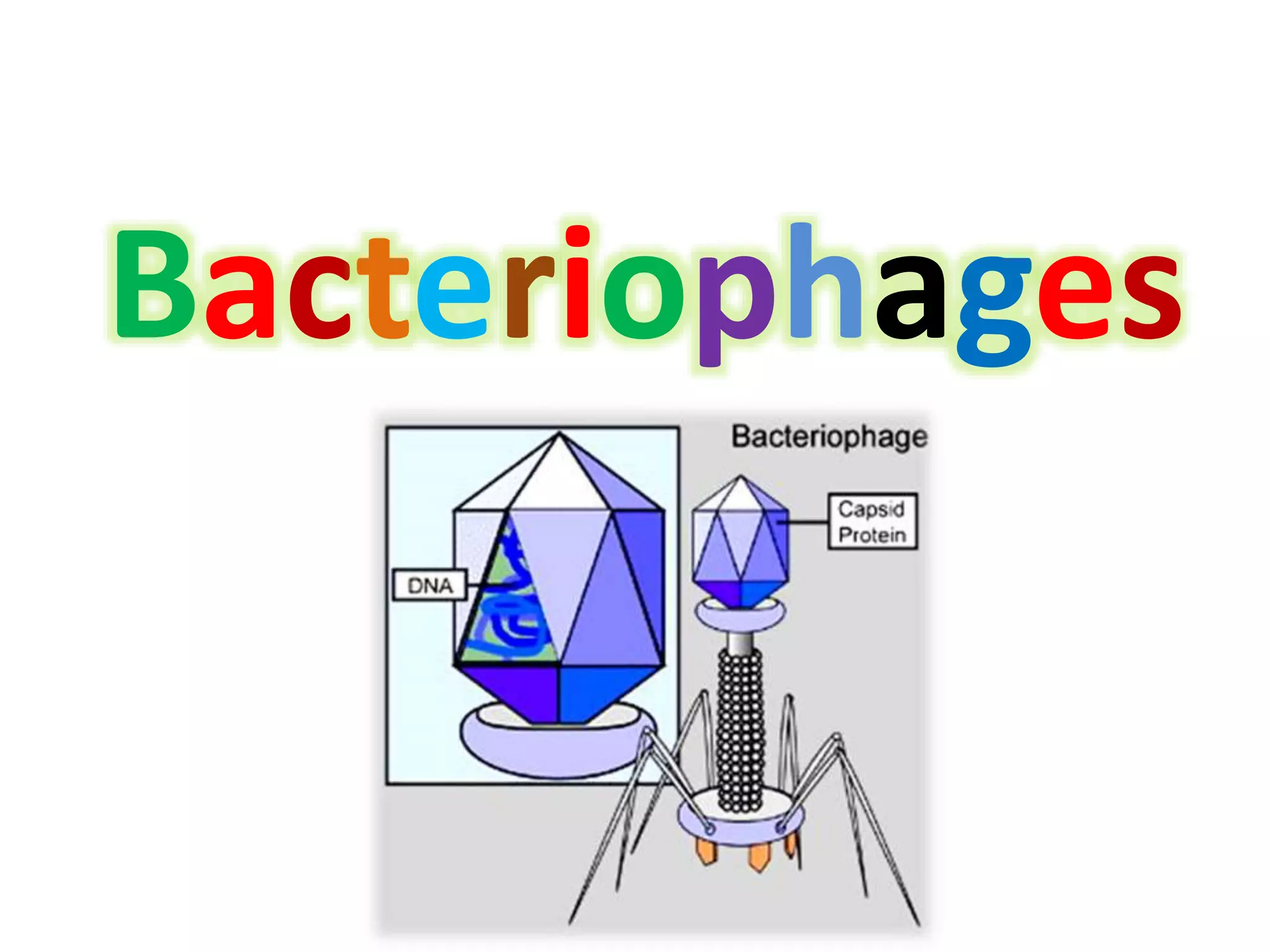
Bacteriophages
Bacteriophages
• Viruses that infect bacterial cells by injecting
their genetic material into the bacterial cell
• Lysis and lysogeny
Reasons why bacteriophage lambda
is a good cloning vehicle
• It can accept very large pieces of foreign DNA.
About 20kb of DNA
• It has been extensively reworked over the
years
Why lambda?
• Large pieces of DNA (up to about 20 kilobase
pairs) can be easily cloned in bacteriophage
lambda substitution vectors.
• Plasmid vectors are less useful for cloning big
passengers.
• But why clone large pieces of DNA in the
first place?
• One obvious reason is that some genes
are very big and it is advantageous
to have them all in one piece
• Another reason for cloning in lambda is the
efficiency it offers in DNA transformation.
.
DNA cloning using phages as vectors
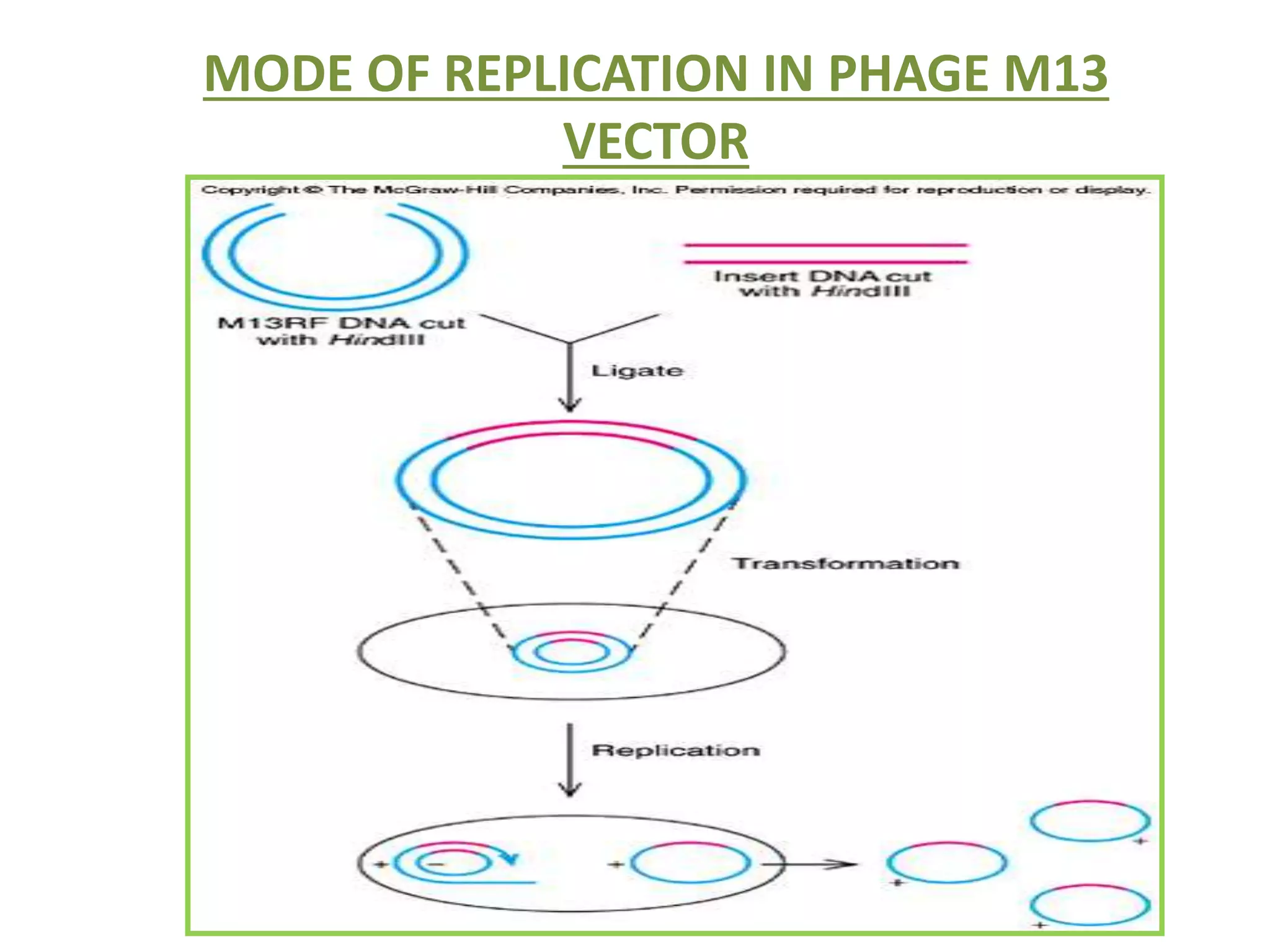
MODE OF REPLICATION IN PHAGE M13
VECTOR
Cosmid vector
Combine parts of the lambda with parts of
plasmids.
an origin of replication (ori).
a cos site(a sequence yield cohesive end) .
an ampicillin resistance gene (amp),
restriction sites for cloning
Cosmids can carry up to 50 kb of inserted
DNA.
Cloning by using Cosmid vectors
APPLICATION
• A particular gene can be isolated and its
nucleotide sequence determined
• Control sequences of DNA can be identified &
analyzed
• Protein/enzyme/RNA function can be
investigated
• Mutations can be identified, e.g. gene defects
related to specific diseases
• Organisms can be ‘engineered’ for specific
purposes, e.g. insulin production.

Enzymes used in Genetic Engineering

  • 1.
    UNIT – 2 Enzymesused in Genetic Engineering
  • 2.
    • Cutting andpasting are two of the first skills children learn, and the tools they use are scissors and glue.
  • 3.
    • Similarly, cuttingDNA and pasting DNA fragments together typically are among the first techniques learned in the molecular biology lab and are fundamental to all recombinant DNA work.
  • 4.
    Such manipulations ofDNA are conducted by a toolkit of enzymes:  restriction endonucleases are used as molecular scissors,  DNA ligase functions to bond pieces of DNA together, and  a variety of additional enzymes that modify DNA are used to facilitate the process.
  • 5.
    DNA modifying enzymes •Restriction enzymes and DNA ligases represent the cutting and joining functions in DNA manipulation. • All other enzymes involved in genetic engineering fall under the broad category of enzymes known as DNA modifying enzymes. • These enzymes are involved in the degradation, synthesis and alteration of the nucleic acids.
  • 7.
  • 8.
    Nucleases • Nuclease enzymesdegrade nucleic acids by breaking the phosphodiester bond that holds the nucleotides together. • Restriction enzymes are good examples of endonucleases, which cut within a DNA strand. • A second group of nucleases, which degrade DNA from the termini of the molecule, are known as exonucleases.
  • 9.
    • Apart fromrestriction enzymes, there are four useful nucleases that are often used in genetic engineering. • These are – Bal 31 and – Exonuclease III (exonucleases), and – Deoxyribonuclease I (DNase I) and – S1-nuclease (endonucleases). • These enzymes differ in their precise mode of action and provide the genetic engineer with a variety of strategies for attacking DNA.
  • 10.
    Mode of action (a)Nuclease Bal 31 is a complex enzyme. Its primary activity is a fast-acting 3’ exonuclease, which is coupled with a slow-acting endonuclease. When Bal 31 is present at a high concentration these activities effectively shorten DNA molecules from both termini. (b) Exonuclease III is a 3’ exonuclease that generates molecules with protruding 5’ termini. (c) DNase I cuts either single-stranded or double- stranded DNA at essentially random sites. (d) Nuclease S1 is specific for single-stranded RNA or DNA.
  • 11.
    Mode of actionof various nucleases. (a)Nuclease Bal 31 is a complex enzyme. Its primary activity is a fast-acting 3’ exonuclease, which is coupled with a slow- acting endonuclease. When Bal 31 is present at a high concentration these activities effectively shorten DNA molecules from both termini.
  • 12.
    (b) Exonuclease IIIis a 3’ exonuclease that generates molecules with protruding 5’ termini. (c) DNase I cuts either single-stranded or double-stranded DNA at essentially random sites. (d) Nuclease S1 is specific for single-stranded RNA or DNA.
  • 13.
    • In additionto DNA-specific nucleases, there are ribonucleases (RNases), which act on RNA. • These may be required for many of the stages in the preparation and analysis of recombinants and are usually used to get rid of unwanted RNA in the preparation. • However, as well as being useful, ribonucleases can pose some unwanted problems. • They are remarkably difficult to inactivate and can be secreted in sweat.
  • 14.
    Polymerases • Polymerase enzymessynthesise copies of nucleic acid molecules and are used in many genetic engineering procedures. • When describing a polymerase enzyme, the terms ‘DNA- dependent’ or ‘RNA-dependent’ may be used to indicate the type of nucleic acid template that the enzyme uses. • Thus, a – DNA-dependent DNA polymerase copies DNA into DNA, – an RNA-dependent DNA polymerase copies RNA into DNA, and – a DNA-dependent RNA polymerase transcribes DNA into RNA.
  • 15.
    • These enzymessynthesise nucleic acids by joining together nucleotides whose bases are complementary to the template strand bases. • The synthesis proceeds in a 5’→3’ direction, as each subsequent nucleotide addition requires a free 3’-OH group for the formation of the phosphodiester bond. • This requirement also means that a short double- stranded region with an exposed 3’-OH (a primer) is necessary for synthesis to begin.
  • 16.
    • Polymerases arethe copying enzymes of the cell; • These enzymes are template-dependent and can be used to copy long stretches of DNA or RNA.
  • 17.
    • The enzymeDNA polymerase I has, in addition to its polymerase function, 5’→3’ and 3’→5’ exonuclease activities. • A major use of this enzyme is in the nick translation procedure for radiolabelling DNA.
  • 18.
    • Nick translation(or Head Translation) was developed in 1977 by Rigby and Paul Berg. • It is a tagging technique in molecular biology in which DNA Polymerase I is used to replace some of the nucleotides of a DNA sequence with their labelled analogues, creating a tagged DNA sequence which can be used as a probe in Fluorescent in situ hybridization or blotting techniques. • It can also be used for radiolabeling
  • 19.
    • The 5’→3’exonuclease function of DNA polymerase I can be removed by cleaving the enzyme to produce what is known as the Klenow fragment. • This retains the polymerase and 3’→5’ exonuclease activities.
  • 20.
    • The Klenowfragment is used where a single- stranded DNA molecule needs to be copied; because the 5’→3’ exonuclease function is missing, the enzyme cannot degrade the non- template strand of dsDNA during synthesis of the new DNA. • Therefore, the large or klenow fragment of DNA Polymerase I has DNA Ploymerase & 3’→5’ Exonuclease activities, and is widely used in molecular biology
  • 22.
    DNA Polymerase I •DNA Polymerase I, a template-dependent DNA polymerase, catalyzes 5'→3' synthesis of DNA. • The enzyme also exhibits 3'→5' exonuclease (proofreading) activity, 5'→3' exonuclease activity.
  • 23.
    Klenow Fragment • KlenowFragment is the large fragment of DNA polymerase I. • It exhibits 5'→3' polymerase activity and 3'→5' exonuclease (proofreading) activity, but lacks 5'→3' exonuclease activity of DNA polymerase I.
  • 24.
    Synthesis of double-strandedDNA from single-stranded templates:
  • 25.
    T4 DNA Polymerase •T4 DNA Polymerase, a template-dependent DNA polymerase, catalyzes 5'-3' synthesis from primed single-stranded DNA. • The enzyme has a 3'-5' exonuclease activity, but lacks 5'-3' exonuclease activity.
  • 26.
    T4 DNA Polymerase Highlights: •Stronger 3'-5' exonuclease activity on single- stranded than on double-stranded DNA and greater (more than 200 times) than DNA polymerase I and Klenow fragment • Active in restriction enzyme, PCR, RT and T4 DNA Ligase buffers
  • 27.
    Applications • Blunting ofDNA ends: fill-in of 5'-overhangs or/and removal of 3'-overhangs • Synthesis of labelled DNA probes by the replacement reaction
  • 28.
    T7 DNA Polymerase •T7 DNA Polymerase, a template dependent DNA polymerase, catalyzes DNA synthesis in the 5'=>3' direction. • It is a highly processive DNA polymerase allowing continuous synthesis of long stretches of DNA.
  • 29.
    • The enzymealso exhibits a high 3'=>5' exonuclease activity towards single and double-stranded DNA. • Assays at 37°C require only short incubation times
  • 30.
    Highlights: • Strong 3’=>5’exonuclease activity, approximately 1000-fold greater than Klenow Fragment. • Active in restriction enzyme buffers
  • 31.
    Terminal Deoxynucleotidyl Transferase • TerminalDeoxynucleotidyl Transferase (TdT), • Template-independent DNA polymerase, catalyzes the repetitive addition of deoxyribonucleotides to the 3'-OH of oligodeoxyribonucleotides and single- stranded and double-stranded DNA .
  • 32.
    • TdT requiresan oligonucleotide of at least three nucleotides to serve as a primer.
  • 33.
    Reverse transcriptase • (RTase)is an RNA-dependent DNA polymerase, and therefore produces a DNA strand from an RNA template. • It has no associated exonuclease activity.
  • 34.
    • The enzymeis used mainly for copying mRNA molecules in the preparation of cDNA (complementary or copy DNA) for cloning, although it will also act on DNA templates. • Reverse transcriptase is a key enzyme in the generation of cDNA; the enzyme is an RNA- dependent DNA polymerase, which produces a DNA copy of an mRNA molecule.
  • 35.
    Enzymes that modifythe ends of DNA molecules • The enzymes alkaline phosphatase, polynucleotide kinase (T4 polynucleotide kinase), and terminal transferase act on the termini of DNA molecules and provide important functions that are used in a variety of ways.
  • 36.
    • The phosphataseand kinase enzymes, as their names suggest, are involved in the removal or addition of phosphate groups respectively. • Bacterial alkaline phosphatase (there is also a similar enzyme, calf intestinal alkaline phosphatase) removes phosphate groups from the 5’ ends of DNA.
  • 37.
    • The enzymeis used to prevent unwanted ligation of DNA molecules, which can be a problem in certain cloning procedures. • Terminal transferase (terminal deoxynucleotidyl transferase) repeatedly adds nucleotides to any available 3 terminus.
  • 38.
    • The enzymeis mainly used to add homopolymer tails to DNA molecules prior to the construction of recombinants. • In many applications it is often necessary to modify the ends of DNA molecules using enzymes such as phosphatases, kinases, and transferases.
  • 39.
    DNA ligase –joining DNA molecules • DNA ligase is an important cellular enzyme, as its function is to repair broken phosphodiester bonds that may occur at random or as a consequence of DNA replication or recombination.
  • 40.
    • In geneticengineering it is used to seal discontinuities in the sugar—phosphate chains that arise when recombinant DNA is made by joining DNA molecules from different sources. • It can therefore be thought of as molecular glue, which is used to stick pieces of DNA together.
  • 41.
    • This functionis crucial to the success of many experiments, and DNA ligase is therefore a key enzyme in genetic engineering. • The enzyme used most often in experiments is T4 DNA ligase, which is purified from E. coli cells infected with bacteriophage T4 • Although the enzyme is most efficient when sealing gaps in fragments that are held together by cohesive ends, it will also join blunt-ended DNA molecules together under appropriate conditions.
  • 42.
    • The enzymeworks best at 37◦C, but is often used at much lower temperatures (4--15◦C) to prevent thermal denaturation of the short base-paired regions that hold the cohesive ends of DNA molecules together. • The ability to cut, modify, and join DNA molecules gives the genetic engineer the freedom to create recombinant DNA molecules. • However, once a recombinant DNA fragment has been generated in vitro, it usually has to be amplified so that enough material is available for subsequent manipulation and analysis.
  • 43.
    • Amplification usuallyrequires a biological system, unless the polymerase chain reaction (PCR) is used. • We must, therefore, examine the types of living systems that can be used for the propagation of recombinant DNA molecules. • DNA ligase is essentially ‘molecular glue’; with restriction enzymes, it provides the tools for cutting and joining DNA molecules.
  • 44.
    Ligases • Fast andefficient ligation of DNA and RNA. – T4 DNA Ligase – T4 RNA Ligase
  • 45.
    T4 DNA Ligase •T4 DNA Ligase catalyzes the formation of a phosphodiester bond between 5'-phosphate and 3'-hydroxyl termini in duplex DNA or RNA. • The enzyme repairs single-strand nicks in duplex DNA, RNA, or DNA/RNA hybrids. • It also joins DNA fragments with either cohesive or blunt termini, but has no activity on single-stranded nucleic acids. • The T4 DNA Ligase requires ATP as a cofactor.
  • 46.
    T4 RNA Ligase •T4 RNA Ligase catalyzes the ATP-dependent intra- and intermolecular formation of phosphodiester bonds between 5'-phosphate and 3'-hydroxyl termini of oligonucleotides, single-stranded RNA and DNA.
  • 47.
    Conclusion • These arethe modifying enzymes represent the cutting and joining functions in DNA manipulation and genetic engineering.
  • 48.
    WHAT IS ANENZYME? • Enzymes are proteins and certain class of RNA (ribozymes) which enhance the rate of a thermodynamically feasible reaction and are not permanently altered in the process.
  • 49.
  • 50.
    RESTRICTION ENZYMES • Arestriction enzyme (or restriction endonuclease) is an enzyme that cuts double- stranded or single stranded DNA at specific recognition nucleotide sequences known as restriction sites.
  • 51.
    Property of restriction enzymes •They that link adjacent nucleotides in DNA molecules.
  • 52.
    HOW RESTRICTION ENZYMES WORKS? •Restriction enzymes recognize a specific sequence of nucleotides, and produce a double-stranded cut in the DNA, these cuts are of two types: • BLUNT ENDS. • STICKY ENDS.
  • 53.
  • 54.
    BLUNT ENDS • Theseblunt ended fragments can be joined to any other DNA fragment with blunt ends. • Enzymes useful for certain types of DNA cloning experiments
  • 55.
    “STICKY ENDS” AREUSEFUL DNA fragments with complimentary sticky ends can be combined to create new molecules which allows the creation and manipulation of DNA sequences from different sources.
  • 56.
    • While recognitionsequences vary widely , with lengths between 4 and 8 nucleotides, many of them are palindromic.
  • 57.
    PALINDROMES IN DNASEQUENCES Genetic palindromes are similar to verbal palindromes. A palindromic sequence in DNA is one in which the 5’ to 3’ base pair sequence is identical on both strands (the 5’ and 3’ ends refers to the chemical structure of the DNA).
  • 58.
    PALINDROME SEQUENCES • Themirror like palindrome in which the same forward and backwards are on a single strand of DNA strand, as in GTAATG • The Inverted repeat palindromes is also a sequence that reads the same forward and backwards, but the forward and backward sequences are found in complementary DNA strands (GTATAC being complementary to CATATG) • Inverted repeat palindromes are more common and have greater biological importance than mirror- like palindromes.
  • 59.
    Star effect • Optimumconditions are necessary for the expected result. • Under extreme conditions such as elevated pH or low ionic strength, RE are capable of cleaving sequences which are similar but not identical to their recognition sequence.
  • 60.
    NOMENCLATURE OF RESTRICTIONENZYME • Each enzyme is named after the bacterium from which it was isolated using a naming system based on bacterial genus, species and strain. For e.g EcoRI
  • 61.
    Derivation of theEcoRI name Abbreviation Meaning Description E Escherichia genus co coli species R RY13 strain I First identified order of identification in the bacterium
  • 62.
    TYPES OF RESTRICTIONENZYMES • Restriction endonucleases are categorized into three general groups. • Type I • Type II • Type III
  • 63.
    TYPES OF RESTRICTIONENZYMES Type I Type II Type III Type IV Artificial restriction enzymes
  • 64.
    continue….. These types arecategorization based on: • Their composition. • Enzyme co-factor requirement. • The nature of their target sequence. • Position of their DNA cleavage site relative to the target sequence.
  • 65.
    Type I • Capableof both restriction and modification activities • The co factors S-Adenosyl Methionine(AdoMet), ATP, and mg++are required for their full activity • Contain: two R(restriction) subunits two M(methylation) subunits one S(specifity) subunits • Cleave DNA at random length from recognition sites
  • 66.
    Type II • Theseare the most commonly available and used restriction enzymes • They are composed of only one subunit. • Their recognition sites are usually undivided and palindromic and 4-8 nucleotides in length, • They recognize and cleave DNA at the same site. • They do not use ATP for their activity • They usually require only mg2+ as a cofactor.
  • 67.
    Type III • TypeIII restriction enzymes cut DNA about 20-30 base pairs after the recognition site. • These enzymes contain more than one subunit. • And require AdoMet and ATP cofactors for their roles in DNA methylation and restriction
  • 68.
    Type IV • Cleaveonly normal and modified DNA (methylated, hydroxymethylated and glucosyl-hydroxymethylated bases). • Recognition sequences have not been well defined • Cleavage takes place ~30 bp away from one of the sites
  • 69.
    ARTIFICIAL RESTRICTION ENZYMES •Generated by fusing a natural or engineered DNA binding domain to a nuclease domain • can target large DNA sites (up to 36 bp) • can be engineered to bind to desired DNA sequences
  • 70.
    Examples of TypeII restriction enzymes EcoRI E = genus Escherichia co = species coli R = strain RY13 I= first endonuclease isolated
  • 71.
    BamHI B =genus Bacillus am = species amyloliquefaciens H = strain H I = first endonuclease isolated
  • 72.
    HindIII H =genus Haemophilus in = species influenzae d = strain Rd III = third endonuclease isolated
  • 73.
    Isoschizomer • Restriction enzymesspecific to the same recognition sequence. For example, SphI (CGTAC/G) and BbuI (CGTAC/G) are isoschizomers of each other.
  • 74.
    Neoschizomer • Enzyme thatrecognizes the same sequence but cuts it differently is a neoschizomer. • For example, SmaI(CCC/GGG) and XmaI (C/CCGGG) are neoschizomers of each other.
  • 75.
    APPLICATIONS They are usedin gene cloning and protein expression experiments Detection of RFLPs Restriction enzymes are most widely used in recombinant DNA technology. DNA Mapping Genotype a DNA sample by SNP
  • 76.
  • 77.
    • The secondstep in molecular cloning is to join the passenger DNA to the DNA of a suitable cloning vehicle. • These vehicles (or vectors) have the property that they replicate themselves and any attached passenger DNA so that the passenger is amplified and can be eventually isolated.
  • 78.
  • 79.
     Relatively Small Double-stranded, closed-circular DNA molecules that exist apart from the chromosomes of their hosts  Naturally occurring plasmids carry one or more genes  For example, some plasmids carry genes which confer resistance to certain antibiotics. Some plasmids may bear genes that code for the restriction and modification enzymes that were discussed previously
  • 80.
    • Some maycarry genes that direct the synthesis of enzymes that aid in the production of bacterial poisons or antibiotics. • The most important property of plasmids is that they bear a special region of DNA called an origin of replication, or more simply an origin.
  • 81.
    Desirable properties of plasmids •It should be small (small plasmids replicate faster and require less energy for replication than large ones. Finally, small plasmids are easier to purify than large ones because they are less fragile.)
  • 82.
    • Its DNAsequence should be known • It should grow to high copy number in the host cell. • It should contain a selectable marker that allows cells containing the plasmid to be isolated • There should be a large number of unique restriction sites
  • 83.
    Plasmid purification The mostcommon method for purifying plasmid DNA involves three steps: • First, the bacteria are broken open and then it’s DNA isolated. • Then the DNA is denatured. • Finally, the DNA is renatured and centrifuged.
  • 84.
    Some popular plasmids •pBR 322: The first really useful plasmid for genetic engineering. • The "B" stands for Bolivar and the "R" for Rodriguez, another scientist in Boyer's laboratory). • It contains an ampicillin resistance gene and a tetracycline resistance gene
  • 85.
    • In additionit has a relaxed origin of replication
  • 86.
    • pUC Plasmid: •About 2.7 kilobase pairs. • These pUC (pronounced PUCK) plasmids • Carry an ampicillin resistance gene and an origin of replication, both from pBR322
  • 87.
    • They alsobear a multiple cloning site -- a sequence of DNA that carries many restriction sites (13, in the case of pUC18) • Multiple cloning site of the pUC plasmids is special because it also codes for a small peptide. This peptide will correct a specific mutation in the chromosomal gene that codes for the enzyme beta-galactosidase.
  • 88.
    • Cells thatharbor an active beta-galactosidase enzyme can be made to turn blue in the presence of certain substrates.
  • 89.
  • 90.
    Bacteriophages • Viruses thatinfect bacterial cells by injecting their genetic material into the bacterial cell • Lysis and lysogeny
  • 91.
    Reasons why bacteriophagelambda is a good cloning vehicle • It can accept very large pieces of foreign DNA. About 20kb of DNA • It has been extensively reworked over the years
  • 92.
    Why lambda? • Largepieces of DNA (up to about 20 kilobase pairs) can be easily cloned in bacteriophage lambda substitution vectors. • Plasmid vectors are less useful for cloning big passengers.
  • 93.
    • But whyclone large pieces of DNA in the first place? • One obvious reason is that some genes are very big and it is advantageous to have them all in one piece • Another reason for cloning in lambda is the efficiency it offers in DNA transformation.
  • 94.
    . DNA cloning usingphages as vectors
  • 95.
    MODE OF REPLICATIONIN PHAGE M13 VECTOR
  • 96.
    Cosmid vector Combine partsof the lambda with parts of plasmids. an origin of replication (ori). a cos site(a sequence yield cohesive end) . an ampicillin resistance gene (amp), restriction sites for cloning Cosmids can carry up to 50 kb of inserted DNA.
  • 97.
    Cloning by usingCosmid vectors
  • 98.
    APPLICATION • A particulargene can be isolated and its nucleotide sequence determined • Control sequences of DNA can be identified & analyzed • Protein/enzyme/RNA function can be investigated • Mutations can be identified, e.g. gene defects related to specific diseases • Organisms can be ‘engineered’ for specific purposes, e.g. insulin production.

Editor's Notes

  • #18 Nick translation  (or Head Translation) was developed in 1977 by Rigby and Paul Berg. It is a tagging technique in molecular biology in which DNA Polymerase I is used to replace some of the nucleotides of a DNA sequence with their labeled analogues, creating a tagged DNA sequence which can be used as a probe in Fluorescent in situ hybridization or blotting techniques. It can also be used for radiolabeling
  • #95 DNA cloning using
  • #96 MODE OF REPLICATION IN PHAGE M13 VECTOR