Overview
A) CHROMOSOME STRUCTURE
B) SEMICONSERVATIVE REPLICATION
C) THE REPLICATION PROCESS
D) THE DNA BLUEPRINT
E) THE GENETIC CODE
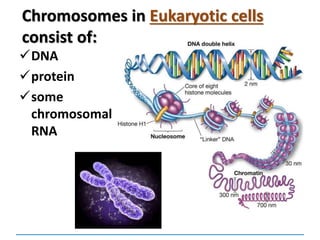
Chromosomes in Eukaryotic cells
consist of:
DNA
protein
some
chromosomal
RNA
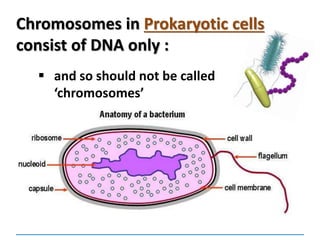
Chromosomes in Prokaryotic cells
consist of DNA only :
 and so should not be called
‘chromosomes’
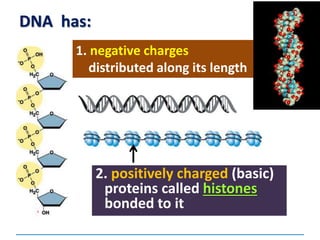
DNA has:
2. positively charged (basic)
proteins called histones
bonded to it
1. negative charges
distributed along its length
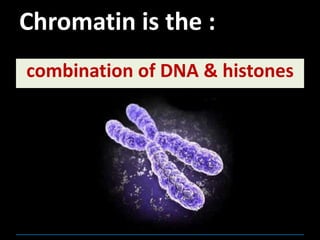
Chromatin is the :
combination of DNA & histones
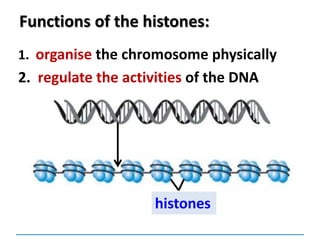
Functions of the histones:
1. organise the chromosome physically
2. regulate the activities of the DNA
histones
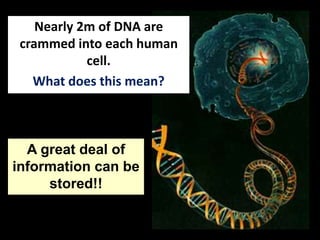
Nearly 2m of DNA are
crammed into each human
cell.
What does this mean?
A great deal of
information can be
stored!!
A closer at DNA:
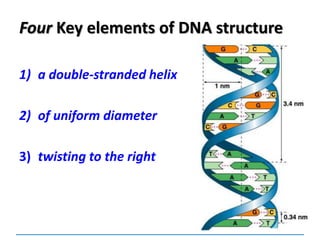
Four Key elements of DNA structure
1) a double-stranded helix
2) of uniform diameter
3) twisting to the right
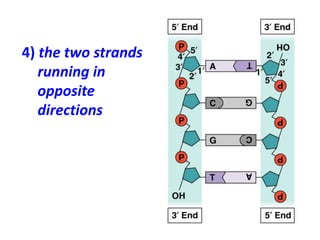
4) the two strands
running in
opposite
directions
Overview
A) CHROMOSOME STRUCTURE
B) SEMICONSERVATIVE REPLICATION
C) THE REPLICATION PROCESS
D) THE DNA BLUEPRINT
E) THE GENETIC CODE
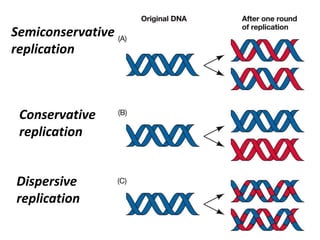
1. Semiconservative replication
2. Conservative replication
3. Dispersive replication
Three possible replication patterns:
Semiconservative
replication
Conservative
replication
Dispersive
replication
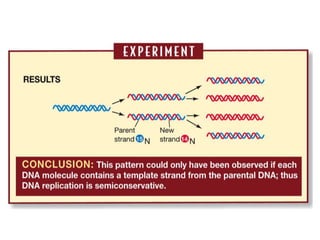
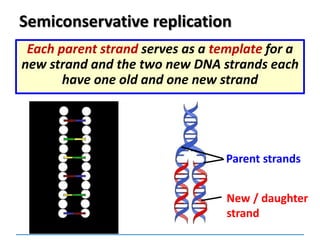
Semiconservative replication
Each parent strand serves as a template for a
new strand and the two new DNA strands each
have one old and one new strand
Parent strands
New / daughter
strand
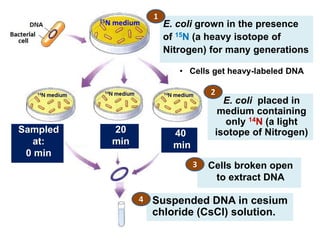
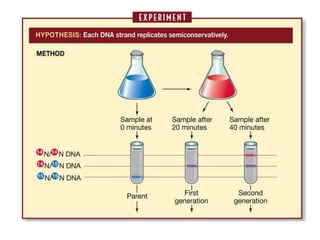
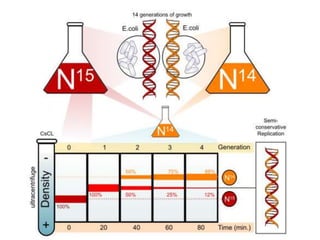
Meselson and Stahl experiment
[1958] demonstrates
semiconservative replication:
Cells broken open
to extract DNA
E. coli grown in the presence
of 15N (a heavy isotope of
Nitrogen) for many generations
E. coli placed in
medium containing
only 14N (a light
isotope of Nitrogen)
• Cells get heavy-labeled DNA
Sampled
at:
0 min
1
2
3
40
min
20
min
Suspended DNA in cesium
chloride (CsCl) solution.
4
15N medium
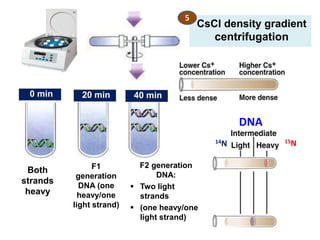
CsCl density gradient
centrifugation
5
15N14N
DNA
Both
strands
heavy
F1
generation
DNA (one
heavy/one
light strand)
0 min 20 min 40 min
F2 generation
DNA:
 Two light
strands
 (one heavy/one
light strand)
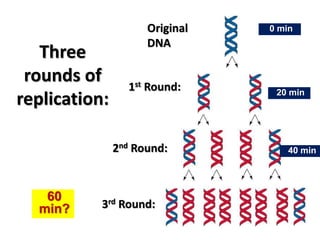
Three
rounds of
replication:
Original
DNA
1st Round:
2nd Round:
3rd Round:
0 min
20 min
40 min
60
min?
Overview
A) CHROMOSOME STRUCTURE
B) SEMICONSERVATIVE REPLICATION
C) THE REPLICATION PROCESS
D) THE DNA BLUEPRINT
E) THE GENETIC CODE
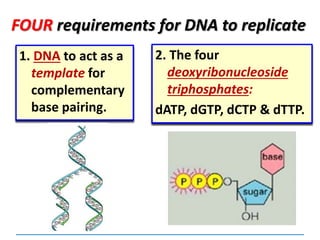
FOUR requirements for DNA to replicate
1. DNA to act as a
template for
complementary
base pairing.
2. The four
deoxyribonucleoside
triphosphates:
dATP, dGTP, dCTP & dTTP.
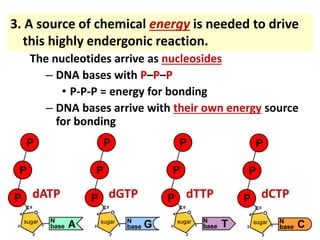
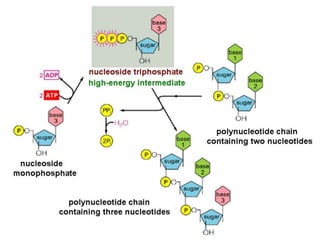
The nucleotides arrive as nucleosides
– DNA bases with P–P–P
• P-P-P = energy for bonding
– DNA bases arrive with their own energy source
for bonding
dATP dGTP dTTP dCTP
3. A source of chemical energy is needed to drive
this highly endergonic reaction.
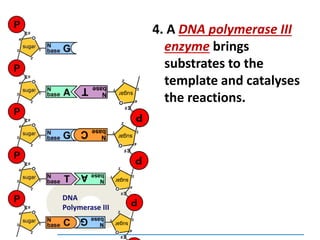
DNA
Polymerase III
4. A DNA polymerase III
enzyme brings
substrates to the
template and catalyses
the reactions.
energy
ATPGTPTTPCTP
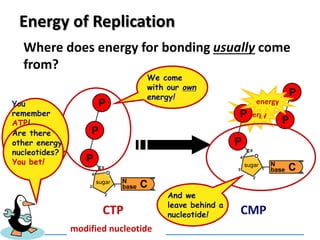
Energy of Replication
Where does energy for bonding usually come
from?
ADPAMPGMPTMPCMP
modified nucleotide
energy
We come
with our own
energy!
And we
leave behind a
nucleotide!
You
remember
ATP!
Are there
other ways
to get energy
out of it?
Are there
other energy
nucleotides?
You bet!
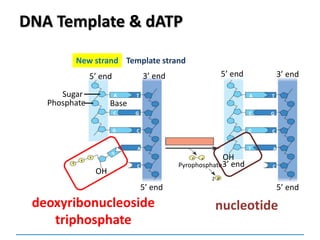
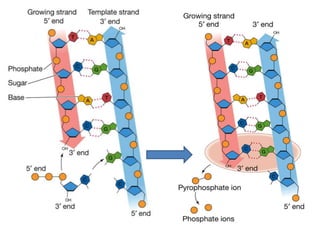
DNA Template & dATP
New strand Template strand
5’ end 3’ end
Sugar A T
Base
C
G
G
C
A
C
OH
P P
3’ end
5’ end 5’ end
A T
C
G
G
C
A
C
T
3’ endPyrophosphate
2 P
OH
Phosphate
5’ end
deoxyribonucleoside
triphosphate
nucleotide
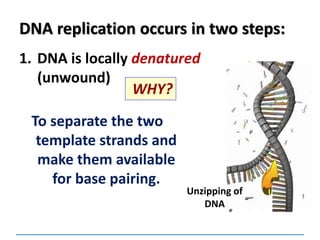
DNA replication occurs in two steps:
1. DNA is locally denatured
(unwound)
WHY?
To separate the two
template strands and
make them available
for base pairing.
Unzipping of
DNA
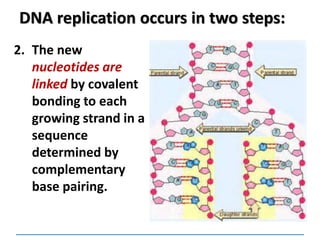
DNA replication occurs in two steps:
2. The new
nucleotides are
linked by covalent
bonding to each
growing strand in a
sequence
determined by
complementary
base pairing.
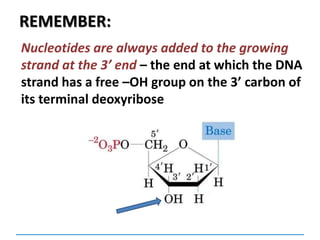
REMEMBER:
Nucleotides are always added to the growing
strand at the 3’ end – the end at which the DNA
strand has a free –OH group on the 3’ carbon of
its terminal deoxyribose
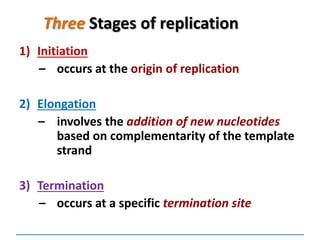
Three Stages of replication
1) Initiation
– occurs at the origin of replication
2) Elongation
– involves the addition of new nucleotides
based on complementarity of the template
strand
3) Termination
– occurs at a specific termination site
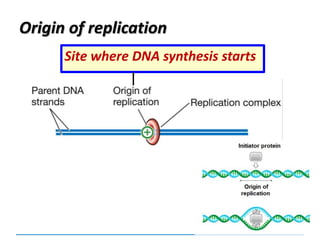
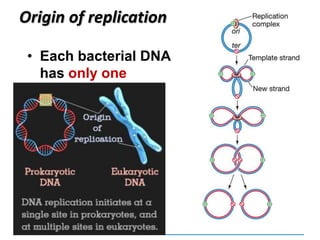
Origin of replication
Site where DNA synthesis starts
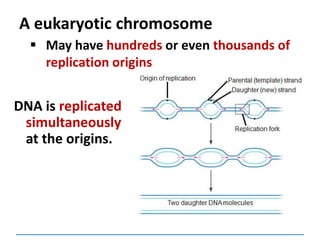
A eukaryotic chromosome
 May have hundreds or even thousands of
replication origins
DNA is replicated
simultaneously
at the origins.
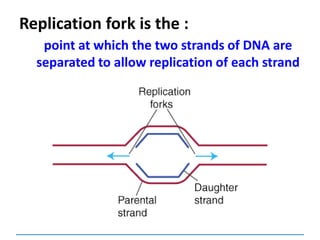
Replication fork is the :
point at which the two strands of DNA are
separated to allow replication of each strand
• Each bacterial DNA
has only one
Origin of replication
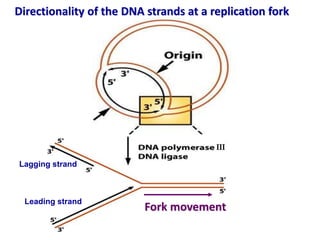
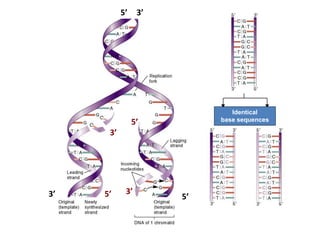
Directionality of the DNA strands at a replication fork
Leading strand
Lagging strand
Fork movement
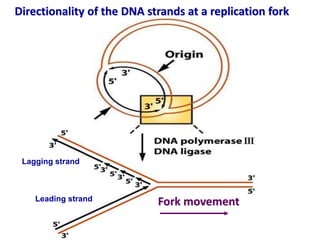
Directionality of the DNA strands at a replication fork
Leading strand
Lagging strand
Fork movement
Protein Role
DNA helicases Unwinds the double helix
RNA primase Synthesises RNA primers
Single-strand binding
proteins
Keep the two strands separated
DNA polymerase I Erases primer and fills gaps
DNA polymerase II
[not in syllabus]
Proofreading of DNA
DNA polymerase III Synthesises DNA; proofreading
DNA ligase Joins the ends of DNA segments;
DNA repair
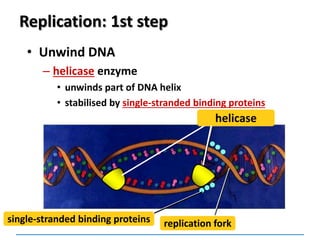
Replication: 1st step
• Unwind DNA
– helicase enzyme
• unwinds part of DNA helix
• stabilised by single-stranded binding proteins
single-stranded binding proteins replication fork
helicase
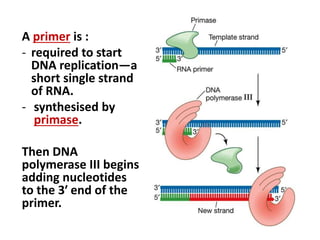
A primer is :
- required to start
DNA replication—a
short single strand
of RNA.
- synthesised by
primase.
Then DNA
polymerase III begins
adding nucleotides
to the 3′ end of the
primer.
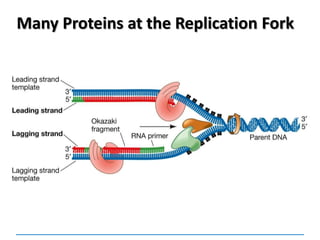
Many Proteins at the Replication Fork
Identical
base sequences
5’
5’
3’
3’ 5’
5’
3’
3’
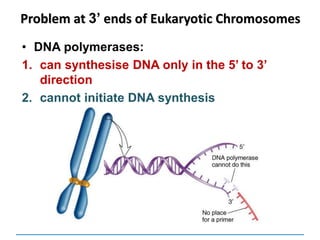
• DNA polymerases:
1. can synthesise DNA only in the 5’ to 3’
direction
2. cannot initiate DNA synthesis
Problem at 3’ ends of Eukaryotic Chromosomes
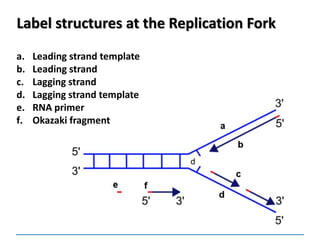
Label structures at the Replication Fork
a. Leading strand template
b. Leading strand
c. Lagging strand
d. Lagging strand template
e. RNA primer
f. Okazaki fragment
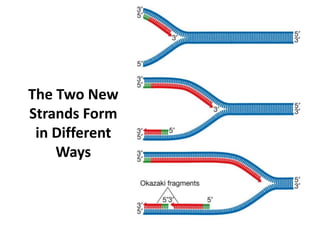
The Two New
Strands Form
in Different
Ways
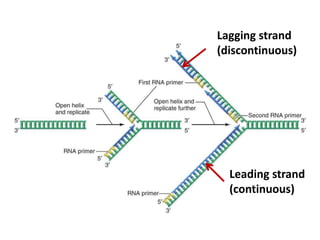
Leading strand
(continuous)
Lagging strand
(discontinuous)
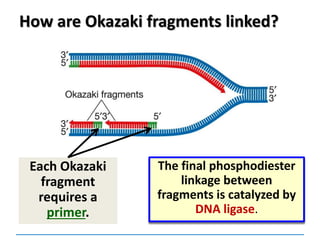
How are Okazaki fragments linked?
Each Okazaki
fragment
requires a
primer.
The final phosphodiester
linkage between
fragments is catalyzed by
DNA ligase.
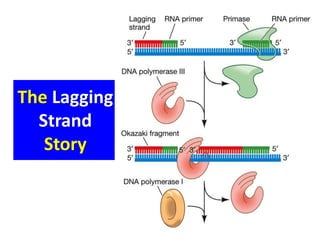
The Lagging
Strand
Story
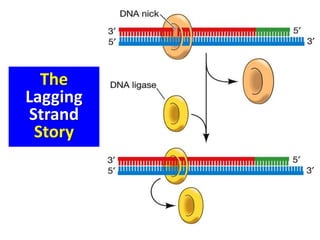
The
Lagging
Strand
Story
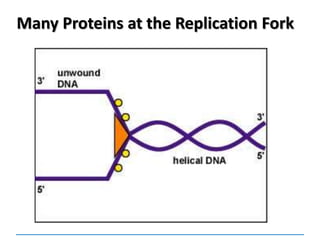
Many Proteins at the Replication Fork
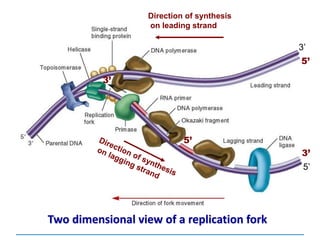
Two dimensional view of a replication fork
Direction of synthesis
on leading strand
3’
5’
3’
5’
3’
5’
Proofreading procedure
• DNA replication is not perfect due to:
1) the high speed of replication
- (1000 nucleotides per second)
2) spontaneous chemical flip-flops in the bases
• occasionally DNA polymerase incorporates
incorrectly matched bases
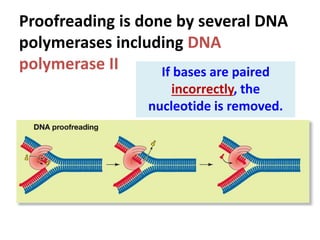
If bases are paired
incorrectly, the
nucleotide is removed.
Proofreading is done by several DNA
polymerases including DNA
polymerase II
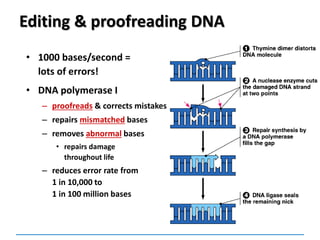
Editing & proofreading DNA
• 1000 bases/second =
lots of errors!
• DNA polymerase I
– proofreads & corrects mistakes
– repairs mismatched bases
– removes abnormal bases
• repairs damage
throughout life
– reduces error rate from
1 in 10,000 to
1 in 100 million bases
Fast & accurate!
• It takes E. coli <1 hour to copy
5 million base pairs in its single chromosome
– divide to form two identical daughter cells
• Human cell copies its 6 billion bases & divide
into daughter cells in only few hours
– remarkably accurate
– only ~1 error per 100 million bases
– ~30 errors per cell cycle
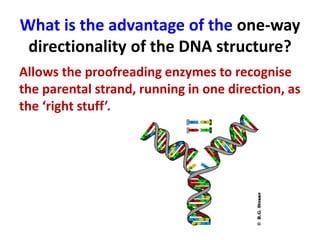
What is the advantage of the one-way
directionality of the DNA structure?
Allows the proofreading enzymes to recognise
the parental strand, running in one direction, as
the ‘right stuff’.
Overview
A) CHROMOSOME STRUCTURE
B) SEMICONSERVATIVE REPLICATION
C) THE REPLICATION PROCESS
D) THE DNA BLUEPRINT
E) THE GENETIC CODE
BLUEPRINT: a design plan or
other technical drawing
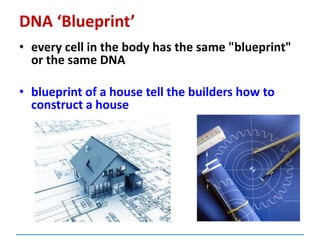
DNA ‘Blueprint’
• every cell in the body has the same "blueprint"
or the same DNA
• blueprint of a house tell the builders how to
construct a house
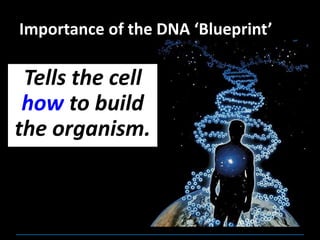
Importance of the DNA ‘Blueprint’
Tells the cell
how to build
the organism.
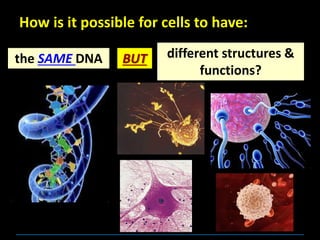
How is it possible for cells to have:
the SAME DNA different structures &
functions?
BUT
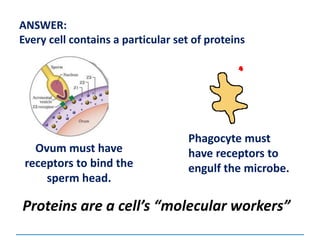
Proteins are a cell’s “molecular workers”
ANSWER:
Every cell contains a particular set of proteins
Ovum must have
receptors to bind the
sperm head.
Phagocyte must
have receptors to
engulf the microbe.
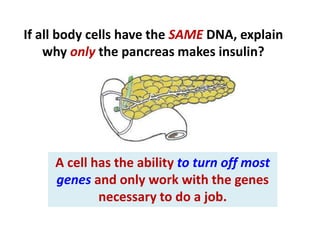
If all body cells have the SAME DNA, explain
why only the pancreas makes insulin?
A cell has the ability to turn off most
genes and only work with the genes
necessary to do a job.
DNA ‘Blueprint’
• information by itself, does not do anything – e.g.
a blueprint may describe the structure of a
house in great detail, but unless that
information is translated into action, no house
will ever be built
• likewise, although the base sequence of DNA,
the “molecular blueprint” of every cell contains
an incredible amount of information, DNA
cannot carry out any action on it own
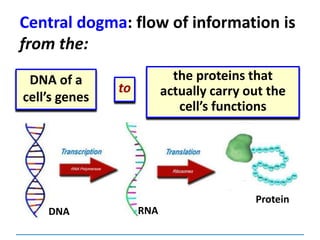
Central dogma: flow of information is
from the:
DNA of a
cell’s genes
the proteins that
actually carry out the
cell’s functions
RNADNA
Protein
to
What is ‘junk DNA’?
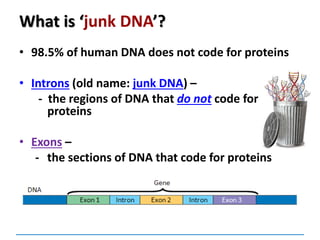
• 98.5% of human DNA does not code for proteins
• Introns (old name: junk DNA) –
- the regions of DNA that do not code for
proteins
• Exons –
- the sections of DNA that code for proteins
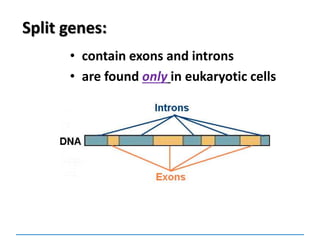
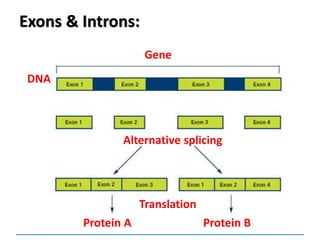
Split genes:
• contain exons and introns
• are found only in eukaryotic cells
Exons & Introns:
Gene
DNA
Translation
Protein A Protein B
Alternative splicing
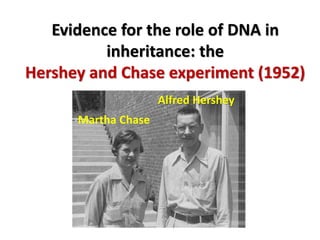
Evidence for the role of DNA in
inheritance: the
Hershey and Chase experiment (1952)
Martha Chase
Alfred Hershey
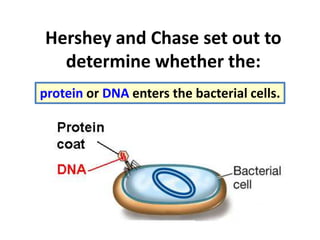
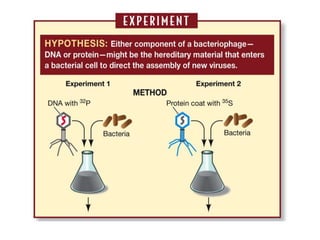
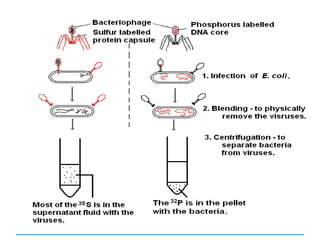
Hershey and Chase set out to
determine whether the:
protein or DNA enters the bacterial cells.
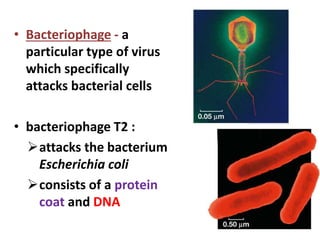
• Bacteriophage - a
particular type of virus
which specifically
attacks bacterial cells
• bacteriophage T2 :
attacks the bacterium
Escherichia coli
consists of a protein
coat and DNA
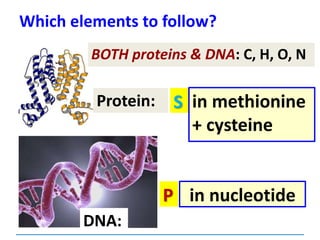
Which elements to follow?
DNA:
in nucleotide
Protein:
BOTH proteins & DNA: C, H, O, N
S
P
in methionine
+ cysteine
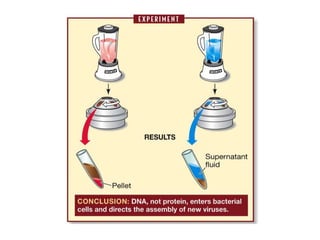
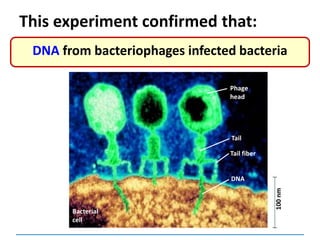
This experiment confirmed that:
DNA from bacteriophages infected bacteria
Phage
head
Tail
Tail fiber
DNA
Bacterial
cell
100nm
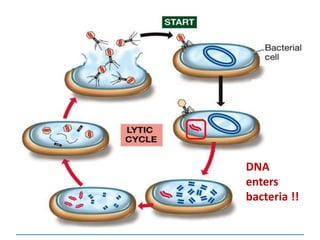
DNA
enters
bacteria !!
Overview
A) CHROMOSOME STRUCTURE
B) SEMICONSERVATIVE REPLICATION
C) THE REPLICATION PROCESS
D) THE DNA BLUEPRINT
E) THE GENETIC CODE
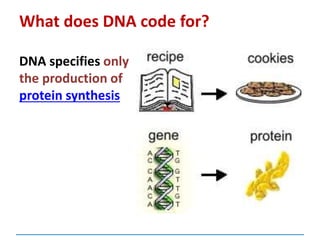
What does DNA code for?
DNA specifies only
the production of
protein synthesis
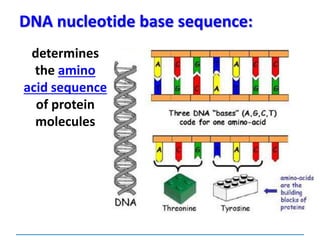
DNA nucleotide base sequence:
determines
the amino
acid sequence
of protein
molecules
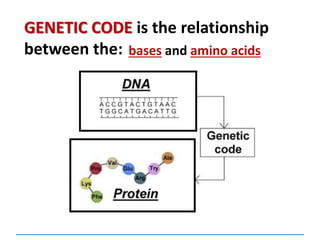
GENETIC CODE is the relationship
between the: bases and amino acids
The code
• DNA nucleotide bases:-
adenine, guanine, cytosine and thymine
• RNA has four nucleotide bases:-
adenine, guanine, cytosine and uracil
• this ‘alphabet’ of 4 letters is responsible for
carrying the code that results in the synthesis of
a potentially infinite number of protein
molecules
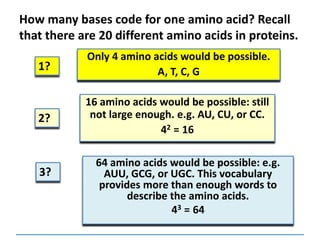
How many bases code for one amino acid? Recall
that there are 20 different amino acids in proteins.
Only 4 amino acids would be possible.
A, T, C, G1?
2?
3?
16 amino acids would be possible: still
not large enough. e.g. AU, CU, or CC.
42 = 16
64 amino acids would be possible: e.g.
AUU, GCG, or UGC. This vocabulary
provides more than enough words to
describe the amino acids.
43 = 64
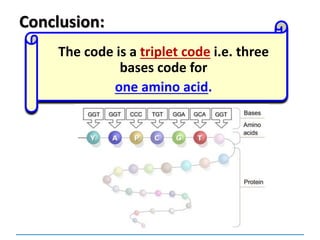
Conclusion:
The code is a triplet code i.e. three
bases code for
one amino acid.
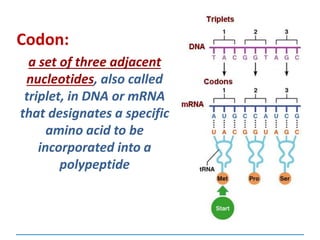
Codon:
a set of three adjacent
nucleotides, also called
triplet, in DNA or mRNA
that designates a specific
amino acid to be
incorporated into a
polypeptide
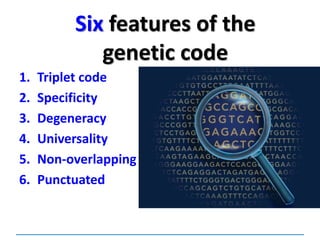
Six features of the
genetic code
1. Triplet code
2. Specificity
3. Degeneracy
4. Universality
5. Non-overlapping
6. Punctuated
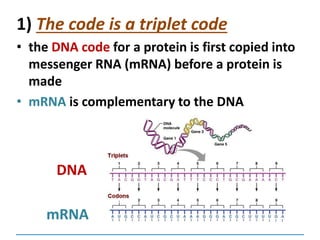
1) The code is a triplet code
• the DNA code for a protein is first copied into
messenger RNA (mRNA) before a protein is
made
• mRNA is complementary to the DNA
DNA
mRNA
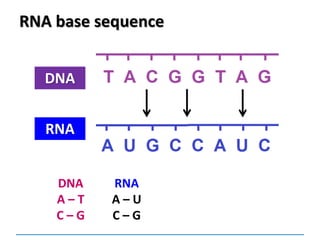
RNA base sequence
DNA
RNA
DNA
A – T
C – G
RNA
A – U
C – G
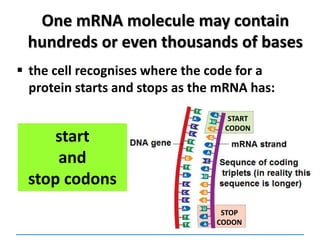
One mRNA molecule may contain
hundreds or even thousands of bases
 the cell recognises where the code for a
protein starts and stops as the mRNA has:
START
CODON
STOP
CODON
start
and
stop codons
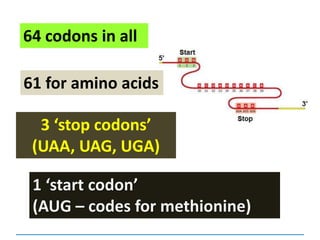
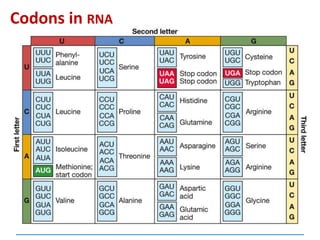
64 codons in all
61 for amino acids
3 ‘stop codons’
(UAA, UAG, UGA)
1 ‘start codon’
(AUG – codes for methionine)
Codons in RNA
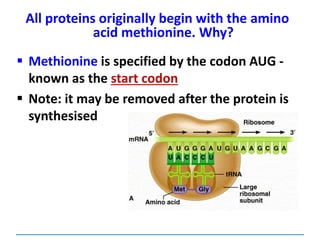
 Methionine is specified by the codon AUG -
known as the start codon
 Note: it may be removed after the protein is
synthesised
All proteins originally begin with the amino
acid methionine. Why?
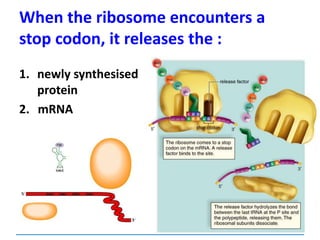
When the ribosome encounters a
stop codon, it releases the :
1. newly synthesised
protein
2. mRNA
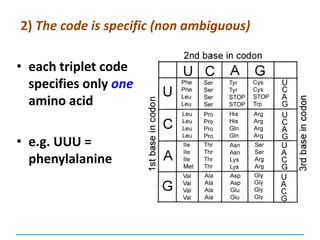
2) The code is specific (non ambiguous)
• each triplet code
specifies only one
amino acid
• e.g. UUU =
phenylalanine
3) The code is degenerate
Valine
GUU
GUC
GUA
GUG
 a given amino acid may be coded for by more
than one codon
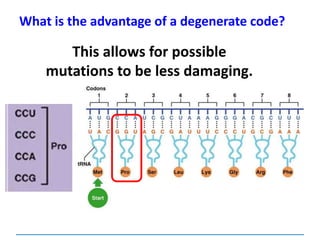
64 codons and only 20
amino acids:
so some amino acids
are coded for by
several codons –
exceptions [next
slide]:
Tyrosine
UAU
UAC
Lysine
AAA
AAG
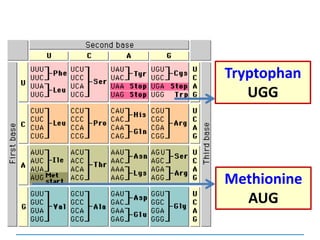
Tryptophan
UGG
Methionine
AUG
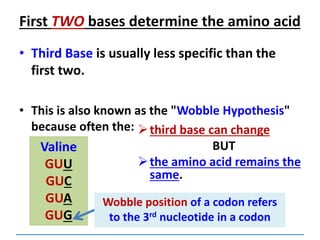
First TWO bases determine the amino acid
• Third Base is usually less specific than the
first two.
• This is also known as the "Wobble Hypothesis"
because often the:
Valine
GUU
GUC
GUA
GUG
third base can change
BUT
the amino acid remains the
same.
Wobble position of a codon refers
to the 3rd nucleotide in a codon
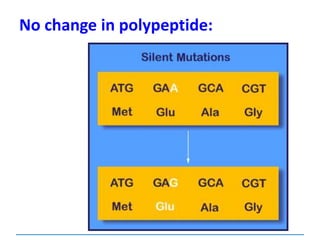
What is the advantage of a degenerate code?
This allows for possible
mutations to be less damaging.
No change in polypeptide:
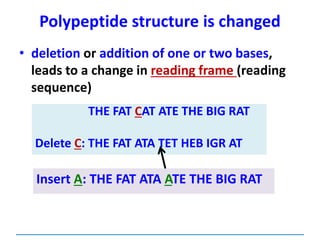
Polypeptide structure is changed
• deletion or addition of one or two bases,
leads to a change in reading frame (reading
sequence)
THE FAT CAT ATE THE BIG RAT
Delete C: THE FAT ATA TET HEB IGR AT
Insert A: THE FAT ATA ATE THE BIG RAT
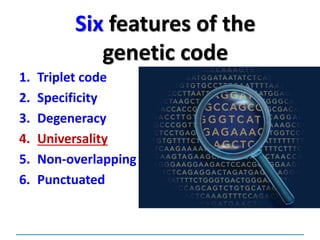
Six features of the
genetic code
1. Triplet code
2. Specificity
3. Degeneracy
4. Universality
5. Non-overlapping
6. Punctuated
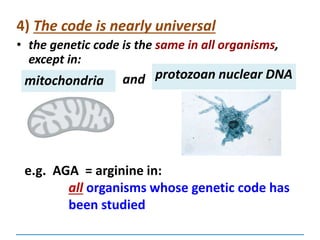
4) The code is nearly universal
• the genetic code is the same in all organisms,
except in:
e.g. AGA = arginine in:
all organisms whose genetic code has
been studied
mitochondria protozoan nuclear DNAand
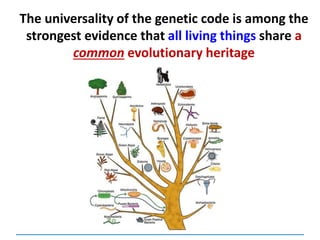
The universality of the genetic code is among the
strongest evidence that all living things share a
common evolutionary heritage
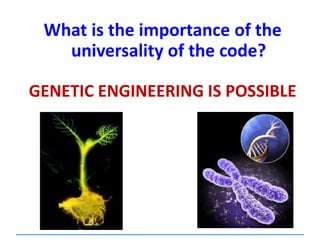
What is the importance of the
universality of the code?
GENETIC ENGINEERING IS POSSIBLE
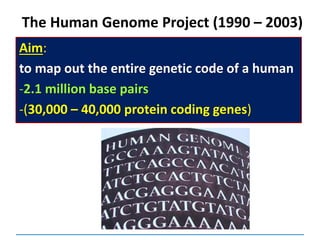
Aim:
to map out the entire genetic code of a human
-2.1 million base pairs
-(30,000 – 40,000 protein coding genes)
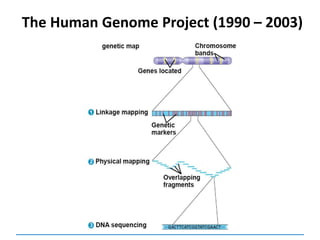
The Human Genome Project (1990 – 2003)
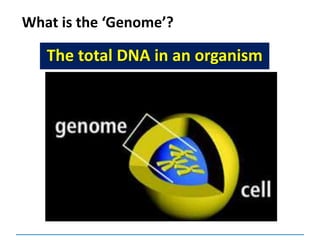
What is the ‘Genome’?
The total DNA in an organism
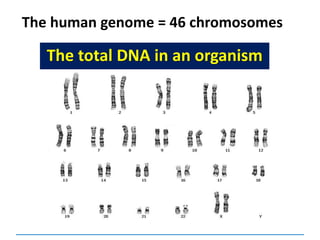
The human genome = 46 chromosomes
The total DNA in an organism
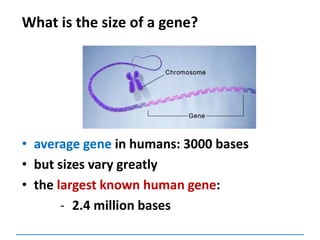
What is the size of a gene?
• average gene in humans: 3000 bases
• but sizes vary greatly
• the largest known human gene:
- 2.4 million bases
Six features of the
genetic code
1. Triplet code
2. Specificity
3. Degeneracy
4. Universality
5. Non-overlapping
6. Punctuated
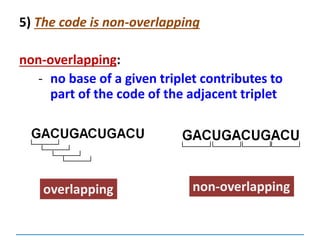
5) The code is non-overlapping
non-overlapping:
- no base of a given triplet contributes to
part of the code of the adjacent triplet
non-overlappingoverlapping
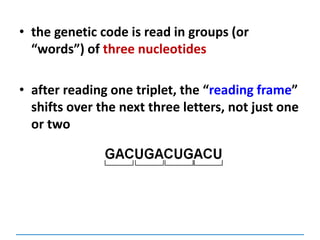
• the genetic code is read in groups (or
“words”) of three nucleotides
• after reading one triplet, the “reading frame”
shifts over the next three letters, not just one
or two
Six features of the
genetic code
1. Triplet code
2. Specificity
3. Degeneracy
4. Universality
5. Non-overlapping
6. Punctuated
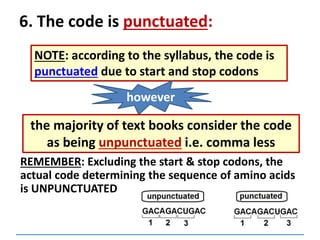
6. The code is punctuated:
REMEMBER: Excluding the start & stop codons, the
actual code determining the sequence of amino acids
is UNPUNCTUATED
NOTE: according to the syllabus, the code is
punctuated due to start and stop codons
however
the majority of text books consider the code
as being unpunctuated i.e. comma less
MUTATIONS
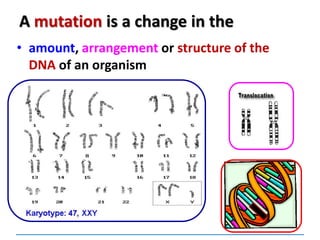
A mutation is a change in the
• amount, arrangement or structure of the
DNA of an organism
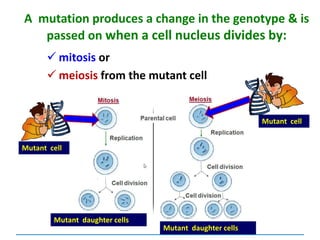
A mutation produces a change in the genotype & is
passed on when a cell nucleus divides by:
 mitosis or
 meiosis from the mutant cell
Mutant daughter cells
Mutant cell
Mutant cell
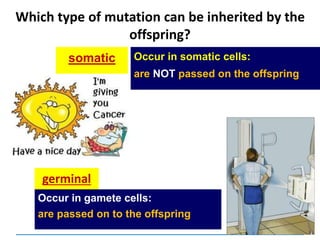
Which type of mutation can be inherited by the
offspring?
germinal
somatic Occur in somatic cells:
are NOT passed on the offspring
Occur in gamete cells:
are passed on to the offspring
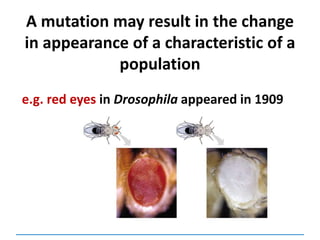
A mutation may result in the change
in appearance of a characteristic of a
population
e.g. red eyes in Drosophila appeared in 1909
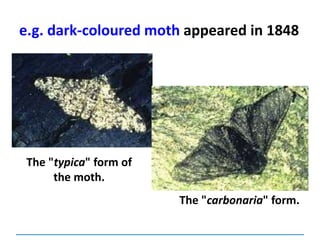
e.g. dark-coloured moth appeared in 1848
The "typica" form of
the moth.
The "carbonaria" form.
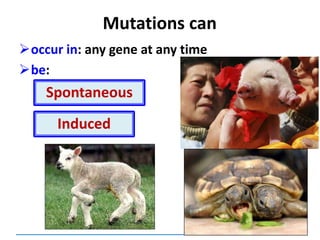
occur in: any gene at any time
be:
Mutations can
Spontaneous
Induced
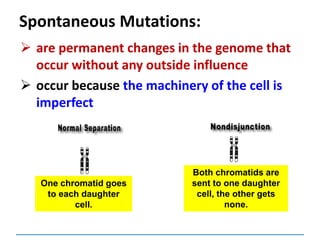
Spontaneous Mutations:
 are permanent changes in the genome that
occur without any outside influence
 occur because the machinery of the cell is
imperfect
Both chromatids are
sent to one daughter
cell, the other gets
none.
One chromatid goes
to each daughter
cell.
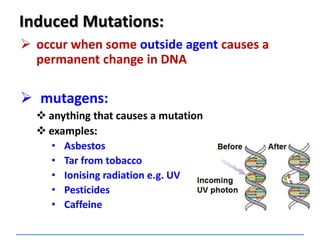
Induced Mutations:
 occur when some outside agent causes a
permanent change in DNA
 mutagens:
 anything that causes a mutation
 examples:
• Asbestos
• Tar from tobacco
• Ionising radiation e.g. UV
• Pesticides
• Caffeine
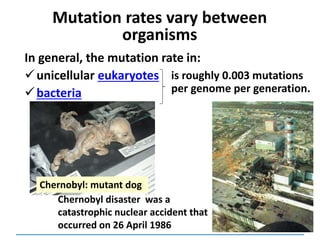
Mutation rates vary between
organisms
In general, the mutation rate in:
unicellular eukaryotes
bacteria
Chernobyl disaster was a
catastrophic nuclear accident that
occurred on 26 April 1986
is roughly 0.003 mutations
per genome per generation.
Chernobyl: mutant dog
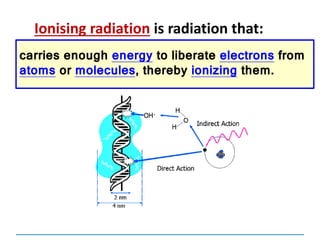
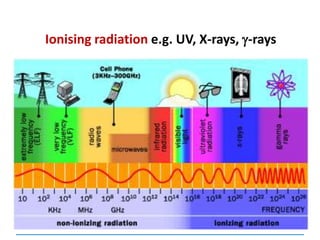
Ionising radiation is radiation that:
carries enough energy to liberate electrons from
atoms or molecules, thereby ionizing them.
Ionising radiation e.g. UV, X-rays, -rays
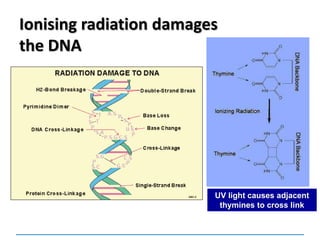
Ionising radiation damages
the DNA
UV light causes adjacent
thymines to cross link
Mutations
can be:
Chromosomal
[covered in 2nd year]
Gene mutations or point mutations:
INSERTION
INVERSION
DELETION
SUBSTITUTION
describe a change in the structure of DNA
at a single locus
1
2
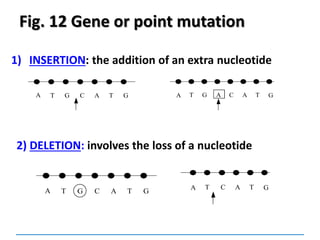
Fig. 12 Gene or point mutation
1) INSERTION: the addition of an extra nucleotide
A GT G C A T A TT G A C A G
2) DELETION: involves the loss of a nucleotide
A GT G C A T A TT C A G
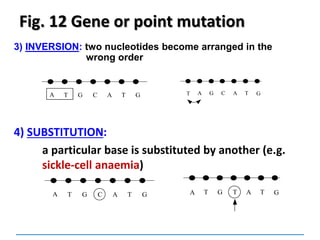
Fig. 12 Gene or point mutation
4) SUBSTITUTION:
a particular base is substituted by another (e.g.
sickle-cell anaemia)
A GT G C A T A TT G T A G
3) INVERSION: two nucleotides become arranged in the
wrong order
A GT G C A T T TA G C A G
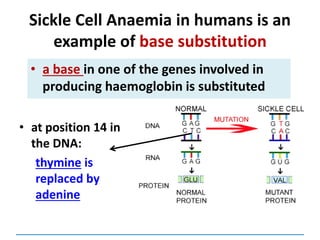
Sickle Cell Anaemia in humans is an
example of base substitution
• a base in one of the genes involved in
producing haemoglobin is substituted
• at position 14 in
the DNA:
thymine is
replaced by
adenine
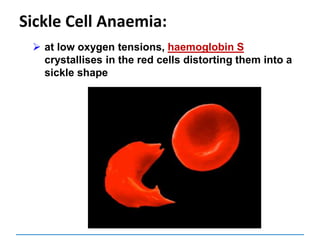
Sickle Cell Anaemia:
 at low oxygen tensions, haemoglobin S
crystallises in the red cells distorting them into a
sickle shape
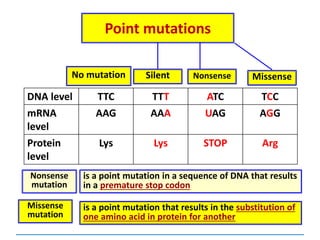
Point mutations
No mutation
DNA level TTC TTT ATC TCC
mRNA
level
AAG AAA UAG AGG
Protein
level
Lys Lys STOP Arg
Silent Nonsense Missense
Missense
mutation
Nonsense
mutation
is a point mutation in a sequence of DNA that results
in a premature stop codon
is a point mutation that results in the substitution of
one amino acid in protein for another
Frameshift mutations
The addition or
deletion
of a single base
has much more profound
consequences than does the
substitution of one base for another
THE CAT SAW THE DOG
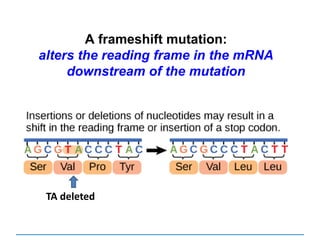
A frameshift mutation:
alters the reading frame in the mRNA
downstream of the mutation
TA deleted
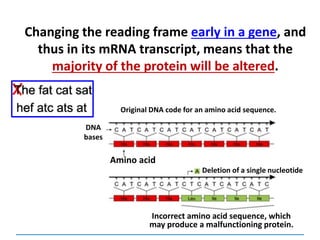
Changing the reading frame early in a gene, and
thus in its mRNA transcript, means that the
majority of the protein will be altered.
Amino acid
Deletion of a single nucleotide
DNA
bases
Original DNA code for an amino acid sequence.
Incorrect amino acid sequence, which
may produce a malfunctioning protein.
End-Of-Year SEP 2013
Use your knowledge of the genetic code to explain
statements (a) and (b) below. Use your knowledge
of genetic mutations to answer statements (c), (d)
and (e). [5 marks each]
i) Distinguish between a base substitution and an
inversion.
i) Distinguish between a deletion and an insertion.
ii) Explain how deletions and insertions lead to
frameshift mutations
Use your knowledge of biology to explain the following.
The structure of the DNA molecule permits vast amounts
of information to be stored. (5 marks)
Question: [SEP, 2007]
1. Information on the DNA molecule is in the form of a
sequence of bases, where three consecutive bases
specify an amino acid. Thus a small number of bases are
needed to code for an amino acid. Considering that DNA
within a eukaryotic cell is 2m long, it allows for a large
amount of information to be stored.
2. In many eukaryotic cells, split genes occur. These
contain regions which code for the protein called exons
and introns which do not code. The way in which the
exons are linked together determines the type of
polypeptide to be formed. Thus one gene can form a
number of closely related polypeptides.
THE END

Dnareplication

  • 2.
    Overview A) CHROMOSOME STRUCTURE B)SEMICONSERVATIVE REPLICATION C) THE REPLICATION PROCESS D) THE DNA BLUEPRINT E) THE GENETIC CODE
  • 3.
    Chromosomes in Eukaryoticcells consist of: DNA protein some chromosomal RNA
  • 4.
    Chromosomes in Prokaryoticcells consist of DNA only :  and so should not be called ‘chromosomes’
  • 5.
    DNA has: 2. positivelycharged (basic) proteins called histones bonded to it 1. negative charges distributed along its length
  • 6.
    Chromatin is the: combination of DNA & histones
  • 7.
    Functions of thehistones: 1. organise the chromosome physically 2. regulate the activities of the DNA histones
  • 8.
    Nearly 2m ofDNA are crammed into each human cell. What does this mean? A great deal of information can be stored!!
  • 9.
  • 10.
    Four Key elementsof DNA structure 1) a double-stranded helix 2) of uniform diameter 3) twisting to the right
  • 11.
    4) the twostrands running in opposite directions
  • 12.
    Overview A) CHROMOSOME STRUCTURE B)SEMICONSERVATIVE REPLICATION C) THE REPLICATION PROCESS D) THE DNA BLUEPRINT E) THE GENETIC CODE
  • 13.
    1. Semiconservative replication 2.Conservative replication 3. Dispersive replication Three possible replication patterns:
  • 14.
  • 15.
    Semiconservative replication Each parentstrand serves as a template for a new strand and the two new DNA strands each have one old and one new strand Parent strands New / daughter strand
  • 16.
    Meselson and Stahlexperiment [1958] demonstrates semiconservative replication:
  • 17.
    Cells broken open toextract DNA E. coli grown in the presence of 15N (a heavy isotope of Nitrogen) for many generations E. coli placed in medium containing only 14N (a light isotope of Nitrogen) • Cells get heavy-labeled DNA Sampled at: 0 min 1 2 3 40 min 20 min Suspended DNA in cesium chloride (CsCl) solution. 4 15N medium
  • 18.
    CsCl density gradient centrifugation 5 15N14N DNA Both strands heavy F1 generation DNA(one heavy/one light strand) 0 min 20 min 40 min F2 generation DNA:  Two light strands  (one heavy/one light strand)
  • 21.
    Three rounds of replication: Original DNA 1st Round: 2ndRound: 3rd Round: 0 min 20 min 40 min 60 min?
  • 23.
    Overview A) CHROMOSOME STRUCTURE B)SEMICONSERVATIVE REPLICATION C) THE REPLICATION PROCESS D) THE DNA BLUEPRINT E) THE GENETIC CODE
  • 24.
    FOUR requirements forDNA to replicate 1. DNA to act as a template for complementary base pairing. 2. The four deoxyribonucleoside triphosphates: dATP, dGTP, dCTP & dTTP.
  • 25.
    The nucleotides arriveas nucleosides – DNA bases with P–P–P • P-P-P = energy for bonding – DNA bases arrive with their own energy source for bonding dATP dGTP dTTP dCTP 3. A source of chemical energy is needed to drive this highly endergonic reaction.
  • 26.
    DNA Polymerase III 4. ADNA polymerase III enzyme brings substrates to the template and catalyses the reactions.
  • 27.
    energy ATPGTPTTPCTP Energy of Replication Wheredoes energy for bonding usually come from? ADPAMPGMPTMPCMP modified nucleotide energy We come with our own energy! And we leave behind a nucleotide! You remember ATP! Are there other ways to get energy out of it? Are there other energy nucleotides? You bet!
  • 28.
    DNA Template &dATP New strand Template strand 5’ end 3’ end Sugar A T Base C G G C A C OH P P 3’ end 5’ end 5’ end A T C G G C A C T 3’ endPyrophosphate 2 P OH Phosphate 5’ end deoxyribonucleoside triphosphate nucleotide
  • 30.
    DNA replication occursin two steps: 1. DNA is locally denatured (unwound) WHY? To separate the two template strands and make them available for base pairing. Unzipping of DNA
  • 31.
    DNA replication occursin two steps: 2. The new nucleotides are linked by covalent bonding to each growing strand in a sequence determined by complementary base pairing.
  • 32.
    REMEMBER: Nucleotides are alwaysadded to the growing strand at the 3’ end – the end at which the DNA strand has a free –OH group on the 3’ carbon of its terminal deoxyribose
  • 34.
    Three Stages ofreplication 1) Initiation – occurs at the origin of replication 2) Elongation – involves the addition of new nucleotides based on complementarity of the template strand 3) Termination – occurs at a specific termination site
  • 35.
    Origin of replication Sitewhere DNA synthesis starts
  • 36.
    A eukaryotic chromosome May have hundreds or even thousands of replication origins DNA is replicated simultaneously at the origins.
  • 37.
    Replication fork isthe : point at which the two strands of DNA are separated to allow replication of each strand
  • 38.
    • Each bacterialDNA has only one Origin of replication
  • 39.
    Directionality of theDNA strands at a replication fork Leading strand Lagging strand Fork movement
  • 40.
    Directionality of theDNA strands at a replication fork Leading strand Lagging strand Fork movement
  • 41.
    Protein Role DNA helicasesUnwinds the double helix RNA primase Synthesises RNA primers Single-strand binding proteins Keep the two strands separated DNA polymerase I Erases primer and fills gaps DNA polymerase II [not in syllabus] Proofreading of DNA DNA polymerase III Synthesises DNA; proofreading DNA ligase Joins the ends of DNA segments; DNA repair
  • 42.
    Replication: 1st step •Unwind DNA – helicase enzyme • unwinds part of DNA helix • stabilised by single-stranded binding proteins single-stranded binding proteins replication fork helicase
  • 43.
    A primer is: - required to start DNA replication—a short single strand of RNA. - synthesised by primase. Then DNA polymerase III begins adding nucleotides to the 3′ end of the primer.
  • 44.
    Many Proteins atthe Replication Fork
  • 45.
  • 46.
    • DNA polymerases: 1.can synthesise DNA only in the 5’ to 3’ direction 2. cannot initiate DNA synthesis Problem at 3’ ends of Eukaryotic Chromosomes
  • 47.
    Label structures atthe Replication Fork a. Leading strand template b. Leading strand c. Lagging strand d. Lagging strand template e. RNA primer f. Okazaki fragment
  • 48.
    The Two New StrandsForm in Different Ways
  • 49.
  • 50.
    How are Okazakifragments linked? Each Okazaki fragment requires a primer. The final phosphodiester linkage between fragments is catalyzed by DNA ligase.
  • 51.
  • 52.
  • 53.
    Many Proteins atthe Replication Fork
  • 54.
    Two dimensional viewof a replication fork Direction of synthesis on leading strand 3’ 5’ 3’ 5’ 3’ 5’
  • 55.
    Proofreading procedure • DNAreplication is not perfect due to: 1) the high speed of replication - (1000 nucleotides per second) 2) spontaneous chemical flip-flops in the bases • occasionally DNA polymerase incorporates incorrectly matched bases
  • 56.
    If bases arepaired incorrectly, the nucleotide is removed. Proofreading is done by several DNA polymerases including DNA polymerase II
  • 57.
    Editing & proofreadingDNA • 1000 bases/second = lots of errors! • DNA polymerase I – proofreads & corrects mistakes – repairs mismatched bases – removes abnormal bases • repairs damage throughout life – reduces error rate from 1 in 10,000 to 1 in 100 million bases
  • 58.
    Fast & accurate! •It takes E. coli <1 hour to copy 5 million base pairs in its single chromosome – divide to form two identical daughter cells • Human cell copies its 6 billion bases & divide into daughter cells in only few hours – remarkably accurate – only ~1 error per 100 million bases – ~30 errors per cell cycle
  • 59.
    What is theadvantage of the one-way directionality of the DNA structure? Allows the proofreading enzymes to recognise the parental strand, running in one direction, as the ‘right stuff’.
  • 60.
    Overview A) CHROMOSOME STRUCTURE B)SEMICONSERVATIVE REPLICATION C) THE REPLICATION PROCESS D) THE DNA BLUEPRINT E) THE GENETIC CODE BLUEPRINT: a design plan or other technical drawing
  • 61.
    DNA ‘Blueprint’ • everycell in the body has the same "blueprint" or the same DNA • blueprint of a house tell the builders how to construct a house
  • 62.
    Importance of theDNA ‘Blueprint’ Tells the cell how to build the organism.
  • 63.
    How is itpossible for cells to have: the SAME DNA different structures & functions? BUT
  • 64.
    Proteins are acell’s “molecular workers” ANSWER: Every cell contains a particular set of proteins Ovum must have receptors to bind the sperm head. Phagocyte must have receptors to engulf the microbe.
  • 65.
    If all bodycells have the SAME DNA, explain why only the pancreas makes insulin? A cell has the ability to turn off most genes and only work with the genes necessary to do a job.
  • 66.
    DNA ‘Blueprint’ • informationby itself, does not do anything – e.g. a blueprint may describe the structure of a house in great detail, but unless that information is translated into action, no house will ever be built • likewise, although the base sequence of DNA, the “molecular blueprint” of every cell contains an incredible amount of information, DNA cannot carry out any action on it own
  • 67.
    Central dogma: flowof information is from the: DNA of a cell’s genes the proteins that actually carry out the cell’s functions RNADNA Protein to
  • 68.
    What is ‘junkDNA’? • 98.5% of human DNA does not code for proteins • Introns (old name: junk DNA) – - the regions of DNA that do not code for proteins • Exons – - the sections of DNA that code for proteins
  • 69.
    Split genes: • containexons and introns • are found only in eukaryotic cells
  • 70.
    Exons & Introns: Gene DNA Translation ProteinA Protein B Alternative splicing
  • 71.
    Evidence for therole of DNA in inheritance: the Hershey and Chase experiment (1952) Martha Chase Alfred Hershey
  • 72.
    Hershey and Chaseset out to determine whether the: protein or DNA enters the bacterial cells.
  • 73.
    • Bacteriophage -a particular type of virus which specifically attacks bacterial cells • bacteriophage T2 : attacks the bacterium Escherichia coli consists of a protein coat and DNA
  • 74.
    Which elements tofollow? DNA: in nucleotide Protein: BOTH proteins & DNA: C, H, O, N S P in methionine + cysteine
  • 78.
    This experiment confirmedthat: DNA from bacteriophages infected bacteria Phage head Tail Tail fiber DNA Bacterial cell 100nm
  • 79.
  • 80.
    Overview A) CHROMOSOME STRUCTURE B)SEMICONSERVATIVE REPLICATION C) THE REPLICATION PROCESS D) THE DNA BLUEPRINT E) THE GENETIC CODE
  • 81.
    What does DNAcode for? DNA specifies only the production of protein synthesis
  • 82.
    DNA nucleotide basesequence: determines the amino acid sequence of protein molecules
  • 83.
    GENETIC CODE isthe relationship between the: bases and amino acids
  • 84.
    The code • DNAnucleotide bases:- adenine, guanine, cytosine and thymine • RNA has four nucleotide bases:- adenine, guanine, cytosine and uracil • this ‘alphabet’ of 4 letters is responsible for carrying the code that results in the synthesis of a potentially infinite number of protein molecules
  • 85.
    How many basescode for one amino acid? Recall that there are 20 different amino acids in proteins. Only 4 amino acids would be possible. A, T, C, G1? 2? 3? 16 amino acids would be possible: still not large enough. e.g. AU, CU, or CC. 42 = 16 64 amino acids would be possible: e.g. AUU, GCG, or UGC. This vocabulary provides more than enough words to describe the amino acids. 43 = 64
  • 86.
    Conclusion: The code isa triplet code i.e. three bases code for one amino acid.
  • 87.
    Codon: a set ofthree adjacent nucleotides, also called triplet, in DNA or mRNA that designates a specific amino acid to be incorporated into a polypeptide
  • 88.
    Six features ofthe genetic code 1. Triplet code 2. Specificity 3. Degeneracy 4. Universality 5. Non-overlapping 6. Punctuated
  • 89.
    1) The codeis a triplet code • the DNA code for a protein is first copied into messenger RNA (mRNA) before a protein is made • mRNA is complementary to the DNA DNA mRNA
  • 90.
    RNA base sequence DNA RNA DNA A– T C – G RNA A – U C – G
  • 91.
    One mRNA moleculemay contain hundreds or even thousands of bases  the cell recognises where the code for a protein starts and stops as the mRNA has: START CODON STOP CODON start and stop codons
  • 92.
    64 codons inall 61 for amino acids 3 ‘stop codons’ (UAA, UAG, UGA) 1 ‘start codon’ (AUG – codes for methionine)
  • 93.
  • 94.
     Methionine isspecified by the codon AUG - known as the start codon  Note: it may be removed after the protein is synthesised All proteins originally begin with the amino acid methionine. Why?
  • 95.
    When the ribosomeencounters a stop codon, it releases the : 1. newly synthesised protein 2. mRNA
  • 96.
    2) The codeis specific (non ambiguous) • each triplet code specifies only one amino acid • e.g. UUU = phenylalanine
  • 97.
    3) The codeis degenerate Valine GUU GUC GUA GUG  a given amino acid may be coded for by more than one codon 64 codons and only 20 amino acids: so some amino acids are coded for by several codons – exceptions [next slide]: Tyrosine UAU UAC Lysine AAA AAG
  • 98.
  • 99.
    First TWO basesdetermine the amino acid • Third Base is usually less specific than the first two. • This is also known as the "Wobble Hypothesis" because often the: Valine GUU GUC GUA GUG third base can change BUT the amino acid remains the same. Wobble position of a codon refers to the 3rd nucleotide in a codon
  • 100.
    What is theadvantage of a degenerate code? This allows for possible mutations to be less damaging.
  • 101.
    No change inpolypeptide:
  • 102.
    Polypeptide structure ischanged • deletion or addition of one or two bases, leads to a change in reading frame (reading sequence) THE FAT CAT ATE THE BIG RAT Delete C: THE FAT ATA TET HEB IGR AT Insert A: THE FAT ATA ATE THE BIG RAT
  • 103.
    Six features ofthe genetic code 1. Triplet code 2. Specificity 3. Degeneracy 4. Universality 5. Non-overlapping 6. Punctuated
  • 104.
    4) The codeis nearly universal • the genetic code is the same in all organisms, except in: e.g. AGA = arginine in: all organisms whose genetic code has been studied mitochondria protozoan nuclear DNAand
  • 105.
    The universality ofthe genetic code is among the strongest evidence that all living things share a common evolutionary heritage
  • 106.
    What is theimportance of the universality of the code? GENETIC ENGINEERING IS POSSIBLE
  • 107.
    Aim: to map outthe entire genetic code of a human -2.1 million base pairs -(30,000 – 40,000 protein coding genes) The Human Genome Project (1990 – 2003)
  • 108.
    The Human GenomeProject (1990 – 2003)
  • 109.
    What is the‘Genome’? The total DNA in an organism
  • 110.
    The human genome= 46 chromosomes The total DNA in an organism
  • 111.
    What is thesize of a gene? • average gene in humans: 3000 bases • but sizes vary greatly • the largest known human gene: - 2.4 million bases
  • 112.
    Six features ofthe genetic code 1. Triplet code 2. Specificity 3. Degeneracy 4. Universality 5. Non-overlapping 6. Punctuated
  • 113.
    5) The codeis non-overlapping non-overlapping: - no base of a given triplet contributes to part of the code of the adjacent triplet non-overlappingoverlapping
  • 114.
    • the geneticcode is read in groups (or “words”) of three nucleotides • after reading one triplet, the “reading frame” shifts over the next three letters, not just one or two
  • 115.
    Six features ofthe genetic code 1. Triplet code 2. Specificity 3. Degeneracy 4. Universality 5. Non-overlapping 6. Punctuated
  • 116.
    6. The codeis punctuated: REMEMBER: Excluding the start & stop codons, the actual code determining the sequence of amino acids is UNPUNCTUATED NOTE: according to the syllabus, the code is punctuated due to start and stop codons however the majority of text books consider the code as being unpunctuated i.e. comma less
  • 117.
  • 118.
    A mutation isa change in the • amount, arrangement or structure of the DNA of an organism
  • 119.
    A mutation producesa change in the genotype & is passed on when a cell nucleus divides by:  mitosis or  meiosis from the mutant cell Mutant daughter cells Mutant daughter cells Mutant cell Mutant cell
  • 120.
    Which type ofmutation can be inherited by the offspring? germinal somatic Occur in somatic cells: are NOT passed on the offspring Occur in gamete cells: are passed on to the offspring
  • 121.
    A mutation mayresult in the change in appearance of a characteristic of a population e.g. red eyes in Drosophila appeared in 1909
  • 122.
    e.g. dark-coloured mothappeared in 1848 The "typica" form of the moth. The "carbonaria" form.
  • 123.
    occur in: anygene at any time be: Mutations can Spontaneous Induced
  • 124.
    Spontaneous Mutations:  arepermanent changes in the genome that occur without any outside influence  occur because the machinery of the cell is imperfect Both chromatids are sent to one daughter cell, the other gets none. One chromatid goes to each daughter cell.
  • 125.
    Induced Mutations:  occurwhen some outside agent causes a permanent change in DNA  mutagens:  anything that causes a mutation  examples: • Asbestos • Tar from tobacco • Ionising radiation e.g. UV • Pesticides • Caffeine
  • 126.
    Mutation rates varybetween organisms In general, the mutation rate in: unicellular eukaryotes bacteria Chernobyl disaster was a catastrophic nuclear accident that occurred on 26 April 1986 is roughly 0.003 mutations per genome per generation. Chernobyl: mutant dog
  • 127.
    Ionising radiation isradiation that: carries enough energy to liberate electrons from atoms or molecules, thereby ionizing them.
  • 128.
    Ionising radiation e.g.UV, X-rays, -rays
  • 129.
    Ionising radiation damages theDNA UV light causes adjacent thymines to cross link
  • 130.
    Mutations can be: Chromosomal [covered in2nd year] Gene mutations or point mutations: INSERTION INVERSION DELETION SUBSTITUTION describe a change in the structure of DNA at a single locus 1 2
  • 131.
    Fig. 12 Geneor point mutation 1) INSERTION: the addition of an extra nucleotide A GT G C A T A TT G A C A G 2) DELETION: involves the loss of a nucleotide A GT G C A T A TT C A G
  • 132.
    Fig. 12 Geneor point mutation 4) SUBSTITUTION: a particular base is substituted by another (e.g. sickle-cell anaemia) A GT G C A T A TT G T A G 3) INVERSION: two nucleotides become arranged in the wrong order A GT G C A T T TA G C A G
  • 133.
    Sickle Cell Anaemiain humans is an example of base substitution • a base in one of the genes involved in producing haemoglobin is substituted • at position 14 in the DNA: thymine is replaced by adenine
  • 134.
    Sickle Cell Anaemia: at low oxygen tensions, haemoglobin S crystallises in the red cells distorting them into a sickle shape
  • 135.
    Point mutations No mutation DNAlevel TTC TTT ATC TCC mRNA level AAG AAA UAG AGG Protein level Lys Lys STOP Arg Silent Nonsense Missense Missense mutation Nonsense mutation is a point mutation in a sequence of DNA that results in a premature stop codon is a point mutation that results in the substitution of one amino acid in protein for another
  • 136.
    Frameshift mutations The additionor deletion of a single base has much more profound consequences than does the substitution of one base for another THE CAT SAW THE DOG
  • 137.
    A frameshift mutation: altersthe reading frame in the mRNA downstream of the mutation TA deleted
  • 138.
    Changing the readingframe early in a gene, and thus in its mRNA transcript, means that the majority of the protein will be altered. Amino acid Deletion of a single nucleotide DNA bases Original DNA code for an amino acid sequence. Incorrect amino acid sequence, which may produce a malfunctioning protein.
  • 139.
    End-Of-Year SEP 2013 Useyour knowledge of the genetic code to explain statements (a) and (b) below. Use your knowledge of genetic mutations to answer statements (c), (d) and (e). [5 marks each] i) Distinguish between a base substitution and an inversion. i) Distinguish between a deletion and an insertion. ii) Explain how deletions and insertions lead to frameshift mutations
  • 140.
    Use your knowledgeof biology to explain the following. The structure of the DNA molecule permits vast amounts of information to be stored. (5 marks) Question: [SEP, 2007] 1. Information on the DNA molecule is in the form of a sequence of bases, where three consecutive bases specify an amino acid. Thus a small number of bases are needed to code for an amino acid. Considering that DNA within a eukaryotic cell is 2m long, it allows for a large amount of information to be stored. 2. In many eukaryotic cells, split genes occur. These contain regions which code for the protein called exons and introns which do not code. The way in which the exons are linked together determines the type of polypeptide to be formed. Thus one gene can form a number of closely related polypeptides.
  • 141.