1
DNA
Replication
2
Replication Facts
• DNA has to be copied
before a cell divides
• DNA is copied during the S
(or synthesis) phase of
interphase
• New cells will need identical
DNA strands
3
Synthesis Phase (S phase)
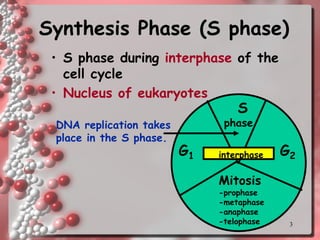
• S phase during interphase of the
cell cycle
• Nucleus of eukaryotes
Mitosis
-prophase
-metaphase
-anaphase
-telophase
G1 G2
S
phase
interphase
DNA replication takes
place in the S phase.
4
DNA Replication
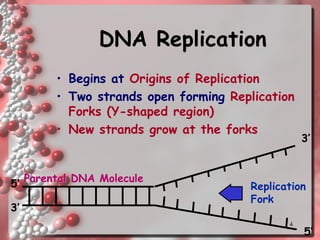
• Begins at Origins of Replication
• Two strands open forming Replication
Forks (Y-shaped region)
• New strands grow at the forks
Replication
Fork
Parental DNA Molecule
3’
5’
3’
5’
5
DNA Replication
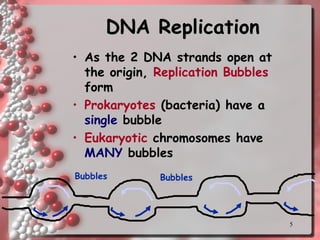
• As the 2 DNA strands open at
the origin, Replication Bubbles
form
• Prokaryotes (bacteria) have a
single bubble
• Eukaryotic chromosomes have
MANY bubbles
Bubbles Bubbles
6
DNA Replication
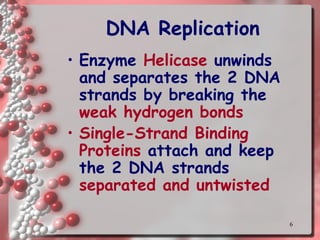
• Enzyme Helicase unwinds
and separates the 2 DNA
strands by breaking the
weak hydrogen bonds
• Single-Strand Binding
Proteins attach and keep
the 2 DNA strands
separated and untwisted
7
DNA Replication
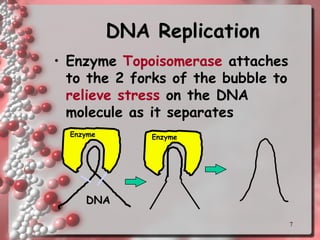
• Enzyme Topoisomerase attaches
to the 2 forks of the bubble to
relieve stress on the DNA
molecule as it separates
Enzyme
DNA
Enzyme
8
DNA Replication
• Before new DNA strands can
form, there must be RNA
primers present to start the
addition of new nucleotides
• Primase is the enzyme that
synthesizes the RNA Primer
• DNA polymerase can then add
the new nucleotides
9
10
DNA Replication
• DNA polymerase can only add
nucleotides to the 3’ end of the
DNA
• This causes the NEW strand to be
built in a 5’ to 3’ direction
RNA
PrimerDNA Polymerase
Nucleotide
5’
5’ 3’
Direction of Replication
11
Remember HOW the
Carbons Are Numbered!
O
O=P-O
O
Phosphate
Group
N
Nitrogenous base
(A, G, C, or T)
CH2
O
C1
C4
C3 C2
5
Sugar
(deoxyribose)
12
Remember the Strands are
Antiparallel
P
P
P
O
O
O
1
2
3
4
5
5
3
3
5
P
P
P
O
O
O
1
2 3
4
5
5
3
5
3
G C
T A
13
Synthesis of the New DNA
Strands
• The Leading Strand is
synthesized as a single strand
from the point of origin toward
the opening replication fork
RNA
PrimerDNA PolymeraseNucleotides
3’5’
5’
14
Synthesis of the New DNA
Strands
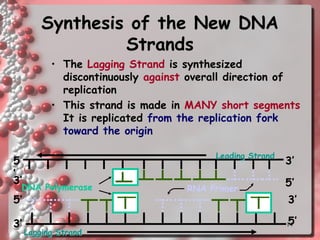
• The Lagging Strand is synthesized
discontinuously against overall direction of
replication
• This strand is made in MANY short segments
It is replicated from the replication fork
toward the origin
RNA Primer
Leading Strand
DNA Polymerase
5
’
5’
3’
3’
Lagging Strand
5’
5’
3’
3’
15
Lagging Strand Segments
• Okazaki Fragments - series of
short segments on the lagging
strand
• Must be joined together by an
enzyme
Lagging Strand
RNA
Primer
DNA
Polymerase
3’
3’
5’
5’
Okazaki Fragment
16
Joining of Okazaki Fragments
• The enzyme Ligase joins the
Okazaki fragments together to
make one strand
Lagging Strand
Okazaki Fragment 2
DNA ligase
Okazaki Fragment 1
5’
5’
3’
3’
17
Replication of Strands
Replication
Fork
Point of Origin
18
Proofreading New DNA
• DNA polymerase initially makes
about 1 in 10,000 base pairing
errors
• Enzymes proofread and correct
these mistakes
• The new error rate for DNA that
has been proofread is 1 in 1 billion
base pairing errors
19
Semiconservative Model of
Replication
• Idea presented by Watson & Crick
• The two strands of the parental
molecule separate, and each acts as a
template for a new complementary
strand
• New DNA consists of 1
PARENTAL (original) and 1 NEW
strand of DNA
Parental DNA
DNA Template
New DNA
20
21
DNA Damage & Repair
• Chemicals & ultraviolet radiation
damage the DNA in our body cells
• Cells must continuously repair
DAMAGED DNA
• Excision repair occurs when any of
over 50 repair enzymes remove
damaged parts of DNA
• DNA polymerase and DNA ligase
replace and bond the new nucleotides
together
22
Question:
• What would be the
complementary DNA
strand for the following
DNA sequence?
DNA 5’-CGTATG-3’
23
Answer:
DNA 5’-CGTATG-3’
DNA 3’-GCATAC-5’
Post-Replicative Modification of DNA
 Methylation; one of the major
post- replicative reactions.
 Site of methylation of eukaryotic
DNA is always on cytosine residues in
CG dinucleotide.
 DNA methylation plays an
important role for epigenetic gene
regulation in development and
disease.
Epigenetics
• Epigenetics refers to the study of changes in
the regulation of gene activity and
expression that are not dependent on gene
DNA sequence.
• While epigenetics often refers to the study of
single genes or sets of genes, epigenomics
refers to more global analyses of epigenetic
changes across the entire genome.
Epigenetics
Mechanisms
Gene Expression
RNA Interference
Histone Modifications DNA Methylation
DNA Methylation
Hypomethylation
Hypermethylation
Natural Roles of DNA
Methylation in
Mammalian System
 Imprinting
 X chromosome inactivation
 Heterochromatin maintenance
 Developmental controls
 Tissue specific expression controls
DNA Methylation and
Other Human Diseases
-- Imprinting Disorder:
• Beckwith-Wiedemann syndrom (BWS)
• Prader-Willi syndrome (PWS)
• Transient neonatal diabetes mellitus (TNDM)
-- Repeat-instability diseases
• Fragile X syndrome (FRAXA)
• Facioscapulohumeral muscular dystroph
-- Defects of the methylation machinery
• Systemic lupus erythemtosus (SLE)
• Immunodeficiency, centromeric instability and
facial anomalies (ICF) syndrome

Dna replication

  • 1.
  • 2.
    2 Replication Facts • DNAhas to be copied before a cell divides • DNA is copied during the S (or synthesis) phase of interphase • New cells will need identical DNA strands
  • 3.
    3 Synthesis Phase (Sphase) • S phase during interphase of the cell cycle • Nucleus of eukaryotes Mitosis -prophase -metaphase -anaphase -telophase G1 G2 S phase interphase DNA replication takes place in the S phase.
  • 4.
    4 DNA Replication • Beginsat Origins of Replication • Two strands open forming Replication Forks (Y-shaped region) • New strands grow at the forks Replication Fork Parental DNA Molecule 3’ 5’ 3’ 5’
  • 5.
    5 DNA Replication • Asthe 2 DNA strands open at the origin, Replication Bubbles form • Prokaryotes (bacteria) have a single bubble • Eukaryotic chromosomes have MANY bubbles Bubbles Bubbles
  • 6.
    6 DNA Replication • EnzymeHelicase unwinds and separates the 2 DNA strands by breaking the weak hydrogen bonds • Single-Strand Binding Proteins attach and keep the 2 DNA strands separated and untwisted
  • 7.
    7 DNA Replication • EnzymeTopoisomerase attaches to the 2 forks of the bubble to relieve stress on the DNA molecule as it separates Enzyme DNA Enzyme
  • 8.
    8 DNA Replication • Beforenew DNA strands can form, there must be RNA primers present to start the addition of new nucleotides • Primase is the enzyme that synthesizes the RNA Primer • DNA polymerase can then add the new nucleotides
  • 9.
  • 10.
    10 DNA Replication • DNApolymerase can only add nucleotides to the 3’ end of the DNA • This causes the NEW strand to be built in a 5’ to 3’ direction RNA PrimerDNA Polymerase Nucleotide 5’ 5’ 3’ Direction of Replication
  • 11.
    11 Remember HOW the CarbonsAre Numbered! O O=P-O O Phosphate Group N Nitrogenous base (A, G, C, or T) CH2 O C1 C4 C3 C2 5 Sugar (deoxyribose)
  • 12.
    12 Remember the Strandsare Antiparallel P P P O O O 1 2 3 4 5 5 3 3 5 P P P O O O 1 2 3 4 5 5 3 5 3 G C T A
  • 13.
    13 Synthesis of theNew DNA Strands • The Leading Strand is synthesized as a single strand from the point of origin toward the opening replication fork RNA PrimerDNA PolymeraseNucleotides 3’5’ 5’
  • 14.
    14 Synthesis of theNew DNA Strands • The Lagging Strand is synthesized discontinuously against overall direction of replication • This strand is made in MANY short segments It is replicated from the replication fork toward the origin RNA Primer Leading Strand DNA Polymerase 5 ’ 5’ 3’ 3’ Lagging Strand 5’ 5’ 3’ 3’
  • 15.
    15 Lagging Strand Segments •Okazaki Fragments - series of short segments on the lagging strand • Must be joined together by an enzyme Lagging Strand RNA Primer DNA Polymerase 3’ 3’ 5’ 5’ Okazaki Fragment
  • 16.
    16 Joining of OkazakiFragments • The enzyme Ligase joins the Okazaki fragments together to make one strand Lagging Strand Okazaki Fragment 2 DNA ligase Okazaki Fragment 1 5’ 5’ 3’ 3’
  • 17.
  • 18.
    18 Proofreading New DNA •DNA polymerase initially makes about 1 in 10,000 base pairing errors • Enzymes proofread and correct these mistakes • The new error rate for DNA that has been proofread is 1 in 1 billion base pairing errors
  • 19.
    19 Semiconservative Model of Replication •Idea presented by Watson & Crick • The two strands of the parental molecule separate, and each acts as a template for a new complementary strand • New DNA consists of 1 PARENTAL (original) and 1 NEW strand of DNA Parental DNA DNA Template New DNA
  • 20.
  • 21.
    21 DNA Damage &Repair • Chemicals & ultraviolet radiation damage the DNA in our body cells • Cells must continuously repair DAMAGED DNA • Excision repair occurs when any of over 50 repair enzymes remove damaged parts of DNA • DNA polymerase and DNA ligase replace and bond the new nucleotides together
  • 22.
    22 Question: • What wouldbe the complementary DNA strand for the following DNA sequence? DNA 5’-CGTATG-3’
  • 23.
  • 24.
    Post-Replicative Modification ofDNA  Methylation; one of the major post- replicative reactions.  Site of methylation of eukaryotic DNA is always on cytosine residues in CG dinucleotide.  DNA methylation plays an important role for epigenetic gene regulation in development and disease.
  • 25.
    Epigenetics • Epigenetics refersto the study of changes in the regulation of gene activity and expression that are not dependent on gene DNA sequence. • While epigenetics often refers to the study of single genes or sets of genes, epigenomics refers to more global analyses of epigenetic changes across the entire genome.
  • 26.
  • 27.
  • 28.
    Natural Roles ofDNA Methylation in Mammalian System  Imprinting  X chromosome inactivation  Heterochromatin maintenance  Developmental controls  Tissue specific expression controls
  • 29.
    DNA Methylation and OtherHuman Diseases -- Imprinting Disorder: • Beckwith-Wiedemann syndrom (BWS) • Prader-Willi syndrome (PWS) • Transient neonatal diabetes mellitus (TNDM) -- Repeat-instability diseases • Fragile X syndrome (FRAXA) • Facioscapulohumeral muscular dystroph -- Defects of the methylation machinery • Systemic lupus erythemtosus (SLE) • Immunodeficiency, centromeric instability and facial anomalies (ICF) syndrome