OPERON CONCEPT
M.Ponninselvam
2018/BT/10/ML
MBB 502 – FUNDAMENTALS OF
MOLECULAR BIOLOGY
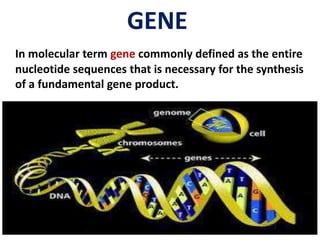
GENE
In molecular term gene commonly defined as the entire
nucleotide sequences that is necessary for the synthesis
of a fundamental gene product.
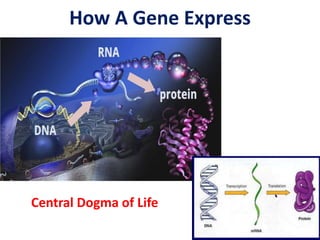
How A Gene Express
Central Dogma of Life
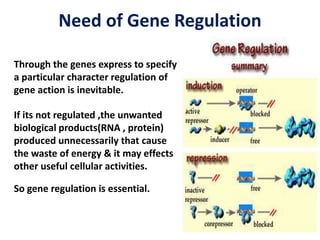
Need of Gene Regulation
Through the genes express to specify
a particular character regulation of
gene action is inevitable.
If its not regulated ,the unwanted
biological products(RNA , protein)
produced unnecessarily that cause
the waste of energy & it may effects
other useful cellular activities.
So gene regulation is essential.
Regulation of Gene Expression
• Each cell of the living organisms contain thousands of genes.
• But all genes do not function at a time.
• Genes control the phenotypic expression of characters
through the production of specific enzymes.
• The synthesis of particular enzyme is depending upon the
requirement of the cell.
• Thus, there exists an on-off system which regulates protein
synthesis in all living cells - study of this on-off mechanism is
called regulation of gene expression.
Regulation of gene expression
Gene expression is regulated at different levels.
•Transcriptional level
•Translation level
•Enzyme function
Most of the research indicate that regulation of transcription
is the most important mode of control of gene expression.
The Operon
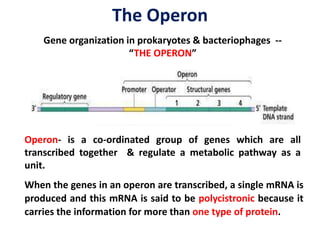
Gene organization in prokaryotes & bacteriophages --
“THE OPERON”
Operon- is a co-ordinated group of genes which are all
transcribed together & regulate a metabolic pathway as a
unit.
When the genes in an operon are transcribed, a single mRNA is
produced and this mRNA is said to be polycistronic because it
carries the information for more than one type of protein.
The Operon
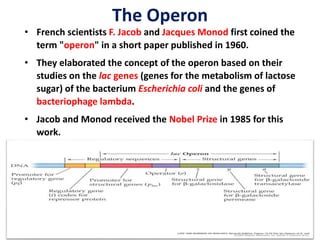
• French scientists F. Jacob and Jacques Monod first coined the
term "operon" in a short paper published in 1960.
• They elaborated the concept of the operon based on their
studies on the lac genes (genes for the metabolism of lactose
sugar) of the bacterium Escherichia coli and the genes of
bacteriophage lambda.
• Jacob and Monod received the Nobel Prize in 1985 for this
work.
The Operon
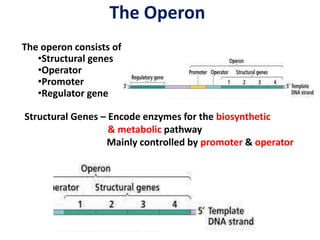
The operon consists of
•Structural genes
•Operator
•Promoter
•Regulator gene
Structural Genes – Encode enzymes for the biosynthetic
& metabolic pathway
Mainly controlled by promoter & operator
The Operon
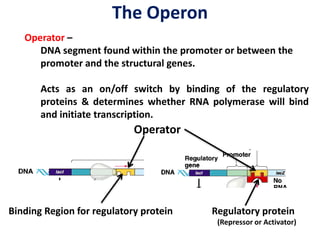
Operator –
DNA segment found within the promoter or between the
promoter and the structural genes.
Acts as an on/off switch by binding of the regulatory
proteins & determines whether RNA polymerase will bind
and initiate transcription.
Operator
Binding Region for regulatory protein Regulatory protein
(Repressor or Activator)
The Operon
Promotor
• The promoter segment is a place where mRNA polymerase
binds with DNA.
• The main function of promoter gene is to initiate mRNA
transcription.
• The promoter starts mRNA transcription only when
operator is free.
• When repressor binds with operator, inactivates the
promoter gene and prevents transcription.
Promoter
The Operon
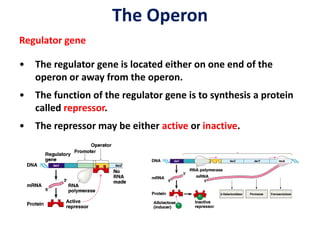
• The regulator gene is located either on one end of the
operon or away from the operon.
• The function of the regulator gene is to synthesis a protein
called repressor.
• The repressor may be either active or inactive.
Regulator gene
The Operon
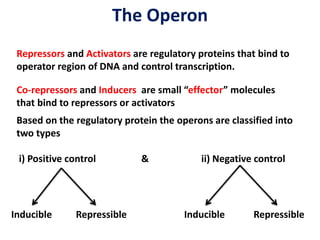
Repressors and Activators are regulatory proteins that bind to
operator region of DNA and control transcription.
Co-repressors and Inducers are small “effector” molecules
that bind to repressors or activators
Based on the regulatory protein the operons are classified into
two types
i) Positive control & ii) Negative control
Inducible Repressible Inducible Repressible
Negative Regulation – Inducible operon
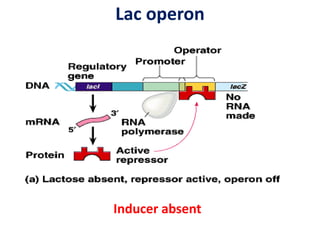
Regulator Protein (Repressor) binds to operator DNA and this
binding stops transcription.
Repressor affect the binding of RNA Polymerase to promoter
region of the operon.
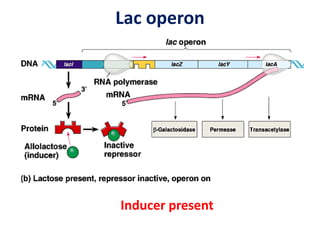
Only when repressor leaves the operator, the enzyme initiates
transcription immediately.
When repressor interacts with specific molecules called inducer,
they become inactive.
Inducer drastically change the binding capacity of repressors.
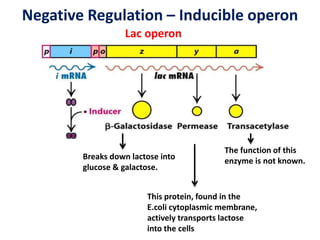
Transcription of the operon begins. --- Lac operon
Negative Regulation – Inducible operon
Lac operon
Breaks down lactose into
glucose & galactose.
This protein, found in the
E.coli cytoplasmic membrane,
actively transports lactose
into the cells
The function of this
enzyme is not known.
Lac operon
Inducer absent
Lac operon
Inducer present
Negative Regulation – Repressible operon
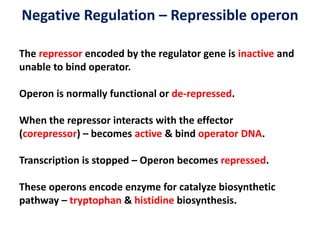
The repressor encoded by the regulator gene is inactive and
unable to bind operator.
Operon is normally functional or de-repressed.
When the repressor interacts with the effector
(corepressor) – becomes active & bind operator DNA.
Transcription is stopped – Operon becomes repressed.
These operons encode enzyme for catalyze biosynthetic
pathway – tryptophan & histidine biosynthesis.
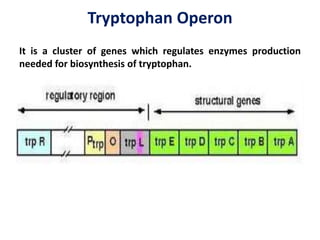
Tryptophan Operon
It is a cluster of genes which regulates enzymes production
needed for biosynthesis of tryptophan.
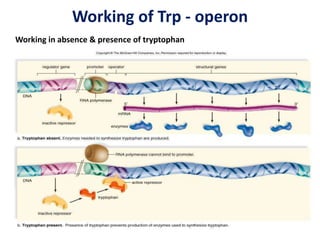
Working of Trp - operon
Working in absence & presence of tryptophan
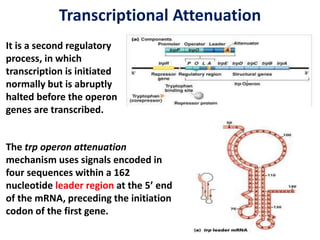
Transcriptional Attenuation
It is a second regulatory
process, in which
transcription is initiated
normally but is abruptly
halted before the operon
genes are transcribed.
The trp operon attenuation
mechanism uses signals encoded in
four sequences within a 162
nucleotide leader region at the 5’ end
of the mRNA, preceding the initiation
codon of the first gene.
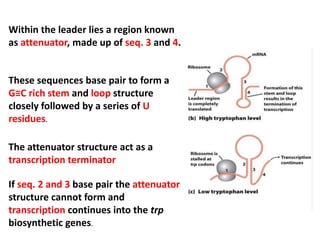
Within the leader lies a region known
as attenuator, made up of seq. 3 and 4.
These sequences base pair to form a
G≡C rich stem and loop structure
closely followed by a series of U
residues.
The attenuator structure act as a
transcription terminator
If seq. 2 and 3 base pair the attenuator
structure cannot form and
transcription continues into the trp
biosynthetic genes.
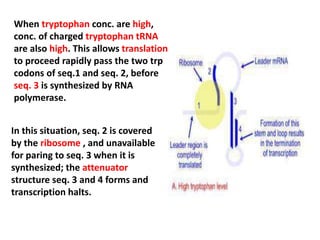
When tryptophan conc. are high,
conc. of charged tryptophan tRNA
are also high. This allows translation
to proceed rapidly pass the two trp
codons of seq.1 and seq. 2, before
seq. 3 is synthesized by RNA
polymerase.
In this situation, seq. 2 is covered
by the ribosome , and unavailable
for paring to seq. 3 when it is
synthesized; the attenuator
structure seq. 3 and 4 forms and
transcription halts.
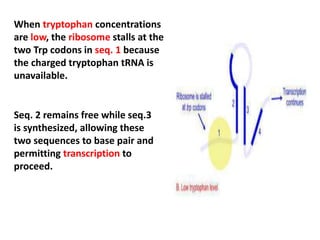
When tryptophan concentrations
are low, the ribosome stalls at the
two Trp codons in seq. 1 because
the charged tryptophan tRNA is
unavailable.
Seq. 2 remains free while seq.3
is synthesized, allowing these
two sequences to base pair and
permitting transcription to
proceed.
Positive Regulation – Inducible Operon
Transcription of the operon does not take place unless the
regulator protein is bind to the operator – Activators.
Inducible system, the activators is in an inactive state and
cannot bind DNA.
Inducer molecule interacts with the activator, becomes active
and binds DNA.
Permits transcription of concerned operon.
Catabolite sensitive operons of E.coli show positive inducible
operons.
Positive Regulation – Inducible Operon
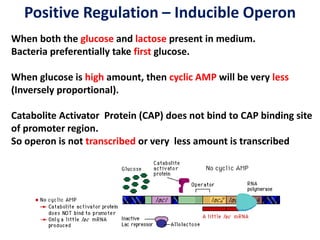
When both the glucose and lactose present in medium.
Bacteria preferentially take first glucose.
When glucose is high amount, then cyclic AMP will be very less
(Inversely proportional).
Catabolite Activator Protein (CAP) does not bind to CAP binding site
of promoter region.
So operon is not transcribed or very less amount is transcribed
Positive Regulation – Inducible Operon
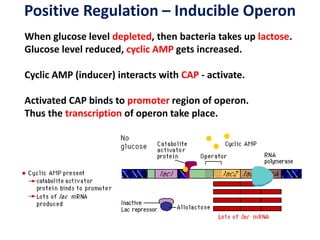
When glucose level depleted, then bacteria takes up lactose.
Glucose level reduced, cyclic AMP gets increased.
Cyclic AMP (inducer) interacts with CAP - activate.
Activated CAP binds to promoter region of operon.
Thus the transcription of operon take place.
CONCLUSION
As the gene expression
is needed to produce
a specific phenotype ,
regulation of gene action
is of same essence to
specify a given a phenotype
under a given circumstance
REFERENCE
Fund. Of Genetics - B.D.Singh
Molecular Cell Biology – Harvery Lodish
Gene XI - Lewin
Operon Concept

Operon Concept

  • 1.
    OPERON CONCEPT M.Ponninselvam 2018/BT/10/ML MBB 502– FUNDAMENTALS OF MOLECULAR BIOLOGY
  • 2.
    GENE In molecular termgene commonly defined as the entire nucleotide sequences that is necessary for the synthesis of a fundamental gene product.
  • 3.
    How A GeneExpress Central Dogma of Life
  • 4.
    Need of GeneRegulation Through the genes express to specify a particular character regulation of gene action is inevitable. If its not regulated ,the unwanted biological products(RNA , protein) produced unnecessarily that cause the waste of energy & it may effects other useful cellular activities. So gene regulation is essential.
  • 5.
    Regulation of GeneExpression • Each cell of the living organisms contain thousands of genes. • But all genes do not function at a time. • Genes control the phenotypic expression of characters through the production of specific enzymes. • The synthesis of particular enzyme is depending upon the requirement of the cell. • Thus, there exists an on-off system which regulates protein synthesis in all living cells - study of this on-off mechanism is called regulation of gene expression.
  • 6.
    Regulation of geneexpression Gene expression is regulated at different levels. •Transcriptional level •Translation level •Enzyme function Most of the research indicate that regulation of transcription is the most important mode of control of gene expression.
  • 7.
    The Operon Gene organizationin prokaryotes & bacteriophages -- “THE OPERON” Operon- is a co-ordinated group of genes which are all transcribed together & regulate a metabolic pathway as a unit. When the genes in an operon are transcribed, a single mRNA is produced and this mRNA is said to be polycistronic because it carries the information for more than one type of protein.
  • 8.
    The Operon • Frenchscientists F. Jacob and Jacques Monod first coined the term "operon" in a short paper published in 1960. • They elaborated the concept of the operon based on their studies on the lac genes (genes for the metabolism of lactose sugar) of the bacterium Escherichia coli and the genes of bacteriophage lambda. • Jacob and Monod received the Nobel Prize in 1985 for this work.
  • 9.
    The Operon The operonconsists of •Structural genes •Operator •Promoter •Regulator gene Structural Genes – Encode enzymes for the biosynthetic & metabolic pathway Mainly controlled by promoter & operator
  • 10.
    The Operon Operator – DNAsegment found within the promoter or between the promoter and the structural genes. Acts as an on/off switch by binding of the regulatory proteins & determines whether RNA polymerase will bind and initiate transcription. Operator Binding Region for regulatory protein Regulatory protein (Repressor or Activator)
  • 11.
    The Operon Promotor • Thepromoter segment is a place where mRNA polymerase binds with DNA. • The main function of promoter gene is to initiate mRNA transcription. • The promoter starts mRNA transcription only when operator is free. • When repressor binds with operator, inactivates the promoter gene and prevents transcription. Promoter
  • 12.
    The Operon • Theregulator gene is located either on one end of the operon or away from the operon. • The function of the regulator gene is to synthesis a protein called repressor. • The repressor may be either active or inactive. Regulator gene
  • 13.
    The Operon Repressors andActivators are regulatory proteins that bind to operator region of DNA and control transcription. Co-repressors and Inducers are small “effector” molecules that bind to repressors or activators Based on the regulatory protein the operons are classified into two types i) Positive control & ii) Negative control Inducible Repressible Inducible Repressible
  • 14.
    Negative Regulation –Inducible operon Regulator Protein (Repressor) binds to operator DNA and this binding stops transcription. Repressor affect the binding of RNA Polymerase to promoter region of the operon. Only when repressor leaves the operator, the enzyme initiates transcription immediately. When repressor interacts with specific molecules called inducer, they become inactive. Inducer drastically change the binding capacity of repressors. Transcription of the operon begins. --- Lac operon
  • 15.
    Negative Regulation –Inducible operon Lac operon Breaks down lactose into glucose & galactose. This protein, found in the E.coli cytoplasmic membrane, actively transports lactose into the cells The function of this enzyme is not known.
  • 16.
  • 17.
  • 18.
    Negative Regulation –Repressible operon The repressor encoded by the regulator gene is inactive and unable to bind operator. Operon is normally functional or de-repressed. When the repressor interacts with the effector (corepressor) – becomes active & bind operator DNA. Transcription is stopped – Operon becomes repressed. These operons encode enzyme for catalyze biosynthetic pathway – tryptophan & histidine biosynthesis.
  • 19.
    Tryptophan Operon It isa cluster of genes which regulates enzymes production needed for biosynthesis of tryptophan.
  • 20.
    Working of Trp- operon Working in absence & presence of tryptophan
  • 21.
    Transcriptional Attenuation It isa second regulatory process, in which transcription is initiated normally but is abruptly halted before the operon genes are transcribed. The trp operon attenuation mechanism uses signals encoded in four sequences within a 162 nucleotide leader region at the 5’ end of the mRNA, preceding the initiation codon of the first gene.
  • 22.
    Within the leaderlies a region known as attenuator, made up of seq. 3 and 4. These sequences base pair to form a G≡C rich stem and loop structure closely followed by a series of U residues. The attenuator structure act as a transcription terminator If seq. 2 and 3 base pair the attenuator structure cannot form and transcription continues into the trp biosynthetic genes.
  • 23.
    When tryptophan conc.are high, conc. of charged tryptophan tRNA are also high. This allows translation to proceed rapidly pass the two trp codons of seq.1 and seq. 2, before seq. 3 is synthesized by RNA polymerase. In this situation, seq. 2 is covered by the ribosome , and unavailable for paring to seq. 3 when it is synthesized; the attenuator structure seq. 3 and 4 forms and transcription halts.
  • 24.
    When tryptophan concentrations arelow, the ribosome stalls at the two Trp codons in seq. 1 because the charged tryptophan tRNA is unavailable. Seq. 2 remains free while seq.3 is synthesized, allowing these two sequences to base pair and permitting transcription to proceed.
  • 25.
    Positive Regulation –Inducible Operon Transcription of the operon does not take place unless the regulator protein is bind to the operator – Activators. Inducible system, the activators is in an inactive state and cannot bind DNA. Inducer molecule interacts with the activator, becomes active and binds DNA. Permits transcription of concerned operon. Catabolite sensitive operons of E.coli show positive inducible operons.
  • 26.
    Positive Regulation –Inducible Operon When both the glucose and lactose present in medium. Bacteria preferentially take first glucose. When glucose is high amount, then cyclic AMP will be very less (Inversely proportional). Catabolite Activator Protein (CAP) does not bind to CAP binding site of promoter region. So operon is not transcribed or very less amount is transcribed
  • 27.
    Positive Regulation –Inducible Operon When glucose level depleted, then bacteria takes up lactose. Glucose level reduced, cyclic AMP gets increased. Cyclic AMP (inducer) interacts with CAP - activate. Activated CAP binds to promoter region of operon. Thus the transcription of operon take place.
  • 28.
    CONCLUSION As the geneexpression is needed to produce a specific phenotype , regulation of gene action is of same essence to specify a given a phenotype under a given circumstance
  • 29.
    REFERENCE Fund. Of Genetics- B.D.Singh Molecular Cell Biology – Harvery Lodish Gene XI - Lewin