DEPARTMENT OF
PHYSICS
EIGEN VALUES,
EIGEN VECTORS, &
DIAGONALIZATION
Submitted by :-Vandana
(M.Sc-1st.)
CONTENTS
 Eigen values
 Eigen vectors
 Similarity Transformation
 Diagonalization of a matrix
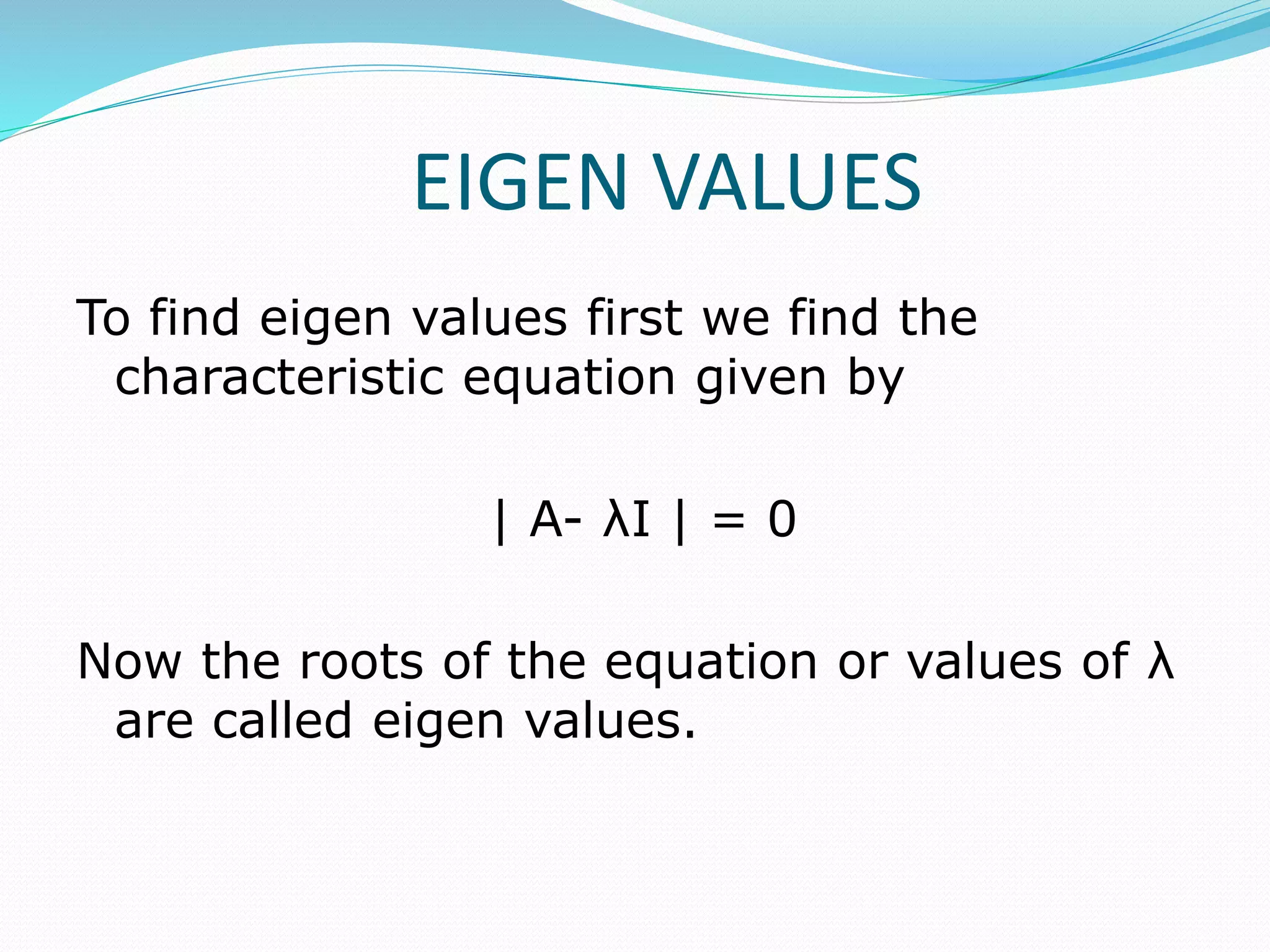
EIGEN VALUES
To find eigen values first we find the
characteristic equation given by
| A- λI | = 0
Now the roots of the equation or values of λ
are called eigen values.
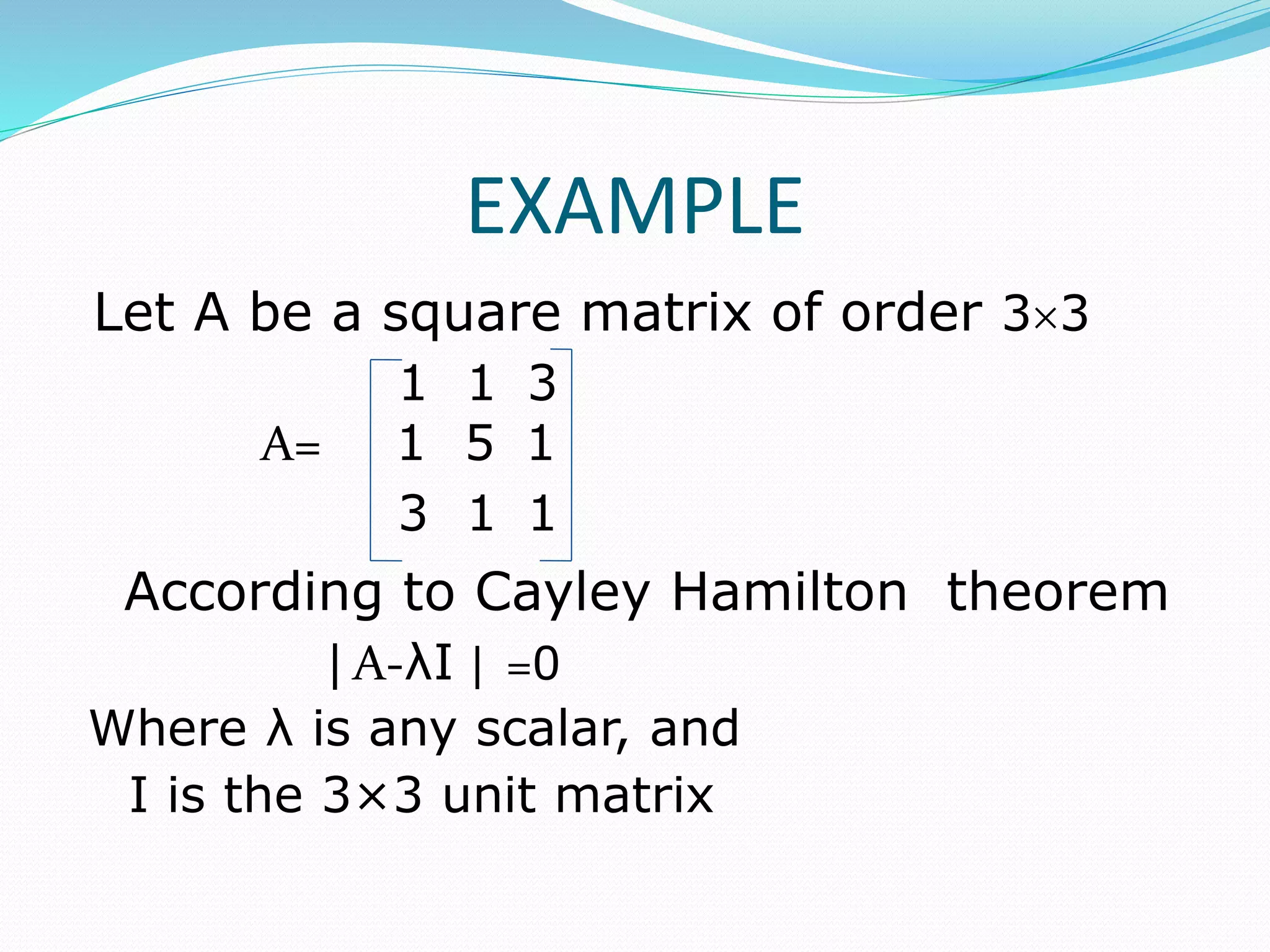
EXAMPLE
Let A be a square matrix of order 33
1 1 3
A= 1 5 1
3 1 1
According to Cayley Hamilton theorem
| A-λI | =0
Where λ is any scalar, and
I is the 3×3 unit matrix
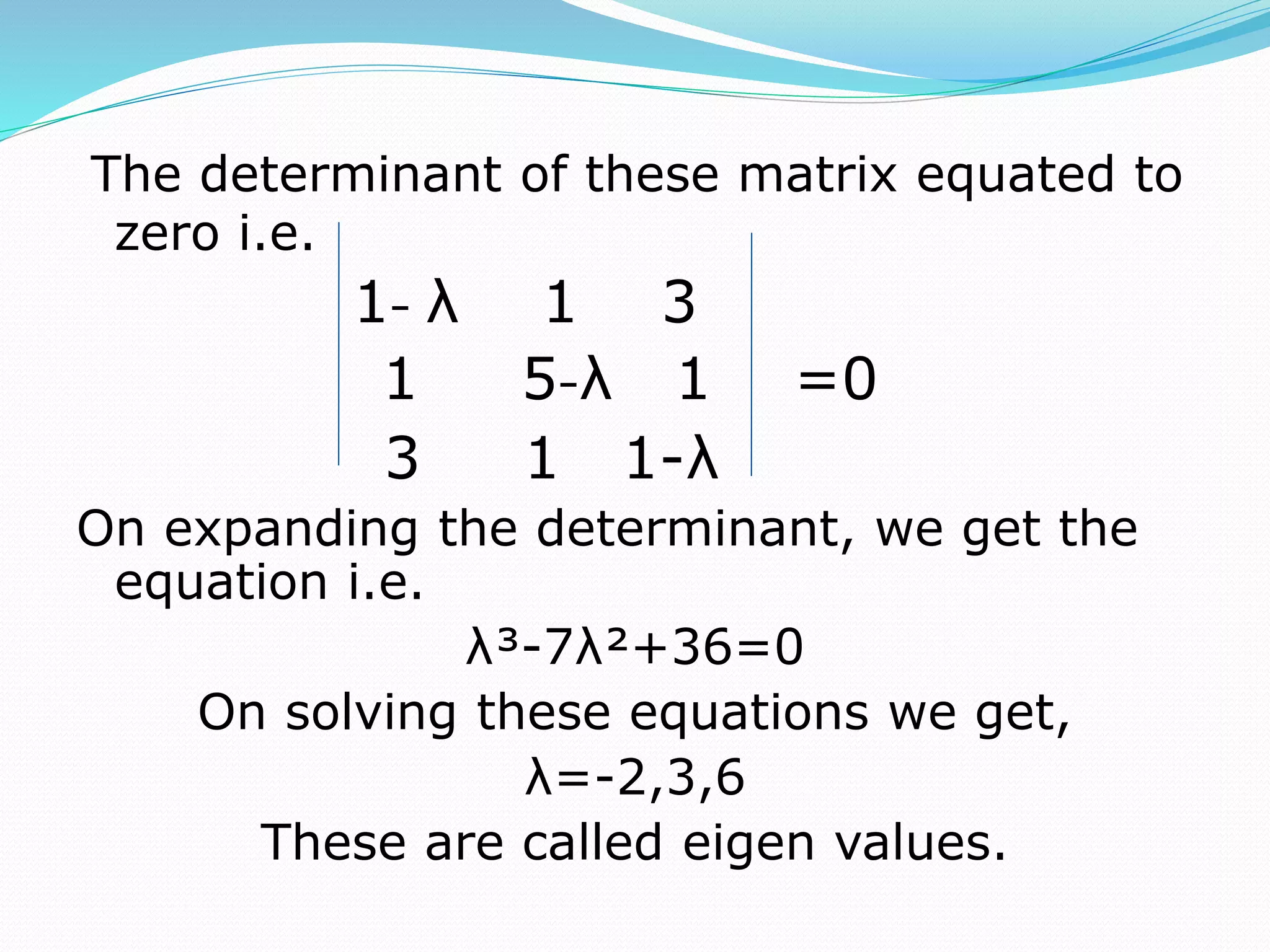
The determinant of these matrix equated to
zero i.e.
1- λ 1 3
1 5-λ 1 =0
3 1 1-λ
On expanding the determinant, we get the
equation i.e.
λ³-7λ²+36=0
On solving these equations we get,
λ=-2,3,6
These are called eigen values.
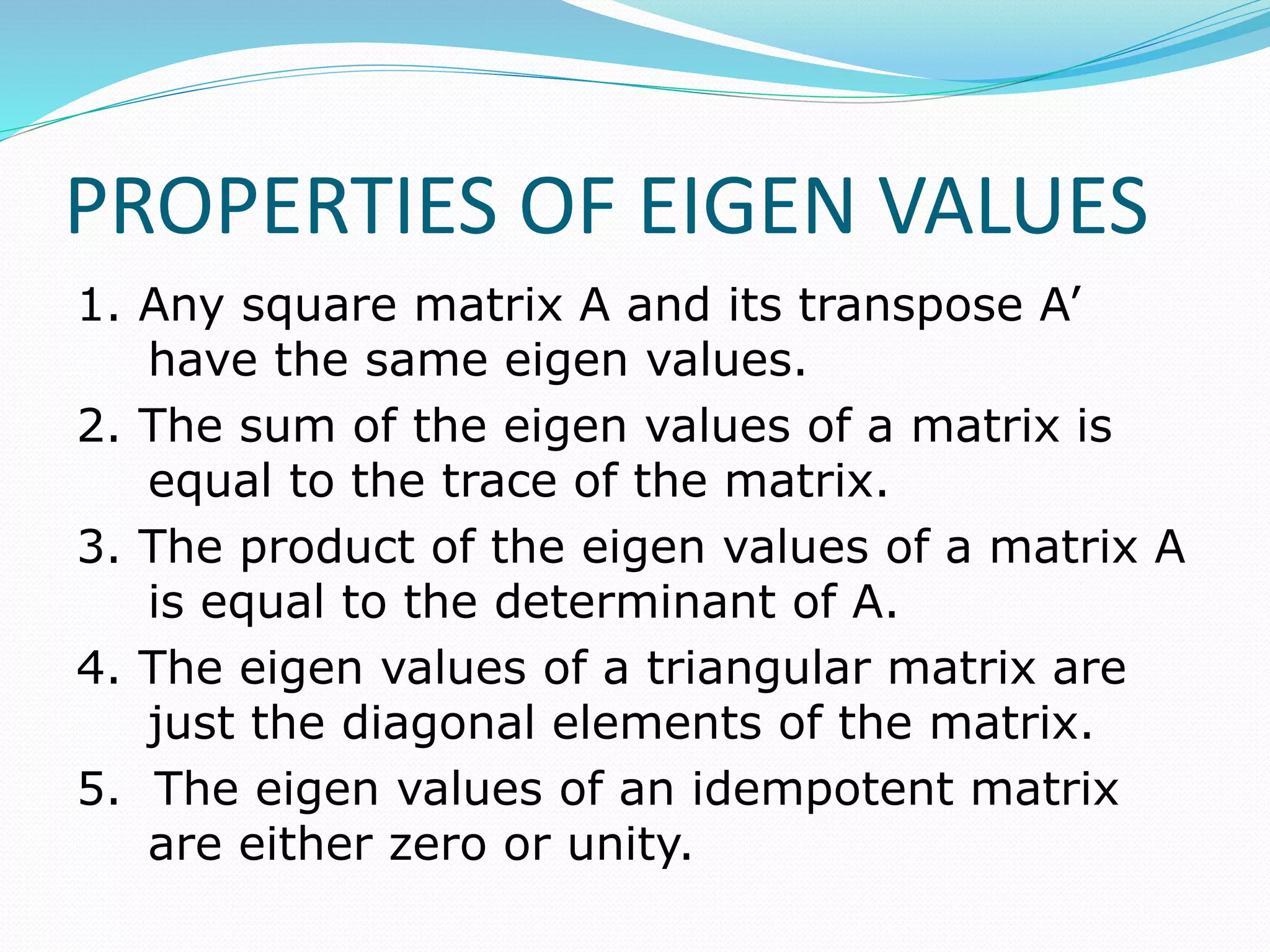
PROPERTIES OF EIGEN VALUES
1. Any square matrix A and its transpose A՚
have the same eigen values.
2. The sum of the eigen values of a matrix is
equal to the trace of the matrix.
3. The product of the eigen values of a matrix A
is equal to the determinant of A.
4. The eigen values of a triangular matrix are
just the diagonal elements of the matrix.
5. The eigen values of an idempotent matrix
are either zero or unity.
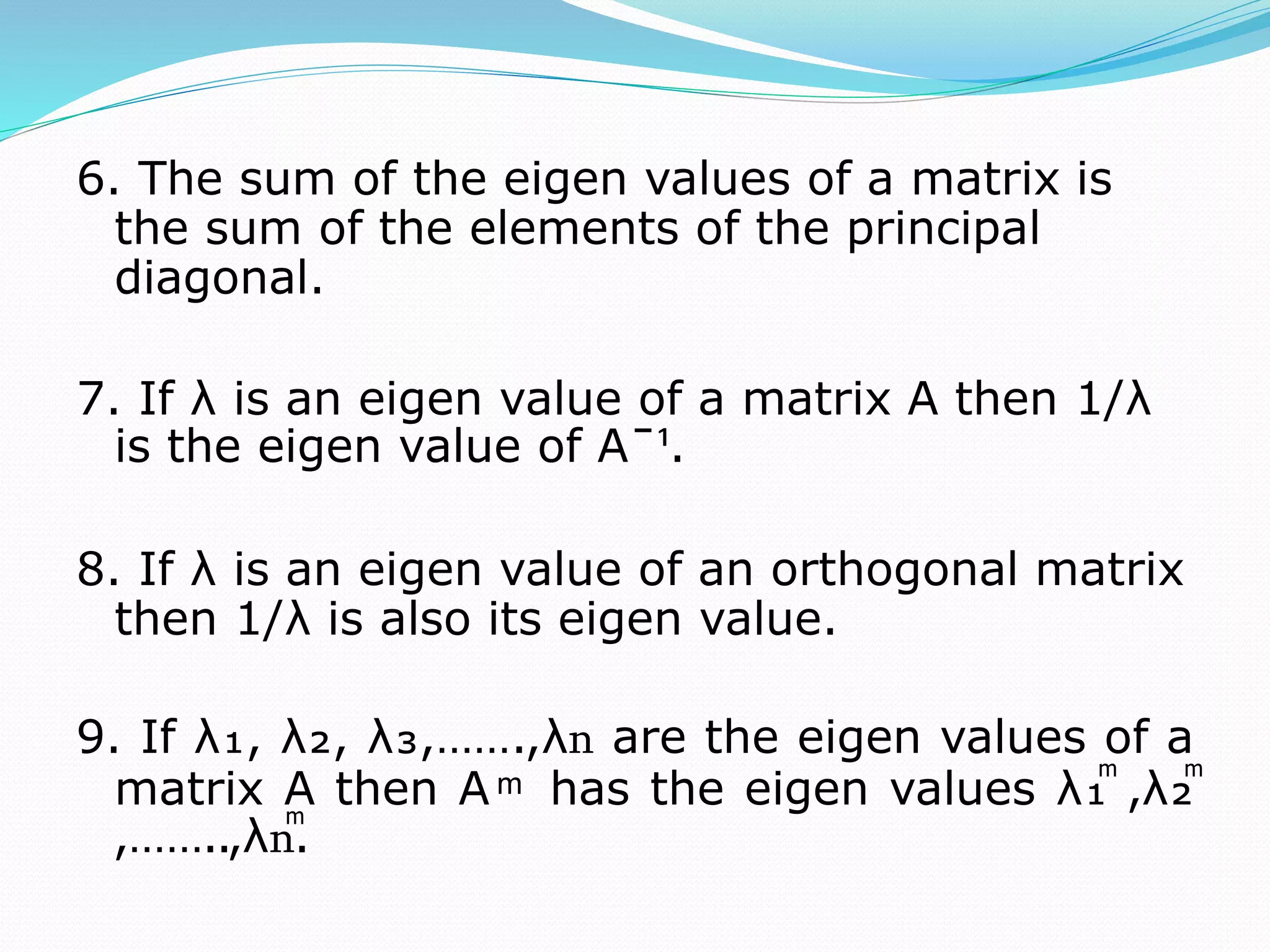
6. The sum of the eigen values of a matrix is
the sum of the elements of the principal
diagonal.
7. If λ is an eigen value of a matrix A then 1/λ
is the eigen value of Aˉ¹.
8. If λ is an eigen value of an orthogonal matrix
then 1/λ is also its eigen value.
9. If λ₁, λ₂, λ₃,…….,λո are the eigen values of a
matrix A then A ͫ has the eigen values λ₁ͫ ,λ₂ͫ
,……..,λոͫ.
EIGEN VECTOR
An eigen vector of a square matrix A is a non
zero vector X such that for some number λ,
we have,
AX=λX
AX-λIX=0
[A-λI]X=0
Where 0 represents the zero vector.
EXAMPLE
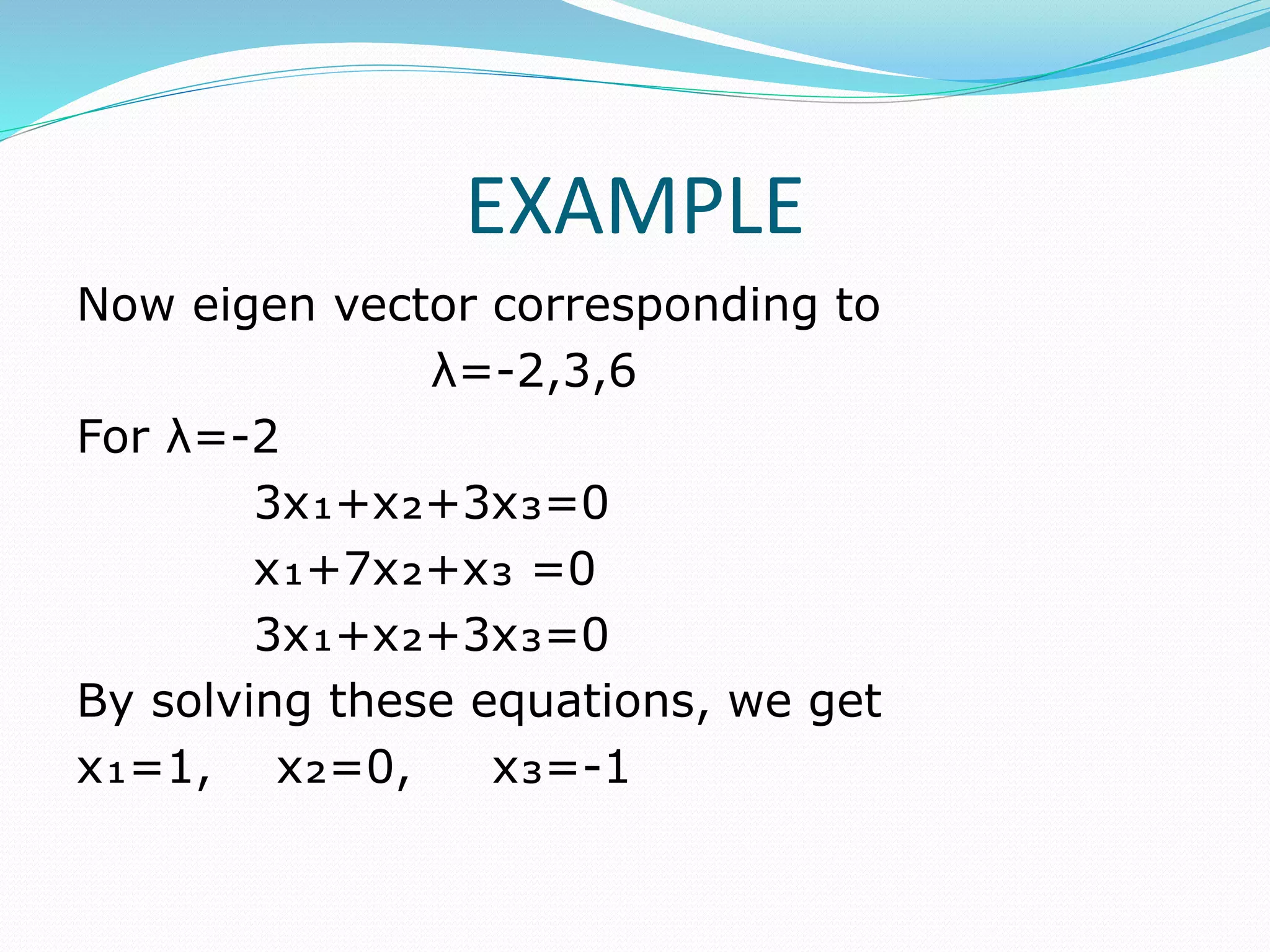
Now eigen vector corresponding to
λ=-2,3,6
For λ=-2
3x₁+x₂+3x₃=0
x₁+7x₂+x₃ =0
3x₁+x₂+3x₃=0
By solving these equations, we get
x₁=1, x₂=0, x₃=-1
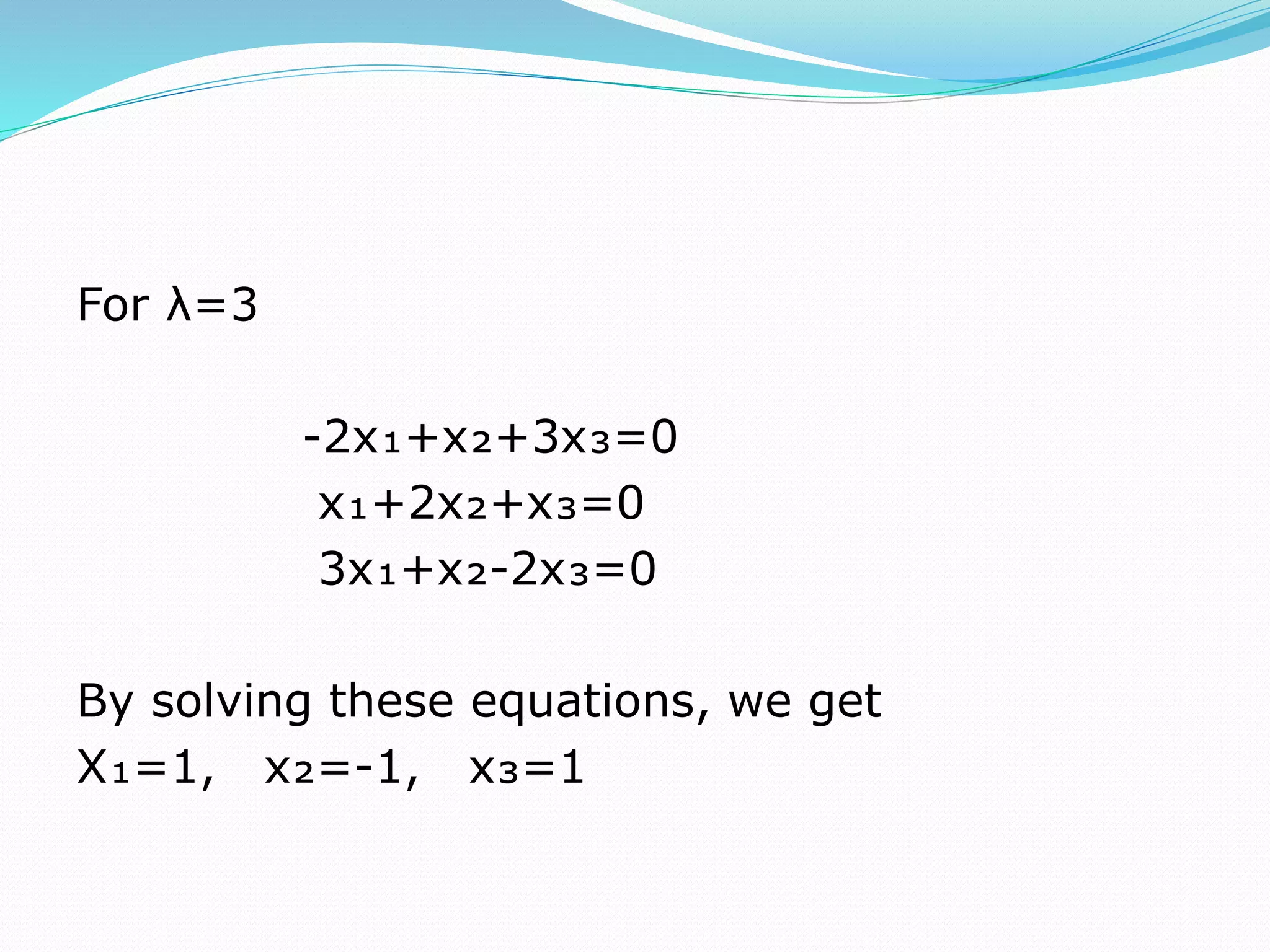
For λ=3
-2x₁+x₂+3x₃=0
x₁+2x₂+x₃=0
3x₁+x₂-2x₃=0
By solving these equations, we get
X₁=1, x₂=-1, x₃=1
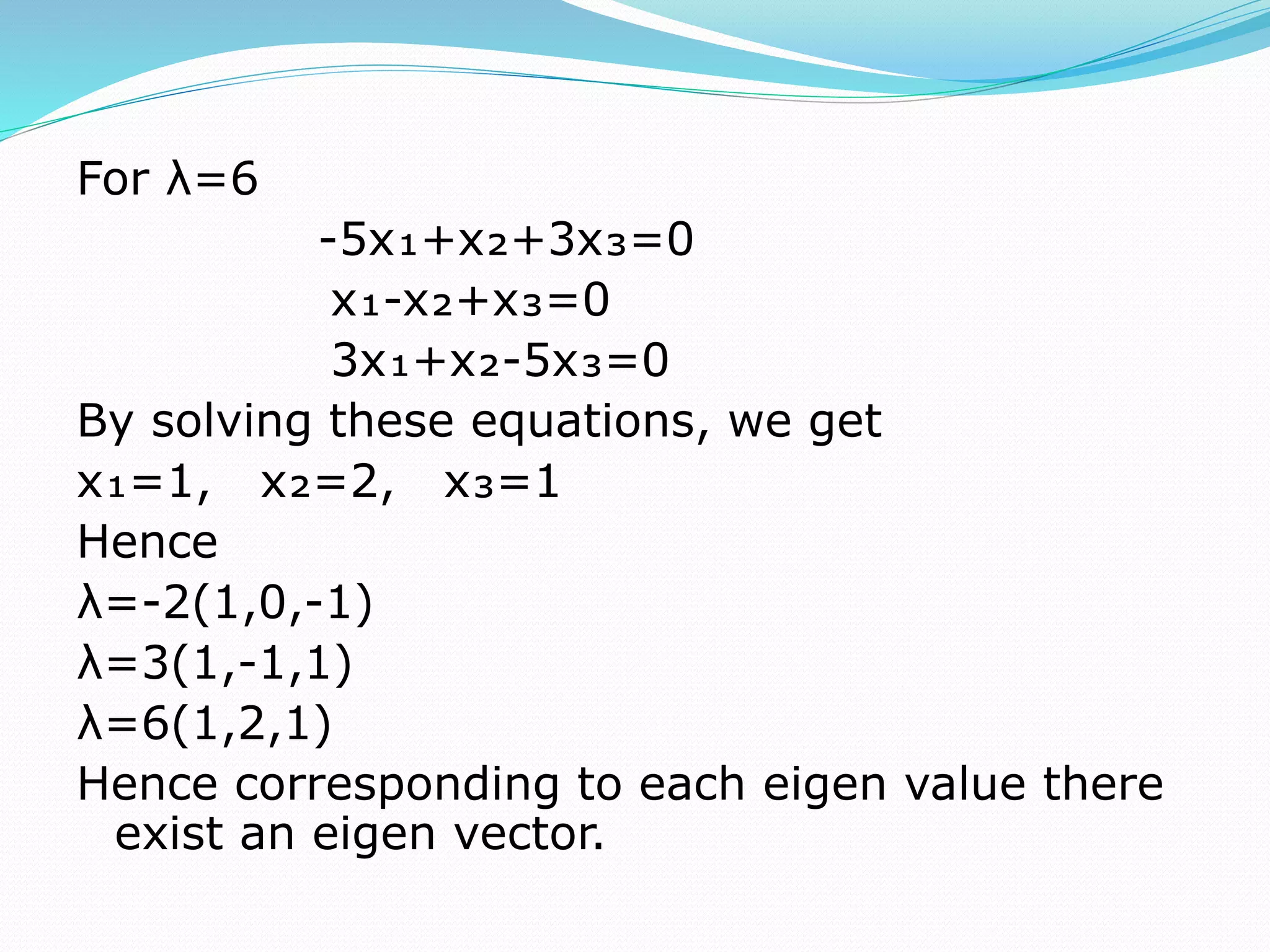
For λ=6
-5x₁+x₂+3x₃=0
x₁-x₂+x₃=0
3x₁+x₂-5x₃=0
By solving these equations, we get
x₁=1, x₂=2, x₃=1
Hence
λ=-2(1,0,-1)
λ=3(1,-1,1)
λ=6(1,2,1)
Hence corresponding to each eigen value there
exist an eigen vector.
PROPERTIES OF EIGEN VECTORS
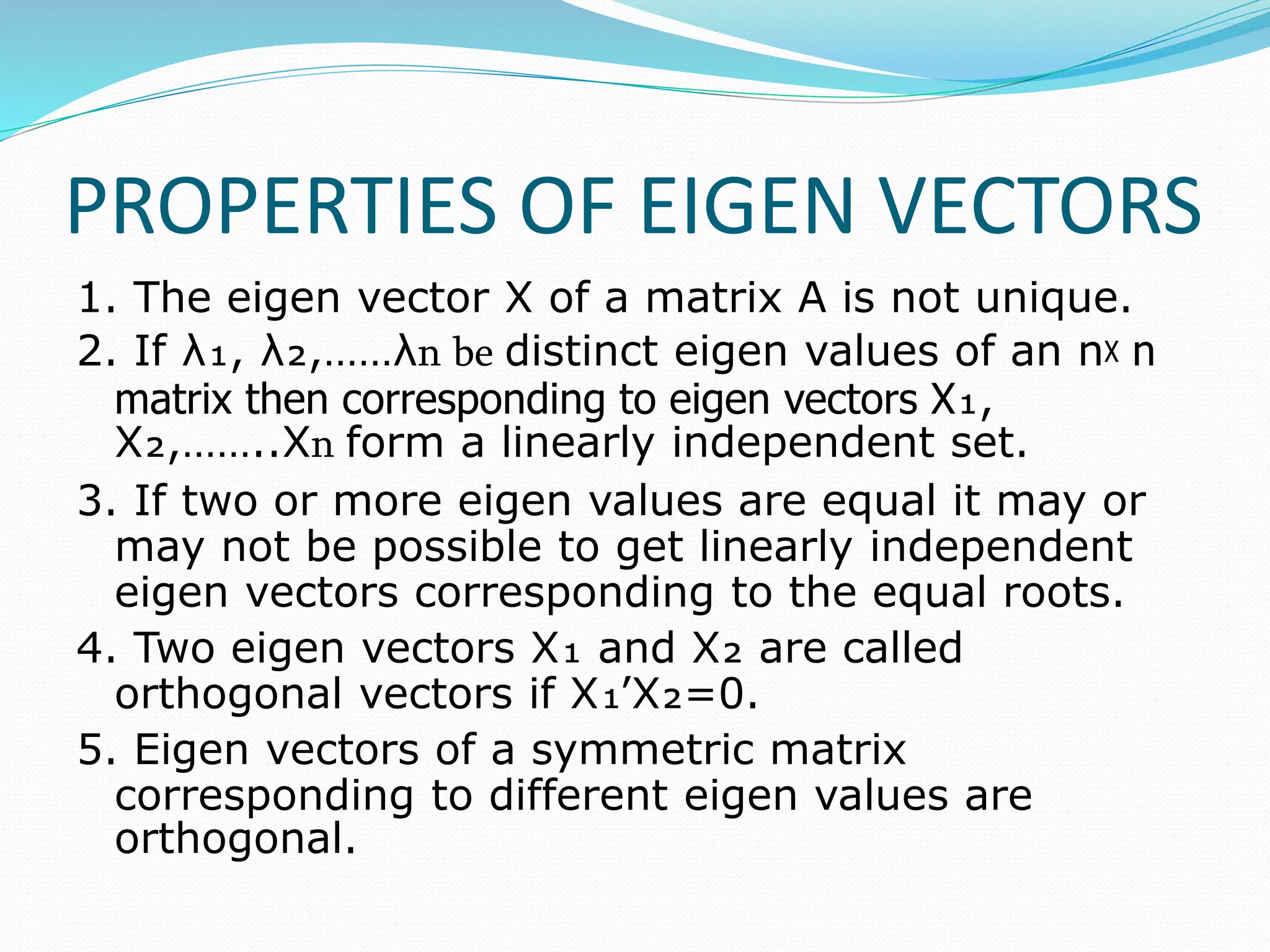
1. The eigen vector X of a matrix A is not unique.
2. If λ₁, λ₂,……λո be distinct eigen values of an nᵡ n
matrix then corresponding to eigen vectors X₁,
X₂,……..Xո form a linearly independent set.
3. If two or more eigen values are equal it may or
may not be possible to get linearly independent
eigen vectors corresponding to the equal roots.
4. Two eigen vectors X₁ and X₂ are called
orthogonal vectors if X₁՚X₂=0.
5. Eigen vectors of a symmetric matrix
corresponding to different eigen values are
orthogonal.
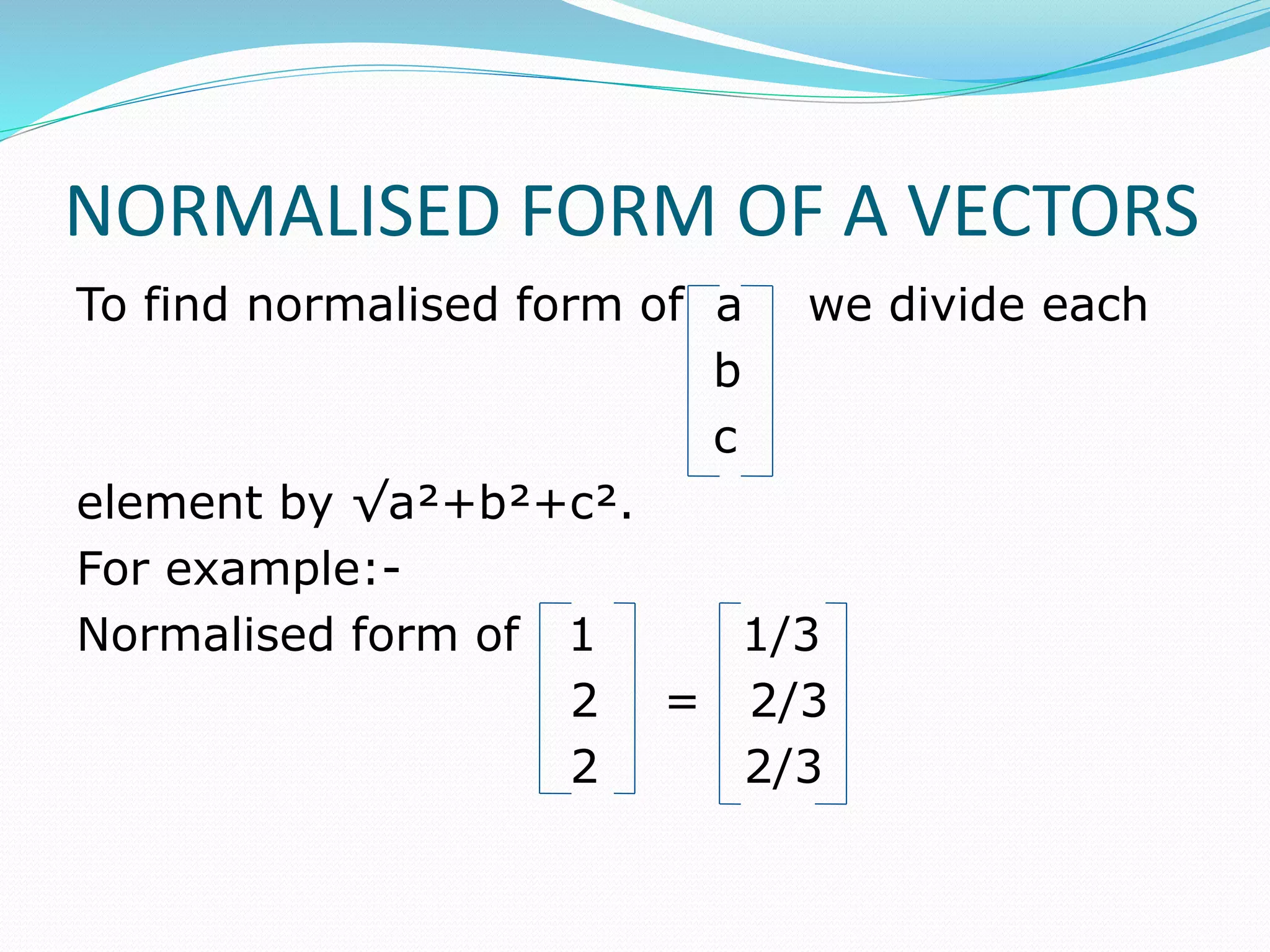
NORMALISED FORM OF A VECTORS
To find normalised form of a we divide each
b
c
element by √a²+b²+c².
For example:-
Normalised form of 1 1/3
2 = 2/3
2 2/3
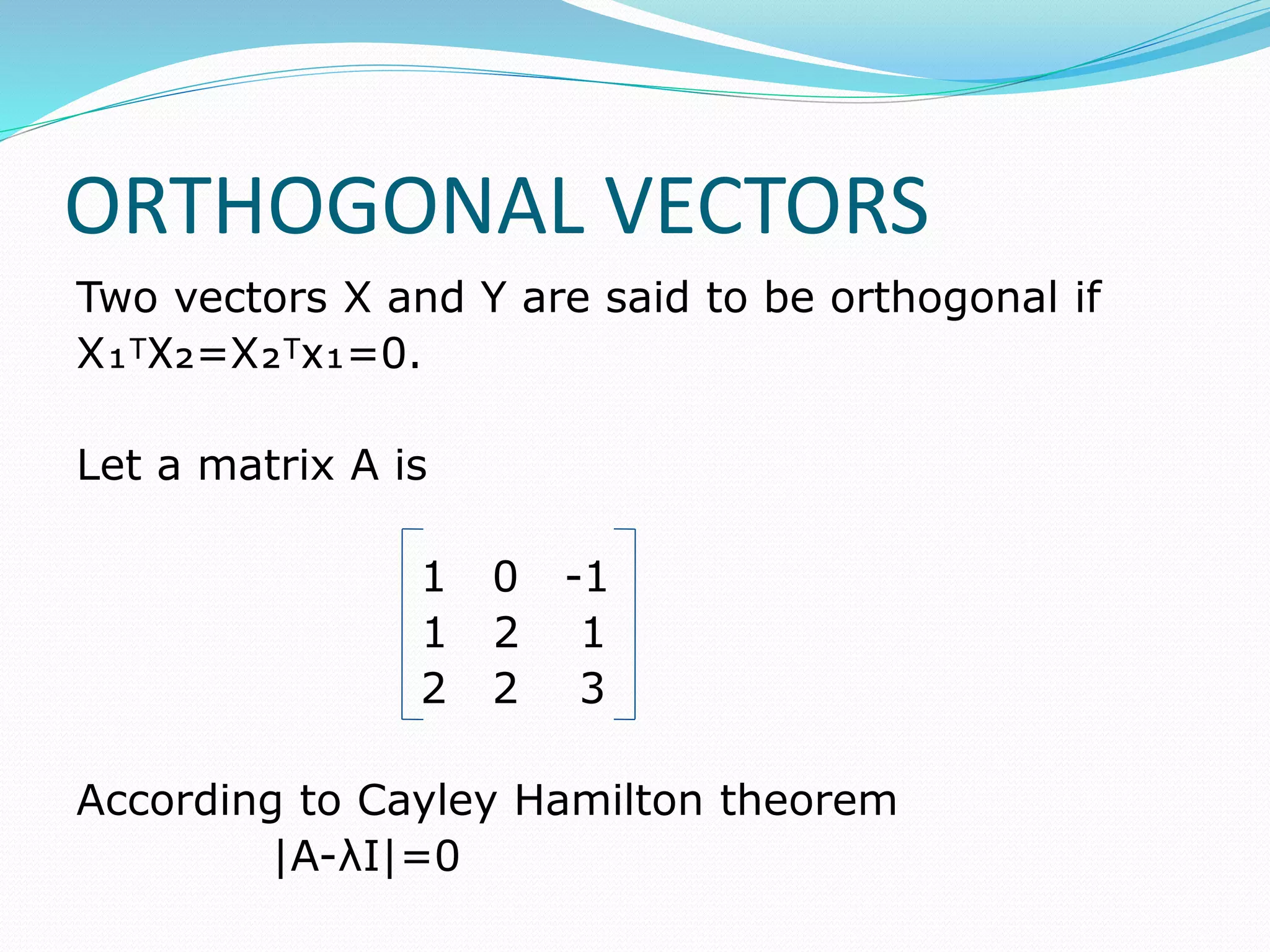
ORTHOGONAL VECTORS
Two vectors X and Y are said to be orthogonal if
X₁ᵀX₂=X₂ᵀx₁=0.
Let a matrix A is
1 0 -1
1 2 1
2 2 3
According to Cayley Hamilton theorem
|A-λI|=0
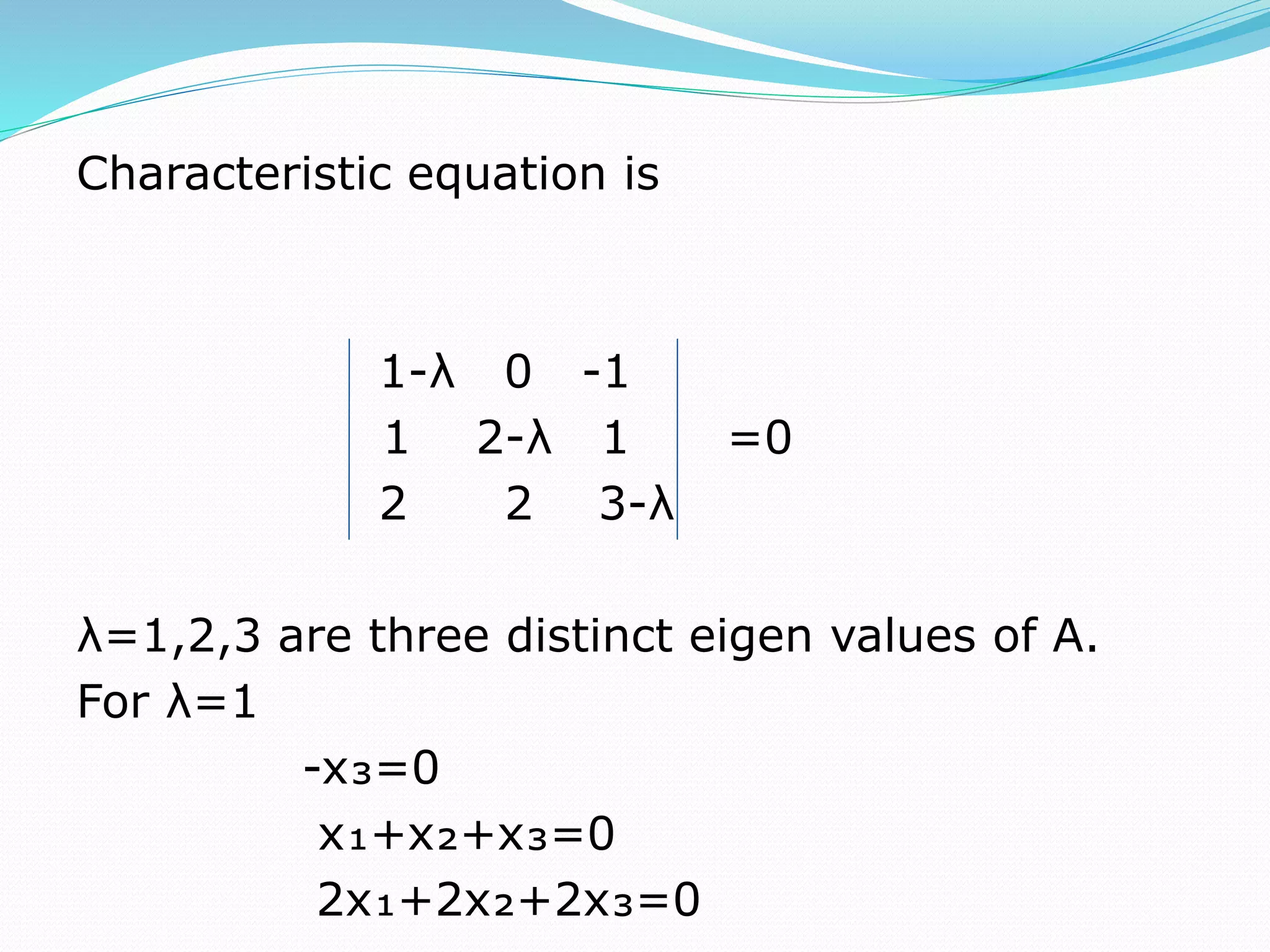
Characteristic equation is
1-λ 0 -1
1 2-λ 1 =0
2 2 3-λ
λ=1,2,3 are three distinct eigen values of A.
For λ=1
-x₃=0
x₁+x₂+x₃=0
2x₁+2x₂+2x₃=0
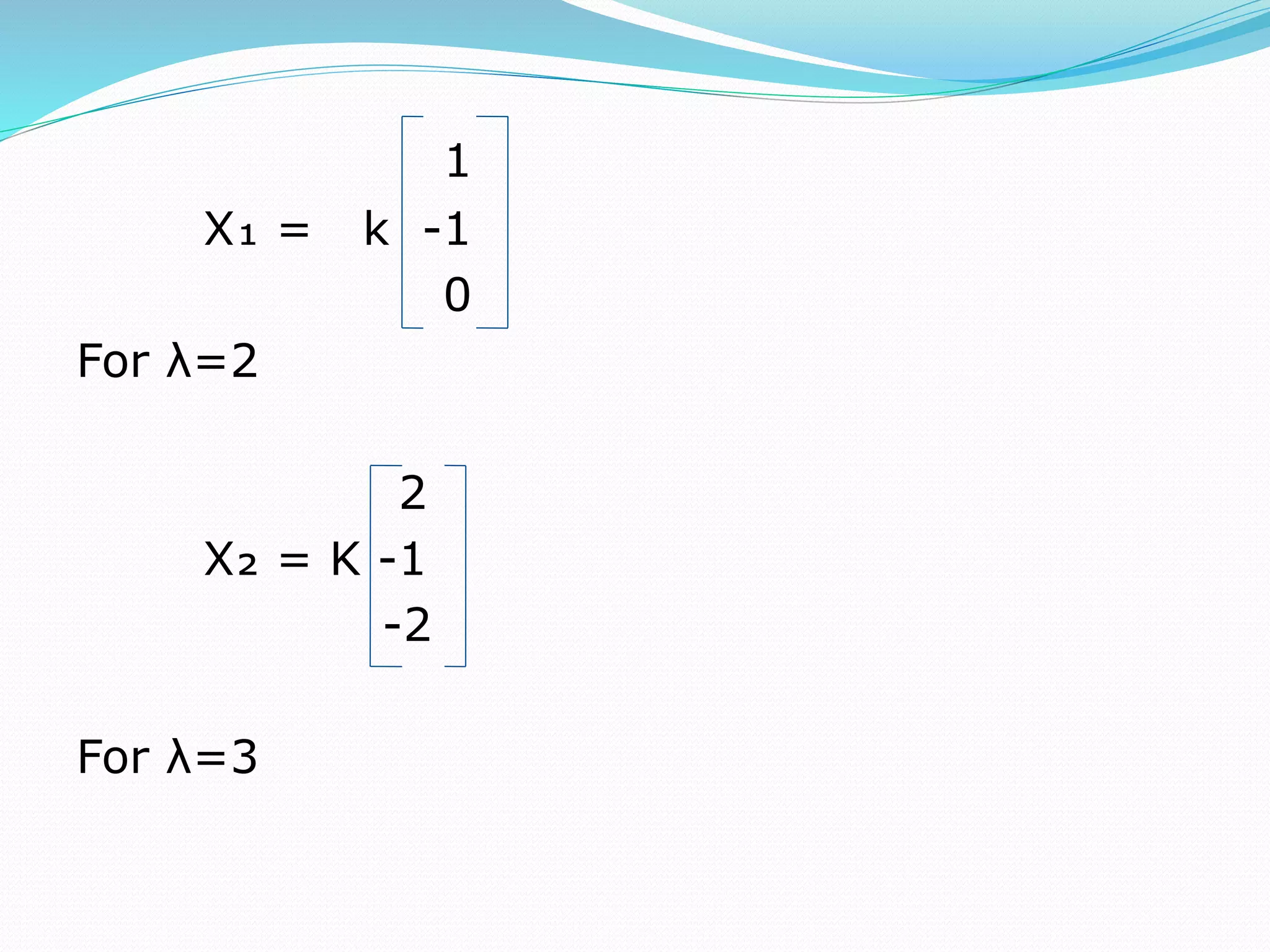
1
X₁ = k -1
0
For λ=2
2
X₂ = K -1
-2
For λ=3
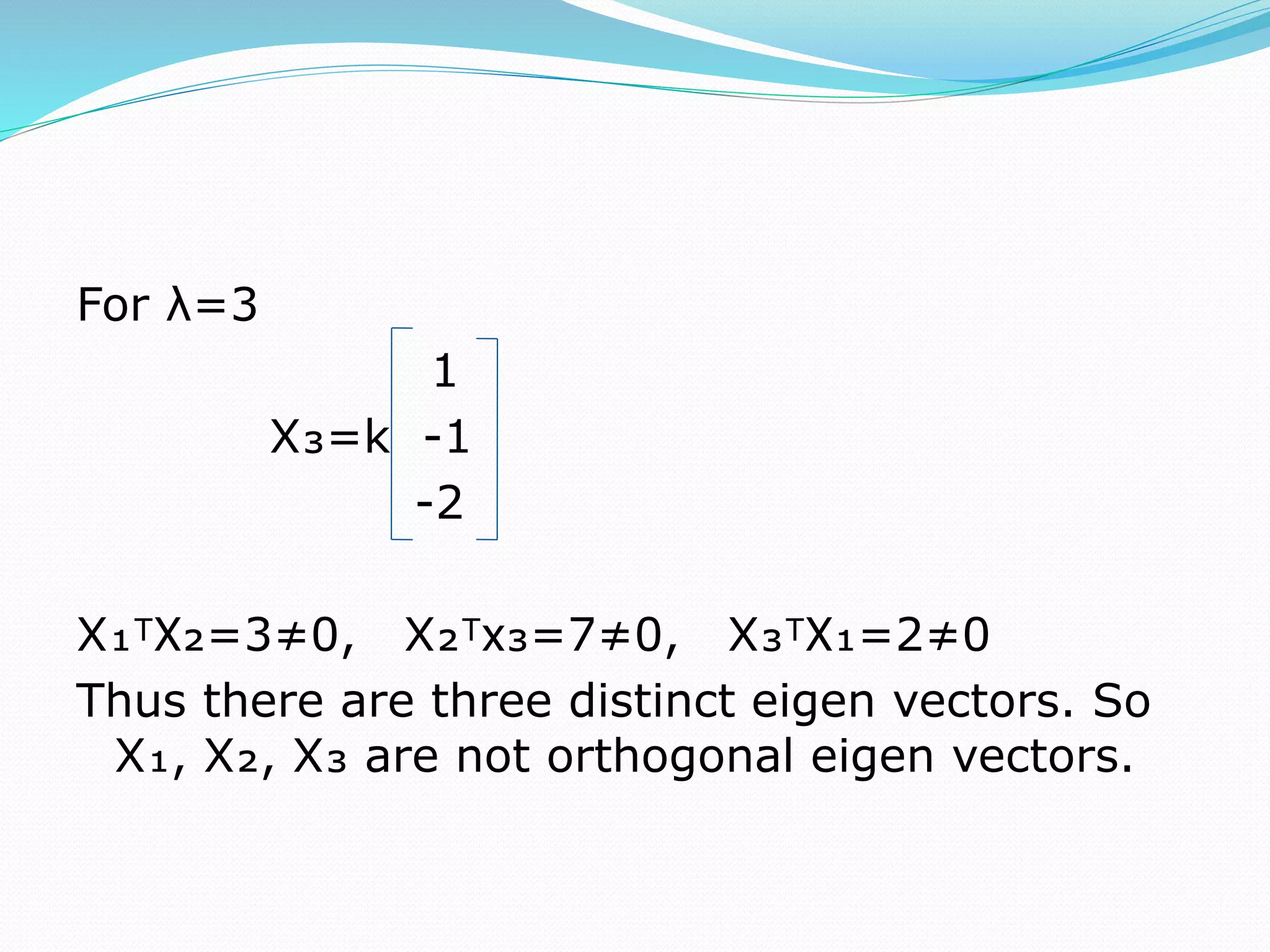
For λ=3
1
X₃=k -1
-2
X₁ᵀX₂=3≠0, X₂ᵀx₃=7≠0, X₃ᵀX₁=2≠0
Thus there are three distinct eigen vectors. So
X₁, X₂, X₃ are not orthogonal eigen vectors.
SIMILARITY TRANSFORMATION
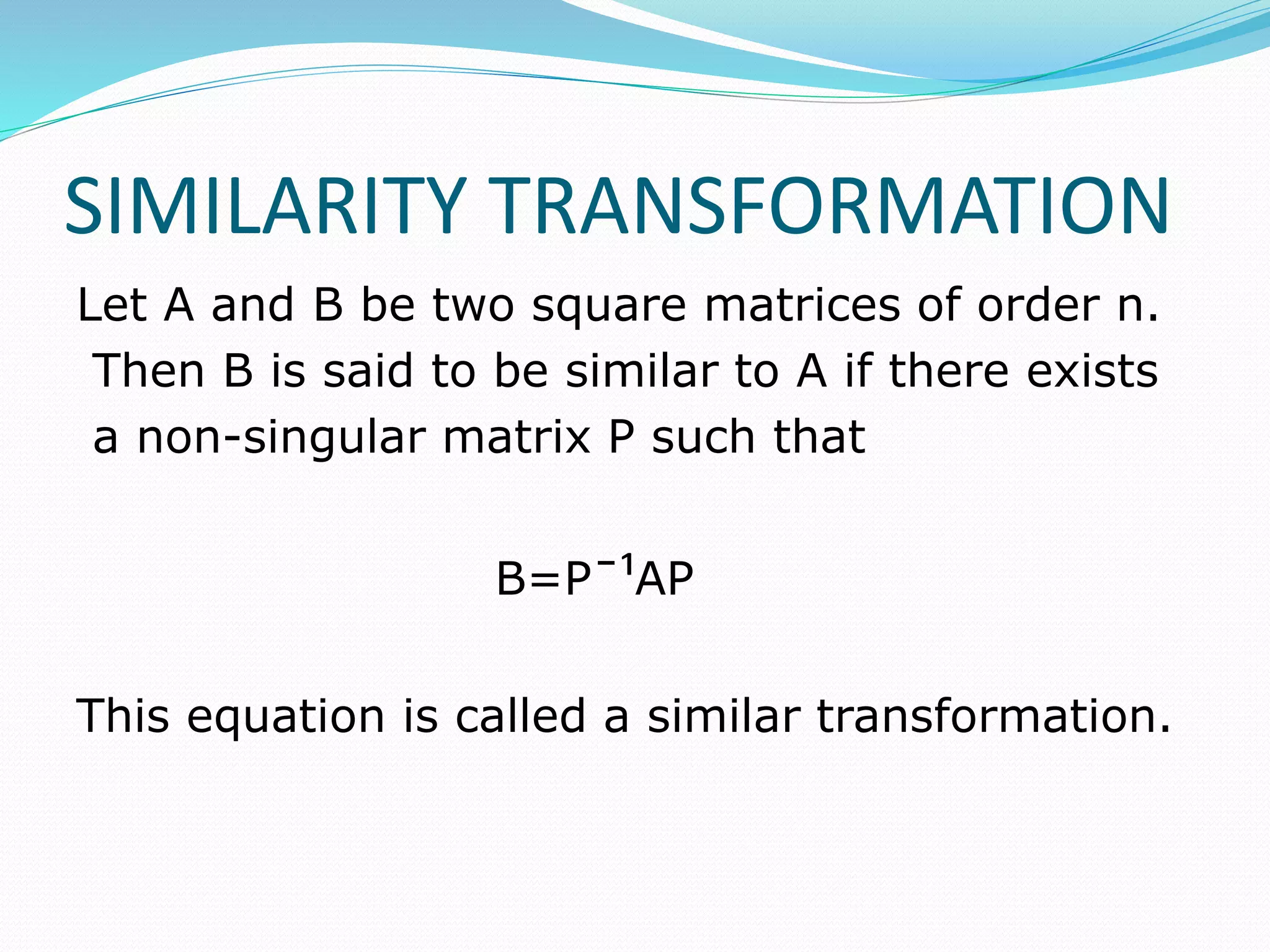
Let A and B be two square matrices of order n.
Then B is said to be similar to A if there exists
a non-singular matrix P such that
B=Pˉ¹AP
This equation is called a similar transformation.
DIAGONALIZATION OF A MATRIX
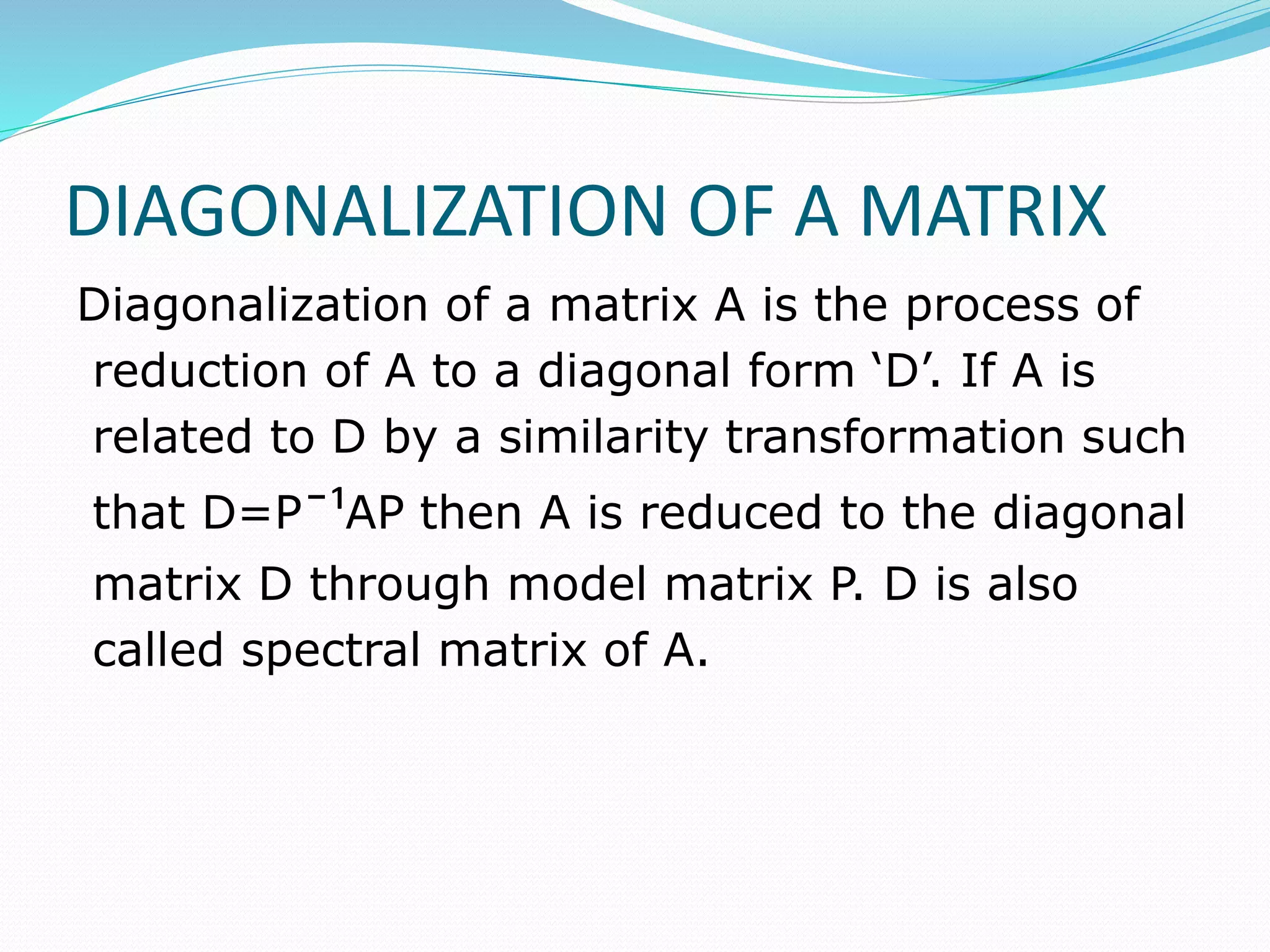
Diagonalization of a matrix A is the process of
reduction of A to a diagonal form ‘D’. If A is
related to D by a similarity transformation such
that D=Pˉ¹AP then A is reduced to the diagonal
matrix D through model matrix P. D is also
called spectral matrix of A.
EXAMPLE
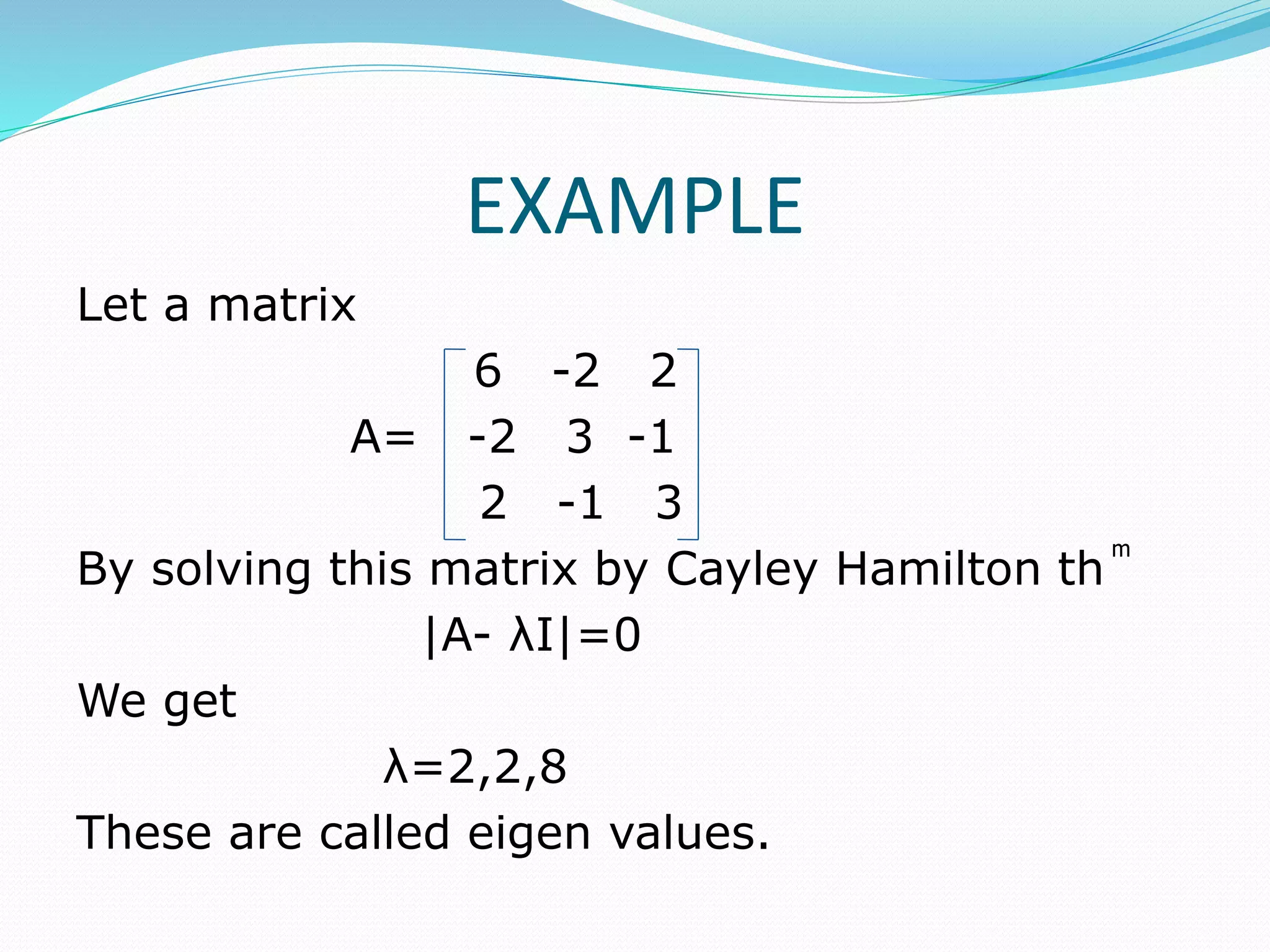
Let a matrix
6 -2 2
A= -2 3 -1
2 -1 3
By solving this matrix by Cayley Hamilton th ͫ
|A- λI|=0
We get
λ=2,2,8
These are called eigen values.
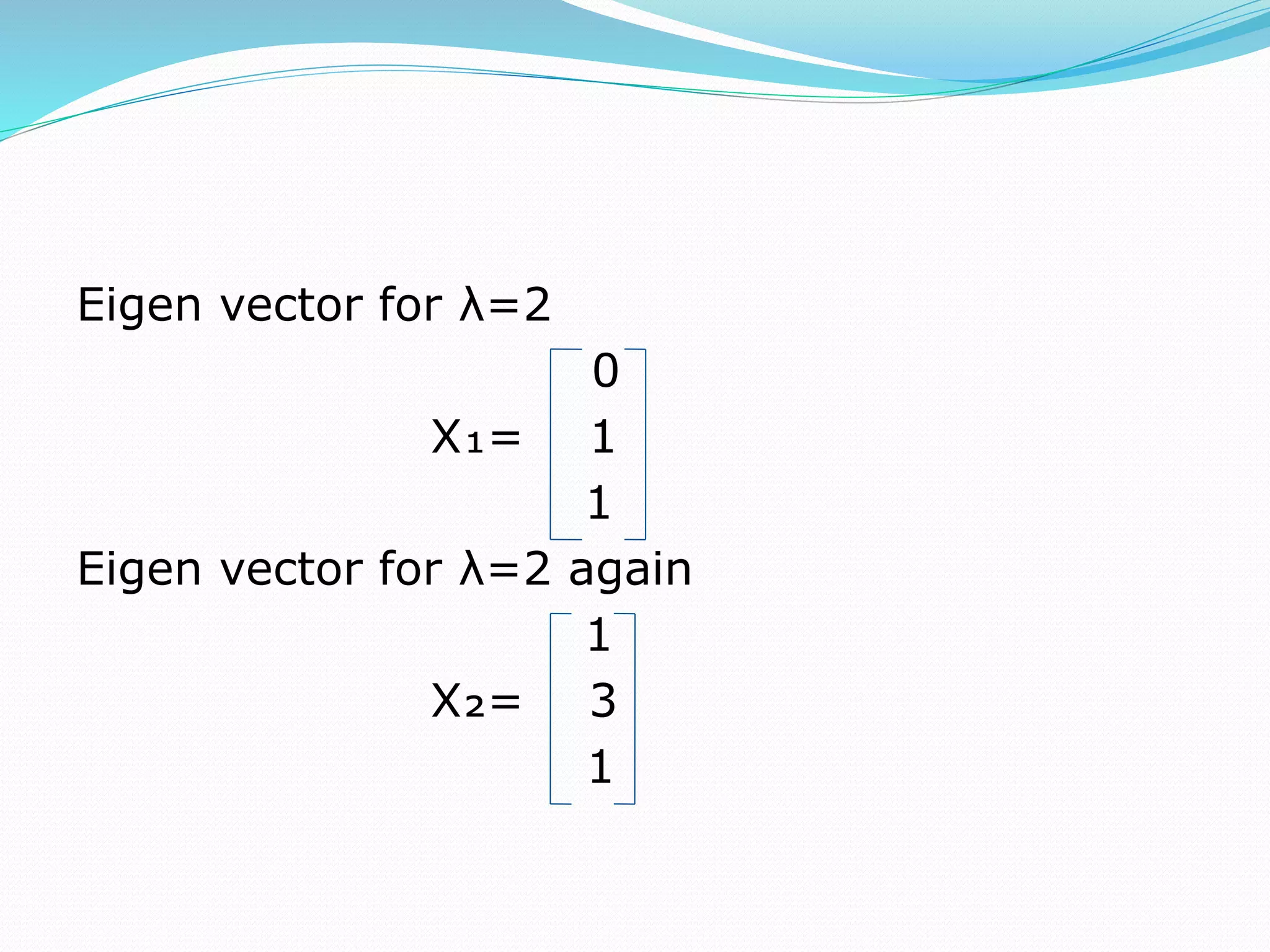
Eigen vector for λ=2
0
X₁= 1
1
Eigen vector for λ=2 again
1
X₂= 3
1
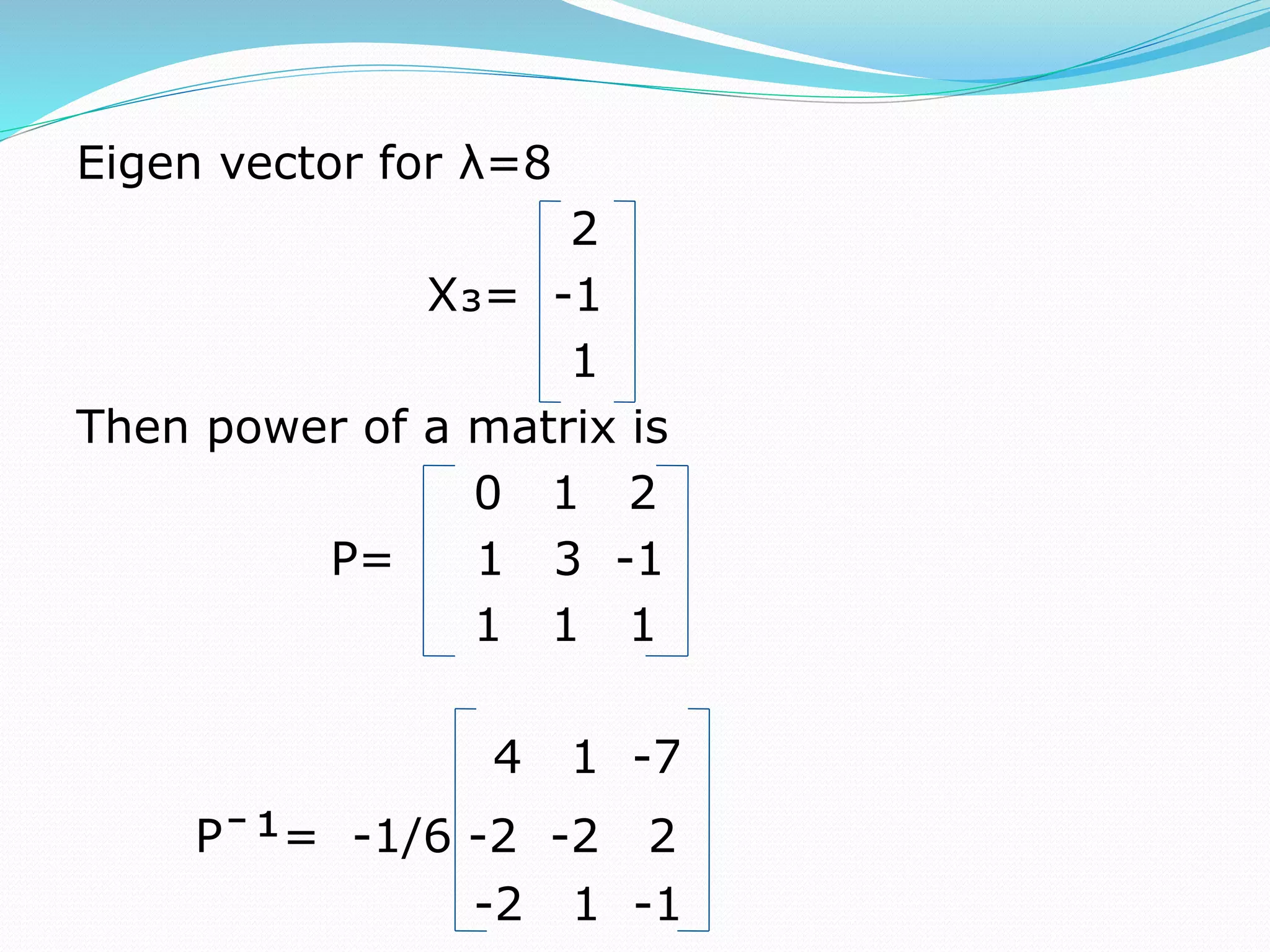
Eigen vector for λ=8
2
X₃= -1
1
Then power of a matrix is
0 1 2
P= 1 3 -1
1 1 1
4 1 -7
Pˉ¹= -1/6 -2 -2 2
-2 1 -1
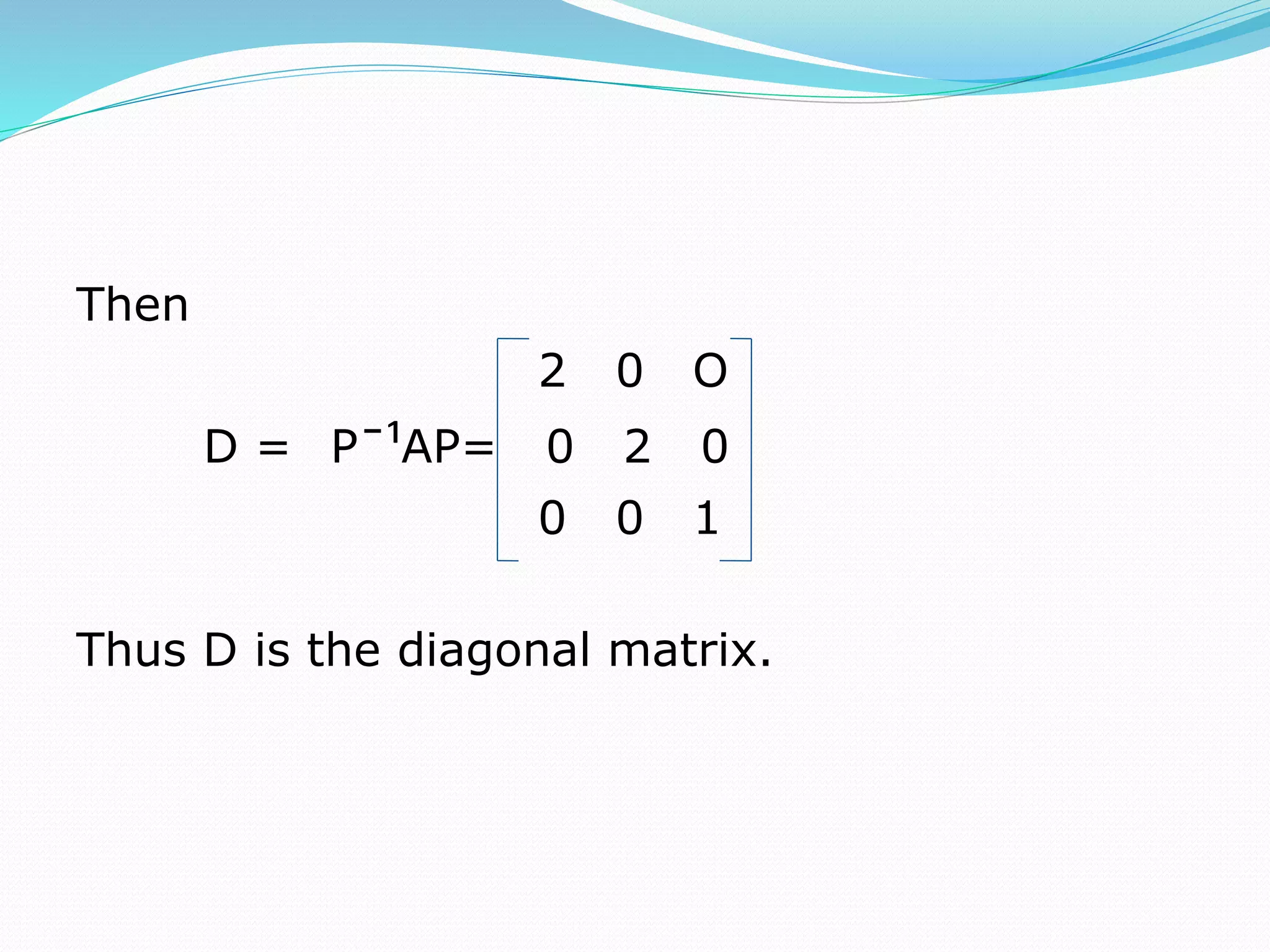
Then
2 0 O
D = Pˉ¹AP= 0 2 0
0 0 1
Thus D is the diagonal matrix.
REFERENCES
● H.K Dass, Dr. Rama Verma,”Mathematical
Physics”, S. Chand & Company PVT.LTD., New
Delhi.
● Dr. B.S. Grewal”Higher Engineering
Mathematics”, Khanna Publishers, New Delhi,
2007.
Diagonalization of matrix

Diagonalization of matrix

  • 1.
    DEPARTMENT OF PHYSICS EIGEN VALUES, EIGENVECTORS, & DIAGONALIZATION Submitted by :-Vandana (M.Sc-1st.)
  • 2.
    CONTENTS  Eigen values Eigen vectors  Similarity Transformation  Diagonalization of a matrix
  • 3.
    EIGEN VALUES To findeigen values first we find the characteristic equation given by | A- λI | = 0 Now the roots of the equation or values of λ are called eigen values.
  • 4.
    EXAMPLE Let A bea square matrix of order 33 1 1 3 A= 1 5 1 3 1 1 According to Cayley Hamilton theorem | A-λI | =0 Where λ is any scalar, and I is the 3×3 unit matrix
  • 5.
    The determinant ofthese matrix equated to zero i.e. 1- λ 1 3 1 5-λ 1 =0 3 1 1-λ On expanding the determinant, we get the equation i.e. λ³-7λ²+36=0 On solving these equations we get, λ=-2,3,6 These are called eigen values.
  • 6.
    PROPERTIES OF EIGENVALUES 1. Any square matrix A and its transpose A՚ have the same eigen values. 2. The sum of the eigen values of a matrix is equal to the trace of the matrix. 3. The product of the eigen values of a matrix A is equal to the determinant of A. 4. The eigen values of a triangular matrix are just the diagonal elements of the matrix. 5. The eigen values of an idempotent matrix are either zero or unity.
  • 7.
    6. The sumof the eigen values of a matrix is the sum of the elements of the principal diagonal. 7. If λ is an eigen value of a matrix A then 1/λ is the eigen value of Aˉ¹. 8. If λ is an eigen value of an orthogonal matrix then 1/λ is also its eigen value. 9. If λ₁, λ₂, λ₃,…….,λո are the eigen values of a matrix A then A ͫ has the eigen values λ₁ͫ ,λ₂ͫ ,……..,λոͫ.
  • 8.
    EIGEN VECTOR An eigenvector of a square matrix A is a non zero vector X such that for some number λ, we have, AX=λX AX-λIX=0 [A-λI]X=0 Where 0 represents the zero vector.
  • 9.
    EXAMPLE Now eigen vectorcorresponding to λ=-2,3,6 For λ=-2 3x₁+x₂+3x₃=0 x₁+7x₂+x₃ =0 3x₁+x₂+3x₃=0 By solving these equations, we get x₁=1, x₂=0, x₃=-1
  • 10.
  • 11.
    For λ=6 -5x₁+x₂+3x₃=0 x₁-x₂+x₃=0 3x₁+x₂-5x₃=0 By solvingthese equations, we get x₁=1, x₂=2, x₃=1 Hence λ=-2(1,0,-1) λ=3(1,-1,1) λ=6(1,2,1) Hence corresponding to each eigen value there exist an eigen vector.
  • 12.
    PROPERTIES OF EIGENVECTORS 1. The eigen vector X of a matrix A is not unique. 2. If λ₁, λ₂,……λո be distinct eigen values of an nᵡ n matrix then corresponding to eigen vectors X₁, X₂,……..Xո form a linearly independent set. 3. If two or more eigen values are equal it may or may not be possible to get linearly independent eigen vectors corresponding to the equal roots. 4. Two eigen vectors X₁ and X₂ are called orthogonal vectors if X₁՚X₂=0. 5. Eigen vectors of a symmetric matrix corresponding to different eigen values are orthogonal.
  • 13.
    NORMALISED FORM OFA VECTORS To find normalised form of a we divide each b c element by √a²+b²+c². For example:- Normalised form of 1 1/3 2 = 2/3 2 2/3
  • 14.
    ORTHOGONAL VECTORS Two vectorsX and Y are said to be orthogonal if X₁ᵀX₂=X₂ᵀx₁=0. Let a matrix A is 1 0 -1 1 2 1 2 2 3 According to Cayley Hamilton theorem |A-λI|=0
  • 15.
    Characteristic equation is 1-λ0 -1 1 2-λ 1 =0 2 2 3-λ λ=1,2,3 are three distinct eigen values of A. For λ=1 -x₃=0 x₁+x₂+x₃=0 2x₁+2x₂+2x₃=0
  • 16.
    1 X₁ = k-1 0 For λ=2 2 X₂ = K -1 -2 For λ=3
  • 17.
    For λ=3 1 X₃=k -1 -2 X₁ᵀX₂=3≠0,X₂ᵀx₃=7≠0, X₃ᵀX₁=2≠0 Thus there are three distinct eigen vectors. So X₁, X₂, X₃ are not orthogonal eigen vectors.
  • 18.
    SIMILARITY TRANSFORMATION Let Aand B be two square matrices of order n. Then B is said to be similar to A if there exists a non-singular matrix P such that B=Pˉ¹AP This equation is called a similar transformation.
  • 19.
    DIAGONALIZATION OF AMATRIX Diagonalization of a matrix A is the process of reduction of A to a diagonal form ‘D’. If A is related to D by a similarity transformation such that D=Pˉ¹AP then A is reduced to the diagonal matrix D through model matrix P. D is also called spectral matrix of A.
  • 20.
    EXAMPLE Let a matrix 6-2 2 A= -2 3 -1 2 -1 3 By solving this matrix by Cayley Hamilton th ͫ |A- λI|=0 We get λ=2,2,8 These are called eigen values.
  • 21.
    Eigen vector forλ=2 0 X₁= 1 1 Eigen vector for λ=2 again 1 X₂= 3 1
  • 22.
    Eigen vector forλ=8 2 X₃= -1 1 Then power of a matrix is 0 1 2 P= 1 3 -1 1 1 1 4 1 -7 Pˉ¹= -1/6 -2 -2 2 -2 1 -1
  • 23.
    Then 2 0 O D= Pˉ¹AP= 0 2 0 0 0 1 Thus D is the diagonal matrix.
  • 24.
    REFERENCES ● H.K Dass,Dr. Rama Verma,”Mathematical Physics”, S. Chand & Company PVT.LTD., New Delhi. ● Dr. B.S. Grewal”Higher Engineering Mathematics”, Khanna Publishers, New Delhi, 2007.

Editor's Notes