INITIAL AND FINAL CONDITION
FOR CIRCUIT
Contents
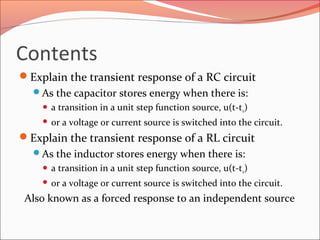
Explain the transient response of a RC circuit
As the capacitor stores energy when there is:
 a transition in a unit step function source, u(t-to)
 or a voltage or current source is switched into the circuit.
Explain the transient response of a RL circuit
As the inductor stores energy when there is:
 a transition in a unit step function source, u(t-to)
 or a voltage or current source is switched into the circuit.
Also known as a forced response to an independent source
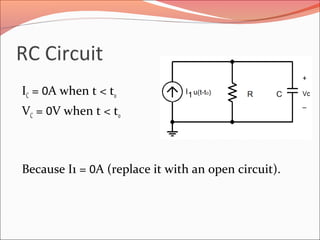
RC Circuit
IC = 0A when t < to
VC = 0V when t < to
Because I1 = 0A (replace it with an open circuit).
RC Circuit
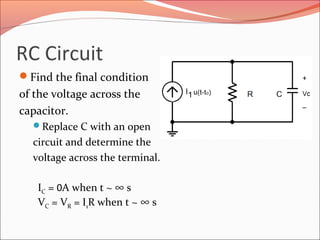
Find the final condition
of the voltage across the
capacitor.
Replace C with an open
circuit and determine the
voltage across the terminal.
IC = 0A when t ~ ∞ s
VC = VR = I1R when t ~ ∞ s
RC Circuit
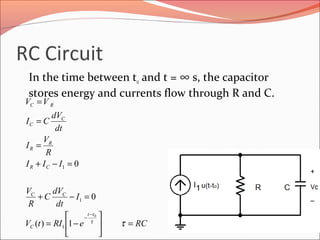
In the time between to and t = ∞ s, the capacitor
stores energy and currents flow through R and C.
RCeRItV
I
dt
dV
C
R
V
III
R
V
I
dt
dV
CI
VV
tt
C
CC
CR
R
R
C
C
RC
=





−=
=−+
=−+
=
=
=
−
−
ττ
1)(
0
0
0
1
1
1
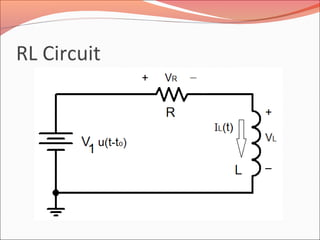
RL Circuit
RL Circuit (con’t)
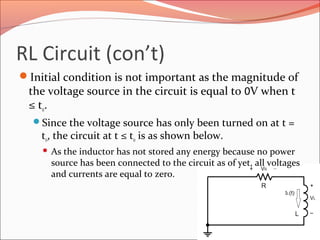
Initial condition is not important as the magnitude of
the voltage source in the circuit is equal to 0V when t
≤ to.
Since the voltage source has only been turned on at t =
to, the circuit at t ≤ to is as shown below.
 As the inductor has not stored any energy because no power
source has been connected to the circuit as of yet, all voltages
and currents are equal to zero.
RL Circuit
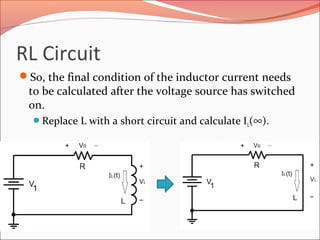
So, the final condition of the inductor current needs
to be calculated after the voltage source has switched
on.
Replace L with a short circuit and calculate IL(∞).
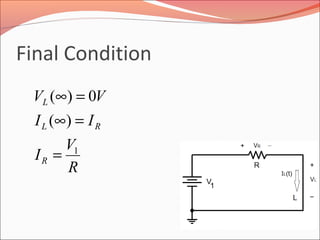
Final Condition
R
V
I
II
VV
R
RL
L
1
)(
0)(
=
=∞
=∞
RL Circuit
[ ]τ/)(1
1
1
1)(
0
0
ott
L
L
L
R
L
e
R
V
tI
L
V
I
L
R
dt
dI
VRI
dt
dI
−−
−=
=−+
=−+
R
L
=τ
dt
dI
LV
RVII
VVV
L
L
RRL
RL
=
==
=++−
/
01
Electronic Response
Typically, we say that the currents and voltages in a
circuit have reached steady-state once 5τ have passed
after a change has been made to the value of a current
or voltage source in the circuit.
In a circuit with a forced response, percentage-wise
how close is the value of the voltage across a capacitor
in an RC circuit to its final value at 5τ?
Complete Response
Is equal to the natural response of the circuit plus the
forced response
Use superposition to determine the final equations for
voltage across components and the currents flowing
through them.
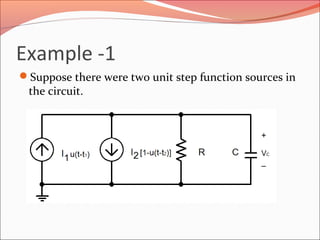
Example -1
Suppose there were two unit step function sources in
the circuit.
Example -1 (con’t)
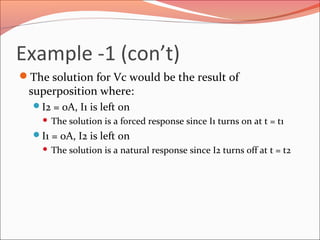
The solution for Vc would be the result of
superposition where:
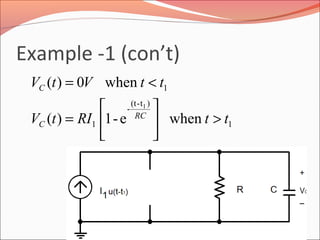
I2 = 0A, I1 is left on
 The solution is a forced response since I1 turns on at t = t1
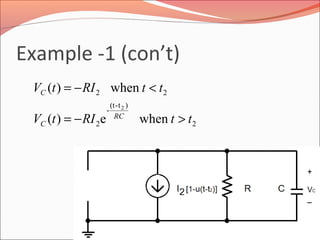
I1 = 0A, I2 is left on
 The solution is a natural response since I2 turns off at t = t2
Example -1 (con’t)
1
)t-(t
-
1
1
whene-1)(
when0)(
1
ttRItV
ttVtV
RC
C
C
>





=
<=
Example -1 (con’t)
2
)t-(t
-
2
22
whene)(
when)(
2
ttRItV
ttRItV
RC
C
C
>−=
<−=
Example -1 (con’t)
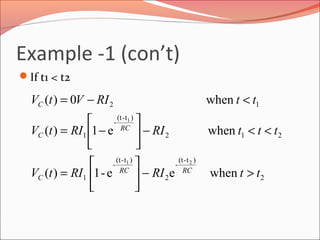
If t1 < t2
2
)t-(t
-
2
)t-(t
-
1
212
)t-(t
-
1
12
whenee-1)(
whene1)(
henw0)(
21
1
ttRIRItV
tttRIRItV
ttRIVtV
RCRC
C
RC
C
C
>−





=
<<−





−=
<−=
General Equations
[ ]
[ ]
[ ]
[ ]
RL
eII
L
tV
eIIItI
RC
eVV
C
tI
eVVVtV
t
LLL
t
LLLL
t
CCC
t
CCCC
/
)0()()(
)()0()()(
)0()()(
)()0()()(
/
/
/
/
=
−∞=
∞−+∞=
=
−∞=
∞−+∞=
−
−
−
−
τ
τ
τ
τ
τ
τ
τ
τ
When a
voltage or
current source
changes its
magnitude at
t= 0s in a
simple RC or
RL circuit.
Equations for a simple RC circuit
Equations for a simple RL circuit
Summary
The final condition for:
the capacitor voltage (Vo) is determined by replacing the
capacitor with an open circuit and then calculating the
voltage across the terminals.
The inductor current (Io) is determined by replacing the
inductor with a short circuit and then calculating the current
flowing through the short.
The time constant for:
an RC circuit is τ = RC and an RL circuit is τ = L/R
The general equations for the forced response of:
the voltage across a capacitor is
the current through an inductor is
[ ]
[ ] o
tt
oL
o
tt
oC
tteItI
tteVtV
o
o
>−=
>−=
−−
−−
when1)(
when1)(
/)(
/)(
τ
τ
Summary
General equations when the magnitude of a voltage
or current source in the circuit changes at t = 0s for
the:
voltage across a capacitor is
current through an inductor is
Superposition should be used if there are multiple
voltage and/or current sources that change the
magnitude of their output as a function of time.
[ ]
[ ] τ
τ
/
/
)()0()()(
)()0()()(
t
LLLL
t
CCCC
eIIItI
eVVVtV
−
−
∞−+∞=
∞−+∞=
References
E draw max (for drawing)
Electrical circuit
Initial and final condition for circuit

Initial and final condition for circuit

  • 1.
    INITIAL AND FINALCONDITION FOR CIRCUIT
  • 2.
    Contents Explain the transientresponse of a RC circuit As the capacitor stores energy when there is:  a transition in a unit step function source, u(t-to)  or a voltage or current source is switched into the circuit. Explain the transient response of a RL circuit As the inductor stores energy when there is:  a transition in a unit step function source, u(t-to)  or a voltage or current source is switched into the circuit. Also known as a forced response to an independent source
  • 3.
    RC Circuit IC =0A when t < to VC = 0V when t < to Because I1 = 0A (replace it with an open circuit).
  • 4.
    RC Circuit Find thefinal condition of the voltage across the capacitor. Replace C with an open circuit and determine the voltage across the terminal. IC = 0A when t ~ ∞ s VC = VR = I1R when t ~ ∞ s
  • 5.
    RC Circuit In thetime between to and t = ∞ s, the capacitor stores energy and currents flow through R and C. RCeRItV I dt dV C R V III R V I dt dV CI VV tt C CC CR R R C C RC =      −= =−+ =−+ = = = − − ττ 1)( 0 0 0 1 1 1
  • 6.
  • 7.
    RL Circuit (con’t) Initialcondition is not important as the magnitude of the voltage source in the circuit is equal to 0V when t ≤ to. Since the voltage source has only been turned on at t = to, the circuit at t ≤ to is as shown below.  As the inductor has not stored any energy because no power source has been connected to the circuit as of yet, all voltages and currents are equal to zero.
  • 8.
    RL Circuit So, thefinal condition of the inductor current needs to be calculated after the voltage source has switched on. Replace L with a short circuit and calculate IL(∞).
  • 9.
  • 10.
  • 11.
    Electronic Response Typically, wesay that the currents and voltages in a circuit have reached steady-state once 5τ have passed after a change has been made to the value of a current or voltage source in the circuit. In a circuit with a forced response, percentage-wise how close is the value of the voltage across a capacitor in an RC circuit to its final value at 5τ?
  • 12.
    Complete Response Is equalto the natural response of the circuit plus the forced response Use superposition to determine the final equations for voltage across components and the currents flowing through them.
  • 13.
    Example -1 Suppose therewere two unit step function sources in the circuit.
  • 14.
    Example -1 (con’t) Thesolution for Vc would be the result of superposition where: I2 = 0A, I1 is left on  The solution is a forced response since I1 turns on at t = t1 I1 = 0A, I2 is left on  The solution is a natural response since I2 turns off at t = t2
  • 15.
  • 16.
  • 17.
    Example -1 (con’t) Ift1 < t2 2 )t-(t - 2 )t-(t - 1 212 )t-(t - 1 12 whenee-1)( whene1)( henw0)( 21 1 ttRIRItV tttRIRItV ttRIVtV RCRC C RC C C >−      = <<−      −= <−=
  • 18.
    General Equations [ ] [] [ ] [ ] RL eII L tV eIIItI RC eVV C tI eVVVtV t LLL t LLLL t CCC t CCCC / )0()()( )()0()()( )0()()( )()0()()( / / / / = −∞= ∞−+∞= = −∞= ∞−+∞= − − − − τ τ τ τ τ τ τ τ When a voltage or current source changes its magnitude at t= 0s in a simple RC or RL circuit. Equations for a simple RC circuit Equations for a simple RL circuit
  • 19.
    Summary The final conditionfor: the capacitor voltage (Vo) is determined by replacing the capacitor with an open circuit and then calculating the voltage across the terminals. The inductor current (Io) is determined by replacing the inductor with a short circuit and then calculating the current flowing through the short. The time constant for: an RC circuit is τ = RC and an RL circuit is τ = L/R The general equations for the forced response of: the voltage across a capacitor is the current through an inductor is [ ] [ ] o tt oL o tt oC tteItI tteVtV o o >−= >−= −− −− when1)( when1)( /)( /)( τ τ
  • 20.
    Summary General equations whenthe magnitude of a voltage or current source in the circuit changes at t = 0s for the: voltage across a capacitor is current through an inductor is Superposition should be used if there are multiple voltage and/or current sources that change the magnitude of their output as a function of time. [ ] [ ] τ τ / / )()0()()( )()0()()( t LLLL t CCCC eIIItI eVVVtV − − ∞−+∞= ∞−+∞=
  • 21.
    References E draw max(for drawing) Electrical circuit