COST FOR PRODUCTION INCLUDING
BREAKING ANALYSIS
CONTENTS
• CONCEPTS OF COST
• VARIOUS TYPES OF COST
• BREAK EVEN ANALYSIS
• BREAK EVEN POINT
CONCEPT OF COST
For every business organization, it is
essential to install a set up as per the nature and
need of the product. Number of employees are
employed in the business organization for
transforming the raw material into finished
products using machines. So, business
organization incurs various types of costs.
So, profit = Total Revenue –Total Costs
VARIOUS TYPES OF COST
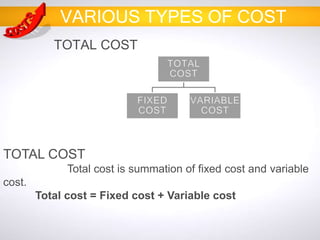
TOTAL COST
TOTAL COST
Total cost is summation of fixed cost and variable
cost.
Total cost = Fixed cost + Variable cost
VARIABLE COST
Variable cost is the cost which varies with number
of unit produced. It increases with increase in number of
units produced and vice versa.
Example - Raw material consumption, Electricity bill, Extra
labour hours etc.
FIXED COST
Fixed cost is the cost which do not vary with
number of units produced. It incurs even if the organization
does not produce a single unit of product.
Example - Rent, Advertising, Insurance, Cost of machine
installation, Salaries of employees, Minimum electricity bill etc.
DIRECT COST
Direct cost can be completely attributed to the
production of specific goods or service. Direct costs refer to
materials, labor and expenses related to the production of a
product. Direct cost varies with number of unit produced.
Example – Electricity bill, installation of machinary etc.
INDIRECT COST
Expenses which are not specific to any product or
good, but these type of cost are incurred in combined for the
business are termed as indirect cost.
Example – Rent, Advertising, Maintenance, Security etc.
AVERAGE COST
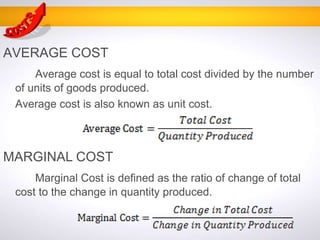
Average cost is equal to total cost divided by the number
of units of goods produced.
Average cost is also known as unit cost.
MARGINAL COST
Marginal Cost is defined as the ratio of change of total
cost to the change in quantity produced.
INCREMENTAL COST
Incremental cost is the cost associated with increasing
production by one unit. The incremental cost total is always
made up of purely variable costs.
RECURRING COST
For each item produced or each service performed is
termed as recurring cost.
Example – Insurance premium, Electricity bill etc.
NON – RECURRING COST
A one-time Charge incurred as a result of rare event or
activity, such as purchase of machine, building construction,
design, development and investment cost is termed as
non-recurring cost.
SUNK COST
Sunk cost is a retrospective (past) cost that has already
been incurred and cannot be recovered. Sunk costs are
independent of any event that may occur in the future.
IMPLICIT COST
An implicit cost, also called an imputed cost, implied
cost, or notional cost, is the opportunity cost equal to what a
firm must given up in order to use factors which it neither
purchases nor hires.
OPPORTUNITY COST
When any of the option is selected out of available
options, other options are not selected. Hence, selector
sacrifices all other options. So, the value which is forgone for
selecting the mutually exclusive alternatives is termed as
opportunity cost.
CASH COST
Cash costs are costs are costs that businesses pay
for when using cash, or a check, but not credit. On a cash
accounting basis, the cost paid for by using credit would not
be recorded in the general ledger until the actual cash has
been paid.
SHORT RUN COST
We consider that any company is installing a plant
for manufacturing a product. For certain period of time,
company cannot adjust the number or size of plants. By hiring
more workers only number of products manufactured can be
increased. So, fixed cost incurred in installing the plant cannot
be varied during certain period of time, is termed as short run
cost.
LONG RUN COST
After several years, company can either expand the
existing plant or increase the number of plants. So, in long
run cost of plants can be varied and hence it is termed as
long run cost.
BREAK EVEN ANALYSIS - BEP
The point at which the company starts to
earn profit is termed as Break Even Point (BEP)
and its analysis is termed as Break Even
analysis (BEA).
Sales revenue = All variable fixed cost
Methods to find out BEP
BEP in Physical Quantity Produced
BEP in terms of Sales Volume
BEP in Physical Quantity Produced
BEP is defined as the ratio of total fixed cost to the
contribution per unit. Here, contribution is defined as the
difference between revenue generated and variable cost
incurred.
Where, Contribution (C) = Revenue – Variable Cost
BEP in terms of Sales Volume
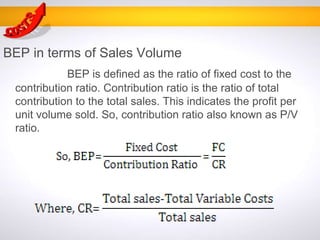
BEP is defined as the ratio of fixed cost to the
contribution ratio. Contribution ratio is the ratio of total
contribution to the total sales. This indicates the profit per
unit volume sold. So, contribution ratio also known as P/V
ratio.
REFRENCES
• Engineering Economics & Management
(Akshay A. Pujara)
Cost for production including breaking  analysis

Cost for production including breaking analysis

  • 1.
    COST FOR PRODUCTIONINCLUDING BREAKING ANALYSIS
  • 2.
    CONTENTS • CONCEPTS OFCOST • VARIOUS TYPES OF COST • BREAK EVEN ANALYSIS • BREAK EVEN POINT
  • 3.
    CONCEPT OF COST Forevery business organization, it is essential to install a set up as per the nature and need of the product. Number of employees are employed in the business organization for transforming the raw material into finished products using machines. So, business organization incurs various types of costs. So, profit = Total Revenue –Total Costs
  • 4.
    VARIOUS TYPES OFCOST TOTAL COST TOTAL COST Total cost is summation of fixed cost and variable cost. Total cost = Fixed cost + Variable cost
  • 5.
    VARIABLE COST Variable costis the cost which varies with number of unit produced. It increases with increase in number of units produced and vice versa. Example - Raw material consumption, Electricity bill, Extra labour hours etc. FIXED COST Fixed cost is the cost which do not vary with number of units produced. It incurs even if the organization does not produce a single unit of product. Example - Rent, Advertising, Insurance, Cost of machine installation, Salaries of employees, Minimum electricity bill etc.
  • 6.
    DIRECT COST Direct costcan be completely attributed to the production of specific goods or service. Direct costs refer to materials, labor and expenses related to the production of a product. Direct cost varies with number of unit produced. Example – Electricity bill, installation of machinary etc. INDIRECT COST Expenses which are not specific to any product or good, but these type of cost are incurred in combined for the business are termed as indirect cost. Example – Rent, Advertising, Maintenance, Security etc.
  • 7.
    AVERAGE COST Average costis equal to total cost divided by the number of units of goods produced. Average cost is also known as unit cost. MARGINAL COST Marginal Cost is defined as the ratio of change of total cost to the change in quantity produced.
  • 8.
    INCREMENTAL COST Incremental costis the cost associated with increasing production by one unit. The incremental cost total is always made up of purely variable costs. RECURRING COST For each item produced or each service performed is termed as recurring cost. Example – Insurance premium, Electricity bill etc.
  • 9.
    NON – RECURRINGCOST A one-time Charge incurred as a result of rare event or activity, such as purchase of machine, building construction, design, development and investment cost is termed as non-recurring cost. SUNK COST Sunk cost is a retrospective (past) cost that has already been incurred and cannot be recovered. Sunk costs are independent of any event that may occur in the future.
  • 10.
    IMPLICIT COST An implicitcost, also called an imputed cost, implied cost, or notional cost, is the opportunity cost equal to what a firm must given up in order to use factors which it neither purchases nor hires. OPPORTUNITY COST When any of the option is selected out of available options, other options are not selected. Hence, selector sacrifices all other options. So, the value which is forgone for selecting the mutually exclusive alternatives is termed as opportunity cost.
  • 11.
    CASH COST Cash costsare costs are costs that businesses pay for when using cash, or a check, but not credit. On a cash accounting basis, the cost paid for by using credit would not be recorded in the general ledger until the actual cash has been paid. SHORT RUN COST We consider that any company is installing a plant for manufacturing a product. For certain period of time, company cannot adjust the number or size of plants. By hiring more workers only number of products manufactured can be increased. So, fixed cost incurred in installing the plant cannot be varied during certain period of time, is termed as short run cost.
  • 12.
    LONG RUN COST Afterseveral years, company can either expand the existing plant or increase the number of plants. So, in long run cost of plants can be varied and hence it is termed as long run cost.
  • 13.
    BREAK EVEN ANALYSIS- BEP The point at which the company starts to earn profit is termed as Break Even Point (BEP) and its analysis is termed as Break Even analysis (BEA). Sales revenue = All variable fixed cost Methods to find out BEP BEP in Physical Quantity Produced BEP in terms of Sales Volume
  • 14.
    BEP in PhysicalQuantity Produced BEP is defined as the ratio of total fixed cost to the contribution per unit. Here, contribution is defined as the difference between revenue generated and variable cost incurred. Where, Contribution (C) = Revenue – Variable Cost
  • 15.
    BEP in termsof Sales Volume BEP is defined as the ratio of fixed cost to the contribution ratio. Contribution ratio is the ratio of total contribution to the total sales. This indicates the profit per unit volume sold. So, contribution ratio also known as P/V ratio.
  • 16.
    REFRENCES • Engineering Economics& Management (Akshay A. Pujara)