Ordinary and Partial
Differential Equations
Course Code: MATH- 305
Saddam Hossain
Lecturer in Mathematics
Basic Science Division
World University of Bangladesh
Email: shossain656@science.wub.edu.bd
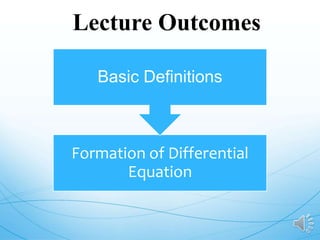
Formation of Differential
Equation
Basic Definitions
Lecture Outcomes
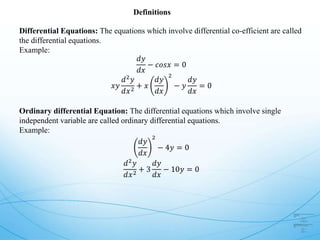
Definitions
Differential Equations: The equations which involve differential co-efficient are called
the differential equations.
Example:
𝑑𝑦
𝑑𝑥
− 𝑐𝑜𝑠𝑥 = 0
𝑥𝑦
𝑑2
𝑦
𝑑𝑥2
+ 𝑥
𝑑𝑦
𝑑𝑥
2
− 𝑦
𝑑𝑦
𝑑𝑥
= 0
Ordinary differential Equation: The differential equations which involve single
independent variable are called ordinary differential equations.
Example:
𝑑𝑦
𝑑𝑥
2
− 4𝑦 = 0
𝑑2𝑦
𝑑𝑥2 + 3
𝑑𝑦
𝑑𝑥
− 10𝑦 = 0
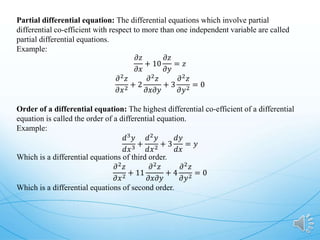
Partial differential equation: The differential equations which involve partial
differential co-efficient with respect to more than one independent variable are called
partial differential equations.
Example:
𝜕𝑧
𝜕𝑥
+ 10
𝜕𝑧
𝜕𝑦
= 𝑧
𝜕2
𝑧
𝜕𝑥2 + 2
𝜕2
𝑧
𝜕𝑥𝜕𝑦
+ 3
𝜕2
𝑧
𝜕𝑦2 = 0
Order of a differential equation: The highest differential co-efficient of a differential
equation is called the order of a differential equation.
Example:
𝑑3
𝑦
𝑑𝑥3 +
𝑑2
𝑦
𝑑𝑥2 + 3
𝑑𝑦
𝑑𝑥
= 𝑦
Which is a differential equations of third order.
𝜕2
𝑧
𝜕𝑥2
+ 11
𝜕2
𝑧
𝜕𝑥𝜕𝑦
+ 4
𝜕2
𝑧
𝜕𝑦2
= 0
Which is a differential equations of second order.
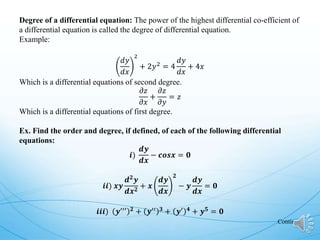
Degree of a differential equation: The power of the highest differential co-efficient of
a differential equation is called the degree of differential equation.
Example:
𝑑𝑦
𝑑𝑥
2
+ 2𝑦2
= 4
𝑑𝑦
𝑑𝑥
+ 4𝑥
Which is a differential equations of second degree.
𝜕𝑧
𝜕𝑥
+
𝜕𝑧
𝜕𝑦
= 𝑧
Which is a differential equations of first degree.
Ex. Find the order and degree, if defined, of each of the following differential
equations:
𝒊)
𝒅𝒚
𝒅𝒙
− 𝒄𝒐𝒔𝒙 = 𝟎
𝒊𝒊) 𝒙𝒚
𝒅𝟐
𝒚
𝒅𝒙𝟐
+ 𝒙
𝒅𝒚
𝒅𝒙
𝟐
− 𝒚
𝒅𝒚
𝒅𝒙
= 𝟎
𝒊𝒊𝒊) 𝒚′′′ 𝟐 + 𝒚′′ 𝟑 + 𝒚′ 𝟒 + 𝒚𝟓 = 𝟎
Continue
𝒊𝒗)
𝒅𝒚
𝒅𝒙
𝟐
+ 𝟐𝒚𝟐
− 𝟒
𝒅𝒚
𝒅𝒙
= 𝟒𝒙
𝒗)
𝒅𝟑
𝒚
𝒅𝒙𝟑
+ 𝟕
𝒅𝟐
𝒚
𝒅𝒙𝟐
+ 𝟖
𝒅𝒚
𝒅𝒙
= 𝐥𝐨𝐠 𝒙
Solution:
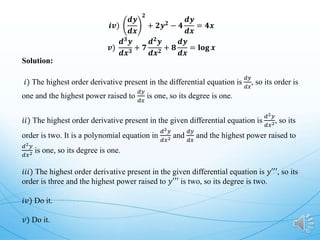
𝑖) The highest order derivative present in the differential equation is
𝑑𝑦
𝑑𝑥
, so its order is
one and the highest power raised to
𝑑𝑦
𝑑𝑥
is one, so its degree is one.
𝑖𝑖) The highest order derivative present in the given differential equation is
𝑑2𝑦
𝑑𝑥2, so its
order is two. It is a polynomial equation in
𝑑2𝑦
𝑑𝑥2 and
𝑑𝑦
𝑑𝑥
and the highest power raised to
𝑑2𝑦
𝑑𝑥2 is one, so its degree is one.
𝑖𝑖𝑖) The highest order derivative present in the given differential equation is 𝑦′′′, so its
order is three and the highest power raised to 𝑦′′′ is two, so its degree is two.
𝑖𝑣) Do it.
𝑣) Do it.
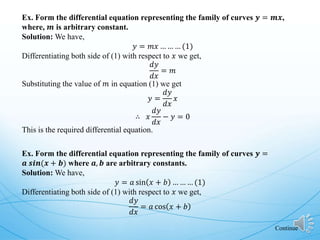
Ex. Form the differential equation representing the family of curves 𝒚 = 𝒎𝒙,
where, 𝒎 is arbitrary constant.
Solution: We have,
𝑦 = 𝑚𝑥 … … … (1)
Differentiating both side of (1) with respect to 𝑥 we get,
𝑑𝑦
𝑑𝑥
= 𝑚
Substituting the value of 𝑚 in equation (1) we get
𝑦 =
𝑑𝑦
𝑑𝑥
𝑥
∴ 𝑥
𝑑𝑦
𝑑𝑥
− 𝑦 = 0
This is the required differential equation.
Ex. Form the differential equation representing the family of curves 𝒚 =
𝒂 𝒔𝒊𝒏(𝒙 + 𝒃) where 𝒂, 𝒃 are arbitrary constants.
Solution: We have,
𝑦 = 𝑎 sin 𝑥 + 𝑏 … … … (1)
Differentiating both side of (1) with respect to 𝑥 we get,
𝑑𝑦
𝑑𝑥
= 𝑎 cos 𝑥 + 𝑏
Continue
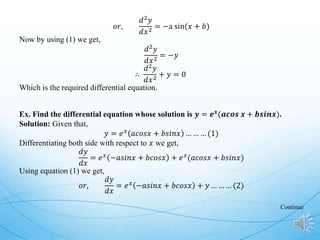
𝑜𝑟,
𝑑2𝑦
𝑑𝑥2
= −a sin(𝑥 + 𝑏)
Now by using (1) we get,
𝑑2
𝑦
𝑑𝑥2 = −𝑦
∴
𝑑2𝑦
𝑑𝑥2 + 𝑦 = 0
Which is the required differential equation.
Ex. Find the differential equation whose solution is 𝒚 = 𝒆𝒙
(𝒂𝒄𝒐𝒔 𝒙 + 𝒃𝒔𝒊𝒏𝒙).
Solution: Given that,
𝑦 = 𝑒𝑥
𝑎𝑐𝑜𝑠𝑥 + 𝑏𝑠𝑖𝑛𝑥 … … … (1)
Differentiating both side with respect to 𝑥 we get,
𝑑𝑦
𝑑𝑥
= 𝑒𝑥
−𝑎𝑠𝑖𝑛𝑥 + 𝑏𝑐𝑜𝑠𝑥 + 𝑒𝑥
(𝑎𝑐𝑜𝑠𝑥 + 𝑏𝑠𝑖𝑛𝑥)
Using equation (1) we get,
𝑜𝑟,
𝑑𝑦
𝑑𝑥
= 𝑒𝑥
−𝑎𝑠𝑖𝑛𝑥 + 𝑏𝑐𝑜𝑠𝑥 + 𝑦 … … … (2)
Continue
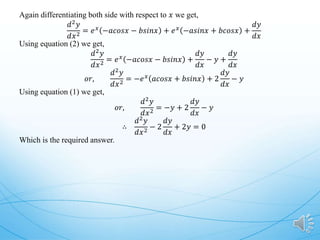
Again differentiating both side with respect to 𝑥 we get,
𝑑2
𝑦
𝑑𝑥2
= 𝑒𝑥
−𝑎𝑐𝑜𝑠𝑥 − 𝑏𝑠𝑖𝑛𝑥 + 𝑒𝑥
−𝑎𝑠𝑖𝑛𝑥 + 𝑏𝑐𝑜𝑠𝑥 +
𝑑𝑦
𝑑𝑥
Using equation (2) we get,
𝑑2𝑦
𝑑𝑥2
= 𝑒𝑥 −𝑎𝑐𝑜𝑠𝑥 − 𝑏𝑠𝑖𝑛𝑥 +
𝑑𝑦
𝑑𝑥
− 𝑦 +
𝑑𝑦
𝑑𝑥
𝑜𝑟,
𝑑2
𝑦
𝑑𝑥2
= −𝑒𝑥
𝑎𝑐𝑜𝑠𝑥 + 𝑏𝑠𝑖𝑛𝑥 + 2
𝑑𝑦
𝑑𝑥
− 𝑦
Using equation (1) we get,
𝑜𝑟,
𝑑2
𝑦
𝑑𝑥2
= −𝑦 + 2
𝑑𝑦
𝑑𝑥
− 𝑦
∴
𝑑2
𝑦
𝑑𝑥2 − 2
𝑑𝑦
𝑑𝑥
+ 2𝑦 = 0
Which is the required answer.
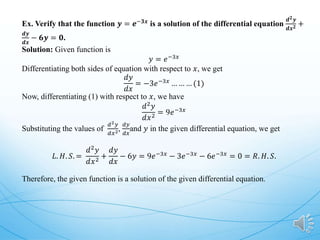
Ex. Verify that the function 𝒚 = 𝒆−𝟑𝒙
is a solution of the differential equation
𝒅𝟐𝒚
𝒅𝒙𝟐 +
𝒅𝒚
𝒅𝒙
− 𝟔𝒚 = 𝟎.
Solution: Given function is
𝑦 = 𝑒−3𝑥
Differentiating both sides of equation with respect to 𝑥, we get
𝑑𝑦
𝑑𝑥
= −3𝑒−3𝑥
… … … (1)
Now, differentiating (1) with respect to 𝑥, we have
𝑑2
𝑦
𝑑𝑥2
= 9𝑒−3𝑥
Substituting the values of
𝑑2𝑦
𝑑𝑥2,
𝑑𝑦
𝑑𝑥
and 𝑦 in the given differential equation, we get
𝐿. 𝐻. 𝑆. =
𝑑2
𝑦
𝑑𝑥2 +
𝑑𝑦
𝑑𝑥
− 6𝑦 = 9𝑒−3𝑥
− 3𝑒−3𝑥
− 6𝑒−3𝑥
= 0 = 𝑅. 𝐻. 𝑆.
Therefore, the given function is a solution of the given differential equation.
Ex. From the differential equation corresponding to the family of curves 𝒚 =
𝒄 𝒙 − 𝒄 𝟐
where 𝒄 is an arbitrary constant.
Solution:
Given the family of the curves are 𝑦 = 𝑐 𝑥 − 𝑐 2
… … … (1)
𝑜𝑟,
𝑑𝑦
𝑑𝑥
= 2𝑐 𝑥 − 𝑐 … … … (2)
Dividing the given equation (1) by the equation (2) we get,
𝑦
𝑑𝑦
𝑑𝑥
=
𝑥 − 𝑐
2
𝑜𝑟,
𝑦
𝑝
=
𝑥 − 𝑐
2
[where
𝑑𝑦
𝑑𝑥
= 𝑝]
𝑜𝑟, 𝑝 𝑥 − 𝑐 = 2𝑦
∴ 𝑐 = 𝑥 −
2𝑦
𝑝
Put the value of 𝑐 in (2) we get,
𝑝 = 2 𝑥 −
2𝑦
𝑝
𝑥 − 𝑥 +
2𝑦
𝑝
𝑜𝑟, 𝑝 =
4𝑦
𝑝
𝑥 −
2𝑦
𝑝
Continue
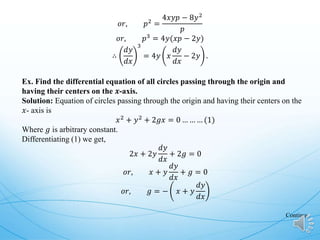
𝑜𝑟, 𝑝2
=
4𝑥𝑦𝑝 − 8𝑦2
𝑝
𝑜𝑟, 𝑝3
= 4𝑦(𝑥𝑝 − 2𝑦)
∴
𝑑𝑦
𝑑𝑥
3
= 4𝑦 𝑥
𝑑𝑦
𝑑𝑥
− 2𝑦 .
Ex. Find the differential equation of all circles passing through the origin and
having their centers on the 𝒙-axis.
Solution: Equation of circles passing through the origin and having their centers on the
𝑥- axis is
𝑥2
+ 𝑦2
+ 2𝑔𝑥 = 0 … … … (1)
Where 𝑔 is arbitrary constant.
Differentiating (1) we get,
2𝑥 + 2𝑦
𝑑𝑦
𝑑𝑥
+ 2𝑔 = 0
𝑜𝑟, 𝑥 + 𝑦
𝑑𝑦
𝑑𝑥
+ 𝑔 = 0
𝑜𝑟, 𝑔 = − 𝑥 + 𝑦
𝑑𝑦
𝑑𝑥
Continue
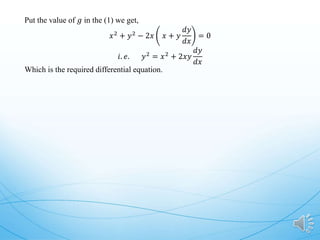
Put the value of 𝑔 in the (1) we get,
𝑥2
+ 𝑦2
− 2𝑥 𝑥 + 𝑦
𝑑𝑦
𝑑𝑥
= 0
𝑖. 𝑒. 𝑦2 = 𝑥2 + 2𝑥𝑦
𝑑𝑦
𝑑𝑥
Which is the required differential equation.
“The ink of the scholar is more sacred than the blood of the martyr.”
-Prophet Muhammad (PBUH)
Best of Luck

Ordinary and Partial Differential equations.pptx

  • 1.
    Ordinary and Partial DifferentialEquations Course Code: MATH- 305 Saddam Hossain Lecturer in Mathematics Basic Science Division World University of Bangladesh Email: shossain656@science.wub.edu.bd
  • 2.
    Formation of Differential Equation BasicDefinitions Lecture Outcomes
  • 3.
    Definitions Differential Equations: Theequations which involve differential co-efficient are called the differential equations. Example: 𝑑𝑦 𝑑𝑥 − 𝑐𝑜𝑠𝑥 = 0 𝑥𝑦 𝑑2 𝑦 𝑑𝑥2 + 𝑥 𝑑𝑦 𝑑𝑥 2 − 𝑦 𝑑𝑦 𝑑𝑥 = 0 Ordinary differential Equation: The differential equations which involve single independent variable are called ordinary differential equations. Example: 𝑑𝑦 𝑑𝑥 2 − 4𝑦 = 0 𝑑2𝑦 𝑑𝑥2 + 3 𝑑𝑦 𝑑𝑥 − 10𝑦 = 0
  • 4.
    Partial differential equation:The differential equations which involve partial differential co-efficient with respect to more than one independent variable are called partial differential equations. Example: 𝜕𝑧 𝜕𝑥 + 10 𝜕𝑧 𝜕𝑦 = 𝑧 𝜕2 𝑧 𝜕𝑥2 + 2 𝜕2 𝑧 𝜕𝑥𝜕𝑦 + 3 𝜕2 𝑧 𝜕𝑦2 = 0 Order of a differential equation: The highest differential co-efficient of a differential equation is called the order of a differential equation. Example: 𝑑3 𝑦 𝑑𝑥3 + 𝑑2 𝑦 𝑑𝑥2 + 3 𝑑𝑦 𝑑𝑥 = 𝑦 Which is a differential equations of third order. 𝜕2 𝑧 𝜕𝑥2 + 11 𝜕2 𝑧 𝜕𝑥𝜕𝑦 + 4 𝜕2 𝑧 𝜕𝑦2 = 0 Which is a differential equations of second order.
  • 5.
    Degree of adifferential equation: The power of the highest differential co-efficient of a differential equation is called the degree of differential equation. Example: 𝑑𝑦 𝑑𝑥 2 + 2𝑦2 = 4 𝑑𝑦 𝑑𝑥 + 4𝑥 Which is a differential equations of second degree. 𝜕𝑧 𝜕𝑥 + 𝜕𝑧 𝜕𝑦 = 𝑧 Which is a differential equations of first degree. Ex. Find the order and degree, if defined, of each of the following differential equations: 𝒊) 𝒅𝒚 𝒅𝒙 − 𝒄𝒐𝒔𝒙 = 𝟎 𝒊𝒊) 𝒙𝒚 𝒅𝟐 𝒚 𝒅𝒙𝟐 + 𝒙 𝒅𝒚 𝒅𝒙 𝟐 − 𝒚 𝒅𝒚 𝒅𝒙 = 𝟎 𝒊𝒊𝒊) 𝒚′′′ 𝟐 + 𝒚′′ 𝟑 + 𝒚′ 𝟒 + 𝒚𝟓 = 𝟎 Continue
  • 6.
    𝒊𝒗) 𝒅𝒚 𝒅𝒙 𝟐 + 𝟐𝒚𝟐 − 𝟒 𝒅𝒚 𝒅𝒙 =𝟒𝒙 𝒗) 𝒅𝟑 𝒚 𝒅𝒙𝟑 + 𝟕 𝒅𝟐 𝒚 𝒅𝒙𝟐 + 𝟖 𝒅𝒚 𝒅𝒙 = 𝐥𝐨𝐠 𝒙 Solution: 𝑖) The highest order derivative present in the differential equation is 𝑑𝑦 𝑑𝑥 , so its order is one and the highest power raised to 𝑑𝑦 𝑑𝑥 is one, so its degree is one. 𝑖𝑖) The highest order derivative present in the given differential equation is 𝑑2𝑦 𝑑𝑥2, so its order is two. It is a polynomial equation in 𝑑2𝑦 𝑑𝑥2 and 𝑑𝑦 𝑑𝑥 and the highest power raised to 𝑑2𝑦 𝑑𝑥2 is one, so its degree is one. 𝑖𝑖𝑖) The highest order derivative present in the given differential equation is 𝑦′′′, so its order is three and the highest power raised to 𝑦′′′ is two, so its degree is two. 𝑖𝑣) Do it. 𝑣) Do it.
  • 7.
    Ex. Form thedifferential equation representing the family of curves 𝒚 = 𝒎𝒙, where, 𝒎 is arbitrary constant. Solution: We have, 𝑦 = 𝑚𝑥 … … … (1) Differentiating both side of (1) with respect to 𝑥 we get, 𝑑𝑦 𝑑𝑥 = 𝑚 Substituting the value of 𝑚 in equation (1) we get 𝑦 = 𝑑𝑦 𝑑𝑥 𝑥 ∴ 𝑥 𝑑𝑦 𝑑𝑥 − 𝑦 = 0 This is the required differential equation. Ex. Form the differential equation representing the family of curves 𝒚 = 𝒂 𝒔𝒊𝒏(𝒙 + 𝒃) where 𝒂, 𝒃 are arbitrary constants. Solution: We have, 𝑦 = 𝑎 sin 𝑥 + 𝑏 … … … (1) Differentiating both side of (1) with respect to 𝑥 we get, 𝑑𝑦 𝑑𝑥 = 𝑎 cos 𝑥 + 𝑏 Continue
  • 8.
    𝑜𝑟, 𝑑2𝑦 𝑑𝑥2 = −a sin(𝑥+ 𝑏) Now by using (1) we get, 𝑑2 𝑦 𝑑𝑥2 = −𝑦 ∴ 𝑑2𝑦 𝑑𝑥2 + 𝑦 = 0 Which is the required differential equation. Ex. Find the differential equation whose solution is 𝒚 = 𝒆𝒙 (𝒂𝒄𝒐𝒔 𝒙 + 𝒃𝒔𝒊𝒏𝒙). Solution: Given that, 𝑦 = 𝑒𝑥 𝑎𝑐𝑜𝑠𝑥 + 𝑏𝑠𝑖𝑛𝑥 … … … (1) Differentiating both side with respect to 𝑥 we get, 𝑑𝑦 𝑑𝑥 = 𝑒𝑥 −𝑎𝑠𝑖𝑛𝑥 + 𝑏𝑐𝑜𝑠𝑥 + 𝑒𝑥 (𝑎𝑐𝑜𝑠𝑥 + 𝑏𝑠𝑖𝑛𝑥) Using equation (1) we get, 𝑜𝑟, 𝑑𝑦 𝑑𝑥 = 𝑒𝑥 −𝑎𝑠𝑖𝑛𝑥 + 𝑏𝑐𝑜𝑠𝑥 + 𝑦 … … … (2) Continue
  • 9.
    Again differentiating bothside with respect to 𝑥 we get, 𝑑2 𝑦 𝑑𝑥2 = 𝑒𝑥 −𝑎𝑐𝑜𝑠𝑥 − 𝑏𝑠𝑖𝑛𝑥 + 𝑒𝑥 −𝑎𝑠𝑖𝑛𝑥 + 𝑏𝑐𝑜𝑠𝑥 + 𝑑𝑦 𝑑𝑥 Using equation (2) we get, 𝑑2𝑦 𝑑𝑥2 = 𝑒𝑥 −𝑎𝑐𝑜𝑠𝑥 − 𝑏𝑠𝑖𝑛𝑥 + 𝑑𝑦 𝑑𝑥 − 𝑦 + 𝑑𝑦 𝑑𝑥 𝑜𝑟, 𝑑2 𝑦 𝑑𝑥2 = −𝑒𝑥 𝑎𝑐𝑜𝑠𝑥 + 𝑏𝑠𝑖𝑛𝑥 + 2 𝑑𝑦 𝑑𝑥 − 𝑦 Using equation (1) we get, 𝑜𝑟, 𝑑2 𝑦 𝑑𝑥2 = −𝑦 + 2 𝑑𝑦 𝑑𝑥 − 𝑦 ∴ 𝑑2 𝑦 𝑑𝑥2 − 2 𝑑𝑦 𝑑𝑥 + 2𝑦 = 0 Which is the required answer.
  • 10.
    Ex. Verify thatthe function 𝒚 = 𝒆−𝟑𝒙 is a solution of the differential equation 𝒅𝟐𝒚 𝒅𝒙𝟐 + 𝒅𝒚 𝒅𝒙 − 𝟔𝒚 = 𝟎. Solution: Given function is 𝑦 = 𝑒−3𝑥 Differentiating both sides of equation with respect to 𝑥, we get 𝑑𝑦 𝑑𝑥 = −3𝑒−3𝑥 … … … (1) Now, differentiating (1) with respect to 𝑥, we have 𝑑2 𝑦 𝑑𝑥2 = 9𝑒−3𝑥 Substituting the values of 𝑑2𝑦 𝑑𝑥2, 𝑑𝑦 𝑑𝑥 and 𝑦 in the given differential equation, we get 𝐿. 𝐻. 𝑆. = 𝑑2 𝑦 𝑑𝑥2 + 𝑑𝑦 𝑑𝑥 − 6𝑦 = 9𝑒−3𝑥 − 3𝑒−3𝑥 − 6𝑒−3𝑥 = 0 = 𝑅. 𝐻. 𝑆. Therefore, the given function is a solution of the given differential equation.
  • 11.
    Ex. From thedifferential equation corresponding to the family of curves 𝒚 = 𝒄 𝒙 − 𝒄 𝟐 where 𝒄 is an arbitrary constant. Solution: Given the family of the curves are 𝑦 = 𝑐 𝑥 − 𝑐 2 … … … (1) 𝑜𝑟, 𝑑𝑦 𝑑𝑥 = 2𝑐 𝑥 − 𝑐 … … … (2) Dividing the given equation (1) by the equation (2) we get, 𝑦 𝑑𝑦 𝑑𝑥 = 𝑥 − 𝑐 2 𝑜𝑟, 𝑦 𝑝 = 𝑥 − 𝑐 2 [where 𝑑𝑦 𝑑𝑥 = 𝑝] 𝑜𝑟, 𝑝 𝑥 − 𝑐 = 2𝑦 ∴ 𝑐 = 𝑥 − 2𝑦 𝑝 Put the value of 𝑐 in (2) we get, 𝑝 = 2 𝑥 − 2𝑦 𝑝 𝑥 − 𝑥 + 2𝑦 𝑝 𝑜𝑟, 𝑝 = 4𝑦 𝑝 𝑥 − 2𝑦 𝑝 Continue
  • 12.
    𝑜𝑟, 𝑝2 = 4𝑥𝑦𝑝 −8𝑦2 𝑝 𝑜𝑟, 𝑝3 = 4𝑦(𝑥𝑝 − 2𝑦) ∴ 𝑑𝑦 𝑑𝑥 3 = 4𝑦 𝑥 𝑑𝑦 𝑑𝑥 − 2𝑦 . Ex. Find the differential equation of all circles passing through the origin and having their centers on the 𝒙-axis. Solution: Equation of circles passing through the origin and having their centers on the 𝑥- axis is 𝑥2 + 𝑦2 + 2𝑔𝑥 = 0 … … … (1) Where 𝑔 is arbitrary constant. Differentiating (1) we get, 2𝑥 + 2𝑦 𝑑𝑦 𝑑𝑥 + 2𝑔 = 0 𝑜𝑟, 𝑥 + 𝑦 𝑑𝑦 𝑑𝑥 + 𝑔 = 0 𝑜𝑟, 𝑔 = − 𝑥 + 𝑦 𝑑𝑦 𝑑𝑥 Continue
  • 13.
    Put the valueof 𝑔 in the (1) we get, 𝑥2 + 𝑦2 − 2𝑥 𝑥 + 𝑦 𝑑𝑦 𝑑𝑥 = 0 𝑖. 𝑒. 𝑦2 = 𝑥2 + 2𝑥𝑦 𝑑𝑦 𝑑𝑥 Which is the required differential equation.
  • 14.
    “The ink ofthe scholar is more sacred than the blood of the martyr.” -Prophet Muhammad (PBUH) Best of Luck