A population grows at the rate of 5% per year. How long does it 
take for the population to double? Use differential equation for it. 
SOLUTION:- Let the initial population be P0 and let the population 
after t years be P, then, 
dP 5 dP P dP 1 
  
    
  
= P = = dt 
dt 100 dt 20 P 20 
dP 1 
= dt 
  
P 20 
e 
1 
log P= t+C 
20 
 
[Integrating both sides]
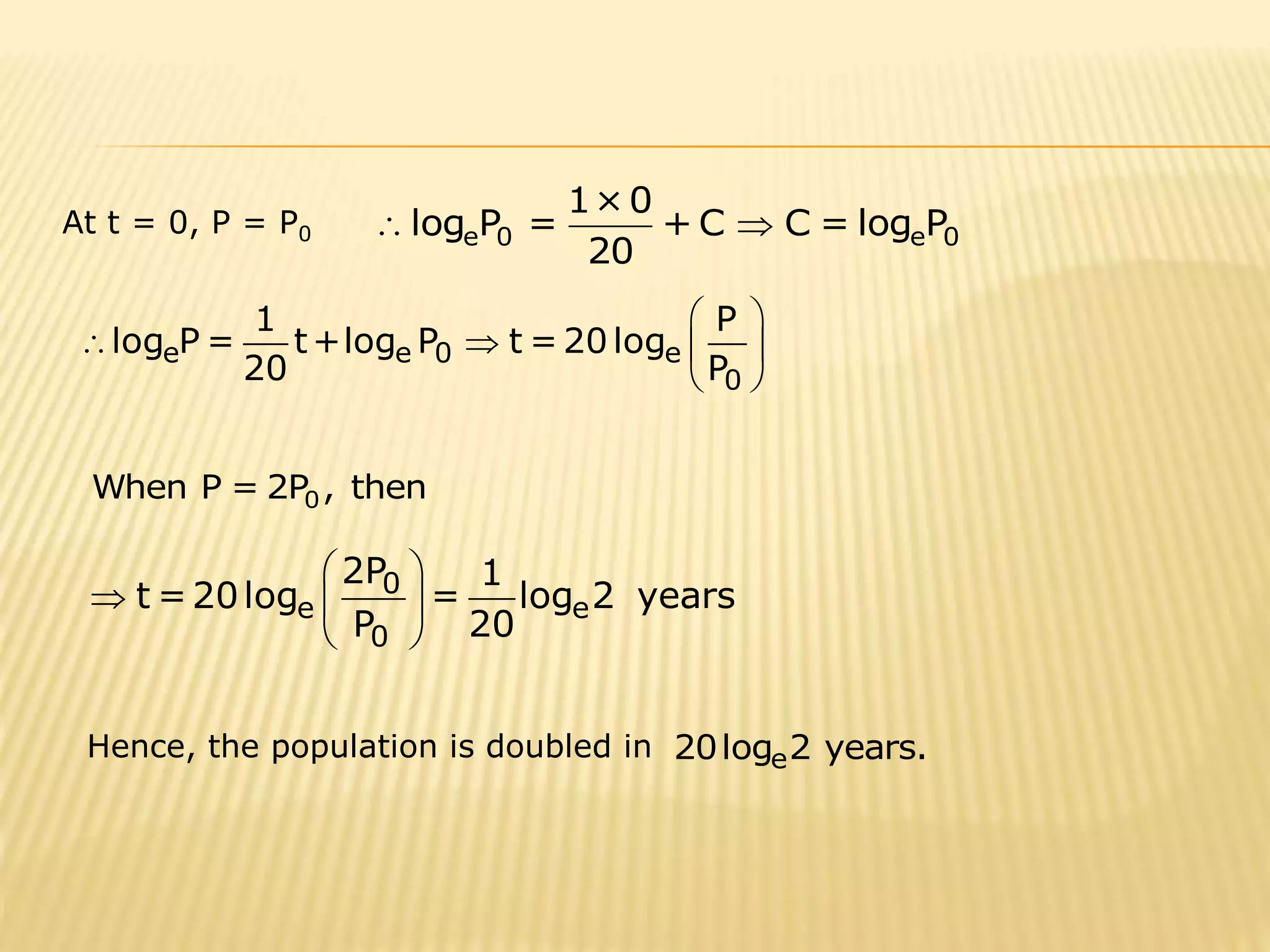
1×0 
log P = +C C =log P 
At t = 0, P = P0 e 0 e 0 
  
20 
  
1 P 
    
e e 0 e 
0 
log P= t+log P t=20log 
20 P 
  
0 When P =2P , then 
2P 1 
  
0 
t=20log = log 2 years 
   
e e 
P 20 
 0 
 
Hence, the population is doubled in 20loge2 years.
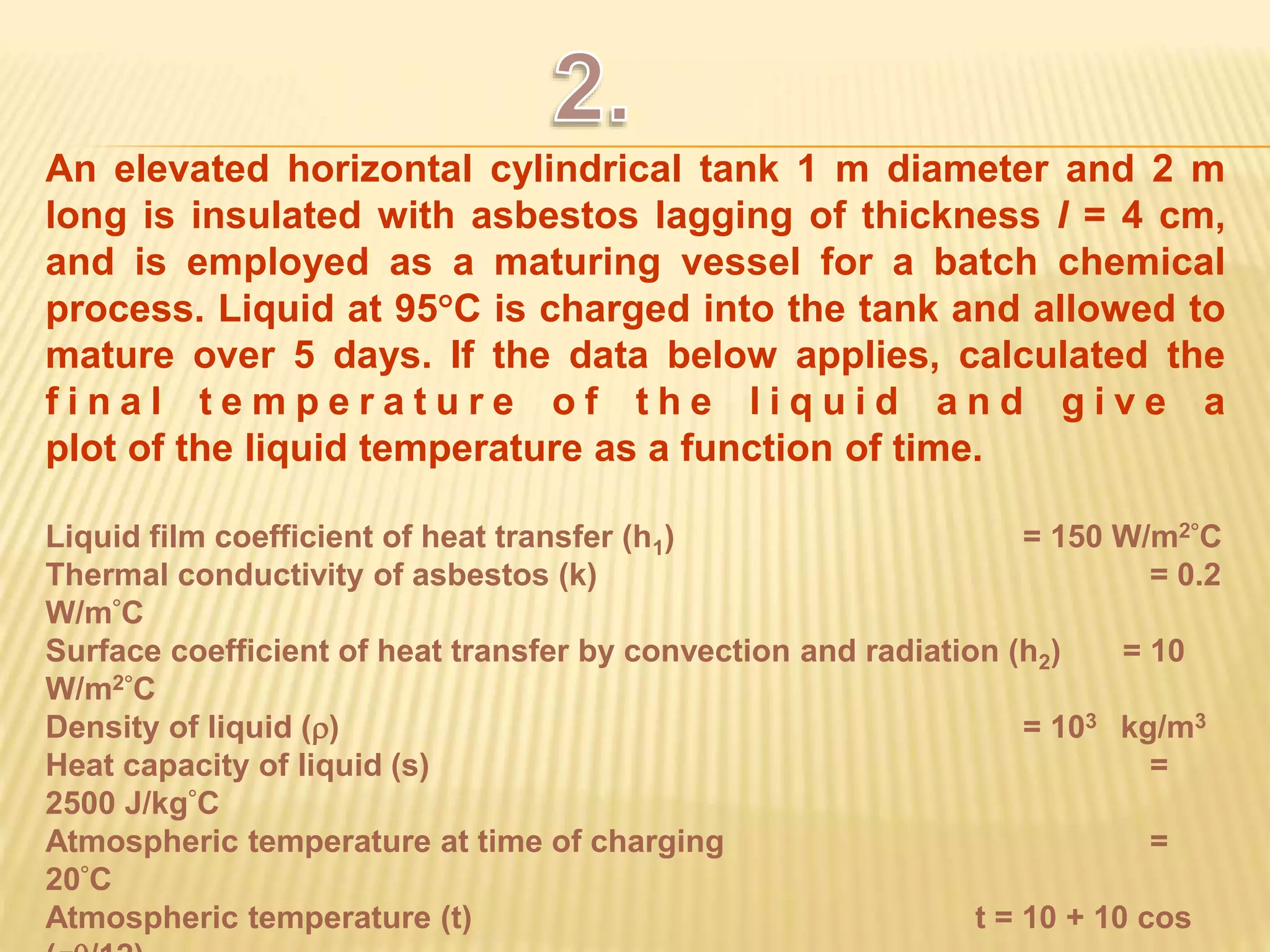
An elevated horizontal cylindrical tank 1 m diameter and 2 m 
long is insulated with asbestos lagging of thickness l = 4 cm, 
and is employed as a maturing vessel for a batch chemical 
process. Liquid at 95C is charged into the tank and allowed to 
mature over 5 days. If the data below applies, calculated the 
f i n a l t e m p e r a t u r e o f t h e l i q u i d a n d g i v e a 
plot of the liquid temperature as a function of time. 
Liquid film coefficient of heat transfer (h1) = 150 W/m2C 
Thermal conductivity of asbestos (k) = 0.2 
W/mC 
Surface coefficient of heat transfer by convection and radiation (h2) = 10 
W/m2C 
Density of liquid () = 103 kg/m3 
Heat capacity of liquid (s) = 
2500 J/kgC 
Atmospheric temperature at time of charging = 
20C 
Atmospheric temperature (t) t = 10 + 10 cos 
(/12)
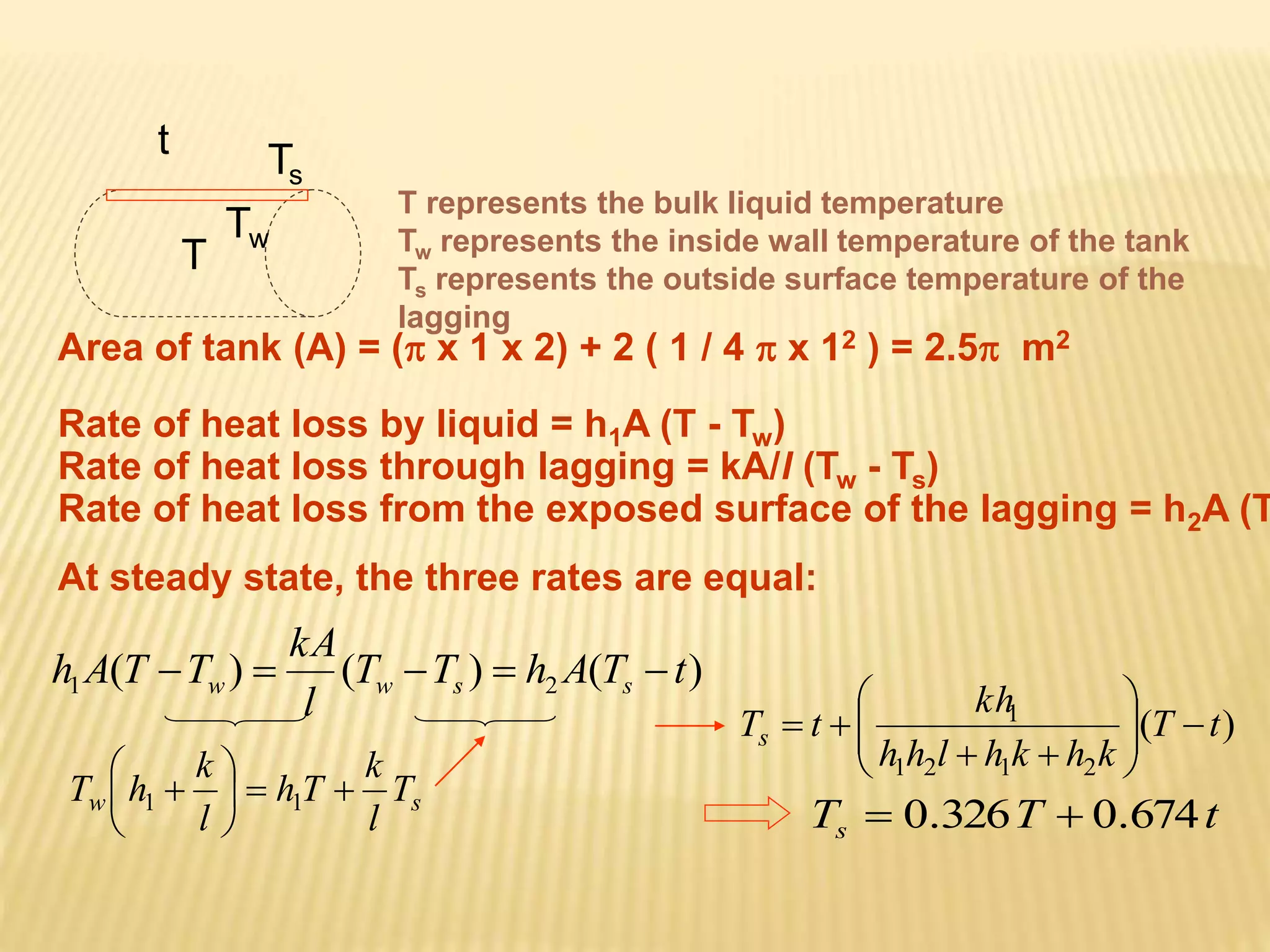
T 
t 
Ts 
Tw 
T represents the bulk liquid temperature 
Tw represents the inside wall temperature of the tank 
Ts represents the outside surface temperature of the 
lagging 
Area of tank (A) = ( x 1 x 2) + 2 ( 1 / 4  x 12 ) = 2.5 m2 
Rate of heat loss by liquid = h1A (T - Tw) 
Rate of heat loss through lagging = kA/l (Tw - Ts) 
Rate of heat loss from the exposed surface of the lagging = h2A (TAt steady state, the three rates are equal: 
kA 
h A T T w w s s      
( ) ( ) ( ) 1 2 T T h A T t 
l 
k 
k 
 
h T    
w s T 
l 
h T 
l 
 
 
 1 1 
kh 
 
1 T t 
 
T t s    
( ) 
h h l h k h k 
1 2 1 2 
 
 
 
  
  
T T t s  0.326  0.674
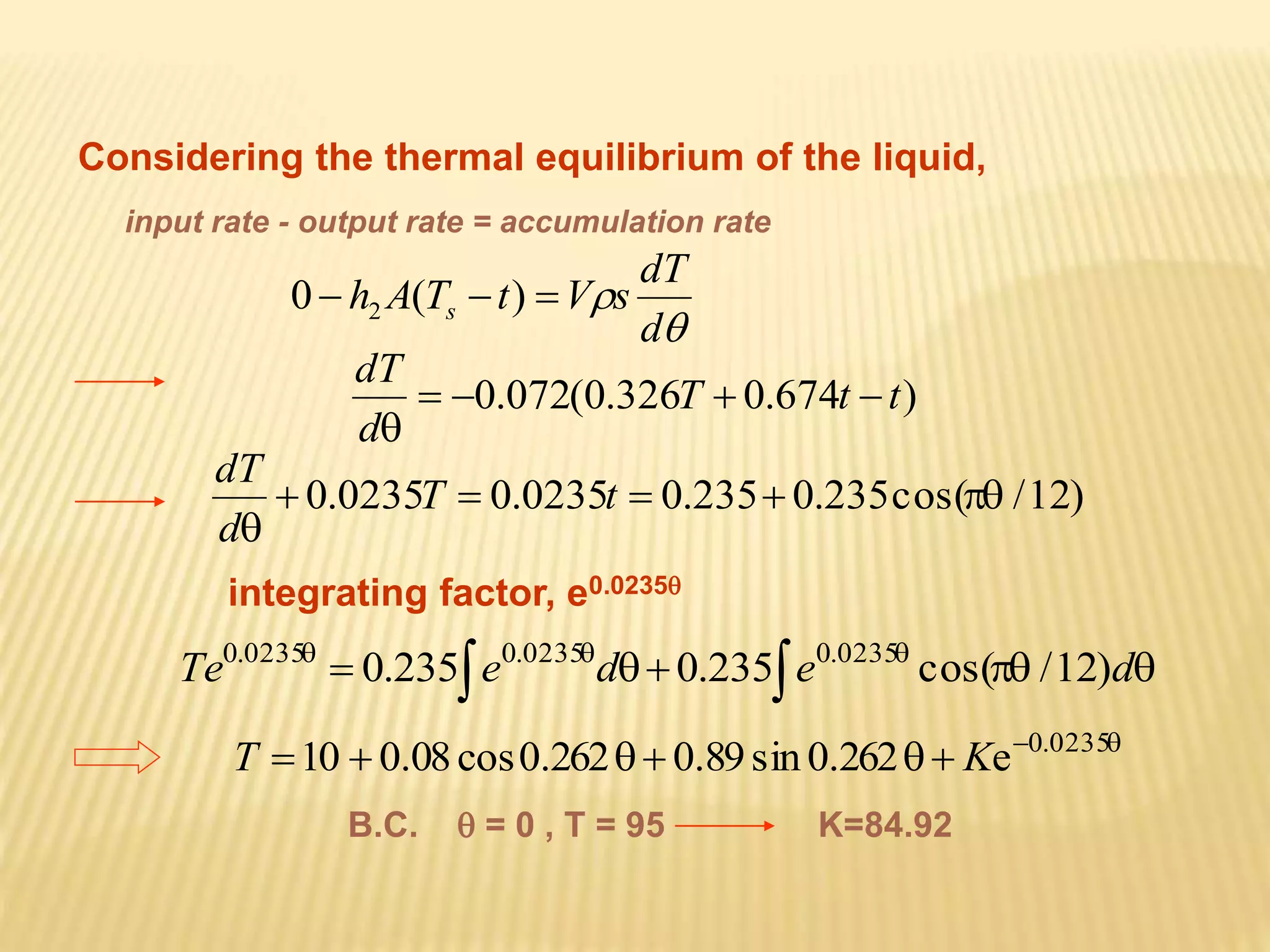
Considering the thermal equilibrium of the liquid, 
input rate - output rate = accumulation rate 
dT 
 
 
d 
h A T t V s s 0  (  )  2 
0.072(0.326T 0.674t t) 
dT 
    
 
d 
T t 
dT 
 0.0235  0.0235  0.235 0.235cos( /12) 
 
d 
integrating factor, e0.0235 
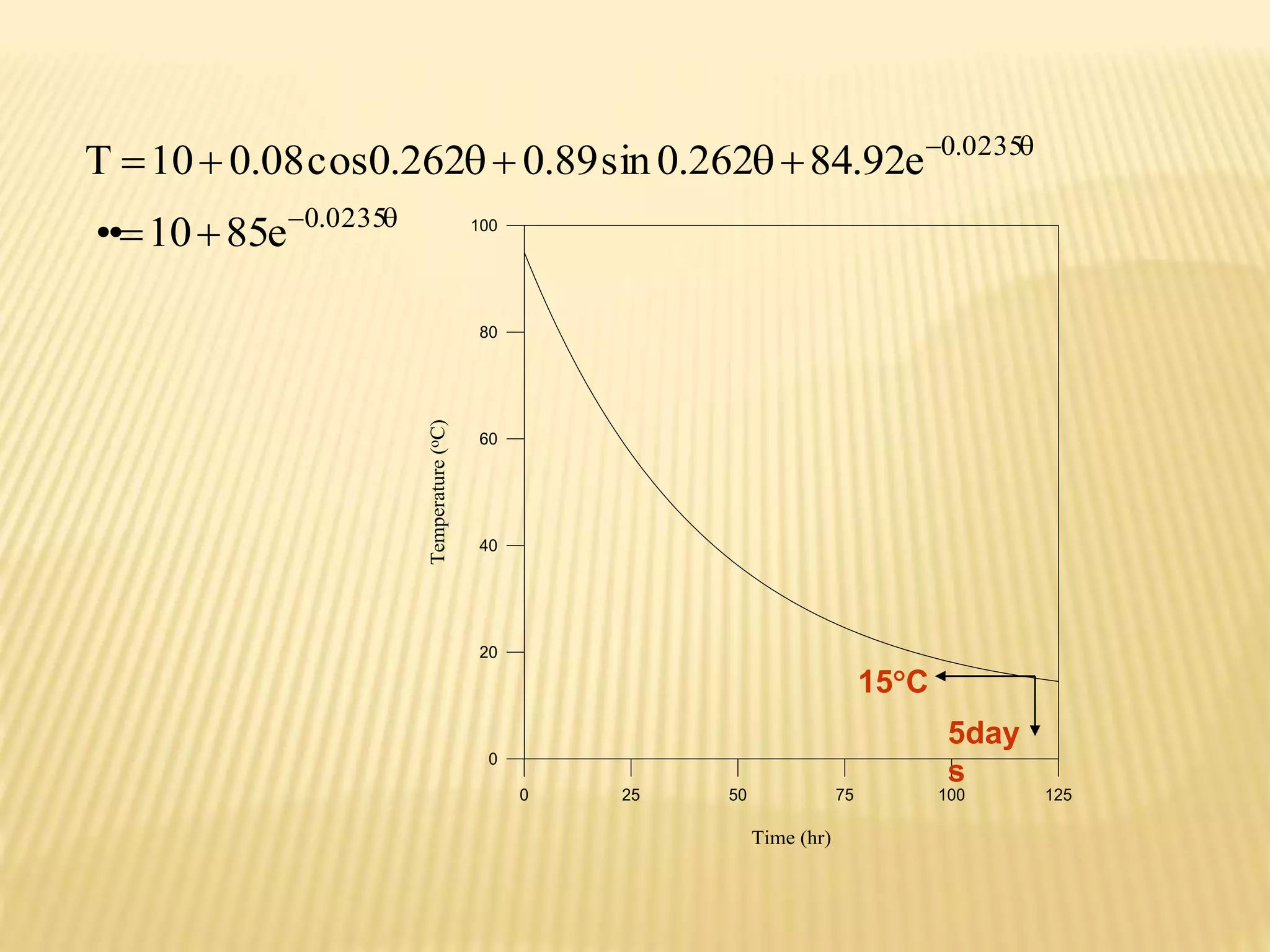
         Te 0.235 e d 0.235 e cos( /12)d 0.0235 0.0235 0.0235 
      0.0235 T 10 0.08 cos0.262 0.89 sin 0.262 Ke 
B.C.  = 0 , T = 95 K=84.92
T  10  0.08cos0.262  0.89sin 0.262  
84.92e 
  
  
  
0.0235 
0.0235 
•• 10 85e 
0 25 50 75 100 125 
Time (hr) 
100 
80 
60 
40 
20 
0 
Temperature (oC) 
5day 
s 
15C
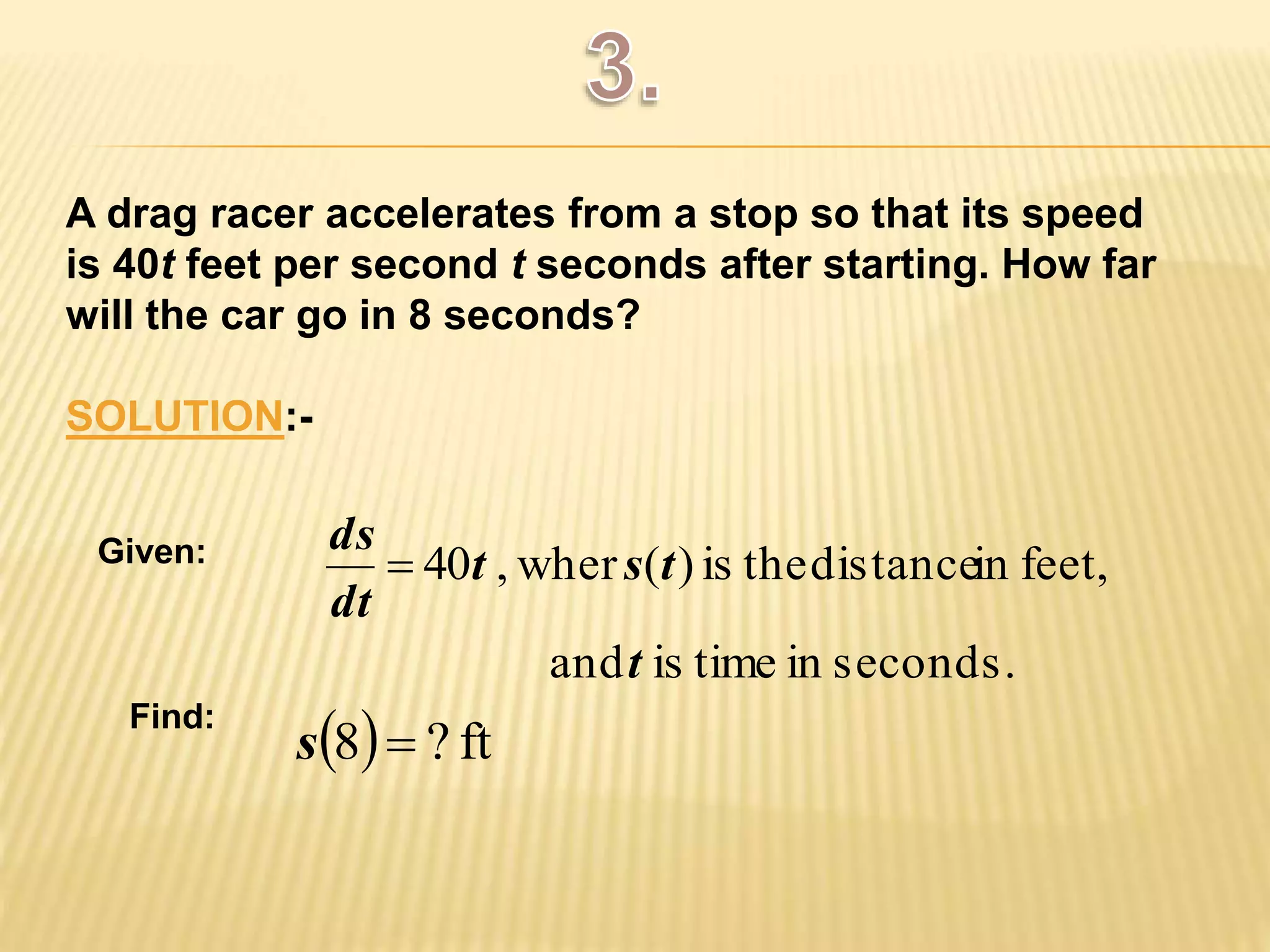
A drag racer accelerates from a stop so that its speed 
is 40t feet per second t seconds after starting. How far 
will the car go in 8 seconds? 
SOLUTION:- 
40 t , wher s ( t 
) is the distance in feet, 
and t 
is time in seconds. 
ds 
dt 
 
s8 ? ft 
Given: 
Find:
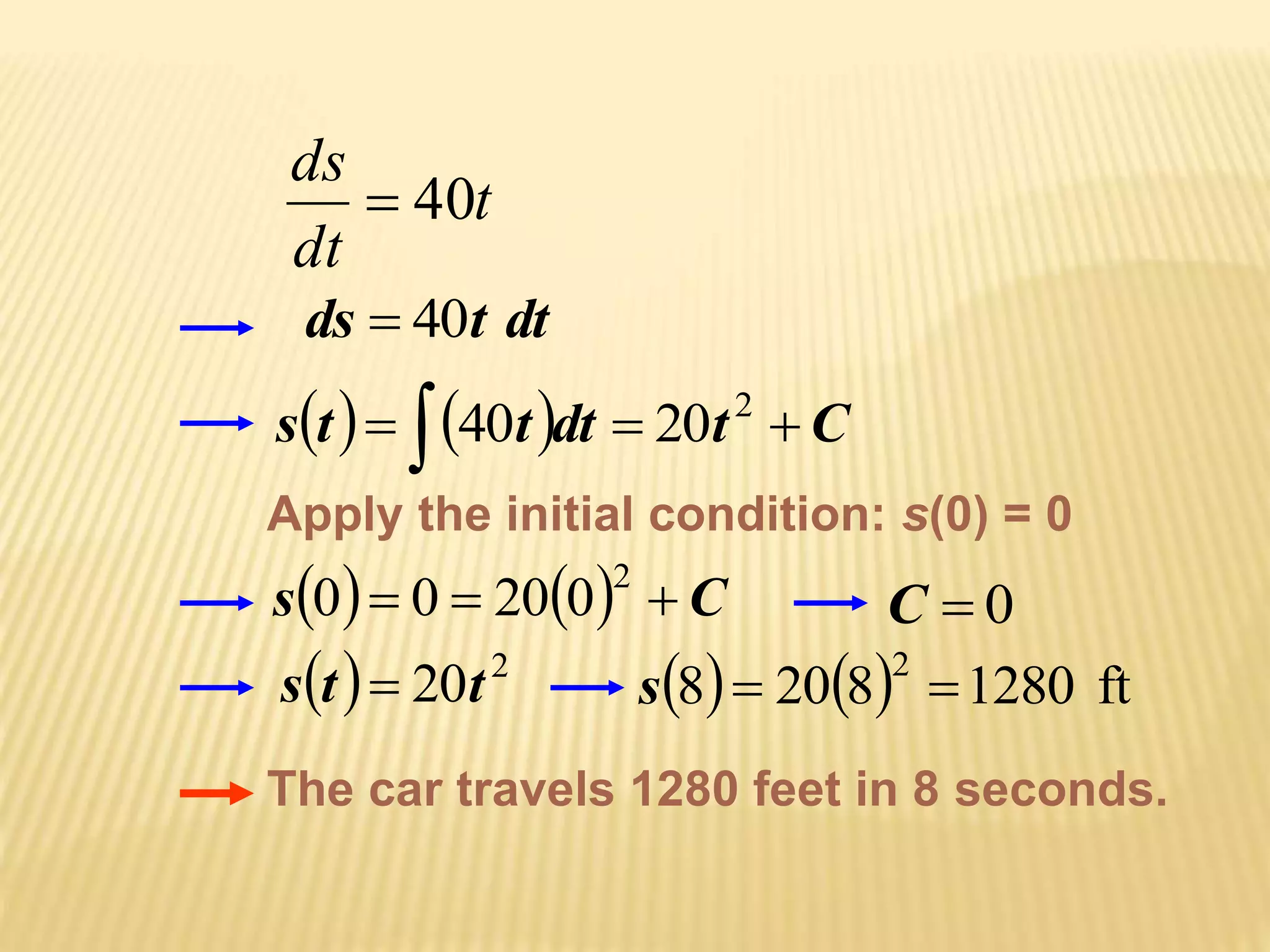
t 
ds 
dt 
 40 
ds  40t dt 
st   40 t dt  20 
t 2 C Apply the initial condition: s(0) = 0 
s 0  0  20  0 
 2  C C  0 
s  t   20t 
2 8 208 1280 ft 2 s   
The car travels 1280 feet in 8 seconds.
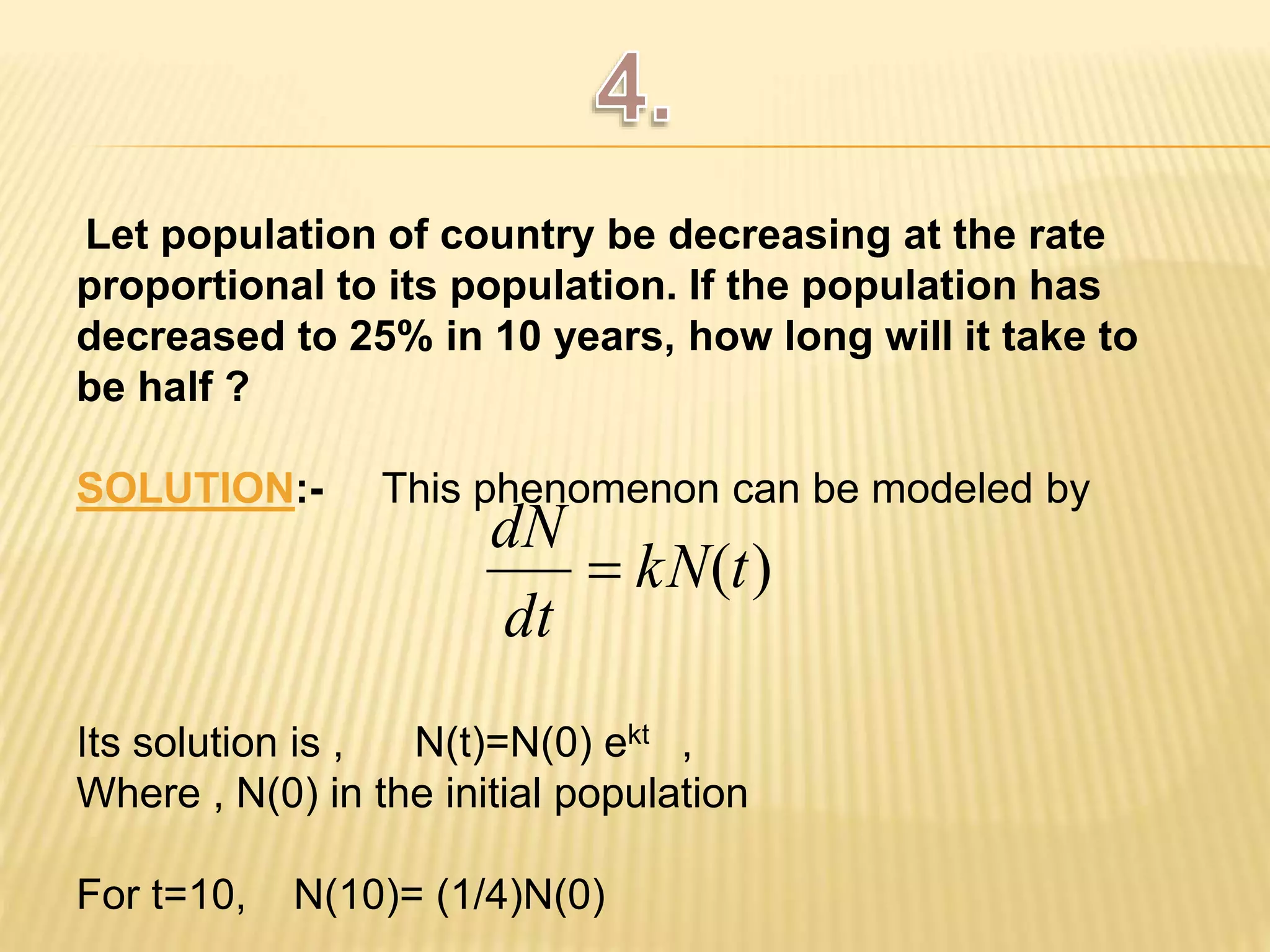
Let population of country be decreasing at the rate 
proportional to its population. If the population has 
decreased to 25% in 10 years, how long will it take to 
be half ? 
SOLUTION:- This phenomenon can be modeled by 
dN 
Its solution is , N(t)=N(0) ekt , 
Where , N(0) in the initial population 
For t=10, N(10)= (1/4)N(0) 
kN(t) 
dt 

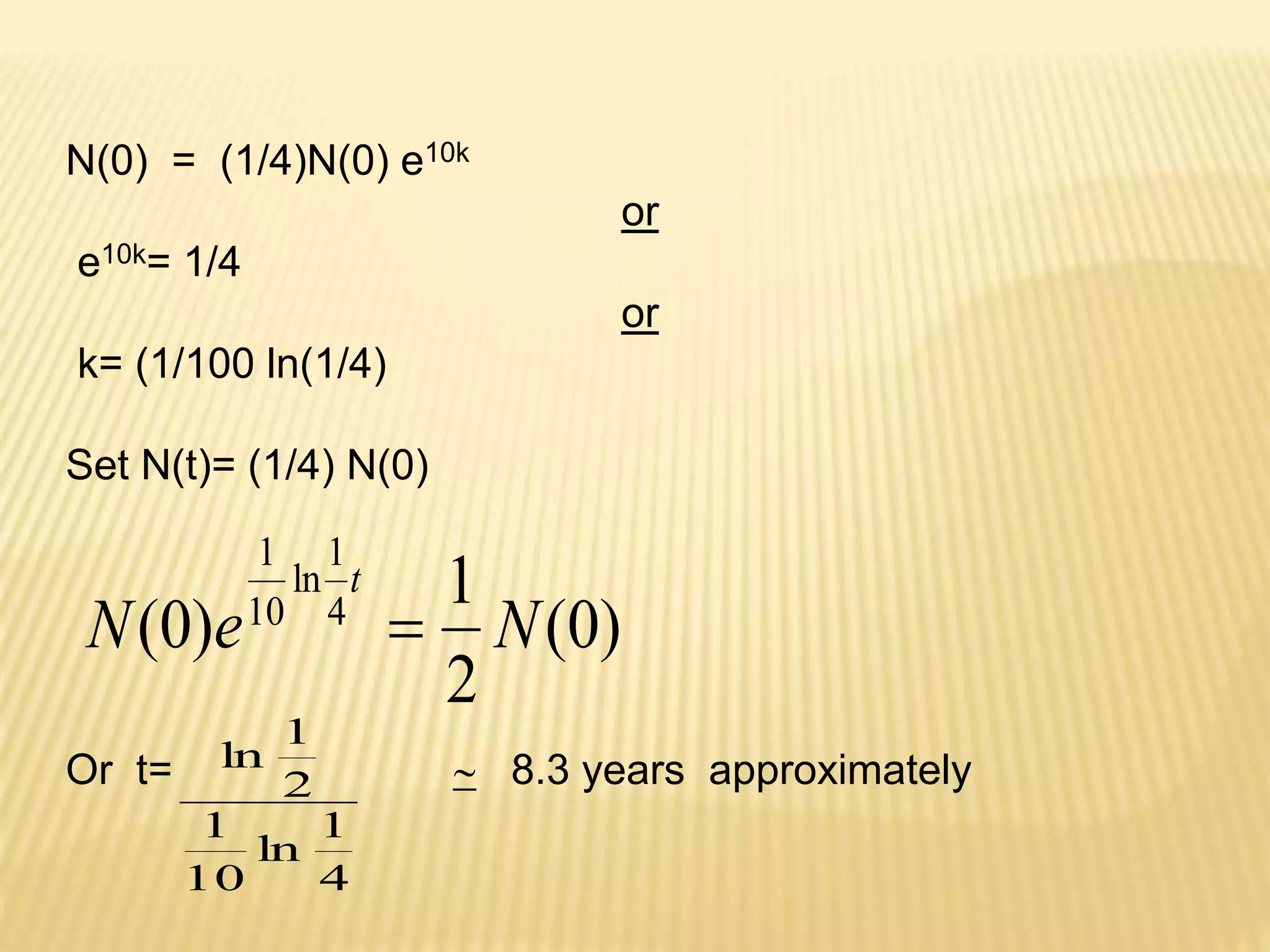
N(0) = (1/4)N(0) e10k 
or 
e10k= 1/4 
or 
k= (1/100 ln(1/4) 
Set N(t)= (1/4) N(0) 
(0) 
1 
t 
 
N e N 
2 
1 
ln 
1 
(0) 10 
4 
1 
Or t=  8.3 years approximately 
1 
4 
ln 
1 
10 
2 
ln
Applications of Differential Equations of First order and First Degree

Applications of Differential Equations of First order and First Degree

  • 2.
    A population growsat the rate of 5% per year. How long does it take for the population to double? Use differential equation for it. SOLUTION:- Let the initial population be P0 and let the population after t years be P, then, dP 5 dP P dP 1         = P = = dt dt 100 dt 20 P 20 dP 1 = dt   P 20 e 1 log P= t+C 20  [Integrating both sides]
  • 3.
    1×0 log P= +C C =log P At t = 0, P = P0 e 0 e 0   20   1 P     e e 0 e 0 log P= t+log P t=20log 20 P   0 When P =2P , then 2P 1   0 t=20log = log 2 years    e e P 20  0  Hence, the population is doubled in 20loge2 years.
  • 4.
    An elevated horizontalcylindrical tank 1 m diameter and 2 m long is insulated with asbestos lagging of thickness l = 4 cm, and is employed as a maturing vessel for a batch chemical process. Liquid at 95C is charged into the tank and allowed to mature over 5 days. If the data below applies, calculated the f i n a l t e m p e r a t u r e o f t h e l i q u i d a n d g i v e a plot of the liquid temperature as a function of time. Liquid film coefficient of heat transfer (h1) = 150 W/m2C Thermal conductivity of asbestos (k) = 0.2 W/mC Surface coefficient of heat transfer by convection and radiation (h2) = 10 W/m2C Density of liquid () = 103 kg/m3 Heat capacity of liquid (s) = 2500 J/kgC Atmospheric temperature at time of charging = 20C Atmospheric temperature (t) t = 10 + 10 cos (/12)
  • 5.
    T t Ts Tw T represents the bulk liquid temperature Tw represents the inside wall temperature of the tank Ts represents the outside surface temperature of the lagging Area of tank (A) = ( x 1 x 2) + 2 ( 1 / 4  x 12 ) = 2.5 m2 Rate of heat loss by liquid = h1A (T - Tw) Rate of heat loss through lagging = kA/l (Tw - Ts) Rate of heat loss from the exposed surface of the lagging = h2A (TAt steady state, the three rates are equal: kA h A T T w w s s      ( ) ( ) ( ) 1 2 T T h A T t l k k  h T    w s T l h T l    1 1 kh  1 T t  T t s    ( ) h h l h k h k 1 2 1 2        T T t s  0.326  0.674
  • 6.
    Considering the thermalequilibrium of the liquid, input rate - output rate = accumulation rate dT   d h A T t V s s 0  (  )  2 0.072(0.326T 0.674t t) dT      d T t dT  0.0235  0.0235  0.235 0.235cos( /12)  d integrating factor, e0.0235          Te 0.235 e d 0.235 e cos( /12)d 0.0235 0.0235 0.0235       0.0235 T 10 0.08 cos0.262 0.89 sin 0.262 Ke B.C.  = 0 , T = 95 K=84.92
  • 7.
    T  10 0.08cos0.262  0.89sin 0.262  84.92e       0.0235 0.0235 •• 10 85e 0 25 50 75 100 125 Time (hr) 100 80 60 40 20 0 Temperature (oC) 5day s 15C
  • 8.
    A drag raceraccelerates from a stop so that its speed is 40t feet per second t seconds after starting. How far will the car go in 8 seconds? SOLUTION:- 40 t , wher s ( t ) is the distance in feet, and t is time in seconds. ds dt  s8 ? ft Given: Find:
  • 9.
    t ds dt  40 ds  40t dt st   40 t dt  20 t 2 C Apply the initial condition: s(0) = 0 s 0  0  20  0  2  C C  0 s  t   20t 2 8 208 1280 ft 2 s   The car travels 1280 feet in 8 seconds.
  • 10.
    Let population ofcountry be decreasing at the rate proportional to its population. If the population has decreased to 25% in 10 years, how long will it take to be half ? SOLUTION:- This phenomenon can be modeled by dN Its solution is , N(t)=N(0) ekt , Where , N(0) in the initial population For t=10, N(10)= (1/4)N(0) kN(t) dt 
  • 11.
    N(0) = (1/4)N(0)e10k or e10k= 1/4 or k= (1/100 ln(1/4) Set N(t)= (1/4) N(0) (0) 1 t  N e N 2 1 ln 1 (0) 10 4 1 Or t=  8.3 years approximately 1 4 ln 1 10 2 ln