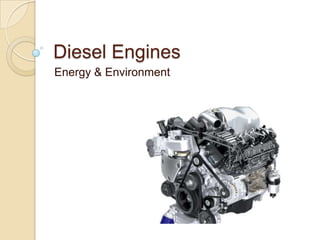
Diesel Engines
Energy & Environment
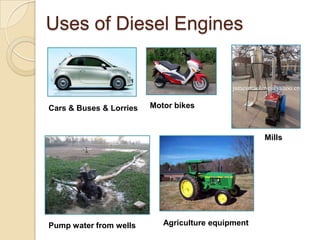
Uses of Diesel Engines


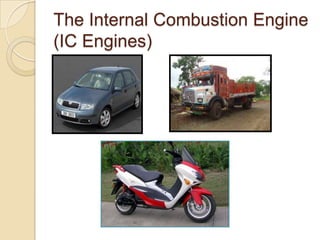
Cars & Buses & Lorries   Motor bikes


                                                    Mills


Pump water from wells       Agriculture equipment
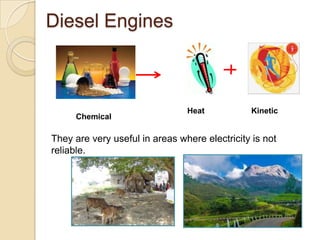
Diesel Engines


                                Heat           Kinetic
     Chemical

They are very useful in areas where electricity is not
reliable.
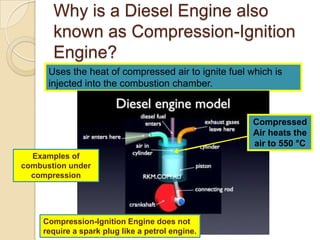
Why is a Diesel Engine also
       known as Compression-Ignition
       Engine?
      Uses the heat of compressed air to ignite fuel which is
      injected into the combustion chamber.


                                                      Compressed
                                                      Air heats the
                                                      air to 550 °C
  Examples of
combustion under
  compression


     Compression-Ignition Engine does not
     require a spark plug like a petrol engine.
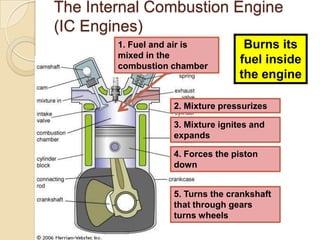
The Internal Combustion Engine
(IC Engines)
        1. Fuel and air is         Burns its
        mixed in the
        combustion chamber
                                  fuel inside
                                  the engine

                   2. Mixture pressurizes

                   3. Mixture ignites and
                   expands

                   4. Forces the piston
                   down


                   5. Turns the crankshaft
                   that through gears
                   turns wheels
The Internal Combustion Engine
(IC Engines)
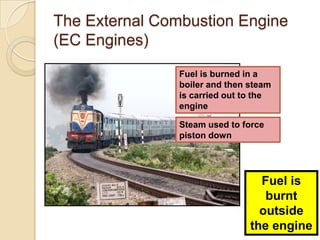
The External Combustion Engine
(EC Engines)
                Fuel is burned in a
                boiler and then steam
                is carried out to the
                engine

                Steam used to force
                piston down


                                  Fuel is
                                   burnt
                                  outside
                                the engine
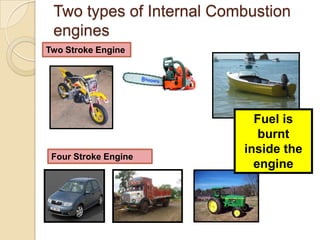
Two types of Internal Combustion
 engines
Two Stroke Engine


                            Fuel is
                             burnt
                          inside the
 Four Stroke Engine
                            engine
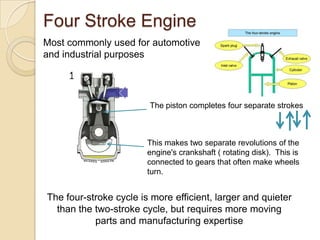
Four Stroke Engine
Most commonly used for automotive
and industrial purposes


                        The piston completes four separate strokes


                        This makes two separate revolutions of the
                        engine's crankshaft ( rotating disk). This is
                        connected to gears that often make wheels
                        turn.


The four-stroke cycle is more efficient, larger and quieter
  than the two-stroke cycle, but requires more moving
           parts and manufacturing expertise
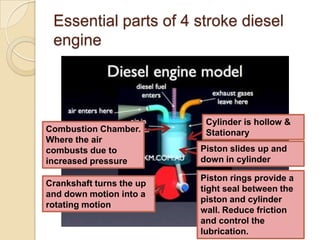
Essential parts of 4 stroke diesel
 engine


                           Cylinder is hollow &
Combustion Chamber.        Stationary
Where the air
combusts due to           Piston slides up and
increased pressure        down in cylinder

                          Piston rings provide a
Crankshaft turns the up
                          tight seal between the
and down motion into a
                          piston and cylinder
rotating motion
                          wall. Reduce friction
                          and control the
                          lubrication.
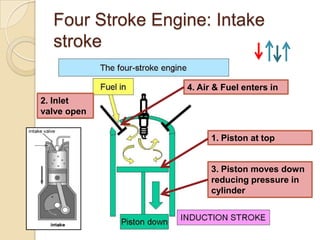
Four Stroke Engine: Intake
  stroke

                  4. Air & Fuel enters in
2. Inlet
valve open

                        1. Piston at top


                        3. Piston moves down
                        reducing pressure in
                        cylinder
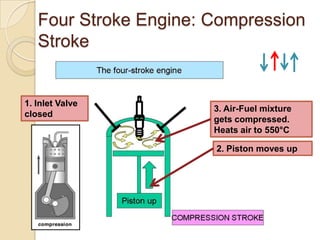
Four Stroke Engine: Compression
   Stroke


1. Inlet Valve
                       3. Air-Fuel mixture
closed
                       gets compressed.
                       Heats air to 550°C

                       2. Piston moves up
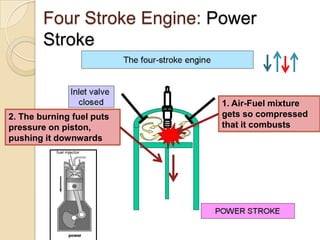
Four Stroke Engine: Power
        Stroke


                            1. Air-Fuel mixture
2. The burning fuel puts    gets so compressed
pressure on piston,         that it combusts
pushing it downwards
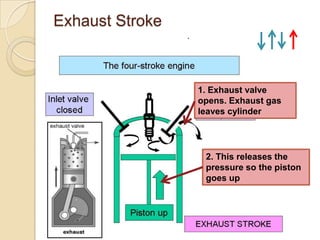
Exhaust Stroke
                 .


                     1. Exhaust valve
                     opens. Exhaust gas
                     leaves cylinder


                      2. This releases the
                      pressure so the piston
                      goes up
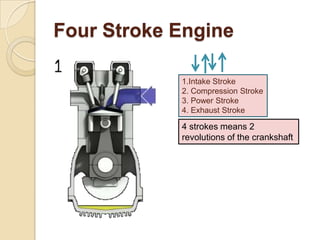
Four Stroke Engine

            1.Intake Stroke
            2. Compression Stroke
            3. Power Stroke
            4. Exhaust Stroke

            4 strokes means 2
            revolutions of the crankshaft
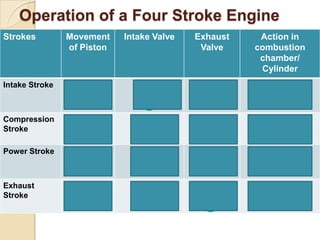
Operation of a Four Stroke Engine
Strokes         Movement    Intake Valve   Exhaust     Action in
                of Piston                   Valve     combustion
                                                       chamber/
                                                       Cylinder
Intake Stroke                  Open        Closed    Fuel & air enters
                                                        chamber


Compression                   Closed       Closed      Fuel & air is
Stroke                                                 compressed

Power Stroke                  Closed       Closed    Compressed fuel
                                                      and air ignites


Exhaust                       Closed        Open      Piston pushes
Stroke                                               exhausts out of
                                                         cylinder
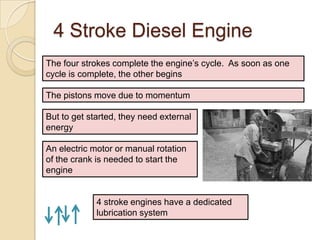
4 Stroke Diesel Engine
The four strokes complete the engine’s cycle. As soon as one
cycle is complete, the other begins

The pistons move due to momentum

But to get started, they need external
energy

An electric motor or manual rotation
of the crank is needed to start the
engine


             4 stroke engines have a dedicated
             lubrication system
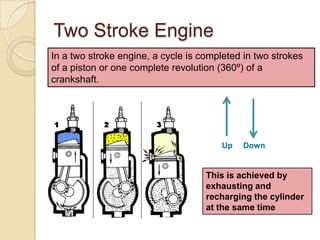
Two Stroke Engine
In a two stroke engine, a cycle is completed in two strokes
of a piston or one complete revolution (360º) of a
crankshaft.


                                        Up   Down


                                    This is achieved by
                                    exhausting and
                                    recharging the cylinder
                                    at the same time
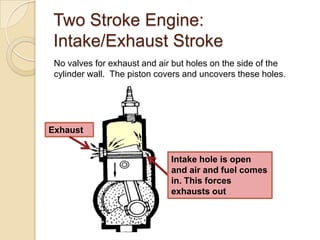
Two Stroke Engine:
Intake/Exhaust Stroke
 No valves for exhaust and air but holes on the side of the
 cylinder wall. The piston covers and uncovers these holes.


Exhaust


                              Intake hole is open
                              and air and fuel comes
                              in. This forces
                              exhausts out
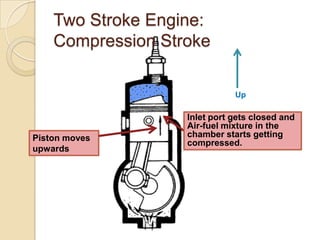
Two Stroke Engine:
    Compression Stroke

                              Up

                   Inlet port gets closed and
                   Air-fuel mixture in the
Piston moves       chamber starts getting
                   compressed.
upwards
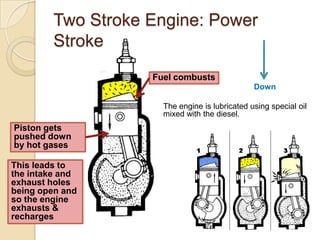
Two Stroke Engine: Power
         Stroke
                    Fuel combusts
                                                Down

                      The engine is lubricated using special oil
                      mixed with the diesel.
Piston gets
pushed down
by hot gases

This leads to
the intake and
exhaust holes
being open and
so the engine
exhausts &
recharges
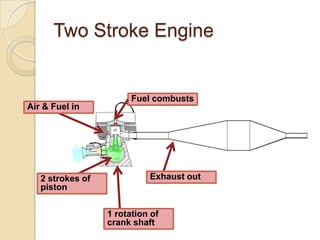
Two Stroke Engine


                        Fuel combusts
Air & Fuel in


   2 strokes of             Exhaust out
   piston


                  1 rotation of
                  crank shaft
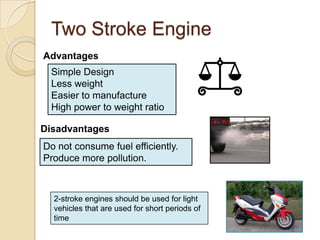
Two Stroke Engine
Advantages
  Simple Design
  Less weight
  Easier to manufacture
  High power to weight ratio

Disadvantages
Do not consume fuel efficiently.
Produce more pollution.


  2-stroke engines should be used for light
  vehicles that are used for short periods of
  time
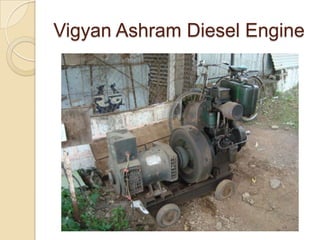
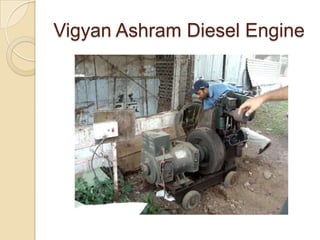
Vigyan Ashram Diesel Engine
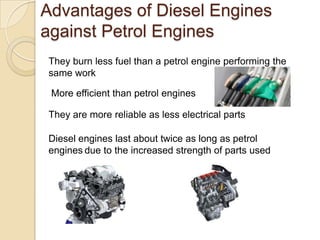
Advantages of Diesel Engines
against Petrol Engines
They burn less fuel than a petrol engine performing the
same work

 More efficient than petrol engines

They are more reliable as less electrical parts

Diesel engines last about twice as long as petrol
engines due to the increased strength of parts used
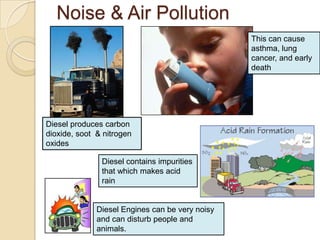
Noise & Air Pollution
                                                 This can cause
                                                 asthma, lung
                                                 cancer, and early
                                                 death


Diesel produces carbon
dioxide, soot & nitrogen
oxides

               Diesel contains impurities
               that which makes acid
               rain


              Diesel Engines can be very noisy
              and can disturb people and
              animals.
Summary Questions
1. Why is an IC engine different from an EC
   engine?
2. What is different about petrol and diesel
   engines with the way they ignite fuel?
3. Where would you expect to find a 4 stroke
   engine?
4. What are some of the advantages of a 2
   stroke engine and when should they be
   used?
5. What type of pollution do we get from
   diesel engines?
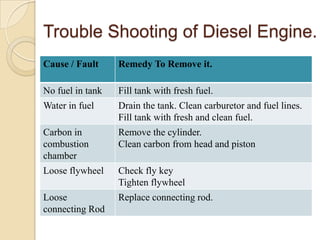
Trouble Shooting of Diesel Engine.
Cause / Fault     Remedy To Remove it.

No fuel in tank   Fill tank with fresh fuel.
Water in fuel     Drain the tank. Clean carburetor and fuel lines.
                  Fill tank with fresh and clean fuel.
Carbon in         Remove the cylinder.
combustion        Clean carbon from head and piston
chamber
Loose flywheel    Check fly key
                  Tighten flywheel
Loose             Replace connecting rod.
connecting Rod
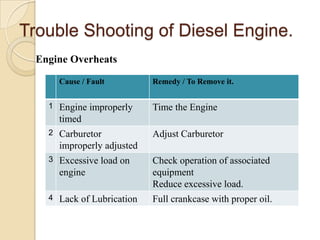
Trouble Shooting of Diesel Engine.
  Engine Overheats

        Cause / Fault         Remedy / To Remove it.


    1   Engine improperly     Time the Engine
        timed
    2   Carburetor            Adjust Carburetor
        improperly adjusted
    3   Excessive load on     Check operation of associated
        engine                equipment
                              Reduce excessive load.
    4   Lack of Lubrication   Full crankcase with proper oil.
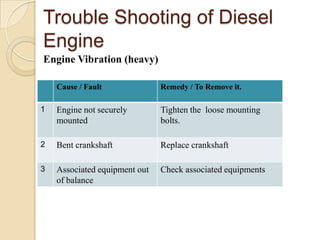
Trouble Shooting of Diesel
Engine
Engine Vibration (heavy)

    Cause / Fault              Remedy / To Remove it.

1   Engine not securely        Tighten the loose mounting
    mounted                    bolts.

2   Bent crankshaft            Replace crankshaft

3   Associated equipment out   Check associated equipments
    of balance

Diesel engine

  • 1.
  • 2.
    Uses of DieselEngines Cars & Buses & Lorries Motor bikes Mills Pump water from wells Agriculture equipment
  • 3.
    Diesel Engines Heat Kinetic Chemical They are very useful in areas where electricity is not reliable.
  • 4.
    Why is aDiesel Engine also known as Compression-Ignition Engine? Uses the heat of compressed air to ignite fuel which is injected into the combustion chamber. Compressed Air heats the air to 550 °C Examples of combustion under compression Compression-Ignition Engine does not require a spark plug like a petrol engine.
  • 5.
    The Internal CombustionEngine (IC Engines) 1. Fuel and air is Burns its mixed in the combustion chamber fuel inside the engine 2. Mixture pressurizes 3. Mixture ignites and expands 4. Forces the piston down 5. Turns the crankshaft that through gears turns wheels
  • 6.
    The Internal CombustionEngine (IC Engines)
  • 7.
    The External CombustionEngine (EC Engines) Fuel is burned in a boiler and then steam is carried out to the engine Steam used to force piston down Fuel is burnt outside the engine
  • 8.
    Two types ofInternal Combustion engines Two Stroke Engine Fuel is burnt inside the Four Stroke Engine engine
  • 9.
    Four Stroke Engine Mostcommonly used for automotive and industrial purposes The piston completes four separate strokes This makes two separate revolutions of the engine's crankshaft ( rotating disk). This is connected to gears that often make wheels turn. The four-stroke cycle is more efficient, larger and quieter than the two-stroke cycle, but requires more moving parts and manufacturing expertise
  • 10.
    Essential parts of4 stroke diesel engine Cylinder is hollow & Combustion Chamber. Stationary Where the air combusts due to Piston slides up and increased pressure down in cylinder Piston rings provide a Crankshaft turns the up tight seal between the and down motion into a piston and cylinder rotating motion wall. Reduce friction and control the lubrication.
  • 11.
    Four Stroke Engine:Intake stroke 4. Air & Fuel enters in 2. Inlet valve open 1. Piston at top 3. Piston moves down reducing pressure in cylinder
  • 12.
    Four Stroke Engine:Compression Stroke 1. Inlet Valve 3. Air-Fuel mixture closed gets compressed. Heats air to 550°C 2. Piston moves up
  • 13.
    Four Stroke Engine:Power Stroke 1. Air-Fuel mixture 2. The burning fuel puts gets so compressed pressure on piston, that it combusts pushing it downwards
  • 14.
    Exhaust Stroke . 1. Exhaust valve opens. Exhaust gas leaves cylinder 2. This releases the pressure so the piston goes up
  • 15.
    Four Stroke Engine 1.Intake Stroke 2. Compression Stroke 3. Power Stroke 4. Exhaust Stroke 4 strokes means 2 revolutions of the crankshaft
  • 16.
    Operation of aFour Stroke Engine Strokes Movement Intake Valve Exhaust Action in of Piston Valve combustion chamber/ Cylinder Intake Stroke Open Closed Fuel & air enters chamber Compression Closed Closed Fuel & air is Stroke compressed Power Stroke Closed Closed Compressed fuel and air ignites Exhaust Closed Open Piston pushes Stroke exhausts out of cylinder
  • 17.
    4 Stroke DieselEngine The four strokes complete the engine’s cycle. As soon as one cycle is complete, the other begins The pistons move due to momentum But to get started, they need external energy An electric motor or manual rotation of the crank is needed to start the engine 4 stroke engines have a dedicated lubrication system
  • 18.
    Two Stroke Engine Ina two stroke engine, a cycle is completed in two strokes of a piston or one complete revolution (360º) of a crankshaft. Up Down This is achieved by exhausting and recharging the cylinder at the same time
  • 19.
    Two Stroke Engine: Intake/ExhaustStroke No valves for exhaust and air but holes on the side of the cylinder wall. The piston covers and uncovers these holes. Exhaust Intake hole is open and air and fuel comes in. This forces exhausts out
  • 20.
    Two Stroke Engine: Compression Stroke Up Inlet port gets closed and Air-fuel mixture in the Piston moves chamber starts getting compressed. upwards
  • 21.
    Two Stroke Engine:Power Stroke Fuel combusts Down The engine is lubricated using special oil mixed with the diesel. Piston gets pushed down by hot gases This leads to the intake and exhaust holes being open and so the engine exhausts & recharges
  • 22.
    Two Stroke Engine Fuel combusts Air & Fuel in 2 strokes of Exhaust out piston 1 rotation of crank shaft
  • 23.
    Two Stroke Engine Advantages Simple Design Less weight Easier to manufacture High power to weight ratio Disadvantages Do not consume fuel efficiently. Produce more pollution. 2-stroke engines should be used for light vehicles that are used for short periods of time
  • 24.
  • 25.
  • 26.
    Advantages of DieselEngines against Petrol Engines They burn less fuel than a petrol engine performing the same work More efficient than petrol engines They are more reliable as less electrical parts Diesel engines last about twice as long as petrol engines due to the increased strength of parts used
  • 27.
    Noise & AirPollution This can cause asthma, lung cancer, and early death Diesel produces carbon dioxide, soot & nitrogen oxides Diesel contains impurities that which makes acid rain Diesel Engines can be very noisy and can disturb people and animals.
  • 28.
    Summary Questions 1. Whyis an IC engine different from an EC engine? 2. What is different about petrol and diesel engines with the way they ignite fuel? 3. Where would you expect to find a 4 stroke engine? 4. What are some of the advantages of a 2 stroke engine and when should they be used? 5. What type of pollution do we get from diesel engines?
  • 29.
    Trouble Shooting ofDiesel Engine. Cause / Fault Remedy To Remove it. No fuel in tank Fill tank with fresh fuel. Water in fuel Drain the tank. Clean carburetor and fuel lines. Fill tank with fresh and clean fuel. Carbon in Remove the cylinder. combustion Clean carbon from head and piston chamber Loose flywheel Check fly key Tighten flywheel Loose Replace connecting rod. connecting Rod
  • 30.
    Trouble Shooting ofDiesel Engine. Engine Overheats Cause / Fault Remedy / To Remove it. 1 Engine improperly Time the Engine timed 2 Carburetor Adjust Carburetor improperly adjusted 3 Excessive load on Check operation of associated engine equipment Reduce excessive load. 4 Lack of Lubrication Full crankcase with proper oil.
  • 31.
    Trouble Shooting ofDiesel Engine Engine Vibration (heavy) Cause / Fault Remedy / To Remove it. 1 Engine not securely Tighten the loose mounting mounted bolts. 2 Bent crankshaft Replace crankshaft 3 Associated equipment out Check associated equipments of balance

Editor's Notes

  • #5 http://www.youtube.com/watch?v=SuBgZkuKSP8&feature=relatedhttp://www.youtube.com/watch?v=ADeYiOYGGYY
  • #9 the concept is also used in diesel compression ignition engines in large and weight insensitive applications, such as ships and locomotives.??? (wiki two stroke)
  • #11 Crankcase :-It is a body of Engine.It contains most of moving parts of engine.Compression Rings :-First two are compression rings. They can move slightly up and down and expand slightly in and out.It act as a power seal ensuring that a maximum amount of the combustion pressure is used in forcing the piston down the cylinder.Flywheel :-The flywheel is mounted on the tapered end of crankshaft.It helps to smooth out the operation of engine.
  • #12 Intake stroke: Air and vaporized fuel are drawn in.
  • #13 Compression stroke: Fuel vapour and air are compressed and ignited.
  • #14 Combustion stroke: Fuel combusts and piston is pushed downwards.
  • #15 Exhaust stroke: Exhaust is driven out. Unlike 2 – stroke engine where oil is mixed with the fuel. In 4 – stroke engine, oil is put separately in the crank case. It gets splashed with the movement of crank and does lubrication
  • #16 Please go to http://www.youtube.com/watch?v=uB2cmkWbCMI to watch the video of four stroke engine.
  • #20 in diesel compression ignition engines in large and weight insensitive applications, such as ships and locomotives..
  • #30 These tables were in the curriculum so have been included for completeness