
BY
INDRANIL MANDAL
ASSISTANT PROFESSOR
DEPARTMENT-MECHANICAL ENGINEERING
IDEAL INSTITUTE OF ENGINEERING
MECHANICAL INJECTION
SYSTEM
INTRODUCTION
 Fuel-Injection System is vital to the working and performance of CI
engine.
 The injection system is required for initiating and controlling the
combustion process.
 In case of carburetion fuel is atomized by processes relying on the air
speed greater than fuel speed at the fuel nozzle, whereas in fuel injection
the fuel speed at the point of delivery is greater than the air speed to
atomize the fuel.
 Fuel is injected into combustion chamber towards the end of
compression. It is atomized as it enters under high velocity and the
droplets get vaporized to form a fuel-air mixture. Due to continued heat
transfer from hot air to fuel, the fuel reaches to its self ignition
temperature to ignite spontaneously initiating combustion. Depending
upon the demand requirements the fuel injection system continues to
deliver the fuel during initial part of combustion.
FUNCTIONAL REQUIREMENTS OF AN INJECTION SYSTEM
 For proper engine operation and satisfactory performance, the
following requirements must be met by the Fuel Injection (FI)
System :-
 Accurate metering of fuel injected per cycle to meet changing
demand of speed & load
 Precise timing of fuel injection in the cycle to ensure performance;
power, fuel economy, emissions
 Proper control of rate of injection to achieve desired heat release
during combustion without knocking
 Proper atomization of fuel into fine droplets
 Proper spray pattern to ensure rapid mixing of fuel & air
 Uniform distribution of fuel droplets throughout the combustion
chamber
 To supply equal quantities of metered fuel to all cylinders in case
of multi cylinder engines
 No lag during beginning and end of injection to eliminate
dribbling of fuel droplets into the cylinder
CLASSIFICATION OF INJECTION SYSTEM
Two types:-
Air Injection system and Solid Injection system
 Air Injection system : Fuel is forced by means of compressed
air. Good mixing with higher mep. It requires compressor.
Ability to use high viscosity fuel. Not much in use.
 Solid Injection system : Liquid fuel is injected directly into
combustion chamber. Solid injection systems can be classified
into ;
i) Individual pump and nozzle system
ii) Unit Injector system
iii) Common rail system
iv) Distributor system
COMPONENTS
All the FI systems comprise of following components:
 Fuel tank
 Fuel feed pump to supply fuel from fuel tank to FI system
 Injection pump to meter and pressurize the fuel for injection
 Governor to ensure that the amount of fuel injected is in
accordance with variation of load
 Injector to take the fuel from the pump and distribute it in the
combustion chamber by atomizing it into fine droplets
 Fuel filters to prevent dust and abrasive particles from entering
the pump & injectors to reduce wear & tear of components
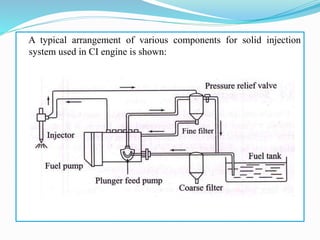
A typical arrangement of various components for solid injection
system used in CI engine is shown:
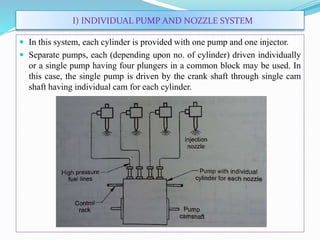
I) INDIVIDUAL PUMP AND NOZZLE SYSTEM
 In this system, each cylinder is provided with one pump and one injector.
 Separate pumps, each (depending upon no. of cylinder) driven individually
or a single pump having four plungers in a common block may be used. In
this case, the single pump is driven by the crank shaft through single cam
shaft having individual cam for each cylinder.
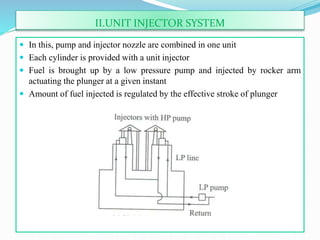
II.UNIT INJECTOR SYSTEM
 In this, pump and injector nozzle are combined in one unit
 Each cylinder is provided with a unit injector
 Fuel is brought up by a low pressure pump and injected by rocker arm
actuating the plunger at a given instant
 Amount of fuel injected is regulated by the effective stroke of plunger
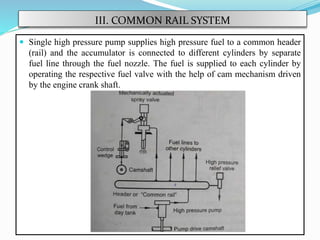
III. COMMON RAIL SYSTEM
 Single high pressure pump supplies high pressure fuel to a common header
(rail) and the accumulator is connected to different cylinders by separate
fuel line through the fuel nozzle. The fuel is supplied to each cylinder by
operating the respective fuel valve with the help of cam mechanism driven
by the engine crank shaft.
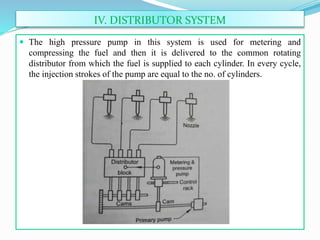
IV. DISTRIBUTOR SYSTEM
 The high pressure pump in this system is used for metering and
compressing the fuel and then it is delivered to the common rotating
distributor from which the fuel is supplied to each cylinder. In every cycle,
the injection strokes of the pump are equal to the no. of cylinders.
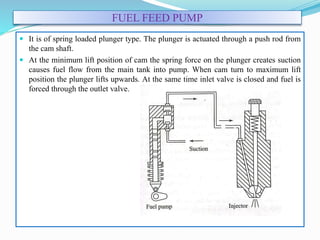
FUEL FEED PUMP
 It is of spring loaded plunger type. The plunger is actuated through a push rod from
the cam shaft.
 At the minimum lift position of cam the spring force on the plunger creates suction
causes fuel flow from the main tank into pump. When cam turn to maximum lift
position the plunger lifts upwards. At the same time inlet valve is closed and fuel is
forced through the outlet valve.
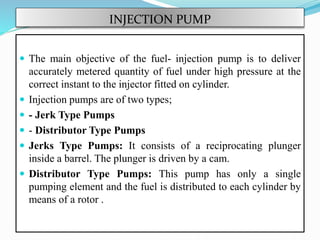
INJECTION PUMP
 The main objective of the fuel- injection pump is to deliver
accurately metered quantity of fuel under high pressure at the
correct instant to the injector fitted on cylinder.
 Injection pumps are of two types;
 - Jerk Type Pumps
 - Distributor Type Pumps
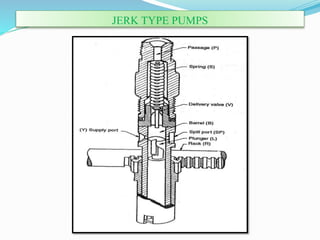
 Jerks Type Pumps: It consists of a reciprocating plunger
inside a barrel. The plunger is driven by a cam.
 Distributor Type Pumps: This pump has only a single
pumping element and the fuel is distributed to each cylinder by
means of a rotor .
JERK TYPE PUMPS
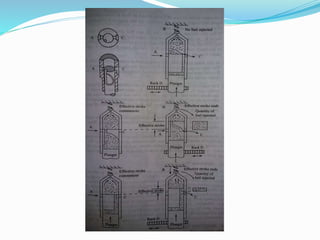
ACTUAL METHOD OF CONTROLLING QUANTITY
OF FUEL INJECTED IN A C.I ENGINE
DISTRIBUTOR TYPE PUMP
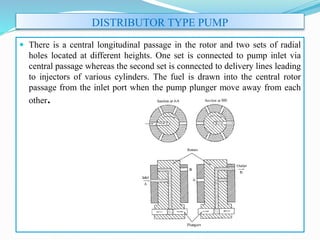
 There is a central longitudinal passage in the rotor and two sets of radial
holes located at different heights. One set is connected to pump inlet via
central passage whereas the second set is connected to delivery lines leading
to injectors of various cylinders. The fuel is drawn into the central rotor
passage from the inlet port when the pump plunger move away from each
other.
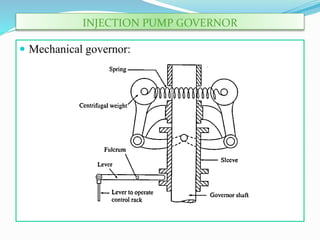
INJECTION PUMP GOVERNOR
 Mechanical governor:
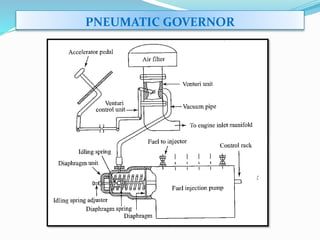
PNEUMATIC GOVERNOR
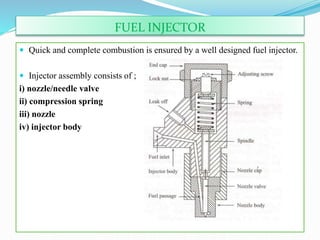
FUEL INJECTOR
 Quick and complete combustion is ensured by a well designed fuel injector.
 Injector assembly consists of ;
i) nozzle/needle valve
ii) compression spring
iii) nozzle
iv) injector body
NOZZLE
 It is that part of an injector through which the liquid fuel is
sprayed into combustion chamber.
 Nozzle should fulfill the following functions:
i) Atomization
ii) Distribution of fuel
iii) Prevention of impingement on walls: decomposition
v) Mixing : in case of non-turbulent type of combustion chamber
 Types of Nozzles
i) Pintle Nozzle ii) Single hole nozzle iii) multi- hole nozzle iv) Pintaux nozzle
SPRAY FORMATION
 At the start of injection the pressure difference across the
orifice is low and single droplets are formed.
 As pressure difference increases following occurs :
 A stream of fuel emerges
 Stream encounter aerodynamic resistance from dense air( 12 to
14 times ambient pressure ) and breaks into a spray at the
break-up distance
 With further increase in pressure the break- up distance
decreases and the cone angle increases until apex of the cone
practically coincides with the orifice
 Successive phases of spray formation is given in the figure.
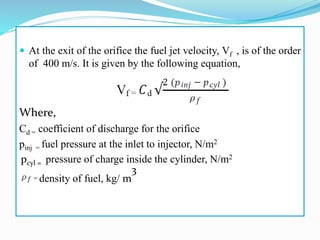
 At the exit of the orifice the fuel jet velocity, Vf , is of the order
of 400 m/s. It is given by the following equation,
Where,
Cd = coefficient of discharge for the orifice
pinj = fuel pressure at the inlet to injector, N/m2
pcyl = pressure of charge inside the cylinder, N/m2
= density of fuel, kg/ m
3
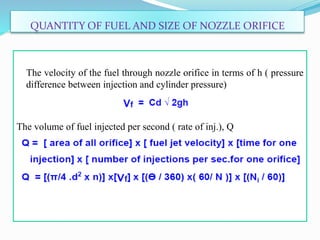
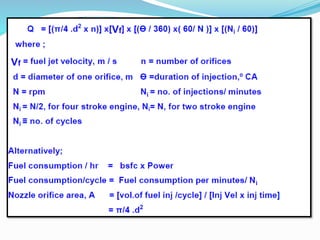
QUANTITY OF FUEL AND SIZE OF NOZZLE ORIFICE
The velocity of the fuel through nozzle orifice in terms of h ( pressure
difference between injection and cylinder pressure)
The volume of fuel injected per second ( rate of inj.), Q
Fuel Injection System

Fuel Injection System

  • 1.
    BY INDRANIL MANDAL ASSISTANT PROFESSOR DEPARTMENT-MECHANICALENGINEERING IDEAL INSTITUTE OF ENGINEERING
  • 2.
  • 3.
    INTRODUCTION  Fuel-Injection Systemis vital to the working and performance of CI engine.  The injection system is required for initiating and controlling the combustion process.  In case of carburetion fuel is atomized by processes relying on the air speed greater than fuel speed at the fuel nozzle, whereas in fuel injection the fuel speed at the point of delivery is greater than the air speed to atomize the fuel.  Fuel is injected into combustion chamber towards the end of compression. It is atomized as it enters under high velocity and the droplets get vaporized to form a fuel-air mixture. Due to continued heat transfer from hot air to fuel, the fuel reaches to its self ignition temperature to ignite spontaneously initiating combustion. Depending upon the demand requirements the fuel injection system continues to deliver the fuel during initial part of combustion.
  • 4.
    FUNCTIONAL REQUIREMENTS OFAN INJECTION SYSTEM  For proper engine operation and satisfactory performance, the following requirements must be met by the Fuel Injection (FI) System :-  Accurate metering of fuel injected per cycle to meet changing demand of speed & load  Precise timing of fuel injection in the cycle to ensure performance; power, fuel economy, emissions  Proper control of rate of injection to achieve desired heat release during combustion without knocking  Proper atomization of fuel into fine droplets  Proper spray pattern to ensure rapid mixing of fuel & air  Uniform distribution of fuel droplets throughout the combustion chamber  To supply equal quantities of metered fuel to all cylinders in case of multi cylinder engines  No lag during beginning and end of injection to eliminate dribbling of fuel droplets into the cylinder
  • 5.
    CLASSIFICATION OF INJECTIONSYSTEM Two types:- Air Injection system and Solid Injection system  Air Injection system : Fuel is forced by means of compressed air. Good mixing with higher mep. It requires compressor. Ability to use high viscosity fuel. Not much in use.  Solid Injection system : Liquid fuel is injected directly into combustion chamber. Solid injection systems can be classified into ; i) Individual pump and nozzle system ii) Unit Injector system iii) Common rail system iv) Distributor system
  • 6.
    COMPONENTS All the FIsystems comprise of following components:  Fuel tank  Fuel feed pump to supply fuel from fuel tank to FI system  Injection pump to meter and pressurize the fuel for injection  Governor to ensure that the amount of fuel injected is in accordance with variation of load  Injector to take the fuel from the pump and distribute it in the combustion chamber by atomizing it into fine droplets  Fuel filters to prevent dust and abrasive particles from entering the pump & injectors to reduce wear & tear of components
  • 7.
    A typical arrangementof various components for solid injection system used in CI engine is shown:
  • 8.
    I) INDIVIDUAL PUMPAND NOZZLE SYSTEM  In this system, each cylinder is provided with one pump and one injector.  Separate pumps, each (depending upon no. of cylinder) driven individually or a single pump having four plungers in a common block may be used. In this case, the single pump is driven by the crank shaft through single cam shaft having individual cam for each cylinder.
  • 9.
    II.UNIT INJECTOR SYSTEM In this, pump and injector nozzle are combined in one unit  Each cylinder is provided with a unit injector  Fuel is brought up by a low pressure pump and injected by rocker arm actuating the plunger at a given instant  Amount of fuel injected is regulated by the effective stroke of plunger
  • 10.
    III. COMMON RAILSYSTEM  Single high pressure pump supplies high pressure fuel to a common header (rail) and the accumulator is connected to different cylinders by separate fuel line through the fuel nozzle. The fuel is supplied to each cylinder by operating the respective fuel valve with the help of cam mechanism driven by the engine crank shaft.
  • 11.
    IV. DISTRIBUTOR SYSTEM The high pressure pump in this system is used for metering and compressing the fuel and then it is delivered to the common rotating distributor from which the fuel is supplied to each cylinder. In every cycle, the injection strokes of the pump are equal to the no. of cylinders.
  • 12.
    FUEL FEED PUMP It is of spring loaded plunger type. The plunger is actuated through a push rod from the cam shaft.  At the minimum lift position of cam the spring force on the plunger creates suction causes fuel flow from the main tank into pump. When cam turn to maximum lift position the plunger lifts upwards. At the same time inlet valve is closed and fuel is forced through the outlet valve.
  • 13.
    INJECTION PUMP  Themain objective of the fuel- injection pump is to deliver accurately metered quantity of fuel under high pressure at the correct instant to the injector fitted on cylinder.  Injection pumps are of two types;  - Jerk Type Pumps  - Distributor Type Pumps  Jerks Type Pumps: It consists of a reciprocating plunger inside a barrel. The plunger is driven by a cam.  Distributor Type Pumps: This pump has only a single pumping element and the fuel is distributed to each cylinder by means of a rotor .
  • 14.
  • 15.
    ACTUAL METHOD OFCONTROLLING QUANTITY OF FUEL INJECTED IN A C.I ENGINE
  • 17.
    DISTRIBUTOR TYPE PUMP There is a central longitudinal passage in the rotor and two sets of radial holes located at different heights. One set is connected to pump inlet via central passage whereas the second set is connected to delivery lines leading to injectors of various cylinders. The fuel is drawn into the central rotor passage from the inlet port when the pump plunger move away from each other.
  • 18.
    INJECTION PUMP GOVERNOR Mechanical governor:
  • 19.
  • 20.
    FUEL INJECTOR  Quickand complete combustion is ensured by a well designed fuel injector.  Injector assembly consists of ; i) nozzle/needle valve ii) compression spring iii) nozzle iv) injector body
  • 21.
    NOZZLE  It isthat part of an injector through which the liquid fuel is sprayed into combustion chamber.  Nozzle should fulfill the following functions: i) Atomization ii) Distribution of fuel iii) Prevention of impingement on walls: decomposition v) Mixing : in case of non-turbulent type of combustion chamber
  • 22.
     Types ofNozzles i) Pintle Nozzle ii) Single hole nozzle iii) multi- hole nozzle iv) Pintaux nozzle
  • 23.
    SPRAY FORMATION  Atthe start of injection the pressure difference across the orifice is low and single droplets are formed.  As pressure difference increases following occurs :  A stream of fuel emerges  Stream encounter aerodynamic resistance from dense air( 12 to 14 times ambient pressure ) and breaks into a spray at the break-up distance  With further increase in pressure the break- up distance decreases and the cone angle increases until apex of the cone practically coincides with the orifice  Successive phases of spray formation is given in the figure.
  • 25.
     At theexit of the orifice the fuel jet velocity, Vf , is of the order of 400 m/s. It is given by the following equation, Where, Cd = coefficient of discharge for the orifice pinj = fuel pressure at the inlet to injector, N/m2 pcyl = pressure of charge inside the cylinder, N/m2 = density of fuel, kg/ m 3
  • 26.
    QUANTITY OF FUELAND SIZE OF NOZZLE ORIFICE The velocity of the fuel through nozzle orifice in terms of h ( pressure difference between injection and cylinder pressure) The volume of fuel injected per second ( rate of inj.), Q