Presented by: Group 3
Operation of
Internal Combustion
Engine
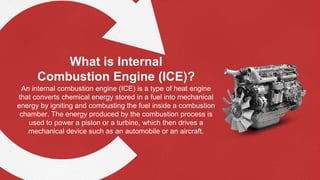
What is Internal
Combustion Engine (ICE)?
An internal combustion engine (ICE) is a type of heat engine
that converts chemical energy stored in a fuel into mechanical
energy by igniting and combusting the fuel inside a combustion
chamber. The energy produced by the combustion process is
used to power a piston or a turbine, which then drives a
mechanical device such as an automobile or an aircraft.
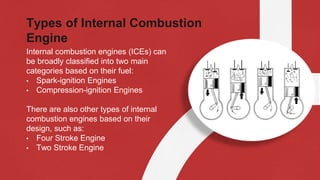
Types of Internal Combustion
Engine
Internal combustion engines (ICEs) can
be broadly classified into two main
categories based on their fuel:
• Spark-ignition Engines
• Compression-ignition Engines
There are also other types of internal
combustion engines based on their
design, such as:
• Four Stroke Engine
• Two Stroke Engine
How Do They
Work?
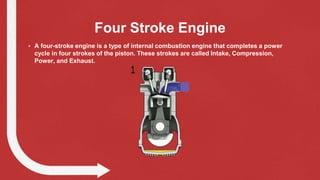
Four Stroke Engine
• A four-stroke engine is a type of internal combustion engine that completes a power
cycle in four strokes of the piston. These strokes are called Intake, Compression,
Power, and Exhaust.
INTAKE Stroke
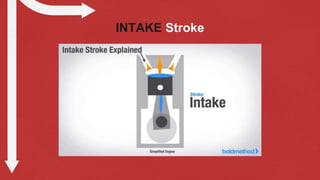
• This starts at the highest point known as top dead center (TDC) and ends at bottom
dead center (BDC).
• Your engine mixes fuel and air in the intake manifold. As it mixes, the intake valve
opens as your piston moves down, drawing the fuel-air mixture into the combustion
chamber.
• The intake stroke allows the piston to suck fuel and air into the combustion chamber
through the intake valve port.
INTAKE Stroke
COMPRESSION Stroke
• The second motion of the stroke takes all the fuel and air that was stored and
compresses it into one tenth its original sizes making the air/fuel mixture increase in
temperature preparing it for the next stage in its combustion cycle.
• The piston is forced up after the intake valve closes, compressing the fuel-air mixture
before it is ignited.
• Compression starts at bottom dead center and ends at top dead center.
COMPRESSION Stroke
POWER Stroke
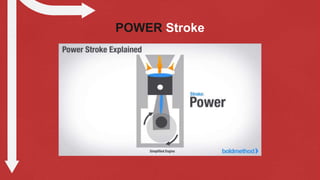
• Right before the piston reaches it's highest point (top-dead-center), your spark plugs
send a current arching across their prongs, igniting the fuel-air mixture. Different
engines have different designs, so their exact firing point will vary depending on your
engine's model. As the fuel and air combust they expand, pushing down the piston.
The directional motion of the piston moving down is converted to rotational motion as
your piston turns the crankshaft, providing power.
POWER Stroke
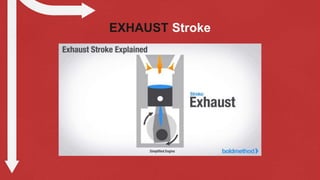
EXHAUST Stroke
• Now that your engine has extracted the potential energy from the fuel-air mixture you
sucked into the cylinders, it's time to set it up again. Your exhaust valve opens, and
the piston moves up, pushing the exhaust gas out of the cylinder and into the exhaust
system.
EXHAUST Stroke
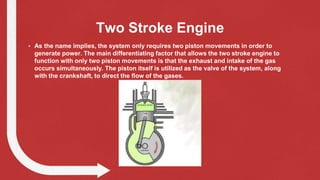
Two Stroke Engine
• As the name implies, the system only requires two piston movements in order to
generate power. The main differentiating factor that allows the two stroke engine to
function with only two piston movements is that the exhaust and intake of the gas
occurs simultaneously. The piston itself is utilized as the valve of the system, along
with the crankshaft, to direct the flow of the gases.
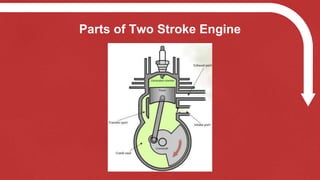
Parts of Two Stroke Engine
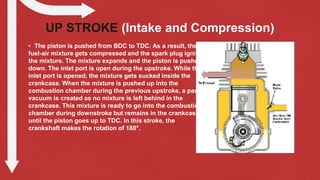
UP STROKE (Intake and Compression)
• The piston is pushed from BDC to TDC. As a result, the
fuel-air mixture gets compressed and the spark plug ignites
the mixture. The mixture expands and the piston is pushed
down. The inlet port is open during the upstroke. While the
inlet port is opened, the mixture gets sucked inside the
crankcase. When the mixture is pushed up into the
combustion chamber during the previous upstroke, a partial
vacuum is created as no mixture is left behind in the
crankcase. This mixture is ready to go into the combustion
chamber during downstroke but remains in the crankcase
until the piston goes up to TDC. In this stroke, the
crankshaft makes the rotation of 180°.
DOWN STROKE (Power and Exhaust
Stroke)
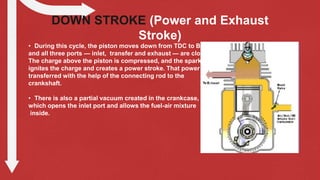
• During this cycle, the piston moves down from TDC to BDC,
and all three ports — inlet, transfer and exhaust — are closed.
The charge above the piston is compressed, and the spark plug
ignites the charge and creates a power stroke. That power is
transferred with the help of the connecting rod to the
crankshaft.
• There is also a partial vacuum created in the crankcase,
which opens the inlet port and allows the fuel-air mixture
inside.
The Beauty of Two Stroke
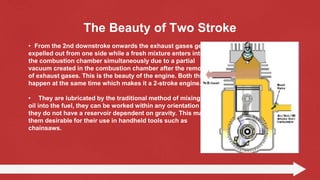
• From the 2nd downstroke onwards the exhaust gases get
expelled out from one side while a fresh mixture enters into
the combustion chamber simultaneously due to a partial
vacuum created in the combustion chamber after the removal
of exhaust gases. This is the beauty of the engine. Both things
happen at the same time which makes it a 2-stroke engine.
• They are lubricated by the traditional method of mixing
oil into the fuel, they can be worked within any orientation as
they do not have a reservoir dependent on gravity. This makes
them desirable for their use in handheld tools such as
chainsaws.
Spark Ignition Engine
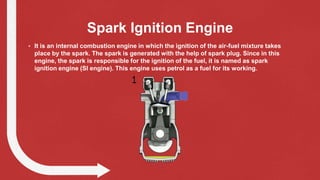
• It is an internal combustion engine in which the ignition of the air-fuel mixture takes
place by the spark. The spark is generated with the help of spark plug. Since in this
engine, the spark is responsible for the ignition of the fuel, it is named as spark
ignition engine (SI engine). This engine uses petrol as a fuel for its working.
Compression Ignition Engine
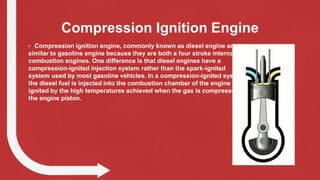
• Compression ignition engine, commonly known as diesel engine are
similar to gasoline engine because they are both a four stroke internal
combustion engines. One difference is that diesel engines have a
compression-ignited injection system rather than the spark-ignited
system used by most gasoline vehicles. In a compression-ignited system,
the diesel fuel is injected into the combustion chamber of the engine and
ignited by the high temperatures achieved when the gas is compressed by
the engine piston.
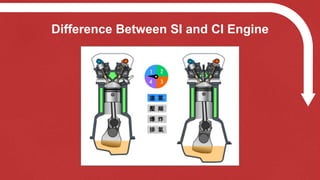
Difference Between SI and CI Engine
• The main difference between a diesel engine and a gas powered engine is the way in
which the combustion occurs.
• In gas engines, the fuel combines with air and then compresses by the piston head and
ignites with a spark plug. This combusts the fuel and force the piston back down. This
process is outlined by the four-stroke combustion cycle.
• In a diesel engine, a similar four-stroke cycle follows, albeit with a several major
changes. In the compression stage air is compressed before the fuel is added and
through a process called auto ignition, the diesel fuel combusts due to the high
temperature of the compressed air in the cylinder without the need of a spark. Glow
plugs replace spark plugs in diesel engines and are only used for the initial
combustion.
Difference Between SI and CI Engine
Emission
Control
System
What is an Emission Control System?
• The emission control system includes a series of functions that the vehicle performs
to keep the emissions as low as possible. Harmful emissions like carbon monoxide
(CO), hydrocarbons (HC) and nitrogen oxide (NOx) are minimized with the help of an
emission control system. We can generally classify the emission control methods into
two categories, prevention/active and destruction/passive.
Catalytic Converters
• The aim of catalyst systems is to remove CO and HC by oxidation to CO2 and water,
and to remove NOx by either reduction to N2 or by decomposition to N2 and O2.
Evaporative Emission Control
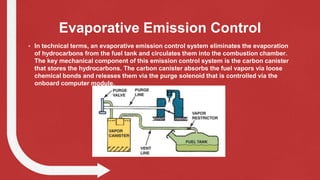
• In technical terms, an evaporative emission control system eliminates the evaporation
of hydrocarbons from the fuel tank and circulates them into the combustion chamber.
The key mechanical component of this emission control system is the carbon canister
that stores the hydrocarbons. The carbon canister absorbs the fuel vapors via loose
chemical bonds and releases them via the purge solenoid that is controlled via the
onboard computer module.
Exhaust Gas Recirculation (EGR)
• EGR valve allows a precise quantity of exhaust gas to
re-enter the intake the system, effectively changing the
chemical makeup of the air entering the engine. With less
oxygen, the now diluted mixture burns slower, lowering
temperatures in the combustion chamber by almost
150°C, and reducing NOx production for a cleaner, more
efficient exhaust.
Charcoal Canister
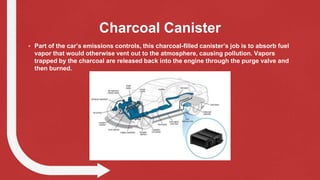
• Part of the car’s emissions controls, this charcoal-filled canister’s job is to absorb fuel
vapor that would otherwise vent out to the atmosphere, causing pollution. Vapors
trapped by the charcoal are released back into the engine through the purge valve and
then burned.
Positive Crankcase Ventilation
• A crankcase ventilation system removes unwanted gases from the crankcase of an
internal combustion engine. The system usually consists of a tube, a one-way valve
and a vacuum source (such as the intake manifold).
https://www.boldmethod.com/learn-to-fly/systems/how-does-your-piston-engine-work/
https://byjus.com/physics/two-stroke-engine/
https://dieselnet.com/tech/diesel_engines.php#:~:text=Conceptually%2C%20diesel%20engines%2
0operate%20by,atomized%20injected%20fuel%20to%20evaporate
https://carorbis.com/blog/what-is-an-emission-control-system-different-types-and-how-they-work/
References
CREDITS: This presentation template was created by Slidesgo,
including icons by Flaticon, infographics and images by Freepik
Thank you!

Internal Combustion Engine Group 3.pptx

  • 1.
    Presented by: Group3 Operation of Internal Combustion Engine
  • 2.
    What is Internal CombustionEngine (ICE)? An internal combustion engine (ICE) is a type of heat engine that converts chemical energy stored in a fuel into mechanical energy by igniting and combusting the fuel inside a combustion chamber. The energy produced by the combustion process is used to power a piston or a turbine, which then drives a mechanical device such as an automobile or an aircraft.
  • 3.
    Types of InternalCombustion Engine Internal combustion engines (ICEs) can be broadly classified into two main categories based on their fuel: • Spark-ignition Engines • Compression-ignition Engines There are also other types of internal combustion engines based on their design, such as: • Four Stroke Engine • Two Stroke Engine
  • 4.
  • 5.
    Four Stroke Engine •A four-stroke engine is a type of internal combustion engine that completes a power cycle in four strokes of the piston. These strokes are called Intake, Compression, Power, and Exhaust.
  • 6.
    INTAKE Stroke • Thisstarts at the highest point known as top dead center (TDC) and ends at bottom dead center (BDC). • Your engine mixes fuel and air in the intake manifold. As it mixes, the intake valve opens as your piston moves down, drawing the fuel-air mixture into the combustion chamber. • The intake stroke allows the piston to suck fuel and air into the combustion chamber through the intake valve port.
  • 7.
  • 8.
    COMPRESSION Stroke • Thesecond motion of the stroke takes all the fuel and air that was stored and compresses it into one tenth its original sizes making the air/fuel mixture increase in temperature preparing it for the next stage in its combustion cycle. • The piston is forced up after the intake valve closes, compressing the fuel-air mixture before it is ignited. • Compression starts at bottom dead center and ends at top dead center.
  • 9.
  • 10.
    POWER Stroke • Rightbefore the piston reaches it's highest point (top-dead-center), your spark plugs send a current arching across their prongs, igniting the fuel-air mixture. Different engines have different designs, so their exact firing point will vary depending on your engine's model. As the fuel and air combust they expand, pushing down the piston. The directional motion of the piston moving down is converted to rotational motion as your piston turns the crankshaft, providing power.
  • 11.
  • 12.
    EXHAUST Stroke • Nowthat your engine has extracted the potential energy from the fuel-air mixture you sucked into the cylinders, it's time to set it up again. Your exhaust valve opens, and the piston moves up, pushing the exhaust gas out of the cylinder and into the exhaust system.
  • 13.
  • 14.
    Two Stroke Engine •As the name implies, the system only requires two piston movements in order to generate power. The main differentiating factor that allows the two stroke engine to function with only two piston movements is that the exhaust and intake of the gas occurs simultaneously. The piston itself is utilized as the valve of the system, along with the crankshaft, to direct the flow of the gases.
  • 15.
    Parts of TwoStroke Engine
  • 16.
    UP STROKE (Intakeand Compression) • The piston is pushed from BDC to TDC. As a result, the fuel-air mixture gets compressed and the spark plug ignites the mixture. The mixture expands and the piston is pushed down. The inlet port is open during the upstroke. While the inlet port is opened, the mixture gets sucked inside the crankcase. When the mixture is pushed up into the combustion chamber during the previous upstroke, a partial vacuum is created as no mixture is left behind in the crankcase. This mixture is ready to go into the combustion chamber during downstroke but remains in the crankcase until the piston goes up to TDC. In this stroke, the crankshaft makes the rotation of 180°.
  • 17.
    DOWN STROKE (Powerand Exhaust Stroke) • During this cycle, the piston moves down from TDC to BDC, and all three ports — inlet, transfer and exhaust — are closed. The charge above the piston is compressed, and the spark plug ignites the charge and creates a power stroke. That power is transferred with the help of the connecting rod to the crankshaft. • There is also a partial vacuum created in the crankcase, which opens the inlet port and allows the fuel-air mixture inside.
  • 18.
    The Beauty ofTwo Stroke • From the 2nd downstroke onwards the exhaust gases get expelled out from one side while a fresh mixture enters into the combustion chamber simultaneously due to a partial vacuum created in the combustion chamber after the removal of exhaust gases. This is the beauty of the engine. Both things happen at the same time which makes it a 2-stroke engine. • They are lubricated by the traditional method of mixing oil into the fuel, they can be worked within any orientation as they do not have a reservoir dependent on gravity. This makes them desirable for their use in handheld tools such as chainsaws.
  • 19.
    Spark Ignition Engine •It is an internal combustion engine in which the ignition of the air-fuel mixture takes place by the spark. The spark is generated with the help of spark plug. Since in this engine, the spark is responsible for the ignition of the fuel, it is named as spark ignition engine (SI engine). This engine uses petrol as a fuel for its working.
  • 20.
    Compression Ignition Engine •Compression ignition engine, commonly known as diesel engine are similar to gasoline engine because they are both a four stroke internal combustion engines. One difference is that diesel engines have a compression-ignited injection system rather than the spark-ignited system used by most gasoline vehicles. In a compression-ignited system, the diesel fuel is injected into the combustion chamber of the engine and ignited by the high temperatures achieved when the gas is compressed by the engine piston.
  • 21.
    Difference Between SIand CI Engine • The main difference between a diesel engine and a gas powered engine is the way in which the combustion occurs. • In gas engines, the fuel combines with air and then compresses by the piston head and ignites with a spark plug. This combusts the fuel and force the piston back down. This process is outlined by the four-stroke combustion cycle. • In a diesel engine, a similar four-stroke cycle follows, albeit with a several major changes. In the compression stage air is compressed before the fuel is added and through a process called auto ignition, the diesel fuel combusts due to the high temperature of the compressed air in the cylinder without the need of a spark. Glow plugs replace spark plugs in diesel engines and are only used for the initial combustion.
  • 22.
    Difference Between SIand CI Engine
  • 23.
  • 24.
    What is anEmission Control System? • The emission control system includes a series of functions that the vehicle performs to keep the emissions as low as possible. Harmful emissions like carbon monoxide (CO), hydrocarbons (HC) and nitrogen oxide (NOx) are minimized with the help of an emission control system. We can generally classify the emission control methods into two categories, prevention/active and destruction/passive.
  • 25.
    Catalytic Converters • Theaim of catalyst systems is to remove CO and HC by oxidation to CO2 and water, and to remove NOx by either reduction to N2 or by decomposition to N2 and O2.
  • 26.
    Evaporative Emission Control •In technical terms, an evaporative emission control system eliminates the evaporation of hydrocarbons from the fuel tank and circulates them into the combustion chamber. The key mechanical component of this emission control system is the carbon canister that stores the hydrocarbons. The carbon canister absorbs the fuel vapors via loose chemical bonds and releases them via the purge solenoid that is controlled via the onboard computer module.
  • 27.
    Exhaust Gas Recirculation(EGR) • EGR valve allows a precise quantity of exhaust gas to re-enter the intake the system, effectively changing the chemical makeup of the air entering the engine. With less oxygen, the now diluted mixture burns slower, lowering temperatures in the combustion chamber by almost 150°C, and reducing NOx production for a cleaner, more efficient exhaust.
  • 28.
    Charcoal Canister • Partof the car’s emissions controls, this charcoal-filled canister’s job is to absorb fuel vapor that would otherwise vent out to the atmosphere, causing pollution. Vapors trapped by the charcoal are released back into the engine through the purge valve and then burned.
  • 29.
    Positive Crankcase Ventilation •A crankcase ventilation system removes unwanted gases from the crankcase of an internal combustion engine. The system usually consists of a tube, a one-way valve and a vacuum source (such as the intake manifold).
  • 30.
  • 31.
    CREDITS: This presentationtemplate was created by Slidesgo, including icons by Flaticon, infographics and images by Freepik Thank you!