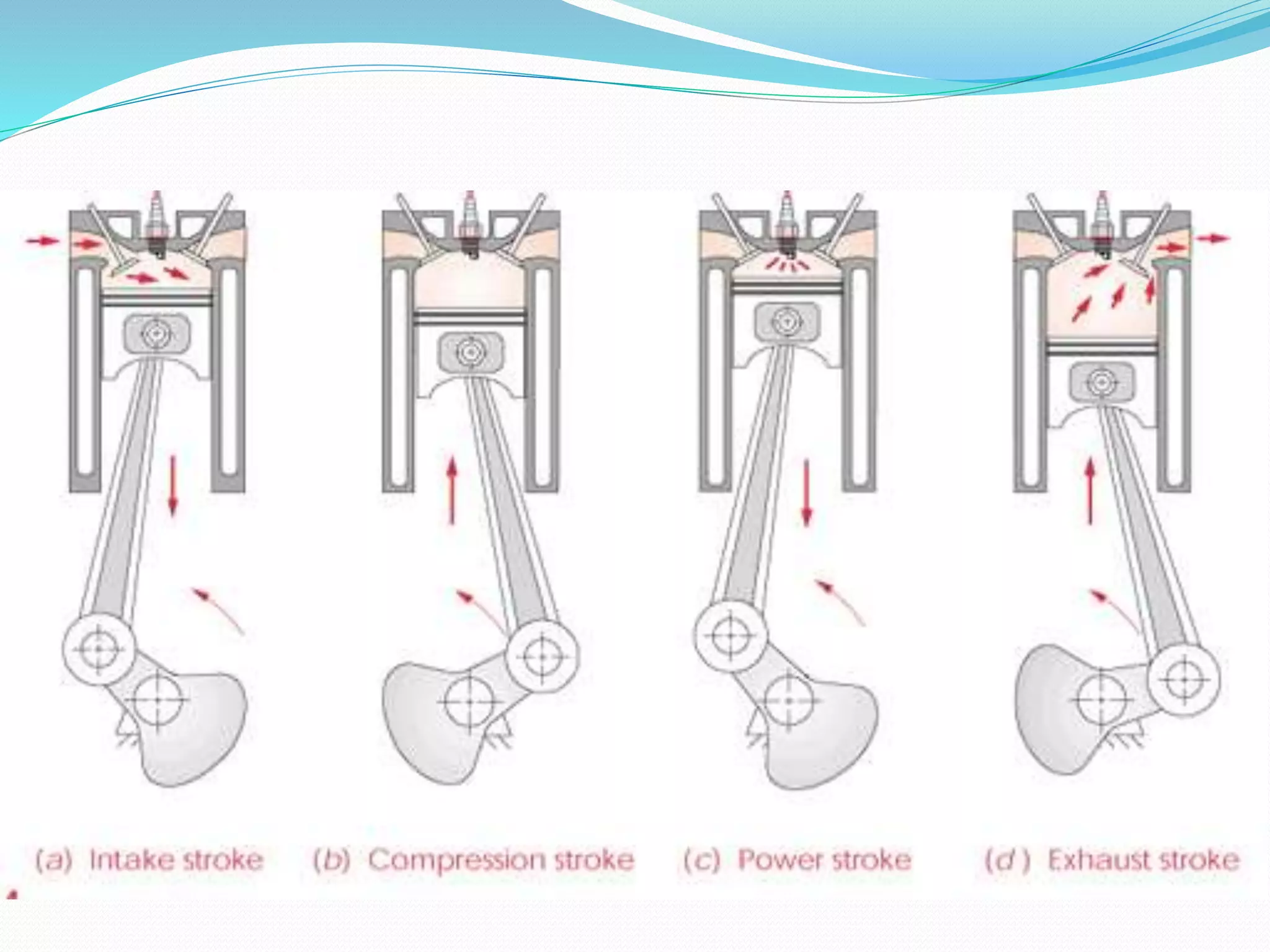
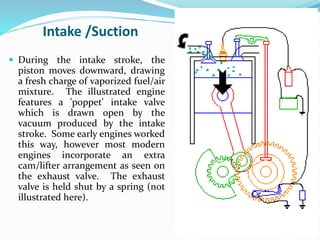
Intake /Suction 
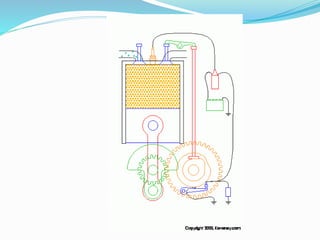
 During the intake stroke, the 
piston moves downward, drawing 
a fresh charge of vaporized fuel/air 
mixture. The illustrated engine 
features a 'poppet' intake valve 
which is drawn open by the 
vacuum produced by the intake 
stroke. Some early engines worked 
this way, however most modern 
engines incorporate an extra 
cam/lifter arrangement as seen on 
the exhaust valve. The exhaust 
valve is held shut by a spring (not 
illustrated here).
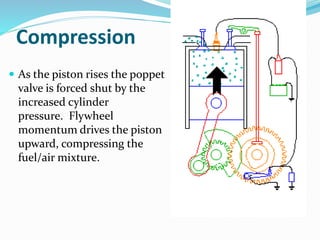
Compression 
 As the piston rises the poppet 
valve is forced shut by the 
increased cylinder 
pressure. Flywheel 
momentum drives the piston 
upward, compressing the 
fuel/air mixture.
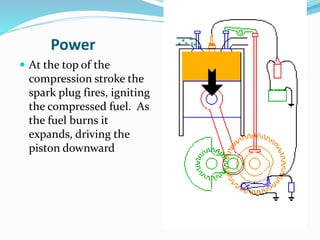
Power 
 At the top of the 
compression stroke the 
spark plug fires, igniting 
the compressed fuel. As 
the fuel burns it 
expands, driving the 
piston downward
Exhaust 
 At the bottom of the 
power stroke, the 
exhaust valve is opened 
by the cam/lifter 
mechanism. The 
upward stroke of the 
piston drives the 
exhausted fuel out of the 
cylinder.
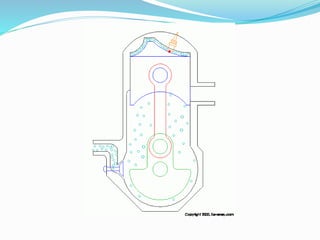
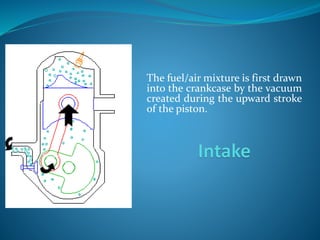
The fuel/air mixture is first drawn 
into the crankcase by the vacuum 
created during the upward stroke 
of the piston.
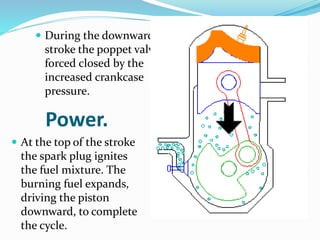
 During the downward 
stroke the poppet valve is 
forced closed by the 
increased crankcase 
pressure. 
Power. 
 At the top of the stroke 
the spark plug ignites 
the fuel mixture. The 
burning fuel expands, 
driving the piston 
downward, to complete 
the cycle.
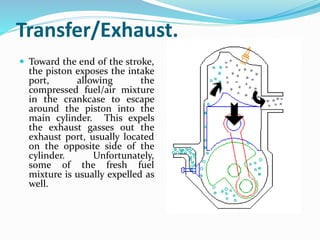
Transfer/Exhaust. 
 Toward the end of the stroke, 
the piston exposes the intake 
port, allowing the 
compressed fuel/air mixture 
in the crankcase to escape 
around the piston into the 
main cylinder. This expels 
the exhaust gasses out the 
exhaust port, usually located 
on the opposite side of the 
cylinder. Unfortunately, 
some of the fresh fuel 
mixture is usually expelled as 
well.
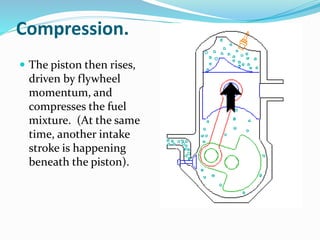
Compression. 
 The piston then rises, 
driven by flywheel 
momentum, and 
compresses the fuel 
mixture. (At the same 
time, another intake 
stroke is happening 
beneath the piston).
 Since the two stroke engine fires on every revolution of 
the crankshaft, a two stroke engine is usually more 
powerful than a four stroke engine of equivalent size. 
 This, coupled with their lighter, simpler construction, 
makes two stroke engines popular in chainsaws, line 
trimmers, outboard motors, snowmobiles, jet-skis, 
light motorcycles, and modelairplanes. 
 Unfortunately most two stroke engines are inefficient 
and are polluters due to the amount of unspent fuel 
that escapes through the exhaust port.
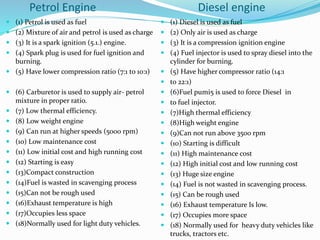
Petrol Engine Diesel engine 
 (1) Petrol is used as fuel 
 (2) Mixture of air and petrol is used as charge 
 (3) It is a spark ignition (5.1.) engine. 
 (4) Spark plug is used for fuel ignition and 
burning. 
 (5) Have lower compression ratio (7:1 to 10:1) 
 (6) Carburetor is used to supply air- petrol 
mixture in proper ratio. 
 (7) Low thermal efficiency. 
 (8) Low weight engine 
 (9) Can run at higher speeds (5000 rpm) 
 (10) Low maintenance cost 
 (11) Low initial cost and high running cost 
 (12) Starting is easy 
 (13)Compact construction 
 (14)Fuel is wasted in scavenging process 
 (15)Can not be rough used 
 (16)Exhaust temperature is high 
 (17)Occupies less space 
 (18)Normally used for light duty vehicles. 
 (1) Diesel is used as fuel 
 (2) Only air is used as charge 
 (3) It is a compression ignition engine 
 (4) Fuel injector is used to spray diesel into the 
cylinder for burning. 
 (5) Have higher compressor ratio (14:1 
 to 22:1) 
 (6)Fuel pumi5 is used to force Diesel in 
 to fuel injector. 
 (7)High thermal efficiency 
 (8)High weight engine 
 (9)Can not run above 3500 rpm 
 (10) Starting is difficult 
 (11) High maintenance cost 
 (12) High initial cost and low running cost 
 (13) Huge size engine 
 (14) Fuel is not wasted in scavenging process. 
 (15) Can be rough used 
 (16) Exhaust temperature Is low. 
 (17) Occupies more space 
 (18) Normally used for heavy duty vehicles like 
trucks, tractors etc.
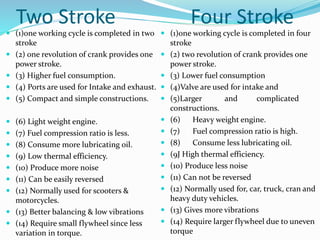
Two Stroke Four Stroke 
 (1)one working cycle is completed in two 
stroke 
 (2) one revolution of crank provides one 
power stroke. 
 (3) Higher fuel consumption. 
 (4) Ports are used for Intake and exhaust. 
 (5) Compact and simple constructions. 
 (6) Light weight engine. 
 (7) Fuel compression ratio is less. 
 (8) Consume more lubricating oil. 
 (9) Low thermal efficiency. 
 (10) Produce more noise 
 (11) Can be easily reversed 
 (12) Normally used for scooters & 
motorcycles. 
 (13) Better balancing & low vibrations 
 (14) Require small flywheel since less 
variation in torque. 
 (1)one working cycle is completed in four 
stroke 
 (2) two revolution of crank provides one 
power stroke. 
 (3) Lower fuel consumption 
 (4)Valve are used for intake and 
 (5)Larger and complicated 
constructions. 
 (6) Heavy weight engine. 
 (7) Fuel compression ratio is high. 
 (8) Consume less lubricating oil. 
 (9J High thermal efficiency. 
 (10) Produce less noise 
 (11) Can not be reversed 
 (12) Normally used for, car, truck, cran and 
heavy duty vehicles. 
 (13) Gives more vibrations 
 (14) Require larger flywheel due to uneven 
torque

2 stroke & 4 stroke engine

  • 2.
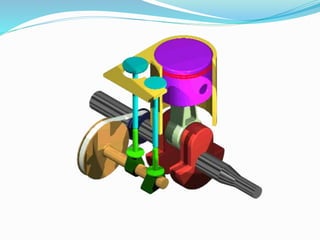
    Intake /Suction During the intake stroke, the piston moves downward, drawing a fresh charge of vaporized fuel/air mixture. The illustrated engine features a 'poppet' intake valve which is drawn open by the vacuum produced by the intake stroke. Some early engines worked this way, however most modern engines incorporate an extra cam/lifter arrangement as seen on the exhaust valve. The exhaust valve is held shut by a spring (not illustrated here).
  • 3.
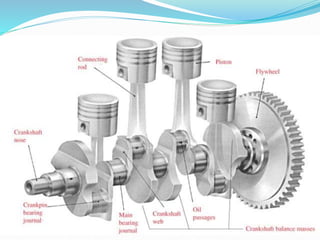
    Compression  Asthe piston rises the poppet valve is forced shut by the increased cylinder pressure. Flywheel momentum drives the piston upward, compressing the fuel/air mixture.
  • 4.
    Power  Atthe top of the compression stroke the spark plug fires, igniting the compressed fuel. As the fuel burns it expands, driving the piston downward
  • 5.
    Exhaust  Atthe bottom of the power stroke, the exhaust valve is opened by the cam/lifter mechanism. The upward stroke of the piston drives the exhausted fuel out of the cylinder.
  • 11.
    The fuel/air mixtureis first drawn into the crankcase by the vacuum created during the upward stroke of the piston.
  • 12.
     During thedownward stroke the poppet valve is forced closed by the increased crankcase pressure. Power.  At the top of the stroke the spark plug ignites the fuel mixture. The burning fuel expands, driving the piston downward, to complete the cycle.
  • 13.
    Transfer/Exhaust.  Towardthe end of the stroke, the piston exposes the intake port, allowing the compressed fuel/air mixture in the crankcase to escape around the piston into the main cylinder. This expels the exhaust gasses out the exhaust port, usually located on the opposite side of the cylinder. Unfortunately, some of the fresh fuel mixture is usually expelled as well.
  • 14.
    Compression.  Thepiston then rises, driven by flywheel momentum, and compresses the fuel mixture. (At the same time, another intake stroke is happening beneath the piston).
  • 15.
     Since thetwo stroke engine fires on every revolution of the crankshaft, a two stroke engine is usually more powerful than a four stroke engine of equivalent size.  This, coupled with their lighter, simpler construction, makes two stroke engines popular in chainsaws, line trimmers, outboard motors, snowmobiles, jet-skis, light motorcycles, and modelairplanes.  Unfortunately most two stroke engines are inefficient and are polluters due to the amount of unspent fuel that escapes through the exhaust port.
  • 16.
    Petrol Engine Dieselengine  (1) Petrol is used as fuel  (2) Mixture of air and petrol is used as charge  (3) It is a spark ignition (5.1.) engine.  (4) Spark plug is used for fuel ignition and burning.  (5) Have lower compression ratio (7:1 to 10:1)  (6) Carburetor is used to supply air- petrol mixture in proper ratio.  (7) Low thermal efficiency.  (8) Low weight engine  (9) Can run at higher speeds (5000 rpm)  (10) Low maintenance cost  (11) Low initial cost and high running cost  (12) Starting is easy  (13)Compact construction  (14)Fuel is wasted in scavenging process  (15)Can not be rough used  (16)Exhaust temperature is high  (17)Occupies less space  (18)Normally used for light duty vehicles.  (1) Diesel is used as fuel  (2) Only air is used as charge  (3) It is a compression ignition engine  (4) Fuel injector is used to spray diesel into the cylinder for burning.  (5) Have higher compressor ratio (14:1  to 22:1)  (6)Fuel pumi5 is used to force Diesel in  to fuel injector.  (7)High thermal efficiency  (8)High weight engine  (9)Can not run above 3500 rpm  (10) Starting is difficult  (11) High maintenance cost  (12) High initial cost and low running cost  (13) Huge size engine  (14) Fuel is not wasted in scavenging process.  (15) Can be rough used  (16) Exhaust temperature Is low.  (17) Occupies more space  (18) Normally used for heavy duty vehicles like trucks, tractors etc.
  • 17.
    Two Stroke FourStroke  (1)one working cycle is completed in two stroke  (2) one revolution of crank provides one power stroke.  (3) Higher fuel consumption.  (4) Ports are used for Intake and exhaust.  (5) Compact and simple constructions.  (6) Light weight engine.  (7) Fuel compression ratio is less.  (8) Consume more lubricating oil.  (9) Low thermal efficiency.  (10) Produce more noise  (11) Can be easily reversed  (12) Normally used for scooters & motorcycles.  (13) Better balancing & low vibrations  (14) Require small flywheel since less variation in torque.  (1)one working cycle is completed in four stroke  (2) two revolution of crank provides one power stroke.  (3) Lower fuel consumption  (4)Valve are used for intake and  (5)Larger and complicated constructions.  (6) Heavy weight engine.  (7) Fuel compression ratio is high.  (8) Consume less lubricating oil.  (9J High thermal efficiency.  (10) Produce less noise  (11) Can not be reversed  (12) Normally used for, car, truck, cran and heavy duty vehicles.  (13) Gives more vibrations  (14) Require larger flywheel due to uneven torque