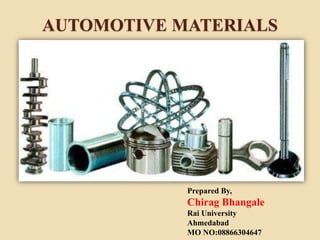
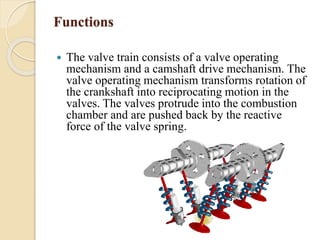
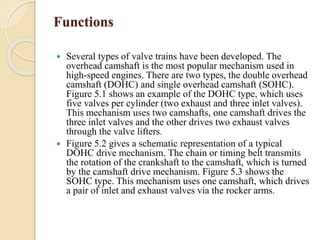
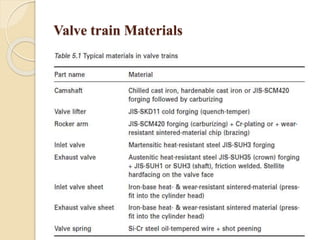
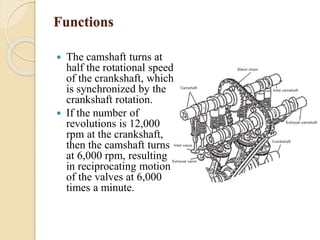
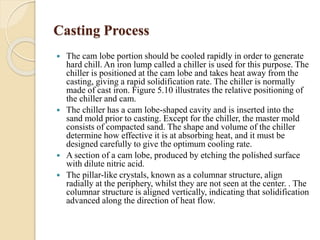
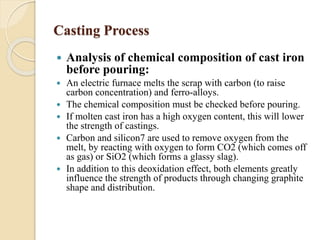
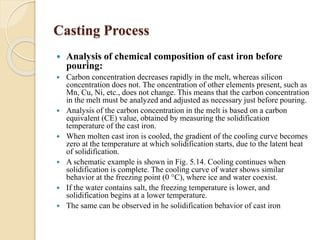
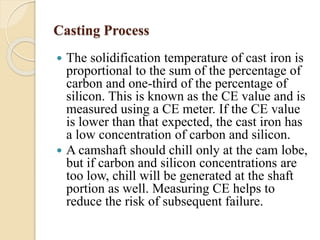
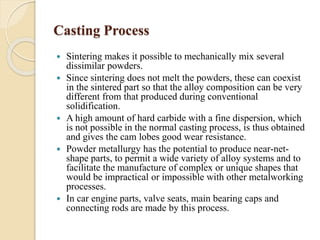
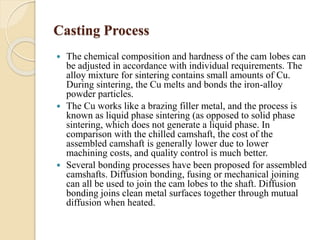
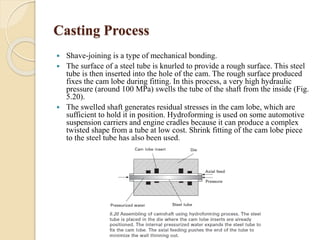
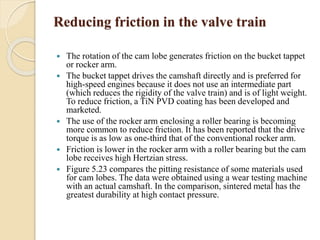
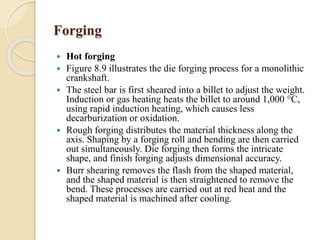
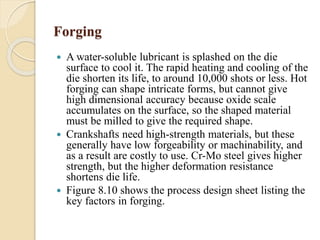
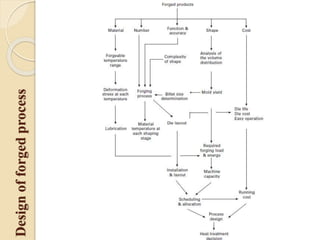
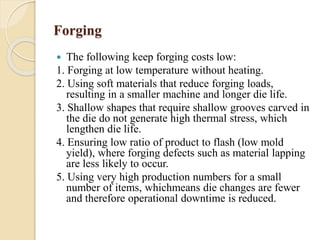
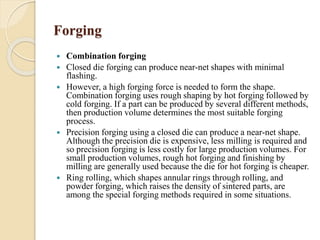
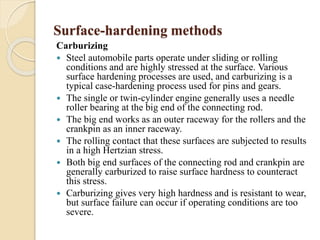
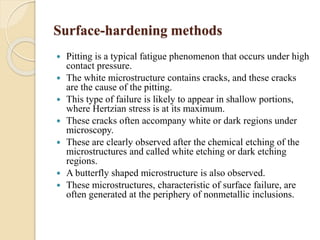
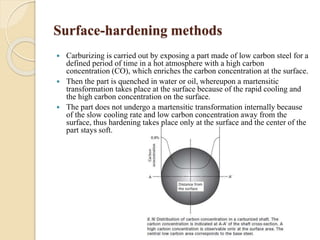
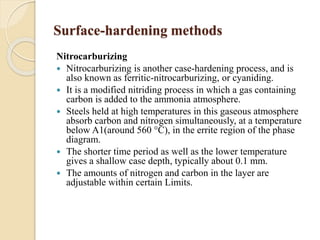
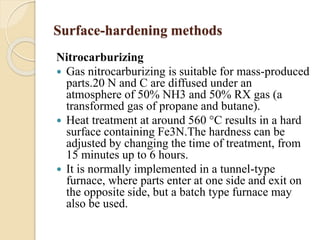
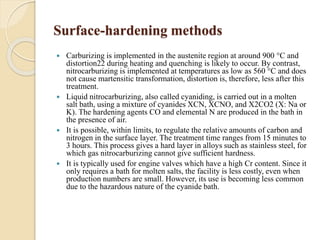
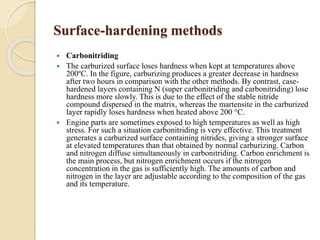
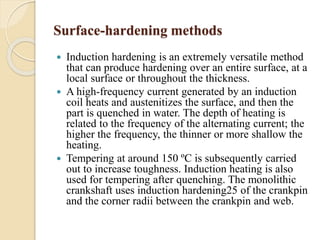
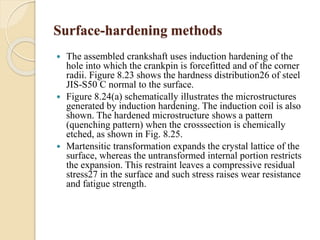
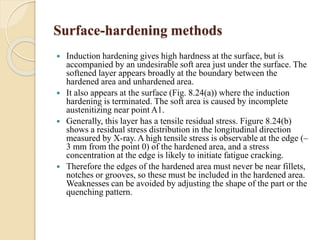
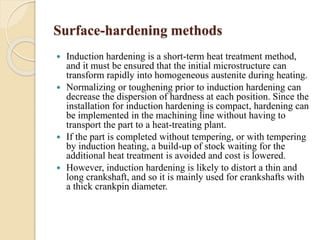
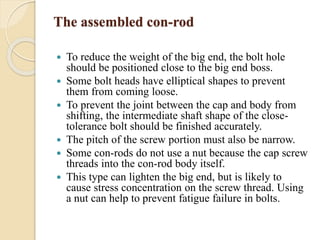
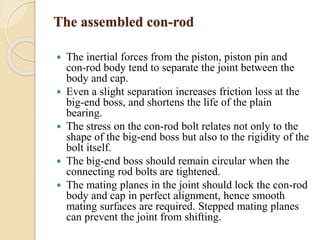
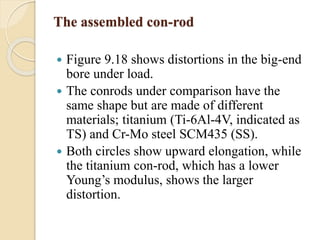
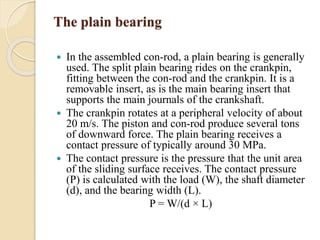
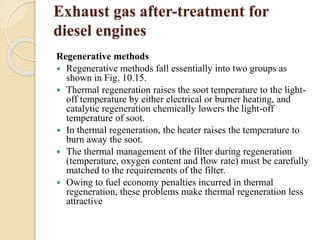
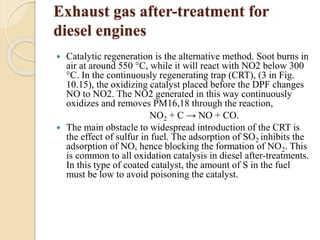
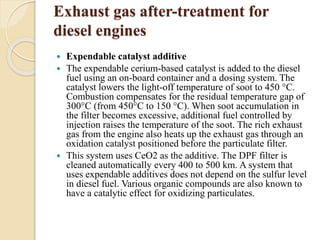
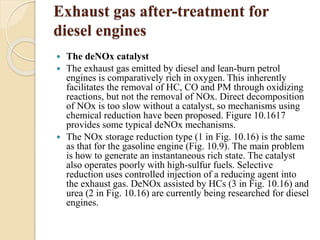
AUTOMOTIVE MATERIALS 
Prepared By, 
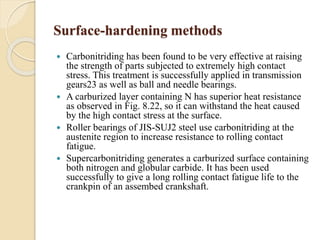
Chirag Bhangale 
Rai University 
Ahmedabad 
MO NO:08866304647
Syllabus 
1. Engines 
2. The cylinder 
3. The piston & piston ring 
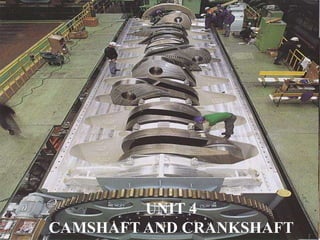
4. The camshaft & crankshaft 
5. The connecting rod 
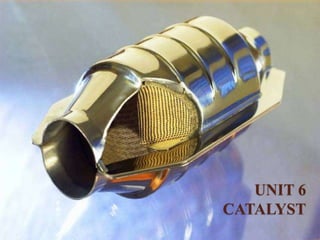
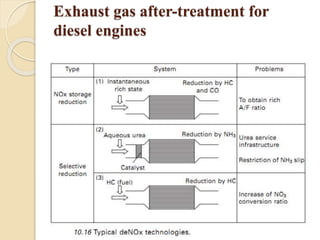
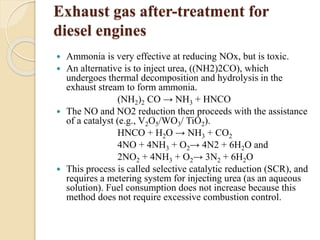
6. The catalyst
Contents 
 The reciprocating engine 
 Advantages and disadvantages of 
reciprocating engines 
 Engine components and typical materials 
 Recent trends in engine technology
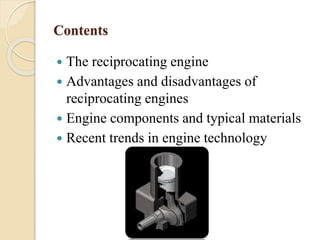
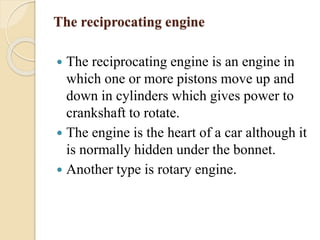
The reciprocating engine 
 The reciprocating engine is an engine in 
which one or more pistons move up and 
down in cylinders which gives power to 
crankshaft to rotate. 
 The engine is the heart of a car although it 
is normally hidden under the bonnet. 
 Another type is rotary engine.
Principal of Reciprocating Engine 
If you put a tiny amount of high energy fuel 
like gasoline in a small enclosed space and 
ignite it so, we can see incredible amount of 
energy is released in the form of expanding 
gas.
Basics of Reciprocating Engines 
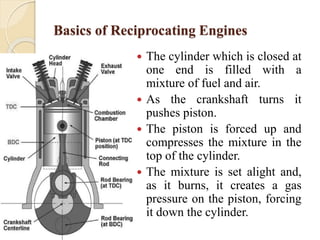
 The cylinder which is closed at 
one end is filled with a 
mixture of fuel and air. 
 As the crankshaft turns it 
pushes piston. 
 The piston is forced up and 
compresses the mixture in the 
top of the cylinder. 
 The mixture is set alight and, 
as it burns, it creates a gas 
pressure on the piston, forcing 
it down the cylinder.
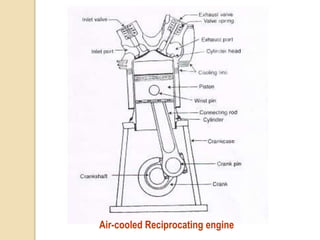
Air-cooled Reciprocating engine
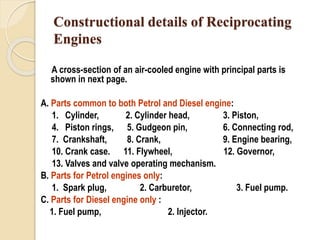
Constructional details of Reciprocating 
Engines 
A cross-section of an air-cooled engine with principal parts is 
shown in next page. 
A. Parts common to both Petrol and Diesel engine: 
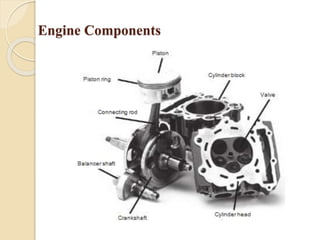
1. Cylinder, 2. Cylinder head, 3. Piston, 
4. Piston rings, 5. Gudgeon pin, 6. Connecting rod, 
7. Crankshaft, 8. Crank, 9. Engine bearing, 
10. Crank case. 11. Flywheel, 12. Governor, 
13. Valves and valve operating mechanism. 
B. Parts for Petrol engines only: 
1. Spark plug, 2. Carburetor, 3. Fuel pump. 
C. Parts for Diesel engine only : 
1. Fuel pump, 2. Injector.
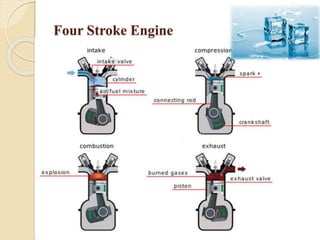
Four Stroke Engine
Working of Four Stroke Engines 
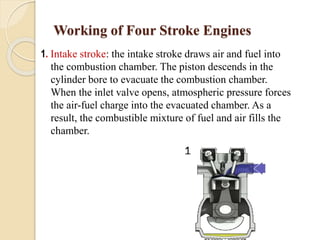
1. Intake stroke: the intake stroke draws air and fuel into 
the combustion chamber. The piston descends in the 
cylinder bore to evacuate the combustion chamber. 
When the inlet valve opens, atmospheric pressure forces 
the air-fuel charge into the evacuated chamber. As a 
result, the combustible mixture of fuel and air fills the 
chamber.
Working of Four Stroke Engines 
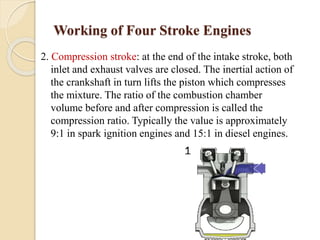
2. Compression stroke: at the end of the intake stroke, both 
inlet and exhaust valves are closed. The inertial action of 
the crankshaft in turn lifts the piston which compresses 
the mixture. The ratio of the combustion chamber 
volume before and after compression is called the 
compression ratio. Typically the value is approximately 
9:1 in spark ignition engines and 15:1 in diesel engines.
Working of Four Stroke Engines 
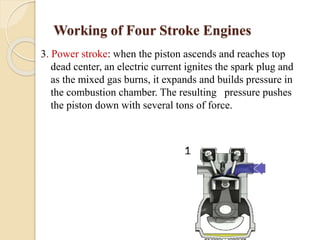
3. Power stroke: when the piston ascends and reaches top 
dead center, an electric current ignites the spark plug and 
as the mixed gas burns, it expands and builds pressure in 
the combustion chamber. The resulting pressure pushes 
the piston down with several tons of force.
Working of Four Stroke Engines 
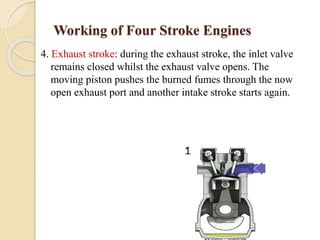
4. Exhaust stroke: during the exhaust stroke, the inlet valve 
remains closed whilst the exhaust valve opens. The 
moving piston pushes the burned fumes through the now 
open exhaust port and another intake stroke starts again.
Salient Features About Engines 
 During one cycle, the piston makes two round trips and 
the crankshaft revolves twice. 
 The inlet and exhaust valves open and close only once. 
 The ignition plug also sparks only once. 
 A petrol engine, whether four- or two-stroke, is called a 
spark ignition (SI) engine because it fires with an 
ignition plug. 
 The four-stroke-cycle engine contains the lubricating oil 
in the crankcase. 
 The oil lubricates the crankshaft bearings and cools the 
hot piston
Two-stroke Engines 
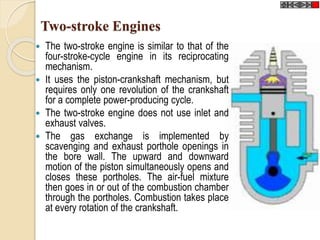
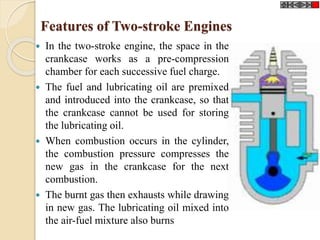
 The two-stroke engine is similar to that of the 
four-stroke-cycle engine in its reciprocating 
mechanism. 
 It uses the piston-crankshaft mechanism, but 
requires only one revolution of the crankshaft 
for a complete power-producing cycle. 
 The two-stroke engine does not use inlet and 
exhaust valves. 
 The gas exchange is implemented by 
scavenging and exhaust porthole openings in 
the bore wall. The upward and downward 
motion of the piston simultaneously opens and 
closes these portholes. The air-fuel mixture 
then goes in or out of the combustion chamber 
through the portholes. Combustion takes place 
at every rotation of the crankshaft.
Working of Two-stroke Engines 
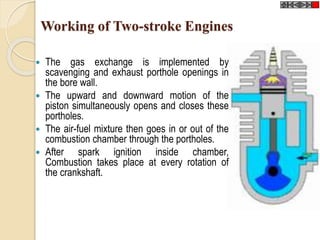
 The gas exchange is implemented by 
scavenging and exhaust porthole openings in 
the bore wall. 
 The upward and downward motion of the 
piston simultaneously opens and closes these 
portholes. 
 The air-fuel mixture then goes in or out of the 
combustion chamber through the portholes. 
 After spark ignition inside chamber, 
Combustion takes place at every rotation of 
the crankshaft.
Features of Two-stroke Engines 
 In the two-stroke engine, the space in the 
crankcase works as a pre-compression 
chamber for each successive fuel charge. 
 The fuel and lubricating oil are premixed 
and introduced into the crankcase, so that 
the crankcase cannot be used for storing 
the lubricating oil. 
 When combustion occurs in the cylinder, 
the combustion pressure compresses the 
new gas in the crankcase for the next 
combustion. 
 The burnt gas then exhausts while drawing 
in new gas. The lubricating oil mixed into 
the air-fuel mixture also burns
Diesel Engine 
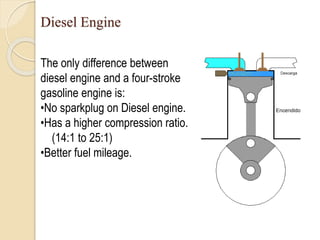
The only difference between 
diesel engine and a four-stroke 
gasoline engine is: 
•No sparkplug on Diesel engine. 
•Has a higher compression ratio. 
(14:1 to 25:1) 
•Better fuel mileage.
Diesel Engine 
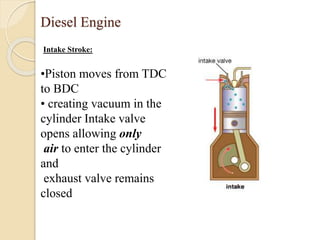
Intake Stroke: 
•Piston moves from TDC 
to BDC 
• creating vacuum in the 
cylinder Intake valve 
opens allowing only 
air to enter the cylinder 
and 
exhaust valve remains 
closed
Diesel Engine 
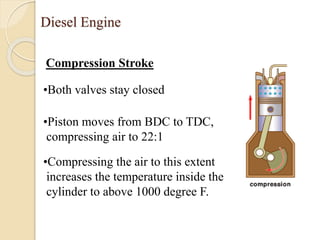
Compression Stroke 
•Both valves stay closed 
•Piston moves from BDC to TDC, 
compressing air to 22:1 
•Compressing the air to this extent 
increases the temperature inside the 
cylinder to above 1000 degree F.
Diesel Engine 
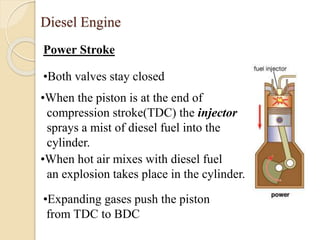
Power Stroke 
•Both valves stay closed 
•When the piston is at the end of 
compression stroke(TDC) the injector 
sprays a mist of diesel fuel into the 
cylinder. 
•When hot air mixes with diesel fuel 
an explosion takes place in the cylinder. 
•Expanding gases push the piston 
from TDC to BDC
Diesel Engine 
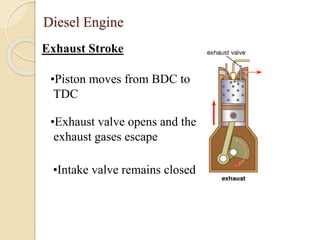
Exhaust Stroke 
•Piston moves from BDC to 
TDC 
•Exhaust valve opens and the 
exhaust gases escape 
•Intake valve remains closed
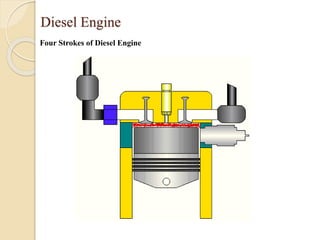
Diesel Engine 
Four Strokes of Diesel Engine
Advantages of Reciprocating Engine 
 The piston loses speed at the dead-center points where the 
travelling direction reverses, which gives enough time for 
combustion and intake as well as for exhaust. 
 The piston ring faces the cylinder bore wall, separated by 
an oil film. The resulting lubrication generates low friction 
and high durability. 
 By sealing the gap between the piston and the cylinder, 
high compression ratio, high heat efficiency and low fuel 
consumption can be achieved. 
Disadvantages of Reciprocating Engine 
• It is difficult to reuse the exhaust heat. 
• The unbalanced inertial force may results in piston ‘slap’ 
that can cause noise and vibration.
Engine Components
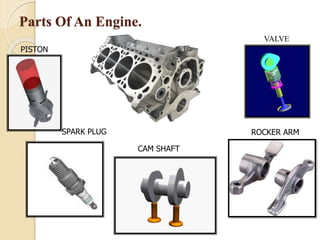
Parts Of An Engine. 
PISTON 
SPARK PLUG 
CAM SHAFT 
VALVE 
ROCKER ARM
Components and its work 
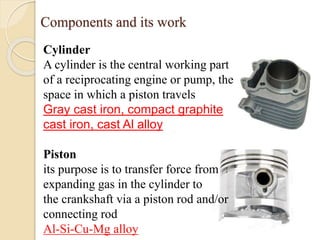
Cylinder 
A cylinder is the central working part 
of a reciprocating engine or pump, the 
space in which a piston travels 
Gray cast iron, compact graphite 
cast iron, cast Al alloy 
Piston 
its purpose is to transfer force from 
expanding gas in the cylinder to 
the crankshaft via a piston rod and/or 
connecting rod 
Al-Si-Cu-Mg alloy
Components and its work 
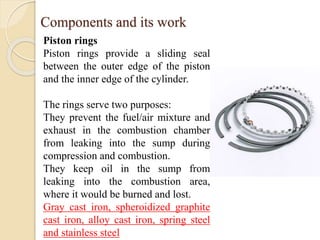
Piston rings 
Piston rings provide a sliding seal 
between the outer edge of the piston 
and the inner edge of the cylinder. 
The rings serve two purposes: 
They prevent the fuel/air mixture and 
exhaust in the combustion chamber 
from leaking into the sump during 
compression and combustion. 
They keep oil in the sump from 
leaking into the combustion area, 
where it would be burned and lost. 
Gray cast iron, spheroidized graphite 
cast iron, alloy cast iron, spring steel 
and stainless steel
Components and its work 
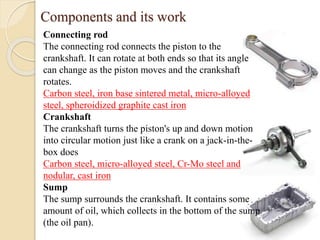
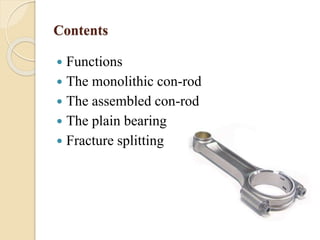
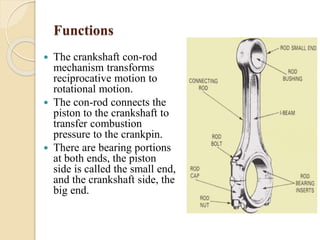
Connecting rod 
The connecting rod connects the piston to the 
crankshaft. It can rotate at both ends so that its angle 
can change as the piston moves and the crankshaft 
rotates. 
Carbon steel, iron base sintered metal, micro-alloyed 
steel, spheroidized graphite cast iron 
Crankshaft 
The crankshaft turns the piston's up and down motion 
into circular motion just like a crank on a jack-in-the-box 
does 
Carbon steel, micro-alloyed steel, Cr-Mo steel and 
nodular, cast iron 
Sump 
The sump surrounds the crankshaft. It contains some 
amount of oil, which collects in the bottom of the sump 
(the oil pan).
Components and its work 
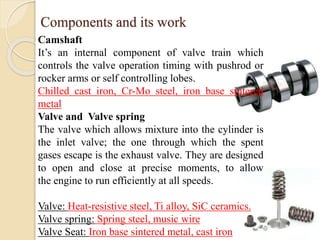
Camshaft 
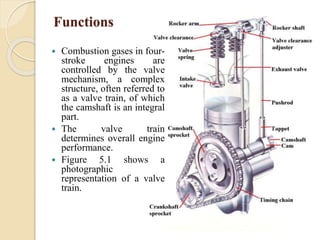
It’s an internal component of valve train which 
controls the valve operation timing with pushrod or 
rocker arms or self controlling lobes. 
Chilled cast iron, Cr-Mo steel, iron base sintered 
metal 
Valve and Valve spring 
The valve which allows mixture into the cylinder is 
the inlet valve; the one through which the spent 
gases escape is the exhaust valve. They are designed 
to open and close at precise moments, to allow 
the engine to run efficiently at all speeds. 
Valve: Heat-resistive steel, Ti alloy, SiC ceramics. 
Valve spring: Spring steel, music wire 
Valve Seat: Iron base sintered metal, cast iron
Components and its work 
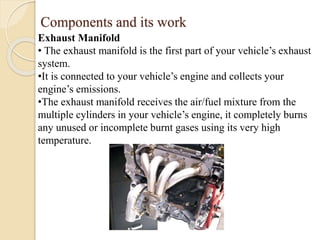
Exhaust Manifold 
• The exhaust manifold is the first part of your vehicle’s exhaust 
system. 
•It is connected to your vehicle’s engine and collects your 
engine’s emissions. 
•The exhaust manifold receives the air/fuel mixture from the 
multiple cylinders in your vehicle’s engine, it completely burns 
any unused or incomplete burnt gases using its very high 
temperature.
Components and its work 
Exhaust Manifold 
•The manifold also houses the first 
oxygen sensor in your exhaust 
system to inspect the amount of 
oxygen entering the system. 
•Once the amount of gas in one 
place completely burnt, the manifold 
sends the emissions into the rest of 
the exhaust system. 
High-Si cast iron, niresist cast iron, 
cast stainless steel,stainless steel 
tube and sheet
Components and its work 
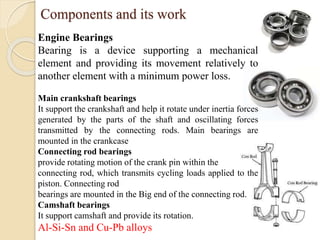
Engine Bearings 
Bearing is a device supporting a mechanical 
element and providing its movement relatively to 
another element with a minimum power loss. 
Main crankshaft bearings 
It support the crankshaft and help it rotate under inertia forces 
generated by the parts of the shaft and oscillating forces 
transmitted by the connecting rods. Main bearings are 
mounted in the crankcase 
Connecting rod bearings 
provide rotating motion of the crank pin within the 
connecting rod, which transmits cycling loads applied to the 
piston. Connecting rod 
bearings are mounted in the Big end of the connecting rod. 
Camshaft bearings 
It support camshaft and provide its rotation. 
Al-Si-Sn and Cu-Pb alloys
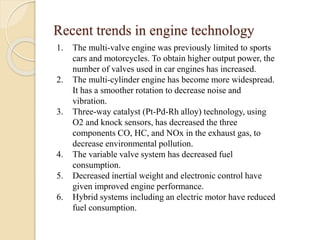
Recent trends in engine technology 
1. The multi-valve engine was previously limited to sports 
cars and motorcycles. To obtain higher output power, the 
number of valves used in car engines has increased. 
2. The multi-cylinder engine has become more widespread. 
It has a smoother rotation to decrease noise and 
vibration. 
3. Three-way catalyst (Pt-Pd-Rh alloy) technology, using 
O2 and knock sensors, has decreased the three 
components CO, HC, and NOx in the exhaust gas, to 
decrease environmental pollution. 
4. The variable valve system has decreased fuel 
consumption. 
5. Decreased inertial weight and electronic control have 
given improved engine performance. 
6. Hybrid systems including an electric motor have reduced 
fuel consumption.
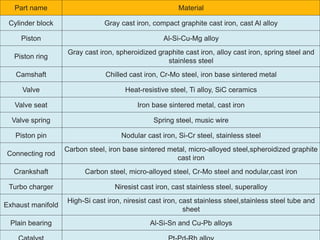
Part name Material 
Cylinder block Gray cast iron, compact graphite cast iron, cast Al alloy 
Piston Al-Si-Cu-Mg alloy 
Piston ring 
Gray cast iron, spheroidized graphite cast iron, alloy cast iron, spring steel and 
stainless steel 
Camshaft Chilled cast iron, Cr-Mo steel, iron base sintered metal 
Valve Heat-resistive steel, Ti alloy, SiC ceramics 
Valve seat Iron base sintered metal, cast iron 
Valve spring Spring steel, music wire 
Piston pin Nodular cast iron, Si-Cr steel, stainless steel 
Connecting rod 
Carbon steel, iron base sintered metal, micro-alloyed steel,spheroidized graphite 
cast iron 
Crankshaft Carbon steel, micro-alloyed steel, Cr-Mo steel and nodular,cast iron 
Turbo charger Niresist cast iron, cast stainless steel, superalloy 
Exhaust manifold 
High-Si cast iron, niresist cast iron, cast stainless steel,stainless steel tube and 
sheet 
Plain bearing Al-Si-Sn and Cu-Pb alloys 
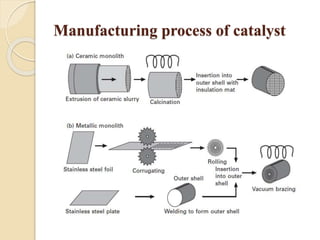
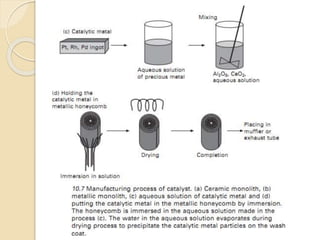
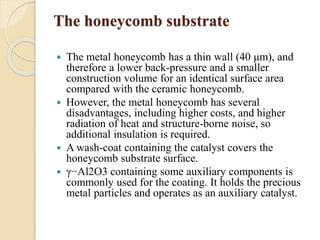
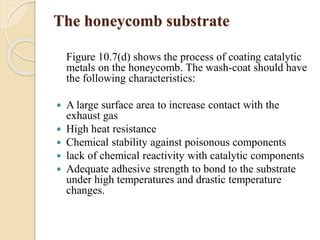
Catalyst Pt-Pd-Rh alloy
Contents 
 Structures and functions 
 The cast iron monolithic block 
 The compact graphite iron monolithic 
block 
 Thermal distortion and heat discharge 
 Casting technologies for aluminum 
cylinder blocks
Function 
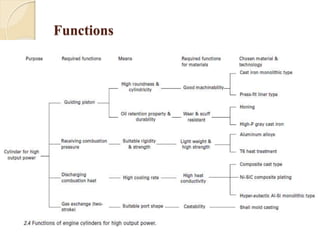
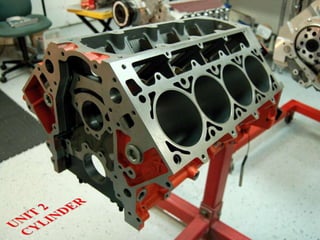
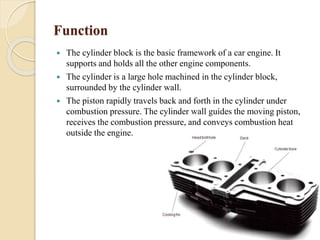
 The cylinder block is the basic framework of a car engine. It 
supports and holds all the other engine components. 
 The cylinder is a large hole machined in the cylinder block, 
surrounded by the cylinder wall. 
 The piston rapidly travels back and forth in the cylinder under 
combustion pressure. The cylinder wall guides the moving piston, 
receives the combustion pressure, and conveys combustion heat 
outside the engine.
Structure 
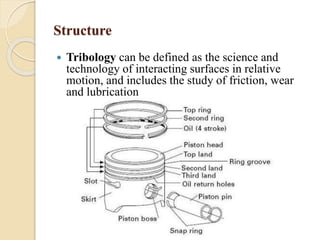
 Tribology can be defined as the science and 
technology of interacting surfaces in relative 
motion, and includes the study of friction, wear 
and lubrication
Structure 
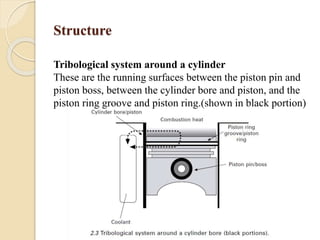
Tribological system around a cylinder 
These are the running surfaces between the piston pin and 
piston boss, between the cylinder bore and piston, and the 
piston ring groove and piston ring.(shown in black portion)
Structure 
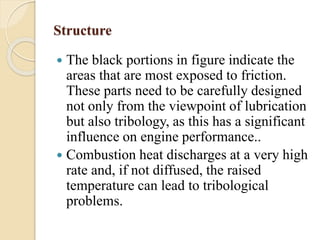
 The black portions in figure indicate the 
areas that are most exposed to friction. 
These parts need to be carefully designed 
not only from the viewpoint of lubrication 
but also tribology, as this has a significant 
influence on engine performance.. 
 Combustion heat discharges at a very high 
rate and, if not diffused, the raised 
temperature can lead to tribological 
problems.
Structure 
 The cylinder must maintain an accurate roundness 
and straightness of the order of μm during 
operation. 
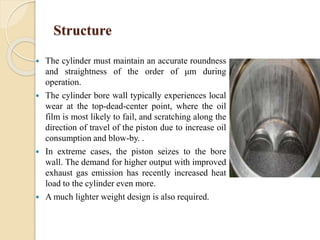
 The cylinder bore wall typically experiences local 
wear at the top-dead-center point, where the oil 
film is most likely to fail, and scratching along the 
direction of travel of the piston due to increase oil 
consumption and blow-by. . 
 In extreme cases, the piston seizes to the bore 
wall. The demand for higher output with improved 
exhaust gas emission has recently increased heat 
load to the cylinder even more. 
 Amuch lighter weight design is also required.
Structure 
 An engine generating high power output 
requires more cooling, since it generates 
more heat. 
 Automotive engines have two types of 
cooling systems, 
◦ air-cooled 
◦ water-cooled. 
 As the heat management of the cylinder 
block is not as easy, most automotive engines 
nowadays use water-cooled systems. 
 The required cooling level for an individual 
engine determines its cylinder structure.
Structure
Structure 
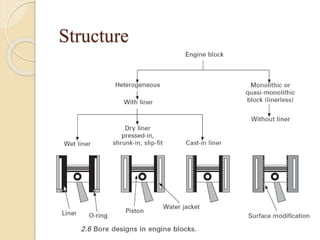
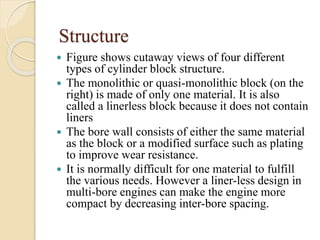
 Figure shows cutaway views of four different 
types of cylinder block structure. 
 The monolithic or quasi-monolithic block (on the 
right) is made of only one material. It is also 
called a linerless block because it does not contain 
liners 
 The bore wall consists of either the same material 
as the block or a modified surface such as plating 
to improve wear resistance. 
 It is normally difficult for one material to fulfill 
the various needs. However a liner-less design in 
multi-bore engines can make the engine more 
compact by decreasing inter-bore spacing.
Cylinder liners 
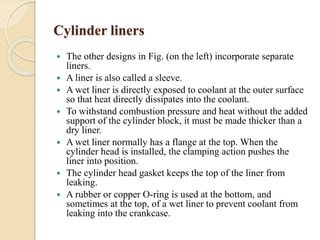
 The other designs in Fig. (on the left) incorporate separate 
liners. 
 A liner is also called a sleeve. 
 A wet liner is directly exposed to coolant at the outer surface 
so that heat directly dissipates into the coolant. 
 To withstand combustion pressure and heat without the added 
support of the cylinder block, it must be made thicker than a 
dry liner. 
 A wet liner normally has a flange at the top. When the 
cylinder head is installed, the clamping action pushes the 
liner into position. 
 The cylinder head gasket keeps the top of the liner from 
leaking. 
 A rubber or copper O-ring is used at the bottom, and 
sometimes at the top, of a wet liner to prevent coolant from 
leaking into the crankcase.
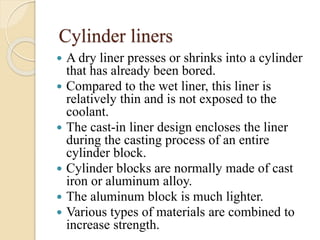
Cylinder liners 
 A dry liner presses or shrinks into a cylinder 
that has already been bored. 
 Compared to the wet liner, this liner is 
relatively thin and is not exposed to the 
coolant. 
 The cast-in liner design encloses the liner 
during the casting process of an entire 
cylinder block. 
 Cylinder blocks are normally made of cast 
iron or aluminum alloy. 
 The aluminum block is much lighter. 
 Various types of materials are combined to 
increase strength.
Functions
The cast iron monolithic block 
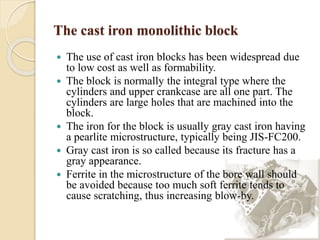
 The use of cast iron blocks has been widespread due 
to low cost as well as formability. 
 The block is normally the integral type where the 
cylinders and upper crankcase are all one part. The 
cylinders are large holes that are machined into the 
block. 
 The iron for the block is usually gray cast iron having 
a pearlite microstructure, typically being JIS-FC200. 
 Gray cast iron is so called because its fracture has a 
gray appearance. 
 Ferrite in the microstructure of the bore wall should 
be avoided because too much soft ferrite tends to 
cause scratching, thus increasing blow-by.
The cast iron monolithic block 
 Cast iron blocks are produced by sand casting. 
 For cast iron, the die casting process using a steel 
die is fairly rare. 
 The lifetime of the steel die is not adequate for 
repeated heat cycles caused by melting iron. As its 
name suggests, sand casting uses a mold that 
consists of sand. 
 The preparation of sand and the bonding are a 
critical and very often rate-controlling step. 
 Permanent patterns are used to make sand molds. 
 Generally, an automated molding machine installs 
the patterns and prepares many molds in the same 
shape.
The cast iron monolithic block 
 Molten metal is poured immediately into the 
mold, giving this process very high 
productivity. 
 After solidification, the mold is destroyed 
and the inner sand is shaken out of the block. 
The sand is then reusable. 
 Two main methods are used for bonding 
sand. 
◦ A green sand mold consists of mixtures of sand, 
clay and moisture. 
◦ A dry sand mold consists of sand and synthetic 
binders cured thermally or chemically.
The cast iron monolithic block 
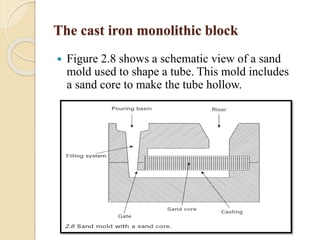
 Figure 2.8 shows a schematic view of a sand 
mold used to shape a tube. This mold includes 
a sand core to make the tube hollow.
The cast iron monolithic block 
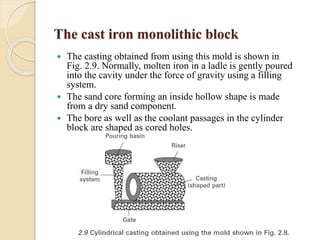
 The casting obtained from using this mold is shown in 
Fig. 2.9. Normally, molten iron in a ladle is gently poured 
into the cavity under the force of gravity using a filling 
system. 
 The sand core forming an inside hollow shape is made 
from a dry sand component. 
 The bore as well as the coolant passages in the cylinder 
block are shaped as cored holes.
Honing, lubrication and oil consumption 
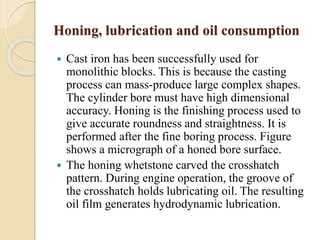
 Cast iron has been successfully used for 
monolithic blocks. This is because the casting 
process can mass-produce large complex shapes. 
The cylinder bore must have high dimensional 
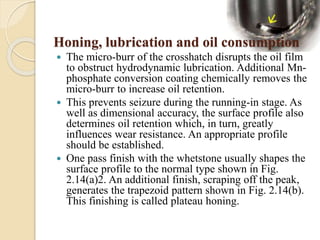
accuracy. Honing is the finishing process used to 
give accurate roundness and straightness. It is 
performed after the fine boring process. Figure 
shows a micrograph of a honed bore surface. 
 The honing whetstone carved the crosshatch 
pattern. During engine operation, the groove of 
the crosshatch holds lubricating oil. The resulting 
oil film generates hydrodynamic lubrication.
Honing, lubrication and oil consumption 
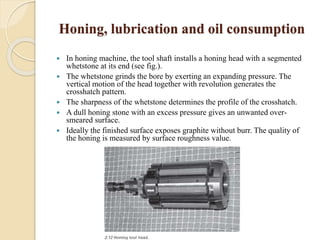
 In honing machine, the tool shaft installs a honing head with a segmented 
whetstone at its end (see fig.). 
 The whetstone grinds the bore by exerting an expanding pressure. The 
vertical motion of the head together with revolution generates the 
crosshatch pattern. 
 The sharpness of the whetstone determines the profile of the crosshatch. 
 A dull honing stone with an excess pressure gives an unwanted over-smeared 
surface. 
 Ideally the finished surface exposes graphite without burr. The quality of 
the honing is measured by surface roughness value.
Honing, lubrication and oil consumption 
 The micro-burr of the crosshatch disrupts the oil film 
to obstruct hydrodynamic lubrication. Additional Mn-phosphate 
conversion coating chemically removes the 
micro-burr to increase oil retention. 
 This prevents seizure during the running-in stage. As 
well as dimensional accuracy, the surface profile also 
determines oil retention which, in turn, greatly 
influences wear resistance. An appropriate profile 
should be established. 
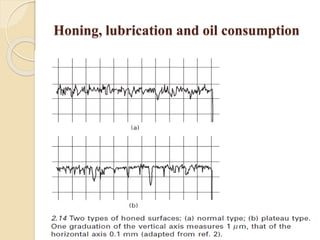
 One pass finish with the whetstone usually shapes the 
surface profile to the normal type shown in Fig. 
2.14(a)2. An additional finish, scraping off the peak, 
generates the trapezoid pattern shown in Fig. 2.14(b). 
This finishing is called plateau honing.
Honing, lubrication and oil consumption
Honing, lubrication and oil consumption 
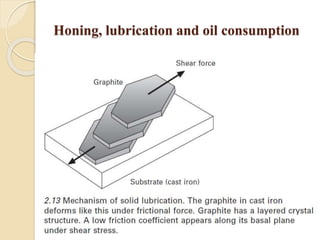
 The graphite in the cast iron block works as a solid lubricant 
during machining as well as in engine operation. A solid 
lubricant gives a low frictional force without hydrodynamic 
lubrication. Graphite, MoS2, WS2, Sn, and Pb are all well 
known as solid lubricants. The low frictional force of graphite 
comes from the fact that the crystal structure has a very low 
frictional coefficient during slip at the basal plane. Figure 
2.13 shows a schematic representation of the mechanism. The 
crystal slides easily along its basal plane even with a low 
shear force. The graphite decreases friction for tools during 
machining. The brittle nature of graphite makes chips 
discontinuous. 
 The resultant high machinability gives high dimensional 
accuracy to cast iron parts. The graphite also works as a solid 
lubricant to prevent seizure of the piston or piston ring even 
under less oily conditions.
Honing, lubrication and oil consumption
The compact graphite iron monolithic 
block 
 There have been trials to improve the strength of gray 
cast iron without losing its superior properties. Petrol 
engines have cylinder pressures ranging from 7 to 12 
MPa, while heavy-duty diesels operate in excess of 20 
MPa. 
 This high pressure generates much higher mechanical 
and thermal stresses on the cylinder block. 
 The use of a cast iron block is widespread because of 
the high strength needed. However, a much stronger 
material is required to enable a lightweight design 
with decreased thickness. 
 For these requirements, a block made of compact 
graphite iron has been proposed.
The compact graphite iron 
monolithic block 
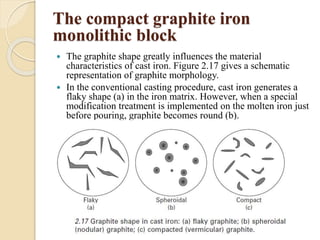
 The graphite shape greatly influences the material 
characteristics of cast iron. Figure 2.17 gives a schematic 
representation of graphite morphology. 
 In the conventional casting procedure, cast iron generates a 
flaky shape (a) in the iron matrix. However, when a special 
modification treatment is implemented on the molten iron just 
before pouring, graphite becomes round (b).
The compact graphite iron 
monolithic block 
 Cast iron having this shape is called 
spheroidal graphite cast iron or nodular cast 
iron. The additive for spheroidizing is called 
a nodularizer. 
 Compared to the flaky shape, this 
geometrical shape can avoid microstructural 
stress concentration to give higher 
mechanical strength and ductility. This is 
also referred to as ductile iron. 
 However, the thermal conductivity and 
resistance to scuffing are not so high.
The compact graphite iron 
monolithic block 
 The third microstructure (c) is compact graphite 
iron (CGI) containing graphite of a vermicular 
(worm-like) form (c). 
 This is a relatively new alloy that has improved 
mechanical strength without diminishing the 
favorable properties of flaky graphite iron. As 
may be inferred from the shape, the properties of 
this iron are positioned between flaky and 
spheroidal iron. 
 It has a higher tensile strength being 1.5 to 2 times 
as strong as flaky iron, higher stiffness and 
approximately double the fatigue strength of flaky 
iron.
The compact graphite iron 
monolithic block 
 The thermal conductivity lies between 
flaky and spheroidal iron. 
 This makes it possible to produce a 
cylinder block that is both thinner and 
stronger. 
 The nodularizer inoculated in the molten 
iron gives perfect spheroidal graphite. 
 An imperfect spheroidizing treatment 
before pouring generates CGI.
The compact graphite iron 
monolithic block 
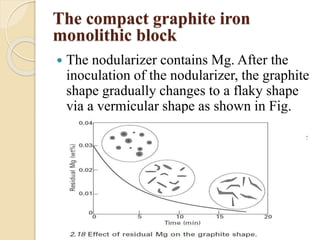
 The nodularizer contains Mg. After the 
inoculation of the nodularizer, the graphite 
shape gradually changes to a flaky shape 
via a vermicular shape as shown in Fig. 
2.18.6 The residual Mg content in the 
molten iron decreases with time due to the 
evaporative nature of Mg. This causes 
degradation of the spheroidal graphite to 
give CGI. An additional explanation is 
given in Chapter 4 and Appendix D.
Thermal distortion and heat discharge 
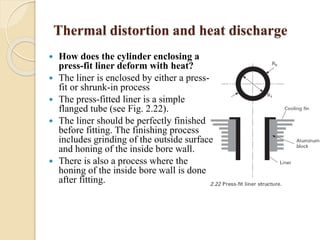
 How does the cylinder enclosing a 
press-fit liner deform with heat? 
 The liner is enclosed by either a press-fit 
or shrunk-in process 
 The press-fitted liner is a simple 
flanged tube (see Fig. 2.22). 
 The liner should be perfectly finished 
before fitting. The finishing process 
includes grinding of the outside surface 
and honing of the inside bore wall. 
 There is also a process where the 
honing of the inside bore wall is done 
after fitting.
Thermal distortion and heat discharge 
 If the liner is inserted into the cylinder body without 
further treatment, it unfastens as a result of the 
thermal expansion of aluminum. The correct design 
enables the bore to retain a perfectly round form when 
the liner elastically expands under the thermal 
expansion of the aluminum body. 
 The external diameter of the liner shrinks from R0 
before fitting to R1 after fitting. 
 The interference (= R0 – R1) should be such that it 
does not cause buckling of the liner but, at the same 
time, provides a sufficient tightening force even at 
elevated temperatures. It is usually around 60 μm for 
a bore diameter of 60 mm.
Thermal distortion and heat discharge 
 The shrunk-in process is also used. It fastens the 
block and liner together by heating the outer block 
until it expands sufficiently to pass over the liner 
diameter and, on cooling, grips it tightly. This 
shrunk-in design is widespread in outboard 
marine engines. 
 Where a cast iron block is used, the liner is 
inserted and held without interference because 
both materials are the same. 
 Unlike the composite cast design, individual liners 
can be replaced once they become worn. Hence, 
replacing the entire block is avoided.
Thermal distortion and heat discharge 
 Powder metallurgical aluminum liner improves 
heat transfer 
 In a composite cast cylinder, the heat transfer through 
a cast iron liner is not that good. A thick liner reduces 
heat conduction, raising the bore wall temperature. 
 A hard aluminum liner has been proposed to deal with 
this problem. 
 Honda has marketed a motorcycle engine using 
cylinder liners made from a rapidly solidified powder 
metallurgical (PM) aluminum alloy. 
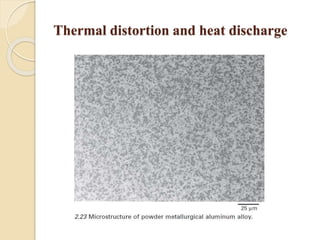
 Figure 2.23 shows a typical microstructure. 
 The hard Si particles (1200 HV) as well as finely 
dispersed intermetallic compounds embedded in the 
aluminum matrix give increased wear resistance.
Thermal distortion and heat discharge
Thermal distortion and heat discharge 
 Powder metallurgical aluminum liner improves 
heat transfer 
 The liner is cast in by high-pressure die casting. The 
resulting wear resistance is nearly the same as that of 
cast iron. 
 Daimler- Chrysler has also used a PM alloy cylinder 
liner in its car engine. 
 It is cast in by high-pressure die casting. 
 This process is considered to be far more cost 
effective and it avoids the difficulties in tribological 
control of the hyper-eutectic Al-Si block (described 
later). 
 The process used to achieve an optimal bore surface is 
almost the same as that used in producing a 
monolithic block of hyper-eutectic Al-Si alloy.
Thermal distortion and heat discharge 
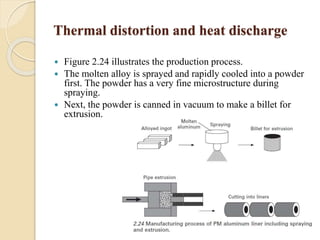
 Figure 2.24 illustrates the production process. 
 The molten alloy is sprayed and rapidly cooled into a powder 
first. The powder has a very fine microstructure during 
spraying. 
 Next, the powder is canned in vacuum to make a billet for 
extrusion.
Thermal distortion and heat discharge 
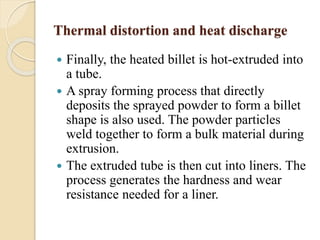
 Finally, the heated billet is hot-extruded into 
a tube. 
 A spray forming process that directly 
deposits the sprayed powder to form a billet 
shape is also used. The powder particles 
weld together to form a bulk material during 
extrusion. 
 The extruded tube is then cut into liners. The 
process generates the hardness and wear 
resistance needed for a liner.
Casting technologies for aluminum cylinder 
blocks
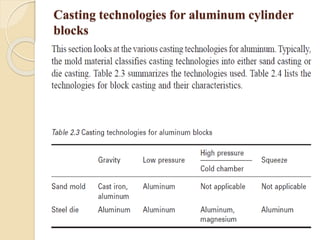
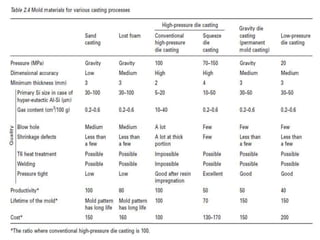
Types of casting for aluminum block 
 Sand casting 
 Lost foam process 
 High pressure die casting 
 Gravity die casting 
 Low pressure die casting 
 Squeeze die casting
Sand casting 
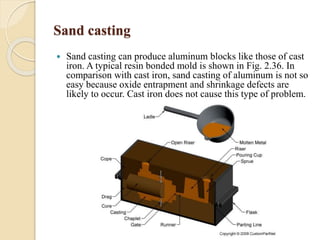
 Sand casting can produce aluminum blocks like those of cast 
iron. A typical resin bonded mold is shown in Fig. 2.36. In 
comparison with cast iron, sand casting of aluminum is not so 
easy because oxide entrapment and shrinkage defects are 
likely to occur. Cast iron does not cause this type of problem.
Sand casting 
 Expansion during solidification due to the formation of 
graphite has made cast iron ideal for the economical 
production of shrinkage-free castings. Sand casting using 
resin bonded sand is normally used for aluminum. The 
Cosworth process is a low-pressure sand casting process used 
to obtain sound castings. 
 An electro-magnetic pump fills molten aluminum from the 
bottom of the resin bonded mold. Large cylinder blocks have 
been produced using this method. Core package system is a 
sand casting process proposed by Hydro Aluminum. A 
chemically bonded mold uses a bottom pouring plan and the 
mold is inverted after pouring. This inversion positions the 
runner portion at the top of the casting. Then the slowly 
solidifying runner portion feeds melt during solidification, 
which generates a porosity-free cylinder block.
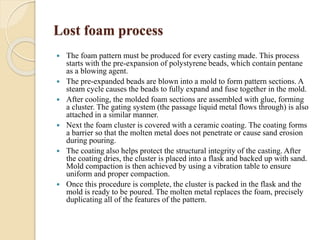
Lost foam process 
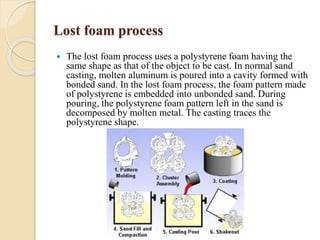
 The lost foam process uses a polystyrene foam having the 
same shape as that of the object to be cast. In normal sand 
casting, molten aluminum is poured into a cavity formed with 
bonded sand. In the lost foam process, the foam pattern made 
of polystyrene is embedded into unbonded sand. During 
pouring, the polystyrene foam pattern left in the sand is 
decomposed by molten metal. The casting traces the 
polystyrene shape.
Lost foam process 
 The foam pattern must be produced for every casting made. This process 
starts with the pre-expansion of polystyrene beads, which contain pentane 
as a blowing agent. 
 The pre-expanded beads are blown into a mold to form pattern sections. A 
steam cycle causes the beads to fully expand and fuse together in the mold. 
 After cooling, the molded foam sections are assembled with glue, forming 
a cluster. The gating system (the passage liquid metal flows through) is also 
attached in a similar manner. 
 Next the foam cluster is covered with a ceramic coating. The coating forms 
a barrier so that the molten metal does not penetrate or cause sand erosion 
during pouring. 
 The coating also helps protect the structural integrity of the casting. After 
the coating dries, the cluster is placed into a flask and backed up with sand. 
Mold compaction is then achieved by using a vibration table to ensure 
uniform and proper compaction. 
 Once this procedure is complete, the cluster is packed in the flask and the 
mold is ready to be poured. The molten metal replaces the foam, precisely 
duplicating all of the features of the pattern.
High-pressure die casting
High-pressure die casting 
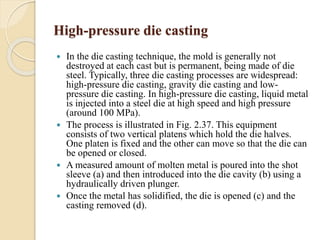
 In the die casting technique, the mold is generally not 
destroyed at each cast but is permanent, being made of die 
steel. Typically, three die casting processes are widespread: 
high-pressure die casting, gravity die casting and low-pressure 
die casting. In high-pressure die casting, liquid metal 
is injected into a steel die at high speed and high pressure 
(around 100 MPa). 
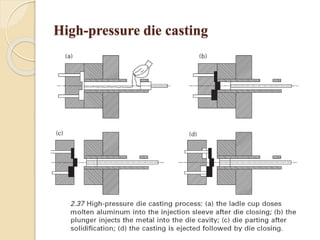
 The process is illustrated in Fig. 2.37. This equipment 
consists of two vertical platens which hold the die halves. 
One platen is fixed and the other can move so that the die can 
be opened or closed. 
 A measured amount of molten metal is poured into the shot 
sleeve (a) and then introduced into the die cavity (b) using a 
hydraulically driven plunger. 
 Once the metal has solidified, the die is opened (c) and the 
casting removed (d).
High-pressure die casting
High-pressure die casting 
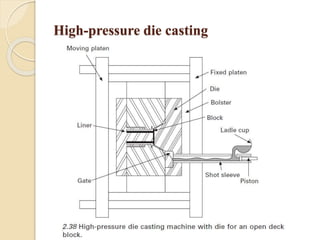
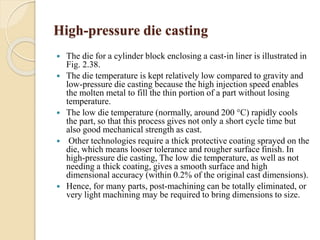
 The die for a cylinder block enclosing a cast-in liner is illustrated in 
Fig. 2.38. 
 The die temperature is kept relatively low compared to gravity and 
low-pressure die casting because the high injection speed enables 
the molten metal to fill the thin portion of a part without losing 
temperature. 
 The low die temperature (normally, around 200 °C) rapidly cools 
the part, so that this process gives not only a short cycle time but 
also good mechanical strength as cast. 
 Other technologies require a thick protective coating sprayed on the 
die, which means looser tolerance and rougher surface finish. In 
high-pressure die casting, The low die temperature, as well as not 
needing a thick coating, gives a smooth surface and high 
dimensional accuracy (within 0.2% of the original cast dimensions). 
 Hence, for many parts, post-machining can be totally eliminated, or 
very light machining may be required to bring dimensions to size.
High-pressure die casting 
 From an economic aspect and for mass production of 
cylinder blocks, the short production cycle time rivals 
highly automated sand casting. Both the machine and 
its die are very expensive and for this reason high-pressure 
die casting is economical only for high-volume 
production. In this process, special 
precautions must be taken to avoid too much gas 
entrapment which causes blistering during subsequent 
heat treatment or welding of the product. 
 High-pressure die casting generally uses liquid 
aluminum, whilst semisolid slurry is also used to get 
strong castings. The injected slurry including solid 
and liquid phases decreases shrinkage defects. Honda 
has recently introduced this process to produce a 
strong aluminum block for a diesel engine.
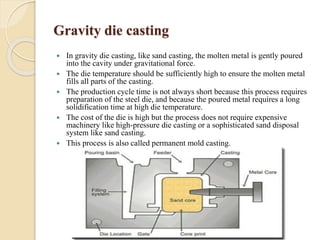
Gravity die casting 
 In gravity die casting, like sand casting, the molten metal is gently poured 
into the cavity under gravitational force. 
 The die temperature should be sufficiently high to ensure the molten metal 
fills all parts of the casting. 
 The production cycle time is not always short because this process requires 
preparation of the steel die, and because the poured metal requires a long 
solidification time at high die temperature. 
 The cost of the die is high but the process does not require expensive 
machinery like high-pressure die casting or a sophisticated sand disposal 
system like sand casting. 
 This process is also called permanent mold casting.
Low-pressure die casting 
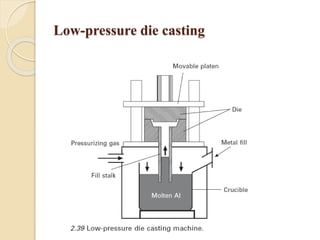
 In low-pressure die casting, the die is filled from a 
pressurized crucible below, and pressures of up to 20 MPa are 
usual. Figure 2.39 shows a schematic view of the process. In 
principle, low-pressure casting is possible for both sand 
molds and permanent molds as well as combinations. A 
crucible is positioned below the die, connected to the die 
through a vertical feed tube. 
 When the chamber is pressurized, the metal level in the feed 
tube (fill stalk) goes up. The rising material slowly fills the 
die with little turbulence and without gas entrapment. The die 
temperature should be raised to get sufficient metal filling. In 
comparison with high-pressure die casting, this process is 
suitable only for a medium walled casting. The hyper-eutectic 
Al-Si block normally uses this process to obtain a sound 
casting with fine dispersion of Si crystals (Table 2.4). Despite 
these benefits, the production cycle time is long.
Low-pressure die casting
Squeeze die casting 
 Squeeze die casting is a high-pressure die casting process that 
can cast with the minimum of turbulence and gas entrapment. 
 The use of very large gates and high hydraulic pressure 
makes the molten metal inject slowly into the cavity and 
pressurize just before solidification. This decreases shrinkage. 
 In comparison with conventional high-pressure die casting, 
the result is a porosity-free, heat-treatable component with a 
thick wall capable of surviving the critical functional testing 
that is essential for structural automotive parts. 
 This technique is mainly used for aluminum blocks having a 
bore wall of composite microstructure. The slow injection 
and medium-pressure squeeze assist aluminum infiltration.
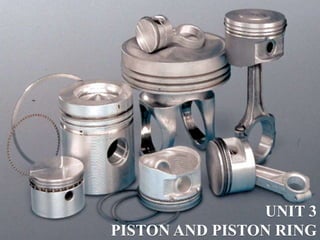
UNIT 3 
PISTON AND PISTON RING
Contents 
 Structures and functions 
 Manufacturing process 
 Piston design to compensate thermal expansion 
 Heat treatment 
 Reinforcement of the piston ring groove 
 The high-strength piston 
 Functions of piston ring 
 Suitable shapes to obtain high power output 
 Ring materials 
 Designing the self-tension of rings 
 Surface modification to improve friction and wear
Structures and functions 
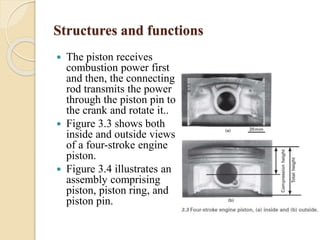
 The piston receives 
combustion power first 
and then, the connecting 
rod transmits the power 
through the piston pin to 
the crank and rotate it.. 
 Figure 3.3 shows both 
inside and outside views 
of a four-stroke engine 
piston. 
 Figure 3.4 illustrates an 
assembly comprising 
piston, piston ring, and 
piston pin.
Structures and functions
Structures and functions 
 A piston can best be described as a moving plug 
within the cylinder bore. Figure 3.5 summarizes 
its various functions. 
 Firstly, the piston together with the piston rings, 
form the combustion chamber with the cylinder 
head, sealing he combustion gas. 
 Second, it transfers combustion pressure to the 
rotating crankshaft through the piston pin and 
connecting rod. 
 Third, in the two stroke engine particularly, the 
piston itself works as the valve, exchanging gas. 
 Pistons also need to be mass-produced at low 
expense.
Structures and functions 
 When exposed to a high-temperature gas, 
the piston must reciprocate at high speed 
along the cylinder bore. Even a small 
engine can generate a high power output 
at an increased revolution number. 
 To generate high power output, the piston 
should be designed to be as light as 
possible whilst retaining durability. Such 
lightweight designs increase the stress on 
the piston material.
Structures and functions 
 In comparison with petrol engines, diesel engines 
generate power at relatively low rotation, although a 
higher cylinder pressure is required. 
 The increased demand on diesels today requires high 
performance at high efficiency with low emissions. 
 These engines use a piston with a centrally located 
combustion bowl. 
 This increased power has raised the piston head 
temperature to as much as 350 °C at the combustion 
bowl edge. 
 Compared to petrol engine pistons, diesels require a 
piston with a much higher strength to withstand these 
high temperatures.
Structures and functions 
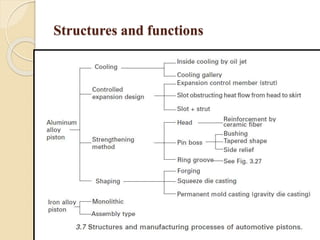
 Light aluminum alloy has been the most 
widely used material. 
 A key issue was whether aluminum, with 
a melting temperature as low as 660 °C, 
could withstand hot combustion gas. 
 Figure 3.7 describes key requirements and 
reinforcement methods for aluminum and 
iron pistons.
Structures and functions
Manufacturing process 
 Casting 
 Modifying the distribution of Si crystal
Manufacturing process
Casting 
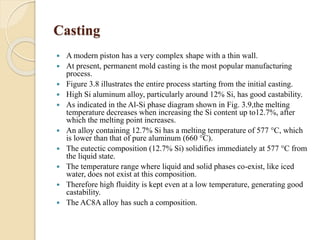
 A modern piston has a very complex shape with a thin wall. 
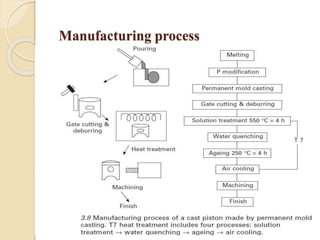
 At present, permanent mold casting is the most popular manufacturing 
process. 
 Figure 3.8 illustrates the entire process starting from the initial casting. 
 High Si aluminum alloy, particularly around 12% Si, has good castability. 
 As indicated in the Al-Si phase diagram shown in Fig. 3.9,the melting 
temperature decreases when increasing the Si content up to12.7%, after 
which the melting point increases. 
 An alloy containing 12.7% Si has a melting temperature of 577 °C, which 
is lower than that of pure aluminum (660 °C). 
 The eutectic composition (12.7% Si) solidifies immediately at 577 °C from 
the liquid state. 
 The temperature range where liquid and solid phases co-exist, like iced 
water, does not exist at this composition. 
 Therefore high fluidity is kept even at a low temperature, generating good 
castability. 
 The AC8A alloy has such a composition.
Casting 
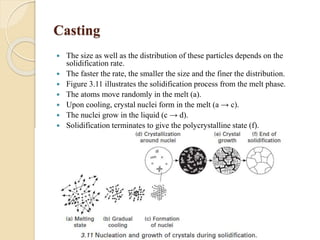
 The size as well as the distribution of these particles depends on the 
solidification rate. 
 The faster the rate, the smaller the size and the finer the distribution. 
 Figure 3.11 illustrates the solidification process from the melt phase. 
 The atoms move randomly in the melt (a). 
 Upon cooling, crystal nuclei form in the melt (a → c). 
 The nuclei grow in the liquid (c → d). 
 Solidification terminates to give the polycrystalline state (f).
Modifying the distribution of Si crystal 
 The second most important property of the piston is 
its ability to transmit combustion pressure. 
 In order to do this, the piston material requires high 
fatigue strength at high temperature. 
 However, high-Si alloy is brittle because it inherits the 
brittleness of Si crystal. 
 The brittleness needs to be overcome to raise fatigue 
strength. 
 The Si in high-Si alloys appears as coarse crystals 
during the slow solidification of permanent mold 
casting. 
 However, the addition of a small amount of 
phosphorus into the melt makes the Si crystals finer 
to reduce brittleness.
Piston design to compensate thermal 
expansion 
 Increased Si in aluminum helps deal with the large thermal 
expansion coefficient of aluminum. 
 However, an appropriate design can also help resolve this 
problem. 
 The ideal design has a piston with a perfect round shape 
moving in a cylinder also with a perfect round shape at an 
appropriate running clearance under hydrodynamic 
lubrication. 
 However, this is difficult in part because a piston has a 
complicated temperature distribution from its head to skirt. 
 The temperature at the piston head is high (about 350 °C), 
whilst that of the skirt is low (about 150 °C). 
 The difference in temperatures is likely to cause distortion 
during operation. Additionally, the gas pressure, inertia force 
and lateral force also increase the distortion. It is therefore 
very difficult to keep a constant running clearance.
Piston design to compensate thermal 
expansion 
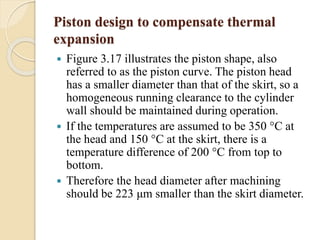
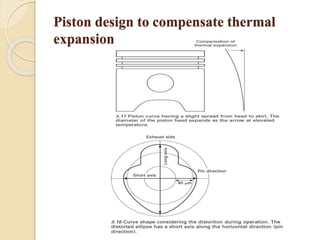
 Figure 3.17 illustrates the piston shape, also 
referred to as the piston curve. The piston head 
has a smaller diameter than that of the skirt, so a 
homogeneous running clearance to the cylinder 
wall should be maintained during operation. 
 If the temperatures are assumed to be 350 °C at 
the head and 150 °C at the skirt, there is a 
temperature difference of 200 °C from top to 
bottom. 
 Therefore the head diameter after machining 
should be 223 μm smaller than the skirt diameter.
Piston design to compensate thermal 
expansion 
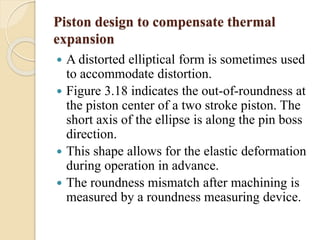
 A distorted elliptical form is sometimes used 
to accommodate distortion. 
 Figure 3.18 indicates the out-of-roundness at 
the piston center of a two stroke piston. The 
short axis of the ellipse is along the pin boss 
direction. 
 This shape allows for the elastic deformation 
during operation in advance. 
 The roundness mismatch after machining is 
measured by a roundness measuring device.
Piston design to compensate thermal 
expansion
Piston design to compensate thermal 
expansion 
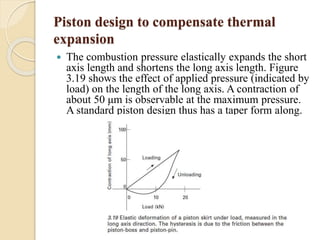
 The combustion pressure elastically expands the short 
axis length and shortens the long axis length. Figure 
3.19 shows the effect of applied pressure (indicated by 
load) on the length of the long axis. A contraction of 
about 50 μm is observable at the maximum pressure. 
A standard piston design thus has a taper form along.
Piston design to compensate thermal 
expansion 
 A standard piston design thus has a taper form 
along the vertical axis together with an elliptical 
cross-section. Only experimental analysis and 
calculation can determine the proper shape. 
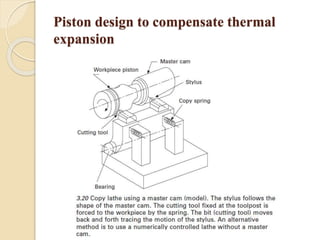
 In order to have good reproducibility, mass-production 
machining is carried out using a copy 
lathe. 
 Figure 3.20 describes the principle of the copy 
lathe for final machining, which gives an accuracy 
of within several μm. It is, however, worth 
mentioning that the delicate piston shape results 
from the accumulated know-how of each 
individual manufacturer.
Piston design to compensate thermal 
expansion
Piston design to compensate thermal 
expansion 
 The final piston design must also allow for the head swing motion 
revolving around the piston pin. 
 It is important to consider not only short-term deformation but also 
long-term creep deformation. 
 Creep deformation is a phenomenon when material exposed to 
elevated temperatures gradually deforms even at a low stress. 
 In aluminum alloy pistons with cast iron blocks, other technologies 
have also been used to control thermal expansion. 
 The running clearance between piston and bore wall should be 
small enough to decrease noise, however, the clearance value must 
be designed for the piston skirt not to touch the bore wall after 
thermal expansion. 
 This means that if the skirt does not expand or cause an increase in 
temperature, then it is possible to decrease the clearance.
Piston design to compensate thermal 
expansion 
 Two types of technologies have been proposed for this 
purpose. 
 One is to make a slot so that it keeps the skirt’s temperature 
low by intercepting the heat flow from head to skirt. 
 This slot is placed just below the oil ring groove. 
 The disadvantage is that the head is likely to be overheated 
because the slot obstructs the heat discharge to the skirt, and 
the slot also lowers the strength of the piston. 
 The other method is a controlled-expansion piston that 
includes small cast-in steel plates around the pin boss area. 
 The cast-in steel plate mechanically restricts thermal 
expansion, so that the clearance to the cylinder bore does not 
decrease when the piston temperature is raised. 
 In the past, this type of method was generally widespread, but 
the use of aluminum blocks has decreased its use.
Heat treatment 
Age hardening and age softening 
 To increase its strength, a heat treatment called T7 
is carried out on the cast piston. 
 T7 is an age-hardening heat treatment typical to 
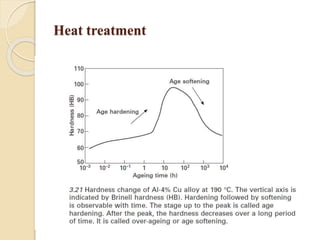
aluminum alloys. Figure 3.21 shows the hardness 
change of Al-4% Cu alloy as a function of time. 
 The alloy is water-quenched from 500 °C and 
then kept at 190 °C for the period indicated in the 
horizontal axis. 
 The water-quenched Al-Cu alloy hardens in 3 to 
30 hours (age hardening), and gradually softens 
over time (age softening).
Heat treatment
Heat treatment 
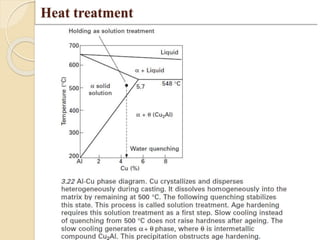
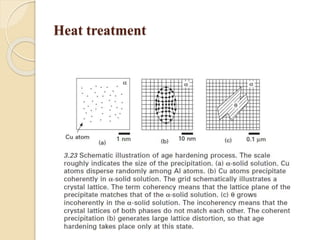
 Figure 3.22 shows the Al-Cu phase diagram. The water quenching 
is carried out along the broken line. The ageing process is 
schematically illustrated with scales in Fig. 3.23. 
 In Fig. 3.23(a), Cu atoms disperse randomly in the aluminum matrix 
after quenching. 
 This state is called α-solid solution. 
 The ageing at 190 °C aggregates Cu atoms. 
 This state is called coherent precipitation of Cu, which increases 
lattice strain and produces hardening. 
 This atomic movement takes place during ageing, the additional 
heating over a long period of time changes the coherent 
precipitation into the stable α + θ. 
 The coherency between the precipitate lattice and matrix lattice 
observed in (b) disappears at this state. 
 Consequently, the hardness and strength decreases. 
 This is called age softening, being observable beyond 30 hours.
Heat treatment
Heat treatment
Heat treatment 
 The ageing mechanism has been explained using the simple Al-Cu 
system. 
 The 1% Cu and 1% Mg in both AC 8 A and AC 9B strengthen the 
Al matrix by ageing. In these piston alloys, hardening takes place at 
the intermediate stage prior to the precipitation of the stable θ or S 
(intermetallic compound Al5CuMg2) phase. 
 In general, ageing is used frequently to harden aluminum alloys. 
 T7 heat treatment is widespread for pistons (Fig. 3.8).
Heat treatment 
 Hardness measurement estimates the piston temperature 
during operation 
 Pistons are used in the hardened state after the application of 
T7 heat treatment. 
 However, a piston operated above 150 °C gradually causes 
age softening in the long term, so that the attained hardness 
obtained after T7 is not kept constant during engine 
operation. 
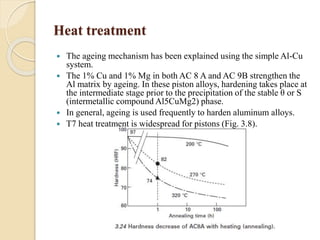
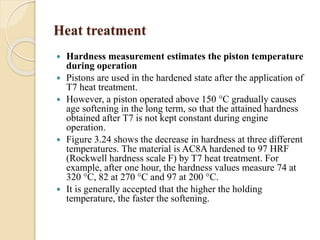
 Figure 3.24 shows the decrease in hardness at three different 
temperatures. The material is AC8A hardened to 97 HRF 
(Rockwell hardness scale F) by T7 heat treatment. For 
example, after one hour, the hardness values measure 74 at 
320 °C, 82 at 270 °C and 97 at 200 °C. 
 It is generally accepted that the higher the holding 
temperature, the faster the softening.
Heat treatment 
 This is because atomic diffusion controls softening. 
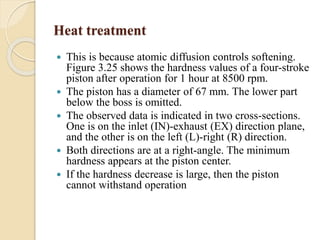
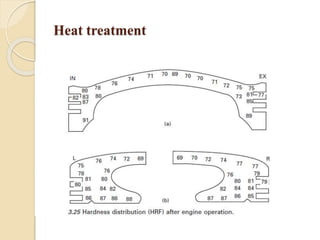
Figure 3.25 shows the hardness values of a four-stroke 
piston after operation for 1 hour at 8500 rpm. 
 The piston has a diameter of 67 mm. The lower part 
below the boss is omitted. 
 The observed data is indicated in two cross-sections. 
One is on the inlet (IN)-exhaust (EX) direction plane, 
and the other is on the left (L)-right (R) direction. 
 Both directions are at a right-angle. The minimum 
hardness appears at the piston center. 
 If the hardness decrease is large, then the piston 
cannot withstand operation
Heat treatment
Heat treatment 
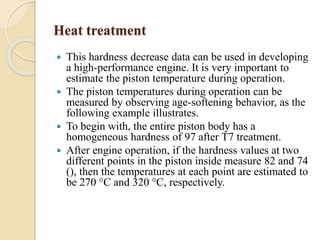
 This hardness decrease data can be used in developing 
a high-performance engine. It is very important to 
estimate the piston temperature during operation. 
 The piston temperatures during operation can be 
measured by observing age-softening behavior, as the 
following example illustrates. 
 To begin with, the entire piston body has a 
homogeneous hardness of 97 after T7 treatment. 
 After engine operation, if the hardness values at two 
different points in the piston inside measure 82 and 74 
(), then the temperatures at each point are estimated to 
be 270 °C and 320 °C, respectively.
Reinforcement of the piston ring groove 
 Abnormal wear at the ring groove not only decreases output 
power, but also increases oil consumption. At worst, seizure 
can take place. 
 Groove wear is strongly influenced by piston thermal 
deformation under sustained working conditions. 
 Ideally, the lateral faces of both the ring and the groove 
should be parallel and perpendicular to the cylinder bore wall, 
so that the contact and the resulting pressures can be 
distributed evenly, minimizing wear. 
 However, the thermal distortion generates an inclination in 
the groove to give localized contact between the lateral faces 
of the groove and the ring. 
 Of course, too high a temperature in the ring groove softens 
aluminum which accelerates wear, but much wear is the result 
of distortion.
Reinforcement of the piston ring groove
Reinforcement of the piston ring groove 
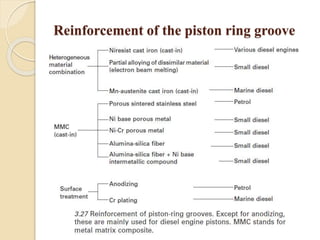
 Several methods listed in Fig. 3.27 have been 
proposed to reinforce the piston-ring groove. 
 During piston operation, the area particularly around 
the top-ring groove is liable to overheat. 
 The aluminum softens and sometimes fuses with the 
top ring. This fusing is also termed as micro-welding. 
 Hard anodizing (hard anodic oxide coating) is often 
used to avoid this fusing. Anodizing is a surface 
treatment widely used for aluminum appliances. 
 When a piece of aluminum is anodized, a thin oxide 
layer is formed on its surface. Hard anodizing 
produces a particularly hard layer. 
 To obtain a suitable hardness, a piston is anodized in a 
dilute sulfuric acid electrolyte at a low temperature.
Reinforcement of the piston ring groove 
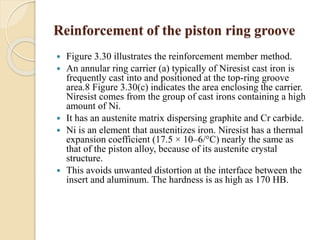
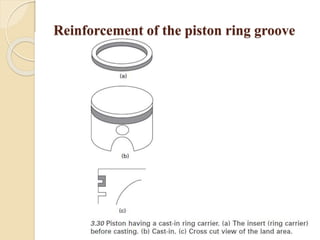
 Figure 3.30 illustrates the reinforcement member method. 
 An annular ring carrier (a) typically of Niresist cast iron is 
frequently cast into and positioned at the top-ring groove 
area.8 Figure 3.30(c) indicates the area enclosing the carrier. 
Niresist comes from the group of cast irons containing a high 
amount of Ni. 
 It has an austenite matrix dispersing graphite and Cr carbide. 
 Ni is an element that austenitizes iron. Niresist has a thermal 
expansion coefficient (17.5 × 10⁻⁶/°C) nearly the same as 
that of the piston alloy, because of its austenite crystal 
structure. 
 This avoids unwanted distortion at the interface between the 
insert and aluminum. The hardness is as high as 170 HB.
Reinforcement of the piston ring groove
Reinforcement of the piston ring groove 
 Since Niresist is an iron, it is heavy. 
 As a lighter alternative, a pre-form of a mixture of 
alumina and silica fibers is also used for 
reinforcement. 
 This is cast-in by the squeeze die casting method. 
 The pre-form looks something like candy floss. 
 The aluminum melt forcibly infiltrates into the pre-form 
by squeeze die casting. 
 The solidified portion becomes a metal matrix 
composite (MMC). 
 This method is also used to reinforce the edge of the 
combustion bowl of diesel pistons and the entire 
piston head of petrol engine pistons
Reinforcement of the piston ring groove 
 Partial remelting of the ring groove area can also increase hardness 
due to the fine microstructure generated by rapid solidification. 
 In addition to this, if alloying is implemented during remelting, the 
groove is strengthened. 
 A dissimilar metal such as Cu is added in the melt using electron 
beam melting. 
 The cast-in ring insert should bond with the piston alloy for good 
thermal conduction. 
 Niresist is, however, a dissimilar metal from the piston alloy. 
 It is impossible to get acceptable metallurgical bonding using just 
the cast-in procedure. 
 For this reason, the insert is coated with aluminum prior to the cast-in. 
 The insert is immersed and heated in the melt aluminum. The 
coated layer works as a binder during the cast-in procedure to give 
good metallurgical bonding with the piston body.
The high-strength piston 
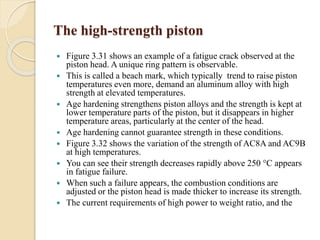
 Figure 3.31 shows an example of a fatigue crack observed at the 
piston head. A unique ring pattern is observable. 
 This is called a beach mark, which typically trend to raise piston 
temperatures even more, demand an aluminum alloy with high 
strength at elevated temperatures. 
 Age hardening strengthens piston alloys and the strength is kept at 
lower temperature parts of the piston, but it disappears in higher 
temperature areas, particularly at the center of the head. 
 Age hardening cannot guarantee strength in these conditions. 
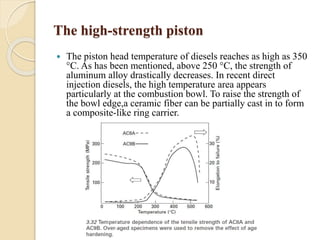
 Figure 3.32 shows the variation of the strength of AC8A and AC9B 
at high temperatures. 
 You can see their strength decreases rapidly above 250 °C appears 
in fatigue failure. 
 When such a failure appears, the combustion conditions are 
adjusted or the piston head is made thicker to increase its strength. 
 The current requirements of high power to weight ratio, and the
The high-strength piston 
 In the temperature range where the age hardening effect 
disappears, the base strength of the alloy becomes important. 
 It is generally known that strength at high temperatures 
depends on the distribution as well as the quantity of 
dispersed intermetallic compounds. 
 For example, alloyed Ni forms an intermetallic compound 
Al3Ni during solidification, which contributes to high 
temperature strength. 
 Generally, the higher the quantity of intermetallic 
compounds, the higher the strength. 
 However, it is difficult to increase the content above a certain 
limited amount. 
 The increased content coarsens the intermetallic compound, 
which in turn makes the material brittle.
The high-strength piston 
 The piston head temperature of diesels reaches as high as 350 
°C. As has been mentioned, above 250 °C, the strength of 
aluminum alloy drastically decreases. In recent direct 
injection diesels, the high temperature area appears 
particularly at the combustion bowl. To raise the strength of 
the bowl edge,a ceramic fiber can be partially cast in to form 
a composite-like ring carrier.
Piston Ring functions 
 The piston ring is essentially a seal with a spring-like 
property. 
 Similar rings are also used in other piston and cylinder 
mechanisms, such as compressors or hydraulic devices. 
 The piston ring of an internal combustion engine must be 
designed with sufficient heat resistance to withstand exposure 
to high temperature gas. 
 The single-piece metallic piston ring with self tension, which 
is generally used in internal combustion engines, was first 
invented by J. Ramsbottom in 1854. 
 Figure 4.1(a) shows typical rings used in a four-stroke engine. 
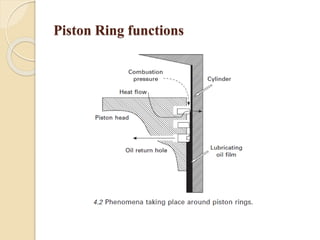
 A piston generally uses three or more rings. Figure 4.2 shows 
a schematic representation of a piston, illustrating the relative 
positioning of the piston rings and the cylinder wall.
Piston Ring functions 
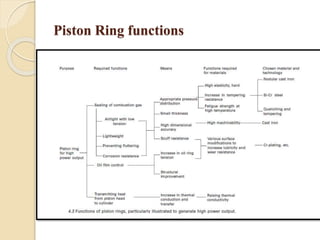
 Figure 4.3 gives a summary of the various functions required of a piston 
ring. A running clearance of about 20–30 μm exists between the cylinder 
and piston. 
 The piston rings seal in the combustion gas.2 The combustion gas exerts 
pressure on the rings through the gap between the piston and cylinder bore 
(Fig. 4.2). 
 The rings also control the thickness of the oil film on the cylinder wall, 
providing hydrodynamic lubrication which sustains a high thrust load. In 
addition, the rings also play an important role in cooling the piston head. 
 The combustion heat received by the piston head flows into the cylinder 
wall through the piston rings. About 70% of the heat received by the piston 
head is transmitted through the rings. A high rotational velocity is necessary 
to generate high power output, requiring light piston rings with low friction 
and high wear resistance. 
 Cast iron rings were often used in the past. However, more demanding 
requirements have increased the use of steel piston rings coated with 
various surface treatments.
Piston Ring functions 
 Generally, four-stroke petrol engines use three rings per 
cylinder, whilst two-stroke engines use only two. 
 Figure 4.1(a) shows the three rings of a four-stroke petrol 
engine, these being the top or compression ring (left), second 
ring (middle) and oil control ring (right). 
 The oil control ring consists of three individual pieces, two 
side rails and a spacer (the corrugated sheet, Fig. 4.1(c)). 
Figure 4.4 shows the two rings in a two-stroke petrol engine. 
 The second ring is shown with the expander (located inside). 
 The expander supports the second ring (described later in Fig. 
4.9), adding tension without a significant increase in total 
weight. 
 To obtain the same tension with a one piece ring, the 
thickness needs to be increased, which in turn makes the ring 
much heavier.
Piston Ring functions
Suitable shapes to obtain high power 
output 
 Figure 4.5 illustrates a piston ring both before and after it 
expands into the ring groove. Figure 4.6 shows a ring 
installed in the ring groove. The piston with rings is inserted 
into the cylinder bore. The ring then expands from its initial 
diameter (d1) and is forced tightly against the cylinder bore 
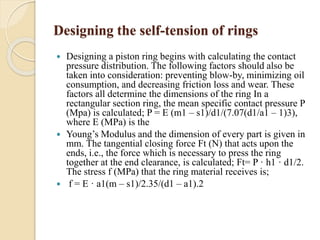
wall (Fig. 4.5). The ring width is called h1 and the radial wall 
thickness a1 (Fig. 4.6). 
 The distance m is defined as the gap when the ring is 
uncompressed. The gap s1, also referred to as the closed gap 
or end clearance, is the minimum gap obtained when the ring 
is installed in the cylinder bore. The load necessary to close 
the gap from m to s1 is called the tangential closing force 
(Ft). The force increases by increasing the gap distance m. In 
the top ring of Fig. 4.1 these values are typically d1 = 80, m = 
10, a1 = 3 and h1 = 0.8 mm, the ring being very thin to 
minimize weight.
Suitable shapes to obtain high power 
output 
 It is the self-tension of the ring itself that presses 
the ring into the cylinder bore wall. During 
operation, the ring glides up and down, touching 
the bore wall. This puts stress on the ring. If the 
cylinder bore is not completely round and straight, 
the ring gap repeatedly opens and closes. The 
resulting stresses are likely to break the ring. A 
lack of lubrication also causes material failure. 
 The surface roughness of the ring groove and 
degree of groove and side clearances, are very 
important in controlling lubrication. Figures 4.7 
and 4.8 show cross-sectional diagrams of three 
rings in a four-stroke engine and two rings in a 
two-stroke engine, respectively
Suitable shapes to obtain high power 
output 
 In four-stroke engines, the top (compression) ring is used mainly for 
sealing combustion gas. 
 The second ring assists the top ring. The oil control ring is 
specifically used in four-stroke engines to scrape off lubrication oil 
from the bore wall. The second ring with a tapered cross-section 
also scrapes off the oil. 
 The tapered face provides contact at the bottom edge to scrape oil 
during the downward stroke. 
 In two-stroke engines,4 two rings are generally used without an oil 
control ring. (Fig. 4.8). 
 The expander frequently supports the second ring (Fig. 4.9) 
 The tension created by the rings restricts the swing motion of the 
piston to suppress any abnormal stroke sound. 
 Since increasing the a1 size of a one piece ring can make it much 
heavier, this two-piece construction raises the tension with less 
increase in total weight.
Suitable shapes to obtain high power 
output 
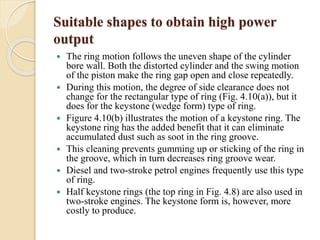
 The ring motion follows the uneven shape of the cylinder 
bore wall. Both the distorted cylinder and the swing motion 
of the piston make the ring gap open and close repeatedly. 
 During this motion, the degree of side clearance does not 
change for the rectangular type of ring (Fig. 4.10(a)), but it 
does for the keystone (wedge form) type of ring. 
 Figure 4.10(b) illustrates the motion of a keystone ring. The 
keystone ring has the added benefit that it can eliminate 
accumulated dust such as soot in the ring groove. 
 This cleaning prevents gumming up or sticking of the ring in 
the groove, which in turn decreases ring groove wear. 
 Diesel and two-stroke petrol engines frequently use this type 
of ring. 
 Half keystone rings (the top ring in Fig. 4.8) are also used in 
two-stroke engines. The keystone form is, however, more 
costly to produce.
Suitable shapes to obtain high power 
output 
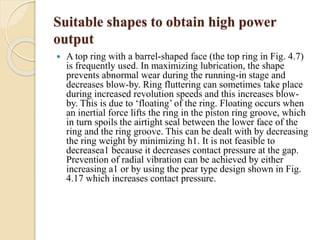
 A top ring with a barrel-shaped face (the top ring in Fig. 4.7) 
is frequently used. In maximizing lubrication, the shape 
prevents abnormal wear during the running-in stage and 
decreases blow-by. Ring fluttering can sometimes take place 
during increased revolution speeds and this increases blow-by. 
This is due to ‘floating’ of the ring. Floating occurs when 
an inertial force lifts the ring in the piston ring groove, which 
in turn spoils the airtight seal between the lower face of the 
ring and the ring groove. This can be dealt with by decreasing 
the ring weight by minimizing h1. It is not feasible to 
decreasea1 because it decreases contact pressure at the gap. 
Prevention of radial vibration can be achieved by either 
increasing a1 or by using the pear type design shown in Fig. 
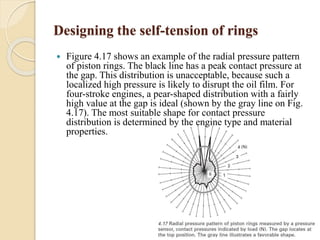
4.17 which increases contact pressure.
Suitable shapes to obtain high power 
output 
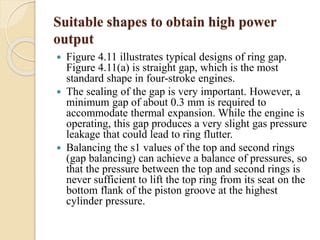
 Figure 4.11 illustrates typical designs of ring gap. 
Figure 4.11(a) is straight gap, which is the most 
standard shape in four-stroke engines. 
 The sealing of the gap is very important. However, a 
minimum gap of about 0.3 mm is required to 
accommodate thermal expansion. While the engine is 
operating, this gap produces a very slight gas pressure 
leakage that could lead to ring flutter. 
 Balancing the s1 values of the top and second rings 
(gap balancing) can achieve a balance of pressures, so 
that the pressure between the top and second rings is 
never sufficient to lift the top ring from its seat on the 
bottom flank of the piston groove at the highest 
cylinder pressure.
Suitable shapes to obtain high power 
output 
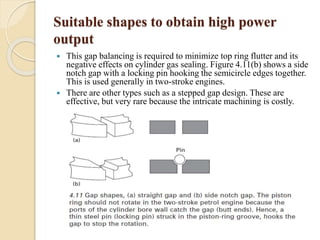
 This gap balancing is required to minimize top ring flutter and its 
negative effects on cylinder gas sealing. Figure 4.11(b) shows a side 
notch gap with a locking pin hooking the semicircle edges together. 
This is used generally in two-stroke engines. 
 There are other types such as a stepped gap design. These are 
effective, but very rare because the intricate machining is costly.
Ring materials 
 Flaky graphite cast iron 
 Two-stroke air-cooled engines use nodular graphite cast iron 
(JIS-FCD) for both top and second rings. 
 Water-cooled engines use Si-Cr spring steel (JIS-SWOSC) for 
the top ring. 
 Four-stroke engines use FCD or flaky graphite cast iron (JIS-FC) 
for second rings. 
 The top ring and the side rail part of the three-piece oil 
control ring use SWOSC. 
 The spacer of the oil control ring, the undulate sheet 
sandwiched between the side rail parts, requires a far more 
intricate shape, so it uses stainless steel JIS-SUS304 because 
of its good formability. 
 The percentage of steel rings is increasing year by year. 
However, up until 1970, most engines used cast iron rings.
Ring materials 
 Piston rings are directly exposed to the very high 
temperatures of combustion gas, but they also 
receive heat from the piston head. The highest 
temperature appears in the top ring where 
temperatures reach about 250 °C. The material 
must maintain its elastic property at high 
temperatures for a long period of time.5 Cast iron 
is excellent in this regard 
 A pearlite or tempered martensite microstructure 
is generally used. The carbon crystallizes to 
generate flaky graphite during solidification of 
cast iron.
Ring materials Characteristics 
 Cast iron has the following qualities that make it 
highly suitable for piston rings. 
1. Heat resistance. Cast iron rings are heat-resistant 
even when exposed to high 
temperatures. The hard martensite or pearlite 
microstructure does not soften at high 
temperatures. 
The high quantity of alloying elements 
(especially a Si content of around 3%) gives 
excellent resistance against tempering. 
Only casting can shape such high alloy 
compositions. Plastic working cannot shape cast 
iron into rings due to its low deformability.
Ring materials Characteristics 
2. Self-lubrication. 
 Self-lubricating Graphite is g, which helps to 
prevent scuffing. 
 This is due to the layered crystal structure of 
graphite. 
 Scuffing6 is a moderate form of adhesive wear 
characterized by macroscopic scratches or surface 
deformation aligned with the direction of motion. 
 This is caused when the points on two sliding 
faces weld themselves together. 
 Scuffing can occur between the cylinder bore wall 
and the ring or the piston outer surface.
Ring materials Characteristics 
3. Machinability. 
 Cast iron has good machinability. 
 The dispersed graphite itself is soft and brittle, 
which works as a chip breaker during machining. 
 A proper oil film must be produced between the 
ring face and cylinder bore wall. 
 A residual burr at the ring corner is unfavorable, 
because it disrupts the oil film and obstructs 
hydrodynamic lubrication, thus all corners should 
be chamfered. 
 Cast iron has high machinability compared to 
steel, which makes deburring much easier.
Ring materials Characteristics 
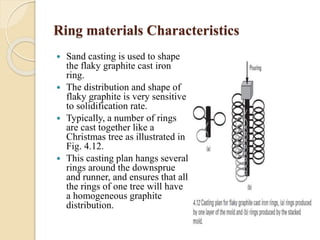
 Sand casting is used to shape 
the flaky graphite cast iron 
ring. 
 The distribution and shape of 
flaky graphite is very sensitive 
to solidification rate. 
 Typically, a number of rings 
are cast together like a 
Christmas tree as illustrated in 
Fig. 4.12. 
 This casting plan hangs several 
rings around the downsprue 
and runner, and ensures that all 
the rings of one tree will have 
a homogeneous graphite 
distribution.
Ring materials Characteristics 
 An alternative method is to slice a cast iron tube 
into rings. 
 It may be cheaper, but this method gives various 
solidification rates at different portions of the 
tube, which in turn disperses graphite unevenly. 
 Hence, particularly for flaky graphite cast iron, 
each ring should be cast separately. High-alloy 
cast iron is used to give much higher wear 
resistance. 
 It disperses Cr-carbide through increasing Cr 
content or hard steadite (iron-phosphorus 
compound) through an increased phosphorus 
quantity of around 0.3%.
Ring materials Characteristics 
 Use of spherical graphite cast iron to 
improve elastic modulus and toughness 
 Decreasing h1 can make the cast iron ring lighter, 
but it also raises the stress. 
 Cast iron has excellent properties as a ring 
material, but is not that tough. 
 The microscopic stress concentration caused by 
flaky graphite is likely to initiate cracking, and the 
flaky graphite microstructure is too weak to resist 
such cracking.
Ring materials Characteristics 
 To increase the strength, nodular graphite cast iron 
(JISFCD), which includes spherical graphite, has 
become more widely used. 
 It is also called spheroidized graphite iron or 
ductile iron. 
 This microstructure is resistant to cracking. Figure 
4.13 is a magnified view showing tempered 
martensite surrounding spherical graphite in the 
second ring of a two-stroke engine. Figure 4.14 is 
a photograph of the ring in cross-section. This is a 
half keystone shape with hard chromium plating 
on its face. The hardness is around 40 HRC due to 
the increased concentrations of Cu, Cr and Mo.
Ring materials Characteristics 
 The tempered martensite microstructure of flaky graphite iron 
gives a bending strength of 400 MPa and an elastic modulus 
of 100 GPa, while that Nodular graphite cast iron with 
martensite matrix. of nodular graphite iron gives 1.2 GPa and 
166 GPa, respectively. 
 Hence, spheroidizing substantially improves mechanical 
properties. Round graphite is generated by adding small 
amounts of nodularizer to the melt just before pouring. 
 The nodularizer is a Mg and/or rare earth Ce alloy containing 
Si, Fe and Ni. This processing originated with simultaneous 
inventions in 1948. 
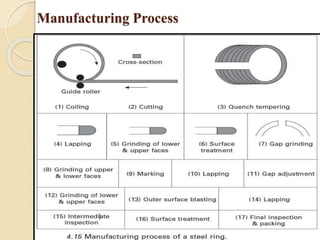
 For a nodular graphite iron ring, manufacturing starts from a 
cast tube. The ring is then sliced from the tube and the gap is 
notched. The machined ring is quenchtempered to create the 
necessary tension
Ring materials Characteristics 
 Using steel to generate lightweight rings 
 Up until 1970, all piston rings were made using cast iron. 
 However, the low fatigue strength and toughness of cast iron mean that it is 
not possible to reduce the weight of the rings by lowering h1. 
 Steel rings8 using spring steel have been developed to address this 
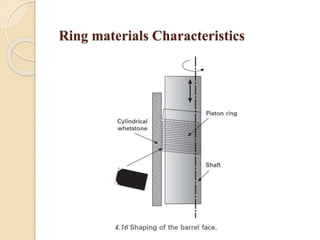
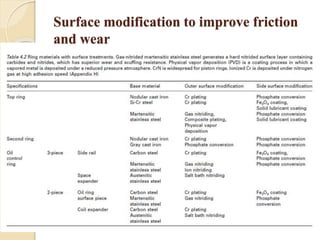
problem. 
 Steel does not have the self lubricating property of cast iron, but it does 
have excellent elastic properties. 
 Various spring steels have been tried for piston rings. At present, Si-Cr 
steel, which is also used for valve springs, is widely used because of its 
high resistance to tempering. 
 The typical chemical composition is Fe-0.5% C-1.4Si-0.7Mn-0.7Cr 
 It is generally used with a tempered martensite microstructure. 
 The high Si content maintains the hardness of the martensite in the middle 
to high temperature range, which in turn maintains ring tension.
Manufacturing Process
Ring materials Characteristics 
 The use of a steel second ring is also becoming more common, 
despite difficulties in machining the taper face. 
 Figure 4.15 illustrates the manufacturing process of a steel ring. 
First, rolling produces a wire with a rectangular section (upper left). 
 This wire is then coiled into an oval shape (1) so that the final shape 
after installation is round. Quench-tempering (3) generates the 
required elastic property (described below). 
 The tensile strength after quench-tempering is typically 1.5 GPa, 
and the elastic modulus 206 GPa. After heat treatment, a lapping 
machine (illustrated in Fig. 4.16) generates a barrel shape (4) from 
the rectangular cross-section. 
 A cylindrical whetstone laps the outer surface of the stacked rings. 
The shaft revolves and moves up and down with the rings. 
 During this motion, the rings are slightly inclined in the cylindrical 
whetstone to generate the barrel face.
Ring materials Characteristics
Ring materials Characteristics 
 Each corner requires a different radius for lubrication. 
Simple deburring, such as barrel polishing, cannot be 
used because the accuracy of the chamfer after barrel 
polishing cannot be controlled. Grinding and lapping 
should be carried out on every corner and face. 
Deburring steel is much more difficult than deburring 
cast iron, because of its high ductility. 
 The top ring for diesel engines is exposed to a much 
higher temperature and pressure than that of petrol 
engines. In addition to the Si-Cr steel, the diesel 
engine frequently uses high-chromium martensitic 
stainless steel (17% Cr steel containing Mo, V, etc.) 
with additional nitriding which shows superior anti-softening 
properties at high temperatures.
Ring materials Characteristics 
 The steel ring with its high elastic modulus is 
also beneficial in terms of weight reduction, 
but it is not always the best solution. 
 For example, compared to cast iron, the a1 of 
the steel ring should be lowered to adjust the 
ring tension, but then the contact area 
between the ring and ring groove decreases, 
reducing heat transfer. 
 A cast iron ring with a lower elastic modulus 
is much more favorable in such a case.
Designing the self-tension of rings 
 The distribution of contact pressure and tension 
 Higher contact pressure for the rings is essential at 
higher-speed revolutions. This is because the 
hydrodynamic force that occurs in the oil film and 
tends to lift the ring away from the cylinder wall 
increases with sliding velocity. 
 The self-tension of the ring forces it against the bore 
wall, which in turn generates a contact pressure. The 
combustion gas pressure transmitted through the 
groove clearance also forces the rings towards the 
bore wall, helping to increase the contact pressure. 
However, at high piston speeds, the time required for 
the formation of an effective gas pressure behind the 
rings becomes much shorter
Designing the self-tension of rings 
 Figure 4.17 shows an example of the radial pressure pattern 
of piston rings. The black line has a peak contact pressure at 
the gap. This distribution is unacceptable, because such a 
localized high pressure is likely to disrupt the oil film. For 
four-stroke engines, a pear-shaped distribution with a fairly 
high value at the gap is ideal (shown by the gray line on Fig. 
4.17). The most suitable shape for contact pressure 
distribution is determined by the engine type and material 
properties.
Designing the self-tension of rings 
 Designing a piston ring begins with calculating the contact 
pressure distribution. The following factors should also be 
taken into consideration: preventing blow-by, minimizing oil 
consumption, and decreasing friction loss and wear. These 
factors all determine the dimensions of the ring In a 
rectangular section ring, the mean specific contact pressure P 
(Mpa) is calculated; P = E (m1 – s1)/d1/(7.07(d1/a1 – 1)3), 
where E (MPa) is the 
 Young’s Modulus and the dimension of every part is given in 
mm. The tangential closing force Ft (N) that acts upon the 
ends, i.e., the force which is necessary to press the ring 
together at the end clearance, is calculated; Ft= P · h1 · d1/2. 
The stress f (MPa) that the ring material receives is; 
 f = E · a1(m – s1)/2.35/(d1 – a1).2
Designing the self-tension of rings 
 The top ring and second ring of four-stroke petrol engines 
have a contact pressure of around 0.2 MPa, the oil ring in the 
range from 0.8 to 1 MPa. The oil ring for diesel engines has a 
contact pressure ranging from 1.6 to 2 MPa. 
 The average tension Ft changes with the dimensions of the 
ring. The combustion gas forces the top and second rings 
towards the bore wall, but does not push the oil ring against 
the bore wall because combustion gas leakage is sealed 
almost perfectly by the top and second rings. Hence, tension 
in the oil ring is generally high. 
 Rings with higher contact pressure remain more effective 
over longer running periods. The stress loss from wear 
reduces contact pressure, whilst a high initial value of contact 
pressure tends to result in greater residual stress than the low 
initial value found in low-tension rings.
Designing the self-tension of rings 
 Lack of oil causes severe wear of the ring and bore wall, 
while excess oil generates too much soot. Soot accumulates in 
the combustion chamber and causes combustion conditions to 
deteriorate, which can result in a number of problems, 
including a tendency for the ring to stick to the ring groove. 
This is partially eliminated by using a keystone ring, but 
optimum oil control is still necessary. The quantity of oil is 
adjusted mainly by the oil control ring, although the 
combined effects of all rings, including the compression ring, 
should be taken into consideration. 
 Operating conditions also influence oil consumption. The 
number of revolutions has a significant influence, as does the 
negative pressure inside the inlet pipe during engine braking. 
Increased tension in the oil ring rapidly leads to lower oil 
consumption, but flexibility is also important. Constant oil 
consumption appears above a certain tension value, and the 
correct tension value is determined empirically.
Designing the self-tension of rings 
 More recently, reducing fuel consumption has 
become important. To accomplish this, friction 
must be reduced and moving parts must be lighter. 
 It has been said that the friction loss arising from 
the piston, piston rings and cylinder bore amounts 
to 40–50%9 of total friction loss in engines. 
 For piston rings, friction on the cylinder bore is 
reduced by lowering the contact pressure and by 
using a narrower ring width. 
 But if the contact pressure is reduced, sealability 
and oil consumption cannot be maintained, and 
the roundness and straightness of the bore must 
also be taken into account
Designing the self-tension of rings 
 Tensioning The most common designs of piston rings have a non-circular 
shape in the free state, so that when they are installed, they 
will conform tightly to the cylinder wall at every point and the 
desired contact pressure distribution will be obtained. This 
favorable shape, characteristic of the ring in its free state, can be 
produced by several different processes. In the case of cast iron 
rings, the shape of the casting gives the desired contact pressure 
distribution. The flaky graphite iron is shaped into an oval without a 
gap (Fig. 4.12). In nodular iron rings, the tube cast for slicing is oval 
in cross-section, and the circular shape is obtained by cutting the 
gap. 
 During processing, the gap is subjected to several repeated cycles of 
opening and closing. This load cycle on the ring removes micro-yielding 
(anelasticity) to increase elastic properties. Micro-yielding 
is the phenomenon where small plastic deformation takes place 
before the macroscopic elastic limit is reached (Appendix K). The 
repeated load cycle on the ring removes it. 
 This effect is very important and is called accommodation.
Designing the self-tension of rings 
 In steel rings, the shape generated in the coiling 
process determines contact pressure distribution 
geometrically. 
 It is also possible to grind a non-circular shape out 
of a circular ring, but this raises the cost quite 
considerably. 
 An alternative method of generating an oval shape 
involves first coiling the wire onto a circular form. 
The coil is then pressed around a core bar with an 
oval section. Heat treatment causes the coil to 
deform thermally and conform to the oval shape 
of the bar. This process is called thermal 
tensioning and is also applied to cast iron rings.
Surface modification to improve friction 
and wear 
 Surface modifications during running-in Ring wear usually appears 
at the outer, top and bottom faces. However, the rings are not all 
subjected to the same conditions. The conditions are most severe for 
the top ring since it is directly subjected to the high pressure, high 
temperature and considerable chemical corrosive effects of 
combustion gas. 
 Furthermore, the top ring also receives the lowest supply of 
lubricating oil. 
 On the cylinder bore, the upper reversal point of the top ring (top 
dead center) is likely to suffer the greatest amount of wear. It is 
important to improve the tribological properties of rings. 
summarizes typical surface treatments used on ring materials. 
 The surface treatments can be classified into (i) improving initial 
wear during running-in, and (ii) improving durability where very 
long running distances are required (for instance, for commercial 
vehicles, which are expected to run for several hundred thousand 
kilometers).
Surface modification to improve friction 
and wear
Surface modification to improve friction 
and wear 
 The running-in period is important, but unfortunately, drivers 
cannot always be relied on to conform to running-in 
requirements. 
 To counteract this, surface treatments have been developed 
specifically for the running-in period. 
 Typically, phosphate conversion coating, as listed in the table, 
is used. 
 This is a chemical conversion treatment that generates a 
phosphate film, for instance manganese phosphate, through 
dissolving the iron substrate. 
 The coated layer is porous, soft and insoluble, and retains oil 
to improve the initial accommodation between the parts. 
 The treatment also removes burrs by dissolving the substrate, 
and prevents rust.
Surface modification to improve friction 
and wear 
 Surface modifications to improve durability 
 Combustion products generated inside the engine 
cause abrasive wear, as can the dust contained in the 
intake air or wear debris from the various parts. 
 Without a hard surface coating, steel rings have poor 
resistance to scuffing. 
 To improve durability, various materials are used to 
coat not only steel rings but also cast iron rings. Hard 
chromium plating is widely used to increase the wear 
resistance of the ring face. 
 It has a hardness of about 800–1200 HV, while cast 
iron rings have a hardness of about 220–270 HV. The 
plating is about 50 μm thick and considerably 
increases wear resistance.
Surface modification to improve friction 
and wear
Surface modification to improve friction 
and wear 
 The hard chromium plating used for piston rings is 
porous chromium plating, as discussed in Chapter 2. 
The crack density included in the plated layer is 
carefully controlled so that the cracks retain adequate 
lubricating oil. 
 More recently, composite chromium plating, which 
includes 4–11% Al2O3 or Si3N4 powder, has been 
proposed.14 It has a higher wear resistance than 
conventional hard chromium plating. First, the 
ceramic powder is mechanically forced into the crack 
in the plated layer, then the additional chromium is 
overlaid. This two-stage plating process makes a 
composite coating. A composite Ni-Si3N4 plating 
including phosphorus is also used to raise scuff 
resistance.
Surface modification to improve friction 
and wear 
 Chrome plating is far more effective and generally less costly, 
but the associated liquid waste contains the hexavalent Cr ion, 
which is a health and safety risk. An alternative dry treatment, 
such as CrN physical vapor deposition (PVD), which does 
not use an electrolyte, has been brought into wide use. 
 CrN has a faster deposition rate than hard TiN, which is 
popular in cutting tools. The hardness is in the range of 1,600 
to 2,200 HV. 
 Figure 4.19 is a schematic representation of a PVD chamber. 
 The vaporized metal positioned at the cathode is ionized and 
then deposited onto the stacked piston ring. The chamber is 
controlled under the reduced pressure of the process gas. The 
table is rotated to provide a uniform film thickness. 
 In addition to this coating method, metal spray using Mo can 
also be used.
Surface modification to improve friction 
and wear
Surface modification to improve friction 
and wear 
 The relative scuffing resistance of four other coatings is 
compared with that of hard Cr plating in Fig. 4.20. In this 
comparison, PVD-CrN coating is the most scuff resistant. 
 It has been reported that CrN including oxygen shows the 
highest resistance,15 however, relative performance depends 
on test conditions. 
 Another coating aimed at reducing friction loss tried recently 
uses a carbon-based film, typically diamond-like carbon. 
 In tests using a reciprocative wear testing machine, the 
friction coefficients decreased in the following order: hard-chromium 
plating, nitrided stainless steel, PVD-CrN and 
diamond-like carbon. 
 The coatings used are selected carefully for each engine, 
taking durability, cost and other factors into account.
UNIT 4 
CAMSHAFT AND CRANKSHAFT
Contents 
 Functions 
 Tribology of the camshaft and valve lifter 
 Improving wear resistance of the cam lobe 
 Reducing friction in the valve train 
 Functions of crankshaft 
 Types of crankshaft 
 Forging 
 Surface-hardening methods 
 Micro-alloyed steel
Functions 
 Combustion gases in four-stroke 
engines are 
controlled by the valve 
mechanism, a complex 
structure, often referred to 
as a valve train, of which 
the camshaft is an integral 
part. 
 The valve train 
determines overall engine 
performance. 
 Figure 5.1 shows a 
photographic 
representation of a valve 
train.
Functions 
 The valve train consists of a valve operating 
mechanism and a camshaft drive mechanism. The 
valve operating mechanism transforms rotation of 
the crankshaft into reciprocating motion in the 
valves. The valves protrude into the combustion 
chamber and are pushed back by the reactive 
force of the valve spring.
Functions 
 Several types of valve trains have been developed. The 
overhead camshaft is the most popular mechanism used in 
high-speed engines. There are two types, the double overhead 
camshaft (DOHC) and single overhead camshaft (SOHC). 
Figure 5.1 shows an example of the DOHC type, which uses 
five valves per cylinder (two exhaust and three inlet valves). 
This mechanism uses two camshafts, one camshaft drives the 
three inlet valves and the other drives two exhaust valves 
through the valve lifters. 
 Figure 5.2 gives a schematic representation of a typical 
DOHC drive mechanism. The chain or timing belt transmits 
the rotation of the crankshaft to the camshaft, which is turned 
by the camshaft drive mechanism. Figure 5.3 shows the 
SOHC type. This mechanism uses one camshaft, which drives 
a pair of inlet and exhaust valves via the rocker arms.
Valve train Materials
Functions 
 The camshaft turns at 
half the rotational speed 
of the crankshaft, which 
is synchronized by the 
crankshaft rotation. 
 If the number of 
revolutions is 12,000 
rpm at the crankshaft, 
then the camshaft turns 
at 6,000 rpm, resulting 
in reciprocating motion 
of the valves at 6,000 
times a minute.
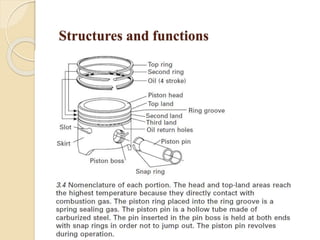
Functions 
 The oval shape of the cam lobe determines the lift 
(displacement) of inlet and exhaust valves. The valve 
itself has an inertial mass. If the curved shape of the 
cam lobe surface is not designed appropriately, then 
the valve cannot accurately follow the contour and 
this will result in irregular motion. This is likely to 
occur at high revolutions. Lighter moving parts in the 
valve train will enable high-speed revolutions. 
 Increasing the tension of the valve springwill increase 
reactive force, helping to prevent irregular motion of 
the valves. 
 However, the high reactive force will result in high 
contact pressure on the cam lobe, so the cam lobe 
should have high wear resistance.
Functions 
 It is essential that adequate amounts of lubricating oil 
are supplied to the cam lobe. The contact between the 
curved surface of the cam lobe and the flat face of the 
valve lifter (bucket tappet) generates high stress,1 and 
therefore both parts require high wear resistance 
where contact occurs. 
 In the DOHC mechanism, the cam lobe makes contact 
with the head of the valve lifter directly or via a thin 
round plate (pad or shim), which is positioned on the 
valve lifter head. The high contact pressure means a 
much harder material is needed for the shims. 
 The SOHC mechanism uses rocker arms. The face 
that is in contact with the cam lobe also needs to have 
good wear resistance.
Tribology of the camshaft and valve lifter 
 The reactive force of the valve spring must be set high 
in order to maintain smooth motion and generate high 
revolutions, as discussed above. The maximum 
permissible surface pressure, usually regarded as the 
decisive parameter limiting cam lobe radius and the 
rate of flank-opening, currently lies between 600 and 
750 MPa, depending on the materials used. 
 When the camshaft is operating at high revolutions, 
contact pressure is reduced by the inertia of the valve 
lifter. Under these conditions, the oil film on the 
running face is maintained most easily, providing 
hydrodynamic lubrication. Contact pressure is 
therefore highest and lubrication most challenging 
when the engine is idling.
Tribology of the camshaft and valve lifter 
 Pitting is another surface fatigue phenomenon. Pitting normally 
manifests itself as small holes and usually appears under high 
contact pressures. 
 The increased temperature at the running surface that results from 
increased friction lowers the viscosity of the lubricating oil, making 
it less efficient. 
 Under these conditions, the mating metal surfaces lose their 
protective oil film and come into direct contact. Wear can appear on 
either the tappet or the cam lobe. It is very important to choose an 
appropriate combination of materials. 
 The function of the shaft itself is also very important. The torque 
from the crankshaft drives the camshaft, so the shaft portion is 
under high torque and therefore must have high torsional rigidity. 
Figure 5.9 shows a section taken at the journal-bearing portion (as 
indicated in Fig. 5.5). 
 The hole at the center runs along the entire length of the camshaft 
and supplies lubricating oil to the journal bearings
Improving wear resistance of the cam lobe 
 The most widely used material for 
camshafts at present is chilled cast iron 
using a high-Cr cast iron. 
 This type of camshaft has hard cam lobes 
with a strong but soft shaft. 
 The chilled camshaft utilizes the unique 
solidification characteristics of cast iron. 
 Figure 5.10 illustrates the production 
process
Casting Process
Casting Process 
 Let us consider a gradual increase in carbon concentration 
towards 4.3% in the iron-carbon phase diagram. 
 Pure iron solidifies at 1,536 °C. The solidification 
temperature decreases with increasing carbon concentration 
to give a minimum value of 1154 °C at a carbon 
concentration of 4.3%, the eutectic point. 
 Molten iron is transferred from furnace to molds using a ladle 
covered with a heat-insulating lining. In manual pouring, one 
ladle of molten iron can be poured into several molds one 
after another, which takes around five minutes. 
 If the solidification temperature of the metal is high, then the 
pouring must be finished within a very short period of time 
otherwise the molten iron will solidify in the ladle. 
 Hence, with a lower solidification temperature there is more 
time for pouring.
Casting Process 
 Sand molds produce a slow solidification rate because the insulating 
effect of the sand slows cooling. Under these conditions, the carbon 
in the cast iron crystallizes as flaky graphite and the casting 
expands. 
 This expansion ensures that the casting fits the mold shape very 
well. The resultant microstructure of the iron matrix becomes 
pearlite. The microstructure of flaky graphite cast iron has sufficient 
strength for the shaft portion. By contrast, the cam lobe needs high 
hardness to provide good wear resistance. 
 If the rate of solidification of cast iron is fast, the included carbon 
forms into hard cementite (Fe3C). 
 Iron combines with carbon to form cementite because graphite is 
difficult to nucleate at high solidification rates. 
 Microstructure associated with rapid solidification is referred to as 
Ledeburite or chill, it is very hard and is highly suitable for the 
hardness requirements of cam lobes.
Casting Process 
 The cam lobe portion should be cooled rapidly in order to generate 
hard chill. An iron lump called a chiller is used for this purpose. The 
chiller is positioned at the cam lobe and takes heat away from the 
casting, giving a rapid solidification rate. The chiller is normally 
made of cast iron. Figure 5.10 illustrates the relative positioning of 
the chiller and cam. 
 The chiller has a cam lobe-shaped cavity and is inserted into the 
sand mold prior to casting. Except for the chiller, the master mold 
consists of compacted sand. The shape and volume of the chiller 
determine how effective it is at absorbing heat, and it must be 
designed carefully to give the optimum cooling rate. 
 A section of a cam lobe, produced by etching the polished surface 
with dilute nitric acid. 
 The pillar-like crystals, known as a columnar structure, align 
radially at the periphery, whilst they are not seen at the center. . The 
columnar structure is aligned vertically, indicating that solidification 
advanced along the direction of heat flow.
Casting Process 
 Analysis of chemical composition of cast iron 
before pouring: 
 An electric furnace melts the scrap with carbon (to raise 
carbon concentration) and ferro-alloys. 
 The chemical composition must be checked before pouring. 
 If molten cast iron has a high oxygen content, this will lower 
the strength of castings. 
 Carbon and silicon7 are used to remove oxygen from the 
melt, by reacting with oxygen to form CO2 (which comes off 
as gas) or SiO2 (which forms a glassy slag). 
 In addition to this deoxidation effect, both elements greatly 
influence the strength of products through changing graphite 
shape and distribution.
Casting Process 
 Analysis of chemical composition of cast iron before 
pouring: 
 Carbon concentration decreases rapidly in the melt, whereas silicon 
concentration does not. The oncentration of other elements present, such as 
Mn, Cu, Ni, etc., does not change. This means that the carbon concentration 
in the melt must be analyzed and adjusted as necessary just before pouring. 
 Analysis of the carbon concentration in the melt is based on a carbon 
equivalent (CE) value, obtained by measuring the solidification 
temperature of the cast iron. 
 When molten cast iron is cooled, the gradient of the cooling curve becomes 
zero at the temperature at which solidification starts, due to the latent heat 
of solidification. 
 A schematic example is shown in Fig. 5.14. Cooling continues when 
solidification is complete. The cooling curve of water shows similar 
behavior at the freezing point (0 °C), where ice and water coexist. 
 If the water contains salt, the freezing temperature is lower, and 
solidification begins at a lower temperature. 
 The same can be observed in he solidification behavior of cast iron
Casting Process 
 The solidification temperature of cast iron is 
proportional to the sum of the percentage of 
carbon and one-third of the percentage of 
silicon. This is known as the CE value and is 
measured using a CE meter. If the CE value 
is lower than that expected, the cast iron has 
a low concentration of carbon and silicon. 
 A camshaft should chill only at the cam lobe, 
but if carbon and silicon concentrations are 
too low, chill will be generated at the shaft 
portion as well. Measuring CE helps to 
reduce the risk of subsequent failure.
Casting Process 
 Finishing – boring and grinding: 
 The camshaft needs a continuous, longitudinal central hole 
for the passage of oil. This also serves to reduce the weight. 
The hole is made using a gun drill (Fig. 5.15), which was 
originally developed for boring guns. The drill consists of a 
long pipe shaft with a cutting bit at the end. Machining oil is 
transmitted through the pipe to the bit during the drilling 
process. If hard chill has occurred in the central portion of the 
camshaft, this prevents the drill from boring effectively. 
 It is possible to eliminate the boring process by making the 
hole in the camshaft during the initial casting process. Figure 
5.16 shows an example in cross-section. Excess metal is cut 
away using a long shell core.
Casting Process 
 The shape of the cam lobe has a direct influence on engine 
performance. 
 A copy-grinding machine is used to finish the cam lobe. The 
grindstone traces a predetermined master cam. The hard chill 
means that each cam lobe has to be ground in small stages. 
Machine finishing is often followed by gas nitriding or 
manganese-phosphate conversion coating. 
 These improve how the cam lobe adapts to the rocker arms 
during the running-in period. As an alternative to chilled 
camshafts, a cam lobe with a microstructure of carbide and 
martensite has also been proposed. In this case, the camshaft 
is made from hardenable cast iron. 
 After machining, induction hardening on the cam lobe portion 
generates hard martensite, which gives a hardness of around 
52 HRC. It has been reported that tough martensite is more 
resistant to pitting than the chill microstructure
Casting Process 
 Composite structures: 
 Camshafts can also be forged from Cr-Mo steel. The entire 
camshaft is carburized and quench-tempered. The multivalve 
engine employs a greater number of valves, and the gap 
between these valves is consequently narrow, particularly in 
the small-bore-diameter engine, requiring short intervals 
between cam lobes. 
 Chill hardening cannot be used where the gap between the 
cam lobes is narrow because of the difficulty in using the 
chiller, so forged camshafts are used. 
 Assembled camshafts consist of a hollow shaft and cam lobe 
pieces. The cam lobe piece is made from a wear-resistant 
sintered material or hardened high carbon steel. The shaft 
portion is a steel tube.
Casting Process 
 This mixture is pressed into the die, which shapes the material in a process 
called cold compaction 
 The resulting shaped material is still porous and soft. 
 The sintering process in the furnace removes pores through atomic diffusion 
and increases the density of the part. 
 Generally, the compacted powder is heated to a temperature well below the 
melting point of the iron, usually between 1100 °C and 1250 °C, in 
continuous furnaces with a protective atmosphere. 
 A density of 90% to 95% of the maximum theoretical value is quite normal, 
leaving between 5% to 10% porosity. This has some influence on the 
properties of the part, but the strength and hardness that can be achieved 
range from those of cast iron to those of hardened and tempered tool steel.
Casting Process 
 Sintering makes it possible to mechanically mix several 
dissimilar powders. 
 Since sintering does not melt the powders, these can coexist 
in the sintered part so that the alloy composition can be very 
different from that produced during conventional 
solidification. 
 A high amount of hard carbide with a fine dispersion, which 
is not possible in the normal casting process, is thus obtained 
and gives the cam lobes good wear resistance. 
 Powder metallurgy has the potential to produce near-net-shape 
parts, to permit a wide variety of alloy systems and to 
facilitate the manufacture of complex or unique shapes that 
would be impractical or impossible with other metalworking 
processes. 
 In car engine parts, valve seats, main bearing caps and 
connecting rods are made by this process.
Casting Process 
 The chemical composition and hardness of the cam lobes can 
be adjusted in accordance with individual requirements. The 
alloy mixture for sintering contains small amounts of Cu. 
During sintering, the Cu melts and bonds the iron-alloy 
powder particles. 
 The Cu works like a brazing filler metal, and the process is 
known as liquid phase sintering (as opposed to solid phase 
sintering, which does not generate a liquid phase. In 
comparison with the chilled camshaft, the cost of the 
assembled camshaft is generally lower due to lower 
machining costs, and quality control is much better. 
 Several bonding processes have been proposed for assembled 
camshafts. Diffusion bonding, fusing or mechanical joining 
can all be used to join the cam lobes to the shaft. Diffusion 
bonding joins clean metal surfaces together through mutual 
diffusion when heated.
Casting Process 
 Shave-joining is a type of mechanical bonding. 
 The surface of a steel tube is knurled to provide a rough surface. This steel 
tube is then inserted into the hole of the cam. The rough surface produced 
fixes the cam lobe during fitting. In this process, a very high hydraulic 
pressure (around 100 MPa) swells the tube of the shaft from the inside (Fig. 
5.20). 
 The swelled shaft generates residual stresses in the cam lobe, which are 
sufficient to hold it in position. Hydroforming is used on some automotive 
suspension carriers and engine cradles because it can produce a complex 
twisted shape from a tube at low cost. Shrink fitting of the cam lobe piece 
to the steel tube has also been used.
Reducing friction in the valve train 
 The rotation of the cam lobe generates friction on the bucket tappet 
or rocker arm. 
 The bucket tappet drives the camshaft directly and is preferred for 
high-speed engines because it does not use an intermediate part 
(which reduces the rigidity of the valve train) and is of light weight. 
To reduce friction, a TiN PVD coating has been developed and 
marketed. 
 The use of the rocker arm enclosing a roller bearing is becoming 
more common to reduce friction. It has been reported that the drive 
torque is as low as one-third that of the conventional rocker arm. 
 Friction is lower in the rocker arm with a roller bearing but the cam 
lobe receives high Hertzian stress. 
 Figure 5.23 compares the pitting resistance of some materials used 
for cam lobes. The data were obtained using a wear testing machine 
with an actual camshaft. In the comparison, sintered metal has the 
greatest durability at high contact pressure.
Reducing friction in the valve train
Reducing friction in the valve train 
 Rocker arms may also be 
produced using sheet metal 
forming, hot forging or 
sintering. 
 The sintered arm is injection 
molded prior to sintering. 
Steel powder mixed with 
binder wax has sufficient 
viscosity to be injected into 
the metal die to shape a pre-form. 
 After dewaxing, the pre-form 
is sintered in a vacuum 
furnace. 
 This powder-metallurgical 
method is called metal 
injection molding (MIM).
Functions of crankshaft 
 The crankshaft converts reciprocative motion 
to rotational motion. It contains counter 
weights to smoothen the engine revolutions. 
There are two types of crankshaft, the 
monolithic type (Fig. 8.1), used for multi-cylinder 
engines, and the assembled type 
(Fig. 8.2) fabricated from separate elements, 
which is mainly used for motorcycles.
Functions of crankshaft 
 The type of crankshaft determines what kind 
of connecting rods are used, and the possible 
combinations of crankshafts and connecting 
rods. 
 Crankshafts are made from forged steel or 
cast iron. Crankshafts for high volume, low-load 
production vehicles are generally 
constructed from nodular cast iron, which 
has high strength. 
 Fuel-efficient engines require a high power-to- 
displacement ratio, which has increased 
the use of forged crankshafts.
Types of crankshaft 
 The monolithic crankshaft 
 Figure 8.1 shows a forged crankshaft for a four-stroke engine. 
The counterweight attached to the shaft balances the weight 
of the connecting rod (con-rod) and piston, to smooth 
revolutions. The con-rod rides on the crankpin via a plain 
bearing. The main bearing of the crankcase supports the main 
journal of the crankshaft. 
 The deep grooves in monolithic crankshafts are obtained by 
hot forging. Carbon steels such as JIS-S45C, S50C or S55C 
with normalizing or toughening are used. 
 Cr-Mo steel (typically, JIS-SCM435) and Mn steel are used to 
increase the strength. 
 An alternative method using micro-alloyed steel containing V 
is becoming more common, as it is cheaper and does not 
require additional quench-hardening.
The monolithic crankshaft 
 The intricate shape of the crankshaft 
requires a great deal of machining. 
 It is common for about 0.1% lead or sulfur 
to be added to the base steel to improve 
machinability. 
 Included lead or MnS particles 
significantly function as a chip breaker 
and a solid lubricant and increase 
machinability.
The monolithic crankshaft 
 Mass-produced sulfured steel is the oldest free-cutting steel. 
The sulfur is distributed homogeneously in the steel as MnS 
inclusions, which elongate according to the direction of 
rolling. 
 As a consequence, elongation and impact strength in the 
direction transverse to rolling are weak. The machinability of 
this steel is proportional to the amount of sulfur it contains. 
Steel for high strength applications needs to contain less than 
0.12% sulfur. 
 Leaded free cutting steel has isotropic properties in 
comparison with sulfured steel and is used for parts requiring 
high strength. The disadvantage of this steel is low fatigue 
life under rolling contact conditions. Crankshafts are 
normalized or quench-tempered after machining. 
 To increase fatigue strength, induction hardening, 
nitrocarburizing and deep rolling are frequently employed.
The assembled crankshaft 
 Figure 8.2 shows an assembled 
crankshaft from a motorcycle, 
including the connecting rod 
and crankpin. 
 The crankpin is precisely 
ground and forcefitted into the 
crankshaft body. The 
disassembled state is shown in 
Fig. 8.5. 
 The appropriate fitting 
allowance and surface 
roughness give sufficient 
torque. 
 To raise the torque, knurling, 
induction hardening or 
carburizing is often carried out 
around the hole.
The assembled crankshaft 
 This type of crankshaft is used in single or twin-cylinder 
engines for motorcycles. In two-stroke engines,2 the structure 
has less lubrication oil at the crankpin bearing, and so it uses 
needle roller bearings. In low-output engines, the crankshaft 
body, including the shaft portion, is made from toughened 
plain carbon steel, such as JIS-S45 C or S55 C. 
 The toughening process consists of quenching and high 
temperature tempering. 
 Additional induction hardening (described below) partly 
hardens the shaft Portion. Needle roller bearings (see Chapter 
9) run on the surface of the crankpin. 
 The high Hertzian stress caused by the rolling contact leads to 
fatigue failure at the pin surface. Therefore, a carburized Cr- 
Mo steel JIS-SCM415 or SCM420 (described below) is used. 
 A bearing steel with a higher carbon content may also be used 
(SUJ2)
Forging 
 Deformation stress 
 The intricate shape of the crankshaft can be formed through hot 
forging using steel dies. In a red-heat state, steel behaves like a 
starch syrup and is extremely soft, so it molds easily to the shape of 
the forging die. The stress required for deformation is low at high 
temperatures and hot forging takes advantage of this soft state. 
 By contrast, deformation at low temperatures requires high stress, 
and the applied strain makes steel hard (known as work hardening,. 
 Deformation increases the dislocation density in the steel, which 
causes hardening. 
 The crystal grains of steel have equiaxed shapes after the annealing 
and prior to deformation, but they stretch heavily after deformation. 
 Forging at low temperature (cold forging) cannot shape the deep 
grooves necessary for crankshafts and the die cannot withstand the 
load because work hardening dramatically increases the required 
load.
Forging 
 Recrystallization and recovery 
 Metals strained at low temperature undergo changes when heated. 
 Hardness does not change when the temperature is low, but rapidly 
decreases above temperature T1. 
 Changes in hardness are accompanied by microstructural change 
caused by recrystallization. Heavy deformation at low temperature 
leaves the metal hardened and the microstructure changed, as shown 
in Fig. 8.7. 
 Recrystallization creates new crystal grains in the strained matrix, 
which eliminates strain in the microstructures and causes softening 
(Fig. 8.8). The hexagonal pattern (grain boundary) indicates that the 
metal has recrystallized and that new crystals have been generated. 
 Recrystallization substantially decreases dislocation density. Each 
metal has a specific minimum temperature (T1) at which 
recrystallization takes place.
Forging 
 When recrystallized metal is annealed further at a 
higher temperature above T2 (Fig. 8.8), the 
recrystallized grains grow. 
 Below T1, recrystallization does not take place, 
and a rearrangement of dislocations along with a 
decrease in density occurs, resulting in slight 
softening. 
 This is referred to as recovery. Plastic working 
carried out above the recrystallization temperature 
T1 is generally called hot working. 
 The temperature at which recrystallization occurs 
is different for each metal, the recrystallization 
temperature of steel is around 700 °C.
Forging 
 Hot forging of steel is carried out at the red heat state, above 
700 °C 
 During hot forging, steel goes through recrystallization and 
recovery as well as strains. 
 These softening processes remove the accumulated strain and 
thus the steel does not harden (Fig. 8.7), making shaping easy. 
 The recrystallization and recovery that take place during hot 
working are referred to as dynamic recrystallization5 and 
dynamic recovery, respectively. These processes eliminate 
work hardening despite the heavy deformation produced by 
forging, giving malleability. 
 Recovery and recrystallization that take place in cold-worked 
metal during annealing are different, and are called static 
recovery and static recrystallization, respectively.
Forging 
 Hot forging 
 Figure 8.9 illustrates the die forging process for a monolithic 
crankshaft. 
 The steel bar is first sheared into a billet to adjust the weight. 
Induction or gas heating heats the billet to around 1,000 °C, 
using rapid induction heating, which causes less 
decarburization or oxidation. 
 Rough forging distributes the material thickness along the 
axis. Shaping by a forging roll and bending are then carried 
out simultaneously. Die forging then forms the intricate 
shape, and finish forging adjusts dimensional accuracy. 
 Burr shearing removes the flash from the shaped material, 
and the shaped material is then straightened to remove the 
bend. These processes are carried out at red heat and the 
shaped material is machined after cooling.
Forging 
 A water-soluble lubricant is splashed on the die 
surface to cool it. The rapid heating and cooling of the 
die shorten its life, to around 10,000 shots or less. Hot 
forging can shape intricate forms, but cannot give 
high dimensional accuracy because oxide scale 
accumulates on the surface, so the shaped material 
must be milled to give the required shape. 
 Crankshafts need high-strength materials, but these 
generally have low forgeability or machinability, and 
as a result are costly to use. Cr-Mo steel gives higher 
strength, but the higher deformation resistance 
shortens die life. 
 Figure 8.10 shows the process design sheet listing the 
key factors in forging.
Design of forged process
Forging 
 The following keep forging costs low: 
1. Forging at low temperature without heating. 
2. Using soft materials that reduce forging loads, 
resulting in a smaller machine and longer die life. 
3. Shallow shapes that require shallow grooves carved in 
the die do not generate high thermal stress, which 
lengthen die life. 
4. Ensuring low ratio of product to flash (low mold 
yield), where forging defects such as material lapping 
are less likely to occur. 
5. Using very high production numbers for a small 
number of items, whichmeans die changes are fewer 
and therefore operational downtime is reduced.
Forging 
 Despite the requirements of manufacturers to keep costs low, 
it is always the market that determines material, shape and 
production numbers. A skilled forger can optimize the process 
by considering several of the factors listed above and in Fig. 
8.10. 
 The forging machine specifications are determined by the 
necessary dimensional accuracy and the quantity of products. 
There are different types of forging machine classified 
according to the drive system, for instance, air hammer, 
mechanical press, hydraulic press, etc. Crankshafts are forged 
mainly using air hammers and mechanical presses. Hot 
forging with an air hammer requires a shorter time for die 
changes. The die and machine are less costly, but require a 
skilled operator as the material is handled manually. 
 This is appropriate where production numbers are small.
Forging 
 Cold and semi-hot forging 
 Cold forging is carried out at ambient temperatures. Typical forging 
patterns are illustrated in Fig. 8.12 – backward extrusion, forward 
extrusion and upsetting. In shaping a cup from a disk-shaped billet 
(a), the forward extrusion (c) pushes out the crown in the travelling 
direction of the press punch, while the backward extrusion (b) 
pushes out the crown in the opposite direction. Upsetting (d) 
expands the billet. 
 Cold forging does not generate oxide scale because of the low 
temperature, so it produces accurate, near-net shapes without flash. 
The metal can be shaped completely within a closed die, and 
production numbers have increased significantly in recent years. 
This method reduces costs because the near-net shaping using a 
closed die decreases the need for additional milling, but the high 
forging force necessary can shorten die life because of the high 
stress. Cold forging is therefore applied mainly to simple shapes 
such as shafts or round cups. Asymmetric or complicated shapes, 
such as crankshafts, are still produced by hot forging.
Forging 
 Phosphate conversion coating is frequently applied as a solid 
lubricant on the billet surface during cold forging. The 
decrease in friction reduces the forging force. To increase the 
malleability of steel, spheroidizing annealing is often carried 
out. 
 This annealing modifies the lamellar carbide to a round 
shape, which prevents micro-stress concentration and thus 
avoids rupture of the workpiece even under severe straining. 
 Semi-hot or warm forging is carried out at intermediate 
temperatures of around 300–600 °C (Fig. 8.6). The semi-hot 
state of the billet decreases deformation stress. 
 This process is similar to cold forging in that low levels of 
oxide scale keep the accuracy high. It is applied to high 
strength materials or large parts.
Forging 
 Combination forging 
 Closed die forging can produce near-net shapes with minimal 
flashing. 
 However, a high forging force is needed to form the shape. 
Combination forging uses rough shaping by hot forging followed by 
cold forging. If a part can be produced by several different methods, 
then production volume determines the most suitable forging 
process. 
 Precision forging using a closed die can produce a near-net shape. 
Although the precision die is expensive, less milling is required and 
so precision forging is less costly for large production volumes. For 
small production volumes, rough hot forging and finishing by 
milling are generally used because the die for hot forging is cheaper. 
 Ring rolling, which shapes annular rings through rolling, and 
powder forging, which raises the density of sintered parts, are 
among the special forging methods required in some situations.
Surface-hardening methods 
Carburizing 
 Steel automobile parts operate under sliding or rolling 
conditions and are highly stressed at the surface. Various 
surface hardening processes are used, and carburizing is a 
typical case-hardening process used for pins and gears. 
 The single or twin-cylinder engine generally uses a needle 
roller bearing at the big end of the connecting rod. 
 The big end works as an outer raceway for the rollers and the 
crankpin as an inner raceway. 
 The rolling contact that these surfaces are subjected to results 
in a high Hertzian stress. 
 Both big end surfaces of the connecting rod and crankpin are 
generally carburized to raise surface hardness to counteract 
this stress. 
 Carburizing gives very high hardness and is resistant to wear, 
but surface failure can occur if operating conditions are too 
severe.
Surface-hardening methods 
 Pitting is a typical fatigue phenomenon that occurs under high 
contact pressure. 
 The white microstructure contains cracks, and these cracks 
are the cause of the pitting. 
 This type of failure is likely to appear in shallow portions, 
where Hertzian stress is at its maximum. 
 These cracks often accompany white or dark regions under 
microscopy. 
 These are clearly observed after the chemical etching of the 
microstructures and called white etching or dark etching 
regions. 
 A butterfly shaped microstructure is also observed. 
 These microstructures, characteristic of surface failure, are 
often generated at the periphery of nonmetallic inclusions.
Surface-hardening methods 
 Carburizing is carried out by exposing a part made of low carbon steel for a 
defined period of time in a hot atmosphere with a high carbon 
concentration (CO), which enriches the carbon concentration at the surface. 
 Then the part is quenched in water or oil, whereupon a martensitic 
transformation takes place at the surface because of the rapid cooling and 
the high carbon concentration on the surface. 
 The part does not undergo a martensitic transformation internally because 
of the slow cooling rate and low carbon concentration away from the 
surface, thus hardening takes place only at the surface and the center of the 
part stays soft.
Surface-hardening methods 
 Figure 8.17 shows a typical hardness distribution curve for a 
carburized part according to depth from the surface, showing a 
hardness of 710 HV at 50 μm below the surface. 
 Two values representing the hardness distribution after carburizing 
are generally used for quality control, effective case depth and total 
case depth. The effective case depth is the thickness of the portion 
showing a higher hardness than the prescribed value.The total case 
depth is the thickness showing a higher hardness than the base steel. 
 These values measured in the hardness distribution curve guarantee 
the carburizing heat treatment.
Surface-hardening methods 
 Carburizing consists of a series of heat treatments; carburizing, quenching 
and tempering. 
 Figure 8.18 explains the principle of carburizing using the iron-carbon 
phase diagram. 
 First, the carbon concentration is increased to around the eutectoid point 
(0.8% C) (represented by the solid arrows in Fig. 8.18), in the process 
known as eutectoid carburizing. 
 The atmosphere in the furnace supplies the carbon atoms, and when it is 
sufficiently high, the carbon atoms spontaneously permeate into the steel. 
 Carbon atoms rapidly diffuse at temperatures above A1
Surface-hardening methods 
 Then quenching and tempering (Fig. 8.19) raise the hardness 
and toughness of the carburized steel through martensitic 
transformation. 
 The austenite phase can dissolve a larger amount of carbon. 
Excessive carburizing beyond the eutectoid point 
(represented by the broken arrows in Fig. 8.18) generates 
carbides and is called supercarburizing.
Surface-hardening methods 
Nitriding 
 It is a case-hardening treatment carried out in enriched 
nitrogen. When a steel part is placed in a hot, nitrogen-rich 
atmosphere containing NH3, the NH3 decomposes 
at the steel surface to catalytically generate elemental 
nitrogen, which diffuses into the material. 
 The nitrogen expands the iron lattice and also forms 
hard compounds (the nitrides Fe4N and Fe3N) with iron 
atoms. The expanded lattice and finely dispersed nitrides 
immobilize dislocations and so harden the steel surface. 
Unlike carburizing, quenching is not necessary after 
nitriding.
Surface-hardening methods 
Nitriding 
 This treatment is carried out in the temperature range where α iron 
exists in the iron-carbon phase diagram. Normally it is around 500– 
520 °C. To obtain very high levels of hardness, 40 to 100 hours of 
nitriding are needed. 
 Nitridable steel reaches the necessary hardness by forming stable 
nitrides, which requires alloying elements such as Al, Cr, Mo, V 
and/or Ti. Al gives high hardness, Cr increases the thickness of the 
nitrided layer and Mo suppresses temper embrittlement (even if the 
part is heated for a long time during nitriding). 
 Productivity is low, so that this treatment is used only for special 
purposes at present. Conversely, nitrocarburizing is widely used for 
massproduced parts.
Surface-hardening methods 
Nitrocarburizing 
 Nitrocarburizing is another case-hardening process, and is 
also known as ferritic-nitrocarburizing, or cyaniding. 
 It is a modified nitriding process in which a gas containing 
carbon is added to the ammonia atmosphere. 
 Steels held at high temperatures in this gaseous atmosphere 
absorb carbon and nitrogen simultaneously, at a temperature 
below A1(around 560 °C), in the errite region of the phase 
diagram. 
 The shorter time period as well as the lower temperature 
gives a shallow case depth, typically about 0.1 mm. 
 The amounts of nitrogen and carbon in the layer are 
adjustable within certain Limits.
Surface-hardening methods 
Nitrocarburizing 
 Gas nitrocarburizing is suitable for mass-produced 
parts.20 N and C are diffused under an 
atmosphere of 50% NH3 and 50% RX gas (a 
transformed gas of propane and butane). 
 Heat treatment at around 560 °C results in a hard 
surface containing Fe3N.The hardness can be 
adjusted by changing the time of treatment, from 
15 minutes up to 6 hours. 
 It is normally implemented in a tunnel-type 
furnace, where parts enter at one side and exit on 
the opposite side, but a batch type furnace may 
also be used.
Surface-hardening methods 
 Carburizing is implemented in the austenite region at around 900 °C and 
distortion22 during heating and quenching is likely to occur. By contrast, 
nitrocarburizing is implemented at temperatures as low as 560 °C and does 
not cause martensitic transformation, distortion is, therefore, less after this 
treatment. 
 Liquid nitrocarburizing, also called cyaniding, is carried out in a molten 
salt bath, using a mixture of cyanides XCN, XCNO, and X2CO2 (X: Na or 
K). The hardening agents CO and elemental N are produced in the bath in 
the presence of air. 
 It is possible, within limits, to regulate the relative amounts of carbon and 
nitrogen in the surface layer. The treatment time ranges from 15 minutes to 
3 hours. This process gives a hard layer in alloys such as stainless steel, for 
which gas nitrocarburizing cannot give sufficient hardness. 
 It is typically used for engine valves which have a high Cr content. Since it 
only requires a bath for molten salts, the facility is less costly, even when 
production numbers are small. However, its use is becoming less common 
due to the hazardous nature of the cyanide bath.
Surface-hardening methods 
 Carbonitriding 
 The carburized surface loses hardness when kept at temperatures above 
200ºC. In the figure, carburizing produces a greater decrease in hardness 
after two hours in comparison with the other methods. By contrast, case-hardened 
layers containing N (super carbonitriding and carbonitriding) lose 
hardness more slowly. This is due to the effect of the stable nitride 
compound dispersed in the matrix, whereas the martensite in the carburized 
layer rapidly loses hardness when heated above 200 °C. 
 Engine parts are sometimes exposed to high temperatures as well as high 
stress. For such a situation carbonitriding is very effective. This treatment 
generates a carburized surface containing nitrides, giving a stronger surface 
at elevated temperatures than that obtained by normal carburizing. Carbon 
and nitrogen diffuse simultaneously in carbonitriding. Carbon enrichment is 
the main process, but nitrogen enrichment occurs if the nitrogen 
concentration in the gas is sufficiently high. The amounts of carbon and 
nitrogen in the layer are adjustable according to the composition of the gas 
and its temperature.
Surface-hardening methods 
 Carbonitriding has been found to be very effective at raising 
the strength of parts subjected to extremely high contact 
stress. This treatment is successfully applied in transmission 
gears23 as well as ball and needle bearings. 
 A carburized layer containing N has superior heat resistance 
as observed in Fig. 8.22, so it can withstand the heat caused 
by the high contact stress at the surface. 
 Roller bearings of JIS-SUJ2 steel use carbonitriding at the 
austenite region to increase resistance to rolling contact 
fatigue. 
 Supercarbonitriding generates a carburized surface containing 
both nitrogen and globular carbide. It has been used 
successfully to give a long rolling contact fatigue life to the 
crankpin of an assembed crankshaft.
Surface-hardening methods 
 Ion nitriding 
 Ion (plasma) nitriding makes use of an ionized gas that serves 
as a medium for both heating and nitriding. The parts are 
placed in a vacuum chamber and the furnace is filled with 
process gas containing N2 and H2 to a pressure of 100–800 
Pa. 
 The plasma is created through glow discharge by applying a 
direct electrical current, with the part acting as the cathode 
and the chamber wall acting as the anode. The applied 
voltage (300–800 V) accelerates the ions towards the surface 
of the part. 
 The plasma process operates at temperatures between 400 and 
800 °C and the treatment is generally implemented by batch. 
It is frequently used for forging dies or casting molds to raise 
resistance to wear and thermal fatigue.
Surface-hardening methods 
 Vacuum plasma carburizing has been investigated. This process is similar 
to the ion nitriding process. Plasma carburizing using methane is a special 
process for partial hardening and carburizing of internal bores. The plasma 
is created between the part as cathode and the chamber wall as anode. For 
partial carburizing, the plasma effect may be prevented by covering with 
metallic conducting masks or sheet metal where it is not required. The 
plasma cannot develop under the cover and therefore the covered surface 
remains free of carburizing. 
 The terminology of carbonitriding and nitrocarburizing often creates 
misunderstandings. 
 Carburizing is the term for adding only carbon. In carbonitriding, the main 
element is carbon with a small amount of nitrogen. The dopant in nitriding 
is nitrogen alone. In nitrocarburizing, the main dopant is nitrogen but a 
small amount of carbon is added simultaneously. For carburizing and 
nitriding, the difference is clear. On the other hand, carbonitriding and 
nitrocarburizing are frequently used with the same meaning. 
 The terminology ‘austenitic nitrocarburizing’ is also used.
Surface-hardening methods 
 Induction hardening 
 The following methods may be classified as simply thermal 
treatments without chemical change. They can be used to harden the 
entire surface or localized areas. Some methods heat only the 
surface of a part. If a part made of high carbon steel is heated to 
austenite only at the surface, the subsequent water quenching 
transforms the surface into martensite to raise hardness at the 
surface. 
 Flame-hardening consists of austenitizing the surface by heating 
with an oxyacetylene or oxyhydrogen torch and immediately 
quenching with water. 
 This process only heats the surface so that the interior core does not 
change. 
 This is a very convenient process and is sometimes used for surface-hardening 
large dies with air cooling, since highly alloyed tool steel 
for dies hardens even in air cooling. However, managing the 
hardness can be difficult.
Surface-hardening methods 
 Induction hardening is an extremely versatile method 
that can produce hardening over an entire surface, at a 
local surface or throughout the thickness. 
 A high-frequency current generated by an induction 
coil heats and austenitizes the surface, and then the 
part is quenched in water. The depth of heating is 
related to the frequency of the alternating current; the 
higher the frequency, the thinner or more shallow the 
heating. 
 Tempering at around 150 ºC is subsequently carried 
out to increase toughness. Induction heating is also 
used for tempering after quenching. The monolithic 
crankshaft uses induction hardening25 of the crankpin 
and the corner radii between the crankpin and web.
Surface-hardening methods 
 The assembled crankshaft uses induction hardening of the 
hole into which the crankpin is forcefitted and of the corner 
radii. Figure 8.23 shows the hardness distribution26 of steel 
JIS-S50 C normal to the surface. 
 Figure 8.24(a) schematically illustrates the microstructures 
generated by induction hardening. The induction coil is also 
shown. The hardened microstructure shows a pattern 
(quenching pattern) when the crosssection is chemically 
etched, as shown in Fig. 8.25. 
 Martensitic transformation expands the crystal lattice of the 
surface, whereas the untransformed internal portion restricts 
the expansion. This restraint leaves a compressive residual 
stress27 in the surface and such stress raises wear resistance 
and fatigue strength.
Surface-hardening methods 
 Induction hardening gives high hardness at the surface, but is 
accompanied by an undesirable soft area just under the surface. The 
softened layer appears broadly at the boundary between the 
hardened area and unhardened area. 
 It also appears at the surface (Fig. 8.24(a)) where the induction 
hardening is terminated. The soft area is caused by incomplete 
austenitizing near point A1. 
 Generally, this layer has a tensile residual stress. Figure 8.24(b) 
shows a residual stress distribution in the longitudinal direction 
measured by X-ray. A high tensile stress is observable at the edge (– 
3 mm from the point 0) of the hardened area, and a stress 
concentration at the edge is likely to initiate fatigue cracking. 
 Therefore the edges of the hardened area must never be near fillets, 
notches or grooves, so these must be included in the hardened area. 
Weaknesses can be avoided by adjusting the shape of the part or the 
quenching pattern.
Surface-hardening methods 
 Induction hardening is a short-term heat treatment method, 
and it must be ensured that the initial microstructure can 
transform rapidly into homogeneous austenite during heating. 
 Normalizing or toughening prior to induction hardening can 
decrease the dispersion of hardness at each position. Since the 
installation for induction hardening is compact, hardening can 
be implemented in the machining line without having to 
transport the part to a heat-treating plant. 
 If the part is completed without tempering, or with tempering 
by induction heating, a build-up of stock waiting for the 
additional heat treatment is avoided and cost is lowered. 
 However, induction hardening is likely to distort a thin and 
long crankshaft, and so it is mainly used for crankshafts with 
a thick crankpin diameter.
Micro-alloyed steel 
 The heat treatments described above can 
improve desirable properties, but they also 
raise costs. 
 Recent cost-saving measures have included 
the increasing use of micro-alloyed high-strength 
steel instead of the conventional 
quenchhardened steel for crankshafts. 
 Developments in manufacturing techniques 
and in alloyed steels have led to improved 
strength, increased fatigue properties and 
enhanced machinability in micro-alloyed 
steels.
Micro-alloyed steel 
 Precipitation hardening is the main method for 
increasing strength at the cooling stage after hot 
forging. 
 Micro-alloyed steel contains a small amount of 
vanadium, which dissolves in the matrix during hot 
forging above 1,200 °C. 
 During air cooling, the dissolved V combines with 
carbon and nitrogen to precipitate as vanadium 
carbide and nitride at around 900 °C. 
 Tempering after air cooling is not necessary because 
these precipitates in the ferrite and pearlite matrix 
strengthen the steel. 
 Maintaining the required temperature for a period of 
time after hot forging ensures sufficient precipitation.
Micro-alloyed steel 
 Figure 8.26 shows the relationship between cooling rate, 
hardness and tensile strength. Controlling both forging 
temperature and cooling rate adjusts hardness and strength to 
obtain the required values. For example, a 100 mm diameter 
rod has a cooling rate of 10 °C/min from 1,200 °C.
Micro-alloyed steel 
 The diagram indicates that hardness for this rod at this 
cooling rate will be around 280 HV, and the tensile strength 
around 900 MPa. In the range given in Fig. 8.26, the faster 
the cooling rate, the higher the hardness. This is because 
higher cooling rates give a finer pearlite matrix, which in turn 
means that the vanadium carbide and nitride will be more 
finely dispersed.
Micro-alloyed steel 
 Strength is controlled by adjusting the 
cooling after hot forging. 
 If cooling is not controlled accurately, this is 
likely to cause a large dispersion in strength. 
 An automatic forging system and a special 
cooling hanger are normally used to control 
cooling. 
 Final strength is also very sensitive to the 
chemical composition of the steel, and this 
must be adjusted carefully.
Micro-alloyed steel 
 The use of lead-free micro-alloyed steel for 
crankshafts has been suggested for environmental 
considerations. 
 For crankshafts, impact strength is not so important, 
but it is crucial for suspension parts. 
 Figure 8.27 shows how strength and toughness of 
microalloyed steel developed over time..
Micro-alloyed steel 
 The original micro-alloyed steel had a 
medium carbon concentration and added 
V using precipitation hardening. 
 The coarse ferrite-pearlite microstructure 
generated by slow cooling after hot 
forging, however, did not provide high 
toughness and as a result, the steel had a 
limited application.
Micro-alloyed steel 
 High strength can be obtained without 
reducing toughness by reducing carbon and 
compensating for the resultant loss of 
strength by adding alloyed elements. 
 This type of alloy generates bainite or 
martensite, but these microstructures are 
unstable in air cooling. 
 Without appreciably changing the chemical 
composition and ferrite-pearlite 
microstructure, both strength nd toughness 
are increased only by grain size refinement.
Micro-alloyed steel 
 As shown in Fig. 8.28 grain size is reduced by 
controlling forging conditions and by adjusting steel 
quality. Forging at low temperature can reduce grain 
size, while the increased forging load shortens die life.
Micro-alloyed steel 
 As shown in Fig. 8.28 grain size is reduced by 
controlling forging conditions and by adjusting steel 
quality. Forging at low temperature can reduce grain 
size, while the increased forging load shortens die life. 
 Another way to obtain fine grain size is to use 
inclusions in steel. Precipitated nitride and sulfide, 
such as TiN and MnS, can make the austenite grain 
fine during forging. 
 In addition, the precipitates act as nuclei for the ferrite 
to promote refining of grains on cooling after forging. 
 The refined ferrite pearlite microstructure raises 
toughness as well as strength, widening the 
application of this type of steel.
Micro-alloyed steel 
 There is still a need to develop strong but sufficiently 
machinable steel. Yield strength directly relates to 
fatigue strength and buckling strength. The higher the 
yield strength, the higher the fatigue and buckling 
strengths. 
 On the other hand, machinability relates to the 
hardness. 
 The higher the hardness, the lower the machinability. 
 Hardness is proportional to tensile strength (σUTS), so 
machinability decreases with increasing σUTS of the 
steel. 
 In order to increase fatigue strength without reducing 
machinability, yield strength should be increased 
without raising the ultimate tensile strength.
Micro-alloyed steel 
 The ratio of yield strength to tensile strength, Ry, 
is given by σy /σUTS; a strong but machinable steel 
should have a high yield ratio value. 
 In comparison with normal carbon steel after 
normalizing or toughening, micro-alloyed steel 
generally has a lower yield ratio. 
 Typically, the Ry value of a normalized steel 
measures around 0.85, while that of a micro-alloyed 
steel is around 0.7. 
 Changing the chemical composition can improve 
the value. The yield ratio is an important indicator 
in developing a well-balanced micro-alloyed steel.
Micro-alloyed steel 
 Micro-alloyed steel does not need conventional 
quenching and tempering, therefore costs are lower 
and the steel is suitable for intricate shapes, because 
the thermal distortion that accompanies quench-hardening 
is avoided. 
 Micro-alloyed steels can give good strength in the as-rolled 
condition, after forging or cold working, and 
their use for automotive steel parts is increasing. 
 High-strength bolts are made of high-strength micro-alloyed 
steel that has improved cold forgeability. 
 Micro-alloyed steel for cold heading wire rod is 
increasingly used at tensile strengths above 800 MPa.
UNIT 5 
CONNECTING ROD
Contents 
 Functions 
 The monolithic con-rod 
 The assembled con-rod 
 The plain bearing 
 Fracture splitting
Functions 
 The crankshaft con-rod 
mechanism transforms 
reciprocative motion to 
rotational motion. 
 The con-rod connects the 
piston to the crankshaft to 
transfer combustion 
pressure to the crankpin. 
 There are bearing portions 
at both ends, the piston 
side is called the small end, 
and the crankshaft side, the 
big end.
Stresses on Connecting rod 
 The con-rod must withstand 
very high forces as the piston 
moves within the cylinder bore. 
 The shaft portion of the con-rod 
is subjected to bending as well 
as tension and compression. 
 The bearing portions receive 
load from the weight of the 
piston and the con-rod. To avoid 
failure of the bearings, the con-rod 
should be made as light as 
possible. To avoid buckling, the 
rod portion usually has an I-beam 
shape because of the high 
rigidity-to-weight ratio of this 
shape.
Stresses on Connecting rod 
 Although con-rods for both four-stroke and two-stroke 
engines have an I beam shape, the thickness 
distribution is slightly different in the two engines. 
 The four-stroke con-rod receives a large tensile load 
during the exhaust stroke as well as a compressive 
load during the combustion stroke. 
 The inertial force of the reciprocating mass generates 
a tensile load which is proportional to the product of 
the piston assembly weight, reciprocating mass of the 
con-rod and square of the rotational velocity. 
 It is bigger than the compressive load above a certain 
rotational speed.
Types of connecting rod 
1. The monolithic con-rod 
2. The assembled con-rod
The monolithic con-rod
The monolithic con-rod 
 Figure shows a monolithic con-rod. The monolithic con-rod 
has a needle roller bearing at the big end, which is illustrated 
in Fig. 9.5 
 The two-stroke engine requires a needle roller bearing 
because the big end has less lubricating oil due to the 
structure. In four-stroke engines, lubricating oil is abundant in 
the crankcase, and the assembly type of con-rod is used 
because of the lower cost of this simpler structure.
The monolithic con-rod 
 Figure shows a needle roller bearing for the big 
end. The needle rollers held in the retainer are 
inserted into the big end and run on the outer 
raceway of the big end and the inner raceway of 
the crankpin. 
 The roller itself receives high stress and also 
exerts high Hertzian stress on the rolling surfaces. 
 The retainer(cage) separates the rollers, 
maintaining an even and consistent spacing during 
rotation, and also guides the rollers accurately in 
the raceways to prevent the rollers from falling 
out.
The monolithic con-rod 
 The big end is carburized to increase rolling 
contact fatigue strength, and honing finishes 
the surface accurately. 
 Carburizing is required only at the rolling 
surface and copper plating is used as a 
coating to prevent other portions from 
carburizing. 
 If carburizing hardens the entire con-rod, the 
subsequent straightening tends to cause 
cracking
The assembled con-rod 
Structure and material: 
 The big end consists of two parts. The bottom part 
is called the bearing cap, and this is bolted to the 
con-rod body. 
 Honing finishes the assembled big end boss to an 
accurate circular shape. The mating planes of the 
cap and rod body should be finished accurately in 
advance because this influences the accuracy of 
the boss. The plain bearing is sandwiched between 
the crankpin and big end. 
 Hot forging shapes the assembled con-rod. 
 Free-cutting steels are frequently used when high 
machinability is required. 
 Toughening is a typical heat treatment for carbon 
steel.
The assembled con-rod 
The con-rod bolt 
 Con-rod bolts and nuts clamp the bearing cap to the con-rod 
body, sandwiching the plain bearing. The bolt is tightened 
with an appropriate load to prevent separation of the joint 
during operation, and so the bolt must be able to withstand 
the tightening load and the maximum inertial force.
The assembled con-rod 
 To reduce the weight of the big end, the bolt hole 
should be positioned close to the big end boss. 
 Some bolt heads have elliptical shapes to prevent 
them from coming loose. 
 To prevent the joint between the cap and body from 
shifting, the intermediate shaft shape of the close-tolerance 
bolt should be finished accurately. 
 The pitch of the screw portion must also be narrow. 
 Some con-rods do not use a nut because the cap screw 
threads into the con-rod body itself. 
 This type can lighten the big end, but is likely to 
cause stress concentration on the screw thread. Using 
a nut can help to prevent fatigue failure in bolts.
The assembled con-rod 
 The inertial forces from the piston, piston pin and 
con-rod body tend to separate the joint between the 
body and cap. 
 Even a slight separation increases friction loss at the 
big-end boss, and shortens the life of the plain 
bearing. 
 The stress on the con-rod bolt relates not only to the 
shape of the big-end boss but also to the rigidity of the 
bolt itself. 
 The big-end boss should remain circular when the 
connecting rod bolts are tightened. 
 The mating planes in the joint should lock the con-rod 
body and cap in perfect alignment, hence smooth 
mating surfaces are required. Stepped mating planes 
can prevent the joint from shifting.
The assembled con-rod 
 Figure 9.18 shows distortions in the big-end 
bore under load. 
 The conrods under comparison have the 
same shape but are made of different 
materials; titanium (Ti-6Al-4V, indicated as 
TS) and Cr-Mo steel SCM435 (SS). 
 Both circles show upward elongation, while 
the titanium con-rod, which has a lower 
Young’s modulus, shows the larger 
distortion.
The plain bearing 
 In the assembled con-rod, a plain bearing is generally 
used. The split plain bearing rides on the crankpin, 
fitting between the con-rod and the crankpin. It is a 
removable insert, as is the main bearing insert that 
supports the main journals of the crankshaft. 
 The crankpin rotates at a peripheral velocity of about 
20 m/s. The piston and con-rod produce several tons 
of downward force. The plain bearing receives a 
contact pressure of typically around 30 MPa. 
 The contact pressure is the pressure that the unit area 
of the sliding surface receives. The contact pressure 
(P) is calculated with the load (W), the shaft diameter 
(d), and the bearing width (L). 
P = W/(d × L)
The plain bearing 
 An appropriate gap is necessary between the 
plain bearing and crankpin so that oil 
penetrates the gap to lift up the crankpin, 
providing hydrodynamic lubrication during 
rotation. 
 The plain bearing must conform to the 
irregularities of the journal surface of the 
crankpin. 
 It should have adequate wear resistance at 
the running-in stage, high fatigue strength at 
high pressure and sufficient seizure 
resistance at boundary lubrication.
The plain bearing 
 The plain bearing should also have the ability to absorb dirt, 
metal or other hard particles that are sometimes carried into 
the bearings. 
 The bearing should allow the particles to sink beneath the 
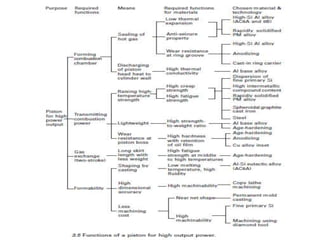
surface and into the bearing material. 
 This will prevent them from scratching, wearing and 
damaging the pin surface. 
 Corrosion resistance is also required because the bearing must 
resist corrosion from acid, water and other impurities in the 
engine oil. 
 The allowable contact pressure was only 10 MPa. 
 Because of this low contact pressure, the crankpin diameter 
had to be increased to decrease the contact pressure. 
 To overcome this, a Cu-Pb alloy bearing having a higher 
allowable contact pressure was invented.
The plain bearing 
 Figure 9.19 schematically illustrates the cross-sectional view of a 
plain bearing. 
 It comprises three layers; the backing metal, which is a steel plate 
facing the con-rod, an intermediate aluminum alloy layer (Al-Sn-Si 
alloy) that has particulate Sn dispersed in the aluminum-silicon 
matrix, and a soft layer (Sn plating), called overlay, on the inside. 
 The steel backing plate supports the soft aluminum alloy and the 
additional soft overlay gives wear resistance during running-in.
The plain bearing 
 The Sn overlay has a low melting temperature of 232 °C. 
 Friction heat is likely to accelerate the diffusion of Sn into the 
bearing layer and cause a loss of Sn from the overlay. 
 To prevent this, a thin layer of Ni is inserted between the 
bearing metal and overlay. This is referred to as the Ni dam. 
 The steel backing plate is laminated to the aluminum alloy 
sheet by cold rolling. 
 Figure 9.20 illustrates schematically the rolling process.
The plain bearing 
 The high pressure between the rollers causes 
plastic deformation at the interface between the 
metals, resulting in strong metallic bonding. 
 This two-metal structure is called clad metal. 
 The plain bearing is shaped from the clad metal 
by a press machine. 
 The Cu-Pb plain bearing also has a bimetal 
structure, where sintering laminates the Cu-Pb 
layer to the steel backing plate. 
 In this process, a Cu-Pb alloy powder is spread 
onto the Cu-plated steel plate. The powder layer is 
sintered and diffusion-bonded to the steel plate at 
high temperatures.
The plain bearing 
 Bearing metals contain soft metals such as tin or lead. These 
soft metals can deform to the shape of the adjacent part (the 
crankpin in this instance) and also create fine oil pools at the 
rubbing surface. 
 However, if the bearing consists only of soft metals, it wears 
out quickly. 
 Appropriate wear properties are provided by small particles 
of tin dispersed in the harder aluminum alloy. 
 Lead particles perform this function in the copper-lead alloy. 
Although bearings containing lead have superior material 
properties, environmental considerations have led to the 
development of a Cu-Sn-Ag bearing as an alternative to the 
Cu-Pb bearing. 
 An Al-Sn-Si alloy is also being used to replace Al-Pb 
bearings.
Fracture splitting 
 The mating planes for the joint should be 
smoothly machined to lock the con-rod body 
and cap in perfect alignment. 
 Positioning using a step mating plane or a 
knock pin, which prevents the joint from 
shifting, is sometimes used. 
 These joint structures give good accuracy for 
plain bearings, but the machining required 
raises the cost of production. 
 To address this increase in cost, an 
alternative method using a broken jagged 
surface at the joint plane has been 
introduced.
Fracture splitting 
 The con-rod in this instance is referred to as a fracture 
split con-rod. The cap is cracked off to produce a 
rough mating surface as shown in Fig. 9.22 
 This surface helps lock the con-rod body and cap in 
perfect alignment and prevents the cap from shifting. 
 The manufacturing process is as follows: first, forging 
and machining shape the big end monolithically.
Fracture splitting 
 After completion, the monolithic big end is broken 
into two pieces (the bearing cap and the rod body), by 
introducing a crack at the joint surface. 
 Special splitting tools have been developed in order to 
split the big end with minimal plastic deformation. 
 To generate cracking at the correct position, notches 
are carved in the internal surface of the big end by 
laser or mechanical broaching. 
 The fractured surfaces should fit exactly into position 
when both portions are overlapped and fastened by 
bolts. 
 Any plastic deformation during splitting should be 
avoided, because if plastic deformation takes place, 
the broken surfaces cannot fit together.
Fracture splitting 
 The crack should not cause branching, otherwise it is 
difficult to reassemble. 
 The fracture split con-rod is made from sintered steel, 
hot forged high carbon steel or hot forged micro-alloyed 
steel. 
 Good mold yield of the sintering (powder metallurgy) 
method lowers costs. 
 The manufacturing process for sintered steel has two 
steps, first, cold compaction of a powder in the mold 
and secondly, sintering the pre-form in a furnace to 
give enough bonding between powder particles. 
 The added Cu increases the density of the sintered 
part through liquid phase sintering.
Fracture splitting 
 Additional hot forging (called powder forging) 
increases strength by removing small pores in the 
sintered steel. 
 Splitting should take place in a brittle manner without 
plastic deformation, and the sintered con-rod is 
suitably brittle. 
 High carbon steel, around 0.7% C, is particularly 
good for this type of con-rod because it can be broken 
easily and the microstructure is pearlitic. 
 Micro-alloyed steel with a typical chemical 
composition of Fe-0.7%C-0.2Si-0.5Mn-0.15Cr-0.04V 
has also been tested for fracture splitting. 
 The vanadium is alloyed to give precipitation 
hardening properties, and the cooling process after hot 
forging is controlled so that precipitation guarantees 
strength
Fracture splitting 
 The use of fracture split con-rods is increasing because of low 
costs and high dimensional accuracy at the big end. 
 To increase fatigue strength against bending, a case-hardened 
fracture split con-rod has also been developed. 
 The fracture split con-rod was originally developed for 
outboard marine engines, which are placed at the stern of a 
boat. 
 Two-stroke multi-cylinder engines are widely used because of 
good acceleration performance and high durability. 
 The exhaust displacement measures about 3,000 cm3 at its 
maximum. 
 The multi-cylinder engine employs a monolithic crankshaft 
because of the need for dimensional accuracy.
Fracture splitting 
 However, a needle roller bearing is indispensable 
at the big end of the two-stroke engine, and so the 
con-rod should be of the assembled type. 
 Since it is difficult to keep dimensional accuracy 
in the machined con-rod, fracture split technology 
has been introduced. 
 The needle-bearing retainer also has to be split. 
Both ends require high hardness for needle rollers, 
so carburizing is used to give sufficient hardness 
to the rolling surface. 
 The monolithic crankshaft is also carburized to 
improve wear resistance to needle rollers.
UNIT 6 
CATALYST
Contents 
 The development of catalysts for petrol 
engines 
 Structures and functions 
 The three-way catalyst 
 The honeycomb substrate 
 Controlling pollutants at cold start 
 Exhaust gas after-treatment for diesel 
engines
The development of catalysts for 
petrol engines 
 The air-polluting effects of internal-combustion 
engines were not recognized until the early 1960s. 
 Up until that time, improvements in power output and 
exhaust noise were the main areas of development. 
 The driving force for change originated in the first 
measures to control air pollution, which were 
introduced in the smog-bound city of Los Angeles, 
USA. 
 Controls for exhaust gases from motor vehicles were 
introduced in Japan and Europe soon afterwards. 
 These early measures were focused on carbon 
monoxide (CO) and unburned hydrocarbon (HC).
The development of catalysts for 
petrol engines 
 The use of oxidizing catalysts to convert HC and 
CO has been mandated under exhaust gas 
regulations in the USA and Japan since 1975. 
 The main components of the early catalysts were 
base metals such as Co, Cu, Fe, Ni and Cr. 
 However, these were found to degrade over time, 
and precious metal catalysts were introduced to 
address problems of sulfur poisoning and metal 
evaporation. 
 Unleaded petrol was developed because it was 
found that the lead in petrol coated the catalysts 
and made them ineffective.
The development of catalysts for 
petrol engines 
 An exhaust gas recirculation (EGR) system 
was introduced to decrease NOx emissions, 
but catalysts to remove NOx were not legally 
required until 1978. 
 Regulations introduced in Japan (1978) and 
the USA (1981) required a further decrease 
in NOx emissions, and although the 
oxidizing catalyst system addressed HC and 
CO requirements, various controls in the 
engine were necessary to decrease NOx. 
 As a result, power output fell and fuel 
consumption increased.
The development of catalysts for 
petrol engines 
 The first vehicle with a three-way catalyst 
was marketed in 1977, although it was not 
introduced for European cars until 1993. A 
system combining a three-way catalyst with 
electronic fuel injection (EFI) and oxygen 
sensors has now become the standard in 
petrol engines for cars. The three-way 
catalyst system reduces exhaust emissions 
after warming up, but recent legislation on 
emissions now requires a further decrease in 
pollutants, and reducing emissions at cold 
start is an important issue.
Functions of modern exhaust system
Structures and functions 
 Figure 10.1 lists the tasks for modern exhaust 
systems1 and the various functions needed to 
bring about improved engine performance while 
keeping emissions low. 
 The catalytic converter is an important component 
of the exhaust system and efforts to comply with 
emission regulations. The main pollutants are HC, 
CO, and NOx. 
 Figure 10.2 illustrates the concentrations of these 
gases against air/fuel ratio. The concentration of 
each component varies with combustion, air/fuel 
ratio, EGR and ignition timing. HC derives from 
unburned fuel.
Structures and functions 
 The concentration of HC decreases in lean combustion, but 
inversely increases in extremely lean combustion due to misfire. 
 The concentration of CO does not depend on engine load, but does 
depend on the air/fuel ratio. 
 The concentration of NOx is largely influenced by the air/fuel ratio 
and combustion temperature, and shows a maximum value at 
around an air/fuel ratio of 16. 
 Catalysts are materials that cause chemical changes without 
being a part of the chemical reaction. 
 All exhaust gas must flow through the catalytic converter (Fig. 
10.3a). The catalysts clean the exhaust gas by converting the 
pollutants to harmless substances, causing the reaction: 
CO + HC + NOx →CO2 + H2O + N2 inside the catalytic converter. 
The result is an exhaust gas containing less HC, CO and NOx.
Structures and functions 
 Normally, the complete unit is referred to as a 
catalytic converter,. 
 This term should only be used to describe the 
catalytic precious metals. 
 These are platinum (Pt), rhodium (Rh) and 
palladium (Pd). 
 Figure 10.3(b) schematically illustrates catalysts 
in a ceramic monolith. 
 A honeycombed monolith of extruded ceramics or 
wrapped metal foils is normally used as the 
carrier, with the catalysts applied in a wash-coat 
covering the honeycomb substrate.
Characteristics 
 Figure 10.5 illustrates the conversion characteristics of a three-way 
catalyst during exhaust gas purification. Pollutants behave very 
differently in the exhaust flow, as demonstrated by the NOx 
conversion in comparison to that of CO and HC. 
 A common optimum for conversion of all pollutants has to be 
determined, and this is known as lambda (λ), or the lambda window. 
 The highest conversion rate for all three components occurs in a 
small range around λ = 1. 
 For the catalytic converter to be most effective, the air/fuel mixture 
must have a stoichiometric ratio of 14.7 : 1. 
 An oxygen sensor in the exhaust flow, the lambda sensor, controls 
the mixture electronically, keeping it at the optimum state over all 
engine loads. 
 The oxygen sensor consists of a solid electrolyte, ZrO2, which 
generates electromotive force (Vs) proportional to the oxygen 
concentration.
Characteristics
Characteristics 
 Electromotive force of the sensor drastically decreases around the 
stoichiometric air/fuel ratio, λ = 1 (Fig. 10.5). This characteristic, 
combined with the EFI system, enables accurate fuel control. 
 Without the sensor, EFI and control electronics, the three-way 
catalyst does not work well. Figure 10.6 illustrates the feedback 
control mechanism of the sensor and fuel injector. 
 To meet future HC and CO limits and to improve fuel economy, 
manufacturers are looking forwards, running air/fuel ratios near 
lambda = 1 for full load engine conditions.
The three-way catalyst 
Oxidation, reduction and three-way catalysts 
 Around 90% of all chemicals are manufactured using 
catalysts. 
 Artificial catalysts are used in the manufacture of 
petrol, plastics, fertilizers, medicines and synthetic 
fibers for clothing. The word catalyst was first used 
by the Swedish chemist J. Berzelius and means ‘to 
break down. 
 A catalyst alters the speed of a chemical reaction but 
is left unchanged once the reaction has finished. For 
example, CO and O2 do not react together at room 
temperature, and a mixture of these gases may remain 
stable for more than a thousand years if it is not 
heated.
The three-way catalyst 
 However, in the presence of a catalyst, the mixture 
rapidly changes to CO2. 
 During this reaction, the gas molecules are adsorbed 
onto the surface of the catalyst. This causes the 
bonding in the CO and O2 molecules to relax, 
resulting in the atomic exchanges that form CO2 and 
generating heat. 
 The exhaust gas catalysts are functionally classified 
into three types, oxidizing, reducing and three-way. 
 The oxidizing catalyst oxidizes HC and CO in an 
oxygen-rich atmosphere. 
 The reducing catalyst reduces NOx even under 
oxygen-rich atmospheres – Cu/Zeorite is a typical 
example.
The three-way catalyst 
 Most catalysts used in petrol engines now are three-way 
catalysts that convert HC and CO into CO2 and H2O and 
reduce NOx to N2. 
 The catalyst comprises an alumina powder carrying Pt, 
Pd and Rh, with auxiliary catalyst CeO2. Pt and Pd 
oxidize HC and CO, and Rh reduces NO. 
 Rh works effectively even under low-oxygen conditions. 
Typically, the chemical reactions assisted by the 
components of three-way catalysts are: 
C3H8 + O2 → CO2 + H2O by Pt and Pd 
CO + O2 → CO2 by Pt and Pd, 
NO + C3H8 → N2 + CO2 + H2O by Rh
The three-way catalyst 
 Efficiency is influenced by several factors, including 
surface area of the catalyst and range of the lambda 
window. The available surface area of precious metal 
particles is maximized by using ultra small particles 
(1 nm) and dispersing them on the porous alumina 
substrate (Fig.10.3b). This basic technology was 
developed in the 1940s, when catalysts were used to 
increase the octane value of petrol. 
 The three pollutants are drastically reduced under 
conditions within the lambda window as shown in 
Fig. 10.5. However, small variations outside the 
lambda window increases exhaust emissions. The 
wider the lambda window, the wider the range of 
air/fuel ratios that the catalyst can clean.
The three-way catalyst 
 To widen the lambda window, CeO2 is added as 
an auxiliary component. CeO2 can store or supply 
oxygen via changes in its crystal lattice. Ce has 
two atomic values, Ce4+ or Ce3+, and the valence 
number changes according to variations in the 
atmosphere, binding or releasing oxygen. 
 2Ce4+O2 → Ce3+2O3 + 1/2O2. 
 This property compensates for deviations in the 
air/fuel ratio away from the stoichiometric ratio 
and therefore helps to maintain optimum 
conditions for catalytic conversion of the exhaust 
gases.
The three-way catalyst 
Deterioration of catalysts 
There are three main causes for the deterioration of 
catalysts: 
1. Physical failure due to thermal shock or 
mechanical vibration. 
2. Poisoning by impurities such as Pb, P and S in the 
petrol and engine oil. and 
3. Thermal failures such as sintering, where the 
precious metal and CeO2 particles aggregate by 
diffusion and therefore reduce available surface 
area, and heating, which decreases the micro-pores 
in the alumina surface.
The honeycomb substrate 
Ceramic 
 The monolithic honeycomb has replaced the pellet 
type as the most commonly used structure for 
catalytic converters. The ceramic monolith (Fig. 10.4) 
has proved to be an ideal carrier (substrate) for 
catalytic coatings containing precious metals. The 
honeycomb substrate must have the following 
properties: 
• Appropriate strength 
• High heat and thermal shock resistance 
• Low back-pressure 
• Adequate adhesive strength to bond catalytic materials 
• Lack of chemical reactivity with the catalysts.
The honeycomb substrate 
 The starting materials for a ceramic honeycomb are 
magnesium oxide, alumina and silicon oxide, which are 
extruded and baked into cordierite (2MgO · 2Al2O3 · 5SiO2). 
 Figure 10.7(a) illustrates the manufacturing process of 
ceramic honeycomb. It has an optimal chemical resistance, 
low thermal expansion, high resistance to heat (melting point 
> 1400 °C) and can be recycled relatively easily. 
 The standard monolith has a structure of 400 or 600 cpsi 
(cells/ inch2). 
 The fine honeycomb structure of the ceramic monolith calls 
for very careful embedding, or canning. 
 Special covers consisting of high-temperature resistant 
ceramic fibers are used (Fig. 10.4). These insulate, protect 
and compensate for the different expansion coefficients of the 
monolith and steel casing.
The honeycomb substrate 
Metal 
 Another type of honeycomb is made of metal foil. Figure 10.8 
shows a typical metal honeycomb. Figure 10.7(b) illustrates the 
manufacturing process for a metallic honeycomb. 
 The cell is constructed from a special, very thin and corrugated steel 
(typically, Fe-20%Cr-5Al-0.05Ti-0.08Ln-0.02C & N) foil.5,6 
Vacuum brazing using a filler metal such as Ni-19%Cr-10Si brazes 
the foil honeycomb directly into the steel casing. 
 Another type of honeycomb is made of metal foil. Figure 10.8 
shows a typical metal honeycomb. 
 Figure 10.7(b) illustrates the manufacturing process for a metallic 
honeycomb. 
 The cell is constructed from a special, very thin and corrugated steel 
(typically, Fe-20%Cr-5Al-0.05Ti-0.08Ln-0.02C & N) foil. 
 Vacuum brazing using a filler metal such as Ni-19%Cr-10Si brazes 
the foil honeycomb directly into the steel casing.
The honeycomb substrate 
 The filler metal has a low Al content, so resistance 
to oxidation deteriorates near the bond. 
 While the alumina protects the honeycomb from 
corrosion, it also obstructs bonding by diffusion at 
high temperature. 
 A solid phase diffusion bonding method was 
developed to avoid the need for filler metal. 
 The alumina film on the foil surface is removed 
by evaporating aluminum atoms from the surface 
through vacuum treatment at high temperature, 
thus enabling diffusion bonding without the use of 
filler metal.
Manufacturing process of catalyst
The honeycomb substrate 
 The metal honeycomb has a thin wall (40 μm), and 
therefore a lower back-pressure and a smaller 
construction volume for an identical surface area 
compared with the ceramic honeycomb. 
 However, the metal honeycomb has several 
disadvantages, including higher costs, and higher 
radiation of heat and structure-borne noise, so 
additional insulation is required. 
 A wash-coat containing the catalyst covers the 
honeycomb substrate surface. 
 γ−Al2O3 containing some auxiliary components is 
commonly used for the coating. It holds the precious 
metal particles and operates as an auxiliary catalyst.
The honeycomb substrate 
Figure 10.7(d) shows the process of coating catalytic 
metals on the honeycomb. The wash-coat should have 
the following characteristics: 
 A large surface area to increase contact with the 
exhaust gas 
 High heat resistance 
 Chemical stability against poisonous components 
 lack of chemical reactivity with catalytic components 
 Adequate adhesive strength to bond to the substrate 
under high temperatures and drastic temperature 
changes.
Controlling pollutants at cold start 
 Advances in emission control technology have 
succeeded in removing 100% of the regulated 
components after warming up. 
 However, to decrease emissions further, the focus 
must now shift to emissions at cold start. The main 
cold start problem relates to the activation of the 
catalyst at low temperatures. 
 The catalytic converter is a chemical reactor and the 
reaction rate mainly depends on the operating 
temperature.The catalyst does not work well in 
temperatures below 350 °C. Figure 10.10 lists some 
countermeasures.12 Two technologies aimed at 
enhancing the activity of catalysts at cold start are 
discussed below.
Controlling pollutants at cold start 
 Reducing heat mass and back-pressure 
 The stricter exhaust gas laws have raised demands on 
the monolith, requiring substrates with a larger 
surface area than the conventional 400 or 600 cpsi. 
 The geometrical surface area of a substrate is mainly 
determined by cell density, while the wall thickness 
has very little influence. 
 For an effective conversion rate, a high cell density is 
preferred. At a constant wall thickness, however, the 
mass of the substrate increases and the pressure drop 
increases due to a reduction in the open frontal 
surface area. 
 The pressure drop obstructs the smooth flow of 
exhaust gas.
Controlling pollutants at cold start 
 A high cell density thus increases the exhaust gas pressure 
drop and the thermal mass of the substrate. This can be 
partially compensated for by reducing the cell wall thickness, 
which in turn may influence the strength and durability of the 
substrate. Ultra-thin walled ceramic substrates with 900 and 
1200 cpsi and a wall thickness of between 2 and 2.5 mil (the 
unit mil represents 0.001 inch) have a high geometric surface 
area and a low mass. 
 Figure 10.11 shows the light-off time (the time to the catalytic 
converter’s effective phase) for HC and CO conversion as a 
function of cell density.
Controlling pollutants at cold start 
 Both heat up quickly and show good 
conversion behavior. The 900 cpsi/2 mil 
substrate is superior to the 1200 cpsi/2 mil 
substrate with regard to backpressure and 
mechanical strength. 
 Thin-walled substrates with a high cell 
density have proven to be very effective for 
catalytic converters. They are lighter than the 
standard monolith, have a larger internal 
surface area and reach the catalytic 
converter’s working temperature with a 
relatively low thermal input.
Controlling pollutants at cold start 
The close-coupled catalytic converter 
 The exhaust gas reaches temperatures of up 
to 900 °C very quickly after cold start. To 
use this energy to heat the catalyst, the 
converter has to be placed as close as 
possible to the engine. The exhaust gas in the 
exhaust pipe loses most of its heat energy in 
the first 1 m away from the engine. 
 If the time between the catalytic converter’s 
response and its effective phase is cut to 
around one quarter, the cleaning efficiency 
rises to almost 98%.
Controlling pollutants at cold start
Exhaust gas after-treatment for 
diesel engines 
Diesel particulate filters 
 Diesel engines are becoming more popular for cars in 
the European market, and this is encouraged not only 
by high performance combustion control but also by 
exhaust gas after-treatment. 
 Basically, diesels are lean combustion engines, so 
NOx and particulates must be after-treated. The use of 
diesel engines in cars is expected to grow if 
particulates and NOx are well controlled. 
 The relationship between the conversion efficiency of 
a three-way catalyst and air/fuel ratio is shown in Fig. 
10.5. Petrol engines reduce NOx, HC and CO by 
controlling the stoichiometric air/fuel ratio.
Exhaust gas after-treatment for 
diesel engines 
 It is difficult to maintain stoichiometric combustion in a 
diesel engine, and therefore NOx cannot be reduced. 
 Particulate matter from diesel engines mainly consists of 
carbon microspheres (dry-soot) on which hydrocarbons, 
soluble organic fraction (SOF) and sulfates from the fuel and 
lubricant condense. 
 The quantity and composition of the particles depends on the 
combustion process, quality of diesel fuel and efficiency of 
after-treatment. 
 The soot is a solid and it is difficult to remove by catalysis. 
To decrease soot, fuel and air should be well mixed, but the 
resulting increased combustion temperature raises NOx. 
 To decrease NOx, flame temperature is lowered using EGR or 
delayed injection timing. (Exhaust gas recirculation has been 
fitted to all light-duty diesels.)
Exhaust gas after-treatment for 
diesel engines 
 But this then results in an increase in soot 
and SOF, so a balance must be achieved 
between the amount of soot and the amount 
of NOx. 
 Various technologies have been proposed to 
remove particulates from the exhaust gas. 
Oxidation catalysts are fitted to all new 
diesel-engined cars and will be fitted to light 
duty trucks. 
 These oxidize the SOF and remove HC and 
CO, but cannot oxidize the soot.
Exhaust gas after-treatment for 
diesel engines 
 Capturing particulates in a filter 
(diesel particulate filter DPF) is a 
solution. 
 The filter captures all particle sizes 
emitted, but the problem is then how 
to eliminate the accumulated soot, 
which raises the back-pressure and 
could potentially cause a malfunction 
of the engine. 
 The soot must therefore be captured 
and burned continuously in the filter. 
Soot burns in the region of 550 to 
600 °C, but diesel car exhaust 
reaches only 150 °C in city traffic 
conditions. The problem of soot 
burn-off is referred to as 
regeneration.
Exhaust gas after-treatment for 
diesel engines 
 Figure 10.12 shows a cutaway view of a typical DPF 
combined with anxidizing catalyst. 
 The DPF has a different microstructure to the monolith for 
petrol engines. Figure 10.13 shows the mechanism. 
 The channels in the DPF15 ceramic monolith are blocked at 
alternate ends (Fig. 10.14). To pass through the monolith, the 
exhaust gas is forced to flow through the channel walls, 
which retain particulate matter in the form of soot but allow 
gaseous components to exit. 
 This type of filter is called a wall-flow filter.
Exhaust gas after-treatment for 
diesel engines
Exhaust gas after-treatment for 
diesel engines 
Regenerative methods 
 Regenerative methods fall essentially into two groups as 
shown in Fig. 10.15. 
 Thermal regeneration raises the soot temperature to the light-off 
temperature by either electrical or burner heating, and 
catalytic regeneration chemically lowers the light-off 
temperature of soot. 
 In thermal regeneration, the heater raises the temperature to 
burn away the soot. 
 The thermal management of the filter during regeneration 
(temperature, oxygen content and flow rate) must be carefully 
matched to the requirements of the filter. 
 Owing to fuel economy penalties incurred in thermal 
regeneration, these problems make thermal regeneration less 
attractive
Exhaust gas after-treatment for 
diesel engines 
 Catalytic regeneration is the alternative method. Soot burns in 
air at around 550 °C, while it will react with NO2 below 300 
°C. In the continuously regenerating trap (CRT), (3 in Fig. 
10.15), the oxidizing catalyst placed before the DPF changes 
NO to NO2. The NO2 generated in this way continuously 
oxidizes and removes PM16,18 through the reaction, 
NO2 + C → NO + CO. 
 The main obstacle to widespread introduction of the CRT is 
the effect of sulfur in fuel. The adsorption of SO2 inhibits the 
adsorption of NO, hence blocking the formation of NO2. This 
is common to all oxidation catalysis in diesel after-treatments. 
In this type of coated catalyst, the amount of S in the fuel 
must be low to avoid poisoning the catalyst.
Exhaust gas after-treatment for 
diesel engines 
 Expendable catalyst additive 
 The expendable cerium-based catalyst is added to the diesel 
fuel using an on-board container and a dosing system. The 
catalyst lowers the light-off temperature of soot to 450 °C. 
Combustion compensates for the residual temperature gap of 
300°C (from 450°C to 150 °C). When soot accumulation in 
the filter becomes excessive, additional fuel controlled by 
injection raises the temperature of the soot. The rich exhaust 
gas from the engine also heats up the exhaust gas through an 
oxidation catalyst positioned before the particulate filter. 
 This system uses CeO2 as the additive. The DPF filter is 
cleaned automatically every 400 to 500 km. A system that 
uses expendable additives does not depend on the sulfur level 
in diesel fuel. Various organic compounds are also known to 
have a catalytic effect for oxidizing particulates.
Exhaust gas after-treatment for 
diesel engines 
 The deNOx catalyst 
 The exhaust gas emitted by diesel and lean-burn petrol 
engines is comparatively rich in oxygen. This inherently 
facilitates the removal of HC, CO and PM through oxidizing 
reactions, but not the removal of NOx. Direct decomposition 
of NOx is too slow without a catalyst, so mechanisms using 
chemical reduction have been proposed. Figure 10.1617 
provides some typical deNOx mechanisms. 
 The NOx storage reduction type (1 in Fig. 10.16) is the same 
as that for the gasoline engine (Fig. 10.9). The main problem 
is how to generate an instantaneous rich state. The catalyst 
also operates poorly with high-sulfur fuels. Selective 
reduction uses controlled injection of a reducing agent into 
the exhaust gas. DeNOx assisted by HCs (3 in Fig. 10.16) and 
urea (2 in Fig. 10.16) are currently being researched for diesel 
engines.
Exhaust gas after-treatment for 
diesel engines
Exhaust gas after-treatment for 
diesel engines 
 Ammonia is very effective at reducing NOx, but is toxic. 
 An alternative is to inject urea, ((NH2)2CO), which 
undergoes thermal decomposition and hydrolysis in the 
exhaust stream to form ammonia. 
(NH2)2 CO → NH3 + HNCO 
 The NO and NO2 reduction then proceeds with the assistance 
of a catalyst (e.g., V2O5/WO3/ TiO2). 
HNCO + H2O → NH3 + CO2 
4NO + 4NH3 + O2→ 4N2 + 6H2O and 
2NO2 + 4NH3 + O2→ 3N2 + 6H2O 
 This process is called selective catalytic reduction (SCR), and 
requires a metering system for injecting urea (as an aqueous 
solution). Fuel consumption does not increase because this 
method does not require excessive combustion control.
Reference Books 
 The science and 
technology of materials in 
automotive engines 
by Hiroshi Yamagata 
 Automotive Engineering 
Lightweight, Functional, 
and Novel Materials 
by Brian Cantor. 
 Advance composite 
materials for automotive 
applications 
by Ahmed Elmarakbi

Automobile material

  • 1.
    AUTOMOTIVE MATERIALS PreparedBy, Chirag Bhangale Rai University Ahmedabad MO NO:08866304647
  • 2.
    Syllabus 1. Engines 2. The cylinder 3. The piston & piston ring 4. The camshaft & crankshaft 5. The connecting rod 6. The catalyst
  • 4.
    Contents  Thereciprocating engine  Advantages and disadvantages of reciprocating engines  Engine components and typical materials  Recent trends in engine technology
  • 5.
    The reciprocating engine  The reciprocating engine is an engine in which one or more pistons move up and down in cylinders which gives power to crankshaft to rotate.  The engine is the heart of a car although it is normally hidden under the bonnet.  Another type is rotary engine.
  • 6.
    Principal of ReciprocatingEngine If you put a tiny amount of high energy fuel like gasoline in a small enclosed space and ignite it so, we can see incredible amount of energy is released in the form of expanding gas.
  • 7.
    Basics of ReciprocatingEngines  The cylinder which is closed at one end is filled with a mixture of fuel and air.  As the crankshaft turns it pushes piston.  The piston is forced up and compresses the mixture in the top of the cylinder.  The mixture is set alight and, as it burns, it creates a gas pressure on the piston, forcing it down the cylinder.
  • 8.
  • 9.
    Constructional details ofReciprocating Engines A cross-section of an air-cooled engine with principal parts is shown in next page. A. Parts common to both Petrol and Diesel engine: 1. Cylinder, 2. Cylinder head, 3. Piston, 4. Piston rings, 5. Gudgeon pin, 6. Connecting rod, 7. Crankshaft, 8. Crank, 9. Engine bearing, 10. Crank case. 11. Flywheel, 12. Governor, 13. Valves and valve operating mechanism. B. Parts for Petrol engines only: 1. Spark plug, 2. Carburetor, 3. Fuel pump. C. Parts for Diesel engine only : 1. Fuel pump, 2. Injector.
  • 10.
  • 11.
    Working of FourStroke Engines 1. Intake stroke: the intake stroke draws air and fuel into the combustion chamber. The piston descends in the cylinder bore to evacuate the combustion chamber. When the inlet valve opens, atmospheric pressure forces the air-fuel charge into the evacuated chamber. As a result, the combustible mixture of fuel and air fills the chamber.
  • 12.
    Working of FourStroke Engines 2. Compression stroke: at the end of the intake stroke, both inlet and exhaust valves are closed. The inertial action of the crankshaft in turn lifts the piston which compresses the mixture. The ratio of the combustion chamber volume before and after compression is called the compression ratio. Typically the value is approximately 9:1 in spark ignition engines and 15:1 in diesel engines.
  • 13.
    Working of FourStroke Engines 3. Power stroke: when the piston ascends and reaches top dead center, an electric current ignites the spark plug and as the mixed gas burns, it expands and builds pressure in the combustion chamber. The resulting pressure pushes the piston down with several tons of force.
  • 14.
    Working of FourStroke Engines 4. Exhaust stroke: during the exhaust stroke, the inlet valve remains closed whilst the exhaust valve opens. The moving piston pushes the burned fumes through the now open exhaust port and another intake stroke starts again.
  • 15.
    Salient Features AboutEngines  During one cycle, the piston makes two round trips and the crankshaft revolves twice.  The inlet and exhaust valves open and close only once.  The ignition plug also sparks only once.  A petrol engine, whether four- or two-stroke, is called a spark ignition (SI) engine because it fires with an ignition plug.  The four-stroke-cycle engine contains the lubricating oil in the crankcase.  The oil lubricates the crankshaft bearings and cools the hot piston
  • 16.
    Two-stroke Engines The two-stroke engine is similar to that of the four-stroke-cycle engine in its reciprocating mechanism.  It uses the piston-crankshaft mechanism, but requires only one revolution of the crankshaft for a complete power-producing cycle.  The two-stroke engine does not use inlet and exhaust valves.  The gas exchange is implemented by scavenging and exhaust porthole openings in the bore wall. The upward and downward motion of the piston simultaneously opens and closes these portholes. The air-fuel mixture then goes in or out of the combustion chamber through the portholes. Combustion takes place at every rotation of the crankshaft.
  • 17.
    Working of Two-strokeEngines  The gas exchange is implemented by scavenging and exhaust porthole openings in the bore wall.  The upward and downward motion of the piston simultaneously opens and closes these portholes.  The air-fuel mixture then goes in or out of the combustion chamber through the portholes.  After spark ignition inside chamber, Combustion takes place at every rotation of the crankshaft.
  • 18.
    Features of Two-strokeEngines  In the two-stroke engine, the space in the crankcase works as a pre-compression chamber for each successive fuel charge.  The fuel and lubricating oil are premixed and introduced into the crankcase, so that the crankcase cannot be used for storing the lubricating oil.  When combustion occurs in the cylinder, the combustion pressure compresses the new gas in the crankcase for the next combustion.  The burnt gas then exhausts while drawing in new gas. The lubricating oil mixed into the air-fuel mixture also burns
  • 19.
    Diesel Engine Theonly difference between diesel engine and a four-stroke gasoline engine is: •No sparkplug on Diesel engine. •Has a higher compression ratio. (14:1 to 25:1) •Better fuel mileage.
  • 20.
    Diesel Engine IntakeStroke: •Piston moves from TDC to BDC • creating vacuum in the cylinder Intake valve opens allowing only air to enter the cylinder and exhaust valve remains closed
  • 21.
    Diesel Engine CompressionStroke •Both valves stay closed •Piston moves from BDC to TDC, compressing air to 22:1 •Compressing the air to this extent increases the temperature inside the cylinder to above 1000 degree F.
  • 22.
    Diesel Engine PowerStroke •Both valves stay closed •When the piston is at the end of compression stroke(TDC) the injector sprays a mist of diesel fuel into the cylinder. •When hot air mixes with diesel fuel an explosion takes place in the cylinder. •Expanding gases push the piston from TDC to BDC
  • 23.
    Diesel Engine ExhaustStroke •Piston moves from BDC to TDC •Exhaust valve opens and the exhaust gases escape •Intake valve remains closed
  • 24.
    Diesel Engine FourStrokes of Diesel Engine
  • 25.
    Advantages of ReciprocatingEngine  The piston loses speed at the dead-center points where the travelling direction reverses, which gives enough time for combustion and intake as well as for exhaust.  The piston ring faces the cylinder bore wall, separated by an oil film. The resulting lubrication generates low friction and high durability.  By sealing the gap between the piston and the cylinder, high compression ratio, high heat efficiency and low fuel consumption can be achieved. Disadvantages of Reciprocating Engine • It is difficult to reuse the exhaust heat. • The unbalanced inertial force may results in piston ‘slap’ that can cause noise and vibration.
  • 26.
  • 27.
    Parts Of AnEngine. PISTON SPARK PLUG CAM SHAFT VALVE ROCKER ARM
  • 28.
    Components and itswork Cylinder A cylinder is the central working part of a reciprocating engine or pump, the space in which a piston travels Gray cast iron, compact graphite cast iron, cast Al alloy Piston its purpose is to transfer force from expanding gas in the cylinder to the crankshaft via a piston rod and/or connecting rod Al-Si-Cu-Mg alloy
  • 29.
    Components and itswork Piston rings Piston rings provide a sliding seal between the outer edge of the piston and the inner edge of the cylinder. The rings serve two purposes: They prevent the fuel/air mixture and exhaust in the combustion chamber from leaking into the sump during compression and combustion. They keep oil in the sump from leaking into the combustion area, where it would be burned and lost. Gray cast iron, spheroidized graphite cast iron, alloy cast iron, spring steel and stainless steel
  • 30.
    Components and itswork Connecting rod The connecting rod connects the piston to the crankshaft. It can rotate at both ends so that its angle can change as the piston moves and the crankshaft rotates. Carbon steel, iron base sintered metal, micro-alloyed steel, spheroidized graphite cast iron Crankshaft The crankshaft turns the piston's up and down motion into circular motion just like a crank on a jack-in-the-box does Carbon steel, micro-alloyed steel, Cr-Mo steel and nodular, cast iron Sump The sump surrounds the crankshaft. It contains some amount of oil, which collects in the bottom of the sump (the oil pan).
  • 31.
    Components and itswork Camshaft It’s an internal component of valve train which controls the valve operation timing with pushrod or rocker arms or self controlling lobes. Chilled cast iron, Cr-Mo steel, iron base sintered metal Valve and Valve spring The valve which allows mixture into the cylinder is the inlet valve; the one through which the spent gases escape is the exhaust valve. They are designed to open and close at precise moments, to allow the engine to run efficiently at all speeds. Valve: Heat-resistive steel, Ti alloy, SiC ceramics. Valve spring: Spring steel, music wire Valve Seat: Iron base sintered metal, cast iron
  • 32.
    Components and itswork Exhaust Manifold • The exhaust manifold is the first part of your vehicle’s exhaust system. •It is connected to your vehicle’s engine and collects your engine’s emissions. •The exhaust manifold receives the air/fuel mixture from the multiple cylinders in your vehicle’s engine, it completely burns any unused or incomplete burnt gases using its very high temperature.
  • 33.
    Components and itswork Exhaust Manifold •The manifold also houses the first oxygen sensor in your exhaust system to inspect the amount of oxygen entering the system. •Once the amount of gas in one place completely burnt, the manifold sends the emissions into the rest of the exhaust system. High-Si cast iron, niresist cast iron, cast stainless steel,stainless steel tube and sheet
  • 34.
    Components and itswork Engine Bearings Bearing is a device supporting a mechanical element and providing its movement relatively to another element with a minimum power loss. Main crankshaft bearings It support the crankshaft and help it rotate under inertia forces generated by the parts of the shaft and oscillating forces transmitted by the connecting rods. Main bearings are mounted in the crankcase Connecting rod bearings provide rotating motion of the crank pin within the connecting rod, which transmits cycling loads applied to the piston. Connecting rod bearings are mounted in the Big end of the connecting rod. Camshaft bearings It support camshaft and provide its rotation. Al-Si-Sn and Cu-Pb alloys
  • 35.
    Recent trends inengine technology 1. The multi-valve engine was previously limited to sports cars and motorcycles. To obtain higher output power, the number of valves used in car engines has increased. 2. The multi-cylinder engine has become more widespread. It has a smoother rotation to decrease noise and vibration. 3. Three-way catalyst (Pt-Pd-Rh alloy) technology, using O2 and knock sensors, has decreased the three components CO, HC, and NOx in the exhaust gas, to decrease environmental pollution. 4. The variable valve system has decreased fuel consumption. 5. Decreased inertial weight and electronic control have given improved engine performance. 6. Hybrid systems including an electric motor have reduced fuel consumption.
  • 36.
    Part name Material Cylinder block Gray cast iron, compact graphite cast iron, cast Al alloy Piston Al-Si-Cu-Mg alloy Piston ring Gray cast iron, spheroidized graphite cast iron, alloy cast iron, spring steel and stainless steel Camshaft Chilled cast iron, Cr-Mo steel, iron base sintered metal Valve Heat-resistive steel, Ti alloy, SiC ceramics Valve seat Iron base sintered metal, cast iron Valve spring Spring steel, music wire Piston pin Nodular cast iron, Si-Cr steel, stainless steel Connecting rod Carbon steel, iron base sintered metal, micro-alloyed steel,spheroidized graphite cast iron Crankshaft Carbon steel, micro-alloyed steel, Cr-Mo steel and nodular,cast iron Turbo charger Niresist cast iron, cast stainless steel, superalloy Exhaust manifold High-Si cast iron, niresist cast iron, cast stainless steel,stainless steel tube and sheet Plain bearing Al-Si-Sn and Cu-Pb alloys Catalyst Pt-Pd-Rh alloy
  • 38.
    Contents  Structuresand functions  The cast iron monolithic block  The compact graphite iron monolithic block  Thermal distortion and heat discharge  Casting technologies for aluminum cylinder blocks
  • 39.
    Function  Thecylinder block is the basic framework of a car engine. It supports and holds all the other engine components.  The cylinder is a large hole machined in the cylinder block, surrounded by the cylinder wall.  The piston rapidly travels back and forth in the cylinder under combustion pressure. The cylinder wall guides the moving piston, receives the combustion pressure, and conveys combustion heat outside the engine.
  • 40.
    Structure  Tribologycan be defined as the science and technology of interacting surfaces in relative motion, and includes the study of friction, wear and lubrication
  • 41.
    Structure Tribological systemaround a cylinder These are the running surfaces between the piston pin and piston boss, between the cylinder bore and piston, and the piston ring groove and piston ring.(shown in black portion)
  • 42.
    Structure  Theblack portions in figure indicate the areas that are most exposed to friction. These parts need to be carefully designed not only from the viewpoint of lubrication but also tribology, as this has a significant influence on engine performance..  Combustion heat discharges at a very high rate and, if not diffused, the raised temperature can lead to tribological problems.
  • 43.
    Structure  Thecylinder must maintain an accurate roundness and straightness of the order of μm during operation.  The cylinder bore wall typically experiences local wear at the top-dead-center point, where the oil film is most likely to fail, and scratching along the direction of travel of the piston due to increase oil consumption and blow-by. .  In extreme cases, the piston seizes to the bore wall. The demand for higher output with improved exhaust gas emission has recently increased heat load to the cylinder even more.  Amuch lighter weight design is also required.
  • 44.
    Structure  Anengine generating high power output requires more cooling, since it generates more heat.  Automotive engines have two types of cooling systems, ◦ air-cooled ◦ water-cooled.  As the heat management of the cylinder block is not as easy, most automotive engines nowadays use water-cooled systems.  The required cooling level for an individual engine determines its cylinder structure.
  • 45.
  • 46.
    Structure  Figureshows cutaway views of four different types of cylinder block structure.  The monolithic or quasi-monolithic block (on the right) is made of only one material. It is also called a linerless block because it does not contain liners  The bore wall consists of either the same material as the block or a modified surface such as plating to improve wear resistance.  It is normally difficult for one material to fulfill the various needs. However a liner-less design in multi-bore engines can make the engine more compact by decreasing inter-bore spacing.
  • 47.
    Cylinder liners The other designs in Fig. (on the left) incorporate separate liners.  A liner is also called a sleeve.  A wet liner is directly exposed to coolant at the outer surface so that heat directly dissipates into the coolant.  To withstand combustion pressure and heat without the added support of the cylinder block, it must be made thicker than a dry liner.  A wet liner normally has a flange at the top. When the cylinder head is installed, the clamping action pushes the liner into position.  The cylinder head gasket keeps the top of the liner from leaking.  A rubber or copper O-ring is used at the bottom, and sometimes at the top, of a wet liner to prevent coolant from leaking into the crankcase.
  • 48.
    Cylinder liners A dry liner presses or shrinks into a cylinder that has already been bored.  Compared to the wet liner, this liner is relatively thin and is not exposed to the coolant.  The cast-in liner design encloses the liner during the casting process of an entire cylinder block.  Cylinder blocks are normally made of cast iron or aluminum alloy.  The aluminum block is much lighter.  Various types of materials are combined to increase strength.
  • 49.
  • 50.
    The cast ironmonolithic block  The use of cast iron blocks has been widespread due to low cost as well as formability.  The block is normally the integral type where the cylinders and upper crankcase are all one part. The cylinders are large holes that are machined into the block.  The iron for the block is usually gray cast iron having a pearlite microstructure, typically being JIS-FC200.  Gray cast iron is so called because its fracture has a gray appearance.  Ferrite in the microstructure of the bore wall should be avoided because too much soft ferrite tends to cause scratching, thus increasing blow-by.
  • 51.
    The cast ironmonolithic block  Cast iron blocks are produced by sand casting.  For cast iron, the die casting process using a steel die is fairly rare.  The lifetime of the steel die is not adequate for repeated heat cycles caused by melting iron. As its name suggests, sand casting uses a mold that consists of sand.  The preparation of sand and the bonding are a critical and very often rate-controlling step.  Permanent patterns are used to make sand molds.  Generally, an automated molding machine installs the patterns and prepares many molds in the same shape.
  • 52.
    The cast ironmonolithic block  Molten metal is poured immediately into the mold, giving this process very high productivity.  After solidification, the mold is destroyed and the inner sand is shaken out of the block. The sand is then reusable.  Two main methods are used for bonding sand. ◦ A green sand mold consists of mixtures of sand, clay and moisture. ◦ A dry sand mold consists of sand and synthetic binders cured thermally or chemically.
  • 53.
    The cast ironmonolithic block  Figure 2.8 shows a schematic view of a sand mold used to shape a tube. This mold includes a sand core to make the tube hollow.
  • 54.
    The cast ironmonolithic block  The casting obtained from using this mold is shown in Fig. 2.9. Normally, molten iron in a ladle is gently poured into the cavity under the force of gravity using a filling system.  The sand core forming an inside hollow shape is made from a dry sand component.  The bore as well as the coolant passages in the cylinder block are shaped as cored holes.
  • 55.
    Honing, lubrication andoil consumption  Cast iron has been successfully used for monolithic blocks. This is because the casting process can mass-produce large complex shapes. The cylinder bore must have high dimensional accuracy. Honing is the finishing process used to give accurate roundness and straightness. It is performed after the fine boring process. Figure shows a micrograph of a honed bore surface.  The honing whetstone carved the crosshatch pattern. During engine operation, the groove of the crosshatch holds lubricating oil. The resulting oil film generates hydrodynamic lubrication.
  • 56.
    Honing, lubrication andoil consumption  In honing machine, the tool shaft installs a honing head with a segmented whetstone at its end (see fig.).  The whetstone grinds the bore by exerting an expanding pressure. The vertical motion of the head together with revolution generates the crosshatch pattern.  The sharpness of the whetstone determines the profile of the crosshatch.  A dull honing stone with an excess pressure gives an unwanted over-smeared surface.  Ideally the finished surface exposes graphite without burr. The quality of the honing is measured by surface roughness value.
  • 57.
    Honing, lubrication andoil consumption  The micro-burr of the crosshatch disrupts the oil film to obstruct hydrodynamic lubrication. Additional Mn-phosphate conversion coating chemically removes the micro-burr to increase oil retention.  This prevents seizure during the running-in stage. As well as dimensional accuracy, the surface profile also determines oil retention which, in turn, greatly influences wear resistance. An appropriate profile should be established.  One pass finish with the whetstone usually shapes the surface profile to the normal type shown in Fig. 2.14(a)2. An additional finish, scraping off the peak, generates the trapezoid pattern shown in Fig. 2.14(b). This finishing is called plateau honing.
  • 58.
    Honing, lubrication andoil consumption
  • 59.
    Honing, lubrication andoil consumption  The graphite in the cast iron block works as a solid lubricant during machining as well as in engine operation. A solid lubricant gives a low frictional force without hydrodynamic lubrication. Graphite, MoS2, WS2, Sn, and Pb are all well known as solid lubricants. The low frictional force of graphite comes from the fact that the crystal structure has a very low frictional coefficient during slip at the basal plane. Figure 2.13 shows a schematic representation of the mechanism. The crystal slides easily along its basal plane even with a low shear force. The graphite decreases friction for tools during machining. The brittle nature of graphite makes chips discontinuous.  The resultant high machinability gives high dimensional accuracy to cast iron parts. The graphite also works as a solid lubricant to prevent seizure of the piston or piston ring even under less oily conditions.
  • 60.
    Honing, lubrication andoil consumption
  • 61.
    The compact graphiteiron monolithic block  There have been trials to improve the strength of gray cast iron without losing its superior properties. Petrol engines have cylinder pressures ranging from 7 to 12 MPa, while heavy-duty diesels operate in excess of 20 MPa.  This high pressure generates much higher mechanical and thermal stresses on the cylinder block.  The use of a cast iron block is widespread because of the high strength needed. However, a much stronger material is required to enable a lightweight design with decreased thickness.  For these requirements, a block made of compact graphite iron has been proposed.
  • 62.
    The compact graphiteiron monolithic block  The graphite shape greatly influences the material characteristics of cast iron. Figure 2.17 gives a schematic representation of graphite morphology.  In the conventional casting procedure, cast iron generates a flaky shape (a) in the iron matrix. However, when a special modification treatment is implemented on the molten iron just before pouring, graphite becomes round (b).
  • 63.
    The compact graphiteiron monolithic block  Cast iron having this shape is called spheroidal graphite cast iron or nodular cast iron. The additive for spheroidizing is called a nodularizer.  Compared to the flaky shape, this geometrical shape can avoid microstructural stress concentration to give higher mechanical strength and ductility. This is also referred to as ductile iron.  However, the thermal conductivity and resistance to scuffing are not so high.
  • 64.
    The compact graphiteiron monolithic block  The third microstructure (c) is compact graphite iron (CGI) containing graphite of a vermicular (worm-like) form (c).  This is a relatively new alloy that has improved mechanical strength without diminishing the favorable properties of flaky graphite iron. As may be inferred from the shape, the properties of this iron are positioned between flaky and spheroidal iron.  It has a higher tensile strength being 1.5 to 2 times as strong as flaky iron, higher stiffness and approximately double the fatigue strength of flaky iron.
  • 65.
    The compact graphiteiron monolithic block  The thermal conductivity lies between flaky and spheroidal iron.  This makes it possible to produce a cylinder block that is both thinner and stronger.  The nodularizer inoculated in the molten iron gives perfect spheroidal graphite.  An imperfect spheroidizing treatment before pouring generates CGI.
  • 66.
    The compact graphiteiron monolithic block  The nodularizer contains Mg. After the inoculation of the nodularizer, the graphite shape gradually changes to a flaky shape via a vermicular shape as shown in Fig. 2.18.6 The residual Mg content in the molten iron decreases with time due to the evaporative nature of Mg. This causes degradation of the spheroidal graphite to give CGI. An additional explanation is given in Chapter 4 and Appendix D.
  • 67.
    Thermal distortion andheat discharge  How does the cylinder enclosing a press-fit liner deform with heat?  The liner is enclosed by either a press-fit or shrunk-in process  The press-fitted liner is a simple flanged tube (see Fig. 2.22).  The liner should be perfectly finished before fitting. The finishing process includes grinding of the outside surface and honing of the inside bore wall.  There is also a process where the honing of the inside bore wall is done after fitting.
  • 68.
    Thermal distortion andheat discharge  If the liner is inserted into the cylinder body without further treatment, it unfastens as a result of the thermal expansion of aluminum. The correct design enables the bore to retain a perfectly round form when the liner elastically expands under the thermal expansion of the aluminum body.  The external diameter of the liner shrinks from R0 before fitting to R1 after fitting.  The interference (= R0 – R1) should be such that it does not cause buckling of the liner but, at the same time, provides a sufficient tightening force even at elevated temperatures. It is usually around 60 μm for a bore diameter of 60 mm.
  • 69.
    Thermal distortion andheat discharge  The shrunk-in process is also used. It fastens the block and liner together by heating the outer block until it expands sufficiently to pass over the liner diameter and, on cooling, grips it tightly. This shrunk-in design is widespread in outboard marine engines.  Where a cast iron block is used, the liner is inserted and held without interference because both materials are the same.  Unlike the composite cast design, individual liners can be replaced once they become worn. Hence, replacing the entire block is avoided.
  • 70.
    Thermal distortion andheat discharge  Powder metallurgical aluminum liner improves heat transfer  In a composite cast cylinder, the heat transfer through a cast iron liner is not that good. A thick liner reduces heat conduction, raising the bore wall temperature.  A hard aluminum liner has been proposed to deal with this problem.  Honda has marketed a motorcycle engine using cylinder liners made from a rapidly solidified powder metallurgical (PM) aluminum alloy.  Figure 2.23 shows a typical microstructure.  The hard Si particles (1200 HV) as well as finely dispersed intermetallic compounds embedded in the aluminum matrix give increased wear resistance.
  • 71.
    Thermal distortion andheat discharge
  • 72.
    Thermal distortion andheat discharge  Powder metallurgical aluminum liner improves heat transfer  The liner is cast in by high-pressure die casting. The resulting wear resistance is nearly the same as that of cast iron.  Daimler- Chrysler has also used a PM alloy cylinder liner in its car engine.  It is cast in by high-pressure die casting.  This process is considered to be far more cost effective and it avoids the difficulties in tribological control of the hyper-eutectic Al-Si block (described later).  The process used to achieve an optimal bore surface is almost the same as that used in producing a monolithic block of hyper-eutectic Al-Si alloy.
  • 73.
    Thermal distortion andheat discharge  Figure 2.24 illustrates the production process.  The molten alloy is sprayed and rapidly cooled into a powder first. The powder has a very fine microstructure during spraying.  Next, the powder is canned in vacuum to make a billet for extrusion.
  • 74.
    Thermal distortion andheat discharge  Finally, the heated billet is hot-extruded into a tube.  A spray forming process that directly deposits the sprayed powder to form a billet shape is also used. The powder particles weld together to form a bulk material during extrusion.  The extruded tube is then cut into liners. The process generates the hardness and wear resistance needed for a liner.
  • 75.
    Casting technologies foraluminum cylinder blocks
  • 77.
    Types of castingfor aluminum block  Sand casting  Lost foam process  High pressure die casting  Gravity die casting  Low pressure die casting  Squeeze die casting
  • 78.
    Sand casting Sand casting can produce aluminum blocks like those of cast iron. A typical resin bonded mold is shown in Fig. 2.36. In comparison with cast iron, sand casting of aluminum is not so easy because oxide entrapment and shrinkage defects are likely to occur. Cast iron does not cause this type of problem.
  • 79.
    Sand casting Expansion during solidification due to the formation of graphite has made cast iron ideal for the economical production of shrinkage-free castings. Sand casting using resin bonded sand is normally used for aluminum. The Cosworth process is a low-pressure sand casting process used to obtain sound castings.  An electro-magnetic pump fills molten aluminum from the bottom of the resin bonded mold. Large cylinder blocks have been produced using this method. Core package system is a sand casting process proposed by Hydro Aluminum. A chemically bonded mold uses a bottom pouring plan and the mold is inverted after pouring. This inversion positions the runner portion at the top of the casting. Then the slowly solidifying runner portion feeds melt during solidification, which generates a porosity-free cylinder block.
  • 80.
    Lost foam process  The lost foam process uses a polystyrene foam having the same shape as that of the object to be cast. In normal sand casting, molten aluminum is poured into a cavity formed with bonded sand. In the lost foam process, the foam pattern made of polystyrene is embedded into unbonded sand. During pouring, the polystyrene foam pattern left in the sand is decomposed by molten metal. The casting traces the polystyrene shape.
  • 81.
    Lost foam process  The foam pattern must be produced for every casting made. This process starts with the pre-expansion of polystyrene beads, which contain pentane as a blowing agent.  The pre-expanded beads are blown into a mold to form pattern sections. A steam cycle causes the beads to fully expand and fuse together in the mold.  After cooling, the molded foam sections are assembled with glue, forming a cluster. The gating system (the passage liquid metal flows through) is also attached in a similar manner.  Next the foam cluster is covered with a ceramic coating. The coating forms a barrier so that the molten metal does not penetrate or cause sand erosion during pouring.  The coating also helps protect the structural integrity of the casting. After the coating dries, the cluster is placed into a flask and backed up with sand. Mold compaction is then achieved by using a vibration table to ensure uniform and proper compaction.  Once this procedure is complete, the cluster is packed in the flask and the mold is ready to be poured. The molten metal replaces the foam, precisely duplicating all of the features of the pattern.
  • 82.
  • 83.
    High-pressure die casting  In the die casting technique, the mold is generally not destroyed at each cast but is permanent, being made of die steel. Typically, three die casting processes are widespread: high-pressure die casting, gravity die casting and low-pressure die casting. In high-pressure die casting, liquid metal is injected into a steel die at high speed and high pressure (around 100 MPa).  The process is illustrated in Fig. 2.37. This equipment consists of two vertical platens which hold the die halves. One platen is fixed and the other can move so that the die can be opened or closed.  A measured amount of molten metal is poured into the shot sleeve (a) and then introduced into the die cavity (b) using a hydraulically driven plunger.  Once the metal has solidified, the die is opened (c) and the casting removed (d).
  • 84.
  • 85.
    High-pressure die casting  The die for a cylinder block enclosing a cast-in liner is illustrated in Fig. 2.38.  The die temperature is kept relatively low compared to gravity and low-pressure die casting because the high injection speed enables the molten metal to fill the thin portion of a part without losing temperature.  The low die temperature (normally, around 200 °C) rapidly cools the part, so that this process gives not only a short cycle time but also good mechanical strength as cast.  Other technologies require a thick protective coating sprayed on the die, which means looser tolerance and rougher surface finish. In high-pressure die casting, The low die temperature, as well as not needing a thick coating, gives a smooth surface and high dimensional accuracy (within 0.2% of the original cast dimensions).  Hence, for many parts, post-machining can be totally eliminated, or very light machining may be required to bring dimensions to size.
  • 86.
    High-pressure die casting  From an economic aspect and for mass production of cylinder blocks, the short production cycle time rivals highly automated sand casting. Both the machine and its die are very expensive and for this reason high-pressure die casting is economical only for high-volume production. In this process, special precautions must be taken to avoid too much gas entrapment which causes blistering during subsequent heat treatment or welding of the product.  High-pressure die casting generally uses liquid aluminum, whilst semisolid slurry is also used to get strong castings. The injected slurry including solid and liquid phases decreases shrinkage defects. Honda has recently introduced this process to produce a strong aluminum block for a diesel engine.
  • 87.
    Gravity die casting  In gravity die casting, like sand casting, the molten metal is gently poured into the cavity under gravitational force.  The die temperature should be sufficiently high to ensure the molten metal fills all parts of the casting.  The production cycle time is not always short because this process requires preparation of the steel die, and because the poured metal requires a long solidification time at high die temperature.  The cost of the die is high but the process does not require expensive machinery like high-pressure die casting or a sophisticated sand disposal system like sand casting.  This process is also called permanent mold casting.
  • 88.
    Low-pressure die casting  In low-pressure die casting, the die is filled from a pressurized crucible below, and pressures of up to 20 MPa are usual. Figure 2.39 shows a schematic view of the process. In principle, low-pressure casting is possible for both sand molds and permanent molds as well as combinations. A crucible is positioned below the die, connected to the die through a vertical feed tube.  When the chamber is pressurized, the metal level in the feed tube (fill stalk) goes up. The rising material slowly fills the die with little turbulence and without gas entrapment. The die temperature should be raised to get sufficient metal filling. In comparison with high-pressure die casting, this process is suitable only for a medium walled casting. The hyper-eutectic Al-Si block normally uses this process to obtain a sound casting with fine dispersion of Si crystals (Table 2.4). Despite these benefits, the production cycle time is long.
  • 89.
  • 90.
    Squeeze die casting  Squeeze die casting is a high-pressure die casting process that can cast with the minimum of turbulence and gas entrapment.  The use of very large gates and high hydraulic pressure makes the molten metal inject slowly into the cavity and pressurize just before solidification. This decreases shrinkage.  In comparison with conventional high-pressure die casting, the result is a porosity-free, heat-treatable component with a thick wall capable of surviving the critical functional testing that is essential for structural automotive parts.  This technique is mainly used for aluminum blocks having a bore wall of composite microstructure. The slow injection and medium-pressure squeeze assist aluminum infiltration.
  • 91.
    UNIT 3 PISTONAND PISTON RING
  • 92.
    Contents  Structuresand functions  Manufacturing process  Piston design to compensate thermal expansion  Heat treatment  Reinforcement of the piston ring groove  The high-strength piston  Functions of piston ring  Suitable shapes to obtain high power output  Ring materials  Designing the self-tension of rings  Surface modification to improve friction and wear
  • 93.
    Structures and functions  The piston receives combustion power first and then, the connecting rod transmits the power through the piston pin to the crank and rotate it..  Figure 3.3 shows both inside and outside views of a four-stroke engine piston.  Figure 3.4 illustrates an assembly comprising piston, piston ring, and piston pin.
  • 94.
  • 95.
    Structures and functions  A piston can best be described as a moving plug within the cylinder bore. Figure 3.5 summarizes its various functions.  Firstly, the piston together with the piston rings, form the combustion chamber with the cylinder head, sealing he combustion gas.  Second, it transfers combustion pressure to the rotating crankshaft through the piston pin and connecting rod.  Third, in the two stroke engine particularly, the piston itself works as the valve, exchanging gas.  Pistons also need to be mass-produced at low expense.
  • 96.
    Structures and functions  When exposed to a high-temperature gas, the piston must reciprocate at high speed along the cylinder bore. Even a small engine can generate a high power output at an increased revolution number.  To generate high power output, the piston should be designed to be as light as possible whilst retaining durability. Such lightweight designs increase the stress on the piston material.
  • 97.
    Structures and functions  In comparison with petrol engines, diesel engines generate power at relatively low rotation, although a higher cylinder pressure is required.  The increased demand on diesels today requires high performance at high efficiency with low emissions.  These engines use a piston with a centrally located combustion bowl.  This increased power has raised the piston head temperature to as much as 350 °C at the combustion bowl edge.  Compared to petrol engine pistons, diesels require a piston with a much higher strength to withstand these high temperatures.
  • 99.
    Structures and functions  Light aluminum alloy has been the most widely used material.  A key issue was whether aluminum, with a melting temperature as low as 660 °C, could withstand hot combustion gas.  Figure 3.7 describes key requirements and reinforcement methods for aluminum and iron pistons.
  • 100.
  • 101.
    Manufacturing process Casting  Modifying the distribution of Si crystal
  • 102.
  • 103.
    Casting  Amodern piston has a very complex shape with a thin wall.  At present, permanent mold casting is the most popular manufacturing process.  Figure 3.8 illustrates the entire process starting from the initial casting.  High Si aluminum alloy, particularly around 12% Si, has good castability.  As indicated in the Al-Si phase diagram shown in Fig. 3.9,the melting temperature decreases when increasing the Si content up to12.7%, after which the melting point increases.  An alloy containing 12.7% Si has a melting temperature of 577 °C, which is lower than that of pure aluminum (660 °C).  The eutectic composition (12.7% Si) solidifies immediately at 577 °C from the liquid state.  The temperature range where liquid and solid phases co-exist, like iced water, does not exist at this composition.  Therefore high fluidity is kept even at a low temperature, generating good castability.  The AC8A alloy has such a composition.
  • 104.
    Casting  Thesize as well as the distribution of these particles depends on the solidification rate.  The faster the rate, the smaller the size and the finer the distribution.  Figure 3.11 illustrates the solidification process from the melt phase.  The atoms move randomly in the melt (a).  Upon cooling, crystal nuclei form in the melt (a → c).  The nuclei grow in the liquid (c → d).  Solidification terminates to give the polycrystalline state (f).
  • 105.
    Modifying the distributionof Si crystal  The second most important property of the piston is its ability to transmit combustion pressure.  In order to do this, the piston material requires high fatigue strength at high temperature.  However, high-Si alloy is brittle because it inherits the brittleness of Si crystal.  The brittleness needs to be overcome to raise fatigue strength.  The Si in high-Si alloys appears as coarse crystals during the slow solidification of permanent mold casting.  However, the addition of a small amount of phosphorus into the melt makes the Si crystals finer to reduce brittleness.
  • 106.
    Piston design tocompensate thermal expansion  Increased Si in aluminum helps deal with the large thermal expansion coefficient of aluminum.  However, an appropriate design can also help resolve this problem.  The ideal design has a piston with a perfect round shape moving in a cylinder also with a perfect round shape at an appropriate running clearance under hydrodynamic lubrication.  However, this is difficult in part because a piston has a complicated temperature distribution from its head to skirt.  The temperature at the piston head is high (about 350 °C), whilst that of the skirt is low (about 150 °C).  The difference in temperatures is likely to cause distortion during operation. Additionally, the gas pressure, inertia force and lateral force also increase the distortion. It is therefore very difficult to keep a constant running clearance.
  • 107.
    Piston design tocompensate thermal expansion  Figure 3.17 illustrates the piston shape, also referred to as the piston curve. The piston head has a smaller diameter than that of the skirt, so a homogeneous running clearance to the cylinder wall should be maintained during operation.  If the temperatures are assumed to be 350 °C at the head and 150 °C at the skirt, there is a temperature difference of 200 °C from top to bottom.  Therefore the head diameter after machining should be 223 μm smaller than the skirt diameter.
  • 108.
    Piston design tocompensate thermal expansion  A distorted elliptical form is sometimes used to accommodate distortion.  Figure 3.18 indicates the out-of-roundness at the piston center of a two stroke piston. The short axis of the ellipse is along the pin boss direction.  This shape allows for the elastic deformation during operation in advance.  The roundness mismatch after machining is measured by a roundness measuring device.
  • 109.
    Piston design tocompensate thermal expansion
  • 110.
    Piston design tocompensate thermal expansion  The combustion pressure elastically expands the short axis length and shortens the long axis length. Figure 3.19 shows the effect of applied pressure (indicated by load) on the length of the long axis. A contraction of about 50 μm is observable at the maximum pressure. A standard piston design thus has a taper form along.
  • 111.
    Piston design tocompensate thermal expansion  A standard piston design thus has a taper form along the vertical axis together with an elliptical cross-section. Only experimental analysis and calculation can determine the proper shape.  In order to have good reproducibility, mass-production machining is carried out using a copy lathe.  Figure 3.20 describes the principle of the copy lathe for final machining, which gives an accuracy of within several μm. It is, however, worth mentioning that the delicate piston shape results from the accumulated know-how of each individual manufacturer.
  • 112.
    Piston design tocompensate thermal expansion
  • 113.
    Piston design tocompensate thermal expansion  The final piston design must also allow for the head swing motion revolving around the piston pin.  It is important to consider not only short-term deformation but also long-term creep deformation.  Creep deformation is a phenomenon when material exposed to elevated temperatures gradually deforms even at a low stress.  In aluminum alloy pistons with cast iron blocks, other technologies have also been used to control thermal expansion.  The running clearance between piston and bore wall should be small enough to decrease noise, however, the clearance value must be designed for the piston skirt not to touch the bore wall after thermal expansion.  This means that if the skirt does not expand or cause an increase in temperature, then it is possible to decrease the clearance.
  • 114.
    Piston design tocompensate thermal expansion  Two types of technologies have been proposed for this purpose.  One is to make a slot so that it keeps the skirt’s temperature low by intercepting the heat flow from head to skirt.  This slot is placed just below the oil ring groove.  The disadvantage is that the head is likely to be overheated because the slot obstructs the heat discharge to the skirt, and the slot also lowers the strength of the piston.  The other method is a controlled-expansion piston that includes small cast-in steel plates around the pin boss area.  The cast-in steel plate mechanically restricts thermal expansion, so that the clearance to the cylinder bore does not decrease when the piston temperature is raised.  In the past, this type of method was generally widespread, but the use of aluminum blocks has decreased its use.
  • 115.
    Heat treatment Agehardening and age softening  To increase its strength, a heat treatment called T7 is carried out on the cast piston.  T7 is an age-hardening heat treatment typical to aluminum alloys. Figure 3.21 shows the hardness change of Al-4% Cu alloy as a function of time.  The alloy is water-quenched from 500 °C and then kept at 190 °C for the period indicated in the horizontal axis.  The water-quenched Al-Cu alloy hardens in 3 to 30 hours (age hardening), and gradually softens over time (age softening).
  • 116.
  • 117.
    Heat treatment Figure 3.22 shows the Al-Cu phase diagram. The water quenching is carried out along the broken line. The ageing process is schematically illustrated with scales in Fig. 3.23.  In Fig. 3.23(a), Cu atoms disperse randomly in the aluminum matrix after quenching.  This state is called α-solid solution.  The ageing at 190 °C aggregates Cu atoms.  This state is called coherent precipitation of Cu, which increases lattice strain and produces hardening.  This atomic movement takes place during ageing, the additional heating over a long period of time changes the coherent precipitation into the stable α + θ.  The coherency between the precipitate lattice and matrix lattice observed in (b) disappears at this state.  Consequently, the hardness and strength decreases.  This is called age softening, being observable beyond 30 hours.
  • 118.
  • 119.
  • 120.
    Heat treatment The ageing mechanism has been explained using the simple Al-Cu system.  The 1% Cu and 1% Mg in both AC 8 A and AC 9B strengthen the Al matrix by ageing. In these piston alloys, hardening takes place at the intermediate stage prior to the precipitation of the stable θ or S (intermetallic compound Al5CuMg2) phase.  In general, ageing is used frequently to harden aluminum alloys.  T7 heat treatment is widespread for pistons (Fig. 3.8).
  • 121.
    Heat treatment Hardness measurement estimates the piston temperature during operation  Pistons are used in the hardened state after the application of T7 heat treatment.  However, a piston operated above 150 °C gradually causes age softening in the long term, so that the attained hardness obtained after T7 is not kept constant during engine operation.  Figure 3.24 shows the decrease in hardness at three different temperatures. The material is AC8A hardened to 97 HRF (Rockwell hardness scale F) by T7 heat treatment. For example, after one hour, the hardness values measure 74 at 320 °C, 82 at 270 °C and 97 at 200 °C.  It is generally accepted that the higher the holding temperature, the faster the softening.
  • 122.
    Heat treatment This is because atomic diffusion controls softening. Figure 3.25 shows the hardness values of a four-stroke piston after operation for 1 hour at 8500 rpm.  The piston has a diameter of 67 mm. The lower part below the boss is omitted.  The observed data is indicated in two cross-sections. One is on the inlet (IN)-exhaust (EX) direction plane, and the other is on the left (L)-right (R) direction.  Both directions are at a right-angle. The minimum hardness appears at the piston center.  If the hardness decrease is large, then the piston cannot withstand operation
  • 123.
  • 124.
    Heat treatment This hardness decrease data can be used in developing a high-performance engine. It is very important to estimate the piston temperature during operation.  The piston temperatures during operation can be measured by observing age-softening behavior, as the following example illustrates.  To begin with, the entire piston body has a homogeneous hardness of 97 after T7 treatment.  After engine operation, if the hardness values at two different points in the piston inside measure 82 and 74 (), then the temperatures at each point are estimated to be 270 °C and 320 °C, respectively.
  • 125.
    Reinforcement of thepiston ring groove  Abnormal wear at the ring groove not only decreases output power, but also increases oil consumption. At worst, seizure can take place.  Groove wear is strongly influenced by piston thermal deformation under sustained working conditions.  Ideally, the lateral faces of both the ring and the groove should be parallel and perpendicular to the cylinder bore wall, so that the contact and the resulting pressures can be distributed evenly, minimizing wear.  However, the thermal distortion generates an inclination in the groove to give localized contact between the lateral faces of the groove and the ring.  Of course, too high a temperature in the ring groove softens aluminum which accelerates wear, but much wear is the result of distortion.
  • 126.
    Reinforcement of thepiston ring groove
  • 127.
    Reinforcement of thepiston ring groove  Several methods listed in Fig. 3.27 have been proposed to reinforce the piston-ring groove.  During piston operation, the area particularly around the top-ring groove is liable to overheat.  The aluminum softens and sometimes fuses with the top ring. This fusing is also termed as micro-welding.  Hard anodizing (hard anodic oxide coating) is often used to avoid this fusing. Anodizing is a surface treatment widely used for aluminum appliances.  When a piece of aluminum is anodized, a thin oxide layer is formed on its surface. Hard anodizing produces a particularly hard layer.  To obtain a suitable hardness, a piston is anodized in a dilute sulfuric acid electrolyte at a low temperature.
  • 128.
    Reinforcement of thepiston ring groove  Figure 3.30 illustrates the reinforcement member method.  An annular ring carrier (a) typically of Niresist cast iron is frequently cast into and positioned at the top-ring groove area.8 Figure 3.30(c) indicates the area enclosing the carrier. Niresist comes from the group of cast irons containing a high amount of Ni.  It has an austenite matrix dispersing graphite and Cr carbide.  Ni is an element that austenitizes iron. Niresist has a thermal expansion coefficient (17.5 × 10⁻⁶/°C) nearly the same as that of the piston alloy, because of its austenite crystal structure.  This avoids unwanted distortion at the interface between the insert and aluminum. The hardness is as high as 170 HB.
  • 129.
    Reinforcement of thepiston ring groove
  • 130.
    Reinforcement of thepiston ring groove  Since Niresist is an iron, it is heavy.  As a lighter alternative, a pre-form of a mixture of alumina and silica fibers is also used for reinforcement.  This is cast-in by the squeeze die casting method.  The pre-form looks something like candy floss.  The aluminum melt forcibly infiltrates into the pre-form by squeeze die casting.  The solidified portion becomes a metal matrix composite (MMC).  This method is also used to reinforce the edge of the combustion bowl of diesel pistons and the entire piston head of petrol engine pistons
  • 131.
    Reinforcement of thepiston ring groove  Partial remelting of the ring groove area can also increase hardness due to the fine microstructure generated by rapid solidification.  In addition to this, if alloying is implemented during remelting, the groove is strengthened.  A dissimilar metal such as Cu is added in the melt using electron beam melting.  The cast-in ring insert should bond with the piston alloy for good thermal conduction.  Niresist is, however, a dissimilar metal from the piston alloy.  It is impossible to get acceptable metallurgical bonding using just the cast-in procedure.  For this reason, the insert is coated with aluminum prior to the cast-in.  The insert is immersed and heated in the melt aluminum. The coated layer works as a binder during the cast-in procedure to give good metallurgical bonding with the piston body.
  • 132.
    The high-strength piston  Figure 3.31 shows an example of a fatigue crack observed at the piston head. A unique ring pattern is observable.  This is called a beach mark, which typically trend to raise piston temperatures even more, demand an aluminum alloy with high strength at elevated temperatures.  Age hardening strengthens piston alloys and the strength is kept at lower temperature parts of the piston, but it disappears in higher temperature areas, particularly at the center of the head.  Age hardening cannot guarantee strength in these conditions.  Figure 3.32 shows the variation of the strength of AC8A and AC9B at high temperatures.  You can see their strength decreases rapidly above 250 °C appears in fatigue failure.  When such a failure appears, the combustion conditions are adjusted or the piston head is made thicker to increase its strength.  The current requirements of high power to weight ratio, and the
  • 133.
    The high-strength piston  In the temperature range where the age hardening effect disappears, the base strength of the alloy becomes important.  It is generally known that strength at high temperatures depends on the distribution as well as the quantity of dispersed intermetallic compounds.  For example, alloyed Ni forms an intermetallic compound Al3Ni during solidification, which contributes to high temperature strength.  Generally, the higher the quantity of intermetallic compounds, the higher the strength.  However, it is difficult to increase the content above a certain limited amount.  The increased content coarsens the intermetallic compound, which in turn makes the material brittle.
  • 134.
    The high-strength piston  The piston head temperature of diesels reaches as high as 350 °C. As has been mentioned, above 250 °C, the strength of aluminum alloy drastically decreases. In recent direct injection diesels, the high temperature area appears particularly at the combustion bowl. To raise the strength of the bowl edge,a ceramic fiber can be partially cast in to form a composite-like ring carrier.
  • 135.
    Piston Ring functions  The piston ring is essentially a seal with a spring-like property.  Similar rings are also used in other piston and cylinder mechanisms, such as compressors or hydraulic devices.  The piston ring of an internal combustion engine must be designed with sufficient heat resistance to withstand exposure to high temperature gas.  The single-piece metallic piston ring with self tension, which is generally used in internal combustion engines, was first invented by J. Ramsbottom in 1854.  Figure 4.1(a) shows typical rings used in a four-stroke engine.  A piston generally uses three or more rings. Figure 4.2 shows a schematic representation of a piston, illustrating the relative positioning of the piston rings and the cylinder wall.
  • 136.
    Piston Ring functions  Figure 4.3 gives a summary of the various functions required of a piston ring. A running clearance of about 20–30 μm exists between the cylinder and piston.  The piston rings seal in the combustion gas.2 The combustion gas exerts pressure on the rings through the gap between the piston and cylinder bore (Fig. 4.2).  The rings also control the thickness of the oil film on the cylinder wall, providing hydrodynamic lubrication which sustains a high thrust load. In addition, the rings also play an important role in cooling the piston head.  The combustion heat received by the piston head flows into the cylinder wall through the piston rings. About 70% of the heat received by the piston head is transmitted through the rings. A high rotational velocity is necessary to generate high power output, requiring light piston rings with low friction and high wear resistance.  Cast iron rings were often used in the past. However, more demanding requirements have increased the use of steel piston rings coated with various surface treatments.
  • 137.
    Piston Ring functions  Generally, four-stroke petrol engines use three rings per cylinder, whilst two-stroke engines use only two.  Figure 4.1(a) shows the three rings of a four-stroke petrol engine, these being the top or compression ring (left), second ring (middle) and oil control ring (right).  The oil control ring consists of three individual pieces, two side rails and a spacer (the corrugated sheet, Fig. 4.1(c)). Figure 4.4 shows the two rings in a two-stroke petrol engine.  The second ring is shown with the expander (located inside).  The expander supports the second ring (described later in Fig. 4.9), adding tension without a significant increase in total weight.  To obtain the same tension with a one piece ring, the thickness needs to be increased, which in turn makes the ring much heavier.
  • 138.
  • 139.
  • 140.
    Suitable shapes toobtain high power output  Figure 4.5 illustrates a piston ring both before and after it expands into the ring groove. Figure 4.6 shows a ring installed in the ring groove. The piston with rings is inserted into the cylinder bore. The ring then expands from its initial diameter (d1) and is forced tightly against the cylinder bore wall (Fig. 4.5). The ring width is called h1 and the radial wall thickness a1 (Fig. 4.6).  The distance m is defined as the gap when the ring is uncompressed. The gap s1, also referred to as the closed gap or end clearance, is the minimum gap obtained when the ring is installed in the cylinder bore. The load necessary to close the gap from m to s1 is called the tangential closing force (Ft). The force increases by increasing the gap distance m. In the top ring of Fig. 4.1 these values are typically d1 = 80, m = 10, a1 = 3 and h1 = 0.8 mm, the ring being very thin to minimize weight.
  • 141.
    Suitable shapes toobtain high power output  It is the self-tension of the ring itself that presses the ring into the cylinder bore wall. During operation, the ring glides up and down, touching the bore wall. This puts stress on the ring. If the cylinder bore is not completely round and straight, the ring gap repeatedly opens and closes. The resulting stresses are likely to break the ring. A lack of lubrication also causes material failure.  The surface roughness of the ring groove and degree of groove and side clearances, are very important in controlling lubrication. Figures 4.7 and 4.8 show cross-sectional diagrams of three rings in a four-stroke engine and two rings in a two-stroke engine, respectively
  • 142.
    Suitable shapes toobtain high power output  In four-stroke engines, the top (compression) ring is used mainly for sealing combustion gas.  The second ring assists the top ring. The oil control ring is specifically used in four-stroke engines to scrape off lubrication oil from the bore wall. The second ring with a tapered cross-section also scrapes off the oil.  The tapered face provides contact at the bottom edge to scrape oil during the downward stroke.  In two-stroke engines,4 two rings are generally used without an oil control ring. (Fig. 4.8).  The expander frequently supports the second ring (Fig. 4.9)  The tension created by the rings restricts the swing motion of the piston to suppress any abnormal stroke sound.  Since increasing the a1 size of a one piece ring can make it much heavier, this two-piece construction raises the tension with less increase in total weight.
  • 143.
    Suitable shapes toobtain high power output  The ring motion follows the uneven shape of the cylinder bore wall. Both the distorted cylinder and the swing motion of the piston make the ring gap open and close repeatedly.  During this motion, the degree of side clearance does not change for the rectangular type of ring (Fig. 4.10(a)), but it does for the keystone (wedge form) type of ring.  Figure 4.10(b) illustrates the motion of a keystone ring. The keystone ring has the added benefit that it can eliminate accumulated dust such as soot in the ring groove.  This cleaning prevents gumming up or sticking of the ring in the groove, which in turn decreases ring groove wear.  Diesel and two-stroke petrol engines frequently use this type of ring.  Half keystone rings (the top ring in Fig. 4.8) are also used in two-stroke engines. The keystone form is, however, more costly to produce.
  • 144.
    Suitable shapes toobtain high power output  A top ring with a barrel-shaped face (the top ring in Fig. 4.7) is frequently used. In maximizing lubrication, the shape prevents abnormal wear during the running-in stage and decreases blow-by. Ring fluttering can sometimes take place during increased revolution speeds and this increases blow-by. This is due to ‘floating’ of the ring. Floating occurs when an inertial force lifts the ring in the piston ring groove, which in turn spoils the airtight seal between the lower face of the ring and the ring groove. This can be dealt with by decreasing the ring weight by minimizing h1. It is not feasible to decreasea1 because it decreases contact pressure at the gap. Prevention of radial vibration can be achieved by either increasing a1 or by using the pear type design shown in Fig. 4.17 which increases contact pressure.
  • 145.
    Suitable shapes toobtain high power output  Figure 4.11 illustrates typical designs of ring gap. Figure 4.11(a) is straight gap, which is the most standard shape in four-stroke engines.  The sealing of the gap is very important. However, a minimum gap of about 0.3 mm is required to accommodate thermal expansion. While the engine is operating, this gap produces a very slight gas pressure leakage that could lead to ring flutter.  Balancing the s1 values of the top and second rings (gap balancing) can achieve a balance of pressures, so that the pressure between the top and second rings is never sufficient to lift the top ring from its seat on the bottom flank of the piston groove at the highest cylinder pressure.
  • 146.
    Suitable shapes toobtain high power output  This gap balancing is required to minimize top ring flutter and its negative effects on cylinder gas sealing. Figure 4.11(b) shows a side notch gap with a locking pin hooking the semicircle edges together. This is used generally in two-stroke engines.  There are other types such as a stepped gap design. These are effective, but very rare because the intricate machining is costly.
  • 147.
    Ring materials Flaky graphite cast iron  Two-stroke air-cooled engines use nodular graphite cast iron (JIS-FCD) for both top and second rings.  Water-cooled engines use Si-Cr spring steel (JIS-SWOSC) for the top ring.  Four-stroke engines use FCD or flaky graphite cast iron (JIS-FC) for second rings.  The top ring and the side rail part of the three-piece oil control ring use SWOSC.  The spacer of the oil control ring, the undulate sheet sandwiched between the side rail parts, requires a far more intricate shape, so it uses stainless steel JIS-SUS304 because of its good formability.  The percentage of steel rings is increasing year by year. However, up until 1970, most engines used cast iron rings.
  • 148.
    Ring materials Piston rings are directly exposed to the very high temperatures of combustion gas, but they also receive heat from the piston head. The highest temperature appears in the top ring where temperatures reach about 250 °C. The material must maintain its elastic property at high temperatures for a long period of time.5 Cast iron is excellent in this regard  A pearlite or tempered martensite microstructure is generally used. The carbon crystallizes to generate flaky graphite during solidification of cast iron.
  • 149.
    Ring materials Characteristics  Cast iron has the following qualities that make it highly suitable for piston rings. 1. Heat resistance. Cast iron rings are heat-resistant even when exposed to high temperatures. The hard martensite or pearlite microstructure does not soften at high temperatures. The high quantity of alloying elements (especially a Si content of around 3%) gives excellent resistance against tempering. Only casting can shape such high alloy compositions. Plastic working cannot shape cast iron into rings due to its low deformability.
  • 150.
    Ring materials Characteristics 2. Self-lubrication.  Self-lubricating Graphite is g, which helps to prevent scuffing.  This is due to the layered crystal structure of graphite.  Scuffing6 is a moderate form of adhesive wear characterized by macroscopic scratches or surface deformation aligned with the direction of motion.  This is caused when the points on two sliding faces weld themselves together.  Scuffing can occur between the cylinder bore wall and the ring or the piston outer surface.
  • 151.
    Ring materials Characteristics 3. Machinability.  Cast iron has good machinability.  The dispersed graphite itself is soft and brittle, which works as a chip breaker during machining.  A proper oil film must be produced between the ring face and cylinder bore wall.  A residual burr at the ring corner is unfavorable, because it disrupts the oil film and obstructs hydrodynamic lubrication, thus all corners should be chamfered.  Cast iron has high machinability compared to steel, which makes deburring much easier.
  • 152.
    Ring materials Characteristics  Sand casting is used to shape the flaky graphite cast iron ring.  The distribution and shape of flaky graphite is very sensitive to solidification rate.  Typically, a number of rings are cast together like a Christmas tree as illustrated in Fig. 4.12.  This casting plan hangs several rings around the downsprue and runner, and ensures that all the rings of one tree will have a homogeneous graphite distribution.
  • 153.
    Ring materials Characteristics  An alternative method is to slice a cast iron tube into rings.  It may be cheaper, but this method gives various solidification rates at different portions of the tube, which in turn disperses graphite unevenly.  Hence, particularly for flaky graphite cast iron, each ring should be cast separately. High-alloy cast iron is used to give much higher wear resistance.  It disperses Cr-carbide through increasing Cr content or hard steadite (iron-phosphorus compound) through an increased phosphorus quantity of around 0.3%.
  • 154.
    Ring materials Characteristics  Use of spherical graphite cast iron to improve elastic modulus and toughness  Decreasing h1 can make the cast iron ring lighter, but it also raises the stress.  Cast iron has excellent properties as a ring material, but is not that tough.  The microscopic stress concentration caused by flaky graphite is likely to initiate cracking, and the flaky graphite microstructure is too weak to resist such cracking.
  • 155.
    Ring materials Characteristics  To increase the strength, nodular graphite cast iron (JISFCD), which includes spherical graphite, has become more widely used.  It is also called spheroidized graphite iron or ductile iron.  This microstructure is resistant to cracking. Figure 4.13 is a magnified view showing tempered martensite surrounding spherical graphite in the second ring of a two-stroke engine. Figure 4.14 is a photograph of the ring in cross-section. This is a half keystone shape with hard chromium plating on its face. The hardness is around 40 HRC due to the increased concentrations of Cu, Cr and Mo.
  • 156.
    Ring materials Characteristics  The tempered martensite microstructure of flaky graphite iron gives a bending strength of 400 MPa and an elastic modulus of 100 GPa, while that Nodular graphite cast iron with martensite matrix. of nodular graphite iron gives 1.2 GPa and 166 GPa, respectively.  Hence, spheroidizing substantially improves mechanical properties. Round graphite is generated by adding small amounts of nodularizer to the melt just before pouring.  The nodularizer is a Mg and/or rare earth Ce alloy containing Si, Fe and Ni. This processing originated with simultaneous inventions in 1948.  For a nodular graphite iron ring, manufacturing starts from a cast tube. The ring is then sliced from the tube and the gap is notched. The machined ring is quenchtempered to create the necessary tension
  • 157.
    Ring materials Characteristics  Using steel to generate lightweight rings  Up until 1970, all piston rings were made using cast iron.  However, the low fatigue strength and toughness of cast iron mean that it is not possible to reduce the weight of the rings by lowering h1.  Steel rings8 using spring steel have been developed to address this problem.  Steel does not have the self lubricating property of cast iron, but it does have excellent elastic properties.  Various spring steels have been tried for piston rings. At present, Si-Cr steel, which is also used for valve springs, is widely used because of its high resistance to tempering.  The typical chemical composition is Fe-0.5% C-1.4Si-0.7Mn-0.7Cr  It is generally used with a tempered martensite microstructure.  The high Si content maintains the hardness of the martensite in the middle to high temperature range, which in turn maintains ring tension.
  • 158.
  • 159.
    Ring materials Characteristics  The use of a steel second ring is also becoming more common, despite difficulties in machining the taper face.  Figure 4.15 illustrates the manufacturing process of a steel ring. First, rolling produces a wire with a rectangular section (upper left).  This wire is then coiled into an oval shape (1) so that the final shape after installation is round. Quench-tempering (3) generates the required elastic property (described below).  The tensile strength after quench-tempering is typically 1.5 GPa, and the elastic modulus 206 GPa. After heat treatment, a lapping machine (illustrated in Fig. 4.16) generates a barrel shape (4) from the rectangular cross-section.  A cylindrical whetstone laps the outer surface of the stacked rings. The shaft revolves and moves up and down with the rings.  During this motion, the rings are slightly inclined in the cylindrical whetstone to generate the barrel face.
  • 160.
  • 161.
    Ring materials Characteristics  Each corner requires a different radius for lubrication. Simple deburring, such as barrel polishing, cannot be used because the accuracy of the chamfer after barrel polishing cannot be controlled. Grinding and lapping should be carried out on every corner and face. Deburring steel is much more difficult than deburring cast iron, because of its high ductility.  The top ring for diesel engines is exposed to a much higher temperature and pressure than that of petrol engines. In addition to the Si-Cr steel, the diesel engine frequently uses high-chromium martensitic stainless steel (17% Cr steel containing Mo, V, etc.) with additional nitriding which shows superior anti-softening properties at high temperatures.
  • 162.
    Ring materials Characteristics  The steel ring with its high elastic modulus is also beneficial in terms of weight reduction, but it is not always the best solution.  For example, compared to cast iron, the a1 of the steel ring should be lowered to adjust the ring tension, but then the contact area between the ring and ring groove decreases, reducing heat transfer.  A cast iron ring with a lower elastic modulus is much more favorable in such a case.
  • 163.
    Designing the self-tensionof rings  The distribution of contact pressure and tension  Higher contact pressure for the rings is essential at higher-speed revolutions. This is because the hydrodynamic force that occurs in the oil film and tends to lift the ring away from the cylinder wall increases with sliding velocity.  The self-tension of the ring forces it against the bore wall, which in turn generates a contact pressure. The combustion gas pressure transmitted through the groove clearance also forces the rings towards the bore wall, helping to increase the contact pressure. However, at high piston speeds, the time required for the formation of an effective gas pressure behind the rings becomes much shorter
  • 164.
    Designing the self-tensionof rings  Figure 4.17 shows an example of the radial pressure pattern of piston rings. The black line has a peak contact pressure at the gap. This distribution is unacceptable, because such a localized high pressure is likely to disrupt the oil film. For four-stroke engines, a pear-shaped distribution with a fairly high value at the gap is ideal (shown by the gray line on Fig. 4.17). The most suitable shape for contact pressure distribution is determined by the engine type and material properties.
  • 165.
    Designing the self-tensionof rings  Designing a piston ring begins with calculating the contact pressure distribution. The following factors should also be taken into consideration: preventing blow-by, minimizing oil consumption, and decreasing friction loss and wear. These factors all determine the dimensions of the ring In a rectangular section ring, the mean specific contact pressure P (Mpa) is calculated; P = E (m1 – s1)/d1/(7.07(d1/a1 – 1)3), where E (MPa) is the  Young’s Modulus and the dimension of every part is given in mm. The tangential closing force Ft (N) that acts upon the ends, i.e., the force which is necessary to press the ring together at the end clearance, is calculated; Ft= P · h1 · d1/2. The stress f (MPa) that the ring material receives is;  f = E · a1(m – s1)/2.35/(d1 – a1).2
  • 166.
    Designing the self-tensionof rings  The top ring and second ring of four-stroke petrol engines have a contact pressure of around 0.2 MPa, the oil ring in the range from 0.8 to 1 MPa. The oil ring for diesel engines has a contact pressure ranging from 1.6 to 2 MPa.  The average tension Ft changes with the dimensions of the ring. The combustion gas forces the top and second rings towards the bore wall, but does not push the oil ring against the bore wall because combustion gas leakage is sealed almost perfectly by the top and second rings. Hence, tension in the oil ring is generally high.  Rings with higher contact pressure remain more effective over longer running periods. The stress loss from wear reduces contact pressure, whilst a high initial value of contact pressure tends to result in greater residual stress than the low initial value found in low-tension rings.
  • 167.
    Designing the self-tensionof rings  Lack of oil causes severe wear of the ring and bore wall, while excess oil generates too much soot. Soot accumulates in the combustion chamber and causes combustion conditions to deteriorate, which can result in a number of problems, including a tendency for the ring to stick to the ring groove. This is partially eliminated by using a keystone ring, but optimum oil control is still necessary. The quantity of oil is adjusted mainly by the oil control ring, although the combined effects of all rings, including the compression ring, should be taken into consideration.  Operating conditions also influence oil consumption. The number of revolutions has a significant influence, as does the negative pressure inside the inlet pipe during engine braking. Increased tension in the oil ring rapidly leads to lower oil consumption, but flexibility is also important. Constant oil consumption appears above a certain tension value, and the correct tension value is determined empirically.
  • 168.
    Designing the self-tensionof rings  More recently, reducing fuel consumption has become important. To accomplish this, friction must be reduced and moving parts must be lighter.  It has been said that the friction loss arising from the piston, piston rings and cylinder bore amounts to 40–50%9 of total friction loss in engines.  For piston rings, friction on the cylinder bore is reduced by lowering the contact pressure and by using a narrower ring width.  But if the contact pressure is reduced, sealability and oil consumption cannot be maintained, and the roundness and straightness of the bore must also be taken into account
  • 169.
    Designing the self-tensionof rings  Tensioning The most common designs of piston rings have a non-circular shape in the free state, so that when they are installed, they will conform tightly to the cylinder wall at every point and the desired contact pressure distribution will be obtained. This favorable shape, characteristic of the ring in its free state, can be produced by several different processes. In the case of cast iron rings, the shape of the casting gives the desired contact pressure distribution. The flaky graphite iron is shaped into an oval without a gap (Fig. 4.12). In nodular iron rings, the tube cast for slicing is oval in cross-section, and the circular shape is obtained by cutting the gap.  During processing, the gap is subjected to several repeated cycles of opening and closing. This load cycle on the ring removes micro-yielding (anelasticity) to increase elastic properties. Micro-yielding is the phenomenon where small plastic deformation takes place before the macroscopic elastic limit is reached (Appendix K). The repeated load cycle on the ring removes it.  This effect is very important and is called accommodation.
  • 170.
    Designing the self-tensionof rings  In steel rings, the shape generated in the coiling process determines contact pressure distribution geometrically.  It is also possible to grind a non-circular shape out of a circular ring, but this raises the cost quite considerably.  An alternative method of generating an oval shape involves first coiling the wire onto a circular form. The coil is then pressed around a core bar with an oval section. Heat treatment causes the coil to deform thermally and conform to the oval shape of the bar. This process is called thermal tensioning and is also applied to cast iron rings.
  • 171.
    Surface modification toimprove friction and wear  Surface modifications during running-in Ring wear usually appears at the outer, top and bottom faces. However, the rings are not all subjected to the same conditions. The conditions are most severe for the top ring since it is directly subjected to the high pressure, high temperature and considerable chemical corrosive effects of combustion gas.  Furthermore, the top ring also receives the lowest supply of lubricating oil.  On the cylinder bore, the upper reversal point of the top ring (top dead center) is likely to suffer the greatest amount of wear. It is important to improve the tribological properties of rings. summarizes typical surface treatments used on ring materials.  The surface treatments can be classified into (i) improving initial wear during running-in, and (ii) improving durability where very long running distances are required (for instance, for commercial vehicles, which are expected to run for several hundred thousand kilometers).
  • 172.
    Surface modification toimprove friction and wear
  • 173.
    Surface modification toimprove friction and wear  The running-in period is important, but unfortunately, drivers cannot always be relied on to conform to running-in requirements.  To counteract this, surface treatments have been developed specifically for the running-in period.  Typically, phosphate conversion coating, as listed in the table, is used.  This is a chemical conversion treatment that generates a phosphate film, for instance manganese phosphate, through dissolving the iron substrate.  The coated layer is porous, soft and insoluble, and retains oil to improve the initial accommodation between the parts.  The treatment also removes burrs by dissolving the substrate, and prevents rust.
  • 174.
    Surface modification toimprove friction and wear  Surface modifications to improve durability  Combustion products generated inside the engine cause abrasive wear, as can the dust contained in the intake air or wear debris from the various parts.  Without a hard surface coating, steel rings have poor resistance to scuffing.  To improve durability, various materials are used to coat not only steel rings but also cast iron rings. Hard chromium plating is widely used to increase the wear resistance of the ring face.  It has a hardness of about 800–1200 HV, while cast iron rings have a hardness of about 220–270 HV. The plating is about 50 μm thick and considerably increases wear resistance.
  • 175.
    Surface modification toimprove friction and wear
  • 176.
    Surface modification toimprove friction and wear  The hard chromium plating used for piston rings is porous chromium plating, as discussed in Chapter 2. The crack density included in the plated layer is carefully controlled so that the cracks retain adequate lubricating oil.  More recently, composite chromium plating, which includes 4–11% Al2O3 or Si3N4 powder, has been proposed.14 It has a higher wear resistance than conventional hard chromium plating. First, the ceramic powder is mechanically forced into the crack in the plated layer, then the additional chromium is overlaid. This two-stage plating process makes a composite coating. A composite Ni-Si3N4 plating including phosphorus is also used to raise scuff resistance.
  • 177.
    Surface modification toimprove friction and wear  Chrome plating is far more effective and generally less costly, but the associated liquid waste contains the hexavalent Cr ion, which is a health and safety risk. An alternative dry treatment, such as CrN physical vapor deposition (PVD), which does not use an electrolyte, has been brought into wide use.  CrN has a faster deposition rate than hard TiN, which is popular in cutting tools. The hardness is in the range of 1,600 to 2,200 HV.  Figure 4.19 is a schematic representation of a PVD chamber.  The vaporized metal positioned at the cathode is ionized and then deposited onto the stacked piston ring. The chamber is controlled under the reduced pressure of the process gas. The table is rotated to provide a uniform film thickness.  In addition to this coating method, metal spray using Mo can also be used.
  • 178.
    Surface modification toimprove friction and wear
  • 179.
    Surface modification toimprove friction and wear  The relative scuffing resistance of four other coatings is compared with that of hard Cr plating in Fig. 4.20. In this comparison, PVD-CrN coating is the most scuff resistant.  It has been reported that CrN including oxygen shows the highest resistance,15 however, relative performance depends on test conditions.  Another coating aimed at reducing friction loss tried recently uses a carbon-based film, typically diamond-like carbon.  In tests using a reciprocative wear testing machine, the friction coefficients decreased in the following order: hard-chromium plating, nitrided stainless steel, PVD-CrN and diamond-like carbon.  The coatings used are selected carefully for each engine, taking durability, cost and other factors into account.
  • 180.
    UNIT 4 CAMSHAFTAND CRANKSHAFT
  • 181.
    Contents  Functions  Tribology of the camshaft and valve lifter  Improving wear resistance of the cam lobe  Reducing friction in the valve train  Functions of crankshaft  Types of crankshaft  Forging  Surface-hardening methods  Micro-alloyed steel
  • 182.
    Functions  Combustiongases in four-stroke engines are controlled by the valve mechanism, a complex structure, often referred to as a valve train, of which the camshaft is an integral part.  The valve train determines overall engine performance.  Figure 5.1 shows a photographic representation of a valve train.
  • 183.
    Functions  Thevalve train consists of a valve operating mechanism and a camshaft drive mechanism. The valve operating mechanism transforms rotation of the crankshaft into reciprocating motion in the valves. The valves protrude into the combustion chamber and are pushed back by the reactive force of the valve spring.
  • 184.
    Functions  Severaltypes of valve trains have been developed. The overhead camshaft is the most popular mechanism used in high-speed engines. There are two types, the double overhead camshaft (DOHC) and single overhead camshaft (SOHC). Figure 5.1 shows an example of the DOHC type, which uses five valves per cylinder (two exhaust and three inlet valves). This mechanism uses two camshafts, one camshaft drives the three inlet valves and the other drives two exhaust valves through the valve lifters.  Figure 5.2 gives a schematic representation of a typical DOHC drive mechanism. The chain or timing belt transmits the rotation of the crankshaft to the camshaft, which is turned by the camshaft drive mechanism. Figure 5.3 shows the SOHC type. This mechanism uses one camshaft, which drives a pair of inlet and exhaust valves via the rocker arms.
  • 185.
  • 186.
    Functions  Thecamshaft turns at half the rotational speed of the crankshaft, which is synchronized by the crankshaft rotation.  If the number of revolutions is 12,000 rpm at the crankshaft, then the camshaft turns at 6,000 rpm, resulting in reciprocating motion of the valves at 6,000 times a minute.
  • 187.
    Functions  Theoval shape of the cam lobe determines the lift (displacement) of inlet and exhaust valves. The valve itself has an inertial mass. If the curved shape of the cam lobe surface is not designed appropriately, then the valve cannot accurately follow the contour and this will result in irregular motion. This is likely to occur at high revolutions. Lighter moving parts in the valve train will enable high-speed revolutions.  Increasing the tension of the valve springwill increase reactive force, helping to prevent irregular motion of the valves.  However, the high reactive force will result in high contact pressure on the cam lobe, so the cam lobe should have high wear resistance.
  • 188.
    Functions  Itis essential that adequate amounts of lubricating oil are supplied to the cam lobe. The contact between the curved surface of the cam lobe and the flat face of the valve lifter (bucket tappet) generates high stress,1 and therefore both parts require high wear resistance where contact occurs.  In the DOHC mechanism, the cam lobe makes contact with the head of the valve lifter directly or via a thin round plate (pad or shim), which is positioned on the valve lifter head. The high contact pressure means a much harder material is needed for the shims.  The SOHC mechanism uses rocker arms. The face that is in contact with the cam lobe also needs to have good wear resistance.
  • 189.
    Tribology of thecamshaft and valve lifter  The reactive force of the valve spring must be set high in order to maintain smooth motion and generate high revolutions, as discussed above. The maximum permissible surface pressure, usually regarded as the decisive parameter limiting cam lobe radius and the rate of flank-opening, currently lies between 600 and 750 MPa, depending on the materials used.  When the camshaft is operating at high revolutions, contact pressure is reduced by the inertia of the valve lifter. Under these conditions, the oil film on the running face is maintained most easily, providing hydrodynamic lubrication. Contact pressure is therefore highest and lubrication most challenging when the engine is idling.
  • 190.
    Tribology of thecamshaft and valve lifter  Pitting is another surface fatigue phenomenon. Pitting normally manifests itself as small holes and usually appears under high contact pressures.  The increased temperature at the running surface that results from increased friction lowers the viscosity of the lubricating oil, making it less efficient.  Under these conditions, the mating metal surfaces lose their protective oil film and come into direct contact. Wear can appear on either the tappet or the cam lobe. It is very important to choose an appropriate combination of materials.  The function of the shaft itself is also very important. The torque from the crankshaft drives the camshaft, so the shaft portion is under high torque and therefore must have high torsional rigidity. Figure 5.9 shows a section taken at the journal-bearing portion (as indicated in Fig. 5.5).  The hole at the center runs along the entire length of the camshaft and supplies lubricating oil to the journal bearings
  • 191.
    Improving wear resistanceof the cam lobe  The most widely used material for camshafts at present is chilled cast iron using a high-Cr cast iron.  This type of camshaft has hard cam lobes with a strong but soft shaft.  The chilled camshaft utilizes the unique solidification characteristics of cast iron.  Figure 5.10 illustrates the production process
  • 192.
  • 193.
    Casting Process Let us consider a gradual increase in carbon concentration towards 4.3% in the iron-carbon phase diagram.  Pure iron solidifies at 1,536 °C. The solidification temperature decreases with increasing carbon concentration to give a minimum value of 1154 °C at a carbon concentration of 4.3%, the eutectic point.  Molten iron is transferred from furnace to molds using a ladle covered with a heat-insulating lining. In manual pouring, one ladle of molten iron can be poured into several molds one after another, which takes around five minutes.  If the solidification temperature of the metal is high, then the pouring must be finished within a very short period of time otherwise the molten iron will solidify in the ladle.  Hence, with a lower solidification temperature there is more time for pouring.
  • 194.
    Casting Process Sand molds produce a slow solidification rate because the insulating effect of the sand slows cooling. Under these conditions, the carbon in the cast iron crystallizes as flaky graphite and the casting expands.  This expansion ensures that the casting fits the mold shape very well. The resultant microstructure of the iron matrix becomes pearlite. The microstructure of flaky graphite cast iron has sufficient strength for the shaft portion. By contrast, the cam lobe needs high hardness to provide good wear resistance.  If the rate of solidification of cast iron is fast, the included carbon forms into hard cementite (Fe3C).  Iron combines with carbon to form cementite because graphite is difficult to nucleate at high solidification rates.  Microstructure associated with rapid solidification is referred to as Ledeburite or chill, it is very hard and is highly suitable for the hardness requirements of cam lobes.
  • 195.
    Casting Process The cam lobe portion should be cooled rapidly in order to generate hard chill. An iron lump called a chiller is used for this purpose. The chiller is positioned at the cam lobe and takes heat away from the casting, giving a rapid solidification rate. The chiller is normally made of cast iron. Figure 5.10 illustrates the relative positioning of the chiller and cam.  The chiller has a cam lobe-shaped cavity and is inserted into the sand mold prior to casting. Except for the chiller, the master mold consists of compacted sand. The shape and volume of the chiller determine how effective it is at absorbing heat, and it must be designed carefully to give the optimum cooling rate.  A section of a cam lobe, produced by etching the polished surface with dilute nitric acid.  The pillar-like crystals, known as a columnar structure, align radially at the periphery, whilst they are not seen at the center. . The columnar structure is aligned vertically, indicating that solidification advanced along the direction of heat flow.
  • 196.
    Casting Process Analysis of chemical composition of cast iron before pouring:  An electric furnace melts the scrap with carbon (to raise carbon concentration) and ferro-alloys.  The chemical composition must be checked before pouring.  If molten cast iron has a high oxygen content, this will lower the strength of castings.  Carbon and silicon7 are used to remove oxygen from the melt, by reacting with oxygen to form CO2 (which comes off as gas) or SiO2 (which forms a glassy slag).  In addition to this deoxidation effect, both elements greatly influence the strength of products through changing graphite shape and distribution.
  • 197.
    Casting Process Analysis of chemical composition of cast iron before pouring:  Carbon concentration decreases rapidly in the melt, whereas silicon concentration does not. The oncentration of other elements present, such as Mn, Cu, Ni, etc., does not change. This means that the carbon concentration in the melt must be analyzed and adjusted as necessary just before pouring.  Analysis of the carbon concentration in the melt is based on a carbon equivalent (CE) value, obtained by measuring the solidification temperature of the cast iron.  When molten cast iron is cooled, the gradient of the cooling curve becomes zero at the temperature at which solidification starts, due to the latent heat of solidification.  A schematic example is shown in Fig. 5.14. Cooling continues when solidification is complete. The cooling curve of water shows similar behavior at the freezing point (0 °C), where ice and water coexist.  If the water contains salt, the freezing temperature is lower, and solidification begins at a lower temperature.  The same can be observed in he solidification behavior of cast iron
  • 198.
    Casting Process The solidification temperature of cast iron is proportional to the sum of the percentage of carbon and one-third of the percentage of silicon. This is known as the CE value and is measured using a CE meter. If the CE value is lower than that expected, the cast iron has a low concentration of carbon and silicon.  A camshaft should chill only at the cam lobe, but if carbon and silicon concentrations are too low, chill will be generated at the shaft portion as well. Measuring CE helps to reduce the risk of subsequent failure.
  • 199.
    Casting Process Finishing – boring and grinding:  The camshaft needs a continuous, longitudinal central hole for the passage of oil. This also serves to reduce the weight. The hole is made using a gun drill (Fig. 5.15), which was originally developed for boring guns. The drill consists of a long pipe shaft with a cutting bit at the end. Machining oil is transmitted through the pipe to the bit during the drilling process. If hard chill has occurred in the central portion of the camshaft, this prevents the drill from boring effectively.  It is possible to eliminate the boring process by making the hole in the camshaft during the initial casting process. Figure 5.16 shows an example in cross-section. Excess metal is cut away using a long shell core.
  • 200.
    Casting Process The shape of the cam lobe has a direct influence on engine performance.  A copy-grinding machine is used to finish the cam lobe. The grindstone traces a predetermined master cam. The hard chill means that each cam lobe has to be ground in small stages. Machine finishing is often followed by gas nitriding or manganese-phosphate conversion coating.  These improve how the cam lobe adapts to the rocker arms during the running-in period. As an alternative to chilled camshafts, a cam lobe with a microstructure of carbide and martensite has also been proposed. In this case, the camshaft is made from hardenable cast iron.  After machining, induction hardening on the cam lobe portion generates hard martensite, which gives a hardness of around 52 HRC. It has been reported that tough martensite is more resistant to pitting than the chill microstructure
  • 201.
    Casting Process Composite structures:  Camshafts can also be forged from Cr-Mo steel. The entire camshaft is carburized and quench-tempered. The multivalve engine employs a greater number of valves, and the gap between these valves is consequently narrow, particularly in the small-bore-diameter engine, requiring short intervals between cam lobes.  Chill hardening cannot be used where the gap between the cam lobes is narrow because of the difficulty in using the chiller, so forged camshafts are used.  Assembled camshafts consist of a hollow shaft and cam lobe pieces. The cam lobe piece is made from a wear-resistant sintered material or hardened high carbon steel. The shaft portion is a steel tube.
  • 202.
    Casting Process This mixture is pressed into the die, which shapes the material in a process called cold compaction  The resulting shaped material is still porous and soft.  The sintering process in the furnace removes pores through atomic diffusion and increases the density of the part.  Generally, the compacted powder is heated to a temperature well below the melting point of the iron, usually between 1100 °C and 1250 °C, in continuous furnaces with a protective atmosphere.  A density of 90% to 95% of the maximum theoretical value is quite normal, leaving between 5% to 10% porosity. This has some influence on the properties of the part, but the strength and hardness that can be achieved range from those of cast iron to those of hardened and tempered tool steel.
  • 203.
    Casting Process Sintering makes it possible to mechanically mix several dissimilar powders.  Since sintering does not melt the powders, these can coexist in the sintered part so that the alloy composition can be very different from that produced during conventional solidification.  A high amount of hard carbide with a fine dispersion, which is not possible in the normal casting process, is thus obtained and gives the cam lobes good wear resistance.  Powder metallurgy has the potential to produce near-net-shape parts, to permit a wide variety of alloy systems and to facilitate the manufacture of complex or unique shapes that would be impractical or impossible with other metalworking processes.  In car engine parts, valve seats, main bearing caps and connecting rods are made by this process.
  • 204.
    Casting Process The chemical composition and hardness of the cam lobes can be adjusted in accordance with individual requirements. The alloy mixture for sintering contains small amounts of Cu. During sintering, the Cu melts and bonds the iron-alloy powder particles.  The Cu works like a brazing filler metal, and the process is known as liquid phase sintering (as opposed to solid phase sintering, which does not generate a liquid phase. In comparison with the chilled camshaft, the cost of the assembled camshaft is generally lower due to lower machining costs, and quality control is much better.  Several bonding processes have been proposed for assembled camshafts. Diffusion bonding, fusing or mechanical joining can all be used to join the cam lobes to the shaft. Diffusion bonding joins clean metal surfaces together through mutual diffusion when heated.
  • 205.
    Casting Process Shave-joining is a type of mechanical bonding.  The surface of a steel tube is knurled to provide a rough surface. This steel tube is then inserted into the hole of the cam. The rough surface produced fixes the cam lobe during fitting. In this process, a very high hydraulic pressure (around 100 MPa) swells the tube of the shaft from the inside (Fig. 5.20).  The swelled shaft generates residual stresses in the cam lobe, which are sufficient to hold it in position. Hydroforming is used on some automotive suspension carriers and engine cradles because it can produce a complex twisted shape from a tube at low cost. Shrink fitting of the cam lobe piece to the steel tube has also been used.
  • 206.
    Reducing friction inthe valve train  The rotation of the cam lobe generates friction on the bucket tappet or rocker arm.  The bucket tappet drives the camshaft directly and is preferred for high-speed engines because it does not use an intermediate part (which reduces the rigidity of the valve train) and is of light weight. To reduce friction, a TiN PVD coating has been developed and marketed.  The use of the rocker arm enclosing a roller bearing is becoming more common to reduce friction. It has been reported that the drive torque is as low as one-third that of the conventional rocker arm.  Friction is lower in the rocker arm with a roller bearing but the cam lobe receives high Hertzian stress.  Figure 5.23 compares the pitting resistance of some materials used for cam lobes. The data were obtained using a wear testing machine with an actual camshaft. In the comparison, sintered metal has the greatest durability at high contact pressure.
  • 207.
    Reducing friction inthe valve train
  • 208.
    Reducing friction inthe valve train  Rocker arms may also be produced using sheet metal forming, hot forging or sintering.  The sintered arm is injection molded prior to sintering. Steel powder mixed with binder wax has sufficient viscosity to be injected into the metal die to shape a pre-form.  After dewaxing, the pre-form is sintered in a vacuum furnace.  This powder-metallurgical method is called metal injection molding (MIM).
  • 209.
    Functions of crankshaft  The crankshaft converts reciprocative motion to rotational motion. It contains counter weights to smoothen the engine revolutions. There are two types of crankshaft, the monolithic type (Fig. 8.1), used for multi-cylinder engines, and the assembled type (Fig. 8.2) fabricated from separate elements, which is mainly used for motorcycles.
  • 210.
    Functions of crankshaft  The type of crankshaft determines what kind of connecting rods are used, and the possible combinations of crankshafts and connecting rods.  Crankshafts are made from forged steel or cast iron. Crankshafts for high volume, low-load production vehicles are generally constructed from nodular cast iron, which has high strength.  Fuel-efficient engines require a high power-to- displacement ratio, which has increased the use of forged crankshafts.
  • 211.
    Types of crankshaft  The monolithic crankshaft  Figure 8.1 shows a forged crankshaft for a four-stroke engine. The counterweight attached to the shaft balances the weight of the connecting rod (con-rod) and piston, to smooth revolutions. The con-rod rides on the crankpin via a plain bearing. The main bearing of the crankcase supports the main journal of the crankshaft.  The deep grooves in monolithic crankshafts are obtained by hot forging. Carbon steels such as JIS-S45C, S50C or S55C with normalizing or toughening are used.  Cr-Mo steel (typically, JIS-SCM435) and Mn steel are used to increase the strength.  An alternative method using micro-alloyed steel containing V is becoming more common, as it is cheaper and does not require additional quench-hardening.
  • 212.
    The monolithic crankshaft  The intricate shape of the crankshaft requires a great deal of machining.  It is common for about 0.1% lead or sulfur to be added to the base steel to improve machinability.  Included lead or MnS particles significantly function as a chip breaker and a solid lubricant and increase machinability.
  • 213.
    The monolithic crankshaft  Mass-produced sulfured steel is the oldest free-cutting steel. The sulfur is distributed homogeneously in the steel as MnS inclusions, which elongate according to the direction of rolling.  As a consequence, elongation and impact strength in the direction transverse to rolling are weak. The machinability of this steel is proportional to the amount of sulfur it contains. Steel for high strength applications needs to contain less than 0.12% sulfur.  Leaded free cutting steel has isotropic properties in comparison with sulfured steel and is used for parts requiring high strength. The disadvantage of this steel is low fatigue life under rolling contact conditions. Crankshafts are normalized or quench-tempered after machining.  To increase fatigue strength, induction hardening, nitrocarburizing and deep rolling are frequently employed.
  • 214.
    The assembled crankshaft  Figure 8.2 shows an assembled crankshaft from a motorcycle, including the connecting rod and crankpin.  The crankpin is precisely ground and forcefitted into the crankshaft body. The disassembled state is shown in Fig. 8.5.  The appropriate fitting allowance and surface roughness give sufficient torque.  To raise the torque, knurling, induction hardening or carburizing is often carried out around the hole.
  • 215.
    The assembled crankshaft  This type of crankshaft is used in single or twin-cylinder engines for motorcycles. In two-stroke engines,2 the structure has less lubrication oil at the crankpin bearing, and so it uses needle roller bearings. In low-output engines, the crankshaft body, including the shaft portion, is made from toughened plain carbon steel, such as JIS-S45 C or S55 C.  The toughening process consists of quenching and high temperature tempering.  Additional induction hardening (described below) partly hardens the shaft Portion. Needle roller bearings (see Chapter 9) run on the surface of the crankpin.  The high Hertzian stress caused by the rolling contact leads to fatigue failure at the pin surface. Therefore, a carburized Cr- Mo steel JIS-SCM415 or SCM420 (described below) is used.  A bearing steel with a higher carbon content may also be used (SUJ2)
  • 216.
    Forging  Deformationstress  The intricate shape of the crankshaft can be formed through hot forging using steel dies. In a red-heat state, steel behaves like a starch syrup and is extremely soft, so it molds easily to the shape of the forging die. The stress required for deformation is low at high temperatures and hot forging takes advantage of this soft state.  By contrast, deformation at low temperatures requires high stress, and the applied strain makes steel hard (known as work hardening,.  Deformation increases the dislocation density in the steel, which causes hardening.  The crystal grains of steel have equiaxed shapes after the annealing and prior to deformation, but they stretch heavily after deformation.  Forging at low temperature (cold forging) cannot shape the deep grooves necessary for crankshafts and the die cannot withstand the load because work hardening dramatically increases the required load.
  • 218.
    Forging  Recrystallizationand recovery  Metals strained at low temperature undergo changes when heated.  Hardness does not change when the temperature is low, but rapidly decreases above temperature T1.  Changes in hardness are accompanied by microstructural change caused by recrystallization. Heavy deformation at low temperature leaves the metal hardened and the microstructure changed, as shown in Fig. 8.7.  Recrystallization creates new crystal grains in the strained matrix, which eliminates strain in the microstructures and causes softening (Fig. 8.8). The hexagonal pattern (grain boundary) indicates that the metal has recrystallized and that new crystals have been generated.  Recrystallization substantially decreases dislocation density. Each metal has a specific minimum temperature (T1) at which recrystallization takes place.
  • 220.
    Forging  Whenrecrystallized metal is annealed further at a higher temperature above T2 (Fig. 8.8), the recrystallized grains grow.  Below T1, recrystallization does not take place, and a rearrangement of dislocations along with a decrease in density occurs, resulting in slight softening.  This is referred to as recovery. Plastic working carried out above the recrystallization temperature T1 is generally called hot working.  The temperature at which recrystallization occurs is different for each metal, the recrystallization temperature of steel is around 700 °C.
  • 221.
    Forging  Hotforging of steel is carried out at the red heat state, above 700 °C  During hot forging, steel goes through recrystallization and recovery as well as strains.  These softening processes remove the accumulated strain and thus the steel does not harden (Fig. 8.7), making shaping easy.  The recrystallization and recovery that take place during hot working are referred to as dynamic recrystallization5 and dynamic recovery, respectively. These processes eliminate work hardening despite the heavy deformation produced by forging, giving malleability.  Recovery and recrystallization that take place in cold-worked metal during annealing are different, and are called static recovery and static recrystallization, respectively.
  • 223.
    Forging  Hotforging  Figure 8.9 illustrates the die forging process for a monolithic crankshaft.  The steel bar is first sheared into a billet to adjust the weight. Induction or gas heating heats the billet to around 1,000 °C, using rapid induction heating, which causes less decarburization or oxidation.  Rough forging distributes the material thickness along the axis. Shaping by a forging roll and bending are then carried out simultaneously. Die forging then forms the intricate shape, and finish forging adjusts dimensional accuracy.  Burr shearing removes the flash from the shaped material, and the shaped material is then straightened to remove the bend. These processes are carried out at red heat and the shaped material is machined after cooling.
  • 224.
    Forging  Awater-soluble lubricant is splashed on the die surface to cool it. The rapid heating and cooling of the die shorten its life, to around 10,000 shots or less. Hot forging can shape intricate forms, but cannot give high dimensional accuracy because oxide scale accumulates on the surface, so the shaped material must be milled to give the required shape.  Crankshafts need high-strength materials, but these generally have low forgeability or machinability, and as a result are costly to use. Cr-Mo steel gives higher strength, but the higher deformation resistance shortens die life.  Figure 8.10 shows the process design sheet listing the key factors in forging.
  • 225.
  • 226.
    Forging  Thefollowing keep forging costs low: 1. Forging at low temperature without heating. 2. Using soft materials that reduce forging loads, resulting in a smaller machine and longer die life. 3. Shallow shapes that require shallow grooves carved in the die do not generate high thermal stress, which lengthen die life. 4. Ensuring low ratio of product to flash (low mold yield), where forging defects such as material lapping are less likely to occur. 5. Using very high production numbers for a small number of items, whichmeans die changes are fewer and therefore operational downtime is reduced.
  • 227.
    Forging  Despitethe requirements of manufacturers to keep costs low, it is always the market that determines material, shape and production numbers. A skilled forger can optimize the process by considering several of the factors listed above and in Fig. 8.10.  The forging machine specifications are determined by the necessary dimensional accuracy and the quantity of products. There are different types of forging machine classified according to the drive system, for instance, air hammer, mechanical press, hydraulic press, etc. Crankshafts are forged mainly using air hammers and mechanical presses. Hot forging with an air hammer requires a shorter time for die changes. The die and machine are less costly, but require a skilled operator as the material is handled manually.  This is appropriate where production numbers are small.
  • 228.
    Forging  Coldand semi-hot forging  Cold forging is carried out at ambient temperatures. Typical forging patterns are illustrated in Fig. 8.12 – backward extrusion, forward extrusion and upsetting. In shaping a cup from a disk-shaped billet (a), the forward extrusion (c) pushes out the crown in the travelling direction of the press punch, while the backward extrusion (b) pushes out the crown in the opposite direction. Upsetting (d) expands the billet.  Cold forging does not generate oxide scale because of the low temperature, so it produces accurate, near-net shapes without flash. The metal can be shaped completely within a closed die, and production numbers have increased significantly in recent years. This method reduces costs because the near-net shaping using a closed die decreases the need for additional milling, but the high forging force necessary can shorten die life because of the high stress. Cold forging is therefore applied mainly to simple shapes such as shafts or round cups. Asymmetric or complicated shapes, such as crankshafts, are still produced by hot forging.
  • 230.
    Forging  Phosphateconversion coating is frequently applied as a solid lubricant on the billet surface during cold forging. The decrease in friction reduces the forging force. To increase the malleability of steel, spheroidizing annealing is often carried out.  This annealing modifies the lamellar carbide to a round shape, which prevents micro-stress concentration and thus avoids rupture of the workpiece even under severe straining.  Semi-hot or warm forging is carried out at intermediate temperatures of around 300–600 °C (Fig. 8.6). The semi-hot state of the billet decreases deformation stress.  This process is similar to cold forging in that low levels of oxide scale keep the accuracy high. It is applied to high strength materials or large parts.
  • 231.
    Forging  Combinationforging  Closed die forging can produce near-net shapes with minimal flashing.  However, a high forging force is needed to form the shape. Combination forging uses rough shaping by hot forging followed by cold forging. If a part can be produced by several different methods, then production volume determines the most suitable forging process.  Precision forging using a closed die can produce a near-net shape. Although the precision die is expensive, less milling is required and so precision forging is less costly for large production volumes. For small production volumes, rough hot forging and finishing by milling are generally used because the die for hot forging is cheaper.  Ring rolling, which shapes annular rings through rolling, and powder forging, which raises the density of sintered parts, are among the special forging methods required in some situations.
  • 232.
    Surface-hardening methods Carburizing  Steel automobile parts operate under sliding or rolling conditions and are highly stressed at the surface. Various surface hardening processes are used, and carburizing is a typical case-hardening process used for pins and gears.  The single or twin-cylinder engine generally uses a needle roller bearing at the big end of the connecting rod.  The big end works as an outer raceway for the rollers and the crankpin as an inner raceway.  The rolling contact that these surfaces are subjected to results in a high Hertzian stress.  Both big end surfaces of the connecting rod and crankpin are generally carburized to raise surface hardness to counteract this stress.  Carburizing gives very high hardness and is resistant to wear, but surface failure can occur if operating conditions are too severe.
  • 233.
    Surface-hardening methods Pitting is a typical fatigue phenomenon that occurs under high contact pressure.  The white microstructure contains cracks, and these cracks are the cause of the pitting.  This type of failure is likely to appear in shallow portions, where Hertzian stress is at its maximum.  These cracks often accompany white or dark regions under microscopy.  These are clearly observed after the chemical etching of the microstructures and called white etching or dark etching regions.  A butterfly shaped microstructure is also observed.  These microstructures, characteristic of surface failure, are often generated at the periphery of nonmetallic inclusions.
  • 234.
    Surface-hardening methods Carburizing is carried out by exposing a part made of low carbon steel for a defined period of time in a hot atmosphere with a high carbon concentration (CO), which enriches the carbon concentration at the surface.  Then the part is quenched in water or oil, whereupon a martensitic transformation takes place at the surface because of the rapid cooling and the high carbon concentration on the surface.  The part does not undergo a martensitic transformation internally because of the slow cooling rate and low carbon concentration away from the surface, thus hardening takes place only at the surface and the center of the part stays soft.
  • 235.
    Surface-hardening methods Figure 8.17 shows a typical hardness distribution curve for a carburized part according to depth from the surface, showing a hardness of 710 HV at 50 μm below the surface.  Two values representing the hardness distribution after carburizing are generally used for quality control, effective case depth and total case depth. The effective case depth is the thickness of the portion showing a higher hardness than the prescribed value.The total case depth is the thickness showing a higher hardness than the base steel.  These values measured in the hardness distribution curve guarantee the carburizing heat treatment.
  • 236.
    Surface-hardening methods Carburizing consists of a series of heat treatments; carburizing, quenching and tempering.  Figure 8.18 explains the principle of carburizing using the iron-carbon phase diagram.  First, the carbon concentration is increased to around the eutectoid point (0.8% C) (represented by the solid arrows in Fig. 8.18), in the process known as eutectoid carburizing.  The atmosphere in the furnace supplies the carbon atoms, and when it is sufficiently high, the carbon atoms spontaneously permeate into the steel.  Carbon atoms rapidly diffuse at temperatures above A1
  • 237.
    Surface-hardening methods Then quenching and tempering (Fig. 8.19) raise the hardness and toughness of the carburized steel through martensitic transformation.  The austenite phase can dissolve a larger amount of carbon. Excessive carburizing beyond the eutectoid point (represented by the broken arrows in Fig. 8.18) generates carbides and is called supercarburizing.
  • 238.
    Surface-hardening methods Nitriding  It is a case-hardening treatment carried out in enriched nitrogen. When a steel part is placed in a hot, nitrogen-rich atmosphere containing NH3, the NH3 decomposes at the steel surface to catalytically generate elemental nitrogen, which diffuses into the material.  The nitrogen expands the iron lattice and also forms hard compounds (the nitrides Fe4N and Fe3N) with iron atoms. The expanded lattice and finely dispersed nitrides immobilize dislocations and so harden the steel surface. Unlike carburizing, quenching is not necessary after nitriding.
  • 239.
    Surface-hardening methods Nitriding  This treatment is carried out in the temperature range where α iron exists in the iron-carbon phase diagram. Normally it is around 500– 520 °C. To obtain very high levels of hardness, 40 to 100 hours of nitriding are needed.  Nitridable steel reaches the necessary hardness by forming stable nitrides, which requires alloying elements such as Al, Cr, Mo, V and/or Ti. Al gives high hardness, Cr increases the thickness of the nitrided layer and Mo suppresses temper embrittlement (even if the part is heated for a long time during nitriding).  Productivity is low, so that this treatment is used only for special purposes at present. Conversely, nitrocarburizing is widely used for massproduced parts.
  • 240.
    Surface-hardening methods Nitrocarburizing  Nitrocarburizing is another case-hardening process, and is also known as ferritic-nitrocarburizing, or cyaniding.  It is a modified nitriding process in which a gas containing carbon is added to the ammonia atmosphere.  Steels held at high temperatures in this gaseous atmosphere absorb carbon and nitrogen simultaneously, at a temperature below A1(around 560 °C), in the errite region of the phase diagram.  The shorter time period as well as the lower temperature gives a shallow case depth, typically about 0.1 mm.  The amounts of nitrogen and carbon in the layer are adjustable within certain Limits.
  • 241.
    Surface-hardening methods Nitrocarburizing  Gas nitrocarburizing is suitable for mass-produced parts.20 N and C are diffused under an atmosphere of 50% NH3 and 50% RX gas (a transformed gas of propane and butane).  Heat treatment at around 560 °C results in a hard surface containing Fe3N.The hardness can be adjusted by changing the time of treatment, from 15 minutes up to 6 hours.  It is normally implemented in a tunnel-type furnace, where parts enter at one side and exit on the opposite side, but a batch type furnace may also be used.
  • 242.
    Surface-hardening methods Carburizing is implemented in the austenite region at around 900 °C and distortion22 during heating and quenching is likely to occur. By contrast, nitrocarburizing is implemented at temperatures as low as 560 °C and does not cause martensitic transformation, distortion is, therefore, less after this treatment.  Liquid nitrocarburizing, also called cyaniding, is carried out in a molten salt bath, using a mixture of cyanides XCN, XCNO, and X2CO2 (X: Na or K). The hardening agents CO and elemental N are produced in the bath in the presence of air.  It is possible, within limits, to regulate the relative amounts of carbon and nitrogen in the surface layer. The treatment time ranges from 15 minutes to 3 hours. This process gives a hard layer in alloys such as stainless steel, for which gas nitrocarburizing cannot give sufficient hardness.  It is typically used for engine valves which have a high Cr content. Since it only requires a bath for molten salts, the facility is less costly, even when production numbers are small. However, its use is becoming less common due to the hazardous nature of the cyanide bath.
  • 243.
    Surface-hardening methods Carbonitriding  The carburized surface loses hardness when kept at temperatures above 200ºC. In the figure, carburizing produces a greater decrease in hardness after two hours in comparison with the other methods. By contrast, case-hardened layers containing N (super carbonitriding and carbonitriding) lose hardness more slowly. This is due to the effect of the stable nitride compound dispersed in the matrix, whereas the martensite in the carburized layer rapidly loses hardness when heated above 200 °C.  Engine parts are sometimes exposed to high temperatures as well as high stress. For such a situation carbonitriding is very effective. This treatment generates a carburized surface containing nitrides, giving a stronger surface at elevated temperatures than that obtained by normal carburizing. Carbon and nitrogen diffuse simultaneously in carbonitriding. Carbon enrichment is the main process, but nitrogen enrichment occurs if the nitrogen concentration in the gas is sufficiently high. The amounts of carbon and nitrogen in the layer are adjustable according to the composition of the gas and its temperature.
  • 244.
    Surface-hardening methods Carbonitriding has been found to be very effective at raising the strength of parts subjected to extremely high contact stress. This treatment is successfully applied in transmission gears23 as well as ball and needle bearings.  A carburized layer containing N has superior heat resistance as observed in Fig. 8.22, so it can withstand the heat caused by the high contact stress at the surface.  Roller bearings of JIS-SUJ2 steel use carbonitriding at the austenite region to increase resistance to rolling contact fatigue.  Supercarbonitriding generates a carburized surface containing both nitrogen and globular carbide. It has been used successfully to give a long rolling contact fatigue life to the crankpin of an assembed crankshaft.
  • 245.
    Surface-hardening methods Ion nitriding  Ion (plasma) nitriding makes use of an ionized gas that serves as a medium for both heating and nitriding. The parts are placed in a vacuum chamber and the furnace is filled with process gas containing N2 and H2 to a pressure of 100–800 Pa.  The plasma is created through glow discharge by applying a direct electrical current, with the part acting as the cathode and the chamber wall acting as the anode. The applied voltage (300–800 V) accelerates the ions towards the surface of the part.  The plasma process operates at temperatures between 400 and 800 °C and the treatment is generally implemented by batch. It is frequently used for forging dies or casting molds to raise resistance to wear and thermal fatigue.
  • 246.
    Surface-hardening methods Vacuum plasma carburizing has been investigated. This process is similar to the ion nitriding process. Plasma carburizing using methane is a special process for partial hardening and carburizing of internal bores. The plasma is created between the part as cathode and the chamber wall as anode. For partial carburizing, the plasma effect may be prevented by covering with metallic conducting masks or sheet metal where it is not required. The plasma cannot develop under the cover and therefore the covered surface remains free of carburizing.  The terminology of carbonitriding and nitrocarburizing often creates misunderstandings.  Carburizing is the term for adding only carbon. In carbonitriding, the main element is carbon with a small amount of nitrogen. The dopant in nitriding is nitrogen alone. In nitrocarburizing, the main dopant is nitrogen but a small amount of carbon is added simultaneously. For carburizing and nitriding, the difference is clear. On the other hand, carbonitriding and nitrocarburizing are frequently used with the same meaning.  The terminology ‘austenitic nitrocarburizing’ is also used.
  • 247.
    Surface-hardening methods Induction hardening  The following methods may be classified as simply thermal treatments without chemical change. They can be used to harden the entire surface or localized areas. Some methods heat only the surface of a part. If a part made of high carbon steel is heated to austenite only at the surface, the subsequent water quenching transforms the surface into martensite to raise hardness at the surface.  Flame-hardening consists of austenitizing the surface by heating with an oxyacetylene or oxyhydrogen torch and immediately quenching with water.  This process only heats the surface so that the interior core does not change.  This is a very convenient process and is sometimes used for surface-hardening large dies with air cooling, since highly alloyed tool steel for dies hardens even in air cooling. However, managing the hardness can be difficult.
  • 248.
    Surface-hardening methods Induction hardening is an extremely versatile method that can produce hardening over an entire surface, at a local surface or throughout the thickness.  A high-frequency current generated by an induction coil heats and austenitizes the surface, and then the part is quenched in water. The depth of heating is related to the frequency of the alternating current; the higher the frequency, the thinner or more shallow the heating.  Tempering at around 150 ºC is subsequently carried out to increase toughness. Induction heating is also used for tempering after quenching. The monolithic crankshaft uses induction hardening25 of the crankpin and the corner radii between the crankpin and web.
  • 249.
    Surface-hardening methods The assembled crankshaft uses induction hardening of the hole into which the crankpin is forcefitted and of the corner radii. Figure 8.23 shows the hardness distribution26 of steel JIS-S50 C normal to the surface.  Figure 8.24(a) schematically illustrates the microstructures generated by induction hardening. The induction coil is also shown. The hardened microstructure shows a pattern (quenching pattern) when the crosssection is chemically etched, as shown in Fig. 8.25.  Martensitic transformation expands the crystal lattice of the surface, whereas the untransformed internal portion restricts the expansion. This restraint leaves a compressive residual stress27 in the surface and such stress raises wear resistance and fatigue strength.
  • 250.
    Surface-hardening methods Induction hardening gives high hardness at the surface, but is accompanied by an undesirable soft area just under the surface. The softened layer appears broadly at the boundary between the hardened area and unhardened area.  It also appears at the surface (Fig. 8.24(a)) where the induction hardening is terminated. The soft area is caused by incomplete austenitizing near point A1.  Generally, this layer has a tensile residual stress. Figure 8.24(b) shows a residual stress distribution in the longitudinal direction measured by X-ray. A high tensile stress is observable at the edge (– 3 mm from the point 0) of the hardened area, and a stress concentration at the edge is likely to initiate fatigue cracking.  Therefore the edges of the hardened area must never be near fillets, notches or grooves, so these must be included in the hardened area. Weaknesses can be avoided by adjusting the shape of the part or the quenching pattern.
  • 251.
    Surface-hardening methods Induction hardening is a short-term heat treatment method, and it must be ensured that the initial microstructure can transform rapidly into homogeneous austenite during heating.  Normalizing or toughening prior to induction hardening can decrease the dispersion of hardness at each position. Since the installation for induction hardening is compact, hardening can be implemented in the machining line without having to transport the part to a heat-treating plant.  If the part is completed without tempering, or with tempering by induction heating, a build-up of stock waiting for the additional heat treatment is avoided and cost is lowered.  However, induction hardening is likely to distort a thin and long crankshaft, and so it is mainly used for crankshafts with a thick crankpin diameter.
  • 252.
    Micro-alloyed steel The heat treatments described above can improve desirable properties, but they also raise costs.  Recent cost-saving measures have included the increasing use of micro-alloyed high-strength steel instead of the conventional quenchhardened steel for crankshafts.  Developments in manufacturing techniques and in alloyed steels have led to improved strength, increased fatigue properties and enhanced machinability in micro-alloyed steels.
  • 253.
    Micro-alloyed steel Precipitation hardening is the main method for increasing strength at the cooling stage after hot forging.  Micro-alloyed steel contains a small amount of vanadium, which dissolves in the matrix during hot forging above 1,200 °C.  During air cooling, the dissolved V combines with carbon and nitrogen to precipitate as vanadium carbide and nitride at around 900 °C.  Tempering after air cooling is not necessary because these precipitates in the ferrite and pearlite matrix strengthen the steel.  Maintaining the required temperature for a period of time after hot forging ensures sufficient precipitation.
  • 254.
    Micro-alloyed steel Figure 8.26 shows the relationship between cooling rate, hardness and tensile strength. Controlling both forging temperature and cooling rate adjusts hardness and strength to obtain the required values. For example, a 100 mm diameter rod has a cooling rate of 10 °C/min from 1,200 °C.
  • 255.
    Micro-alloyed steel The diagram indicates that hardness for this rod at this cooling rate will be around 280 HV, and the tensile strength around 900 MPa. In the range given in Fig. 8.26, the faster the cooling rate, the higher the hardness. This is because higher cooling rates give a finer pearlite matrix, which in turn means that the vanadium carbide and nitride will be more finely dispersed.
  • 256.
    Micro-alloyed steel Strength is controlled by adjusting the cooling after hot forging.  If cooling is not controlled accurately, this is likely to cause a large dispersion in strength.  An automatic forging system and a special cooling hanger are normally used to control cooling.  Final strength is also very sensitive to the chemical composition of the steel, and this must be adjusted carefully.
  • 257.
    Micro-alloyed steel The use of lead-free micro-alloyed steel for crankshafts has been suggested for environmental considerations.  For crankshafts, impact strength is not so important, but it is crucial for suspension parts.  Figure 8.27 shows how strength and toughness of microalloyed steel developed over time..
  • 258.
    Micro-alloyed steel The original micro-alloyed steel had a medium carbon concentration and added V using precipitation hardening.  The coarse ferrite-pearlite microstructure generated by slow cooling after hot forging, however, did not provide high toughness and as a result, the steel had a limited application.
  • 259.
    Micro-alloyed steel High strength can be obtained without reducing toughness by reducing carbon and compensating for the resultant loss of strength by adding alloyed elements.  This type of alloy generates bainite or martensite, but these microstructures are unstable in air cooling.  Without appreciably changing the chemical composition and ferrite-pearlite microstructure, both strength nd toughness are increased only by grain size refinement.
  • 260.
    Micro-alloyed steel As shown in Fig. 8.28 grain size is reduced by controlling forging conditions and by adjusting steel quality. Forging at low temperature can reduce grain size, while the increased forging load shortens die life.
  • 261.
    Micro-alloyed steel As shown in Fig. 8.28 grain size is reduced by controlling forging conditions and by adjusting steel quality. Forging at low temperature can reduce grain size, while the increased forging load shortens die life.  Another way to obtain fine grain size is to use inclusions in steel. Precipitated nitride and sulfide, such as TiN and MnS, can make the austenite grain fine during forging.  In addition, the precipitates act as nuclei for the ferrite to promote refining of grains on cooling after forging.  The refined ferrite pearlite microstructure raises toughness as well as strength, widening the application of this type of steel.
  • 262.
    Micro-alloyed steel There is still a need to develop strong but sufficiently machinable steel. Yield strength directly relates to fatigue strength and buckling strength. The higher the yield strength, the higher the fatigue and buckling strengths.  On the other hand, machinability relates to the hardness.  The higher the hardness, the lower the machinability.  Hardness is proportional to tensile strength (σUTS), so machinability decreases with increasing σUTS of the steel.  In order to increase fatigue strength without reducing machinability, yield strength should be increased without raising the ultimate tensile strength.
  • 263.
    Micro-alloyed steel The ratio of yield strength to tensile strength, Ry, is given by σy /σUTS; a strong but machinable steel should have a high yield ratio value.  In comparison with normal carbon steel after normalizing or toughening, micro-alloyed steel generally has a lower yield ratio.  Typically, the Ry value of a normalized steel measures around 0.85, while that of a micro-alloyed steel is around 0.7.  Changing the chemical composition can improve the value. The yield ratio is an important indicator in developing a well-balanced micro-alloyed steel.
  • 264.
    Micro-alloyed steel Micro-alloyed steel does not need conventional quenching and tempering, therefore costs are lower and the steel is suitable for intricate shapes, because the thermal distortion that accompanies quench-hardening is avoided.  Micro-alloyed steels can give good strength in the as-rolled condition, after forging or cold working, and their use for automotive steel parts is increasing.  High-strength bolts are made of high-strength micro-alloyed steel that has improved cold forgeability.  Micro-alloyed steel for cold heading wire rod is increasingly used at tensile strengths above 800 MPa.
  • 265.
  • 266.
    Contents  Functions  The monolithic con-rod  The assembled con-rod  The plain bearing  Fracture splitting
  • 267.
    Functions  Thecrankshaft con-rod mechanism transforms reciprocative motion to rotational motion.  The con-rod connects the piston to the crankshaft to transfer combustion pressure to the crankpin.  There are bearing portions at both ends, the piston side is called the small end, and the crankshaft side, the big end.
  • 268.
    Stresses on Connectingrod  The con-rod must withstand very high forces as the piston moves within the cylinder bore.  The shaft portion of the con-rod is subjected to bending as well as tension and compression.  The bearing portions receive load from the weight of the piston and the con-rod. To avoid failure of the bearings, the con-rod should be made as light as possible. To avoid buckling, the rod portion usually has an I-beam shape because of the high rigidity-to-weight ratio of this shape.
  • 269.
    Stresses on Connectingrod  Although con-rods for both four-stroke and two-stroke engines have an I beam shape, the thickness distribution is slightly different in the two engines.  The four-stroke con-rod receives a large tensile load during the exhaust stroke as well as a compressive load during the combustion stroke.  The inertial force of the reciprocating mass generates a tensile load which is proportional to the product of the piston assembly weight, reciprocating mass of the con-rod and square of the rotational velocity.  It is bigger than the compressive load above a certain rotational speed.
  • 270.
    Types of connectingrod 1. The monolithic con-rod 2. The assembled con-rod
  • 271.
  • 272.
    The monolithic con-rod  Figure shows a monolithic con-rod. The monolithic con-rod has a needle roller bearing at the big end, which is illustrated in Fig. 9.5  The two-stroke engine requires a needle roller bearing because the big end has less lubricating oil due to the structure. In four-stroke engines, lubricating oil is abundant in the crankcase, and the assembly type of con-rod is used because of the lower cost of this simpler structure.
  • 273.
    The monolithic con-rod  Figure shows a needle roller bearing for the big end. The needle rollers held in the retainer are inserted into the big end and run on the outer raceway of the big end and the inner raceway of the crankpin.  The roller itself receives high stress and also exerts high Hertzian stress on the rolling surfaces.  The retainer(cage) separates the rollers, maintaining an even and consistent spacing during rotation, and also guides the rollers accurately in the raceways to prevent the rollers from falling out.
  • 274.
    The monolithic con-rod  The big end is carburized to increase rolling contact fatigue strength, and honing finishes the surface accurately.  Carburizing is required only at the rolling surface and copper plating is used as a coating to prevent other portions from carburizing.  If carburizing hardens the entire con-rod, the subsequent straightening tends to cause cracking
  • 275.
    The assembled con-rod Structure and material:  The big end consists of two parts. The bottom part is called the bearing cap, and this is bolted to the con-rod body.  Honing finishes the assembled big end boss to an accurate circular shape. The mating planes of the cap and rod body should be finished accurately in advance because this influences the accuracy of the boss. The plain bearing is sandwiched between the crankpin and big end.  Hot forging shapes the assembled con-rod.  Free-cutting steels are frequently used when high machinability is required.  Toughening is a typical heat treatment for carbon steel.
  • 276.
    The assembled con-rod The con-rod bolt  Con-rod bolts and nuts clamp the bearing cap to the con-rod body, sandwiching the plain bearing. The bolt is tightened with an appropriate load to prevent separation of the joint during operation, and so the bolt must be able to withstand the tightening load and the maximum inertial force.
  • 277.
    The assembled con-rod  To reduce the weight of the big end, the bolt hole should be positioned close to the big end boss.  Some bolt heads have elliptical shapes to prevent them from coming loose.  To prevent the joint between the cap and body from shifting, the intermediate shaft shape of the close-tolerance bolt should be finished accurately.  The pitch of the screw portion must also be narrow.  Some con-rods do not use a nut because the cap screw threads into the con-rod body itself.  This type can lighten the big end, but is likely to cause stress concentration on the screw thread. Using a nut can help to prevent fatigue failure in bolts.
  • 278.
    The assembled con-rod  The inertial forces from the piston, piston pin and con-rod body tend to separate the joint between the body and cap.  Even a slight separation increases friction loss at the big-end boss, and shortens the life of the plain bearing.  The stress on the con-rod bolt relates not only to the shape of the big-end boss but also to the rigidity of the bolt itself.  The big-end boss should remain circular when the connecting rod bolts are tightened.  The mating planes in the joint should lock the con-rod body and cap in perfect alignment, hence smooth mating surfaces are required. Stepped mating planes can prevent the joint from shifting.
  • 279.
    The assembled con-rod  Figure 9.18 shows distortions in the big-end bore under load.  The conrods under comparison have the same shape but are made of different materials; titanium (Ti-6Al-4V, indicated as TS) and Cr-Mo steel SCM435 (SS).  Both circles show upward elongation, while the titanium con-rod, which has a lower Young’s modulus, shows the larger distortion.
  • 280.
    The plain bearing  In the assembled con-rod, a plain bearing is generally used. The split plain bearing rides on the crankpin, fitting between the con-rod and the crankpin. It is a removable insert, as is the main bearing insert that supports the main journals of the crankshaft.  The crankpin rotates at a peripheral velocity of about 20 m/s. The piston and con-rod produce several tons of downward force. The plain bearing receives a contact pressure of typically around 30 MPa.  The contact pressure is the pressure that the unit area of the sliding surface receives. The contact pressure (P) is calculated with the load (W), the shaft diameter (d), and the bearing width (L). P = W/(d × L)
  • 281.
    The plain bearing  An appropriate gap is necessary between the plain bearing and crankpin so that oil penetrates the gap to lift up the crankpin, providing hydrodynamic lubrication during rotation.  The plain bearing must conform to the irregularities of the journal surface of the crankpin.  It should have adequate wear resistance at the running-in stage, high fatigue strength at high pressure and sufficient seizure resistance at boundary lubrication.
  • 282.
    The plain bearing  The plain bearing should also have the ability to absorb dirt, metal or other hard particles that are sometimes carried into the bearings.  The bearing should allow the particles to sink beneath the surface and into the bearing material.  This will prevent them from scratching, wearing and damaging the pin surface.  Corrosion resistance is also required because the bearing must resist corrosion from acid, water and other impurities in the engine oil.  The allowable contact pressure was only 10 MPa.  Because of this low contact pressure, the crankpin diameter had to be increased to decrease the contact pressure.  To overcome this, a Cu-Pb alloy bearing having a higher allowable contact pressure was invented.
  • 283.
    The plain bearing  Figure 9.19 schematically illustrates the cross-sectional view of a plain bearing.  It comprises three layers; the backing metal, which is a steel plate facing the con-rod, an intermediate aluminum alloy layer (Al-Sn-Si alloy) that has particulate Sn dispersed in the aluminum-silicon matrix, and a soft layer (Sn plating), called overlay, on the inside.  The steel backing plate supports the soft aluminum alloy and the additional soft overlay gives wear resistance during running-in.
  • 284.
    The plain bearing  The Sn overlay has a low melting temperature of 232 °C.  Friction heat is likely to accelerate the diffusion of Sn into the bearing layer and cause a loss of Sn from the overlay.  To prevent this, a thin layer of Ni is inserted between the bearing metal and overlay. This is referred to as the Ni dam.  The steel backing plate is laminated to the aluminum alloy sheet by cold rolling.  Figure 9.20 illustrates schematically the rolling process.
  • 285.
    The plain bearing  The high pressure between the rollers causes plastic deformation at the interface between the metals, resulting in strong metallic bonding.  This two-metal structure is called clad metal.  The plain bearing is shaped from the clad metal by a press machine.  The Cu-Pb plain bearing also has a bimetal structure, where sintering laminates the Cu-Pb layer to the steel backing plate.  In this process, a Cu-Pb alloy powder is spread onto the Cu-plated steel plate. The powder layer is sintered and diffusion-bonded to the steel plate at high temperatures.
  • 286.
    The plain bearing  Bearing metals contain soft metals such as tin or lead. These soft metals can deform to the shape of the adjacent part (the crankpin in this instance) and also create fine oil pools at the rubbing surface.  However, if the bearing consists only of soft metals, it wears out quickly.  Appropriate wear properties are provided by small particles of tin dispersed in the harder aluminum alloy.  Lead particles perform this function in the copper-lead alloy. Although bearings containing lead have superior material properties, environmental considerations have led to the development of a Cu-Sn-Ag bearing as an alternative to the Cu-Pb bearing.  An Al-Sn-Si alloy is also being used to replace Al-Pb bearings.
  • 287.
    Fracture splitting The mating planes for the joint should be smoothly machined to lock the con-rod body and cap in perfect alignment.  Positioning using a step mating plane or a knock pin, which prevents the joint from shifting, is sometimes used.  These joint structures give good accuracy for plain bearings, but the machining required raises the cost of production.  To address this increase in cost, an alternative method using a broken jagged surface at the joint plane has been introduced.
  • 288.
    Fracture splitting The con-rod in this instance is referred to as a fracture split con-rod. The cap is cracked off to produce a rough mating surface as shown in Fig. 9.22  This surface helps lock the con-rod body and cap in perfect alignment and prevents the cap from shifting.  The manufacturing process is as follows: first, forging and machining shape the big end monolithically.
  • 289.
    Fracture splitting After completion, the monolithic big end is broken into two pieces (the bearing cap and the rod body), by introducing a crack at the joint surface.  Special splitting tools have been developed in order to split the big end with minimal plastic deformation.  To generate cracking at the correct position, notches are carved in the internal surface of the big end by laser or mechanical broaching.  The fractured surfaces should fit exactly into position when both portions are overlapped and fastened by bolts.  Any plastic deformation during splitting should be avoided, because if plastic deformation takes place, the broken surfaces cannot fit together.
  • 290.
    Fracture splitting The crack should not cause branching, otherwise it is difficult to reassemble.  The fracture split con-rod is made from sintered steel, hot forged high carbon steel or hot forged micro-alloyed steel.  Good mold yield of the sintering (powder metallurgy) method lowers costs.  The manufacturing process for sintered steel has two steps, first, cold compaction of a powder in the mold and secondly, sintering the pre-form in a furnace to give enough bonding between powder particles.  The added Cu increases the density of the sintered part through liquid phase sintering.
  • 291.
    Fracture splitting Additional hot forging (called powder forging) increases strength by removing small pores in the sintered steel.  Splitting should take place in a brittle manner without plastic deformation, and the sintered con-rod is suitably brittle.  High carbon steel, around 0.7% C, is particularly good for this type of con-rod because it can be broken easily and the microstructure is pearlitic.  Micro-alloyed steel with a typical chemical composition of Fe-0.7%C-0.2Si-0.5Mn-0.15Cr-0.04V has also been tested for fracture splitting.  The vanadium is alloyed to give precipitation hardening properties, and the cooling process after hot forging is controlled so that precipitation guarantees strength
  • 292.
    Fracture splitting The use of fracture split con-rods is increasing because of low costs and high dimensional accuracy at the big end.  To increase fatigue strength against bending, a case-hardened fracture split con-rod has also been developed.  The fracture split con-rod was originally developed for outboard marine engines, which are placed at the stern of a boat.  Two-stroke multi-cylinder engines are widely used because of good acceleration performance and high durability.  The exhaust displacement measures about 3,000 cm3 at its maximum.  The multi-cylinder engine employs a monolithic crankshaft because of the need for dimensional accuracy.
  • 293.
    Fracture splitting However, a needle roller bearing is indispensable at the big end of the two-stroke engine, and so the con-rod should be of the assembled type.  Since it is difficult to keep dimensional accuracy in the machined con-rod, fracture split technology has been introduced.  The needle-bearing retainer also has to be split. Both ends require high hardness for needle rollers, so carburizing is used to give sufficient hardness to the rolling surface.  The monolithic crankshaft is also carburized to improve wear resistance to needle rollers.
  • 294.
  • 295.
    Contents  Thedevelopment of catalysts for petrol engines  Structures and functions  The three-way catalyst  The honeycomb substrate  Controlling pollutants at cold start  Exhaust gas after-treatment for diesel engines
  • 296.
    The development ofcatalysts for petrol engines  The air-polluting effects of internal-combustion engines were not recognized until the early 1960s.  Up until that time, improvements in power output and exhaust noise were the main areas of development.  The driving force for change originated in the first measures to control air pollution, which were introduced in the smog-bound city of Los Angeles, USA.  Controls for exhaust gases from motor vehicles were introduced in Japan and Europe soon afterwards.  These early measures were focused on carbon monoxide (CO) and unburned hydrocarbon (HC).
  • 297.
    The development ofcatalysts for petrol engines  The use of oxidizing catalysts to convert HC and CO has been mandated under exhaust gas regulations in the USA and Japan since 1975.  The main components of the early catalysts were base metals such as Co, Cu, Fe, Ni and Cr.  However, these were found to degrade over time, and precious metal catalysts were introduced to address problems of sulfur poisoning and metal evaporation.  Unleaded petrol was developed because it was found that the lead in petrol coated the catalysts and made them ineffective.
  • 298.
    The development ofcatalysts for petrol engines  An exhaust gas recirculation (EGR) system was introduced to decrease NOx emissions, but catalysts to remove NOx were not legally required until 1978.  Regulations introduced in Japan (1978) and the USA (1981) required a further decrease in NOx emissions, and although the oxidizing catalyst system addressed HC and CO requirements, various controls in the engine were necessary to decrease NOx.  As a result, power output fell and fuel consumption increased.
  • 299.
    The development ofcatalysts for petrol engines  The first vehicle with a three-way catalyst was marketed in 1977, although it was not introduced for European cars until 1993. A system combining a three-way catalyst with electronic fuel injection (EFI) and oxygen sensors has now become the standard in petrol engines for cars. The three-way catalyst system reduces exhaust emissions after warming up, but recent legislation on emissions now requires a further decrease in pollutants, and reducing emissions at cold start is an important issue.
  • 300.
    Functions of modernexhaust system
  • 301.
    Structures and functions  Figure 10.1 lists the tasks for modern exhaust systems1 and the various functions needed to bring about improved engine performance while keeping emissions low.  The catalytic converter is an important component of the exhaust system and efforts to comply with emission regulations. The main pollutants are HC, CO, and NOx.  Figure 10.2 illustrates the concentrations of these gases against air/fuel ratio. The concentration of each component varies with combustion, air/fuel ratio, EGR and ignition timing. HC derives from unburned fuel.
  • 302.
    Structures and functions  The concentration of HC decreases in lean combustion, but inversely increases in extremely lean combustion due to misfire.  The concentration of CO does not depend on engine load, but does depend on the air/fuel ratio.  The concentration of NOx is largely influenced by the air/fuel ratio and combustion temperature, and shows a maximum value at around an air/fuel ratio of 16.  Catalysts are materials that cause chemical changes without being a part of the chemical reaction.  All exhaust gas must flow through the catalytic converter (Fig. 10.3a). The catalysts clean the exhaust gas by converting the pollutants to harmless substances, causing the reaction: CO + HC + NOx →CO2 + H2O + N2 inside the catalytic converter. The result is an exhaust gas containing less HC, CO and NOx.
  • 304.
    Structures and functions  Normally, the complete unit is referred to as a catalytic converter,.  This term should only be used to describe the catalytic precious metals.  These are platinum (Pt), rhodium (Rh) and palladium (Pd).  Figure 10.3(b) schematically illustrates catalysts in a ceramic monolith.  A honeycombed monolith of extruded ceramics or wrapped metal foils is normally used as the carrier, with the catalysts applied in a wash-coat covering the honeycomb substrate.
  • 305.
    Characteristics  Figure10.5 illustrates the conversion characteristics of a three-way catalyst during exhaust gas purification. Pollutants behave very differently in the exhaust flow, as demonstrated by the NOx conversion in comparison to that of CO and HC.  A common optimum for conversion of all pollutants has to be determined, and this is known as lambda (λ), or the lambda window.  The highest conversion rate for all three components occurs in a small range around λ = 1.  For the catalytic converter to be most effective, the air/fuel mixture must have a stoichiometric ratio of 14.7 : 1.  An oxygen sensor in the exhaust flow, the lambda sensor, controls the mixture electronically, keeping it at the optimum state over all engine loads.  The oxygen sensor consists of a solid electrolyte, ZrO2, which generates electromotive force (Vs) proportional to the oxygen concentration.
  • 306.
  • 307.
    Characteristics  Electromotiveforce of the sensor drastically decreases around the stoichiometric air/fuel ratio, λ = 1 (Fig. 10.5). This characteristic, combined with the EFI system, enables accurate fuel control.  Without the sensor, EFI and control electronics, the three-way catalyst does not work well. Figure 10.6 illustrates the feedback control mechanism of the sensor and fuel injector.  To meet future HC and CO limits and to improve fuel economy, manufacturers are looking forwards, running air/fuel ratios near lambda = 1 for full load engine conditions.
  • 308.
    The three-way catalyst Oxidation, reduction and three-way catalysts  Around 90% of all chemicals are manufactured using catalysts.  Artificial catalysts are used in the manufacture of petrol, plastics, fertilizers, medicines and synthetic fibers for clothing. The word catalyst was first used by the Swedish chemist J. Berzelius and means ‘to break down.  A catalyst alters the speed of a chemical reaction but is left unchanged once the reaction has finished. For example, CO and O2 do not react together at room temperature, and a mixture of these gases may remain stable for more than a thousand years if it is not heated.
  • 309.
    The three-way catalyst  However, in the presence of a catalyst, the mixture rapidly changes to CO2.  During this reaction, the gas molecules are adsorbed onto the surface of the catalyst. This causes the bonding in the CO and O2 molecules to relax, resulting in the atomic exchanges that form CO2 and generating heat.  The exhaust gas catalysts are functionally classified into three types, oxidizing, reducing and three-way.  The oxidizing catalyst oxidizes HC and CO in an oxygen-rich atmosphere.  The reducing catalyst reduces NOx even under oxygen-rich atmospheres – Cu/Zeorite is a typical example.
  • 310.
    The three-way catalyst  Most catalysts used in petrol engines now are three-way catalysts that convert HC and CO into CO2 and H2O and reduce NOx to N2.  The catalyst comprises an alumina powder carrying Pt, Pd and Rh, with auxiliary catalyst CeO2. Pt and Pd oxidize HC and CO, and Rh reduces NO.  Rh works effectively even under low-oxygen conditions. Typically, the chemical reactions assisted by the components of three-way catalysts are: C3H8 + O2 → CO2 + H2O by Pt and Pd CO + O2 → CO2 by Pt and Pd, NO + C3H8 → N2 + CO2 + H2O by Rh
  • 311.
    The three-way catalyst  Efficiency is influenced by several factors, including surface area of the catalyst and range of the lambda window. The available surface area of precious metal particles is maximized by using ultra small particles (1 nm) and dispersing them on the porous alumina substrate (Fig.10.3b). This basic technology was developed in the 1940s, when catalysts were used to increase the octane value of petrol.  The three pollutants are drastically reduced under conditions within the lambda window as shown in Fig. 10.5. However, small variations outside the lambda window increases exhaust emissions. The wider the lambda window, the wider the range of air/fuel ratios that the catalyst can clean.
  • 312.
    The three-way catalyst  To widen the lambda window, CeO2 is added as an auxiliary component. CeO2 can store or supply oxygen via changes in its crystal lattice. Ce has two atomic values, Ce4+ or Ce3+, and the valence number changes according to variations in the atmosphere, binding or releasing oxygen.  2Ce4+O2 → Ce3+2O3 + 1/2O2.  This property compensates for deviations in the air/fuel ratio away from the stoichiometric ratio and therefore helps to maintain optimum conditions for catalytic conversion of the exhaust gases.
  • 313.
    The three-way catalyst Deterioration of catalysts There are three main causes for the deterioration of catalysts: 1. Physical failure due to thermal shock or mechanical vibration. 2. Poisoning by impurities such as Pb, P and S in the petrol and engine oil. and 3. Thermal failures such as sintering, where the precious metal and CeO2 particles aggregate by diffusion and therefore reduce available surface area, and heating, which decreases the micro-pores in the alumina surface.
  • 314.
    The honeycomb substrate Ceramic  The monolithic honeycomb has replaced the pellet type as the most commonly used structure for catalytic converters. The ceramic monolith (Fig. 10.4) has proved to be an ideal carrier (substrate) for catalytic coatings containing precious metals. The honeycomb substrate must have the following properties: • Appropriate strength • High heat and thermal shock resistance • Low back-pressure • Adequate adhesive strength to bond catalytic materials • Lack of chemical reactivity with the catalysts.
  • 315.
    The honeycomb substrate  The starting materials for a ceramic honeycomb are magnesium oxide, alumina and silicon oxide, which are extruded and baked into cordierite (2MgO · 2Al2O3 · 5SiO2).  Figure 10.7(a) illustrates the manufacturing process of ceramic honeycomb. It has an optimal chemical resistance, low thermal expansion, high resistance to heat (melting point > 1400 °C) and can be recycled relatively easily.  The standard monolith has a structure of 400 or 600 cpsi (cells/ inch2).  The fine honeycomb structure of the ceramic monolith calls for very careful embedding, or canning.  Special covers consisting of high-temperature resistant ceramic fibers are used (Fig. 10.4). These insulate, protect and compensate for the different expansion coefficients of the monolith and steel casing.
  • 316.
    The honeycomb substrate Metal  Another type of honeycomb is made of metal foil. Figure 10.8 shows a typical metal honeycomb. Figure 10.7(b) illustrates the manufacturing process for a metallic honeycomb.  The cell is constructed from a special, very thin and corrugated steel (typically, Fe-20%Cr-5Al-0.05Ti-0.08Ln-0.02C & N) foil.5,6 Vacuum brazing using a filler metal such as Ni-19%Cr-10Si brazes the foil honeycomb directly into the steel casing.  Another type of honeycomb is made of metal foil. Figure 10.8 shows a typical metal honeycomb.  Figure 10.7(b) illustrates the manufacturing process for a metallic honeycomb.  The cell is constructed from a special, very thin and corrugated steel (typically, Fe-20%Cr-5Al-0.05Ti-0.08Ln-0.02C & N) foil.  Vacuum brazing using a filler metal such as Ni-19%Cr-10Si brazes the foil honeycomb directly into the steel casing.
  • 317.
    The honeycomb substrate  The filler metal has a low Al content, so resistance to oxidation deteriorates near the bond.  While the alumina protects the honeycomb from corrosion, it also obstructs bonding by diffusion at high temperature.  A solid phase diffusion bonding method was developed to avoid the need for filler metal.  The alumina film on the foil surface is removed by evaporating aluminum atoms from the surface through vacuum treatment at high temperature, thus enabling diffusion bonding without the use of filler metal.
  • 318.
  • 320.
    The honeycomb substrate  The metal honeycomb has a thin wall (40 μm), and therefore a lower back-pressure and a smaller construction volume for an identical surface area compared with the ceramic honeycomb.  However, the metal honeycomb has several disadvantages, including higher costs, and higher radiation of heat and structure-borne noise, so additional insulation is required.  A wash-coat containing the catalyst covers the honeycomb substrate surface.  γ−Al2O3 containing some auxiliary components is commonly used for the coating. It holds the precious metal particles and operates as an auxiliary catalyst.
  • 321.
    The honeycomb substrate Figure 10.7(d) shows the process of coating catalytic metals on the honeycomb. The wash-coat should have the following characteristics:  A large surface area to increase contact with the exhaust gas  High heat resistance  Chemical stability against poisonous components  lack of chemical reactivity with catalytic components  Adequate adhesive strength to bond to the substrate under high temperatures and drastic temperature changes.
  • 322.
    Controlling pollutants atcold start  Advances in emission control technology have succeeded in removing 100% of the regulated components after warming up.  However, to decrease emissions further, the focus must now shift to emissions at cold start. The main cold start problem relates to the activation of the catalyst at low temperatures.  The catalytic converter is a chemical reactor and the reaction rate mainly depends on the operating temperature.The catalyst does not work well in temperatures below 350 °C. Figure 10.10 lists some countermeasures.12 Two technologies aimed at enhancing the activity of catalysts at cold start are discussed below.
  • 323.
    Controlling pollutants atcold start  Reducing heat mass and back-pressure  The stricter exhaust gas laws have raised demands on the monolith, requiring substrates with a larger surface area than the conventional 400 or 600 cpsi.  The geometrical surface area of a substrate is mainly determined by cell density, while the wall thickness has very little influence.  For an effective conversion rate, a high cell density is preferred. At a constant wall thickness, however, the mass of the substrate increases and the pressure drop increases due to a reduction in the open frontal surface area.  The pressure drop obstructs the smooth flow of exhaust gas.
  • 324.
    Controlling pollutants atcold start  A high cell density thus increases the exhaust gas pressure drop and the thermal mass of the substrate. This can be partially compensated for by reducing the cell wall thickness, which in turn may influence the strength and durability of the substrate. Ultra-thin walled ceramic substrates with 900 and 1200 cpsi and a wall thickness of between 2 and 2.5 mil (the unit mil represents 0.001 inch) have a high geometric surface area and a low mass.  Figure 10.11 shows the light-off time (the time to the catalytic converter’s effective phase) for HC and CO conversion as a function of cell density.
  • 325.
    Controlling pollutants atcold start  Both heat up quickly and show good conversion behavior. The 900 cpsi/2 mil substrate is superior to the 1200 cpsi/2 mil substrate with regard to backpressure and mechanical strength.  Thin-walled substrates with a high cell density have proven to be very effective for catalytic converters. They are lighter than the standard monolith, have a larger internal surface area and reach the catalytic converter’s working temperature with a relatively low thermal input.
  • 326.
    Controlling pollutants atcold start The close-coupled catalytic converter  The exhaust gas reaches temperatures of up to 900 °C very quickly after cold start. To use this energy to heat the catalyst, the converter has to be placed as close as possible to the engine. The exhaust gas in the exhaust pipe loses most of its heat energy in the first 1 m away from the engine.  If the time between the catalytic converter’s response and its effective phase is cut to around one quarter, the cleaning efficiency rises to almost 98%.
  • 327.
  • 328.
    Exhaust gas after-treatmentfor diesel engines Diesel particulate filters  Diesel engines are becoming more popular for cars in the European market, and this is encouraged not only by high performance combustion control but also by exhaust gas after-treatment.  Basically, diesels are lean combustion engines, so NOx and particulates must be after-treated. The use of diesel engines in cars is expected to grow if particulates and NOx are well controlled.  The relationship between the conversion efficiency of a three-way catalyst and air/fuel ratio is shown in Fig. 10.5. Petrol engines reduce NOx, HC and CO by controlling the stoichiometric air/fuel ratio.
  • 329.
    Exhaust gas after-treatmentfor diesel engines  It is difficult to maintain stoichiometric combustion in a diesel engine, and therefore NOx cannot be reduced.  Particulate matter from diesel engines mainly consists of carbon microspheres (dry-soot) on which hydrocarbons, soluble organic fraction (SOF) and sulfates from the fuel and lubricant condense.  The quantity and composition of the particles depends on the combustion process, quality of diesel fuel and efficiency of after-treatment.  The soot is a solid and it is difficult to remove by catalysis. To decrease soot, fuel and air should be well mixed, but the resulting increased combustion temperature raises NOx.  To decrease NOx, flame temperature is lowered using EGR or delayed injection timing. (Exhaust gas recirculation has been fitted to all light-duty diesels.)
  • 330.
    Exhaust gas after-treatmentfor diesel engines  But this then results in an increase in soot and SOF, so a balance must be achieved between the amount of soot and the amount of NOx.  Various technologies have been proposed to remove particulates from the exhaust gas. Oxidation catalysts are fitted to all new diesel-engined cars and will be fitted to light duty trucks.  These oxidize the SOF and remove HC and CO, but cannot oxidize the soot.
  • 331.
    Exhaust gas after-treatmentfor diesel engines  Capturing particulates in a filter (diesel particulate filter DPF) is a solution.  The filter captures all particle sizes emitted, but the problem is then how to eliminate the accumulated soot, which raises the back-pressure and could potentially cause a malfunction of the engine.  The soot must therefore be captured and burned continuously in the filter. Soot burns in the region of 550 to 600 °C, but diesel car exhaust reaches only 150 °C in city traffic conditions. The problem of soot burn-off is referred to as regeneration.
  • 332.
    Exhaust gas after-treatmentfor diesel engines  Figure 10.12 shows a cutaway view of a typical DPF combined with anxidizing catalyst.  The DPF has a different microstructure to the monolith for petrol engines. Figure 10.13 shows the mechanism.  The channels in the DPF15 ceramic monolith are blocked at alternate ends (Fig. 10.14). To pass through the monolith, the exhaust gas is forced to flow through the channel walls, which retain particulate matter in the form of soot but allow gaseous components to exit.  This type of filter is called a wall-flow filter.
  • 333.
    Exhaust gas after-treatmentfor diesel engines
  • 334.
    Exhaust gas after-treatmentfor diesel engines Regenerative methods  Regenerative methods fall essentially into two groups as shown in Fig. 10.15.  Thermal regeneration raises the soot temperature to the light-off temperature by either electrical or burner heating, and catalytic regeneration chemically lowers the light-off temperature of soot.  In thermal regeneration, the heater raises the temperature to burn away the soot.  The thermal management of the filter during regeneration (temperature, oxygen content and flow rate) must be carefully matched to the requirements of the filter.  Owing to fuel economy penalties incurred in thermal regeneration, these problems make thermal regeneration less attractive
  • 335.
    Exhaust gas after-treatmentfor diesel engines  Catalytic regeneration is the alternative method. Soot burns in air at around 550 °C, while it will react with NO2 below 300 °C. In the continuously regenerating trap (CRT), (3 in Fig. 10.15), the oxidizing catalyst placed before the DPF changes NO to NO2. The NO2 generated in this way continuously oxidizes and removes PM16,18 through the reaction, NO2 + C → NO + CO.  The main obstacle to widespread introduction of the CRT is the effect of sulfur in fuel. The adsorption of SO2 inhibits the adsorption of NO, hence blocking the formation of NO2. This is common to all oxidation catalysis in diesel after-treatments. In this type of coated catalyst, the amount of S in the fuel must be low to avoid poisoning the catalyst.
  • 336.
    Exhaust gas after-treatmentfor diesel engines  Expendable catalyst additive  The expendable cerium-based catalyst is added to the diesel fuel using an on-board container and a dosing system. The catalyst lowers the light-off temperature of soot to 450 °C. Combustion compensates for the residual temperature gap of 300°C (from 450°C to 150 °C). When soot accumulation in the filter becomes excessive, additional fuel controlled by injection raises the temperature of the soot. The rich exhaust gas from the engine also heats up the exhaust gas through an oxidation catalyst positioned before the particulate filter.  This system uses CeO2 as the additive. The DPF filter is cleaned automatically every 400 to 500 km. A system that uses expendable additives does not depend on the sulfur level in diesel fuel. Various organic compounds are also known to have a catalytic effect for oxidizing particulates.
  • 337.
    Exhaust gas after-treatmentfor diesel engines  The deNOx catalyst  The exhaust gas emitted by diesel and lean-burn petrol engines is comparatively rich in oxygen. This inherently facilitates the removal of HC, CO and PM through oxidizing reactions, but not the removal of NOx. Direct decomposition of NOx is too slow without a catalyst, so mechanisms using chemical reduction have been proposed. Figure 10.1617 provides some typical deNOx mechanisms.  The NOx storage reduction type (1 in Fig. 10.16) is the same as that for the gasoline engine (Fig. 10.9). The main problem is how to generate an instantaneous rich state. The catalyst also operates poorly with high-sulfur fuels. Selective reduction uses controlled injection of a reducing agent into the exhaust gas. DeNOx assisted by HCs (3 in Fig. 10.16) and urea (2 in Fig. 10.16) are currently being researched for diesel engines.
  • 338.
    Exhaust gas after-treatmentfor diesel engines
  • 339.
    Exhaust gas after-treatmentfor diesel engines  Ammonia is very effective at reducing NOx, but is toxic.  An alternative is to inject urea, ((NH2)2CO), which undergoes thermal decomposition and hydrolysis in the exhaust stream to form ammonia. (NH2)2 CO → NH3 + HNCO  The NO and NO2 reduction then proceeds with the assistance of a catalyst (e.g., V2O5/WO3/ TiO2). HNCO + H2O → NH3 + CO2 4NO + 4NH3 + O2→ 4N2 + 6H2O and 2NO2 + 4NH3 + O2→ 3N2 + 6H2O  This process is called selective catalytic reduction (SCR), and requires a metering system for injecting urea (as an aqueous solution). Fuel consumption does not increase because this method does not require excessive combustion control.
  • 340.
    Reference Books The science and technology of materials in automotive engines by Hiroshi Yamagata  Automotive Engineering Lightweight, Functional, and Novel Materials by Brian Cantor.  Advance composite materials for automotive applications by Ahmed Elmarakbi