
ENGINEERING
   TECHNOLOGY
 Manufacturing > Communication > Transportation and Power > Construction >
 Industrial Design


Prepared by:

Engineering Technology Teachers
Unit Kurikulum, Jabatan Pelajaran Perak.
ENGINEERING TECHNOLOGY
Manufacturing > Communication > Transportation and Power > Construction > Industrial Design
 MAIN PAGE
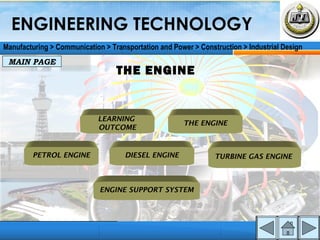
                                  THE ENGINE


                            LEARNING
                                                      THE ENGINE
                            OUTCOME


        PETROL ENGINE                DIESEL ENGINE              TURBINE GAS ENGINE


                             ENGINE SUPPORT SYSTEM
LEARNING OUTCOME
 Students should be able to:
List types of engine
 Describe the basic operating principles of
various engines.
Briefly explain ignition systems, fuel system,
cooling systems and lubrication systems.
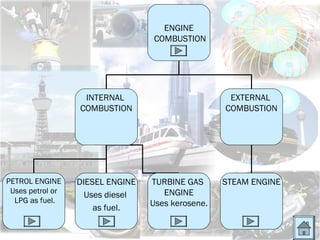
ENGINE
                                  COMBUSTION


                   INTERNAL                         EXTERNAL
                  COMBUSTION                       COMBUSTION


PETROL ENGINE     DIESEL ENGINE   TURBINE GAS      STEAM ENGINE
 Uses petrol or                      ENGINE
                    Uses diesel
  LPG as fuel.                    Uses kerosene.
                      as fuel.
INTERNAL COMBUSTION
                AND
        EXTERNAL COMBUSTION
 An engine produces power through the process of
 fuel combustion.
 If the combustion occurs in the engine cylinder, then the engine
 is called an internal combustion engine.
 If the combustion occurs outside (external combustion) the engin
it is known as a steam engine .
PETROL ENGINE
TYPES OF PETROL ENGINES

TWO STROKE ENGINES

FOUR STROKE ENGINES

COMPARISON TWO STROKE AND FOUR STROKE
PETROL ENGINE

          TYPES OF PETROL
              ENGINES


 TWO STROKE            FOUR STROKE
   ENGINES                ENGINE
TWO STROKE ENGINE
-INTAKE STROKE AND COMPRESSION STROKE

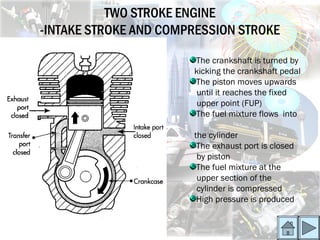
                       The crankshaft is turned by
                       kicking the crankshaft pedal
                       The piston moves upwards
                       until it reaches the fixed
                       upper point (FUP)
                       The fuel mixture flows into

                       the cylinder
                        The exhaust port is closed
                        by piston
                        The fuel mixture at the
                        upper section of the
                        cylinder is compressed
                        High pressure is produced
TWO STROKE ENGINE
-INTAKE STROKE AND COMPRESSION STROKE

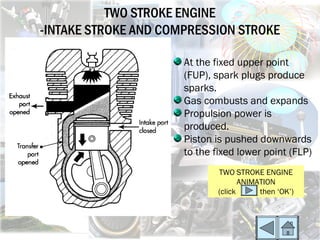
                      At the fixed upper point
                      (FUP), spark plugs produce
                      sparks.
                      Gas combusts and expands
                      Propulsion power is
                      produced.
                      Piston is pushed downwards
                      to the fixed lower point (FLP)
                              TWO STROKE ENGINE
                                     ANIMATION
                              (click      then ‘OK’)
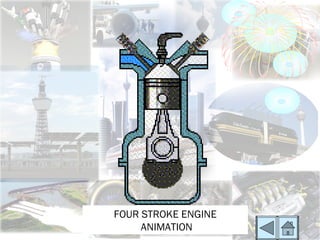
FOUR STROKE ENGINE
  -INTAKE STROKE

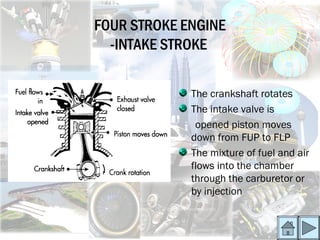
             The crankshaft rotates
             The intake valve is
              opened piston moves
             down from FUP to FLP
             The mixture of fuel and air
             flows into the chamber
             through the carburetor or
             by injection
FOUR STROKE ENGINE
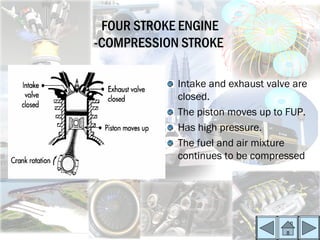
-COMPRESSION STROKE

            Intake and exhaust valve are
            closed.
            The piston moves up to FUP.
            Has high pressure.
            The fuel and air mixture
            continues to be compressed
FOUR STROKE ENGINE
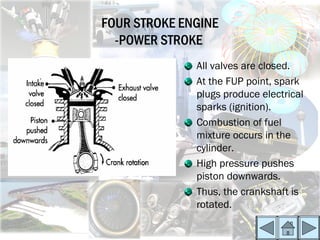
  -POWER STROKE
              All valves are closed.
              At the FUP point, spark
              plugs produce electrical
              sparks (ignition).
              Combustion of fuel
              mixture occurs in the
              cylinder.
              High pressure pushes
              piston downwards.
              Thus, the crankshaft is
              rotated.
FOUR STROKE ENGINE
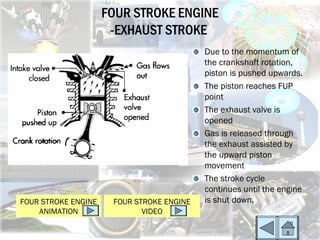
                      -EXHAUST STROKE
                                           Due to the momentum of
                                           the crankshaft rotation,
                                           piston is pushed upwards.
                                           The piston reaches FUP
                                           point
                                           The exhaust valve is
                                           opened
                                           Gas is released through
                                           the exhaust assisted by
                                           the upward piston
                                           movement
                                           The stroke cycle
                                           continues until the engine
FOUR STROKE ENGINE    FOUR STROKE ENGINE   is shut down.
    ANIMATION                VIDEO
FOUR STROKE ENGINE
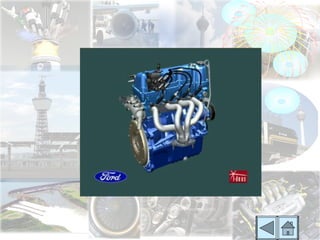
     ANIMATION
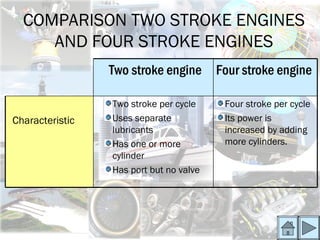
COMPARISON TWO STROKE ENGINES
     AND FOUR STROKE ENGINES
                 Two stroke engine       Four stroke engine

                 Two stroke per cycle     Four stroke per cycle
Characteristic   Uses separate            Its power is
                 lubricants               increased by adding
                 Has one or more          more cylinders.
                 cylinder
                 Has port but no valve
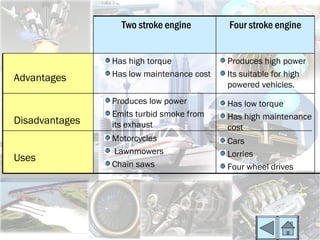
Two stroke engine        Four stroke engine


                Has high torque            Produces high power
Advantages      Has low maintenance cost   Its suitable for high
                                           powered vehicles.
                Produces low power         Has low torque
                Emits turbid smoke from    Has high maintenance
Disadvantages   its exhaust                cost
                Motorcycles                Cars
                Lawnmowers                 Lorries
Uses
                Chain saws                 Four wheel drives
DIESEL ENGINE


INTRODUCTION

FOUR STROKE ENGINES

EXAMPLES OF DIESEL ENGINES
INTRODUCTION
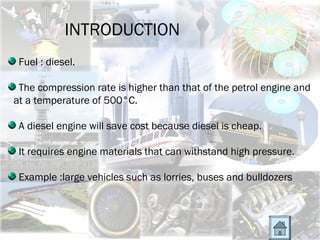
 Fuel : diesel.

 The compression rate is higher than that of the petrol engine and
at a temperature of 500°C.

 A diesel engine will save cost because diesel is cheap.

 It requires engine materials that can withstand high pressure.

 Example :large vehicles such as lorries, buses and bulldozers
FOUR STROKE ENGINE
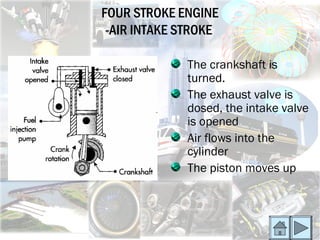
 -AIR INTAKE STROKE

             The crankshaft is
             turned.
             The exhaust valve is
             dosed, the intake valve
             is opened
             Air flows into the
             cylinder
             The piston moves up
FOUR STROKE ENGINE
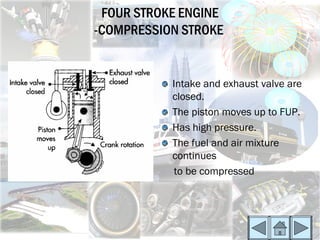
-COMPRESSION STROKE


           Intake and exhaust valve are
           closed.
           The piston moves up to FUP.
           Has high pressure.
           The fuel and air mixture
           continues
            to be compressed
FOUR STROKE ENGINE
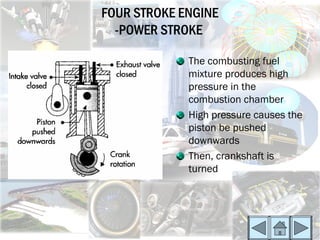
  -POWER STROKE

             The combusting fuel
             mixture produces high
             pressure in the
             combustion chamber
             High pressure causes the
             piston be pushed
             downwards
             Then, crankshaft is
             turned
FOUR STROKE ENGINE
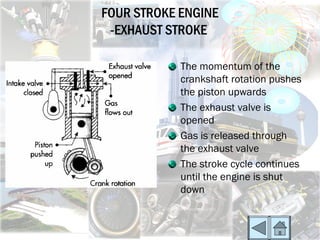
 -EXHAUST STROKE

            The momentum of the
            crankshaft rotation pushes
            the piston upwards
            The exhaust valve is
            opened
            Gas is released through
            the exhaust valve
            The stroke cycle continues
            until the engine is shut
            down
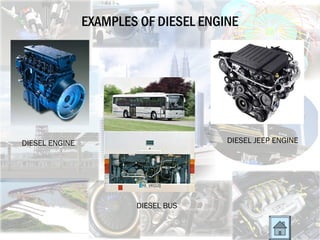
EXAMPLES OF DIESEL ENGINE


DIESEL ENGINE                          DIESEL JEEP ENGINE


                        DIESEL BUS
TURBINE GAS ENGINE

INTRODUCTION

TURBINE GAS ENGINE OPERATION

EXAMPLES OF TURBINE GAS ENGINE
INTRODUCTION

   The advantage of a turbine gas engine is its ability to operate
   using a variety of fuel including diesel, petrol and gas.


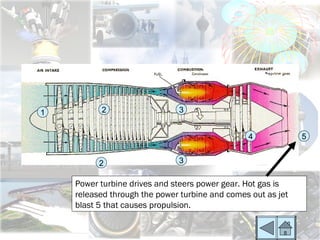
       A turbine gas engine has three parts:
i)     A Compression impeller
ii)    A driver turbine
iii)   A power turbine
1               2    3


                                 4   5


                       2     3


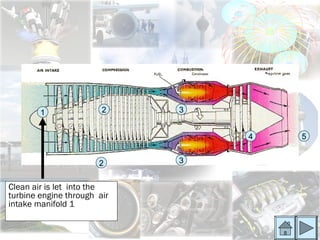
Clean air is let into the
turbine engine through air
intake manifold 1
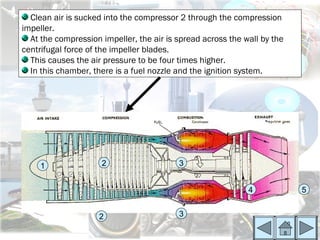
Clean air is sucked into the compressor 2 through the compression
impeller.
  At the compression impeller, the air is spread across the wall by the
centrifugal force of the impeller blades.
  This causes the air pressure to be four times higher.
  In this chamber, there is a fuel nozzle and the ignition system.


     1               2                    3


                                                             4            5


                    2                     3
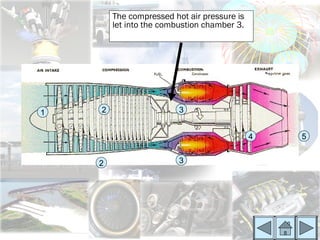
The compressed hot air pressure is
        let into the combustion chamber 3.


1   2                    3


                                             4   5


    2                    3
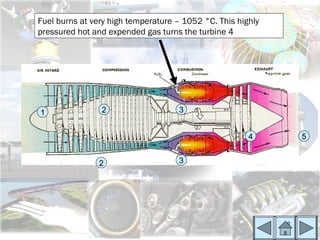
Fuel burns at very high temperature – 1052 °C. This highly
pressured hot and expended gas turns the turbine 4


1               2                    3


                                                       4     5


                2                    3
1         2                   3


                                                4             5


          2                   3

    Power turbine drives and steers power gear. Hot gas is
    released through the power turbine and comes out as jet
    blast 5 that causes propulsion.
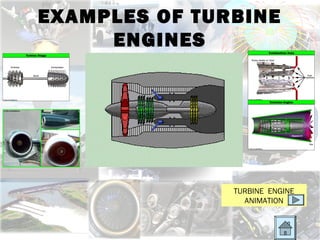
EXAMPLES OF TURBINE
     ENGINES


               TURBINE ENGINE
                 ANIMATION
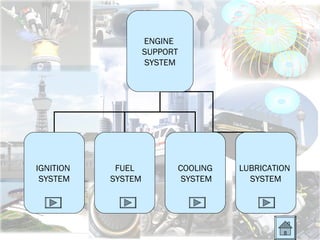
ENGINE
                    SUPPORT
                    SYSTEM


IGNITION    FUEL          COOLING   LUBRICATION
 SYSTEM    SYSTEM          SYSTEM     SYSTEM
IGNITION SYSTEM

MAIN PARTS AND OPERATION

FUNCTION
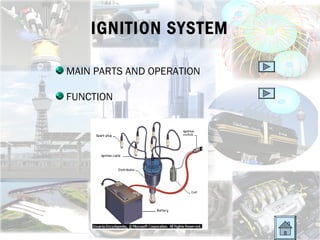
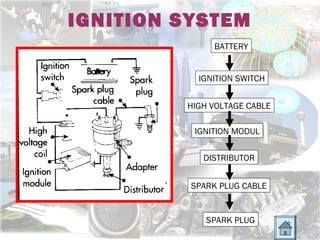
IGNITION SYSTEM
              BATTERY


           IGNITION SWITCH


         HIGH VOLTAGE CABLE

          IGNITION MODUL

            DISTRIBUTOR


          SPARK PLUG CABLE


             SPARK PLUG
IGNITION SYSTEM
    - FUNCTION
Used on a petrol engine

Produces sparks at the spark plug

Functions at the end of the compression
stroke during the fuel combustion process
FUEL SYSTEM

MAIN PARTS AND OPERATION

FUNCTION
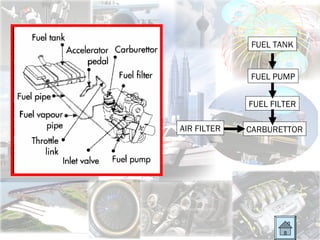
FUEL TANK


             FUEL PUMP


             FUEL FILTER

AIR FILTER   CARBURETTOR
FUEL SYSTEM
                  - FUNCTION
  Inlet flowof fuel and air

  Mixes air and fuel at the right ratio

  The way fuel is supplied to the combustion cylinder

  Through injection and carburettor

  Carburettor controls the fuel and air mixture
so that it is at the right ratio and also controls
the speed of the engine
COOLING SYSTEM

MAIN PARTS AND OPERATION

FUNCTION

VIDEO
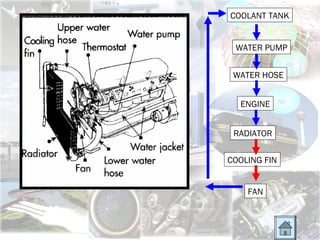
COOLANT TANK


 WATER PUMP


 WATER HOSE


  ENGINE


 RADIATOR


COOLING FIN


    FAN
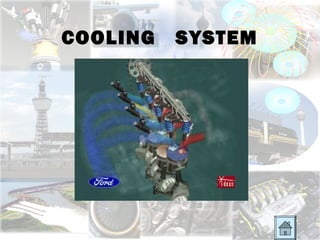
COOLING   SYSTEM
COOLING SYSTEM
                - FUNCTION
  Controls engine temperature
  Cooling by air or water
  Air cooling is suitable for small engines such as a
motorcycle engine
  Water cooling is suitable for large engines such as car
engines
  Water is flowing in the engine to transfer the resultant heat
elsewhere
  Water tank (radiator) is installed in front of the engine
along with an additional fan
LUBRICATION SYSTEM

MAIN PARTS AND OPERATION

VIDEO
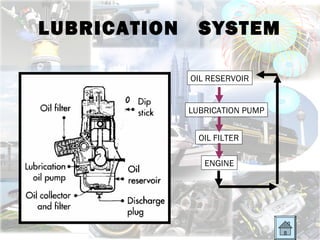
LUBRICATION     SYSTEM

              OIL RESERVOIR


              LUBRICATION PUMP


                OIL FILTER

                 ENGINE
LUBRICATION   SYSTEM
THE END

Chapter 9 c engine

  • 1.
    ENGINEERING TECHNOLOGY Manufacturing > Communication > Transportation and Power > Construction > Industrial Design Prepared by: Engineering Technology Teachers Unit Kurikulum, Jabatan Pelajaran Perak.
  • 3.
    ENGINEERING TECHNOLOGY Manufacturing >Communication > Transportation and Power > Construction > Industrial Design MAIN PAGE THE ENGINE LEARNING THE ENGINE OUTCOME PETROL ENGINE DIESEL ENGINE TURBINE GAS ENGINE ENGINE SUPPORT SYSTEM
  • 4.
    LEARNING OUTCOME Studentsshould be able to: List types of engine Describe the basic operating principles of various engines. Briefly explain ignition systems, fuel system, cooling systems and lubrication systems.
  • 5.
    ENGINE COMBUSTION INTERNAL EXTERNAL COMBUSTION COMBUSTION PETROL ENGINE DIESEL ENGINE TURBINE GAS STEAM ENGINE Uses petrol or ENGINE Uses diesel LPG as fuel. Uses kerosene. as fuel.
  • 6.
    INTERNAL COMBUSTION AND EXTERNAL COMBUSTION An engine produces power through the process of fuel combustion. If the combustion occurs in the engine cylinder, then the engine is called an internal combustion engine. If the combustion occurs outside (external combustion) the engin it is known as a steam engine .
  • 7.
    PETROL ENGINE TYPES OFPETROL ENGINES TWO STROKE ENGINES FOUR STROKE ENGINES COMPARISON TWO STROKE AND FOUR STROKE
  • 8.
    PETROL ENGINE TYPES OF PETROL ENGINES TWO STROKE FOUR STROKE ENGINES ENGINE
  • 9.
    TWO STROKE ENGINE -INTAKESTROKE AND COMPRESSION STROKE The crankshaft is turned by kicking the crankshaft pedal The piston moves upwards until it reaches the fixed upper point (FUP) The fuel mixture flows into the cylinder The exhaust port is closed by piston The fuel mixture at the upper section of the cylinder is compressed High pressure is produced
  • 10.
    TWO STROKE ENGINE -INTAKESTROKE AND COMPRESSION STROKE At the fixed upper point (FUP), spark plugs produce sparks. Gas combusts and expands Propulsion power is produced. Piston is pushed downwards to the fixed lower point (FLP) TWO STROKE ENGINE ANIMATION (click then ‘OK’)
  • 11.
    FOUR STROKE ENGINE -INTAKE STROKE The crankshaft rotates The intake valve is opened piston moves down from FUP to FLP The mixture of fuel and air flows into the chamber through the carburetor or by injection
  • 12.
    FOUR STROKE ENGINE -COMPRESSIONSTROKE Intake and exhaust valve are closed. The piston moves up to FUP. Has high pressure. The fuel and air mixture continues to be compressed
  • 13.
    FOUR STROKE ENGINE -POWER STROKE All valves are closed. At the FUP point, spark plugs produce electrical sparks (ignition). Combustion of fuel mixture occurs in the cylinder. High pressure pushes piston downwards. Thus, the crankshaft is rotated.
  • 14.
    FOUR STROKE ENGINE -EXHAUST STROKE Due to the momentum of the crankshaft rotation, piston is pushed upwards. The piston reaches FUP point The exhaust valve is opened Gas is released through the exhaust assisted by the upward piston movement The stroke cycle continues until the engine FOUR STROKE ENGINE FOUR STROKE ENGINE is shut down. ANIMATION VIDEO
  • 16.
  • 17.
    COMPARISON TWO STROKEENGINES AND FOUR STROKE ENGINES Two stroke engine Four stroke engine Two stroke per cycle Four stroke per cycle Characteristic Uses separate Its power is lubricants increased by adding Has one or more more cylinders. cylinder Has port but no valve
  • 18.
    Two stroke engine Four stroke engine Has high torque Produces high power Advantages Has low maintenance cost Its suitable for high powered vehicles. Produces low power Has low torque Emits turbid smoke from Has high maintenance Disadvantages its exhaust cost Motorcycles Cars Lawnmowers Lorries Uses Chain saws Four wheel drives
  • 19.
    DIESEL ENGINE INTRODUCTION FOUR STROKEENGINES EXAMPLES OF DIESEL ENGINES
  • 20.
    INTRODUCTION Fuel :diesel. The compression rate is higher than that of the petrol engine and at a temperature of 500°C. A diesel engine will save cost because diesel is cheap. It requires engine materials that can withstand high pressure. Example :large vehicles such as lorries, buses and bulldozers
  • 21.
    FOUR STROKE ENGINE -AIR INTAKE STROKE The crankshaft is turned. The exhaust valve is dosed, the intake valve is opened Air flows into the cylinder The piston moves up
  • 22.
    FOUR STROKE ENGINE -COMPRESSIONSTROKE Intake and exhaust valve are closed. The piston moves up to FUP. Has high pressure. The fuel and air mixture continues to be compressed
  • 23.
    FOUR STROKE ENGINE -POWER STROKE The combusting fuel mixture produces high pressure in the combustion chamber High pressure causes the piston be pushed downwards Then, crankshaft is turned
  • 24.
    FOUR STROKE ENGINE -EXHAUST STROKE The momentum of the crankshaft rotation pushes the piston upwards The exhaust valve is opened Gas is released through the exhaust valve The stroke cycle continues until the engine is shut down
  • 25.
    EXAMPLES OF DIESELENGINE DIESEL ENGINE DIESEL JEEP ENGINE DIESEL BUS
  • 26.
    TURBINE GAS ENGINE INTRODUCTION TURBINEGAS ENGINE OPERATION EXAMPLES OF TURBINE GAS ENGINE
  • 27.
    INTRODUCTION The advantage of a turbine gas engine is its ability to operate using a variety of fuel including diesel, petrol and gas. A turbine gas engine has three parts: i) A Compression impeller ii) A driver turbine iii) A power turbine
  • 28.
    1 2 3 4 5 2 3 Clean air is let into the turbine engine through air intake manifold 1
  • 29.
    Clean air issucked into the compressor 2 through the compression impeller. At the compression impeller, the air is spread across the wall by the centrifugal force of the impeller blades. This causes the air pressure to be four times higher. In this chamber, there is a fuel nozzle and the ignition system. 1 2 3 4 5 2 3
  • 30.
    The compressed hotair pressure is let into the combustion chamber 3. 1 2 3 4 5 2 3
  • 31.
    Fuel burns atvery high temperature – 1052 °C. This highly pressured hot and expended gas turns the turbine 4 1 2 3 4 5 2 3
  • 32.
    1 2 3 4 5 2 3 Power turbine drives and steers power gear. Hot gas is released through the power turbine and comes out as jet blast 5 that causes propulsion.
  • 33.
    EXAMPLES OF TURBINE ENGINES TURBINE ENGINE ANIMATION
  • 34.
    ENGINE SUPPORT SYSTEM IGNITION FUEL COOLING LUBRICATION SYSTEM SYSTEM SYSTEM SYSTEM
  • 35.
    IGNITION SYSTEM MAIN PARTSAND OPERATION FUNCTION
  • 36.
    IGNITION SYSTEM BATTERY IGNITION SWITCH HIGH VOLTAGE CABLE IGNITION MODUL DISTRIBUTOR SPARK PLUG CABLE SPARK PLUG
  • 37.
    IGNITION SYSTEM - FUNCTION Used on a petrol engine Produces sparks at the spark plug Functions at the end of the compression stroke during the fuel combustion process
  • 38.
    FUEL SYSTEM MAIN PARTSAND OPERATION FUNCTION
  • 39.
    FUEL TANK FUEL PUMP FUEL FILTER AIR FILTER CARBURETTOR
  • 40.
    FUEL SYSTEM - FUNCTION Inlet flowof fuel and air Mixes air and fuel at the right ratio The way fuel is supplied to the combustion cylinder Through injection and carburettor Carburettor controls the fuel and air mixture so that it is at the right ratio and also controls the speed of the engine
  • 41.
    COOLING SYSTEM MAIN PARTSAND OPERATION FUNCTION VIDEO
  • 42.
    COOLANT TANK WATERPUMP WATER HOSE ENGINE RADIATOR COOLING FIN FAN
  • 43.
    COOLING SYSTEM
  • 44.
    COOLING SYSTEM - FUNCTION Controls engine temperature Cooling by air or water Air cooling is suitable for small engines such as a motorcycle engine Water cooling is suitable for large engines such as car engines Water is flowing in the engine to transfer the resultant heat elsewhere Water tank (radiator) is installed in front of the engine along with an additional fan
  • 45.
    LUBRICATION SYSTEM MAIN PARTSAND OPERATION VIDEO
  • 46.
    LUBRICATION SYSTEM OIL RESERVOIR LUBRICATION PUMP OIL FILTER ENGINE
  • 47.
  • 48.