I.C. Engines
4 Stroke Petrol & Diesel Engines
1
Dr. S. VIJAYA BHASKAR
Professor in Mechanical Engineering
Sreenidhi Institute of Science &
Technology, Hyderabad
Working Principle of IC Engines
NOT TALKING ABOUT 2 OR 4 STROKE OR
PETROL OR DIESEL ENGINE
JUST WORKING OF ANY IC ENGINE
 TWO stroke engine rotates only 360 or
ONE revolution of crank shaft rotation
 FOUR stroke cycle completed through 720 of crank
rotation or TWO revolution of crank shaft rotation
Working Principle of IC Engines
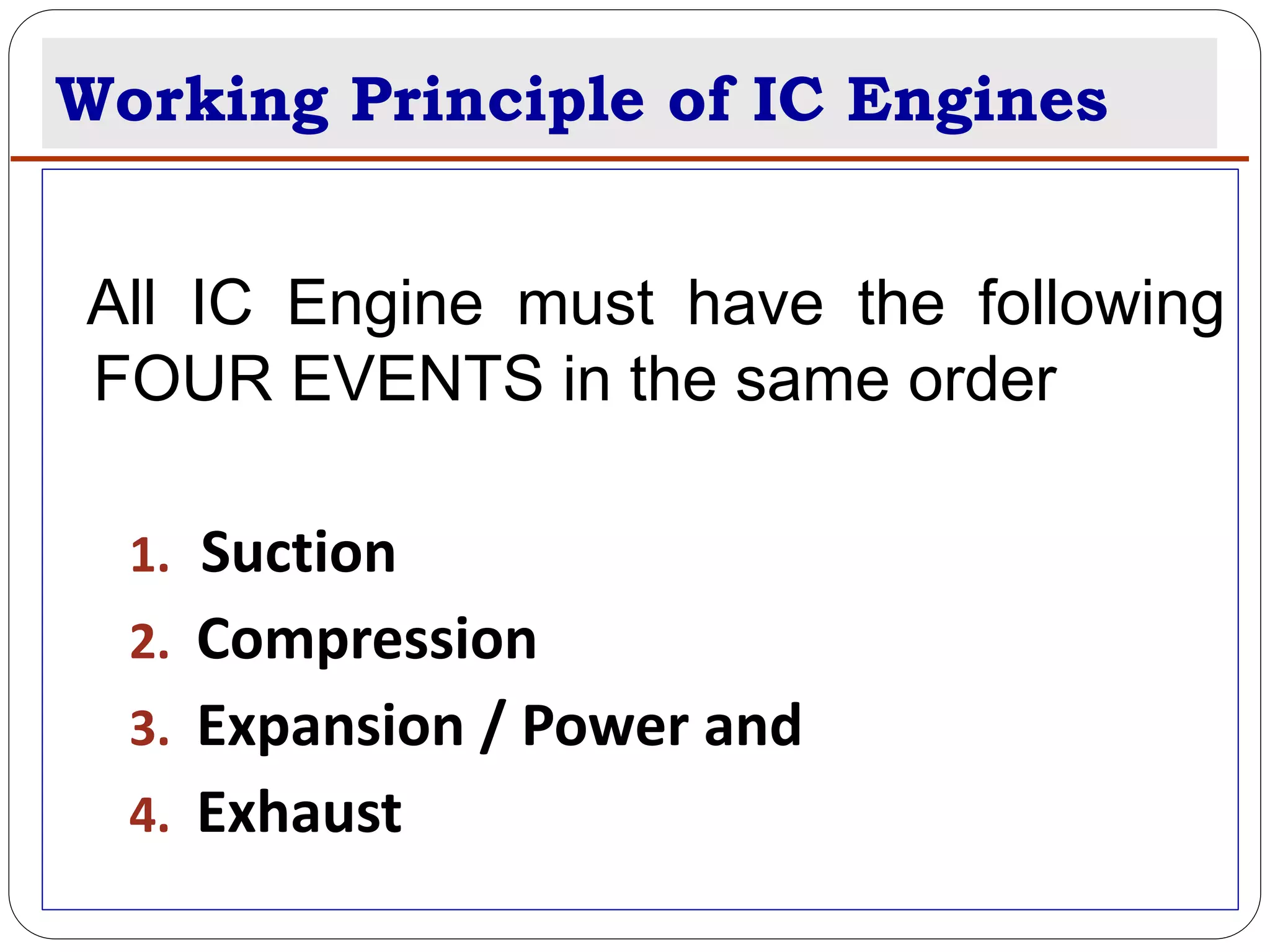
All IC Engine must have the following
FOUR EVENTS in the same order
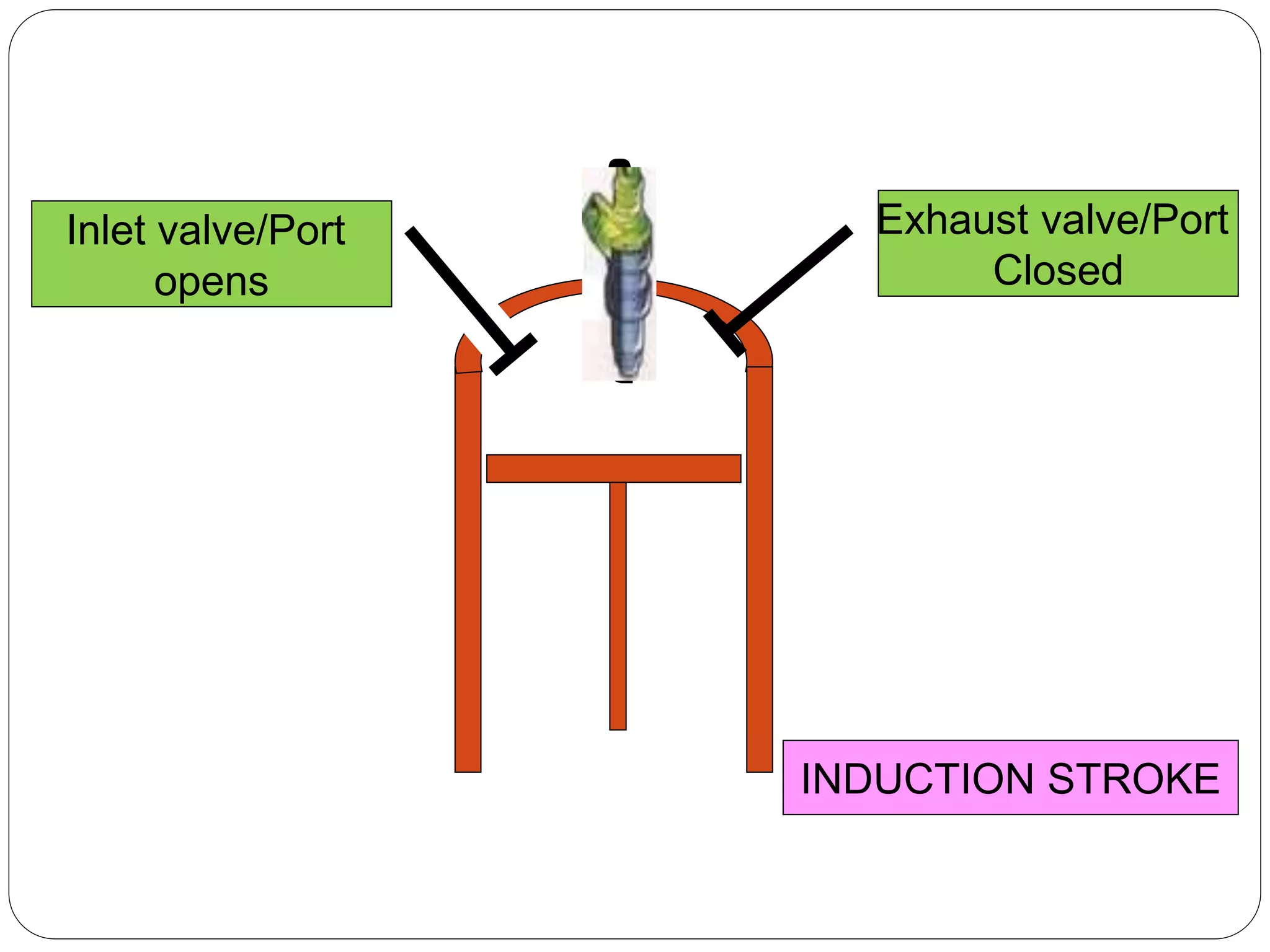
1. Suction
2. Compression
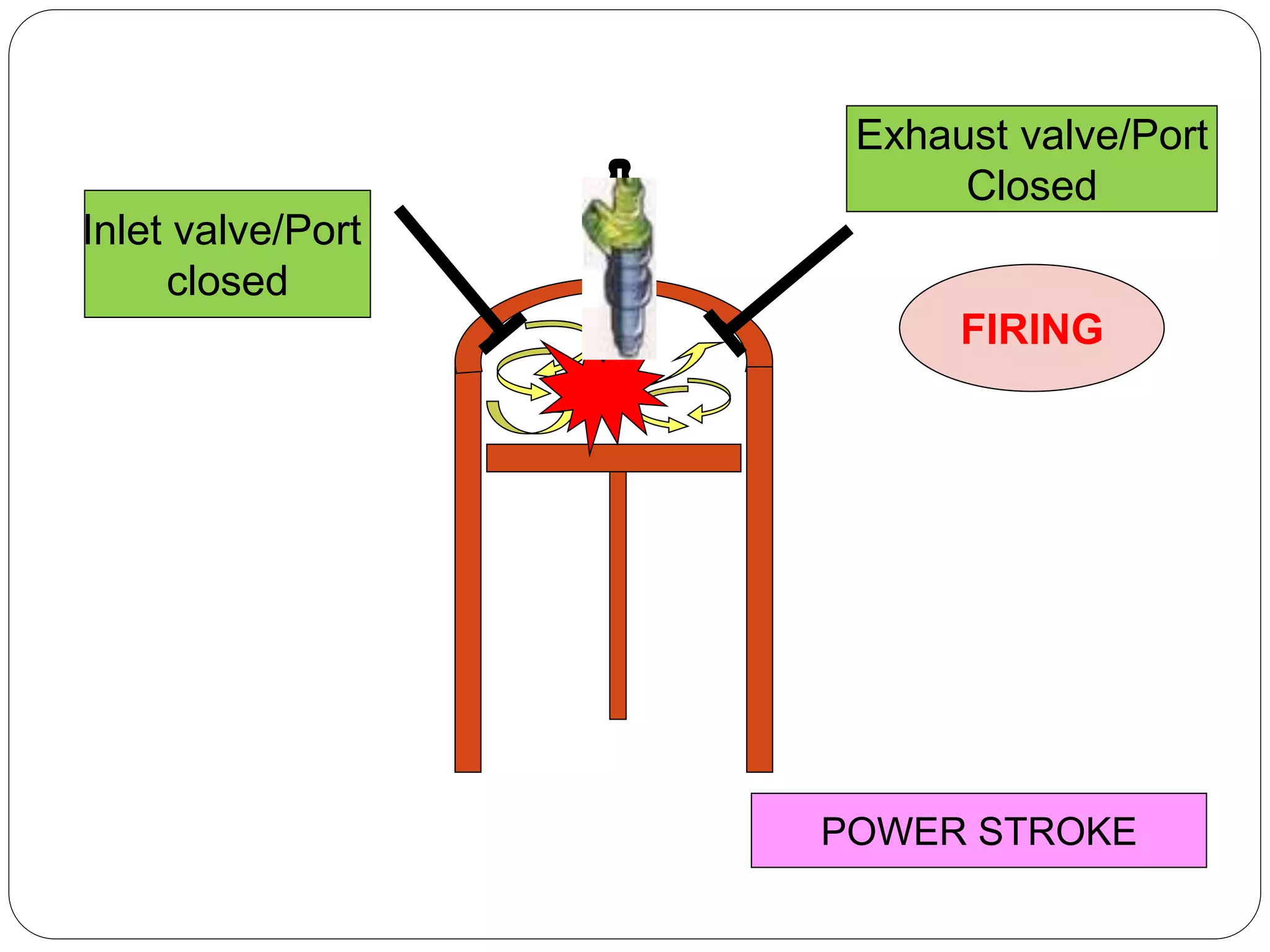
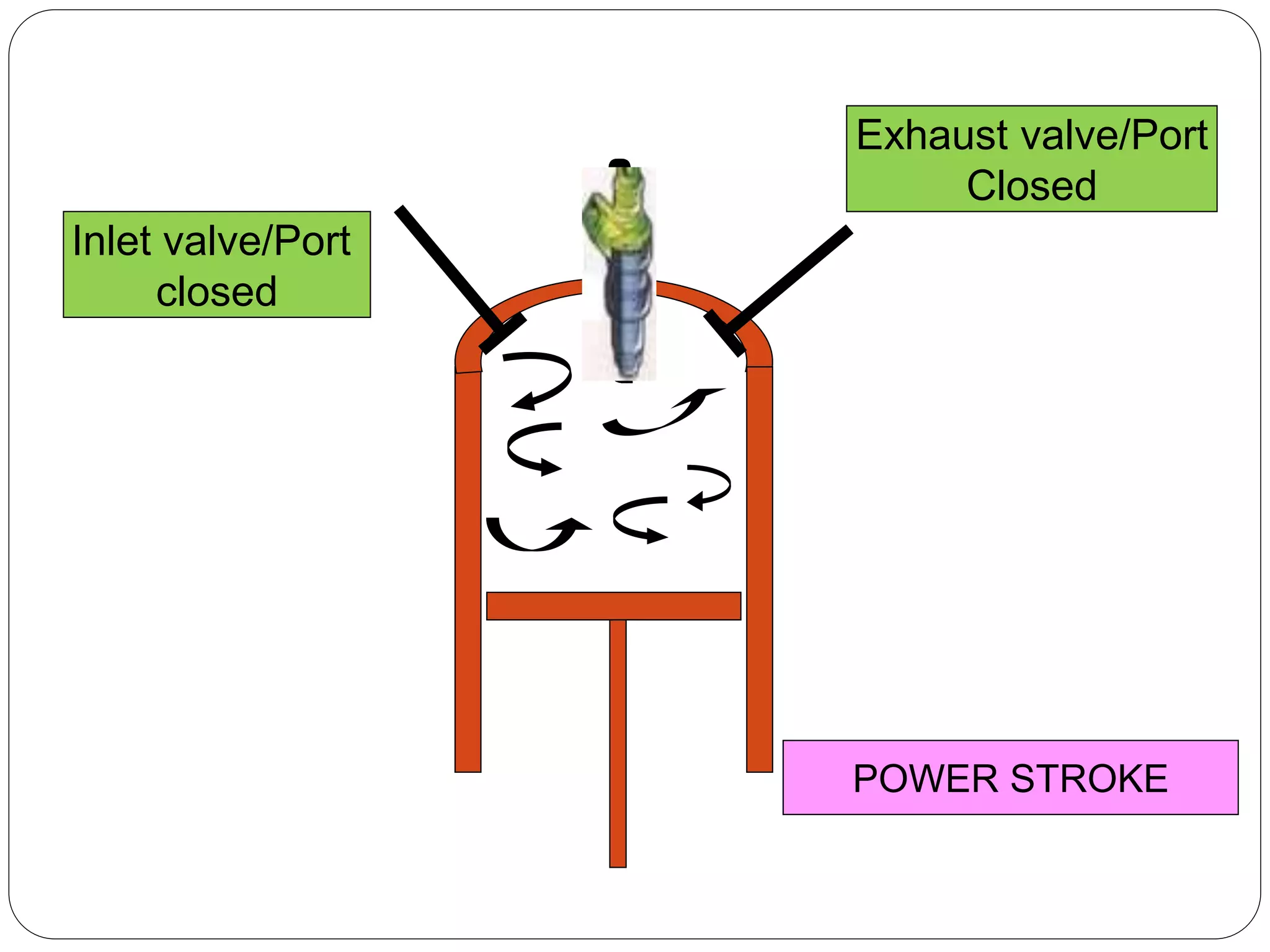
3. Expansion / Power and
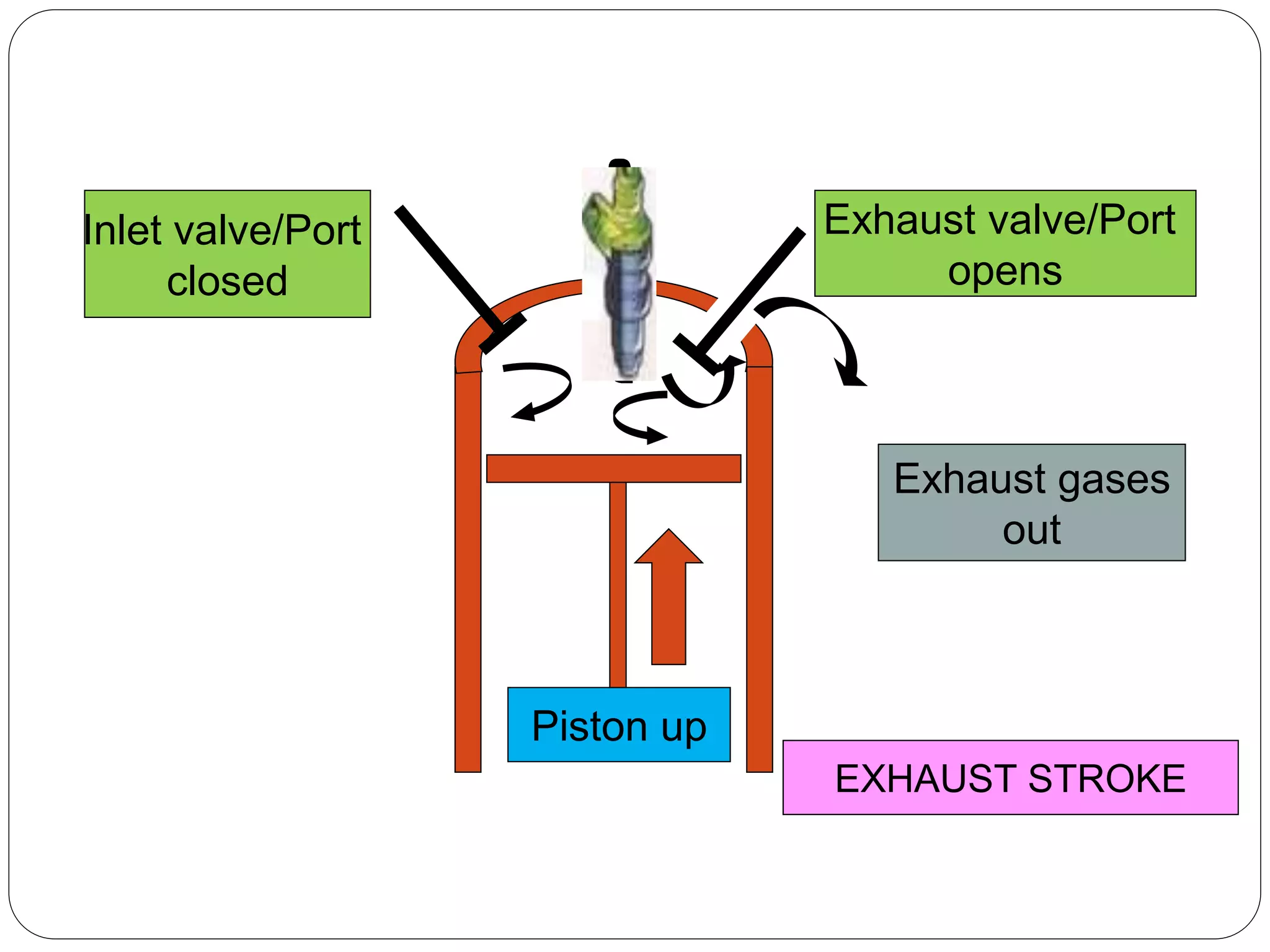
4. Exhaust
Spark plug
Inlet valve/Port
Exhaust valve/
Port
Cylinder
Piston
Fuel Injector
Inlet valve/Port
opens
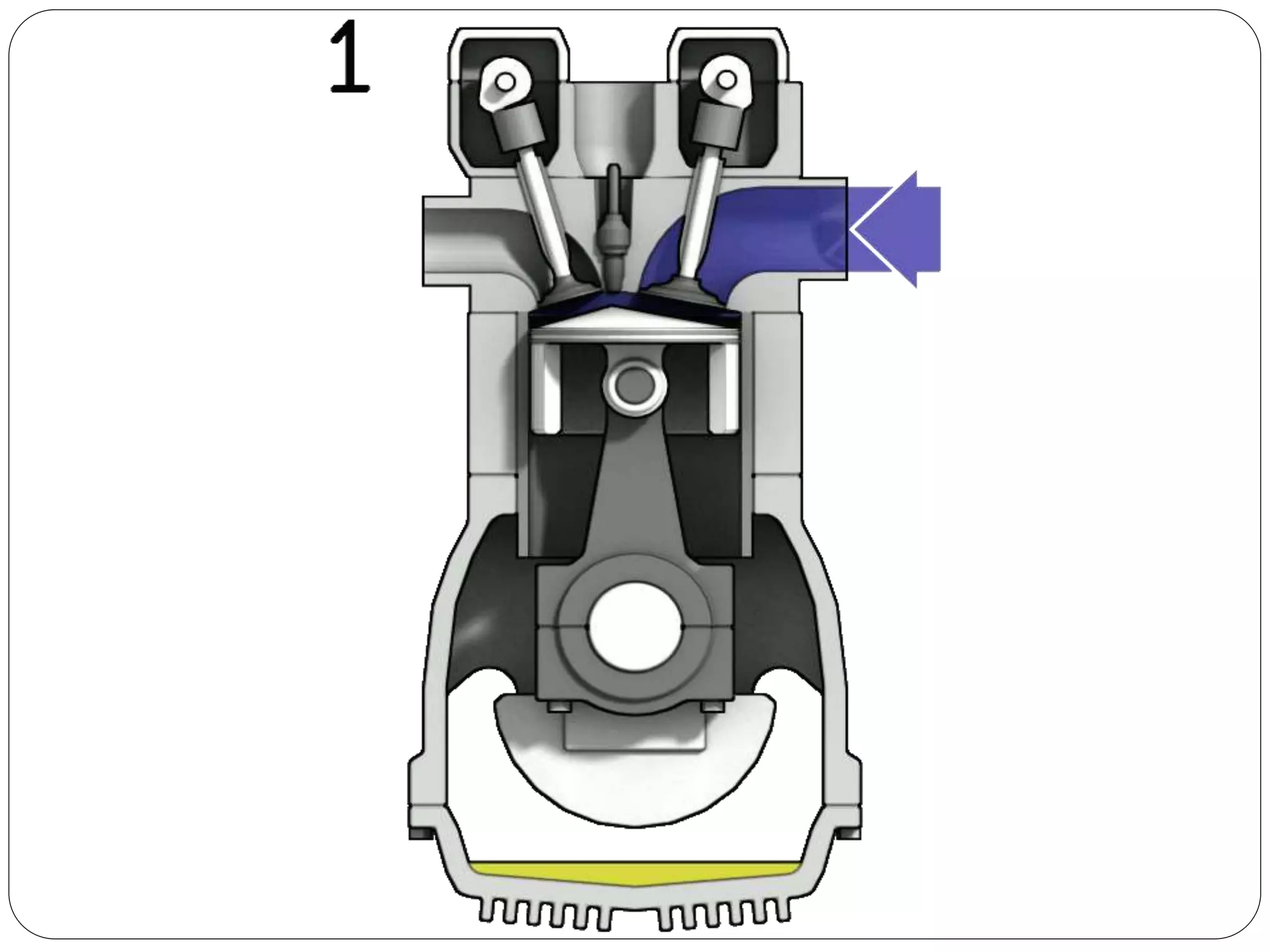
SUCTION STROKE
Exhaust valve/Port
Closed
Piston down
INTAKE STROKE
Inlet valve/Port
opens
Exhaust valve/Port
Closed
Inlet valve /
Port open
Piston down
INDUCTION STROKE
Air/Fuel Mixture InAir ONLY In Exhaust valve/Port
Closed
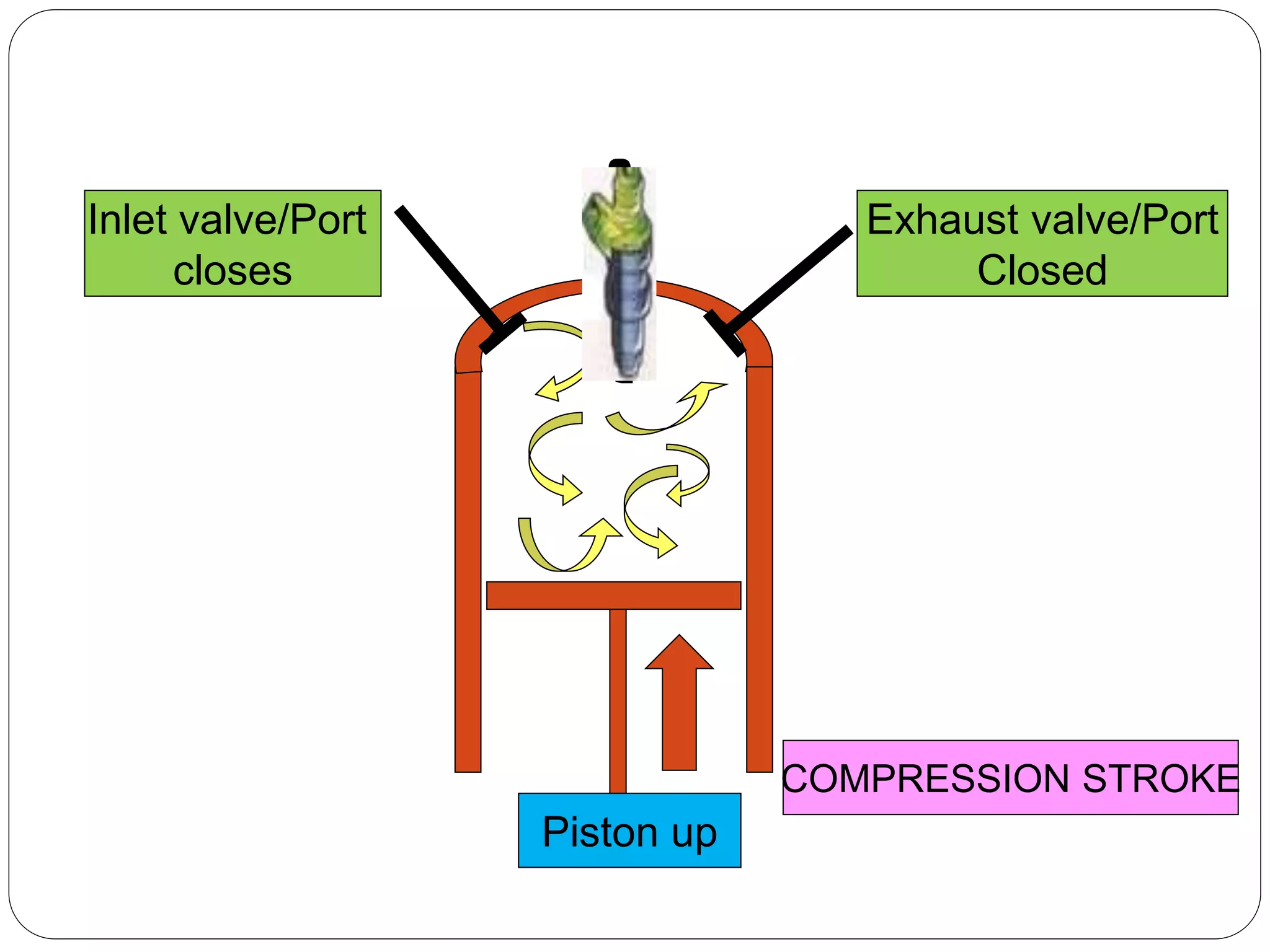
Inlet valve/Port
closes
COMPRESSION STROKE
Piston up
Exhaust valve/Port
Closed
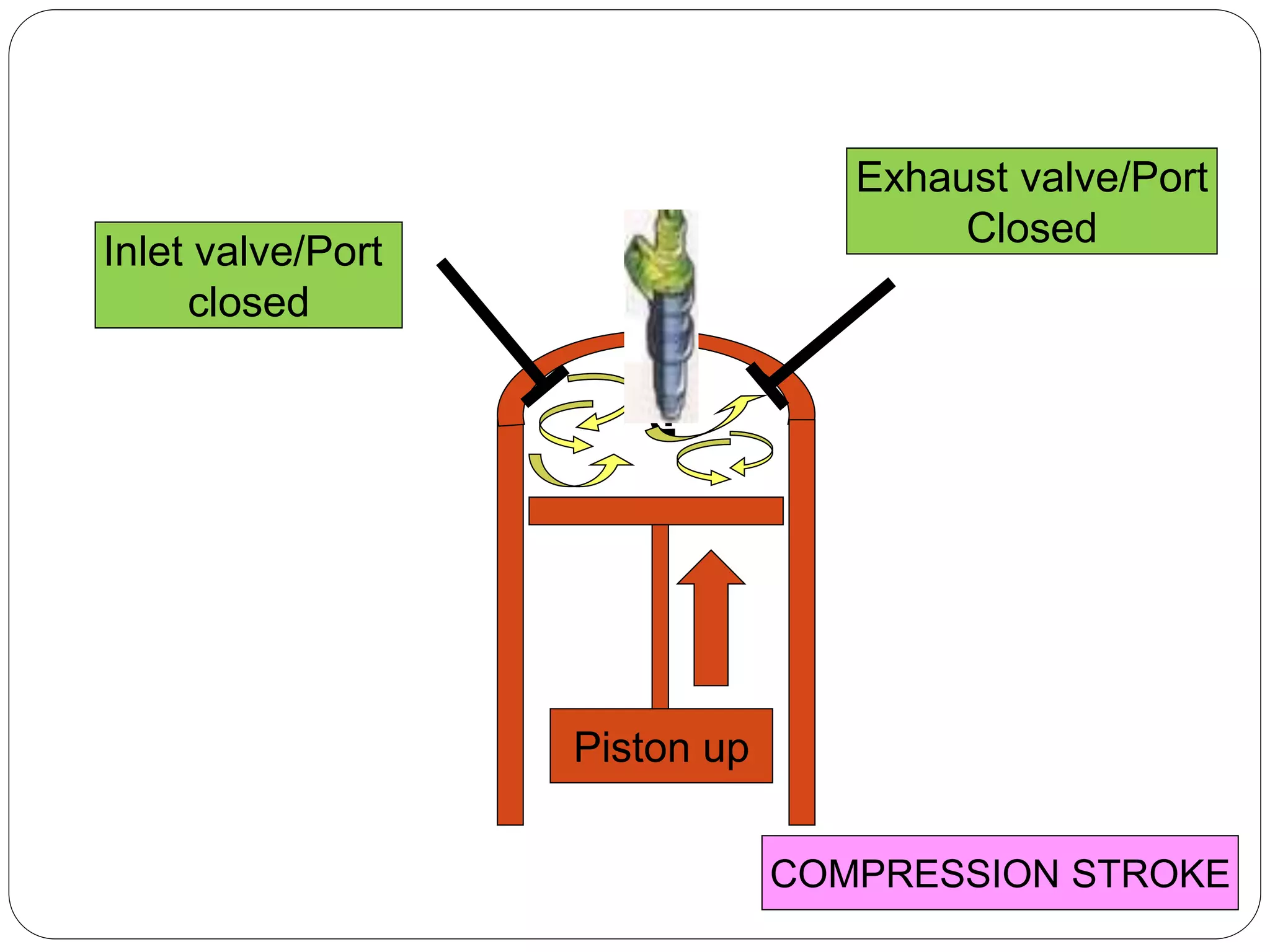
Inlet valve/Port
closed
COMPRESSION STROKE
Piston up
Exhaust valve/Port
Closed
POWER STROKE
FIRING
Inlet valve/Port
closed
Exhaust valve/Port
Closed
POWER STROKE
Piston down
powerfully
Inlet valve/Port
closed
Inlet valve/Port
closed
POWER STROKE
Piston down
powerfully
Inlet valve/Port
closed
POWER STROKE
Exhaust valve/Port
Closed
Inlet valve/Port
closed
EXHAUST STROKE
Exhaust valve/Port
opens
EXHAUST STROKE
Exhaust valve/Port
opens
Piston up
Exhaust gases
out
Inlet valve/Port
closed
EXHAUST STROKE
Exhaust valve/Port
opens
Piston up
Exhaust gases
out
Inlet valve/Port
closed
Inlet valve/Port
opens
INDUCTION STROKE
Exhaust valve/Port
Closed
4-Stroke Spark Ignition (SI)
Engine
18
Inlet valve
opens
SUCTION STROKE
Four-stroke SI Engine
Inlet valve
open
Piston down
SUCTION STROKE
Four-stroke SI Engine
Inlet valve
open
Piston down
INDUCTION STROKE
Four-stroke SI Engine
Air/Fuel Mixture In
Inlet valve
closes
COMPRESSION STROKE
Four-stroke SI Engine
Piston up
Inlet valve
closed
COMPRESSION STROKE
Four-stroke SI Engine
Piston up
Inlet valve
closed
POWER STROKE
Four-stroke SI Engine
Combustion
Inlet valve
closed
POWER STROKE
Four-stroke SI Engine
Piston down
powerfully
Inlet valve
closed
POWER STROKE
Four-stroke SI Engine
Piston down
powerfully
Inlet valve
closed
POWER STROKE
Four-stroke engine
Inlet valve
closed
EXHAUST STROKE
Four-stroke engine
Exhaust valve
open
Inlet valve
closed
EXHAUST STROKE
Four-stroke SI Engine
Exhaust valve
open
Piston up
Exhaust gases
out
Inlet valve
closed
EXHAUST STROKE
Four-stroke SI Engine
Exhaust valve
open
Piston up
Exhaust gases
out
Inlet valve
opens
INDUCTION STROKE
Four-stroke SI Engine
Exhaust valve
closed
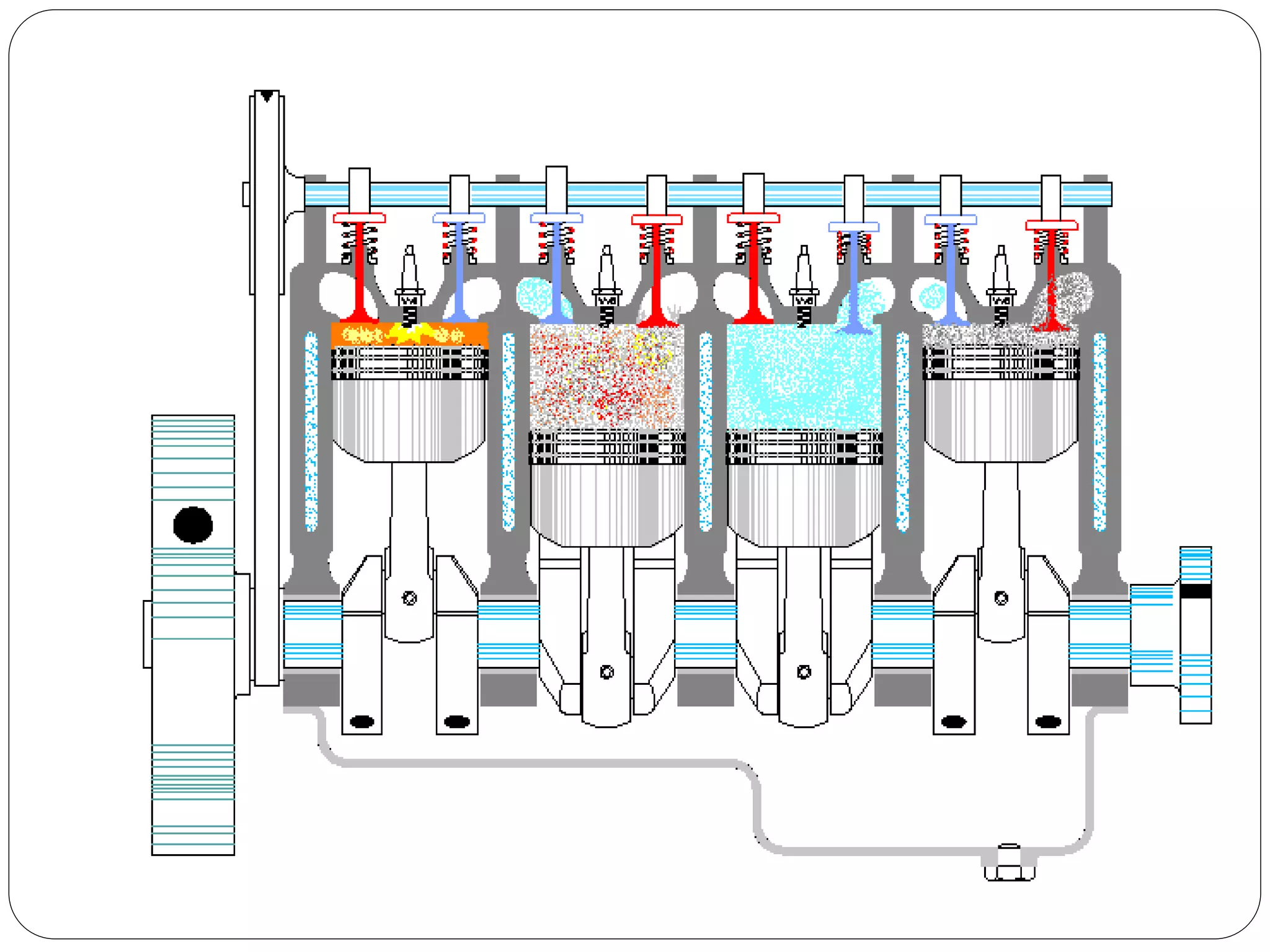
Operation of 4-Stroke Petrol
Engine
3
4
INLET

EXHAUST
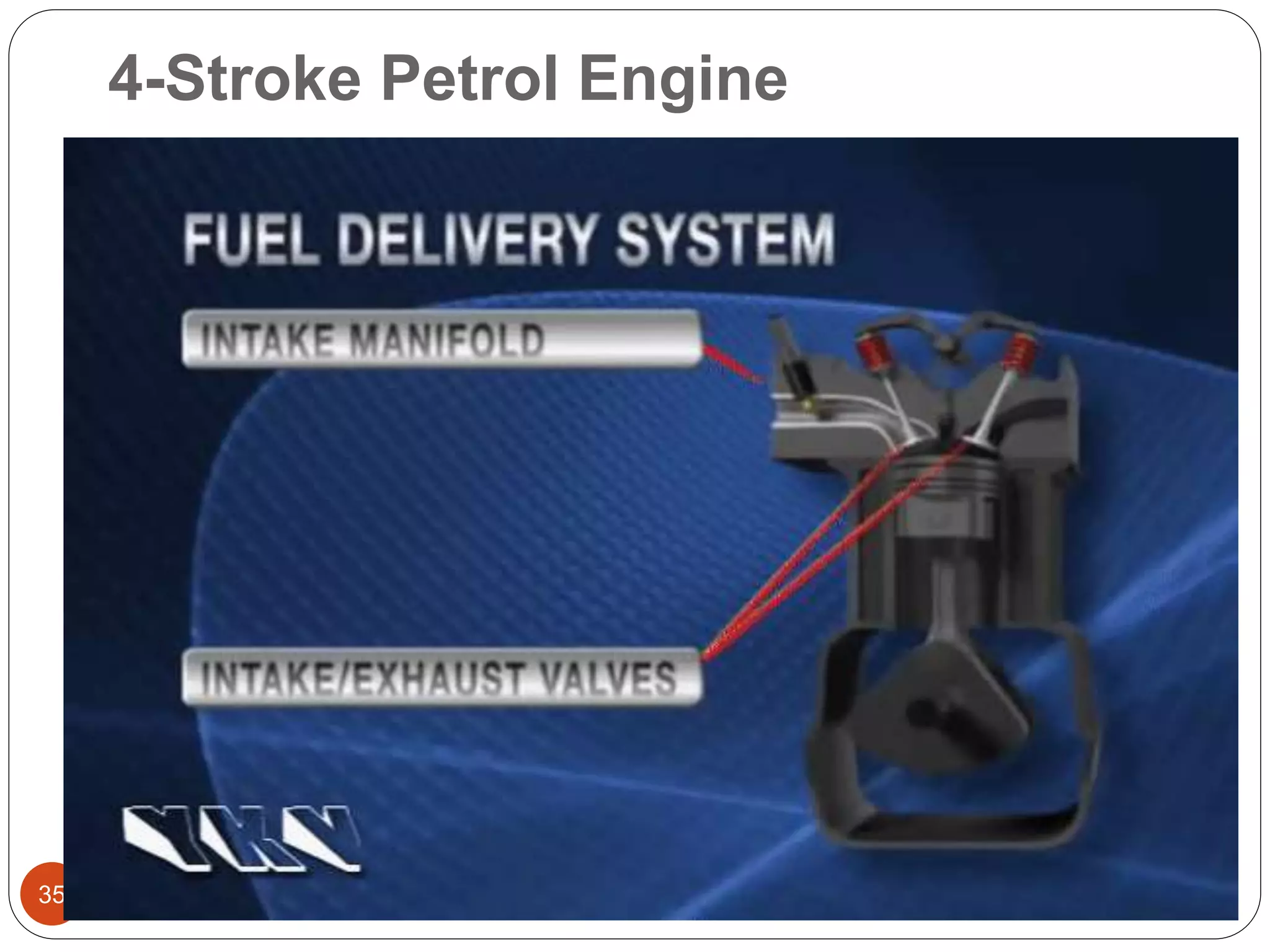
4-Stroke Petrol Engine
35
4-stroke petrol engine
4-S Petrol
Engine
37
Works on Otto
Cycle
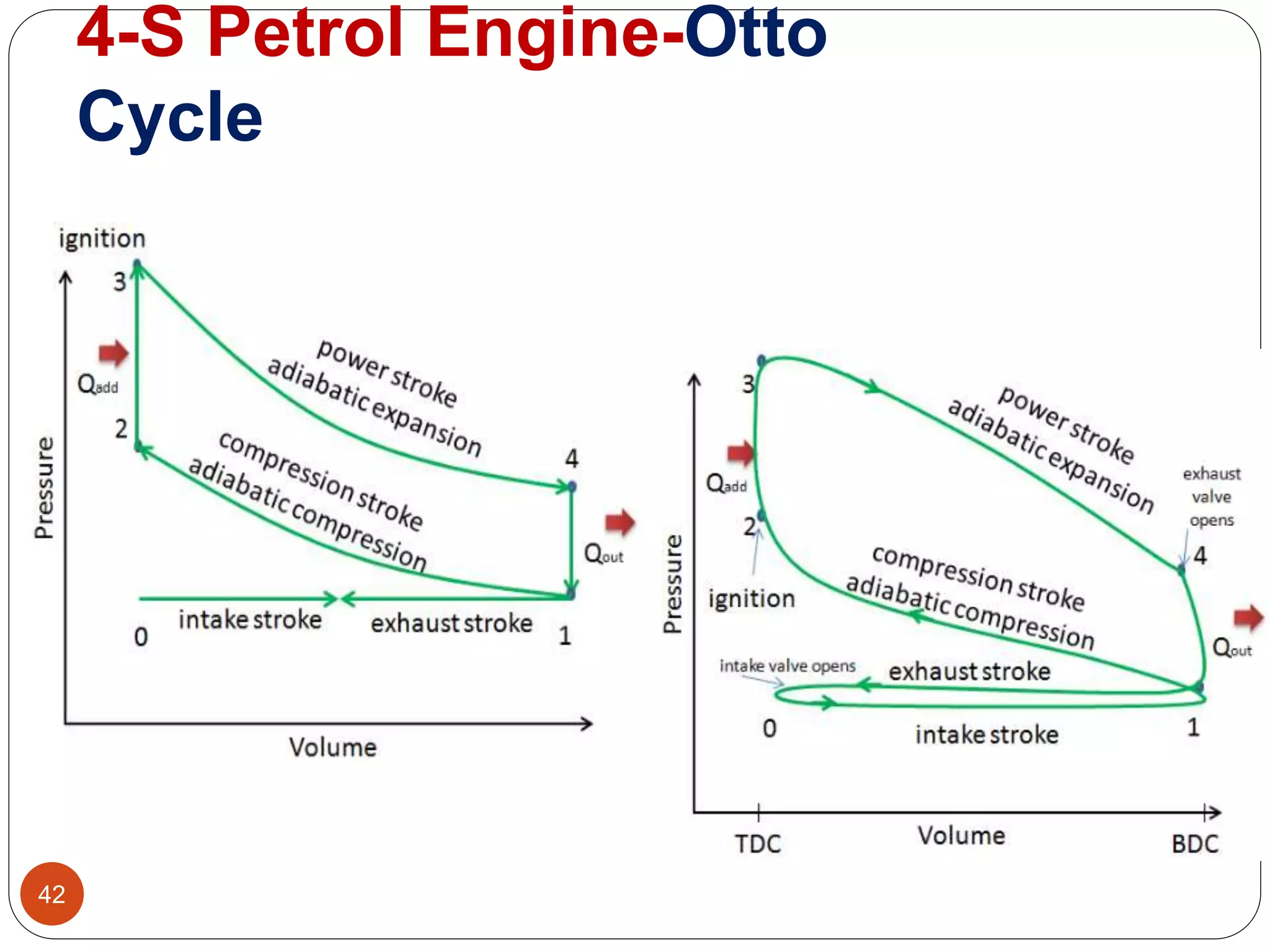
Power Cycle: Otto cycle
The air standard Otto Cycle is an ideal cycle that
approximates a spark- ignition internal combustion engine.
It assumes that the heat addition occurs instantaneously
while the piston is at TDC.
Process
(1-2) Isentropic Compression
Compression from ν1 to v2
↓
BDC(β=180º )
↓
TDC (θ=0º)
(2-3) Constant Volume Heat Addition: QH
•While at TDC
•Ignition of fuel (chemical reaction takes place)
(3-4) Isentropic Expansion
•Power is delivered while s = const.
(4-1) Constant volume Heat Rejection process
Otto Cycle
Otto Cycle
 Process 1–2 is an isentropic compression of the air as the
piston moves from bottom dead center to top dead center.
 Process 2–3 is a constant-volume heat transfer to the air
from an external source while the piston is at top dead
center. This process is intended to represent the ignition of
the fuel–air mixture and the subsequent rapid burning.
 Process 3–4 is an isentropic expansion (power stroke).
 Process 4–1 completes the cycle by a constant-volume
process in which heat is rejected from the air while the
piston is at bottom dead center.
4-S Petrol Engine-Otto
Cycle
42
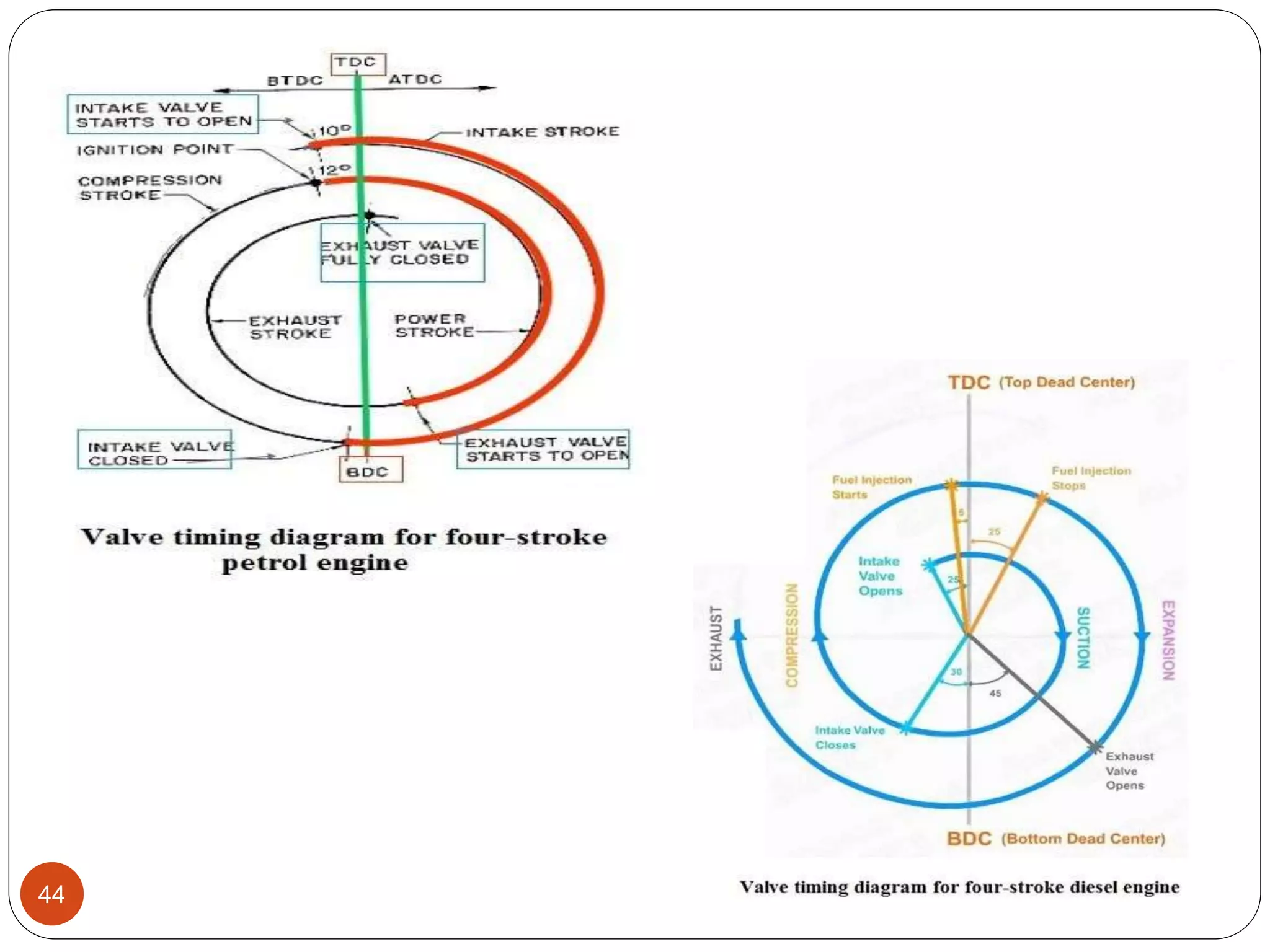
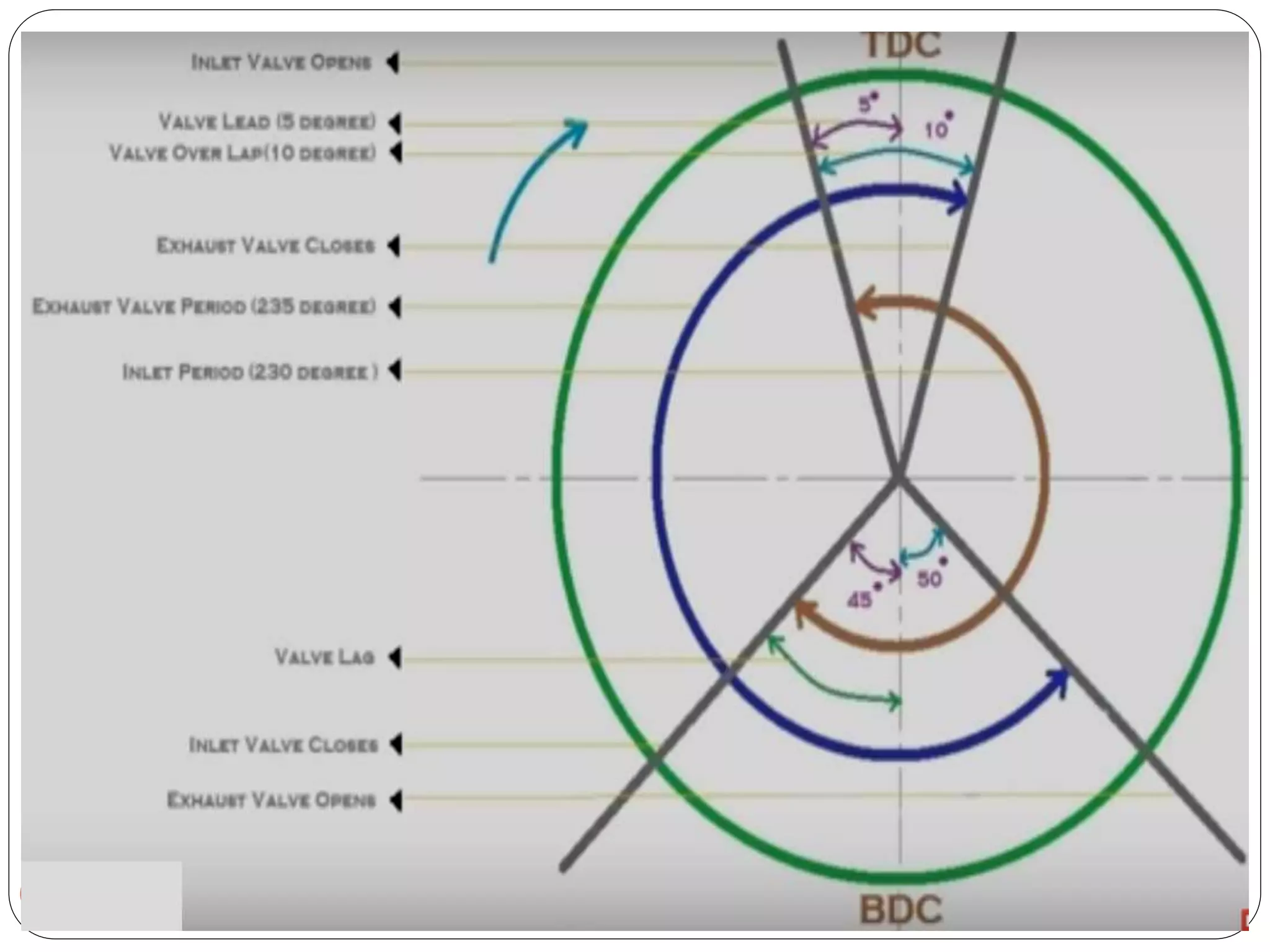
THEORETICAL VALVE TIMING DIAGRAM
FOR FOUR STROKE ENGINE
43
44
45
Typical Theoretical P-V and Valve Timing Diagrams of a Four-
Stroke Spark Ignition Engine
46
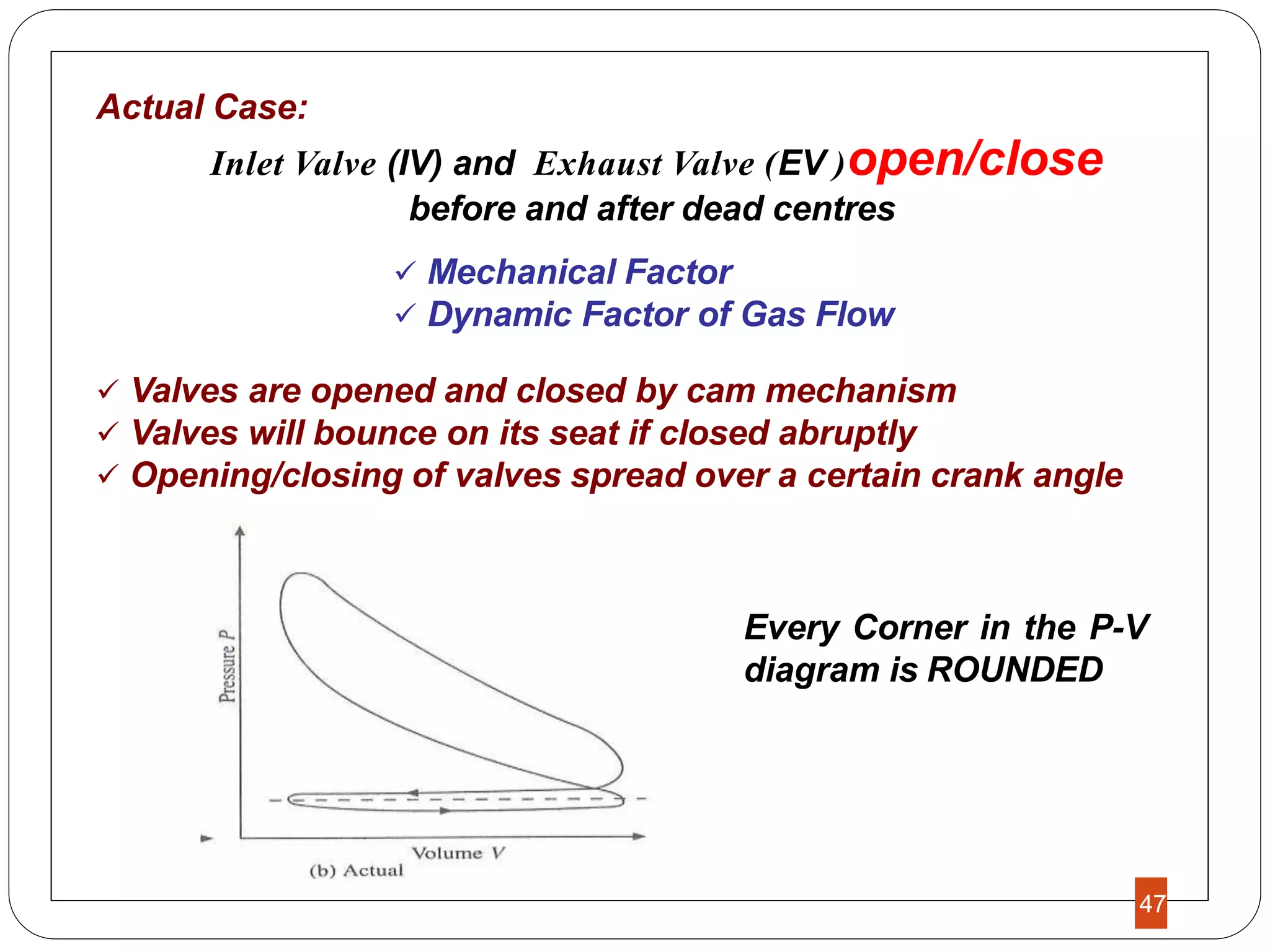
Observations:
 P-V diagram shows sharp edges
i.e., valves open/close instantaneously at dead centres
Actual Case:
Inlet Valve (IV) and Exhaust Valve (EV )open/close
before and after dead centres
 Mechanical Factor
 Dynamic Factor of Gas Flow
 Valves are opened and closed by cam mechanism
 Valves will bounce on its seat if closed abruptly
 Opening/closing of valves spread over a certain crank angle
Every Corner in the P-V
diagram is ROUNDED
47
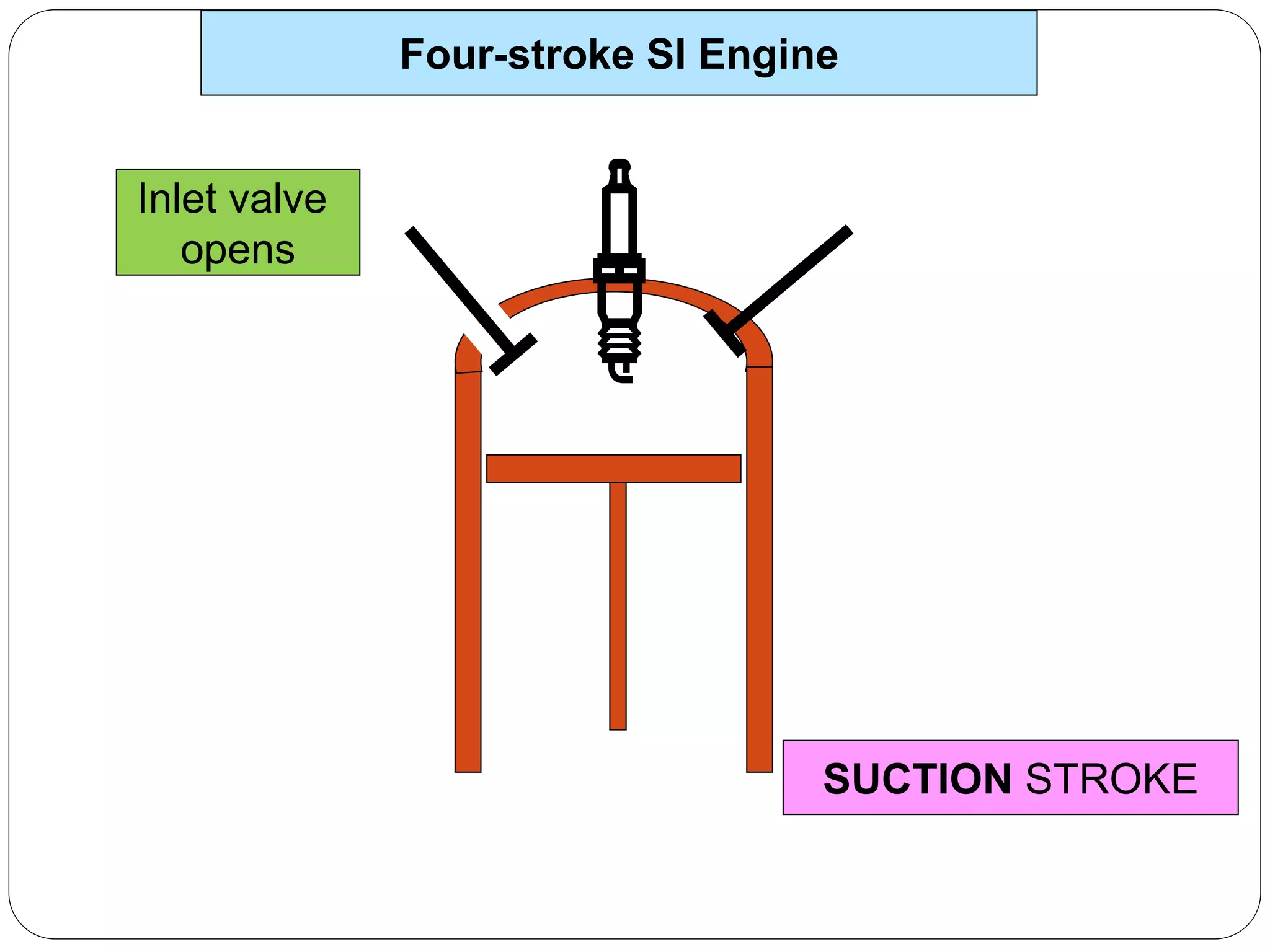
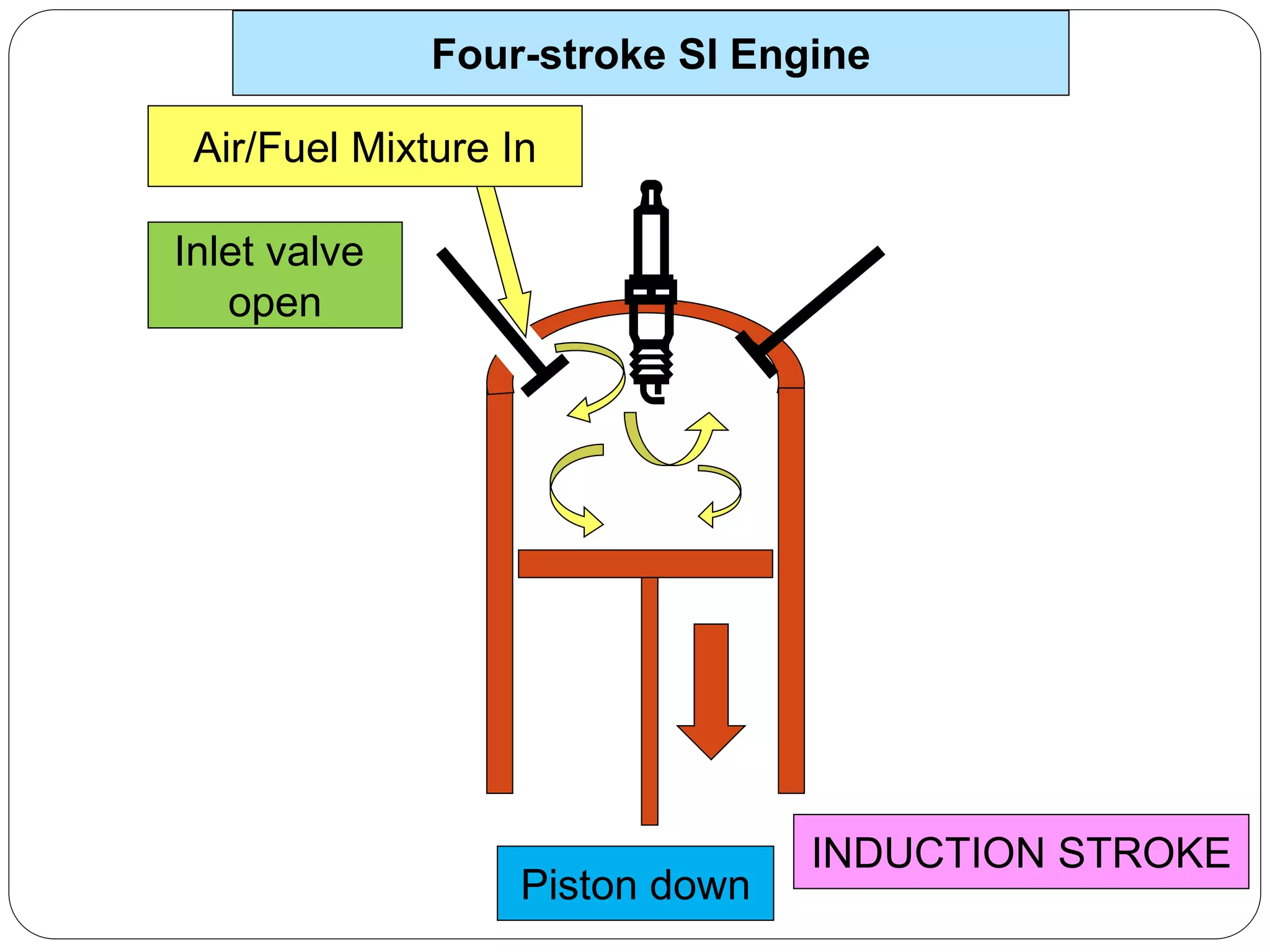
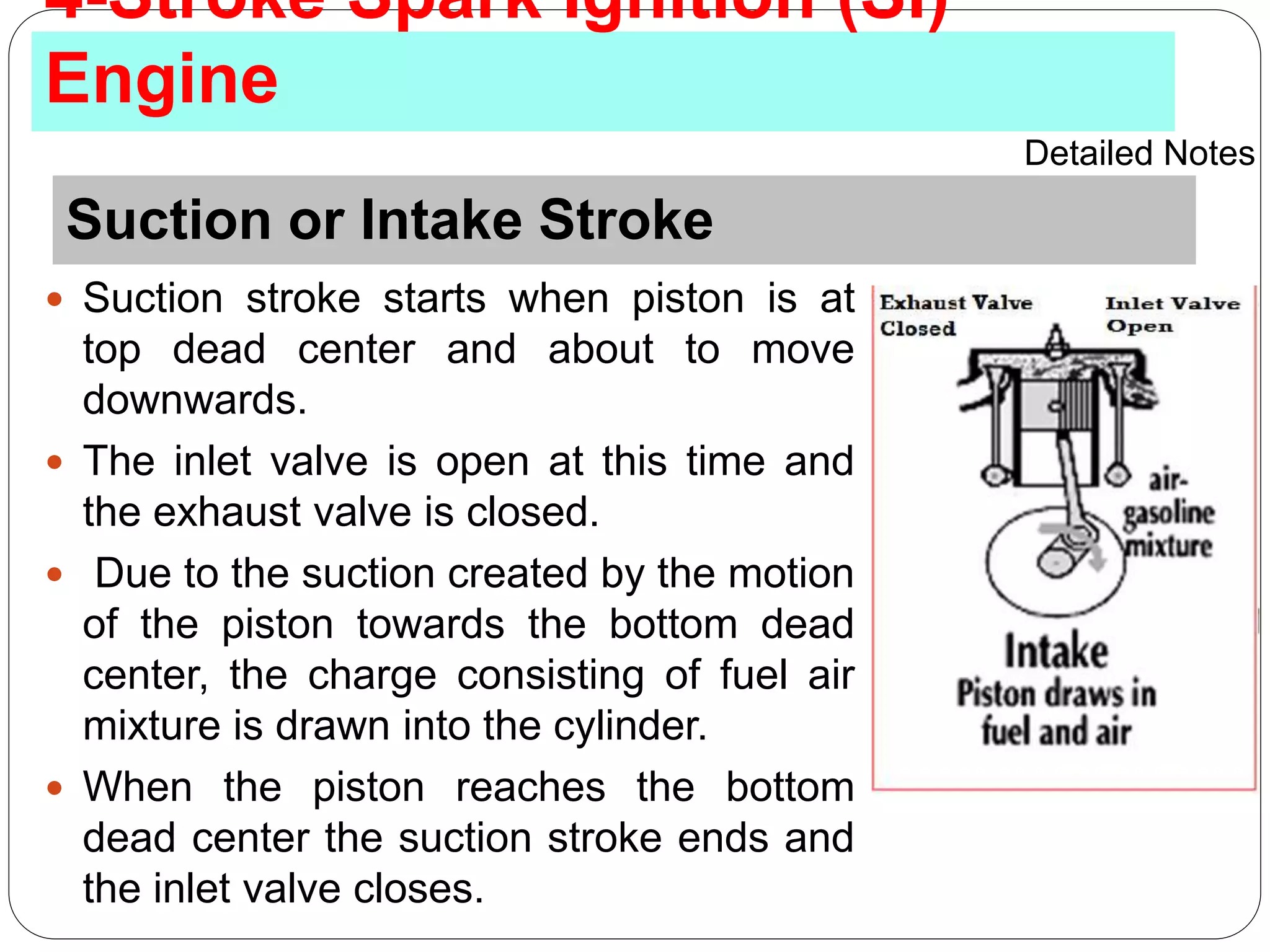
Suction or Intake Stroke
 Suction stroke starts when piston is at
top dead center and about to move
downwards.
 The inlet valve is open at this time and
the exhaust valve is closed.
 Due to the suction created by the motion
of the piston towards the bottom dead
center, the charge consisting of fuel air
mixture is drawn into the cylinder.
 When the piston reaches the bottom
dead center the suction stroke ends and
the inlet valve closes.
4-Stroke Spark Ignition (SI)
Engine
Detailed Notes
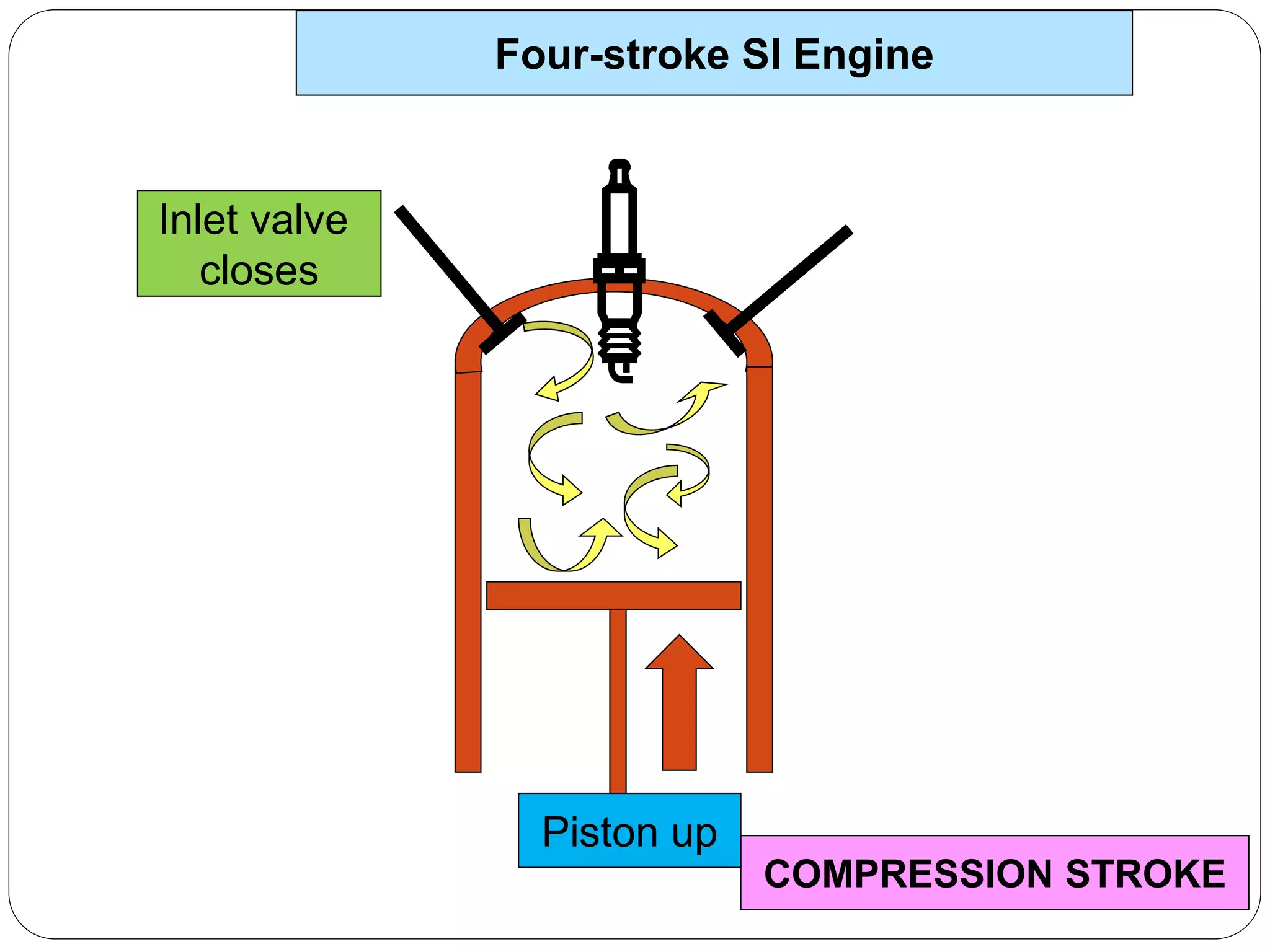
Compression Stroke
 The charge taken into the cylinder during the
suction stroke is compressed by the return
stroke of the piston.
 During this stroke both inlet and exhaust
valves are in closed position. The mixture
which fills the entire cylinder volume is now
compressed into the clearance volume.
 At the end of the compression stroke the
mixture is ignited with the help of a spark plug
located on the cylinder head. During the
burning process the chemical energy of the
fuel is converted into heat energy.
 The pressure at the end of the combustion
process is considerably increased due to heat
from the fuel.
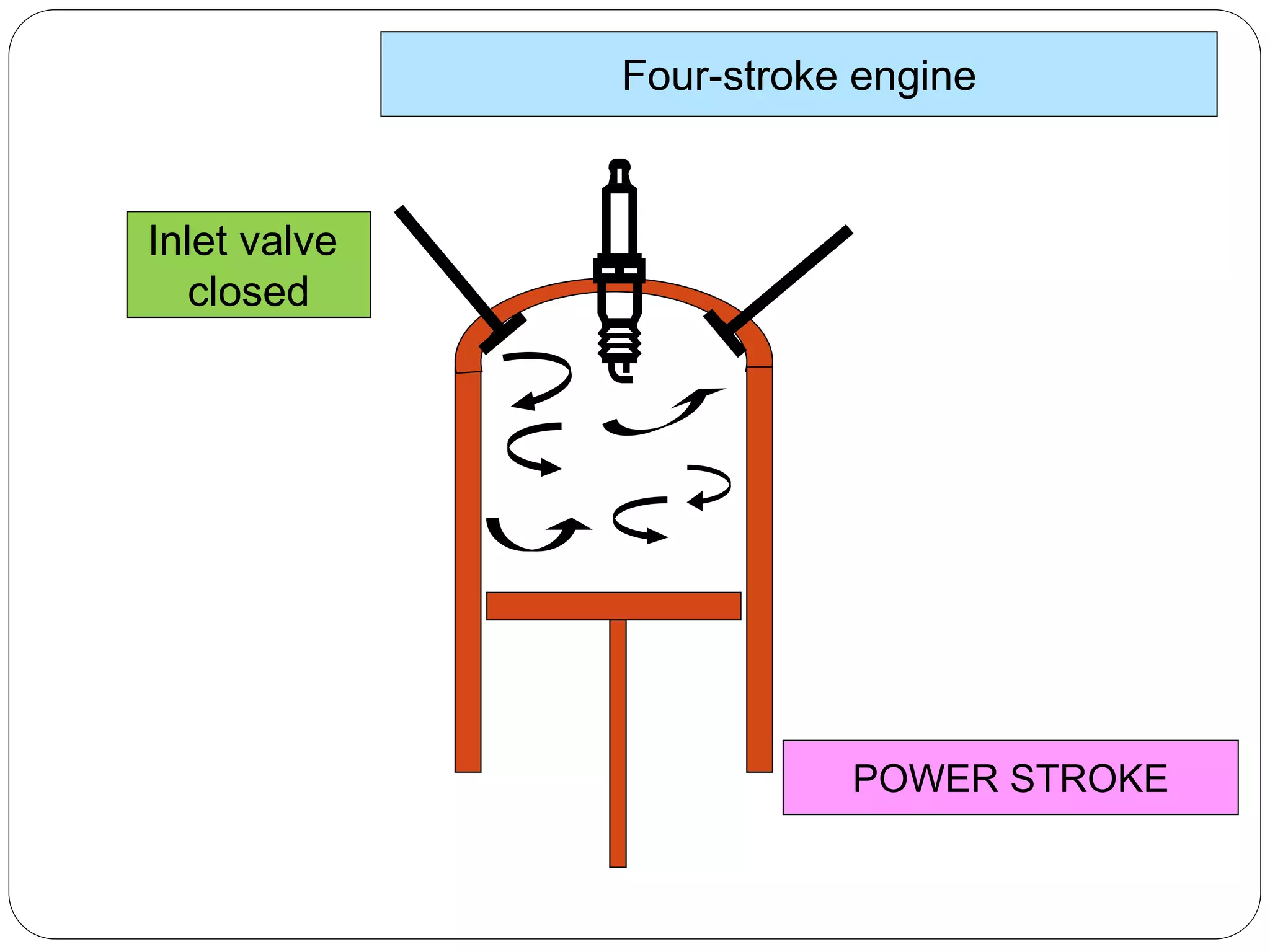
Expansion or Power Stroke
 The high pressure of the burnt
gases forces the piston towards
the BDC, both the valves are in
closed position. Of the four strokes
only during this stroke power is
produced.
 Both pressure and temperature
decrease during expansion.
Exhaust Stroke
 At the end of the expansion stroke
the exhaust valve opens and the
inlet valve remains closed.
 The pressure falls to atmospheric
level a part of the burnt gases
escape.
 The piston starts moving from the
bottom dead center to top dead
center and sweeps the burnt gases
out from the cylinder almost at
atmospheric pressure.
 The exhaust valve closes when the
piston reaches TDC.
Four Stroke Diesel / CI
Engine
 Diesel Engine was invented by Rudolph Diesel.
It is ignited by compression of charge, so it’s also
called as compression ignition (CI) engine.
 It is similar to four stroke petrol engine but operates at a
much higher compression ratio. The compression ratio of an
SI engine is between 6 and 10:1 while for a CI engine it is
from 16 to 20:1.
 A high pressure fuel injector is used to inject the fuel into
the combustion chamber.
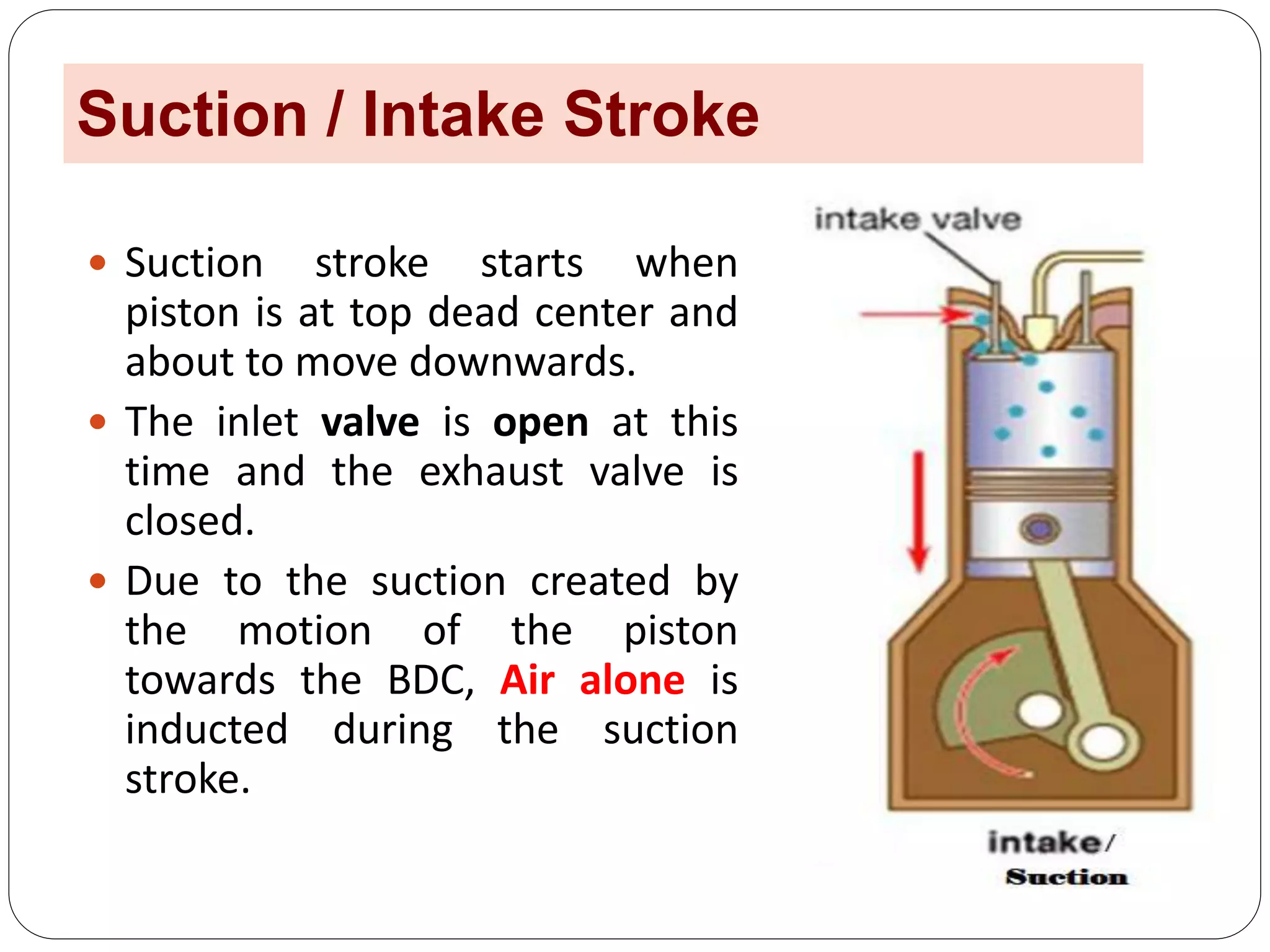
Suction / Intake Stroke
 Suction stroke starts when
piston is at top dead center and
about to move downwards.
 The inlet valve is open at this
time and the exhaust valve is
closed.
 Due to the suction created by
the motion of the piston
towards the BDC, Air alone is
inducted during the suction
stroke.
Compression Stroke
 Air inducted during the suction
stroke is compressed into the
clearance volume due to return
stroke of piston.
 Both valves remain closed
during this stroke.
 The air in the combustion
chamber is at high
temperature and high pressure
with a decrease in volume.
Both Valves Closed
Expansion Stroke or Power
Stroke
 At the end of compression stroke, the
fuel is injected into the cylinder in the
form of fine spray through the nozzle and
is ignited by the temperature of hot
compressed air in the chamber.
 So that combustion process is started at
the end of compression stroke.
 The combustion of gases expands inside
the cylinder so that piston start to move
towards BDC.
 Both the valves remain closed during this
stroke
Both Valves Closed
Piston Crown
56
Exhaust Stroke
 The piston traveling from
BDC to TDC pushes out
the product of
combustion.
 The exhaust valve is
open and the intake
valve is closed during
this stroke.
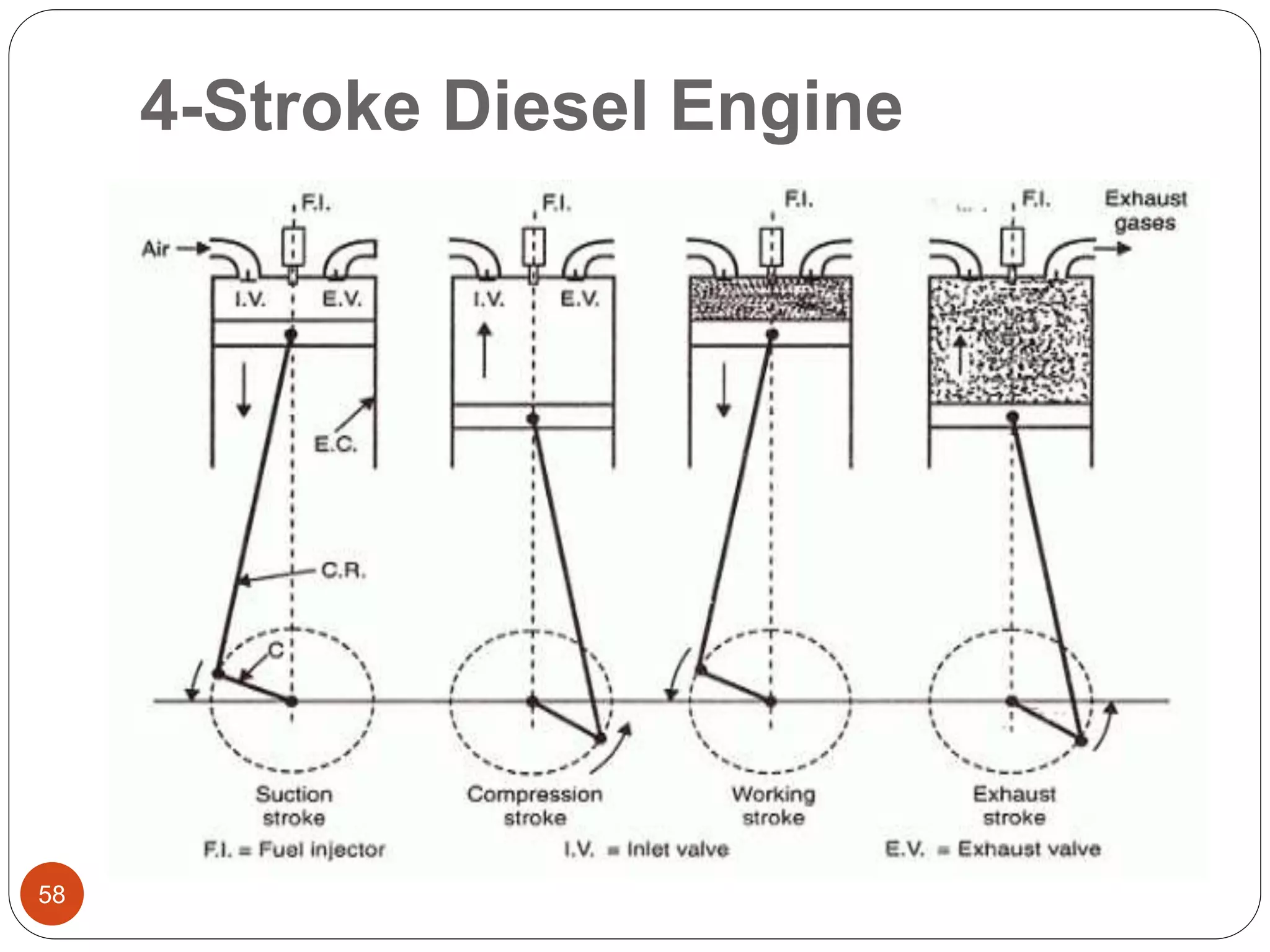
4-Stroke Diesel Engine
58
59
S
N
o
Four Stroke Engine Two Stroke Engine
1. The thermodynamic cycle
is completed in four strokes
of the piston or in two
revolutions of crank shaft
or 720° of crank angle.
The thermodynamic cycle is
completed in two strokes of
the piston or in one
revolution of the crank shaft
or 3600 of crank angle
2. One power stroke is
obtained in every two
revolution of crank shaft /
4-strokes of the Piston.
One power stroke is obtained
in each revolution of crank
shaft.
3. Because of above, turning
moment is not so uniform
and hence a heavier
flywheel is needed.
Because of above, turning
moment is more uniform and
hence a lighter flywheel can
be used.
4. Power produced for same
size of engine is less. In
Power produced for same size
of engine is twice, or for same
S.
N
o
Four Stroke Engine Two Stroke Engine
5. Lesser cooling and lubrication
requirements. Lower rate of wear
and tear.
Greater cooling and lubrication
requirements. Higher rate of wear
and tear.
6. It has valves and valve actuating
mechanisms for opening and
closing of the intake and exhaust
valves.
It has no valves but only ports
7. Because of comparatively higher
weight and complicated valve
mechanism, the initial cost of the
engine is more.
Because of light weight and
simplicity due to the absence of
valve actuating mechanism, initial
cost of the engine is less.
8. Volumetric efficiency is more due
to more time for induction.
Volumetric efficiency is low due to
lesser time for induction.
9. Thermal efficiency is higher, part
load efficiency is better.
Thermal efficiency is lower, part
load efficiency is poor.
1
0.
Application : Cars, Buses, Trucks,
Tractors, Aero planes and Power
Application : Mopeds, Scooters,
Motorcycles, Hand sprayers etc.,

Four Stroke SI and CI engines

  • 1.
    I.C. Engines 4 StrokePetrol & Diesel Engines 1 Dr. S. VIJAYA BHASKAR Professor in Mechanical Engineering Sreenidhi Institute of Science & Technology, Hyderabad
  • 2.
    Working Principle ofIC Engines NOT TALKING ABOUT 2 OR 4 STROKE OR PETROL OR DIESEL ENGINE JUST WORKING OF ANY IC ENGINE  TWO stroke engine rotates only 360 or ONE revolution of crank shaft rotation  FOUR stroke cycle completed through 720 of crank rotation or TWO revolution of crank shaft rotation
  • 3.
    Working Principle ofIC Engines All IC Engine must have the following FOUR EVENTS in the same order 1. Suction 2. Compression 3. Expansion / Power and 4. Exhaust
  • 4.
    Spark plug Inlet valve/Port Exhaustvalve/ Port Cylinder Piston Fuel Injector
  • 5.
  • 6.
    Piston down INTAKE STROKE Inletvalve/Port opens Exhaust valve/Port Closed
  • 7.
    Inlet valve / Portopen Piston down INDUCTION STROKE Air/Fuel Mixture InAir ONLY In Exhaust valve/Port Closed
  • 8.
  • 9.
  • 10.
  • 11.
  • 12.
  • 13.
  • 14.
  • 15.
    EXHAUST STROKE Exhaust valve/Port opens Pistonup Exhaust gases out Inlet valve/Port closed
  • 16.
    EXHAUST STROKE Exhaust valve/Port opens Pistonup Exhaust gases out Inlet valve/Port closed
  • 17.
  • 18.
  • 19.
  • 20.
    Inlet valve open Piston down SUCTIONSTROKE Four-stroke SI Engine
  • 21.
    Inlet valve open Piston down INDUCTIONSTROKE Four-stroke SI Engine Air/Fuel Mixture In
  • 22.
  • 23.
  • 24.
  • 25.
    Inlet valve closed POWER STROKE Four-strokeSI Engine Piston down powerfully
  • 26.
    Inlet valve closed POWER STROKE Four-strokeSI Engine Piston down powerfully
  • 27.
  • 28.
  • 29.
    Inlet valve closed EXHAUST STROKE Four-strokeSI Engine Exhaust valve open Piston up Exhaust gases out
  • 30.
    Inlet valve closed EXHAUST STROKE Four-strokeSI Engine Exhaust valve open Piston up Exhaust gases out
  • 31.
    Inlet valve opens INDUCTION STROKE Four-strokeSI Engine Exhaust valve closed
  • 34.
    Operation of 4-StrokePetrol Engine 3 4 INLET  EXHAUST
  • 35.
  • 36.
  • 37.
  • 38.
    Power Cycle: Ottocycle The air standard Otto Cycle is an ideal cycle that approximates a spark- ignition internal combustion engine. It assumes that the heat addition occurs instantaneously while the piston is at TDC.
  • 39.
    Process (1-2) Isentropic Compression Compressionfrom ν1 to v2 ↓ BDC(β=180º ) ↓ TDC (θ=0º) (2-3) Constant Volume Heat Addition: QH •While at TDC •Ignition of fuel (chemical reaction takes place) (3-4) Isentropic Expansion •Power is delivered while s = const. (4-1) Constant volume Heat Rejection process Otto Cycle
  • 40.
  • 41.
     Process 1–2is an isentropic compression of the air as the piston moves from bottom dead center to top dead center.  Process 2–3 is a constant-volume heat transfer to the air from an external source while the piston is at top dead center. This process is intended to represent the ignition of the fuel–air mixture and the subsequent rapid burning.  Process 3–4 is an isentropic expansion (power stroke).  Process 4–1 completes the cycle by a constant-volume process in which heat is rejected from the air while the piston is at bottom dead center.
  • 42.
  • 43.
    THEORETICAL VALVE TIMINGDIAGRAM FOR FOUR STROKE ENGINE 43
  • 44.
  • 45.
  • 46.
    Typical Theoretical P-Vand Valve Timing Diagrams of a Four- Stroke Spark Ignition Engine 46 Observations:  P-V diagram shows sharp edges i.e., valves open/close instantaneously at dead centres
  • 47.
    Actual Case: Inlet Valve(IV) and Exhaust Valve (EV )open/close before and after dead centres  Mechanical Factor  Dynamic Factor of Gas Flow  Valves are opened and closed by cam mechanism  Valves will bounce on its seat if closed abruptly  Opening/closing of valves spread over a certain crank angle Every Corner in the P-V diagram is ROUNDED 47
  • 48.
    Suction or IntakeStroke  Suction stroke starts when piston is at top dead center and about to move downwards.  The inlet valve is open at this time and the exhaust valve is closed.  Due to the suction created by the motion of the piston towards the bottom dead center, the charge consisting of fuel air mixture is drawn into the cylinder.  When the piston reaches the bottom dead center the suction stroke ends and the inlet valve closes. 4-Stroke Spark Ignition (SI) Engine Detailed Notes
  • 49.
    Compression Stroke  Thecharge taken into the cylinder during the suction stroke is compressed by the return stroke of the piston.  During this stroke both inlet and exhaust valves are in closed position. The mixture which fills the entire cylinder volume is now compressed into the clearance volume.  At the end of the compression stroke the mixture is ignited with the help of a spark plug located on the cylinder head. During the burning process the chemical energy of the fuel is converted into heat energy.  The pressure at the end of the combustion process is considerably increased due to heat from the fuel.
  • 50.
    Expansion or PowerStroke  The high pressure of the burnt gases forces the piston towards the BDC, both the valves are in closed position. Of the four strokes only during this stroke power is produced.  Both pressure and temperature decrease during expansion.
  • 51.
    Exhaust Stroke  Atthe end of the expansion stroke the exhaust valve opens and the inlet valve remains closed.  The pressure falls to atmospheric level a part of the burnt gases escape.  The piston starts moving from the bottom dead center to top dead center and sweeps the burnt gases out from the cylinder almost at atmospheric pressure.  The exhaust valve closes when the piston reaches TDC.
  • 52.
    Four Stroke Diesel/ CI Engine  Diesel Engine was invented by Rudolph Diesel. It is ignited by compression of charge, so it’s also called as compression ignition (CI) engine.  It is similar to four stroke petrol engine but operates at a much higher compression ratio. The compression ratio of an SI engine is between 6 and 10:1 while for a CI engine it is from 16 to 20:1.  A high pressure fuel injector is used to inject the fuel into the combustion chamber.
  • 53.
    Suction / IntakeStroke  Suction stroke starts when piston is at top dead center and about to move downwards.  The inlet valve is open at this time and the exhaust valve is closed.  Due to the suction created by the motion of the piston towards the BDC, Air alone is inducted during the suction stroke.
  • 54.
    Compression Stroke  Airinducted during the suction stroke is compressed into the clearance volume due to return stroke of piston.  Both valves remain closed during this stroke.  The air in the combustion chamber is at high temperature and high pressure with a decrease in volume. Both Valves Closed
  • 55.
    Expansion Stroke orPower Stroke  At the end of compression stroke, the fuel is injected into the cylinder in the form of fine spray through the nozzle and is ignited by the temperature of hot compressed air in the chamber.  So that combustion process is started at the end of compression stroke.  The combustion of gases expands inside the cylinder so that piston start to move towards BDC.  Both the valves remain closed during this stroke Both Valves Closed
  • 56.
  • 57.
    Exhaust Stroke  Thepiston traveling from BDC to TDC pushes out the product of combustion.  The exhaust valve is open and the intake valve is closed during this stroke.
  • 58.
  • 59.
  • 60.
    S N o Four Stroke EngineTwo Stroke Engine 1. The thermodynamic cycle is completed in four strokes of the piston or in two revolutions of crank shaft or 720° of crank angle. The thermodynamic cycle is completed in two strokes of the piston or in one revolution of the crank shaft or 3600 of crank angle 2. One power stroke is obtained in every two revolution of crank shaft / 4-strokes of the Piston. One power stroke is obtained in each revolution of crank shaft. 3. Because of above, turning moment is not so uniform and hence a heavier flywheel is needed. Because of above, turning moment is more uniform and hence a lighter flywheel can be used. 4. Power produced for same size of engine is less. In Power produced for same size of engine is twice, or for same
  • 61.
    S. N o Four Stroke EngineTwo Stroke Engine 5. Lesser cooling and lubrication requirements. Lower rate of wear and tear. Greater cooling and lubrication requirements. Higher rate of wear and tear. 6. It has valves and valve actuating mechanisms for opening and closing of the intake and exhaust valves. It has no valves but only ports 7. Because of comparatively higher weight and complicated valve mechanism, the initial cost of the engine is more. Because of light weight and simplicity due to the absence of valve actuating mechanism, initial cost of the engine is less. 8. Volumetric efficiency is more due to more time for induction. Volumetric efficiency is low due to lesser time for induction. 9. Thermal efficiency is higher, part load efficiency is better. Thermal efficiency is lower, part load efficiency is poor. 1 0. Application : Cars, Buses, Trucks, Tractors, Aero planes and Power Application : Mopeds, Scooters, Motorcycles, Hand sprayers etc.,