Cooking Stoves
Energy & Environment
Why is it important to cook food?
Makes it safe to eat
Kills bacteria, prevent
illness and disease
Fuels
Cooking uses over 50% of the
energy used by a rural family
The normal method of cooking
uses about 8 kgs of firewood to
cook food for a family of five.
The average rural family spends
20% or more of its income
purchasing wood or charcoal for
cooking
8 kgs
Standard approaches to conserving
cooking fuel
Use a cooking
lid
Use a stove that can
heat more than one
pan
40%
less
fuel
40%
less
fuel
How does this work?
Revision: Trapping Heat
Prevents convection
Convection is when hot air particles travel to cool areas
Warm air
Cold air
Hot airWarm air
40% less fuel needed when a lid is used
Pot/Pressure Cooker
Revision: Trapping Heat
Prevents convection
Convection is when hot air particles travel to cool areas
Warm air
Cold air
Hot airWarm air Warm air
Cold air
Hot airWarm air
Cooking 2 pots separately
Pot Pot
Revision: Trapping Heat
Prevents convection
Convection is when hot air particles travel to cool areas
Warm air
Cold air
Hot airWarm air
40% less fuel needed when pots are cooked beside one another
Pot 1 Pot 2
Exercise on using a pot lid
Rupal cooks for her family every day of the week
She uses 8kg of wood per day
How much wood does she use in a week?
Total weight of wood used per week
=7 days x 8kg per day
=56 kg per week
She starts putting a lid on the pot so she uses 40% less
fuel. How much fuel does she now use in a week?
Exercise on using a pot lid
Total weight of wood used per week
=7 days x 8kg per day
=56 kg per week
40% saved so still uses
100%-40%= 60% of total fuel
60%= 60
100
40%
60%
New Fuel use
Fuel not used
any more
Fuel still used
So we want to find 56 kg per week x 60
100
By using a lid Rupal has
reduced her fuel use from
56kg to 33.6 kg a week
56 x 60 =3360 = 33.6 kg per week
100 100
Traditional stone cooking fire-
Problems?
Fire touches
bottom of
pan
Fire spreads out of
cooker
Thermal efficiency is 5 to 15 %.
Take more time to cook so
needs lots of fuel.
The smoke makes the cooking pots
dirty this increases the work load of
women.
Smoke entering into the
kitchen room leads to
‘Indoor air Pollution’( IAP)
Every year IAP is responsible for the death
of 1.6 million people - that's one death
every 20 seconds
This creates a risk of burns and scalds.
Only one cooking pot
can be used at a time.
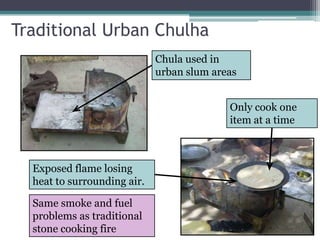
Traditional Urban Chulha
Chula used in
urban slum areas
Exposed flame losing
heat to surrounding air.
Only cook one
item at a time
Same smoke and fuel
problems as traditional
stone cooking fire
Problems with Traditional Chulha:
Smoke
Every year 500,000 women and
children die in India due to long term
exposure to smoke in rural kitchens.
The smoke causes:
User and family
exposed to smoke Family members often need to climb
on the roof to clean the chimney. This
has been blamed for many accidents.
Eye problems Lung problems
Problems with using wood as a fuel:
Time & Money
Women and children have to spend time collecting wood.
Women could be earning money and children could be
at school
This means less money to spend on food, education, and
medical care. An improved cooking stove can help boost
a family's income
The cost of wood is going up in urban
areas
Problems with using wood as a fuel:
Deforestation
Quality of the land will decrease Erosion will increase
Diversification will decrease
Flooding may increase
Reduced quality of air
Runoff is increased so ground water
recharge is minimised
The main goal of most improved
cooking stoves is to reduce amount of
wood the stoves consume
A better cook stove needs to:
Minimse fuel usage Cook two things at once
Reduce the smoke
emitted towards the
user
Use different biomass
fuels
Easy to build from
local materials
Cook different things
rice, chipatti etc
Accept different cooking
vessels
So we have seen the
problems with using a
traditional wood stove
and what is needed to
make it better….
Now lets look at some improved
stoves
Bharatlaxmi stove
The stove needs to be installed in
a mud and brick platform.
Fixed improved
single pot hole stove
No behavioural
change required
Affordable to rural
population
Price of stove:
INR 500
8 bricks of insulating cement
metallic wire for tying
the bricks together
Metallic pot holder
50%
less
fuel 30%
less
cooking
time
The Smokeless Chulha
Two pot holders
It traps smoke and
heat inside
Vent lid to
stop rain
and animals
entering
Vents smoke out of
room with a chimney
80% of heat
cooking
20% of heat
Keeping
food warm
Smokeless Chulha at Vigyan Ashram
Materials needed for Smokeless
Chulah construction
Bricks or mud made out of
Clay – 1 Part
Sand – 5 part
Bhoosa or paddy husk or
cow dung.
Chimney made from cement pipe.
(Metal pipes will get too hot and plastic pipes may melt)
Cap on the chimney top, to protect from rain, animals and
sparks
Laxmi Stove
Any household pot
can be placed on
top of the stove
60% heat
40% heat
Two dishes can be cooked at same time
Pots sit flush on the
potholes, so the
gases do not escape
into the kitchen
Fixed Cement stove
Manufactured by
local worksphops
that own a mold
Price of Mold:
INR 2000
Chimney
50%
less
fuel
50%
less
smoke
An Improved Sampoorna Smokeless
Chulha from Philips
Indoor access for
cleaning
Stack of clay tablets
that clean the exhaust
Chimney made from
several sections, easier
to manufacture and
transport and clean
90%
less
smoke
This smokeless chulha was constructed
but can you see anything wrong?
The pipe is cut too
short. The smoke
will collect under
the roof
The pans expanded with
the heat of the fire and
cracked the stove
This can be prevented by
placing a metal sheet on the
top of the stove
Now popular in urban areas too!
Many people living in cities miss
the food cooked on chulhas.
The modified chulhas can be easily installed in flats or
urban homes, as they do not emit smoke and require less
fuel.
Case Study of Good Use
30%
less
fuel
80%
less
smoke
30%
less
cooking
time
Village Nandal is now a smoke
free village. Every family in this
village is now a proud owner of
a Bharatlaxmi Stove.
Benefits of Smokeless Chulha
Reduced risk of
carcinogenic fumes
Reduced risk of
eye injuries
Thermal
efficiency
increased by
25%
Reduces
deforestation
Affordable and
made with local
materials
Risk of burns
reduced from
open flames
But some people don’t want them
Other types of stove….
Sarai Cooking System
Portable even when cooking
Cooks by steam
& retaining
heat
Can be left
unattended
Cleanest ways of
using charcoal for
household cooking
Keeps food
warm for 3
hours
Price of Stove:
Medium: INR
1150
Sampada Gasifier Stove
Portable metallic stove
Fuel=dry twigs & wood chips
Can cook for 1hr
Charcoal is left
behind in the fuel
holder after cooking
Price of Stove: INR 1500
Sampada Gasifier Stove Excersise
After cooking, charcoal is left behind in fuel holder.
Burning 1 kg of wood, leaves 250gm of charcoal.
Cost of fuel wood (1 kg) = Rs. 2
Value of charcoal (250 gm) = Rs. 3
What is the profit gained every time this
stove is used?
Profit=value earned-value spent
=Rs. 3-Rs.2
=Rs. 1
If you used the stove 3x a day. How many
days would it take to break even? The stove
costs Rs. 1500
Sampada Gasifier Stove Exercise
Profit gained every time used=value earned-value spent
=Rs. 3-Rs.2
=Rs. 1
If stove used 3x a day. Then profit gained every day
=3 times x profit per use
=3 x Rs. 1
=Rs.3 profit per day
Days to pay for stove
=Price of stove ÷ profit per day
=Rs. 1500 ÷ Rs.3
=500 days
Years to pay for stove
=500 days ÷ 365
=1 year and about 5 months
Factor Kerosene Wood
Cost Subsidized by
the Government
of India
Cheap in rural area but
expensive in cities
Availability Subsidized fuel is not
always available
Usually available
Pollution Burns cleaner Smokey
Taste ok Better Taste
Kerosene Burners or Primus stove
Exercise
If a family buys 14 litres of kerosene a month. How much does this
cost a year?
Buying from government shops Rs.9 per litre
14 liters
x Rs.9/liter
Rs. 126 . Per month
Rs. 126
x 12 months
25 2
+ 1260
Rs. 1512 Per year
Kerosene Burners or Primus stove
Exercise
The black market sells kerosene for Rs. 30 per litre. How much
would it cost if the family bought their kerosene from the black
market 20% of the time?
14 liters
x Rs.30/liter
Rs. 420 . Per month
Rs. 420
x 12 months
840
+ 4200
Rs. 5040 Per year
Kerosene Burners or Primus stove
Exercise
For a years supply of kerosene from the government shop it
costs Rs. 1512
For a years supply of kerosene from the black market it costs
Rs. 5040
The family buy their kerosene from the black market 20% of
the time
80% of time from Government shops
=Rs 1512 x 80% =1512 x 80 = 120960 = Rs. 1209.6
100 100
20% of time from the Black market
=Rs 5040 x 20% =5040 x 20 = 100800 = Rs. 1008
100 100
Kerosene Burners or Primus stove
Exercise
80% of time from Government shops= Rs. 1209.6
20% of time from the Black market= Rs. 1008
Total cost for 1 year
= 1209.6
+ 1008.0
Rs. 2217 .6
So even if the family buy their fuel from the black market only
20% of the time. Their annual fuel bill goes up by almost 50%!
% increase = change in cost x 100
original cost 1
= 2217.6- 1512 x 100
1512 1
= 705.6 x 100
1512 1
=0.47 x 100
1
=47%
So now we can
work out the %
increase in their
annual fuel bill
Gas Cooking Stove
Non permanent
From a health and environmental
view this is the best option for
cooking
A family of 4 cooking uses about
50% less fuel when using gas rather
than wood
Rs. 3,500
Many people prefer the taste of
food cooked on a wood stove
LPG is
subsidized
by the
government
Class Stove Exercise
Calculate the % of the class that have each of the following
cook stoves in their homes. Present your findings in a pie
chart.
What is the most popular and why do you think this is?
Traditional
stone stove
Traditional urban stove
Smokeless Chulha
Sarai Cooking System
Sampada Gasifier
Stove
Gas Cooking Stove
Kerosene
Stove

Cooking stoves

  • 1.
  • 2.
    Why is itimportant to cook food? Makes it safe to eat Kills bacteria, prevent illness and disease
  • 3.
    Fuels Cooking uses over50% of the energy used by a rural family The normal method of cooking uses about 8 kgs of firewood to cook food for a family of five. The average rural family spends 20% or more of its income purchasing wood or charcoal for cooking 8 kgs
  • 4.
    Standard approaches toconserving cooking fuel Use a cooking lid Use a stove that can heat more than one pan 40% less fuel 40% less fuel How does this work?
  • 5.
    Revision: Trapping Heat Preventsconvection Convection is when hot air particles travel to cool areas Warm air Cold air Hot airWarm air 40% less fuel needed when a lid is used Pot/Pressure Cooker
  • 6.
    Revision: Trapping Heat Preventsconvection Convection is when hot air particles travel to cool areas Warm air Cold air Hot airWarm air Warm air Cold air Hot airWarm air Cooking 2 pots separately Pot Pot
  • 7.
    Revision: Trapping Heat Preventsconvection Convection is when hot air particles travel to cool areas Warm air Cold air Hot airWarm air 40% less fuel needed when pots are cooked beside one another Pot 1 Pot 2
  • 8.
    Exercise on usinga pot lid Rupal cooks for her family every day of the week She uses 8kg of wood per day How much wood does she use in a week? Total weight of wood used per week =7 days x 8kg per day =56 kg per week She starts putting a lid on the pot so she uses 40% less fuel. How much fuel does she now use in a week?
  • 9.
    Exercise on usinga pot lid Total weight of wood used per week =7 days x 8kg per day =56 kg per week 40% saved so still uses 100%-40%= 60% of total fuel 60%= 60 100 40% 60% New Fuel use Fuel not used any more Fuel still used So we want to find 56 kg per week x 60 100 By using a lid Rupal has reduced her fuel use from 56kg to 33.6 kg a week 56 x 60 =3360 = 33.6 kg per week 100 100
  • 10.
    Traditional stone cookingfire- Problems? Fire touches bottom of pan Fire spreads out of cooker Thermal efficiency is 5 to 15 %. Take more time to cook so needs lots of fuel. The smoke makes the cooking pots dirty this increases the work load of women. Smoke entering into the kitchen room leads to ‘Indoor air Pollution’( IAP) Every year IAP is responsible for the death of 1.6 million people - that's one death every 20 seconds This creates a risk of burns and scalds. Only one cooking pot can be used at a time.
  • 11.
    Traditional Urban Chulha Chulaused in urban slum areas Exposed flame losing heat to surrounding air. Only cook one item at a time Same smoke and fuel problems as traditional stone cooking fire
  • 12.
    Problems with TraditionalChulha: Smoke Every year 500,000 women and children die in India due to long term exposure to smoke in rural kitchens. The smoke causes: User and family exposed to smoke Family members often need to climb on the roof to clean the chimney. This has been blamed for many accidents. Eye problems Lung problems
  • 13.
    Problems with usingwood as a fuel: Time & Money Women and children have to spend time collecting wood. Women could be earning money and children could be at school This means less money to spend on food, education, and medical care. An improved cooking stove can help boost a family's income The cost of wood is going up in urban areas
  • 14.
    Problems with usingwood as a fuel: Deforestation Quality of the land will decrease Erosion will increase Diversification will decrease Flooding may increase Reduced quality of air Runoff is increased so ground water recharge is minimised The main goal of most improved cooking stoves is to reduce amount of wood the stoves consume
  • 15.
    A better cookstove needs to: Minimse fuel usage Cook two things at once Reduce the smoke emitted towards the user Use different biomass fuels Easy to build from local materials Cook different things rice, chipatti etc Accept different cooking vessels So we have seen the problems with using a traditional wood stove and what is needed to make it better…. Now lets look at some improved stoves
  • 16.
    Bharatlaxmi stove The stoveneeds to be installed in a mud and brick platform. Fixed improved single pot hole stove No behavioural change required Affordable to rural population Price of stove: INR 500 8 bricks of insulating cement metallic wire for tying the bricks together Metallic pot holder 50% less fuel 30% less cooking time
  • 17.
    The Smokeless Chulha Twopot holders It traps smoke and heat inside Vent lid to stop rain and animals entering Vents smoke out of room with a chimney 80% of heat cooking 20% of heat Keeping food warm
  • 18.
    Smokeless Chulha atVigyan Ashram
  • 19.
    Smokeless Chulha atVigyan Ashram
  • 20.
    Materials needed forSmokeless Chulah construction Bricks or mud made out of Clay – 1 Part Sand – 5 part Bhoosa or paddy husk or cow dung. Chimney made from cement pipe. (Metal pipes will get too hot and plastic pipes may melt) Cap on the chimney top, to protect from rain, animals and sparks
  • 21.
    Laxmi Stove Any householdpot can be placed on top of the stove 60% heat 40% heat Two dishes can be cooked at same time Pots sit flush on the potholes, so the gases do not escape into the kitchen Fixed Cement stove Manufactured by local worksphops that own a mold Price of Mold: INR 2000 Chimney 50% less fuel 50% less smoke
  • 22.
    An Improved SampoornaSmokeless Chulha from Philips Indoor access for cleaning Stack of clay tablets that clean the exhaust Chimney made from several sections, easier to manufacture and transport and clean 90% less smoke
  • 23.
    This smokeless chulhawas constructed but can you see anything wrong? The pipe is cut too short. The smoke will collect under the roof The pans expanded with the heat of the fire and cracked the stove This can be prevented by placing a metal sheet on the top of the stove
  • 24.
    Now popular inurban areas too! Many people living in cities miss the food cooked on chulhas. The modified chulhas can be easily installed in flats or urban homes, as they do not emit smoke and require less fuel.
  • 25.
    Case Study ofGood Use 30% less fuel 80% less smoke 30% less cooking time Village Nandal is now a smoke free village. Every family in this village is now a proud owner of a Bharatlaxmi Stove.
  • 26.
    Benefits of SmokelessChulha Reduced risk of carcinogenic fumes Reduced risk of eye injuries Thermal efficiency increased by 25% Reduces deforestation Affordable and made with local materials Risk of burns reduced from open flames
  • 27.
    But some peopledon’t want them
  • 28.
    Other types ofstove….
  • 29.
    Sarai Cooking System Portableeven when cooking Cooks by steam & retaining heat Can be left unattended Cleanest ways of using charcoal for household cooking Keeps food warm for 3 hours Price of Stove: Medium: INR 1150
  • 30.
    Sampada Gasifier Stove Portablemetallic stove Fuel=dry twigs & wood chips Can cook for 1hr Charcoal is left behind in the fuel holder after cooking Price of Stove: INR 1500
  • 31.
    Sampada Gasifier StoveExcersise After cooking, charcoal is left behind in fuel holder. Burning 1 kg of wood, leaves 250gm of charcoal. Cost of fuel wood (1 kg) = Rs. 2 Value of charcoal (250 gm) = Rs. 3 What is the profit gained every time this stove is used? Profit=value earned-value spent =Rs. 3-Rs.2 =Rs. 1 If you used the stove 3x a day. How many days would it take to break even? The stove costs Rs. 1500
  • 32.
    Sampada Gasifier StoveExercise Profit gained every time used=value earned-value spent =Rs. 3-Rs.2 =Rs. 1 If stove used 3x a day. Then profit gained every day =3 times x profit per use =3 x Rs. 1 =Rs.3 profit per day Days to pay for stove =Price of stove ÷ profit per day =Rs. 1500 ÷ Rs.3 =500 days Years to pay for stove =500 days ÷ 365 =1 year and about 5 months
  • 33.
    Factor Kerosene Wood CostSubsidized by the Government of India Cheap in rural area but expensive in cities Availability Subsidized fuel is not always available Usually available Pollution Burns cleaner Smokey Taste ok Better Taste Kerosene Burners or Primus stove
  • 34.
    Kerosene Burners orPrimus stove Exercise If a family buys 14 litres of kerosene a month. How much does this cost a year? Buying from government shops Rs.9 per litre 14 liters x Rs.9/liter Rs. 126 . Per month Rs. 126 x 12 months 25 2 + 1260 Rs. 1512 Per year
  • 35.
    Kerosene Burners orPrimus stove Exercise The black market sells kerosene for Rs. 30 per litre. How much would it cost if the family bought their kerosene from the black market 20% of the time? 14 liters x Rs.30/liter Rs. 420 . Per month Rs. 420 x 12 months 840 + 4200 Rs. 5040 Per year
  • 36.
    Kerosene Burners orPrimus stove Exercise For a years supply of kerosene from the government shop it costs Rs. 1512 For a years supply of kerosene from the black market it costs Rs. 5040 The family buy their kerosene from the black market 20% of the time 80% of time from Government shops =Rs 1512 x 80% =1512 x 80 = 120960 = Rs. 1209.6 100 100 20% of time from the Black market =Rs 5040 x 20% =5040 x 20 = 100800 = Rs. 1008 100 100
  • 37.
    Kerosene Burners orPrimus stove Exercise 80% of time from Government shops= Rs. 1209.6 20% of time from the Black market= Rs. 1008 Total cost for 1 year = 1209.6 + 1008.0 Rs. 2217 .6 So even if the family buy their fuel from the black market only 20% of the time. Their annual fuel bill goes up by almost 50%! % increase = change in cost x 100 original cost 1 = 2217.6- 1512 x 100 1512 1 = 705.6 x 100 1512 1 =0.47 x 100 1 =47% So now we can work out the % increase in their annual fuel bill
  • 38.
    Gas Cooking Stove Nonpermanent From a health and environmental view this is the best option for cooking A family of 4 cooking uses about 50% less fuel when using gas rather than wood Rs. 3,500 Many people prefer the taste of food cooked on a wood stove LPG is subsidized by the government
  • 39.
    Class Stove Exercise Calculatethe % of the class that have each of the following cook stoves in their homes. Present your findings in a pie chart. What is the most popular and why do you think this is? Traditional stone stove Traditional urban stove Smokeless Chulha Sarai Cooking System Sampada Gasifier Stove Gas Cooking Stove Kerosene Stove

Editor's Notes

  • #4 1 liter of Kerosene for lighting vs. 400-600kgs of firewood perhousehold per month for cooking.
  • #6 Trapping heat: Air flow will cool the surface. Therefore air inside the cooker is isolated from the outside air. For better efficiency the collected hot need to be trapped
  • #7 Trapping heat: Air flow will cool the surface. Therefore air inside the cooker is isolated from the outside air. For better efficiency the collected hot need to be trapped
  • #8 Trapping heat: Air flow will cool the surface. Therefore air inside the cooker is isolated from the outside air. For better efficiency the collected hot need to be trapped
  • #13 Insert picture of lung and eye
  • #17 http://www.samuchit.com/index.php?option=com_content&view=article&id=1&Itemid=3
  • #18 http://blog.indicorps.org/wp-content/uploads/2009/11/Shaila.pdf.
  • #23 
  • #26 Need to check this photo
  • #31 Emission Results(for cooking 2.5 lit of food) CO = 8.1 gmParticulate Matter = 69 mg Already about 500 stoves sold, growing demand from all over the state. Price of Stove: INR1500 (USD 38, Euro 25)